Work Requirement
belated? estb 3 25 primary on snap b3 big b bill
cover/talking pt for attack on medicare
AOC CALLS OUT GA MODEL?
SEE SNAP POST B3 BIG BILL
SEE FGA MOFO STANK
SEE CRUEL STRICT FR
SEE ~ FACT EMPIR
---
-=-=
-=-=
AN 10 26
Rural West Virginia town voted 76 percent for Trump — now it’s starving
BITE ASS
The Republicans' "One Big Beautiful Bill" ushered in such significant budget cuts that one rural West Virginia town is experiencing a hunger crisis.
Dunlow, West Virginia, has been hit particularly hard by cuts to two programs: the Supplemental Nutrition Assistance Program (SNAP) and federal food-purchasing cuts.
The GOP's budget bill mandated new eligibility and work-reporting requirements that have been particularly difficult in rural coal country, where jobs and training programs are scarce. While Trump claimed he'd bring back coal jobs during the 2024 campaign, he hasn't delivered. So, those who counted on those jobs are still struggling. Then Congress cut whatever safety net was left.
NBC reported Friday that approximately 24,000 West Virginians, including 8,000 children, have lost food-stamp benefits since last summer. Those are statewide figures, not counts specific to Dunlow or Matewan, but GOP Rep. Carol Miller, who covers that district, voted in support of the cuts. The state's senators, Jim Justice (R) and Shelley Moore Capito (R), also supported the legislation.
In fact, Wayne County, where Dunlow is located, voted 76 percent for President Donald Trump in 2024.
The second problem comes from the food-purchasing cuts. The GOP eliminated a $400 million program that purchased food from local farmers and put it in food banks to ensure that the needy could have access to healthy food. It also helped American farmers. The hit was twofold, hurting the food banks and farmers, who are also now suffering under tariffs and high diesel prices.
Facing Hunger told NBC News that its federal food supply has fallen by one-third. In Dunlow, that means the food pantry only has 2.5 pounds of USDA food per household in the entire month of August, said Bill Likens, who runs the pantry. A few years ago, that number was closer to 20 pounds a month.
The report noted that it isn't entirely the fault of the federal officials, however. Separate reporting by Mountain State Spotlight reported that West Virginia’s state allocation for food banks fell from $10 million annually under a previous funding to just $1.4 million in the current budget.
At a time when folks have less money for groceries because fuel costs and grocery prices have spiked, families are also losing programs designed to support them.
Speaking with residents, NBC News highlighted Washington D.C.'s distance from these kinds of communities and the struggles that they face. Dr. Mehmet Oz fumed at Molly Martinez of Gray Media's Washington News Bureau in an interview this week when she cited sweeping Medicaid spending cuts totaling $911 billion over the next 10 years. That includes $137 billion for rural America.
Now that hospitals and clinics are starting to close, the government is rushing to throw in $50 billion, but it hardly makes up for the $87 billion shortfall. The only response from the celebrity doctor was to allege the reporter was "deliberately duplicitous."
Retired school bus driver Bonnie Newsome told NBC News she remains affectionate toward Trump but admitted he has disappointed her. Without the food pantry, she said, couldn't survive.
Joanne Girvin, 73, told NBC that she has lost 20 pounds so far because she cannot afford enough food. She has started relying on eggs from backyard chickens and deer meat.
In an economically depleted region with limited jobs, significant disability and persistent child poverty, neighbors are sharing milk and redistributing pantry supplies.
White House spokesperson Anna Kelly claimed, “President Trump is strengthening SNAP for the Americans who need it by ensuring these programs are sustainable for future generations." Thanks to him, she said, they can "crack down on waste, fraud and abuse.”
===
===
mpu
pgm more $ for admin than services?!
every diff state gets billed for each query over and over
Sep 8, 2026
The biggest welfare scam in the country is run by a consulting giant. Deloitte has made over $6 billion running error-prone eligibility systems that make it harder for Americans to get the healthcare and food aid they rely on. We investigated the big business of welfare.
The People Abusing Welfare Are Not Who You Think
-=-=
-=-=
btb 6 26
work medicaid?!
ps://elizabethginexi.substack.com/p/this-new-omb-rule-is-bigger-than
When I published my summary of OMB’s proposed Federal Financial Assistance rule last week, I was writing from my lane. I spent 22 years as an NIH Program Official overseeing federally funded science. I know firsthand how real and severe that damage to science funding would be, and it deserved to be named clearly.
I want to widen the lens now, because the more I have dug into this rule, the more I realize that scientists are not the only ones who should be alarmed. Not even close.
2 CFR Part 200, the regulation being rewritten here, is not the science grants regulation. It is the universal legal framework governing every federal grant to every recipient across every agency in the federal government. When OMB rewrites it, they are rewriting the rules for all of it.
According to the Congressional Research Service, in FY2024 the federal government sent $1.1 trillion in grants to state and local governments. That money is what funds:
- Medicaid — more than $600 billion, with the federal government covering between 50 and 77 cents of every dollar states spend on health care for their most vulnerable residents
- Transportation — $95 billion for highways, bridges, transit systems, airports, and ports
- Education — $65 billion for Title I schools, special education, Head Start, and workforce training
- Food assistance — $51 billion
- and much more
Every single one of those programs operates under 2 CFR Part 200. Every one of them is now subject to the same provisions I described last week.
Consider what that means in practice. Political appointees who can override expert judgment and block science grants that don’t advance the President’s priorities would have that same power over transportation awards, and housing funds, not just NIH applications. Any active grant could be canceled mid-project because it no longer serves ‘the national interest.’ A highway already under construction. A tribal health program mid-delivery. A city still rebuilding from a flood. And every new grant program must align with administration priorities before a single application is even solicited. Entire categories of funding can be quietly discontinued without a public announcement or a vote.
Federal grants are not peripheral to how states and communities function. They represent, on average, 36 cents of every dollar a state spends. This rule puts that entire financial partnership between the federal government and the states under political control, without an act of Congress, effective October 1, 2026.
A scientist reading my last post understood immediately why they should be worried. These professionals should also be concerned:
- The county engineer overseeing a federally funded bridge.
- The housing authority director managing Section 8 vouchers.
- The rural hospital administrator whose Medicaid reimbursements depend on stable federal grant terms.
- The Head Start center manager operating preschools with teachers hired, children enrolled, and parents depending on them for the childcare that lets them go to work.
- The school principal whose Title I funding supports her lowest-income students.
This rule touches all of them.
If you found my original post worth sharing, I hope you will share this one too, especially with people outside the scientific community who may not yet know this is coming. The comment period is open now and closes July 13, 2026.
Submit your comment in opposition here: https://www.regulations.gov/document/OMB-2026-0034-0001**
You do not need to be an expert. You need to describe, in your own words, how your community, your program, your state, or your work depends on stable, merit-based federal grants and what it would mean to lose that. Cite the specific section that would hurt your community.
Below I have compiled the specific provisions that should concern people outside the scientific community, organized by who they affect most. Pick one or two that apply to your situation and cite them in your comment.
For State & Local Governments and Communities
§200.340 — Discretionary Termination is the one that should keep every state and local budget director awake at night. This is the provision that allows any active federal grant to be canceled mid-project because a political appointee decides it no longer serves the national interest.
§200.202 — Program Goals Must Align with Administration Priorities is the second most important for states, because it operates upstream of everything else. Before a state can even apply for a grant, the federal program must be designed to align with the President’s policy priorities.
§200.204 — Grant Competitions Can Be Hidden from Public View compounds the §200.202 problem. If agencies can exempt funding opportunities from public posting on Grants.gov under a broad national interest exception, states may not even know a competition exists until it is over.
§200.205 — Political Appointee Pre-Issuance Review is particularly alarming for local governments and community organizations because it inserts a political filter between a competitive application and an award decision. A local housing authority, a tribal nation, or a rural health clinic that wins on the merits can still be denied, with no appeal right and no requirement to explain why.
§200.206 — Denial Based on Organizational Affiliations is one that community-based organizations need to flag urgently. The language is broad enough to disqualify civil rights groups, environmental advocacy organizations, public health nonprofits, and community organizing entities. Given how expansively the rule’s preamble defines “anti-American activity,” this provision threatens the civic infrastructure that delivers many federally funded community services.
For Healthcare and Social Service Providers
§200.300 — DEI and Related Prohibitions is the most urgent provision for healthcare and social service organizations. The prohibition on using federal funds to promote or facilitate “DEI practices,” “gender ideology,” or related activities is embedded as a mandatory grant condition across all agencies and all programs. For Medicaid-funded health systems, community health centers, and social service agencies, this creates an impossible conflict: the populations these organizations serve are, by definition, the ones equity-focused programs are designed to reach. And because the rule never defines what counts as a prohibited DEI practice, providers face open-ended liability for ordinary program activities.
§200.218 — Disparate Impact Research and Programming Banned is a completely new provision, with no current counterpart in the regulations. It prohibits federal grant funds from supporting disparate-impact studies, disparate-impact litigation, and any program design based on “the assumed risk of disparate-impact liability.” Disparate-impact analysis is a foundational tool of civil rights law, public health research, environmental justice, housing policy, and labor economics. Banning its use in federally funded work would gut decades of evidence-based policy research.
§200.340 — Discretionary Termination applies here too, with particular cruelty. A community health center mid-way through a three-year federally funded program serving patients with chronic disease, a behavioral health organization running a longitudinal treatment study, a food bank administering a multi-year USDA nutrition program—all are now exposed to termination with only a brief written rationale required and no meaningful appeal right.
For Education Providers
§200.300 — DEI Prohibitions applied to Title I, IDEA, Head Start, and workforce training grants creates a direct conflict with the statutory purpose of those programs. Title I exists to direct resources to high-poverty schools. IDEA exists to ensure children with disabilities receive appropriate services. Characterizing equity-focused programming as an unallowable DEI activity inverts the entire purpose of the statutes Congress passed to create those programs.
§200.205 — Political Appointee Review applied to education grants means that competitive federal education awards, including those for curriculum development, teacher training, and educational research, pass through a political screen that has nothing to do with educational quality or student outcomes.
§200.450 — Issue Advocacy Prohibition is particularly significant for education providers because it could restrict grantees from communicating findings, advocating for students before state agencies, or engaging in routine community education work.
How to write an effective Comment. Make it completely unique! Do not cut and paste.
1:Say who you are and why you are qualified to comment. You do not need credentials. Being affected is enough, and simply being a concerned citizen is perfectly fine.
2:List the exact provision #s [PICK ONE or TWO FROM LIST ABOVE] that concern you, and explain what they would do. You do not need to quote the rule directly. Just explain what you understand it to mean in plain terms.
3:Explain the concrete harm. What would happen to you, your community, or your state if this provision takes effect?
4:Closing: State clearly what you want OMB to do. This can be as simple as: “I urge OMB to withdraw these specific provisions: §200.340, §200.202, §200.205.” or “I urge OMB not to finalize this rule.”
Submit your comment in opposition here: https://www.regulations.gov/document/OMB-2026-0034-0001**** The deadline is July 13, 2026.
https://elizabethginexi.substack.com/p/summary-of-key-changes-in-ombs-proposed
https://www.federalregister.gov/documents/2026/05/29/2026-10817/regulation-for-federal-financial-assistance
---
2024 musk kid cancer --> and b3
AI Overview
The Working Families Tax Cuts Act (Public Law 119-21) includes several key provisions for Medicare and Medicaid. For Medicare, the law increases provider payments, introduces a $50 billion Rural Health Transformation Program, expands telehealth access, and repeals a specific nurse staffing rule.
Medicaid (.gov) +2
Specific changes impacting Medicare, Medicaid, and broader health rules include:
- Increased Provider Payments: Increases Medicare payments to doctors and healthcare providers.
 Senate Committee on Finance (.gov)
- Rural Health & Telehealth: Provides $50 billion for the Rural Health Transformation Program over five years and expands access to zero-deductible telehealth services.
 Senate Committee on Finance (.gov)
- Health Savings Accounts (HSAs): Increases access to HSAs.
 Senate Committee on Finance (.gov)
- Nursing Rules: Repeals the prior nurse staffing rule, which threatened rural nursing home services.
 Senate Committee on Finance (.gov)
- Medicaid Work Requirements: Requires able-bodied adult Medicaid enrollees (ages 19-64 without dependents) to meet an 80-hour monthly work or community engagement requirement as a condition of eligibility.
Medicaid (.gov) +1
- Budget Neutrality: Ensures Medicaid demonstration projects do not cost the federal government more than standard approaches.
 Centers for Medicare & Medicaid Services | CMS (.gov)
---
context
4 26
How Billionaires Cracked the Food Stamp Cheat Code

3.21M subscribers i am one
809,634 views Feb 12, 2026
mcD kroger, doordash? fedex ups, dollar gen tree; home dept, temp agy? ADDUS homecare illinois
Your taxes subsidize Amazon and Walmart poverty wages. These are trillion dollar companies, but 33% of Amazon workers need public assistance and 25% of Walmart workers need SNAP to survive. We investigated how corporations are taking advantage of workers—and all of us. Read more of our analysis here: https://substack.perfectunion.us/p/yo...
https://substack.perfectunion.us/p/your-tax-dollars-are-subsidizing

*By Donald Shaw and David Moore
Public records obtained from state agencies show that some of the most profitable and powerful companies in the U.S. are also among the largest employers of workers who rely on food assistance.
In state after state, data received by More Perfect Union through open records requests list giant retailers and gig-economy companies among those with the most workers enrolled in the Supplemental Nutrition Assistance Program (SNAP), giving a window into how taxpayer-funded public assistance is being used as de facto wage subsidies for some of the wealthiest American corporations.
We requested data from all 50 states, and after nearly two months of correspondence received information from four: Colorado, Illinois, Michigan, and Washington. An additional state, Massachusetts, released similar information to the Boston Globe last year, and is also analyzed in this report. Most of the other states either flatly rejected our requests or said they did not maintain such records, while Texas referred the request to its attorney general, and Utah requested a fee of $5,652 for the data.
In each of the states for which we have data, two companies are among the top four employers of SNAP recipients: Amazon and Walmart. Ranked by revenue, Amazon and Walmart are also the two largest companies in the world.
Amazon’s reliance on public subsidies for its underpaid labor force has been well known for years. In 2023, researchers at the University of Illinois conducted a survey of Amazon warehouse workers across 42 states and found that 33% of those surveyed had used public assistance programs in the previous three months, including 23% who had used SNAP. Eighty-nine percent of the survey respondents said they work at least 30 hours per week, the threshold used by the Internal Revenue Service for determining if someone is considered a full-time worker.
Walmart not only relies on SNAP to make up for its low wages, but it also benefits more than any other company from people using food stamps to buy their groceries. According to a Numerator survey covering the 12 months ending July 31, 2025, Walmart is the largest retailer for SNAP benefit redemption in the U.S., receiving 25.8% of all SNAP dollars.
Other companies that frequently appear at the top of the state lists include McDonald’s, DoorDash, Uber, Dollar Tree, and Dollar General. The dollar stores accept SNAP, so are double-dipping in the same way as Walmart. DoorDash and Uber have fought efforts to reclassify their workers as employees through aggressive lobbying and political spending, most notably spending tens of millions of dollars each in 2020 to pass a California ballot proposition that exempted app-based drivers from a recently enacted state law designed to grant them employee status and minimum wage protections.
Here’s what we heard back from the states that responded:
:...
---
MMA
February 2, 2026, edition of The Daily Wire's The Matt Walsh Show
MATT WALSH (HOST): So now if you're between the ages of 18 and 64 with the new requirements added to the previous requirements, if you're 18 and 64, so an adult below retirement age, and you don't have children under the age of 14, then you need to work for 20 hours a week to qualify for food stamps.
Otherwise, it says you can have food stamps, but only for three months in a three year period, so it's like a cushion that -- and then you got to get back on your feet. These are not only reasonable requirements, but so minimal and so basic that they barely even count as requirements. And yet the Congressional Budget Office estimates that these bare minimum requirements will disqualify millions of people.
You know, because millions of people are on the dole, bilking the system, taking money out of your pocket while making no attempt to care for themselves and not even putting in the bare minimum of effort. Like, needless to say, if you're an able-bodied adult, there is no valid reason why you can't work at least a part-time job. Like, there's no reason why you can't go out and get and then work at least a part-time job, but really a full-time job, especially if you don't have young children at home. No young children at home, you're able-bodied, you're an adult below retirement age, you should be able to work. That's it.
Now I'm happy these requirements are going to place. I would much prefer that everybody in this category, which is adults without young children who are not elderly or disabled -- I'd prefer that everyone just be disqualified from food stamps outright. I think that'd be perfectly fair. And I don't even think you need to wind it down. If we're up to me, I wouldn't even wind it down for somebody like Kenny. I would just say you're out. Like, you're out. Go get a job, man. Like, what are you doing? Oh, there are barriers. What what barriers are preventing you from getting any job at all? Stop it. OK. A 16 year-old can go out there and get some kind of job. You're telling me that a 16 year-old could go out there and get some kind of job, but you can't get any as a grown ass man, as an adult in your, what, your 50s? You can't get any job? None? Come on.
And, look, I'm sure Kenny is a nice guy. I have no problem with Kenny. But this is really the question. Why should I be forced to give Penny -- to give Kenny -- to give Kenny a single penny? Why should I be forced to give Kenny a penny? Why should I? Like, to anyone who supports the SNAP program, this is kind of the question. This is really where the rubber meets the road. What moral obligation do I have to Kenny, who we just saw there? Again, probably a nice guy. What obligation do I have to him? Because that's the whole premise of entitlement. It's right there in the name, entitlements. Like, they're entitled to it. Well, entitled from who? Because it's -- the money's not coming out of nowhere. It's coming from taxpayers. So what we're being told is that they are entitled to your money. Let's if they -- so Kenny is on the food stamps. He is an entitlement. He is entitled — entitled — entitled — to your money. Entitled. You owe it to him. What? Why do you owe -- what do you owe him? Why do you owe him anything at all?
---
---
an 8 25
NPR reports Republicans facing fury back home over their Big Beautiful bill appear to be hiding behind a placard of conservative talking points when confronted with the facts — that is if they let themselves get confronted at all.
"The playbook is simple: focus on Republicans' efforts to improve voters' everyday lives and show the contrast with out of touch Democrats," according to a memo released by the National Republican Congressional Committee (NRCC).
But earlier this year, the NRCC also urged GOP lawmakers to avoid town halls altogether, and NPR reports Republicans took the message well. Out of 219 House Republicans, roughly 37 hosted some kind of townhall so far during the August recess, according to an NPR tally. Of those, approximately 16 hosted at least one in-person event.
READ MORE: 'Reckless': Lifelong diplomats are 'stunned' by Trump's 'obnoxious' new appointee
And those that do venture into a crowd appear ready with the NRCC list of issues that polled well to deflect recrimination.
“How can you justify taking health care away from 78,000 Nebraskans?" asked one attendee at an Aug. 4 town hall for Rep. Mike Flood (R-Neb.).
“Flood's responses to the hasty questions often followed a formula,” reports NPR. “He would state something positive about the policy while propping up a conservative talking point.”
"You have an additional $700 million coming into the state of Nebraska for Nebraska hospitals," responded Flood to the question. "If you are able to work and you're 28 years old and you choose not to work, you don't get free health care in America."
READ MORE: 'Completely lost the leverage': Big law firms that cut deals with Trump now ignoring him
Rep. Dan Newhouse (R-Wash.) followed a similar script at a townhall in July.
"The (Big Beautiful) bill also cuts out $700 billion from Medicaid and millions of people are going to lose their insurance coverage,” demanded one of Newhouse’s constituents. “So what leads you to believe that this is good?"
"We're going to encourage work in this country, which used to be a good thing. Work ethic is something that we value. If somebody is going to be benefiting from the American taxpayer and they're able to work, then they should," responded Newhouse, aping Flood’s vetted ‘everyone should work’ message.
Other talking points the NRCC suggested Republicans pivot to are the “no tax on tips” and “no tax on overtime” aspects of Trump’s bill.
READ MORE: 'Cry more!' Fox host mercilessly mocked after complaining about Newsom's dig at Texas gov
But political scientist Jim Curry told NPR that Republican incumbents visiting back home are going to have a difficult time selling their behavior to voter.
"I don't think the Republicans messaging on the bill is particularly strong or effective, in part because it's not very clear cut," said Curry. “… What almost invariably happens is a party sweeps into power. They're given control of everything, and then they overreach.”
Read the full NPR report at this link.
---
---
MMA
Fox guests have spent months advocating cuts to SNAP, which are now reportedly included in the Big Beautiful Bill
Written by Isabella Corrao, Helena Hind, Jane Lee & Alicia Sadowski
:{Published 06/27/25
Senate Republicans are planning to include big cuts to the Supplemental Nutrition Assistance Program (aka food stamps) to pay for tax cuts in the “Big Beautiful Bill,” per new reporting in The New York Times and Politico.
Fox News has consistently argued against and criticized the nation’s food stamps program, which helps over 42 million people purchase groceries. Similarly, Project 2025 called for sweeping cuts to the program.
Politico reports that the current plan “would cut around $186 billion from federal spending on agriculture, with the majority from coming from SNAP.” In response to a previous House plan to cut SNAP food assistance, one expert said that “a lot of people are going to lose their benefits as a consequence” of the plan, which would effectively push some costs of SNAP onto states.
Fox guests advocated for cuts to SNAP to reduce the deficit
- Conservative podcast host Matt Whitlock on cuts to Medicaid and SNAP: “The fraud, waste, and abuse in those programs is making it more difficult for those programs to serve the people that need it.” Fox News, *Fox News @ Night*, [5/30/25]
- Fox News Sunday guest Sen. Rand Paul (R-KY) argued that those who opposed cuts to SNAP and other welfare programs were “just not frankly serious.” Paul said: “There is no free lunch. You can offer people free stuff, but if you're borrowing money to do it, you end up punishing them with inflation. The same people that are getting the free stuff are also being punished by inflation and never seem to creep out of poverty or climb up out of poverty. So, it's a bait and switch.” Fox News, *Fox News Sunday*, [5/25/25]
- ## Fox guests advocated for work requirements to be added to SNAP in the spending bill
- By expanding work requirements for households with school-aged children and raising the maximum age for required employment, researchers estimate that the bill’s expanded SNAP work requirements alone would cause 1.8 million people to “lose benefits entirely.”
- Senate Majority Whip John Barrasso (R-WY) declared: “There are five million people in this country, working-age men who ought to be working, but they're not, and they're getting food stamps, they’re getting Medicaid. We need to have strict work requirements. That's why we have to get this bill passed soon, so the hardworking taxpayers in this country get the benefits almost immediately.” Host Maria Bartiromo agreed: “These are such important points that you have just made, senator.” Fox News, *Sunday Morning Futures with Maria Bartiromo*, [6/15/24]
- Former Trump economic adviser Stephen Moore: “If you're going to get food stamps, or if you're going to get Medicaid, if you're going to get free public housing, any of these programs, you should have to work for these. … You either should be in a job training program or you should be in work if you're an employable adult.” Fox News, *Sunday Night in America with Trey Gowdy*, [6/9/25]
- Rep. Chip Roy (R-TX) touted “some really good things” in Trump’s big, beautiful bill, noting that the House “made Medicaid work requirements move up to 2026 to make sure they would actually apply” and “applied work requirements to food stamps.” Roy continued: “If we were to actually make sure that the able-bodied were no longer scamming, along with the blue states, the vulnerable population on Medicaid — and it is actually waste, fraud, and abuse what’s going on, I support the president on that — we could save another $4, 500 billion.” Fox News,*The Will Cain Show*, [6/5/25]
- Centers for Medicare and Medicaid Services administrator Dr. Mehmet Oz: “There is a work requirement for SNAP, right, the food stamps program. There's a lot we can do to — I think there's a moral hazard if we don't, because you’ve got people who are not working who could work, who should work. And it's better for them and better for the country if they do. And it's worth about $400 billion to the reconciliation bill.” Fox News, *Sunday Morning Futures*, [5/25/25]
- ## Fox guests praised efforts by Republican governors to limit sugary items from SNAP
- On May 19, Nebraska became the first state to receive a USDA waiver banning the purchase of soda and energy drinks with SNAP. Data does not show that banning soda from SNAP reduces their consumption or improves public health, and advocates maintain that such exemptions further marginalize low-income people.
- Former TV personality Jillian Michaels praised the effort by states to ban soda and junk food, claiming, “This is a supplemental nutrition program. There is no nutrition in a soda.” Fox News, *Fox & Friends*, [6/12/25]
- Senior advisor to the White House on “Make America Healthy Again” Calley Means claimed that through SNAP, “we subsidize and recommend sugar for children.” Fox News, *The Story with Martha MacCallum*, [6/4/25]
- Fox News senior medical analyst Mark Siegel said that he supported the changes to SNAP because sugar consumption was “almost like opioid addiction in that the receptors in the brain are used to seeing a ton of sugar or seeing fats or high-fructose corn syrup.” Fox News, *Fox News Live*, [4/19/25]
- On Fox & Friends, Maricopa County Superintendent Shelli Boggs said if Arizona Gov. Katie Hobbs does not sign a bill banning SNAP recipients from using benefits to buy soda that it “would just say that she supports, you know, poisoning these kids.” Fox News, *Fox & Friends*, [4/9/25]
- ## Fox guests claimed “illegal aliens” are benefitting from access to SNAP
- Under federal law, undocumented immigrants are not eligible to receive SNAP benefits.
- Fox News contributor Newt Gingrich remarked that the Boulder attacker, an asylum seeker, “may well be on Medicaid and may well be on food stamps.” Fox News, *The Faulkner Focus*, [6/4/25; NBC News, 6/5/25]
- OnFox News Sunday, Speaker Mike Johnson (R-LA) declared: “We're ensuring that programs like Medicaid and SNAP are strengthened for the U.S. citizens who need and deserve them and not being squandered away by illegal aliens and persons who are ineligible to receive them and are cheating the system.” Fox News, *Fox News Sunday*, [5/18/25]
- ## Fox News has a long history of arguing against SNAP benefits and criticizing the program
- In 2013, Fox News aired a special profiling Jason Greenslate, “a blissfully jobless California surfer,” in an attempt to make him the face of SNAP recipients. Media Matters, [8/9/13]
- In 2014, when a report showed that the SNAP benefits program hit a historic low for waste in 2012, Fox’s Brian Kilmeade accused the program of being wasteful. He stated, “The government is overpaying on food stamps by about $2 billion.” Media Matters, [7/24/14]
- In 2018, Mollie Hemingway blamed SNAP for helping perpetuate obesity in America. Hemingway: “People on these programs tend to eat a lot of cookies, candies, sugary snacks.” Fox News, *The Story with Martha MacCallum*, [2/13/18]
- In 2018, Fox's Jesse Watters praised the Trump administration's food stamp cuts and claimed that SNAP fraud was a major issue, even though it had fallen over the past several decades.Watters also said, “Food stamps skyrocketed under President Obama and under President Trump they’re coming down. That’s a good thing. You don’t want to be dependent on government, but you want to do it with heart.” Media Matters, [2/13/18; Time, 3/30/17]
- In 2019,Fox & Friendsguest Star Parker celebrated Trump’s move kicking hundreds of thousands of people off SNAP: “This is fantastic news.” She added, “They are now acknowledging those that are sitting on their couch, they've gotten very comfortable on the couch, to say our national food stamp program is for those that are in need, desperate need.” Fox News, *Fox & Friends*, [12/5/19]
:{:{---}:
---
sn an 6 25
U.S. Sen. Josh Hawley is presenting himself as the rare Republican willing to fight for low-income Americans who will lose their health care or food assistance if his party makes massive cuts to Medicaid and SNAP. He has been rewarded with much credulous reporting suggesting he is sincere about that.
But as Missouri’s senior U.S. senator and former attorney general, it’s fair to expect Hawley to know what is happening on the ground here: an abject failure to administer federal benefits in compliance with current law.
There is absolutely no possibility that Missouri can handle additional red tape like the “work requirements” in both the House and Senate versions of Republicans’ “Big Beautiful Bill,” yet Hawley has endorsed them.
Missouri just isn’t capable of enhanced eligibility requirements. A lawsuit brought by disabled Missourians who were denied SNAP benefits, formerly known as food stamps, proves this.
One plaintiff with cancer and COPD, lacking internet access, transportation — and, let’s not forget, food —used her prepaid cell phone minutes sitting on hold for days trying to get an application. When she gave up and paid for a ride to a benefits office, she got an application but couldn’t complete the required interview due to lack of staff. So she spent more days on hold before having her application denied for failure to complete the interview that she couldn’t get.
That lawsuit was filed when Hawley’s fellow senator from Missouri, Eric Schmitt, was our attorney general. Instead of fixing the problem, the state has defended the lawsuit for three years.
When the court found that Missouri was not complying with the law, current Attorney General Andrew Bailey appealed a non-appealable order that merely requires monthly progress reports on call wait times. In January of this year, the lowest daily average call wait time was 58 minutes and the highest average was 2 hours. The maximum wait time was 5 hours, roughly 21,000 calls were dropped and 14,134 callers gave up (or ran out of cell phone minutes, or had to pick up their kids, or had to go to work, etc).
On the Medicaid front, Missouri was investigated and offered support by the Biden Administration to deal with our worst in the nation, legally non-compliant wait times for enrollment.
Individuals submitting their renewal information — online, in person, by fax, or even certified mail — regularly lose their coverage automatically because the state fails to process their documents in time.
A woman who already had coverage through MO HealthNet, Missouri’s Medicaid program, went months without prenatal care because she was unable to reach anyone to tell them she was pregnant.
When the pandemic freeze on Medicaid disenrollments expired, Missouri made a mess of the eligibility review process so families learned at the pediatrician’s office that their children had lost their health insurance despite still being eligible. Children who went without medications for manageable conditions like asthma ended up at emergency rooms.
Now imagine everyone has to navigate a dysfunctional system every six months to keep their health insurance as both versions of the bill would require. Or even once a month – as the bills would allow.
You have to take time off work to prove you are working. Or you have to use up time and cell phone minutes to try to prove you can’t work and qualify for an exemption. In a system as broken as Missouri’s, many people can’t jump through those hoops even when they treat it like a full time job.
If Missouri can’t or won’t run it’s SNAP program properly under current law – where the federal government pays all of the benefits and 50% of the cost of administering those food aid dollars that go straight into our local economies – there is no way food insecurity here won’t get significantly worse and our economy won’t take a serious hit with Republicans’ planned cuts.
Those proposed cuts include states losing at least 5% and up to 25% of their SNAP dollars depending on their “error rate” of under and over payments to households with SNAP. Missouri’s most recent error rate is 10.2%, which means we would lose 25% of our funding for being over 10%, like the majority of states. And the bill would also cut funding for administrative costs which will inevitably make our error rate worse. SNAP is an optional program, and I wouldn’t put it past our legislature to end it all together and let people starve.
As to Medicaid, instead of allocating the funding needed to run MO HealthNet properly, our legislators blame leadership issues or technology problems. Our legislature has done nothing to prepare for what the proposed Trump cuts would do to us, nor what the DOGE impoundments are already doing. They just keep passing tax cut after tax cut.
Given we are not currently capable of running our Medicaid or SNAP programs, there is no possibility that we can manage added expensive red tape.
But that’s the goal. Republicans know, because it has been widely documented, that work requirements don’t work even in more functional states. They don’t increase employment because people with Medicaid who can work are already working.
(I am setting aside the larger undiscussed issue of why working full time in the U.S. is not enough to afford health care, unlike in peer nations.)
The idea that there is $880 billion, or even a fraction of that, in “fraud, waste, and abuse,” in Medicaid is ridiculous. The savings Republicans are counting on would come from deliberately making it too burdensome for the struggling people these programs were intended to help to continue using them.
Look at Arkansas. The state implemented a work requirement and 18,000 people lost their insurance in the few months before a court determined the requirement had been illegally implemented.
Georgia enacted a program in lieu of Medicaid expansion that requires monthly eligibility paperwork. It has enrolled only 3% of Georgians with qualifying incomes, and the money spent on verifying eligibility has dwarfed that spent on providing actual medical care.
Republicans are counting on this happening on a much larger scale to offset their tax cuts. It’s an incredibly wasteful and dangerous strategy.
We burn money on processes to root out non-existent “fraud.” Then, when the people least equipped to navigate those processes can’t do so, they will lose their preventative health care and end up sicker and resorting to more expensive care at hospitals that are required by law to treat them regardless of ability to pay. Then all our premiums go up.
In Missouri, cuts will exacerbate our existing shortage of healthcare providers as more rural hospitals shutter due to lack of funds.
Hawley acknowledged that Missouri’s rural hospitals are in trouble when he opposed a different provision in the House bill, which would curtail a Republican-created and very popular state tax used to get federal Medicaid dollars to hospitals. (He has since caved on the House’s curtailment, and now only opposes the Senate’s significantly more drastic one.)
Rural Missourians will have particular difficulty navigating the work requirement due to lacking internet access, transportation, and job opportunities. And you know what makes it harder to keep a job? Losing your health insurance so you can’t manage your health conditions.
Despite there being no universe in which Missouri becomes capable of administering additional eligibility requirements anytime soon, Hawley doesn’t even object to Republicans moving the implementation deadline up from 2029 to next year. This is not a serious proposal for a functioning eligibility process. It’s a plan to take insurance from eligible people on purpose.
When Hawley was asked last week about people “inadvertently losing coverage,” he said: “We can sort that out.” How? If it’s so easy to sort, why didn’t Hawley or Schmitt sort it out when they were state officials or since?
Hawley is portraying himself as an advocate for the people by using the Trumpian tactic of telling us that up is down and a cut is not a cut. Presuming Hawley knows anything about the reality in Missouri, he knows better.
Missouri Independent is part of States Newsroom, a nonprofit news network supported by grants and a coalition of donors as a 501c(3) public charity. Missouri Independent maintains editorial independence. Contact Editor Jason Hancock for questions: info@missouriindependent.com.
---
mma}:
Right-wing media solidify around “able-bodied” myth as Senate GOP weighs Medicaid cuts
Congressional Republicans are set to kick millions off of Medicaid by implementing work requirements, which conservative pundits falsely claim will strengthen the health insurance program
Written by John Knefel
Research contributions from Sophie Lawton
:{Published 06/04/25
As Republicans in Congress negotiate a budget expected to deliver massive tax cuts to the wealthy while decimating the social safety net, right-wing media figures are perpetuating the myth that large numbers of Medicaid recipients are able-bodied people who refuse to work and therefore should be removed from the program.
The messaging from conservative pundits echoes rhetoric from the Trump administration, which denies that its proposals will kick millions of people off of Medicaid. Instead, the White House is arguing that those who will lose Medicaid coverage “didn’t deserve it in the first place,” according to Politico, which further reports that the administration’s goal is to win passage for the bill “by redefining what qualifies as a cut.”
House Republicans passed their version of the bill on May 22. It has now been taken up by the Senate.
- ### Congressional Republicans push bill to slash Medicaid and deliver windfall to the rich
- On May 22, The New York Times reported that the “work requirement in the bill that just passed the House represents the strictest version Republicans in Congress have ever put forward.” The bill “would require childless adults without disabilities who want Medicaid coverage to prove that they had worked, volunteered or attended school for 80 hours in the month before enrollment.” Medicaid enrollees who failed to meet the requirement would also be barred from buying insurance through the Affordable Care Act’s exchanges. The New York Times, [5/22/25]
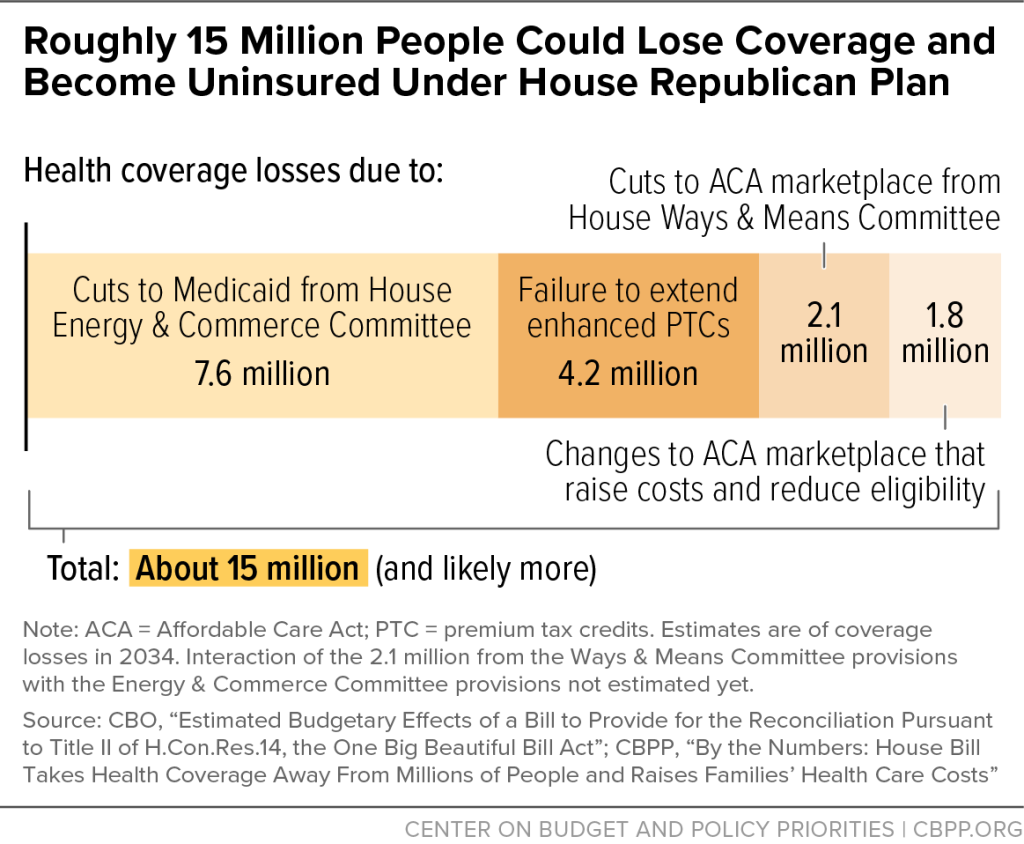
- The Congressional Budget Office, which offers nonpartisan analysis of federal spending, determined that an earlier version of the bill would cause at least 7.6 million people to become uninsured, with 10.3 million fewer Medicaid enrollees. According to an analysis from liberal think tank the Center on Budget and Policy Priorities, when other aspects of the House bill’s changes are included — such as cuts to subsidies for people on ACA plans — “roughly 15 million low- and moderate-income people would lose health coverage and become uninsured under the House Republicans’ sweeping and draconian health care agenda.” Politico, [5/13/25; Center on Budget and Policy Priorities, 5/29/25]
- Research from KFF, formerly the Kaiser Family Foundation, determined that 92% of Medicaid enrollees are either working full- or part-time, or could qualify for a work requirement exemption — such as being enrolled in school, having a disability, or performing caretaking duties. A separate study from the University of Massachusetts Boston found that of able-bodied people who would not qualify for an exemption, 79% are women who likely live in rural areas, are taking care of elderly parents or adult children, and have recently left the workforce. KFF, [5/20/25; University of Massachusetts Boston, 5/2025]
- CNBC reported that the Medicaid-slashing bill will deliver its biggest financial windfalls to “to the wealthiest Americans, courtesy of tax-cutting measures such as those for business owners, investors and homeowners in high-tax areas.” Further analysis from the Center on Budget and Policy Priorities found that “the top 1 percent of people would receive tax cuts three times the size of those for people with incomes in the bottom 60 percent, measured as a share of after-tax income.” CNBC, [5/23/25; Center on Budget and Policy Priorities, 5/22/25]
- ### Right-wing media figures push myth that Medicaid is overwhelmed by able-bodied people who refuse to work
- On Newsmax, former Trump campaign press secretary Hogan Gidley said the bill “strengthens Medicaid by making sure 1.4 illegal aliens aren't on the program stealing from American citizens. It makes sure that able-bodied Americans, those who can work but refuse to work — also cheating from the system — are no longer covered under this.” Newsmax, *Wake Up America*, [6/3/25]
- Fox News host Laura Ingraham lamented the rise of “stay-at-home sons,” and her guest, Fox contributor Tomi Lahren, suggested that they “may be deadbeat folks on Medicaid.” Fox News, *The Ingraham Angle*, [5/29/25]
- Fox News contributor James Freeman criticized the Affordable Care Act’s Medicaid expansion for opening up the program to “able-bodied, working age people.” The ACA’s expansion has allowed more than 20 million people across 40 states and the District of Columbia to access the health care program. Freeman urged Republican senators to go after the Medicaid expansion, saying, “I think they need to be bolder in the Senate.” He continued: “For example, one big change that Barack Obama made was extending Medicaid, which used to be for disabled people and poor children, to able-bodied working age people. That needs to be rolled back.” He praised the House bill for including work requirements, but argued the entire expansion should be “rescinded, if they want to change the trajectory of federal spending.” Fox News, *America’s Newsroom*, [5/29/25; KFF, “State Health Facts,” accessed 6/2/25; KFF, “Status of State Medicaid Expansion Decisions,” 5/9/25]
- Fox News host Greg Gutfeld: “In terms of cutting Medicaid, let’s be honest about the Medicaid cuts — this is about able-bodied young men and illegal immigrants.” Fox News, *The Five*, [5/28/25]
- The Daily Wire’s Ben Shapiro: “Of course, if you are able-bodied and just poor, you should have to work in order to receive Medicaid.” He added that “80 hours a month, again, that’s 20 hours a week, that’s four hours a workday — my kids are in school for like twice that length of time.” Shapiro previously argued that for able-bodied people who aren’t working, it’s “not because of lack of job opportunity,” and told Medicaid recipients to “get off your butt and work.” Despite Shapiro’s blithe dismissals, when Arkansas implemented its work requirements, roughly 1 in 4 Medicaid recipients statewide lost their coverage even though 95% of the targeted population met the requirements or qualified for an exemption. The Daily Wire, *The Ben Shapiro Show*, [5/22/25, 5/15/25; KFF, “5 Key Facts About Work Requirements,” 2/18/25; New England Journal of Medicine, 6/19/19]
- On the morning the House bill passed, Fox national correspondent Aishah Hasnie said that some Republicans were “worried there were going to be massive cuts,” but that “really, Republicans wanted to go after illegal immigrants that were using Medicaid and able-bodied men that were on Medicaid.” She added: “They wanted to add work requirements, and those work requirements now will start in 2026. It’s a huge win for fiscal conservatives.” Fox News, *Fox & Friends*, [5/22/29]
- Fox News anchor Martha MacCallum claimed that “Medicaid was designed for low-income families with children, pregnant women, the elderly, people with disabilities, and people in need of long-term care. It was not designed for able-bodied people who can work and aren't working.” She added that the government should make sure only “people who deserve these benefits can get them.” Fox News, *The Story With Martha MacCallum*, [5/20/25]
- Fox News host Jesse Watters said, “If you're a young, able-bodied, healthy American man — 26 years old, you don't even want to go to work — you can get on Medicaid.” He added: “You can live at your parents’ house, play softball on the weekend, sell ecstasy on the side, not even look for a job — and you can get free health care. That’s what they’re doing. They’re just closing that lazy loophole.” Fox News, *The Five*, [5/19/25]
- Fox News host Charlie Hurt falsely argued that work requirements would strengthen Medicaid. “A major Democrat attack on the bill is they claim it cuts Medicaid,” Hurt said on May 19. “What it actually does is it saves Medicaid by not paying, first of all, people who are ineligible for it, but also because it doesn’t — it puts in work requirements for, you know, 30-year-old, able-bodied males without dependents, and it says, you know, if you are going to get welfare from the government, you're going to need to work, and that seems like a really low standard to a regular person.” Fox News, *Fox & Friends*, [5/19/25]
- Former Trump adviser Steve Bannon has simultaneously attempted to portray himself as a defender of Medicaid — by acknowledging that many of President Donald Trump’s voters use the program — while also arguing for harsh work requirements. “We don't have great jobs, and that’s why a lot of MAGA is on Medicaid,” Bannon said. He added: “An able-bodied seaman ought to be putting in, I don’t know, 40-60 hours? If it’s a month they ought to just rack it up.” (Bannon is a former Navy officer and frequently speaks in military slang.) “If you’re able-bodied, you’ve got to show that you’ve got work requirements, minimum,” he concluded. Real America’s Voice, *War Room*, [5/13/25; Media Matters, 3/4/25]
---
MAGA media parrot GOP lie about looming Medicaid cuts
Analysts predict millions of Americans will lose Medicaid coverage to fund Republican tax cuts for the rich
Written by Zachary Pleat
Published 06/03/25 mma
Trump administration officials and Republican lawmakers are getting help from their MAGA media allies to deny the effects of their “One Big Beautiful Bill,” which passed the GOP-controlled House last month and is expected to kick millions of Americans off their Medicaid coverage while cutting taxes for the rich. Journalists and experts are calling out these Republicans for their lies that their bill won’t cut Medicaid.
Following this criticism, the administration is reportedly shifting its argument to falsely claim that the only people who will lose Medicaid coverage will be those who don’t deserve it, specifically “people who are here illegally” and “capable and able-bodied men who refuse to work.” This too, is a lie.
The vast majority (92%) of people on Medicaid already work or engage in caregiving or have disabilities or other statuses that would exempt them from a work requirement. The remaining 8% of the population is overwhelmingly made up of women, not the hypothetical “capable and able-bodied men who refuse to work.” And furthermore, federal Medicaid funding already cannot be used to pay for coverage of undocumented immigrants; states that currently provide analogous health care coverage to undocumented immigrants do so with their own tax dollars.
- ## Republican officials denied Medicaid cuts will result in enrollment losses
- House Speaker Rep. Mike Johnson (R-LA) said on NBC’sMeet the Pressthat “4.8 million people will not lose their Medicaid unless they choose to do so.” Johnson was defending the work requirements the GOP legislation is adding to Medicaid. NBC News, [_{6/1/25}_]
- Trump Office of Management and Budget Director Russ Vought on CNN’sState of the Union: “No one will lose coverage as a result of this bill.” Vought also defended the new Medicaid work requirements, stating: “We have able-bodied working adults that don’t have a work requirement that they would have in TANF or even SNAP. And those are something that’s very important to institute. That’s what this bill does.” Politico, [_{6/1/25}_]
- Trump Centers for Medicare and Medicaid Services Administrator Dr. Mehmet Oz said in a Politico interview, “We’re not cutting Medicaid.” Later in the interview, Oz agreed when interviewer Dasha Burns said that work requirements are “the biggest part of” how Republicans “want to kind of cut and cull” Medicaid. Politico, [_{6/1/25}_]
- Sen. Markwayne Mullin (R-OK) on CNBC’sSquawk Box: “There’s a lot of confusion that Democrats have lied about. They went out there, Joe, and said that we’re cutting Medicaid benefits.” CNBC, *Squawk Box*, [_{6/2/25}_]
- Sen. Joni Ernst (R-IA) told a constituent that “we are all going to die” in response to complaints about the GOP bill stripping Americans of Medicaid coverage. This comment followed her claim that only people ineligible for Medicaid would lose coverage. NPR, [_{5/31/25}_]
- ## Right-wing media have amplified these Republican lies that their bill will not lead to losses in Medicaid coverage
- Breitbart: “Speaker Johnson: ‘No Medicaid cuts in the big beautiful bill.’”Breitbart, [_{6/1/25}_]
- The Post Millennial posted clips of Johnson claiming “we’re not cutting Medicaid,” defending Medicaid work requirements, and framing those requirements as “strengthening the program.” Twitter/X, [_{6/1/25}_, 6/1/25]
- Daily Caller: “‘We’re not cutting Medicaid’: Dr. Oz seems to confirm Trump’s ‘Big, Beautiful Bill’ will not cut program.” Daily Caller, [_{5/30/25}_]
- Pro-Trump CNBC host Joe Kernen joined Mullin in denying that Republicans are cutting Medicaid, stating: “No one believes that.” CNBC, *Squawk Box*, [_{6/2/25}_; Mediaite, 12/5/24]
- Fox Business host Dagen McDowell: “Anybody on the left, Josh Hawley, anybody crying about Medicaid cuts, there are no cuts. Shut up.” Fox Business, *The Big Money Show*, [_{6/2/25}_]
- Newsmax chyron: “Dems lie about Trump’s ‘big beautiful bill.'” Newsmax host Carl Higbie aired clips of Democrats calling out Republican cuts to Medicaid and said, “They are not exactly telling the truth.” His guest, Rep. Derrick Van Orden (R-WI), said, “Medicaid, Medicare, Social Security are not getting touched,” after Higbie said: “So no cuts there.” Newsmax, *Carl Higbie Frontline*, [_{5/29/25}_]
- Newsmax host Marc Lotter cited a Trump post claiming there will be “NO CUTS” to Medicaid when asking a guest, “Do you think, finally, Americans can actually separate the fact from fiction here?” Lotter added: “Democrats use this same rhetoric every time they oppose Republicans.” Newsmax, *Wake Up America*, [_{6/3/25}_]
- ## Media and issue experts call out Republicans for lies about the bill cutting Medicaid coverage
- Rolling Stone: “Mike Johnson and Russ Vought continue to lie about Medicaid cuts.” The Rolling Stone article noted that Vought vastly exaggerated the rate of “improper” Medicaid payments, and falsely claimed that undocumented immigrants are “on the program.” Rolling Stone then cited multiple estimates showing millions of people losing Medicaid coverage if the GOP bill becomes law. A second Rolling Stone article on this topic declared, “Republicans are flat-out lying about their Medicaid cuts.” Rolling Stone, [_{6/1/25}_, 6/2/25]
- Washington Post economics columnist Catherine Rampell mocked the Republican dissembling about Medicaid coverage losses from their bill. Rampell wrote: “OP response to credible estimates that ~8m people will lose insurance due to Medicaid cuts: 1) no one will lose coverage 2) only the freeloaders and bums will lose coverage (not deserving people like you!) 3) look we're all going to die anyway.” Twitter/X, [_{6/1/25}_]
- Public Notice’s Aaron Rupar: “Vought blatantly lies about Medicaid cuts on CNN, claiming ‘no one will lose coverage as a result of this bill.’” Twitter/X, [_{6/1/25}_]
- Rupar: “Mike Johnson blatantly lies on Meet the Press: ‘You can underscore what I'm about to tell you -- there are no Medicaid cuts in the big beautiful bill.’”Twitter/X, [_{6/1/25}_]
- Rupar: “CNBC allows Markwayne Mullin to lie with impunity that Republicans aren't cutting Medicaid benefits (they are cutting Medicaid benefits).” Twitter/X, [_{6/2/25}_]
- Chamber of Progress director of economic analysis Tahra Hoops: “This is incredibly false. Millions would lose their coverage under this bill, there is no other result should this pass.” Twitter/X, [_{6/1/25}_]
- KFF executive vice president for health policy Larry Levitt: “You can’t argue that cuts to Medicaid of over $700 billion over a decade won’t result in people losing coverage.”Twitter/X, [_{6/1/25}_]
- The Atlantic contributing writer James Surowiecki: “If no one will lose Medicaid coverage as a result of the budget bill, then Republicans are telling extraordinary lies about the spending cuts in the bill.” Twitter/X, [_{6/2/25}_]
- Bloomberg columnist Matthew Yglesias: “The CBO says that approximately 7,600,000 people will lose coverage as a result of the bill’s Medicaid cuts.” Yglesias was responding to a clip of Vought denying losses of Medicaid coverage in his CNN interview. Twitter/X, [_{6/1/25}_]
- ## Independent estimates predict millions of Americans will lose their Medicaid coverage if the bill passes
- Center on Budget and Policy Priorities: Republicans’ tax bill would cut $1.1 trillion from Medicaid, the Affordable Care Act, and SNAP to fund tax cuts for people earning more than $500,000 annually. Center on Budget and Policy Priorities, [_{5/16/25}_]
- Politico: The Congressional Budget Office estimated that “the Medicaid portions of the GOP megabill would lead to 10.3 million people losing coverage under the health safety net program and 7.6 million people going uninsured.” According to Politico, this was a partial estimate released by Republicans. Politico, [_{5/13/25}_]
- CBPP: “Roughly 15 million people could lose coverage and become uninsured under House Republican plan.” The CBPP added the expected 7.6 million uninsured from the Medicaid cuts alone to estimates of coverage losses from the House GOP bill’s failure to extend premium tax credits and other cuts to the Affordable Care Act. Center on Budget and Policy Priorities, [_{5/29/25}_]
- KFF: Forty states and the District of Columbia could see at least 13% of their Medicaid recipients kicked off their insurance, with rates of loss as high as 32%. This is a high-end estimate of state-by-state Medicaid coverage losses from KFF. KFF, [_{5/16/25}_]
- Center on Budget and Policy Priorities: New work requirements alone could put “9.7 million to 14.4 million people at risk of losing Medicaid coverage in 2034.” CBPP explained, “Evidence shows that much of the coverage loss due to work requirements would occur among people who work or should qualify for an exemption but nevertheless would lose coverage due to red tape.” Center on Budget and Policy Priorities, [_{5/13/25}_]
- Economic Policy Institute: “Work requirements effectively function like a cut to programs.” EPI explained that “while work requirements do not reliably increase employment, they do significantly increase the administrative burden and costs of applying for safety net programs. This increased administrative burden, in turn, reduces access and take-up.” EPI further explained, “In many cases, the sheer amount of additional administrative burdens levied on adults seeking benefits, and on case workers screening to ensure that work requirements are met, is a major driver in the decline in participation.” Economic Policy Institute, [_{1/24/25}_]
//
:{05/20/25
:{06/03/25
05/28/25
---
an
no lnx
Expert warns 'gaslighting' Republican plan does 'much more harm' than just gutting Medicare
John Stoehr June 04, 2025
---
MMA
Contrary to right-wing media claims, the GOP's Medicaid cuts are for far more than “able-bodied men”
While right-wing media yell about “able-bodied men,” in truth Medicaid work requirements would hit caregivers the most — and they are disproportionately women
Written by John Knefel
Research contributions from Sophie Lawton
Published 05/22/25
Right-wing media figures are telling their audiences that proposed work requirements for Medicaid will be targeted at men who are unwilling to look for a job, when the actual population most likely to be affected is poor, rural women who are taking care of elderly parents or adult children.
The discussion comes as congressional Republicans negotiate a budget bill that is widely predicted to deliver massive tax cuts to the wealthy and corporations while gutting social safety net programs like Medicaid and the Supplemental Nutrition Assistance Program, formerly known as food stamps. The House passed its version of the bill on May 22, which included what Axios described as “the biggest Medicaid rewrite in the history of the safety-net program, which will likely result in millions of Americans losing their health insurance coverage.”
One of the ways the House's legislation reduces Medicaid costs is by introducing arduous and unnecessary work requirements for beneficiaries that would begin at the end of 2026. The Congressional Budget Office, which provides nonpartisan economic analysis to lawmakers, estimated that 10.3 million people would lose their Medicaid by 2034 if the bill was passed in its May 14 form. The New York Times cited the same figure in its coverage of the House bill’s passage. (The bill also adds work requirements to SNAP, which could put almost 11 million people at risk of losing some of their food assistance.)
Much of the right-wing commentary supporting the bill mischaracterizes Medicaid beneficiaries by claiming there is a large pool of “able-bodied” people who refuse to seek employment. In fact, 92% of people on Medicaid are working, have a disability, or are performing duties — such as going to school or caregiving — that could qualify for an exemption from meeting work requirements.
It’s true that there is a group of people who qualify as able-bodied, nonworking Medicaid recipients without a young child who also aren’t enrolled in school. But contrary to conservative punditry, that population is overwhelmingly made up of women (79%), mostly living in rural areas, who are caring for elderly parents or adult children and have low levels of formal education and have recently left the workforce, according to new research from the University of Massachusetts Boston.
“Work requirements would primarily target this population,” the researchers write.
Fox News’ Jesse Watters says Medicaid work requirements target men in their 20s who “sell ecstasy on the side"
Fox News, Fox Business, and the Wall Street Journal’s editorial page — three gilded properties in Rupert Murdoch’s media empire — have pushed for cuts to Medicaid, either by adding work requirements or through an outright rollback of the program’s expansion under the Affordable Care Act. Slashing Medicaid is incredibly unpopular, including among supporters of President Donald Trump, so on some occasions Fox has misled its viewers into thinking the Republican budget doesn’t pose a threat to the program.
But as Trump has thrown his weight behind the bill, so too has Fox modified its austerity-heavy rhetoric.
Following the House’s passage of the bill, Fox national correspondent Aishah Hasnie said some Republicans from states that have “a lot of constituents on Medicaid” were “worried there were going to be massive cuts.”
“Really, Republicans wanted to go after illegal immigrants that were using Medicaid and able-bodied men that were on Medicaid,” she continued. “They wanted to add work requirements, and those work requirements now will start in 2026. It’s a huge win for fiscal conservatives.”
Video
Citation
From the May 22, 2025, edition of Fox News' Fox & Friends
On May 19, host Jesse Watters said, “If you're a young, able-bodied, healthy American man — 26 years old, you don't even want to go to work — you can get on Medicaid.”
“You can live at your parents’ house, play softball on the weekend, sell ecstasy on the side, not even look for a job — and you can get free health care,” Watters added. “That’s what they’re doing. They’re just closing that lazy loophole."
Video
Citation
From the May 19, 2025, edition of Fox News' The Five
The same day on Fox & Friends, on at least two occasions co-host Charlie Hurt falsely argued that work requirements strengthened Medicaid.
“A major Democrat attack on the bill is they claim it cuts Medicaid,” Hurt said. “What it actually does is it saves Medicaid by not paying, first of all, people who are ineligible for it, but also because it doesn’t — it puts in work requirements for, you know, 30-year-old, able-bodied males without dependents, and it says, you know, if you are going to get welfare from the government, you're going to need to work, and that seems like a really low standard to a regular person."
Video e
Citation
From the May 19, 2025, edition of Fox News' Fox & Friends
Elsewhere in the program, Hurt argued the bill strengthens Medicaid and “protects it by getting people off that — able-bodied, 30-year-old men … without dependents ought to be working."
Steve Bannon says Medicaid work requirements for able-bodied men should be “40 to 60 hours” at a “minimum”
Former Trump adviser Steve Bannon has attempted to present himself as both a defender of Medicaid and an advocate for large cuts to the program. One of the ways he tries to reconcile that contradiction is by dividing Medicaid users into the deserving and undeserving poor, using rhetoric strikingly similar to Fox’s.
On May 13, Bannon acknowledged that in the United States “we don’t have great jobs, and that’s why a lot of MAGA is on Medicaid."
“An able-bodied seaman ought to be putting in, I don’t know, 40-60 hours?” Bannon said, reminding his audience of his former career as a Naval officer. “If it’s a month they ought to just rack it up."
“If you’re able-bodied, you’ve got to show that you’ve got work requirements, minimum,” he continued.
Video
Citation
From the May 13, 2025, edition of Real America's Voice's War Room
In February, Bannon also mischaracterized the Medicaid population as laden with nonworking, able-bodied men.
“Right now, why are people on Medicaid? It's economic distress,” Bannon said. “They don't want to be on Medicaid. It's economic distress. You’ve got 18 million men not in the workforce. Able-bodied men — 18 million men in this nation not in the workforce."
Right-wing pundits push “able-bodied” trope without specifying gender
Some right-wing coverage of work requirements pushes the trope of the able-bodied, nonworking Medicaid recipient without specifying gender.
On May 19, Bannon took aim at the Medicaid expansion population, even as he acknowledged how many Trump supporters could get hurt by slashing the program.
“I’m one of the proponents of not cutting Medicaid to the bone because you’ve got a ton of working class people on Medicaid now,” he said.
“You’ve got the able-bodied that are not even doing basic checks because of what Biden put in,” he added, apparently referring to states that joined the Medicaid expansion during Biden’s term.
The following day, Fox News anchor Martha MacCallum claimed that “Medicaid was designed for low-income families with children, pregnant women, the elderly, people with disabilities, and people in need of long-term care."
“It was not designed for able-bodied people who can work and aren't working,” she continued, adding that the government should make sure only “people who deserve these benefits can get them."
On May 15, the Daily Wire’s Ben Shapiro devoted nearly five minutes to reading and praising an op-ed in The New York Times written by four top Trump administration officials in support of work requirements.
Shapiro argued that for able-bodied people who aren’t working, it’s “not because of lack of job opportunity,” and concluded by telling Medicaid recipients to “get off your butt and work."
Taking Arkansas’ disastrous experiment nationwide
The op-ed from the Trump officials that Shapiro endorsed relied heavily on a report from conservative think tank the American Enterprise Institute. The report found that “Medicaid work requirements would target a large number of recipients, many of whom do not currently work a sufficient number of hours to comply.” The author acknowledged his finding “appears to contrast with the conclusions of some similar analyses, which suggest that most Medicaid recipients who can work, do work.” (Hyperlinks in original.)
Given that discrepancy, it’s worth examining AEI’s record on the issue. In 2018, AEI published a blog headlined “The Truth About Medicaid Work Requirements,” which discussed the first Trump administration’s approval of Arkansas’ request to mandate work requirements for its Medicaid population.
“Critics have warned of catastrophe” that will “threaten the well-being of low-income Americans,” the article states, before adding, “A closer look at what the states are actually proposing suggests these claims are overblown."
“It’s hard to imagine why those not exempt could not easily meet these requirements,” the piece concludes.
AEI’s predictions proved totally wrong. When Arkansas followed through and mandated work requirements for Medicaid in 2018, more than 18,000 recipients — roughly 1 in 4 statewide — lost their coverage, even though “more than 95% of the target population appeared to meet the requirements or qualify for an exemption,” according to a study published in the New England Journal of Medicine.
There were myriad reasons for the program’s catastrophic failure. The NEJM study found that “the implementation of this policy was plagued by confusion among many enrollees,” and a “lack of Internet access was also a barrier to reporting information to the state."
Research from liberal think tank the Center on Budget and Policy Priorities further found that people “who were supposed to be exempted from submitting monthly proof of their work hours were not always shielded from losing coverage."
“People were confused because of the different types of exemptions that were available and varying timelines for re-verifying different exemptions,” CBPP concluded.
And the policy also failed on its own terms. As the NEJM study noted, the study didn’t find “any significant change in employment” or in the amount “of hours worked or overall rates of community engagement activities."
Illustratively, AEI reacted to the NEJM study — which undermined the arguments the conservative think tank had put forward — by simply dismissing it. In a 2023 blog, AEI wrote that the study “attempted to assess the effects of Medicaid work requirements on employment, but challenges associated with implementing the policy and studying its effects make those results difficult to interpret."
It’s safe to say that for the more than 18,000 Arkansans who lost their Medicaid, the ultimate effect of the work requirement mandate was not difficult to interpret. Right-wing media figures now want to take that disastrous experiment nationwide, all to fund a tax cut that will overwhelmingly benefit the extremely wealthy. Attacking the trope of the able-bodied man who refuses to work is simply their latest tactic.
//
05/22/25 12:54 PM EDT
05/21/25 5:09 PM EDT
05/21/25
---
an 5 25
:{:{During the House’s marathon markup of President Donald Trump’s historic budget bill, the Chairwoman of the powerful Rules Committee lashed out at Democrats for plainly describing the legislation’s sweeping consequences. Officially dubbed the “One Big, Beautiful Bill Act,” the measure narrowly passed in the early hours of Thursday by a 215–214 vote. }:
It removes $800 billion in funding from Medicaid, would lead to $535 billion in cuts to Medicare, and is projected to cause an estimated 8.6 to 13.7 million Americans to lose their health care. It will also add $3 trillion to the federal deficit—fueled by tax breaks heavily tilted toward the wealthy and the nation’s first-ever $1 trillion defense budget.}:
“I am concerned about what has been said about this bill and what it’s going to do,” Chairwoman Virginia Foxx (R-NC) told the members of her committee Wednesday night. “The extreme comments that have been made about it, and how I believe that it is scaring people out there in the country unnecessarily.”
“The words I’ve heard, particularly today, are ‘cut,’ ‘rip,’ ‘gut,’ ‘kill,’ ‘cruel,’ ‘stealing food,’ ‘losing coverage,’ ‘jammed through,’ ‘biggest transfer of wealth from vulnerable to wealthy people,’ ‘irresponsible’.”
“That is not the way we ought to be talking about this bill.”
READ MORE: ‘Sovereignly Appointed’: Trump Praised in Pentagon Prayer Event Led by Hegseth and Pastor
Many appear to disagree.
MSNBC columnist Michael A. Cohen, just after the bill passed Thursday morning, wrote: “What we do know about the legislation the GOP is calling the ‘One Big Beautiful Bill Act’ is genuinely terrifying.”
“What makes this situation even worse is that Republicans, from the president on down, are consistently lying about what the bill would do,” Cohen charged.
“The House Republican budget plan would eviscerate Medicaid and food assistance and shift resources toward the wealthiest Americans,” the Center for American Progress (CAP) warned ten days ago, adding that it “would implement the largest cuts to both Medicaid and the Supplemental Nutrition Assistance Program (SNAP) in history—kicking millions of Americans off their health insurance and taking food away from hungry children.”
“It would raise household electricity costs while trapping most middle-class and poor students in greater student loan debt to afford a higher education,” CAP’s Bobby Kogan, Senior Director for Federal Budget Policy wrote. “And it would make all these changes as a means to partially offset tax breaks that disproportionately go to the richest Americans, giving households in the top 0.1 percent a multihundred-thousand-dollar tax break on average while increasing deficits by trillions of dollars. Taken as a whole, the bill would add trillions of dollars to structural deficits despite these enormous cuts to critical services.”
“If enacted,” Kogan warned, “this would be the largest transfer of wealth from the poor to the rich in a single law in U.S. history.”
READ MORE: ‘Get Out of Here’: Trump Erupts, Calls for NBC Probe After Reporter Asks About Qatari Jet
“Taken as a whole, this bill would harm Americans—particularly the most vulnerable people—and leave the country worse off. It would lead to preventable deaths by taking health care away from millions of people. It would worsen food insecurity by taking food away from the hungry, particularly kids.”
“Budgets showcase our morality because they force governments to decide how to prioritize limited resources. The House Republican budget plan would shift funding away from the sick and hungry and, instead, toward the wealthiest Americans.”
U.S. Rep. Veronica Escobar (D-TX) responded to Foxx, saying, “In other words, ‘please don’t call this bill what it is or say what it does’.”
Watch the video below or at this link.
---
---
MMA
Fox’s Maria Bartiromo whips Republican support for devastating Medicaid cuts
Republicans plan to slash Medicaid to fund Trump’s next tax giveaway to the rich
Written by Zachary Pleat
Published 05/20/25
House Republicans are working on legislation dubbed “One, Big, Beautiful Bill” to finance a permanent extension of President Donald Trump’s 2017 tax giveaway to the rich by slashing Medicaid, which will result in millions of Americans losing their health insurance. Supporters of the legislation have also singled out Medicare and the Supplemental Nutritional Assistance Program for additional cuts. Analyses show that the vast majority of the tax cuts will go to the rich, while lower-income Americans stand to lose money due to the massive cuts to health care coverage and other benefits.
Fox Business anchor Maria Bartiromo, an obsequious booster and right-wing media ally of Trump, has used her Mornings with Maria program to whip Republican lawmakers for support of the bill and especially to shore up its Medicaid cuts. During these frequent Fox Business appearances, Bartiromo, her guests, and even her guest host have advocated for useless work requirements and spread false claims that federal Medicaid funds are paying for coverage of undocumented immigrants or that the cuts are targeting supposedly massive “waste, fraud, and abuse” in the program. After more than a week of Bartiromo's effort to manufacture consent for these Medicaid cuts, Trump reportedly told Republicans “don't fuck around with Medicaid.”
Republican lawmakers frequented Mornings with Maria to promote Medicaid cuts for their tax legislation
- Bartiromo urged Sen. Jim Justice (R-WV) to get Republicans to “unify on Medicaid reform” by Memorial Day weekend. Fox Business, *Mornings with Maria*, [_{5/16/25}_]
- Bartiromo to Rep. Jason Smith (R-MO): “Where are practical areas to cut Medicaid and Medicare, but not the benefits and muscle of the programs?” Fox Business, *Mornings with Maria*, [_{5/16/25}_]
- Rep. Dan Crenshaw (R-TX) to Bartiromo: “We're being yelled at about taking away people's Medicaid. That's not really true.” Later, Crenshaw admitted to Bartiromo: “The person we’re taking it away from is the able-bodied adult with no children who refuses to work.” He added: “If they would just get a job, they could keep their Medicaid.” During the interview, Bartiromo complained that Democrats weren’t assisting Republicans in cutting Medicaid. Fox Business, *Mornings with Maria*, [_{5/16/25}_]
- Bartiromo to Rep. Earl Carter (R-GA): “Thank you for your work on the House Energy and Commerce Committee. Everybody was rooting you on, you advanced the biggest Medicaid rewrite in the program’s 60-year history.” Bartiromo then invited Carter to defend Republicans from Democrats’ statements that the legislation will kick people off Medicaid. Fox Business, *Mornings with Maria*, [_{5/15/25}_]
- Bartiromo to Sen. Roger Marshall (R-KS): “That sounds great, and I love the idea that you can identify $2 trillion in cuts,” including from Medicaid. Fox Business, *Mornings with Maria*, [_{5/14/25}_]
- Rep. Andy Harris (R-MD) on Medicaid cuts: “I do hope that we find more reductions.” Fox Business, *Mornings with Maria*, [_{5/12/25}_]
- Rep. Russell Fry (R-SC) falsely claimed California’s coverage of undocumented immigrants in its state Medicaid program “is a tremendous cost to the federal taxpayer because we are subsidizing this in these states.” In fact, California was covering those costs with state funds. Fox Business, *Mornings with Maria*, [_{5/12/25}_; The Associated Press, 5/14/25]
- Rep. Riley Moore (R-WV) touted “over $900 billion savings coming out of” Medicaid and other programs overseen by the House Energy and Commerce Committee. Fox Business, *Mornings with Maria*, [_{5/12/25}_]
- Discussing the tax cut bill onMornings with Maria, Rep. Carlos Gimenez (R-FL) said states that didn’t expand Medicaid were “fiscally responsible” because “they knew what was coming.” Fox Business, *Mornings with Maria*, [_{5/9/25}_]
- Sen. Rand Paul (R-KY) encouraged Republicans to “take the entitlements away — Social Security, Medicare, Medicaid, food stamps” — to reduce the national debt. Fox Business, *Mornings with Maria*, [_{5/8/25}_]
- Bartiromo interviewed Rep. Andy Ogles (R-TN) about his effort to pass work requirements for Medicaid recipients. During the interview, Ogles likened this effort to “rooting out waste, fraud, and abuse.” Fox Business, *Mornings with Maria*, [_{5/8/25}_]
- Bartiromo encouraged Rep. Lance Gooden (R-TX) to explain how Republicans will cut “Medicaid or Medicare” to “get around paying for the Trump agenda.” During the interview, Gooden said: “I think we’re all in agreement that work requirements should be increased” adding, “We all agree that able-bodied men in their 20s should be working and not getting paid to sit on the couch.” Fox Business, *Mornings with Maria*, [_{5/7/25}_]
- ## The Republican bill slashes benefits from the poor to fund tax cuts for the rich
- Center on Budget and Policy Priorities: Republicans’ tax bill would cut $1.1 trillion from Medicaid, the Affordable Care Act, and SNAP to fund tax cuts for people earning more than $500,000 annually. Center on Budget and Policy Priorities, [_{5/16/25}_]
{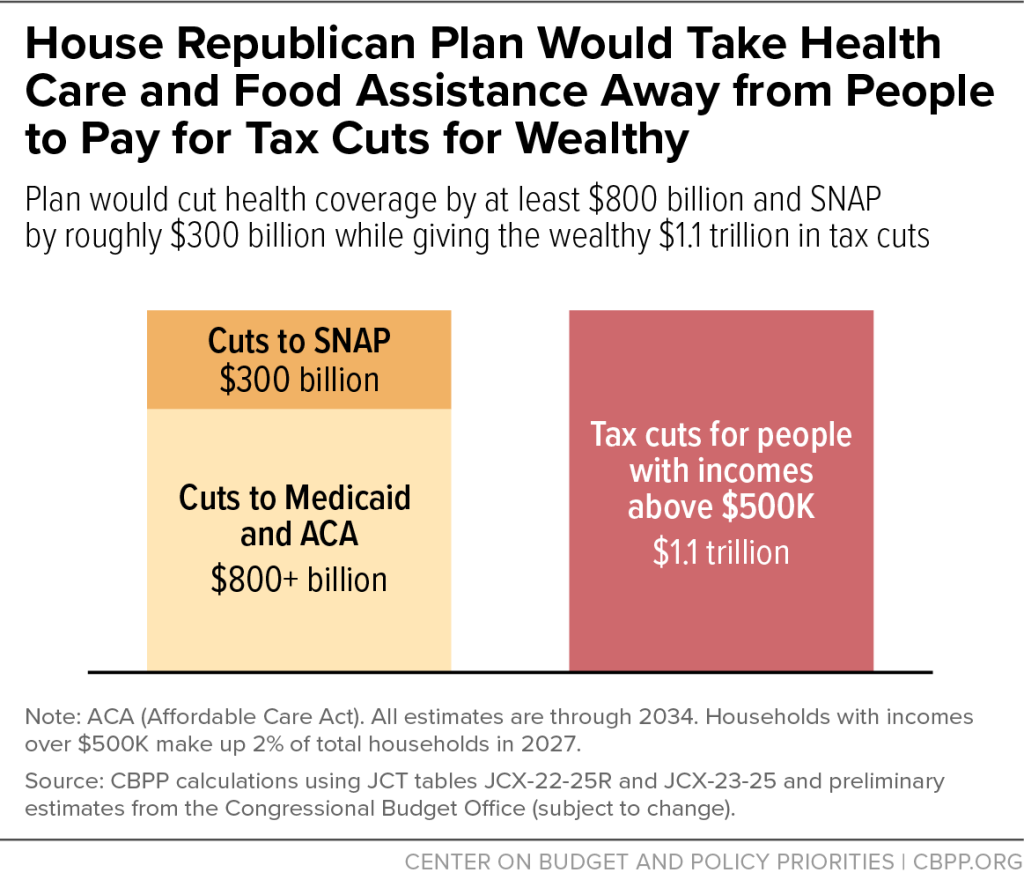
- CBPP director of federal tax policy Kris Cox: House Republican bill gives $500 more per child to wealthy families but leaves the low-income families of 17 million children out of the maximum Child Tax Credit. According to the CBPP, this affects “roughly 1 in 4 children … who currently receive less than the full credit or no credit at all because their families’ incomes are too low.” Bluesky, [_{5/12/25}_, Center on Budget and Policy Priorities, 2/5/25]
- Institute on Taxation and Economic Policy: “Two-thirds of the tax cuts offered in 2027 would go to the top 20 percent of families, and 41 percent would flow to just the top 5 percent of families.” ITEP further explained how regressive the GOP tax bill is: “While working-class families (defined here loosely as the bottom 40 percent of earners) could expect an average tax cut of $361 in 2027, the nation’s highest-income families (defined as the top 0.1 percent) would receive an average tax cut of at least $255,670 in that year.” Institute on Taxation and Economic Policy, [_{5/16/25}_]
- The New York Times: “Economists found that many Americans who make less than $51,000 a year would see their after-tax income fall as a result of the Republican proposal beginning in 2026.” The New York Times reported on an analysis of the GOP tax bill from the Penn Wharton Budget Model, which found that “computing the effects of the tax cuts as well as the plan to pay for them by slashing federal spending on other programs, including Medicaid and food stamps” results in lower-income Americans losing money from the tax cuts. Specifically, “people making between about $51,000 and $17,000 could lose about $700 on average in after-tax income beginning in 2026. … People reporting less than $17,000 in income would see a reduction closer to $1,000, on average, also increasing over time, a shortfall that underscores their reliance on federal benefits.” The New York Times, [_{5/16/25}_]
- CBPP senior director for federal fiscal policy Brendan Duke: “The House GOP tax bill gives large tax cuts to millionaires and paltry tax cuts to the working-class--tax cuts that will be wiped away by the cuts to health care and nutrition in the same freaking bill.” Twitter/X, [_{5/14/25}_]
- Yale’s Budget Lab: “Changes proposed by the House budget resolution would result in a decline of almost 4 percent (over $800) to income for the bottom quintile, but an increase of over 4 percent (nearly $70,000) for the top 1 percent.” The Budget Lab analysis added: “Even assuming that states make up some of the cuts, the bottom quintile would see an income loss of about 2 percent ($345 dollars).” The Budget Lab, [_{5/19/25}_]
- ## The GOP bill would kick millions off Medicaid while adding trillions to the national debt
- Politico: The Congressional Budget Office estimated that “the Medicaid portions of the GOP megabill would lead to 10.3 million people losing coverage under the health safety net program and 7.6 million people going uninsured.” According to Politico, this was a partial estimate released by Republicans. Politico, [_{5/13/25}_]
- KFF: Forty states and the District of Columbia could see at least 13% of their Medicaid recipients kicked off their insurance, with rates of loss as high as 32%. This is a high-end estimate of state-by-state Medicaid coverage losses from KFF. KFF, [_{5/16/25}_]
- Committee for a Responsible Federal Budget: The House GOP bill would “increase debt by $3.3 trillion, or $5.2 trillion if made permanent.”According to the CRFB, it would also “increase annual deficits to $2.9 trillion (6.9 percent of Gross Domestic Product), or $3.3 trillion (7.8 percent of GDP)”; “Increase yearly interest costs to $1.8 trillion (4.2 percent of GDP), or $1.9 trillion (4.4 percent of GDP)”; and “increase debt to 125 percent of GDP, or 129 percent of GDP if made permanent.” Committee for a Responsible Federal Budget, [_{5/14/25}_]
- Tax Foundation: The House GOP’s “One, Big, Beautiful Bill” will reduce federal tax revenue by $3.3-4.1 trillion in return for miniscule economic benefits spread over a decade. The Tax Foundation estimated that GDP growth would be boosted by a mere 0.6% over 10 years and only 794,000 additional jobs would be created, averaging out to less than 8,000 additional jobs per year. Tax Foundation, [_{5/13/25}_]
- ## The GOP's Medicaid work requirements would likely kick millions off Medicaid without increasing employment
- Center on Budget and Policy Priorities: New work requirements alone could put “9.7 million to 14.4 million people at risk of losing Medicaid coverage in 2034.” CBPP explained, “Evidence shows that much of the coverage loss due to work requirements would occur among people who work or should qualify for an exemption but nevertheless would lose coverage due to red tape.” Center on Budget and Policy Priorities, [_{5/13/25}_]
- KFF: As of 2023, nearly two-thirds of non-disabled and non-elderly adults on Medicaid were already working.Analysis from KFF of current population survey data showed that in 2023, “Among adults under age 65 with Medicaid who do not receive benefits from the Social Security disability programs, Supplemental Security Income (SSI) and Social Security Disability Insurance (SSDI), and who are not also covered by Medicare (referred to hereafter as “Medicaid adults”), 92% were working full or part-time (64%), or not working due to caregiving responsibilities, illness or disability, or school attendance. The remaining 8% of Medicaid adults reported that they are retired, unable to find work, or were not working for another reason.” KFF, [_{2/4/25}_]
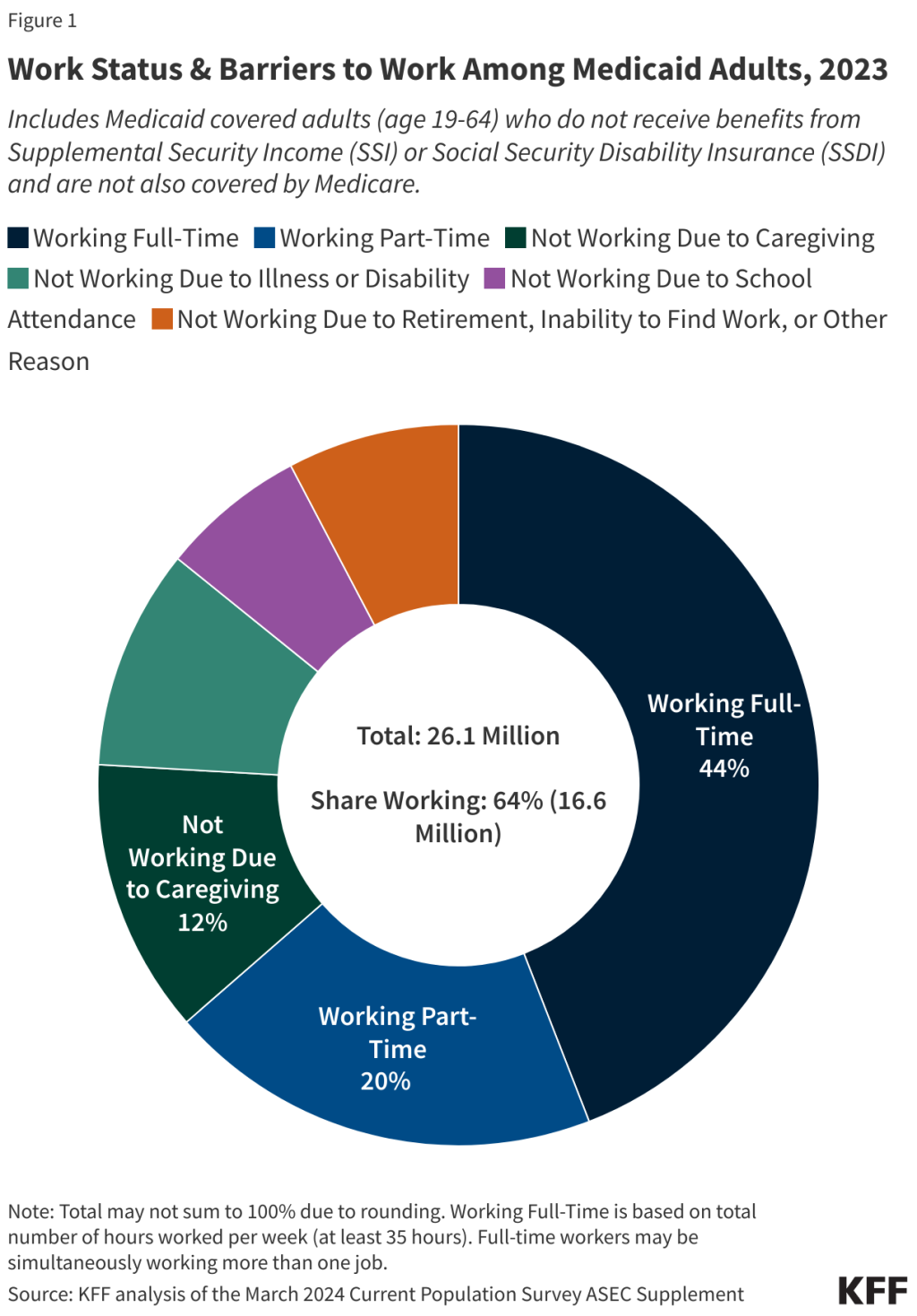
- KFF: Most Medicaid enrollees who work are working full-time. KFF’s analysis showed that “among Medicaid adults who work, nearly seven in ten (69%) worked full-time and half worked full-time for the entire year (at least 50 weeks) (Appendix Table 2). Many Medicaid adults who work part-time (31% of all workers) cited that reasons for working part-time include work limits like shorter work weeks (less than 35 hours per week) (16%), slack work/business conditions (12%), or inability to find full-time work (7%) (Figure 4). Part-time workers also pointed to childcare problems (9%) and other family or personal obligations (22%).” KFF, [_{2/4/25}_]
- Economic Policy Institute: “Work requirements effectively function like a cut to programs.” EPI explained that “while work requirements do not reliably increase employment, they do significantly increase the administrative burden and costs of applying for safety net programs. This increased administrative burden, in turn, reduces access and take-up.” EPI further explained, “In many cases, the sheer amount of additional administrative burdens levied on adults seeking benefits, and on case workers screening to ensure that work requirements are met, is a major driver in the decline in participation.” Economic Policy Institute, [_{1/24/25}_]
- A Congressional Budget Office estimate of a 2023 GOP bill that would have instituted Medicaid work requirements stated, “The agency concludes that the amendment would have a negligible effect on employment status or hours worked by people who would be subject to the work requirements.” Congressional Budget Office, [_{4/26/23}_]
- People’s Policy Project founder Matt Bruenig in The New York Times: “There is not an epidemic of non-working able-bodied adults living high on Medicaid, despite such claims from the Trump administration. Medicaid work requirements are a solution to a problem that doesn’t exist.” After accounting for Medicaid enrollees who work, are retired, are children, or are disabled, Bruenig explained in his op-ed: “Only 6 percent of working-age enrollees are not engaged in work long term, which is just 3 percent of the entire Medicaid population.” The New York Times, [_{5/16/25}_]
- CBPP: Arkansas’ Medicaid work requirements resulted in 25% of enrollees losing insurance. From a February CBPP report: “In Arkansas, about 1 in 4 enrollees subject to the requirements — some 18,000 people — lost coverage in only seven months in 2018 before a federal court halted the program. A large share of the enrollees who lost coverage in 2018 should have been eligible to retain coverage but did not reapply, according to data as of early March 2019, shortly before the program was halted.” Center on Budget and Policy Priorities, [_{2/5/25}_]
- A study published in The New England Journal of Medicine found that Arkansas’ work requirements were “associated with significant losses in health insurance coverage in the policy’s initial six months but no significant change in employment.” The study continued: “Lack of awareness and confusion about the reporting requirements were common, which may explain why thousands of individuals lost coverage even though more than 95% of the target population appeared to meet the requirements or qualify for an exemption.” Vox, [_{6/19/19}_]
- An analysis from The Commonwealth Fund found that Arkansas’s Medicaid work requirements “did not increase employment among 30-to-49-year-old Arkansans (the age group targeted by the policy) and did result in significant coverage losses while the requirements were in effect in 2018.” The Commonwealth Fund, [_{9/15/20}_]
- CBPP: New Hampshire’s Medicaid work requirements were halted in just two months, after they risked disenrolling two-thirds of people subject to the requirements. CBPP noted that this occurred even “with the express intention of avoiding Arkansas’ failures by allowing more flexibility in reporting requirements and pursuing broader, more robust outreach efforts.” Center on Budget and Policy Priorities, [_{2/5/25}_]
- CBPP: Georgia’s attempt to apply work requirements to new Medicaid enrollees resulted in just a fraction of the eligible population getting coverage and wasted two-thirds of its spending on administrative costs. CBPP explained that “18 months after the program began, only about 6,500 people were covered, far below the 240,000 uninsured people estimated to be potentially eligible. Meanwhile, the program cost about $13,360 per enrollee through the end of the first year, with only about one-third of the spending on health care and the rest on systems modifications to implement work reporting, additional staff, and other administrative expenses. That’s far more than the roughly $2,490 per enrollee the program was initially estimated to cost in the first year.” Center on Budget and Policy Priorities, [_{2/5/25}_]
//
Fox News chyron: Medicaid “reforms” or cuts? Answer: both
05/12/25 8:28 PM EDT
05/07/25 1:00 PM EDT
05/05/2
------
AN 5 25 COMM DR
U.S. Rep. Alexandria Ocasio-Cortez castigated House Republicans for pursuing massive cuts to Medicaid "in the dead of night" as a committee markup hearing on the GOP's legislation dragged on into the early hours of Wednesday morning.
Ocasio-Cortez (D-N.Y.) said it is shameful that Republicans are rushing ahead with their proposal "at 2:38 in the morning, when everyone is asleep, when we've asked for the opportunity to do this in the light of day so that people can call their representatives' offices in order to stop this disaster."
As the House Energy and Commerce Committee hearing kicked off Tuesday afternoon, demonstrators gathered in the Rayburn House Office Building and more than two dozen people were arrested for protesting the GOP's Medicaid proposal, which would cut the program by around $800 billion over the next decade and leave around 8 million more people uninsured.
But attention on the hearing naturally dwindled as it continued into the night and early Wednesday morning. As of this writing, the critical.
During her remarks at the hearing, Ocasio-Cortez said Republicans have looked to the state of Georgia as a model for their Medicaid proposals—particularly their push for work requirements that advocates say would endanger coverage for millions of people who are eligible for benefits.
Ocasio-Cortez noted that Georgia is among the states with the highest uninsured rates in the nation.
"The Republican majority has looked at the state with the third-highest number of uninsured Americans and said, 'That's what we want to model our Medicaid system after—this catastrophic failure,'" said the New York Democrat.
The Center on Budget and Policy Priorities (CBPP) noted Tuesday that beginning in 2029, the GOP bill would "require states to deny coverage to people applying for Medicaid if they are not already working (or participating in another qualifying activity) at least 80 hours per month, as well as terminate Medicaid for people already enrolled if they cannot document that they are meeting work requirements."
"Evidence shows that much of the coverage loss due to work requirements would occur among people who work or should qualify for an exemption but nevertheless would lose coverage due to red tape (states should be able to exempt most people with children automatically, but many others who should be exempt, such as people with disabilities, would not be automatically exempted)," the group observed.
CBPP estimated that the Republican plan would put between 9.7 million and 14.4 million people at risk of losing Medicaid coverage by 2034.
"Let me be clear—this is not a moderate bill, and it is not focused on cutting 'waste, fraud, and abuse,'" said Rep. Frank Pallone Jr. (D-N.J.), the ranking member of the House Energy and Commerce Committee. "Instead, Republicans are intentionally taking healthcare away from millions of Americans so they can give giant tax breaks to the ultra-rich who don’t need them."
Politicoreported early Wednesday that "after hours of debate, Republicans in unison voted down a Democratic amendment that would have required the Health and Human Services Secretary to certify that the GOP bill would not reduce any Medicaid benefits offered by states, pointing to President Donald Trump's repeated pledges to protect the program."
Republicans started several markup sessions for key pieces of their reconciliation package at around the same time on Tuesday, reportedly a deliberate effort to disperse and weaken the opposition.
"Down the hallway, they are trying to finance tax cuts for people who are inheriting $22 million houses," Ocasio-Cortez said Wednesday, referring to the House Ways and Means Committee's marathon hearing on the tax section of the reconciliation bill.
Republicans also held a hearing Tuesday for their proposal to slash the Supplemental Nutrition Assistance Program (SNAP) by hundreds of billions of dollars. The lasted more than three hours and is expected to resume Wednesday morning.
"Tonight, you're taking food away from single moms with 7-year-olds at home—as if being a single parent raising a young child wasn't hard enough already. And farmers, too, will suffer from your direct attacks on SNAP," Rep. Angie Craig (D-Minn.), the top Democrat on the House Agriculture Committee, said at the hearing. "Benefits will get cut—and for what? To fund tax breaks for everyone but the middle class."
NOW READ:How MAGA got brainwashed: The science behind the right-wing’s 50-year propaganda campaign
---
---
an 5 25
PHOENIX — As an Arizona bill to block people from using government aid to buy soda headed to the governor’s desk in April, the nation’s top health official joined Arizona lawmakers in the state Capitol to celebrate its passage.
Health and Human Services Secretary Robert F. Kennedy Jr. said to applause that the legislation was just the start and that he wanted to prevent federal funding from paying for other unhealthy foods.
“We’re not going to do that overnight,” Kennedy said. “We’re going to do that in the next four years.”
Those words of caution proved prescient when Arizona’s Democratic governor, Katie Hobbs, vetoed the bill a week later. Nevertheless, state legislation to restrict what low-income people can buy using Supplemental Nutrition Assistance Program benefits is gaining momentum, boosted by Kennedy’s touting it as part of his “Make America Healthy Again” platform. At least 14 states have considered bills this year with similar SNAP restrictions on specific unhealthy foods such as candy, with Idaho and Utah passing such legislation as of mid-April.
Healthy food itself isn’t largely a partisan issue, and those who study nutrition tend to agree that reducing the amount of sugary food people eat is a good idea to avoid health consequences such as heart disease. But the question over the government’s role in deciding who can buy what has become political.
The organization largely behind SNAP restriction legislation is the Foundation for Government Accountability, a conservative policy think tank out of Florida, and its affiliated lobbying arm, which has used the name Opportunity Solutions Project.
FGA has worked for more than a decade to reshape the nation’s public assistance programs. That includes SNAP, which federal data shows helps an average of 42 million people afford food each month. It also advocates for ways to cut Medicaid, the federal-state program that connects 71 million people to subsidized health care, including efforts in Idaho and Montana this year.
FGA’s proposals often seek to limit who taps into that aid and the help they receive. Those backing the group’s mission say the goal is to save tax dollars and help people lift themselves out of poverty. Critics argue that FGA’s proposals are a backdoor way to cut off aid to people who need it and that making healthy food and health care more affordable is a better fix.
Now, FGA sees more room for change under the Trump administration and the Kennedy-led health department, calling 2025 a “window of opportunity for major reform,” according to its latest annual report.
A Vision for Limiting Government Benefits
Tarren Bragdon, a former Maine legislator, founded FGA in 2011 to promote policies to “free millions from government dependency and open the doors for them to chase their own American Dream,” he said in a statement on FGA’s website. The main foundation started out as a staff of three with about $60,000 in the bank. As of 2023, it had a budget of more than $15 million and a team of roughly 64, according to the latest available tax documents, and that’s not counting the lobbying arm.
The foundation got early funding from a grant from the State Policy Network, which has long backed right-leaning think tanks with ties to conservative activists including brothers Charles and David Koch.
FGA declined several interview requests for this article.
In recent years, the nonprofit helped draft a 2017 Mississippi law, the Jackson Free Press found, which intensified eligibility checks for public aid that made it more difficult for some applicants to qualify. It successfully pushed a 2023 effort in Idaho to impose work requirements for food benefits that health care advocates said led some recipients to lose access.
The same year, the group helped pass SNAP restrictions affecting eligibility in Iowa. Since those restrictions have taken effect, the Food Bank of Iowa has seen a record number of people show up at its pantries amid rising grocery prices and a scaling back of covid pandemic-era federal support, said Annette Hacker, a vice president at the nonprofit.
Part of the group’s strategy is to pass legislation state by state, with the idea that the crush of new laws will increase pressure on the federal government. For example, states can’t limit what food is purchased through SNAP without federal approval through a waiver process. And in the past, some of FGA’s efforts have stalled because states never got that approval.
Kennedy’s agenda now echoes some of FGA’s key messages, and he has said states can expect approval of their waivers. Meanwhile, congressional leaders are eyeing nationwide Medicaid cuts and work requirements, which FGA considers among its major issues. The foundation also has a connection working inside the administration: Its former policy director, Sam Adolphsen, was tapped to advise President Donald Trump on domestic matters.
“We’re excited to fight from Topeka to Washington, D.C., as opposed to Washington, D.C., to Topeka,” Roy Lenardson, FGA’s state government affairs director, told Kansas lawmakers in February when testifying in support of SNAP legislation there.
Shaping State Policies
In the states, FGA has become known as a conservative “thought leader,” said Brian Colby, vice president of public policy for Missouri Budget Project, a progressive nonprofit that provides analysis of state policy issues.
“Conservatives used to try to chop away at the federal budget,” Colby said. “These guys are doing it at the state level.”
In its 14 years, FGA has created a playbook to shape state policy discussions around public benefits behind the scenes. In Montana, retired Republican legislator Cary Smith, who worked with FGA, said not all of the think tank’s ideas split along party lines.
“They offer a buffet of options,” he said. “Their agenda is making government accountable; it’s in the name.”
He said besides drafting legislation, FGA provides talking points and data to help policymakers support their arguments. “They would go in and would say, ‘This is what Medicaid fraud is costing us,’” Smith said. “That would be the number you’d want to use in your bill.”In January, FGA released a memo for states to “stop taxpayer-funded junk food.” In February, Stateline reported that Wyoming Republican state Rep. Jacob Wasserburger said the group asked him to sponsor a SNAP restriction bill. The state sponsor of similar legislation in Missouri has repeated at least one of FGA’s talking points, as reported by the Missouri Independent. In Arizona, Republican Rep. Leo Biasiucci, who sponsored the SNAP legislation there, told KFF Health News FGA was behind that bill as well.
Opponents of such bills argue the proposals are not as simple as they sound. Amid debate on a SNAP bill in Montana, Kiera Condon, with the Montana Food Bank Network, testified the legislation would force grocery store workers to sort through what counts as soda or candy, “which could result in retailers not participating in SNAP at all.”
State lawmakers tabled the Montana bill in April.
Montana legislators also easily passed a bill to extend the state’s Medicaid expansion program even after FGA began publishing a series of papers that asserted the program was “breaking” Montana’s budget. FGA had presented data saying most Montanans on the program don’t work, which state data refutes.
Ed Bolen, who leads food aid strategies at the left-leaning Center on Budget and Policy Priorities think tank, said FGA has a pattern of proposing technical changes to existing laws and “unworkable work requirements” that cause people to lose benefits.
After working with policymakers in Kansas for a decade, FGA helped pass legislation that limited how long people can access cash assistance, added work requirements to SNAP, and banned the state from spending federal or state funds to promote public aid. Many of those changes came through 2015 legislation known as the “HOPE Act” drafted by FGA, The Washington Post reported.
Analysis from Kansas Appleseed, an advocacy organization for low-income Kansans, found the SNAP caseload sharply declined after the bill was enacted because of the new hurdles, dropping from 140,000 households in January 2014 to 90,000 as of January 2020.
“It’s death by a thousand cuts,” said Karen Siebert, an adviser for Harvesters, a community food bank network in Kansas and Missouri. “Some of these FGA proposals are such complex policies, it’s hard to argue against and to explain the ripple effects.”
In 2024, the foundation produced more than two dozen videos featuring state politicians from across the nation touting the organization’s goals and dozens of research papers arguing public benefits are wrecking state budgets. FGA also has its own polling team to produce data out of the states it’s working to influence.
The organization released a list of 14 states it labeled as “redder and better” places to exert more influence. That included Idaho, where the group has four registered lobbyists in the state Capitol.
In 2023, FGA helped present and successfully lobby for legislation there to require people receiving food aid to work at least 80 hours a month. The organization called the resulting law “landmark welfare reform” years in the making.
And this year, Idaho lawmakers passed more requirements for people enrolled in Medicaid who can work. FGA staffers worked with one of the co-sponsors of the legislation on a similar bill last year that failed, then again this year. A compromise bill passed with FGA’s backing, marking another victory for the foundation.
David Lehman, a lobbyist for the Idaho Association of Community Providers, which represents health organizations that have opposed FGA bills, said Idaho illustrates how FGA works with sympathetic lawmakers in conservative states to gain more ground.
“They’re pushing an already rolling rock downhill,” he said.
KFF Health News is a national newsroom
---
---
an 4 25
Speaker of the House Mike Johnson is blaming what he calls “young men” playing video games instead of working, as he defends Republicans’ plan to gut Medicaid—slashing what Democrats say is $880 billion from the vital health program that provides medical care to one in five Americans.
“No one has talked about cutting one benefit in Medicaid to anyone who’s duly owed — what we’ve talked about is returning work requirements, so, for example, you don’t have able-bodied young men on a program that’s designed for single mothers and the elderly and disabled,” said the Speaker. Johnson’s own Louisiana district has a disproportionately high rate of Americans on the life-saving program: CBS News this week reported Medicaid is a “lifeline” for people in his district.
Johnson blamed what he suggested is a large number of male gamers on Medicaid for “draining resources.”
“So if you clean that up and shore it up, you save a lot of money, and you return the dignity of work to young men who need to be out working instead of playing video games all day,” he again declared.
READ MORE: ‘Giant Grift’: Calls for Trump Insider Trading Probe Surge Over ‘Corruption’ Questions
“We have a lot of fraud, waste, and abuse in Medicaid. Just one tiny example. The estimate is $51 billion a year, in Medicaid is lost to fraud. That’s unconscionable,” the Louisiana GOP lawmaker claimed.
But rather than target professionals who may be bilking the system, or other factors including paperwork errors, Johnson has chosen to repeatedly target what he claims are “29-year-old males sitting on their couches playing video games.”
The nonpartisan health policy organization KFF (formerly the Kaiser Family Foundation) reported in February that “data show most Medicaid adults are working or face barriers to work. Many Medicaid adults who are working low-wage jobs are employed by small firms and in industries that have low employer-sponsored insurance offer rates.”
KFF also reports that the vast majority of adult Medicaid recipients under the age of retirement (65) are already working, with no work requirement.
The Congressional Budget Office estimates that adding a work requirement would only serve as a barrier to Medicaid participation, and therefore spending, but would not increase the employment levels for otherwise eligible recipients.
“In Arkansas,” KFF reports, “implementing Medicaid work requirements resulted in more than 18,000 people losing coverage.”
Adding work requirements also increases monitoring and implementation costs at the state level.
Critics blasted Johnson.
READ MORE: ‘Pump and Dump’: Market Manipulation Questions Swirl Over Trump Tariff Pause
“Of course, nothing says ‘dignity’ like ripping healthcare away from poor people based on outdated, classist stereotypes,” wrote Wall Street investment banker Evaristus Odinikaeze. “Young men on Medicaid aren’t ‘playing video games all day,’ they’re often underpaid, overworked, or struggling in a rigged economy. This is just MAGA cruelty dressed up as moral judgment.”
Annie Shoup of the nonprofit Protect Our Care wrote: “We know that people on Medicaid who are able to work already do. This will only hurt people and prevent them from getting the health care they deserve, including caregivers who are staying at home caring for family members.”
The organization Social Security Works added, “Medicaid pays for two-thirds of nursing home care in America. That’s what Mike Johnson wants to rip away from seniors and people with disabilities.”
Watch the video below or at this link.
---
===
mma
“You need to cut Medicaid”: Right-wing pundits call to gut health coverage for the poor
Written by Emma Mae Weber & Reed McMaster
Research contributions from John Knefel & Zachary Pleat
Published 03/11/25
Right-wing pundits are calling for cuts to Medicaid as the administration searches for ways to offset Trump’s tax cuts for the wealthy. Conservative media have set their sights on health care, advocating cuts to Medicaid and work requirements for its beneficiaries, which could knock millions off of their health insurance.
* ## Republicans are currently focusing in on cuts to Medicaid, which could put millions at risk of losing healthcare coverage
- On February 25, Republicans in the House of Representatives passed a budget framework calling for up to $2 trillion in spending cuts and $4.5 trillion in tax cuts.The resolution doesn’t directly call for cuts to Medicaid and instead uses a rhetorical sleight-of-hand to disguise the rollbacks as part of an unspecified $880 billion reduction in spending. The New York Times reported that “Medicaid is likely to be the largest target for cuts to achieve the $880 billion in budget savings set out in the legislation.” NYT, [2/26/25, 2/25/25]
- According to the Congressional Budget Office, the GOP's budget resolution will not be feasible without huge cuts to Medicaid or Medicare. Trump said that only “fraud” will be cut to fund the agenda. House Speaker Mike Johnson (R-LA) falsely insisted that the Republican plan would help “save the program for those who really need it” by cutting “out the fraud, waste, and abuse.” Politico, [2/25/25; The Guardian, 3/6/25; Media Matters, 3/6/25; Fox News, Outnumbered, 3/7/25]
| :{ |
|
- ## Right-wing pundits advocate for sweeping cuts to Medicaid
- Fox News contributor Ari Fleischer: “Medicaid needs to be touched.” Fleischer called for kicking people off their health insurance, saying, “These people need to come off.” Fleischer added, “They shouldn't be on Medicaid for life. So, Medicaid needs to be touched.” Fox News, *The Story with Martha MacCallum*, [2/26/25]
- Daily Wire’s Ben Shapiro suggested Medicaid is a waste of money and that coverage is “no better” than having no coverage. Shapiro praised the House budget blueprint and claimed, “There's some good studies that actually demonstrate that Medicaid coverage is no better than you having no coverage.” The Daily Wire, *The Ben Shapiro Show*, [2/26/25]
- Right-wing podcaster Candace Owens bizarrely claimed getting rid of Medicaid will make healthcare more affordable.Appearing on Theo Von's podcast, Owens argued, “If we get rid of Medicaid, if we get rid of Obamacare, whatever it is, then you guys are not gonna be able to afford — it's actually the exact opposite. Like, you get rid of these things, and you'll be able to afford it because you're getting rid of all these people that are just taking money from you and stealing from you.” *This Past Weekend with Theo Von*, uploaded to YouTube, [3/5/25]
- Right-wing pundit Kane from Citizen Free Press celebrated the cuts and called for more, specifically for Medicaid. “I’m so excited, Charlie, I’ve never seen anything like these cuts,” Kane said on The Charlie Kirk Show. He added: “I want more. And we haven’t even gotten started. You know: Social Security, Defense, Medicare, Medicaid, those are going to be really, really big for cuts.” Salem Media Group, *The Charlie Kirk Show*, [2/25/25]
- Fox guest Noah Rothman: “Until we start to address the really popular stuff that people like in entitlement programs, Medicare, Medicaid, Social Security and the interest on all that, we’re not going to be talking about real deficit reduction.”Rothman continued, “All of it matters, all of it contributes to, you know, getting back to a fiscally sound trajectory. We shouldn't be pooh-poohing this stuff that is bright and shiny and really obnoxious in the waste of what the federal government spends, but it’s just not going to be the end all, be all to get us to the point at which we're on a sounder fiscal trajectory.” Fox News, *America’s Newsroom*, [3/3/25]
- ## Right-wing pundits call for Medicaid work requirements
- Steve Bannon argued, “You need to cut Medicaid. You can cut Medicaid with both work requirements and stopping Medicaid for illegal aliens, but it has to be really thought through."Real America’s Voice, *War Room*, [2/24/25]
- Bannon also said, “I’m all for cutting Medicaid, particularly taking the waste, fraud, and abuse.”Bannon argued, “Number one, I do think there has to be significant and meaningful work requirements for this.” He added, “Number two, all illegal aliens — or even anyone on the margins of illegal aliens — have to be off those rolls.” Real America’s Voice, *War Room*, [2/24/25]
- Fox News anchor Martha MacCallum argued that work requirements are “common sense” while agreeing with Sen. John Kennedy (R-LA) that there should be work requirements for Medicaid. Discussing a recent op-ed in National Review by Kennedy, MacCallum claimed, “The idea is that if you're able-bodied and you are accepting Medicaid, you should be working as well. Gainfully employed. And it is an idea that I think would be common sense to a lot of people.” Fox News, *The Story with Martha MacCallum*, [2/7/25; National Review, 2/6/25]
- Fox News anchor John Roberts also referenced Kennedy’s op-ed and falsely claimed there are “15 million able-bodied adults without children on Medicaid” who could work.Kennedy’s op-ed relied on a mischaracterization of a 2023 report from the Congressional Budget Office, which in fact found that “many of those people would qualify for an exemption.” Fox News, *America Reports*, [2/6/25; National Review, 2/6/25; Congressional Budget Office, 4/25/23; Media Matters, 3/4/25]
- Ben Shapiro praised a September 2024 op-ed in The Wall Street Journal calling for Medicaid work requirements, adding that “what’s actually going to bring long-lasting success is the politically difficult thing.” Shapiro agreed with the article’s conclusions, arguing that the thing that “is actually driving America’s systemic national debt” is “the means-tested social welfare spending programs, and precisely the things that neither party actually wants to touch — things like Medicaid, food stamps,” and other social programs. The Daily Wire, *The Ben Shapiro Show*, [2/24/25; The Wall Street Journal, 9/11/24]
an 3 25
As Republicans debate a way to cut spending in order to implement President Donald Trump’s tax cuts, they are considering adding work requirements to Medicaid. In order to support the idea, one GOP lawmaker cited two examples: However, those were instances in which Medicaid work requirements actually went wrong.
“There are already tens of millions of Americans who are subject to work requirements. This is not a new concept,” Rep. Dusty Johnson (R-S.D.) told NOTUS in a piece published Monday. “[Work requirements] are fantastically effective in helping people… The evidence suggests that overwhelmingly, the impact, on average, is positive.”
He listed Maine and Arkansas as examples of where work requirements went well. But in Maine, NOTUS’ Emily Kennard pointed out the potential work requirements were actually rejected. Republican Governor Paul LePage had requested them, and then-President Trump approved them. Later, Democratic Governor Janet Mills, put a stop to the plan. And in Arkansas, a judge ended up blocking the program.
READ MORE:'Hail Mary mode': Industries brace for 'consequences' of Trump tariffs
“Maine’s low unemployment rate, its widely dispersed population, and our lowest per capita income in New England make mandates – without appropriate supports like vocational training and specific exemptions for groups like people undergoing treatment – problematic,” Mills wrote a 2019 letter to U.S. Centers for Medicare & Medicaid Services. “We believe that the likely result of this [requirement] would leave more Maine people uninsured without improving their participation in the workforce.”
In Arkansas, data “tells a much different story than the case Johnson made,” Kennard writes. The only state to implement such requirements, Medicaid recipients age 30 to 49 were notified in 2018 that they were required to work 80 hours per month. Almost 17,000 people lost their coverage as a result. However, a study published by the New England Journal of Medicine found that 97 percent of respondents were eligible under these new requirements.
“Studies found that beneficiaries were confused by the policy, and some lacked internet access to report their work hours,” Kennard adds.
By 2019, a federal judge had stopped the Arkansas program. An appeals court struck down the requirements in 2020. “Failure to consider whether the project will result in coverage loss is arbitrary and capricious,” the 2020 ruling said.
READ MORE:'These are not savings': The 5 largest DOGE cuts actually saved 99% less than Musk claimed
Kennard writes: “While it did not increase beneficiaries’ workforce participation, it did increase medical debt, and delay care for more than half of those disenrolled:64% of people affected delayed taking medication because they couldn’t afford it. The CBO [Congressional Budget Office] concludedin 2023 that “the employment status of and hours worked by Medicaid recipients would be unchanged” by work requirements, but it would lead to more uninsured Americans. The CBO came to that conclusion in part thanks to data from Arkansas.”
But when presented with that information, Johnson said the CBO should not “draw conclusions on the basis of one state’s experience.”