Cigna HMO
---
an 52 5
U.S. Rep. Jim Jordan of Ohio wanted to slip a sweeping measure into a spending bill that would gut the Federal Trade Commission. Critics say it’s no coincidence that the FTC is suing mammoth health care conglomerates and tech giants like Amazon.
Jordan is chairman of the powerful House Judiciary Committee. Last week, it released a version of a bill that included tax cuts, federal spending cuts and more spending at the border.
It also contained provisions that would give Trump sweeping new powers to gut government regulations. It would also transfer funds and personnel currently controlled by the FTC to the Antitrust Division of the Justice Department — without the FTC’s unique enforcement authority going with them.
The measure was abruptly nixed, but it would have effectively killed antitrust powers Congress created more than a century ago.
The FTC history
Amid abuses to consumers by big corporations, the Federal Trade Commission Act was passed in 1914. Antitrust enforcement by the Department of Justice dates back further, to 1903.
But the Justice Department is overseen by the attorney general, a presidential appointee. Attorneys general traditionally have had a high degree of independence, but Trump is said to be politicizing the Justice Department at a breakneck pace.
The FTC was created in part to be more independent. It’s governed by commissioners from both parties who are appointed to fixed terms that can be renewed.
Earlier this year, Trump tried to fire the two Democratic commissioners, but they say the move was illegal, and they’re fighting it in court. Antitrust advocates said Trump was doing that as a favor to his billionaire supporters such as Elon Musk.
The two Democratic commissioners, Alvaro Bedoya and Rebecca Slaughter, acted to block the Kroger-Albertson’s mega-merger, and they voted to sue Amazon, saying it is “illegally maintaining monopoly power.”
Under Jordan’s leadership, the Judiciary Committee in 2023 attacked the FTC on behalf of Musk. He’s the world’s richest man, whom Trump is allowing to make deep cuts to federal programs for the elderly, veterans, the poor, and agencies that promote science and health.
“THE WEAPONIZATION OF THE FEDERAL TRADE COMMISSION: AN AGENCY’S OVERREACH TO HARASS ELON MUSK’S TWITTER,” read the all-caps title of the Jordan-led committee’s report.
A year earlier, the FTC had charged Twitter with using deceptively gathered data from users to target ads at them. If true, it would be added to the fact that an unofficial, Musk-run entity is now collecting much more sensitive government data. It’s raised concerns among several federal judges who said such collections invite abuse and likely violate the law.
“One of Elon Musk’s Department of Government Efficiency lieutenants working in the Social Security Administration has been pushing dubious claims about noncitizens voting, apparently using access to data that court records suggest (the so-called Department of Government Efficiency) isn’t supposed to have,” NPR reported earlier this month.
The proposal from Jordan to gut the FTC could have halted major initiatives to regulate giant health conglomerates that own powerful pharmacy middlemen, said Bedoya, one of the commissioners Trump is trying to fire.
Jordan’s office didn’t respond to a request for comment on this story.
PBMs
Each of the three conglomerates — UnitedHealth Group, CVS Health and Cigna-Express Scripts — is among the 15 largest corporations in the United States. Each owns a top-ten health insurer and each owns a pharmacy middleman known as a pharmacy benefit manager, or PBM.
Combined, the PBMs control nearly 80% of the insured drug transactions in the United States. They decide which drugs are covered and use that power toextractrebates from drugmakers. They also determine varying reimbursements to pharmacies — including ones owned by their parent companies as well as the pharmacies with which they compete. Critics — including four-fifths of state attorneys general — say they have a conflict of interest under the arrangement, and that they abuse it.
Last October, the FTC sued the conglomerates, saying they used their dominance in multiple parts of the marketplace to illegally jack up the price of insulin — a drug millions of diabetics need to survive.
The lawsuit comes after the agency in 2022 undertook a major investigation of the health conglomerates. In January, it released an interim report accusing the PBMs of using their dominance to instigate wild price hikes and possibly steer business to affiliated pharmacies.
Politico recently reported that Jordan said his move to consolidate the FTC into the Justice Department was meant to “address the cost of over-regulation.”
“Part of our jurisdiction in Judiciary deals with regulatory concerns and so we are looking at … spending and costs associated with certain regulations. That’s why that language is written the way it was,” Politico reported him as saying.
Many businesses facing regulation — and their advocates in government — have long focused only on the costs. But government regulation can also protect health, safety, the environment, economic stability and competition. Some researchers have said regulation can always be smarter, but its benefits far outweigh the costs.
In a social media post last week, Bedoya, the FTC commissioner, said Jordan’s proposed changes to the agency served another agenda.
“This will gut the FTC,” Bedoya wrote. “FTC is trying to finish a study that already showed how pharmacy middlemen mark up cancer drugs by up to 4,000%. It’s also suing them for allegedly competing to raise insulin prices. If this passes I have no idea what’ll happen to that study and lawsuit.”
Bedoya added, “Take the lawsuit. The draft bill purports to transfer FTC lawyers and lawsuits to DOJ — but it doesn’t transfer the laws that FTC enforces, or authority to enforce those laws. Look (at) page 98 — employees, assets, funding — but no authorities.”
Bedoya also said that when it created the FTC, Congress meant to augment the government’s antitrust powers. Jordan’s changes would remove the government’s ability to police “unfair methods of competition,” Bedoya said, implying that Jordan was trying to slash the government’s power to police wealthy corporations in an era when the political influence of the mega-rich is exploding and the wealth gap is yawning.
“The purpose behind the FTC’s creation in 1914 was to supplement the existing enforcement mechanism (and enforcement gap created by) the Department of Justice,” Bedoya said on X. “When FTC was created in 1914, it alone was authorized to stop something called ‘unfair methods of competition.’ DOJ did not get this” under Jordan’s proposal.
YOU MAKE OUR WORK POSSIBLE. SUPPORT
Ohio Capital Journal is part of States Newsroom, a nonprofit news network supported by grants and a coalition of donors as a 501c(3) public charity. Ohio Capital Journal maintains editorial independence. Contact Editor David Dewitt for questions: info@ohiocapitaljournal.com.
==
https://www.alternet.org/2021/05/capitol-riot-2653051980/
Corporations have sent $2.6 million to ‘Sedition Caucus’ Republicans who promoted the January 6 sinsurrection': report
ah 521
A common talking point among far-right Trumpistas — from Sen. Josh Hawley of Missouri to Rep. Matt Gaetz of Florida — is that Corporate America, especially big tech, has it in for Republicans and is using "cancel culture" in an effort to bully them into silence. Hawley, in his fundraising e-mails, has claimed that "woke" corporations are "canceling" him for promoting election security. But according to a new report by the watchdog group Citizens for Responsibility and Ethics in Washington, corporate dollars have been flowing, in a big way, to Republican "insurrectionists" in Congress who voted against certifying President Joe Biden's Electoral College victory over former President Donald Trump in the 2020 election.
CREW members Robert Maguire and Caitlin Moniz, in an article published by its website this week, explain, "In just the first few months since the (January 6) insurrection, corporate and industry PACs have contributed more than $2.6 million to campaigns, leadership PACs, and party committees allied with the 147 members of Congress who fed the Big Lie that led to the deadly attack on the Capitol. In all, 170 business PACs — some of which had previously committed to stop giving — have donated to political committees that support and defend the members who voted not to certify the election results."
The many Senate and House Republicans who voted against Biden's Electoral College certification have been slammed as "the Sedition Caucus" by Democrats as well as by some Never Trump conservatives. And Corporate America, according to CREW, has been generous with Republicans who promoted the Big Lie.
"So far, at least 103 of the 147 members of the so-called Sedition Caucus, along with the two main GOP congressional party committees, the (National Republican Senatorial Committee) and (National Republican Congressional Committee), have benefited from corporate giving after January 6," Maguire and Moniz note. "The ten members with the most corporate donations as of the end of March, which is the latest date for which data is available, have nettedmore than $22,000 each from an average of ten business PACs per member."
Maguire and Moniz cite Rep. Glenn Thompson of Pennsylvania as a member of the GOP "Sedition Caucus" who received "$44,000 from 17 corporations and industry groups." Another Republican they mention is Rep. Blaine Luetkemeyer of Missouri.
"The NRCC and NRSC — the two main party committees backing Republicans in the House and Senate — have brought in a combined $1.7 million from PACs tied to more than 57 companies and industry groups," Maguire and Moniz note. "The list includes household names likePfizer, Intel, T-Mobile, and CVS, as well as PACs tied to trade groups that represent industries as varied as real estate, mortgage banking, and insurance agents."
Another company mentioned in CREW's report is Cigna.
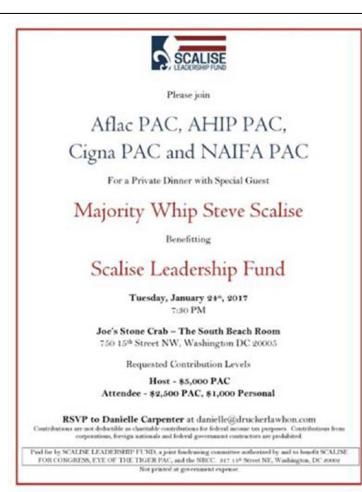
According to Maguire and Moniz, "The health insurer Cigna…. released a statement after the insurrection saying that it would "discontinue support of any elected official who encouraged or supported violence, or otherwise hindered a peaceful transition of power." But within a month, its PAC was back to making contributions, starting with a $15,000 contribution to the NRSC — soon followed by another $15,000 to the NRCC."
FROM YOUR SITE ARTICLES
- Inside the Capitol riot: What more than 500 Parler videos reveal ... ›
- Capitol riot suspect from Florida claims he was breaking into the ... ›
- Democrats move to censure GOP House members who downplay ... ›
RELATED ARTICLES AROUND THE WEB
- U.S. House approves Capitol riot probe; many Republicans buck ... ›
- McCarthy Opposes Commission to Investigate Capitol Riot - The ... ›
- What we know about the Capitol riot arrests - CBS News ›
420 pro publ
Health Insurers to Investors: We’re Good. Health Insurers to Lawmakers: Please Help.
Cigna executives told analysts the pandemic wouldn’t hurt its business, while the health insurance lobby asked Congress for aid.
by Isaac Arnsdorf