dicamba
SEE WHEELER EPA T1
MERRI OK
---
SEE MAHA
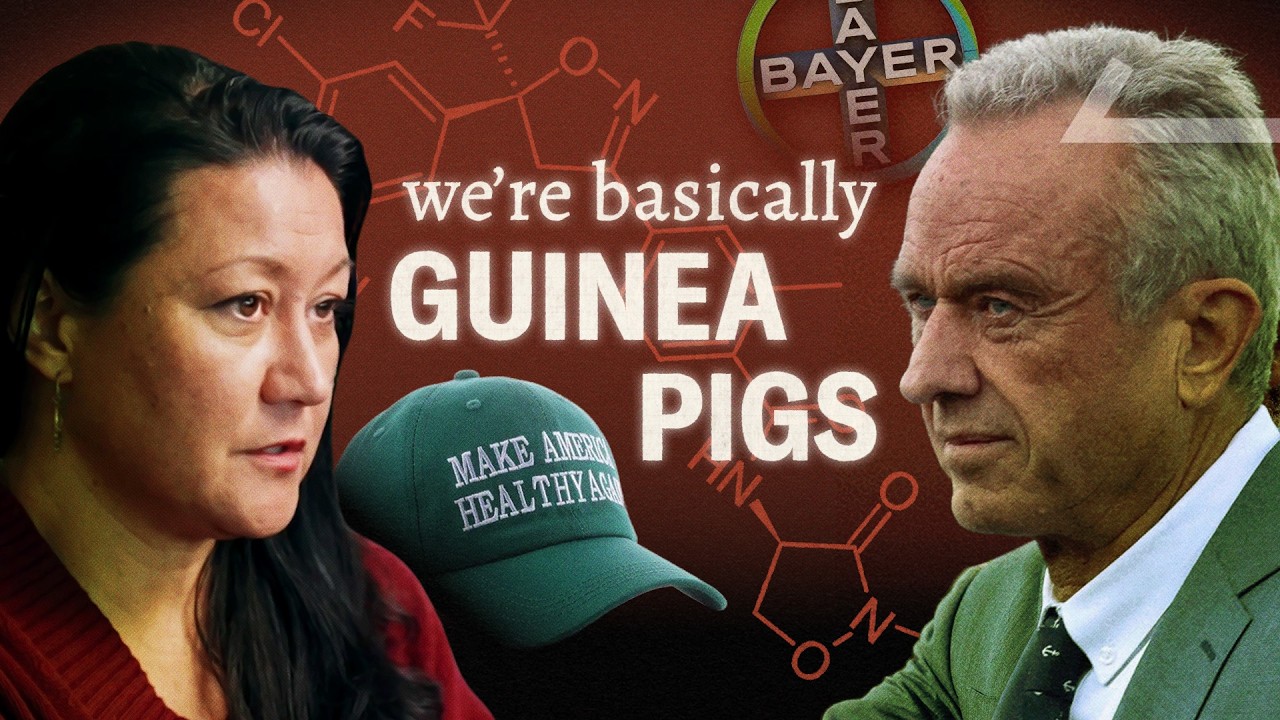
We Uncovered A Conspiracy To Poison Your Food
Fundraiser
More Perfect Union
3.31M subscribers
527,745 views Mar 20, 2026
Four former chemical lobbyists control America’s pesticide regulations, letting pesticide companies pump the country full of toxins. For every 1 meeting with an environmental group, the EPA met 25x with corporate interests. We revealed the corporate lobby poisoning America:
---
ref 12/25
how-trumps-big-ag-bailout-is-alienating-his-maha-base
At a White House roundtable last Monday, president Donald Trump, alongside Agriculture Secretary Brooke Rollins and a handful of other leaders in the government, announced a $12 billion farm aid program intended to offset the economic blowback that U.S. farmers have faced this year as a result of the president’s volatile trade policies.
But there’s a catch: only major commodity farming operations — such as those that grow corn, cotton, peanuts, rice, wheat, and soybeans — will be eligible for more than 92 percent of the money, which is scheduled to begin flowing in February. Just $1 billion of the bailout has been set aside for farmers who produce other crops; when those payments will be made available has not yet been announced.
The move is par for the course from the administration, which has allocated a near-record total of $40 billion in farm subsidies this year, with at least two-thirds of those payments having gone to commodity farms. But Trump’s latest billion-dollar bailout does much more than funnel even more cash into Big Ag, which accounts for a significant share of the roughly 10 percent of total greenhouse gas emissions released by agricultural activities nationwide. The corporate handout is also adding kindling to a feud brewing within factions of the right wing in American politics.
During the president’s 2024 re-election campaign, Trump and Robert F. Kennedy, Jr. both repeatedly promised to reign in the widespread use of dangerous pesticides and industry influence within the federal government. This messaging struck a chord with everyone from mom influencers to chiropractors and vaccine skeptics — all eager for an administration that would do away with all the corporate-fueled toxicity in the air we breathe, water we drink, and food we eat. Voters rallied around the need to clean it all up, and quickly.
After taking office, the administration changed course. Its new Environmental Protection Agency administrator Lee Zeldin has initiated a series of actions that have softened regulations on the chemical industry, including on products that have agricultural applications. In March, Zeldin promoted Nancy Beck to help lead the agency’s chemicals office. Beck previously worked as a lobbyist for the chemical industry, and as an EPA official during the first Trump administration, she fought against rigorous chemical regulations and became known for championing industry interests.
Read Next
2025: The year the US gave up on climate, and the world gave up on us
Over the course of the year, the agency has sought to approve five pesticides containing PFAS, or “forever chemicals,” for farm use on commodity crops such as canola, corn, soybeans, and wheat. Using a very narrow definition of PFAS, which excludes chemicals with single fluorinated carbons, the agency contends that these five pesticides are not technically “forever chemicals” — even though under the international intergovernmental definition, they are.
The EPA is mandated to assess the cumulative risks of all chemicals that are classified as PFAS, which persist in the environment for incredibly long times and have been linked to a variety of harmful human health conditions. So the agency’s narrowed definition may have grave implications and has alarmed environmentalists and public health experts alike. A Grist review of the Office of Chemical Safety and Pollution Prevention proposed assessment documents confirmed that the agency plans to forgo the certain compound risk assessments, which measure how the substances interact with other pesticides, in its review process for all five of the proposed pesticides. Two of those five chemicals, cyclobutrifluram and isocycloseram, have already been green-lit for use in agricultural production — and neither were tested using the cumulative risk approach.
In response to Grist’s request for comment, an EPA spokesperson denied that forgoing the cumulative risk assessments in the agency’s evaluation process is cause for concern. The spokesperson noted that Zeldin “corrected the record on the fake news from Democrats and their media allies” and underscored that the registrations of the five newly proposed pesticides are all in “full compliance” with federal law.
“The administrator made clear that protecting American families remains the top priority — ensuring that EVERY approved pesticide undergoes thorough gold-standard scientific safety evaluations and poses no health risks when used as directed, with NO exceptions. Period,” the spokesperson wrote in an email. “The Trump EPA has not approved any pesticides containing PFAS. This is basic chemistry. And it’s not just us saying this — in fact, it was the Biden EPA that officially ruled single fluorinated compounds are NOT PFAS or ‘forever chemicals.’”
While the EPA’s actions adhere to federal review mandates, a former staffer in the office of pesticide programs, who asked to remain anonymous, said that there is still cause for concern about whether the agency’s newfound priorities increase the risks posed to long-term environmental and human health. According to the former employee, Zeldin’s agency is streamlining new approval applications at the expense of reevaluating older pesticides that have been recently found to be linked to health complications but are still being widely commercially distributed. And if the EPA doesn’t conduct cumulative risk assessments on the proposed pesticides, the former staffer warned that the agency will have a limited understanding of how the chemicals might interact with ones that are already in use.
Other major pesticide-related changes at EPA this year include changes to how companies report PFAS chemical use, the alteration of endangered species protections to enable the use of some pesticides in agricultural applications, and the proposed reinstatement of pesticides, such as dicamba, that were previously vacated by different federal courts. Though it’s been used as a common weed killer for over half a century in the U.S., the chemical has become more widespread on soybean and cotton farms in the last decade, and has been linked to some cancers and ecosystem degradation.
Read Next
Trump’s latest USDA cuts undermine his plan to ‘Make America Healthy Again’
While many industry farm groups have voiced their support for the EPA’s approach to pesticide regulation, another bloc of the nation’s conservative movement finds it in direct contradiction with their interests: the Make America Healthy Again coalition.
In May, to much fanfare, a team led by Kennedy released the first MAHA report. But to the dismay of MAHA supporters anticipating a crackdown on pesticides, the document fell short of the campaign’s strong language. The following month, Zeldin hired another former lobbyist to a lead regulatory position. Kyle Kunkler, a former American Soybean Board lobbyist who fought pesticide restrictions, was brought in to take charge of pesticide policy — one of four prominent industry insiders hired by the EPA under Zeldin’s stewardship.
Then, the highly anticipated follow-up to the report, intended to lay out a strategy on how to accomplish its goals, was released in September. That document didn’t mention pesticides at all — a “gift to Big Ag” that fed the MAHA movement’s growing discontent.
The MAHA discord over Big Ag’s influence on policy was further heightened when, in November, the EPA started rapidly finalizing the approval of several of the newly proposed PFAS pesticides, pushing tensions to their breaking point. Behind the scenes, an effort by some congressional Republicans to limit corporate lawsuits on pesticides came just before the Trump administration urged the Supreme Court, earlier this month, to take up a pesticide manufacturer’s appeal in a landmark case that would block thousands of lawsuits brought by cancer patients who allege the weed killer Roundup is to blame.
“Obviously the people at EPA are entrenched in this industrial agricultural system in the beginning, right? Like, that’s pretty clear with what happened with dicamba,” said J.W. Glass, an EPA policy analyst at the conservation nonprofit Center for Biological Diversity. “What’s dicamba used primarily on? Modified soy. What’s atrazine primarily used on? Corn and soy. The issue is, when you even call into question pesticides that industrial agriculture is so reliant on, it provokes such a vicious response … It is almost like a golden goose that cannot be touched.”
But that hasn’t dampened the mounting frustrations from a bloc of the MAHA movement. Nearly three weeks ago, a group of MAHA leaders and activists launched a campaign to publicly urge Trump to fire Zeldin. “Rather than supporting your initiative to ‘Make America Healthy Again,’ which millions of Republicans and independents alike embraced, Administrator Zeldin has prioritized the interests of chemical corporations over the well-being of American families and children,” the group stated in the petition that’s racked up more than 8,000 signatures. “These chemicals, now being released into our food and water supplies, pose serious threats to both present and future generations.”
“I think there’s been a large misconception in the Republican Party, thinking that the constituents don’t really care about these issues,” Kelly Ryerson, one of the organizers of the petition, told Grist. “A key part” of the MAHA agenda, Ryerson continued, “is removing corporate interests from our regulators.”
“If anything, the EPA is significantly worse off in this administration than it was during the Biden administration,” she added. “And that is something that really frustrates tons and tons of voters that came along with this promise.”
The coalition’s ire, however, seems to be only aimed at Zeldin (who recently teased his own forthcoming MAHA agenda). Ryerson has nothing but praise for other leaders in the administration — Kennedy, Rollins, and the president himself. Last Wednesday, Kennedy and Rollins announced a pilot program that will direct $700 million toward supporting regenerative agriculture, which Ryerson cited as one example of the administration’s commitment to cleaning up the nation’s food system.
All the while, the administration’s support for industrial farms, which are the major users of toxic pesticides, has far outweighed its support for farms that practice more planet-friendly methods. Ryerson freely admits this; she said that factory farming “has dominated agriculture, and we all know it’s a really inconvenient fact, but we all know that it’s killed our soil.” Still, she said, the problem lies with the EPA.
“The MAHA movement,” Ryerson continued, “we would love to see a complete overhaul of our ag system that is just spending this ridiculously obscene amount of money on subsidies for products that aren’t even really food for us at all.”
And yet, Trump shows no signs of abandoning his billion-dollar farm bailout playbook — propping up the very pesticide-sustaining system that MAHA is rallying against.
---
Next Story
The EPA website got the basics of climate science right. Until last week.
---
GUK AP 2 26
The Environmental Protection Agency on Friday reapproved the weedkiller dicamba for use on genetically modified soybeans and cotton. It is a pesticide that has raised widespread concern over its tendency to drift and destroy nearby crops.
The agency said dicamba was critical for farmers who would otherwise have their crops threatened by fast-growing weeds. To ensure the pesticide is used safely, the agency said it imposed strong protections and limits on its use.
Dicamba is a common weedkiller that can be sprayed on top of genetically engineered crops. It kills the weeds but doesn’t hurt the crops. It has been in use for decades, but it has become more widespread on farms in recent years.
Advocates sharply criticized the agency, saying it was moving forward after courts blocked similar efforts in 2020 and 2024. Allowing its use on these two common crops would drastically expand how much is applied and increase harm, advocates say.
Kelly Ryerson, an activist with the Make American Healthy Again (Maha) movement that has forged a fragile political allegiance with the Trump administration, said she was disheartened by the decision.
“A top priority of mine was to have the use of dicamba for over-the-top applications permanently discontinued because” of their harm, she said. “New restrictions on use are not sufficient, and will perpetuate the chemical treadmill where many farmers are trapped.”
The EPA said growers want the weedkiller and they need to be supported – and that it was not a Maha versus EPA issue.
The agency said concerns about dicamba drifting to places where it was not intended were real and must be managed. It set limits on how much can be applied per acre, how much can be applied on hot days and established buffer zones to prevent harm to nearby crops. If followed, the chemical can be used without threatening humans or the environment, according to EPA.
The American Soybean Association applauded the decision, saying clear rules would help farmers prepare for the next growing season and control destructive weeds.
Environmental groups said dicamba drift has damaged immense acreage, devastating vegetable farms, trees and other critical plants.
“When push comes to shove, this administration is willing to bend over backward to appease the pesticide industry, regardless of the consequences to public health or the environment,” said Nathan Donley, environmental health science director at the nonprofit Center for Biological Diversity.
Environmentalists said the EPA’s use restrictions were insufficient, allowing application for too much of the time and for too many days of the year. The buffer the agency uses to prevent harm to nearby plants had already proved ineffective, they said.
Researchers have been working to better understand its health risks. A 2020 study in the International Journal of Epidemiology found that dicamba exposure was linked to an increased risk for some cancers, including liver cancer and a type of leukemia affecting the blood and bone marrow.
Bayer, a manufacturer of dicamba, said the federal registration would allow them to now seek state approvals. They will launch training for applicators in the coming weeks.
---
---
For Immediate Release, August 15, 2025
MAHA Commission Succumbs to Pesticide Industry Pressure
*Draft Report Walks Back Administration’s Promises of Bold Action on Pesticides
WASHINGTON— A much-anticipated draft action plan from the Make America Healthy Again Commission eliminated any plans for action on pesticides. This report is the follow up to the commission’s May MAHA report, which included pesticides and specifically named both glyphosate and atrazine.
The threat of any new restrictions being placed on the use of dangerous pesticides spurred a massive and successful lobbying effort by the chemical industry and commodity growers’ groups, alongside their friends in Congress and the EPA, to force the commission to back off. Instead of action, the recommendations direct the EPA and Big Ag to work together to convince the public to have confidence in pesticide review processes, which are broadly criticized for scientific inadequacy and excessive industry influence. It also encourages research into new pesticide application technologies
“Despite the administration’s promises to MAHA and the reality that using a billion pounds of pesticides in the U.S. each year is a major threat to public health, pesticide interests again prevailed in protecting their profits,” said Lori Ann Burd, environmental health director at the Center for Biological Diversity. “Big Ag’s success in steamrolling the commission’s attempt to act on pesticides is a gut punch to everyone who genuinely believed we could finally make progress on protecting children’s health from these poisons.”
More than 300 million pounds of glyphosate and 70 million pounds of atrazine are used by U.S. farmers annually. Thousands of lawsuits have been filed by cancer victims who used Roundup, which contains glyphosate. Atrazine, a powerful endocrine disruptor that contaminates the drinking water of 40 million Americans, is so toxic it is banned in more than 60 countries.
The United States allows use of 85 pesticides that have been banned or are being phased out in the European Union, China or Brazil, according to a peer-reviewed study published by the academic journal Environmental Health. Over a quarter of all agricultural pesticide use in this country includes pesticides banned in the European Union.
“The MAHA Commission is insulting the intelligence of Americans. It’s outlandish to recommend solving our pesticide woes by having the EPA and Big Ag try to convince us that the deeply flawed pesticide regulatory process is working just fine,” said Burd. “While Big Ag won this battle, the powerful grassroots movement of millions of Americans who know that these chemicals are making us sick will continue fighting to protect their families from pesticides like glyphosate and atrazine.”
Some of the strongest resistance against action on pesticides appears to have come from the administration’s political appointees in the EPA’s chemical safety office. Widespread reporting has pointed a finger at Nancy Beck, a former executive with the American Chemistry Council who, after diligently serving pesticide interests in Trump’s first administration, has been brought back as principal deputy assistant administrator overseeing the EPA’s Office of Chemical Safety. Another American Chemistry Council veteran, Lynn Ann Dekleva, is also back at the EPA, serving as deputy assistant administrator for new chemicals.
More recently, the administration appointed well-known MAHA critic and American Soybean Association lobbyist Kyle Kunkler as deputy assistant administrator for pesticides at the EPA. Just one month after Kunkler’s arrival at the EPA, the agency proposed to reapprove over-the-top use of dicamba, a highly controversial pesticide that Kunkler lobbied for extensively in his former position.
Health and Human Services Secretary Robert F. Kennedy Jr. has repeatedly stated that many of the most-used pesticides in the United States are “extraordinarily toxic,” including and organophosphates. He has that pesticides — many of which have scientifically well-documented links to cancer, infertility, obesity and developmental disorders — are significant contributors to chronic health problems faced by people across the nation.
Following his reelection Trump expressed his own concerns that the United States continues spending “billions and billions of dollars on pesticides,” compared to the European Union and yet has far worse health outcomes. He pledged that his administration would “ensure that everybody will be protected from harmful chemicals, pollutants, [and] pesticides.”
As part of that pledge, he nominated Kennedy as secretary of the Department of Health and Human Services with a mandate to “go wild on the food.” Trump stated that Kennedy is “looking into [pesticides] very seriously because maybe it's not necessary to use all of that.”
The Center for Biological Diversity is a national, nonprofit conservation organization with more than 1.8 million members and online activists dedicated to the protection of endangered species and wild places.}:
---
https://www.alternet.org/2020/06/federal-court-urged-to-hold-rogue-trump-epa-head-in-contempt-for-blatant-defiance-of-ban-on-toxic-weed-killer/
common dreams
a coalition of farming and conservation groups is calling on a federal appeals court to hold EPA chief Andrew Wheeler in contempt for defying an order to immediately suspend use of dicamba, a poisonous weed-killer that is notorious for its tendency to drift and destroy nearby crops.
“Trump’s EPA is so rogue it thinks it can blow off a federal court ruling that stops the damaging dicamba spraying in an administrative order,” George Kimbrell of the Center for Food Safety, lead counsel in the case, said in a statement late Thursday night. “EPA needs a lesson in separation of powers and we’re asking the court to give it to them.”
On Monday, the EPA issued guidance greenlighting the use of dicamba through July 31 despite a June 3 Ninth Circuit Court of Appeals ruling that overturned the agency’s approval of XtendiMax, Engenia, and FeXapan—dicamba-based herbicides sold by chemical giants Bayer (formerly Monsanto), BASF, and Corteva, respectively.
In its 56-page ruling (pdf), the Ninth Circuit said the EPA “entirely failed to recognize the enormous social cost to farming communities where use of dicamba herbicides had turned farmer against farmer, and neighbor against neighbor.”
...
---