BAYER 2 bak
---
perhaps neglected? see neo-nics, pollinator
SEE CORP BAD ACTOR CANCER CORP PERSONHOOD?
SEE PESTICIDE MAHA EPA6 FAIL ZELDIN RFK2 LOBBY NANCY BECK ACC GLYPHOSATE XO NAT SEC // EMERGENCY BROOKE ROLLINS HEGSETH
SEE USRTK LOBBY EXPOSE 2 26? BONDI WILES BALLARD, BIG LAW
ballroom INAUGURATION CEO ATTENDED
SEE TRUMP ADMIN CORRUPT BALLARD BUNDLER 50M$?
SEE LOBBY MODERN AG ALLIANCE FRONT
bak 320
---
AI Overview
Bayer made headlines regarding presidential inaugurations when the German life-sciences corporation contributed $1 million to the 2025 presidential inauguration committee of Donald Trump and Vice President JD Vance. [1, 2]
The company's involvement in the inauguration drew significant public attention and sparked political debate across multiple fronts:
- Leadership Attendance: Bayer CEO Bill Anderson and Bayer US CEO Sebastian Guth personally attended the inauguration events, signaling a push by the company to establish closer ties with the new administration. [1, 2]
- Lobbying and Litigation: Following the inauguration, Bayer faced heavy scrutiny from consumer and environmental advocates regarding its legal efforts to seek federal protections or immunity against state-level cancer warnings associated with its glyphosate-based weedkiller, Roundup. [1, 2, 3, 4, 5]
- Political Fallout: The company's attempts to secure federal preemption of state pesticide laws sparked backlash from "Make America Healthy Again" (MAHA) supporters and some lawmakers, who argued that supporting Bayer's Supreme Court efforts to dismiss Roundup-related claims contradicted earlier promises to restrict hazardous pesticides. [1]
For more information on corporate disclosures and lobbying records, you can review details tracked by OpenSecrets. To read about the public watchdog perspectives, check reports from Food & Water Watch.
---
-=-=
mma
MAHA advocates are rallying against GOP “traitors” who passed the farm bill
Moms Across America founder Zen Honeycutt: “If the Republicans lose the midterm elections … this will be one of the reasons why”
Written by Alyssa Tirrell
Published 09/17/26
This week, the Senate Agriculture Committee passed the farm bill, a policy package that has repeatedly faced opposition from the “Make America Healthy Again” movement.
While the farm bill was being considered, MAHA advocates urged their followers to contact senators to vote “no,” arguing that the bill's language would fail to hold pesticide manufacturers accountable. Following the bill’s passage, advocates expressed frustration with Republican senators, highlighting tensions between a key faction of President Donald Trump's base and the broader GOP prior to the midterms.
This week: MAHA vs. the farm bill
As the Senate Agriculture Committee reconsidered the farm bill, MAHA advocates asked their followers to call senators and urge them not to pass a package that would delay pesticide reviews and cut funding for regenerative agriculture, a pesticide-free farming method.
Several major MAHA accounts, including Moms Across America, Kelly Ryerson (known online as Glyphosate Girl) and Courtney Swan, joined in a September 14 post on Instagram urging their followers to contact five Republican senators — Alabama’s Tommy Tuberville, Iowa’s Joni Ernst, Kansas’ Roger Marshall, North Dakota’s John Hoeven, and West Virginia’s Jim Justice — and tell them to vote “no” on the farm bill.
MAHA activist Alexandra Munoz shared the post and commented, “This bill must be stopped! Don’t let them deregulate pesticides more!” The post was further shared in an Instagram story by MAHA podcaster Alex Clark, and the MAHA Mom Coalition included the call to action in a series of posts critical of the bill.
Zen Honeycutt, founder of Moms Across America, posted a video Tuesday morning encouraging her audience to call their senators to vote “no” on the bill. In an additional video posted the following day, Honeycutt elaborated, “We just want to let them know we will be watching their vote.”
She added, “If the Republicans lose the midterm elections and they are voting — doing things like this, like voting party lines instead of listening to their constituents — this will be one of the reasons why."
On Wednesday, the farm bill passed the Senate Agriculture Committee in a vote along party lines. The stalemate was broken by Sen. Mitch McConnell (R-KY), who has been privately dealing with health issues since at least June and reportedly returned to the Senate in part to break the deadlock.
MAHA advocates responded by expressing frustration, particularly with Republican senators.
Vani Hari (known online as the Food Babe), Munoz, Ryerson, and Swan shared a post condemning the passage of the farm bill. Hari wrote, “What happened with the Farm Bill today is absolutely insulting to the American people. Congress had an opportunity to demand MORE accountability for the chemicals being sprayed on our food.” The caption included a “Traitor list” naming a dozen Republican senators.
Ryerson also separately posted an image of McConnell returning to the Senate with the caption, “Ailing Sen McConnell dragged in from medical leave to VOTE TO DEFUND REGEN AG and POSTPONE GLYPHOSATE REVIEW.”
In a new video, Honeycutt said, “We're very disappointed. I’m going to read the Republicans who voted for the farm bill, which is not what their constituents want.” She also claimed that McConnell “did not have the wherewithal, he was not in mental or physical fitness to be able to do that vote, that should absolutely not be allowed.”
She then read a list of Republican senators who voted to pass the bill, adding, “Folks, the Republicans need to hear from you.”
Recap: MAHA vs. glyphosate
This spring, the herbicide ingredient glyphosate became a particular rallying point for MAHA advocates as the Supreme Court prepared to hear a case that would shield Bayer, the manufacturer of the glyphosate-based Roundup, from liability. As CNBC reported, “The Environmental Protection Agency does not classify glyphosate as a carcinogen and does not require labels to disclose cancer risk, but the World Health Organization’s International Agency for Research on Cancer in 2015 said the chemical is ‘probably carcinogenic to humans.’”
The issue was further charged in March after the Trump administration, which had signed an executive order promoting glyphosate production in February, wrote an amicus brief to the Supreme Court in support of Bayer.
In response, MAHA advocates organized “The People vs. Poison” rally in D.C. on April 27. The protest prompted the House of Representatives to remove language from the farm bill that MAHA figures said would also have shielded pesticide manufacturers from liability. The bill passed the House without the pesticide protections just a few days later, and MAHA celebrated the win.
The victory was short-lived, however. In late June, the Supreme Court decided in favor of Bayer, finding that “that the company can't be sued in state courts because federal regulations have found a cancer link unlikely and do not require a warning label.”
Then, in early August, Senate Republicans voted down a Democrat-led amendment to the farm bill that would have allowed injured parties to file suit against pesticide companies. The legislation then stalled in committee, according to The Hill, thanks primarily to Democratic members who oppose a “provision in the bill that would require states to help cover the cost of Supplemental Nutrition Assistance Program (SNAP) funding.”
//
MAHA moms are taking on data centers
06/10/26
MAHA and wellness advocates sound the alarm after the primary defeat of Rep. Thomas Massie
05/21/26
MAHA is outraged over Supreme Court ruling that shields Monsanto owner Bayer from cancer liability
06/26/26
-=-=
-=-=
MALKIN S
Federal disclosures show Bayer reported spending $9.19 million on lobbying Congress and the executive branch in 2025, which includes fees paid to at least 13 outside lobbying firms. As of the fourth quarter of 2025, 45 lobbyistswere registered to lobby for Bayer under the Lobbying Disclosure Act.
In this post, we list the 13 firms registered to lobby for Bayer and the company’s in-house lobbyists. Registered lobbyists for Bayer appear in red. In an effort to understand Bayer’s influence with the Trump administration, we also reviewed the leadership of Bayer’s lobby firms to look for ties to Trump; these are highlighted in yellow. Unless otherwise noted these firms lobbied for Bayer for all of 2025. See our analysis of Trump administration ties here:
...
See also our recent reporting on Bayer’s effort to influence policymakers in states across the nation. Modern Ag Alliance is a Bayer lobbying and PR group**: **Nearly all its expenses last year went to a PR firm that works for Bayer
Bayer’s lobby firms
Ballard Partners
Brian Ballard, Founder:Key Trump campaign fundraiser (“bundler”), reportedly raising over $50 million for the 2024 campaign. Served on Trump’s 2024 inaugural and transition finance committees. Previously represented the Trump Organization as a Florida lobbyist. His firm employed Chief of Staff Susie Wiles and Attorney General Pam Bondi as partners/lobbyists. Ballard is also registered to lobby for the American Chemistry Council.
Daniel McFaul, Managing Partner:Served on Trump’s 2016-2017 presidential transition team. Previously worked as legislative director for Rep. Joe Scarborough (R-FL), and chief of staff for Rep. Jeff Miller (R-FL) and Rep. Matt Gaetz (R-FL). McFaul is also registered to lobby for the American Chemistry Council.
Mike Rubino, Partner:Senior advisor on Trump’s 2016 campaign where he directed operations in 10 states. He was appointed as a senior official at the U.S. Department of Health and Human Services in 2017 in Trump’s first term.
Don't miss another story.
Get the Right to Know newsletter in your inbox.
Subscribe
Hunter Morgen, Partner:Special assistant to the President, senior advisor for policy and strategy in the first Trump White House; principal deputy to Peter Navarro and Stephen Miller. Policy advisor at the State Department in the Office of Policy and Planning. Previously worked on the Trump 2016 campaign and transition team. In 2020, Trump appointed Morgen to the Presidential Council on Improving Federal Civil Architecture. He was the Trump 2024 campaign’s State Director for Mississippi and Advisor for DC Outreach.
William Russell, Partner:Special assistant to the President and deputy director of presidential advance and trip director in Trump’s first term. He was the aide responsible for Trump’s daily travel and logistics for nearly four years. He also worked on Trump’s 2016 and 2024 campaigns. He worked on Trump’s 2016 campaign and was later appointed to USDA as advisor to the office of the under secretary of Farm and Foreign Agriculture Services.
Mercury Public Affairs
Registered August 2025
Bryan Lanza, Partner:Communications director for the Trump transition team in 2017; deputy communications director for the 2016 Trump-Pence campaign. Lanza has often appeared on cable news shows and has been cited as a senior advisor to the 2024 Trump campaign and transition team.
John Lonergan, Partner: Political background includes stints on the campaigns of Gov. George Pataki (R-NY) and the National Republican Senatorial Committee specializing in research, polling and messaging.
Brian Hughes, Partner:NASA chief of staff from May to December 2025. Deputy national security advisor for strategic communications at the White House. Senior advisor and Florida campaign director Trump 2024. Communications director Trump-Vance transition team.
Danielle Alvarez, Partner:Senior advisor for the Trump 2024 campaign and worked on communication strategy for the Trump-Vance transition team. During the 2022 midterms, she was communications director for the Republican National Committee, and served as communications director for the southern gulf region for Trump’s 2020 campaign.
Venture Government Strategies
Robert Hobart, Partner: Earlier in his career worked as deputy chief of staff, appropriations associate staff and legislative director for three Republican members of Congress.
Hamilton Bloom, Partner:Republican subcommittee staff director and clerk for the Senate Appropriations Committee on Commerce, Justice, Science, and Related Agencies 2019-2021. Legislative assistant to Senate Appropriations Chairman Richard Shelby (R-AL).
Will Brewster, Senior Director: Policy advisor for economic development for Gov. Brian Kemp (R-GA). Legislative assistant to Senator Richard Shelby (R-AL) for five years.
Jonathan Blum, Senior Vice President:He held several senior roles within the U.S. Department of the Treasury during both Trump terms. He was deputy assistant secretary for legislative affairs (banking and finance) from 2018 to 2021. He returned to the Treasury in January 2025 as principal deputy assistant secretary for legislative affairs and served as acting assistant secretary through much of 2025 before joining Venture in December.
Todd Strategy Group
Nicholas Uhelecke, Principal: Senior advisor to the Secretary of Health and Human Services during the first Trump administration (2019–2021). Professional staff and senior legislative assistant, House Ways and Means Subcommittee on Health, 2011-2019.
Ted Lehman, Principal:Former chief of staff to Sen. Thom Tillis (R-NC). Chief counsel for nominations and senior counsel for then-chairman of the Senate Judiciary Committee Senator Chuck Grassley (R-IA). Counsel on the Judiciary Committee for former Ranking Member Senator Jeff Sessions (R-AL).
Paul Edattel, Principal:Chief counsel for House Energy and Commerce Committee Health Subcommittee (2016-2018), assistant to Speaker of the House John Boehner (R-OH).
Daniel Todd, Principal and Founder: Senior health counsel for the Senate Finance Committee (2011-2014); special assistant CMS Office of the Administrator, U.S. Department of Health and Human Services (2003-2005).
Eric Bergren, Principal:Chief of staff for Rep. Brett Guthrie (R-KY) (2009-2021). Chief of staff and legislative director for Rep. Ron Lewis (R-KY) (2004-2008)
Katherine Fleming, Associate: Legislative assistant, legislative correspondent and staff assistant to Rep. Brett Guthrie (R-KY) (2016-2022)
Peter Oppenheim, Principal:General counsel, Senate HELP Committee (2019-2021). Trump-appointed assistant secretary at the U.S. Department of Education (2017-2019). Education policy director and counsel to the Senate HELP Committee (2013-2017). Legislative counsel, U.S. Senator Lamar Alexander (R-TN) (2011-2013).
Taylor Sexton, Principal:Senior advisor to the assistant secretary for preparedness and response (ASPR) at the U.S. Department of Health and Human Services (2020-2021).
Holland & Hart
Registered April 2025
Andrew Wheeler, Partner and head of federal affairs:Administrator of the U.S. Environmental Protection Agency in Trump’s first term (2019–2021). He served as acting administrator of EPA in 2018 and 2019, and prior to that as deputy administrator from April to July 2018.
Troy Lyons, Senior director of federal affairs:Associate administrator for the EPA Office of Congressional and Intergovernmental Relations (2017–2019) and EPA senior advisor to the administrator for external affairs (2019), serving under EPA Administrators Wheeler and Scott Pruitt. He was EPA’s chief liaison to Congress, the White House and state governments and he managed the confirmation process for EPA nominees in Trump’s first term.
Jennifer Scheller Neumann, Of counsel:Served for over 20 years and held every leadership rank within the appellate section of the Environment and Natural Resources Division (ENDR) in the U.S. Department of Justice, most recently as chief in charge of directing litigation and appeals involving nearly every major environmental and natural resources statute and representing a broad range of federal agencies. She departed the DOJ in May 2025 and joined Holland & Hart.
Amelia Yowel, Of counsel:Appellate attorney in the Environment and Natural Resources Division (ENRD) in the U.S. Department of Justice (2019–2025).
Invariant
Ken Barbic, Principal, Food and Agriculture Practice Group:Assistant secretary for congressional relations at the U.S. Department of Agriculture (2018–2021).
Anne MacMillan, Chief Strategy Officer: Deputy chief of staff to USDA Agriculture Secretary Tom Vilsack and senior policy advisor to House Speaker Nancy Pelosi (D-CA).
Amy Swonger, Principal:Director of legislative affairs and assistant to the President, White House (2020–2021). Deputy director of legislative affairs and deputy assistant to the President (2017-2020).
Jordan Bonfitto, Director: Senior advisor to Secretary of Agriculture Brooke Rollins and chief of staff for USDA’s marketing and regulatory programs. (February to October 2025). During the first Trump administration, he held senior roles at USDA and the White House National Economic Council.
Morgan Viña, Principal: Chief of staff for international security affairs at the Department of Defense (2019-2021). Chief of staff to Ambassador to the United Nations Nikki R. Haley (2017-2019). U.S. Senate Committee on Foreign Relations advisor to then-Chairman Bob Corker (R-TN).
Capitol Counsel
John Martin, Partner & head of health care practice:Principal associate commissioner for legislation at the FDA under Commissioner Scott Gottlieb. Previously served as legislative director for Sen. Tom Cotton (R-AR), senior health policy advisor for Gov. Asa Hutchinson (R-AR), and political director for Tommy Thompson for Senate.
David Olander, Partner & tax practice lead:He was the majority chief tax counsel to the House Ways and Means Committee under Chairman Dave Camp (R-MI). Tax and policy counsel for Rep. Thomas Reynolds (R-NY).
Clint Robinson, Partner:Appointed by former President George W. Bush to the role of associate administrator of congressional and intergovernmental affairs of the U.S. General Services Administration (GSA) and served as senior staff to House Republican Leadership.
Shannon Finley, Founding partner: Senior advisor and political consultant to Sen. Max Baucus (D-MT) for eight years. Finance director to the Baucus 2002 re-election campaign and director of his PAC.
Jeffrey Carroll, Partner:Staff director for the House Energy and Commerce Committee under Chairman Frank Pallone, Jr. (D-NJ), also served as chief of staff for Rep. Pallone, Jr. and managed his campaign to become the senior Democrat on the Energy and Commerce Committee.
Former Senator Pat Roberts, Partner:Former Senator and Congressman from Kansas. He is the only person in U.S. history to have chaired both the House and Senate Agriculture Committees.
George Sifakis, Partner: Assistant to the President and director of the Office of Public Liaison (2017). Served on the presidential transition team in 2016 and 2000. Worked as advance staff for former President George W. Bush and First Lady Laura Bush.
Phil Hardy, Partner:Served on the committee to elect the President during the 2016 Trump campaign. Communications director and district coalitions director for Rep. Paul Labrador (R-ID) and worked as communications director and policy advisor for Lt. Gov. Brad Little (R-ID).
BGR Government Affairs
Brent Del Monte, Principal & head of health and life sciences:Vice president for federal government relations at the Biotechnology Innovation Organization (BIO), the biotech industry’s main trade group for 10 years. FDA counsel at the House Committee on Energy and Commerce under Chairmen Tom Bliley (R-VA) and Billy Tauzin (R-LA).
Remy Brim, PhD, Principal & head of health and life sciences:Senior FDA policy advisor to the Senate HELP Committee Ranking Member Patty Murray (D-WA). Health policy advisor to Sen. Elizabeth Warren (D-MA) from 2013-2016.
John Stone, Principal, FDA & public health:House Energy and Commerce Committee staff for nearly seven years, first as a counsel on the Oversight and Investigations Subcommittee and then senior counsel on the Health Subcommittee (2011-2017). Worked for Chairman Fred Upton (R-MI) for seven years.
Joel Bailey, Vice President: Chief of staff to Rep. Jimmy Panetta (D-CA) until 2021. Prior to this role, Bailey spent over a decade working in various Congressional offices.
David Urban, Managing Director: Senior advisor to the 2016, 2020, and 2024 Trump campaigns. Appointed by Trump to serve as the 11th chairman of the American Battle Monuments Commission and as a trustee to the United States Military Academy at West Point. Chief of staff to Sen. Arlen Specter (R-PA) from 1997 to 2002.
William Crozer, Practice head & principal:Special Assistant to the president and deputy director of the White House Office of Intergovernmental Affairs (2018-2021). Before joining Trump’s White House he was a vice president at BGR Group (2013-2018). He previously served in Gov. Nathan Deal’s (R-GA) office of the executive counsel and was a major donor club director for the Republican National Committee (2007-2009).
Joseph Lai, Principal: Served in the White House as special assistant to the president for legislative affairs (2017-2019). He was a key White House liaison to the Senate, leading the outreach and vote-counting efforts to confirm Justices Gorsuch and Kavanaugh, as well as appointees to the Federal Reserve and the Cabinet. He also helped pass the Tax Cuts and Jobs Act and the USMCA trade agreement.
Kirsten Madison, Senior vice president: Assistant secretary of state for international narcotics and law enforcement affairs (2018-2021). She has also held many other advisory roles for government leaders for 20 years.
Akin Gump Strauss Hauer & Feld
Lynn Tjeerdsma, Consultant: Two decades as a top advisor to Senator (now Majority Leader) John Thune (R-SD). Assistant deputy administrator for farm programs at the U.S. Department of Agriculture (2008-2011).
David Schwietert, Senior policy advisor:Spent over 15 years as a primary aide for Senator (now Majority Leader) John Thune (R-SD). Legislative director for Thune (2006-2013). Staff director for the Senate Commerce Committee during Thune’s tenure as chair and ranking member (2013-2015).
Geoff Verhoff, Senior advisor:Served on the Trump-Pence victory finance leadership committee 2017-2021 and was the vice chair of the RNC Finance Committee in those years. Previously worked for Sen. William Roth Jr. (R-DE) during Roth’s tenure as chair of the Senate Finance Committee.
Kelly Ann Shaw, Partner: Deputy assistant to the President for international economic affairs and the U.S. lead negotiator (Sherpa) for the G7, G20, and APEC (2018-2019). Prior to the White House, she was Republican trade counsel to the House Committee on Ways and Means Committee and assistant general counsel for the Office of the U.S. Trade Representative.
Anna Abram, Senior advisor:Deputy commissioner for policy, legislation and international affairs at the FDA (2017-2021). Health and policy director and senior advisor to Sen. Richard Burr (R-NC) and worked at the Senate HELP Committee (2009-2017). Associate director at the White House Domestic Policy Council (2007-2009).
The Russell Group
Randy Russell, President and CEO: Widely recognized as one of D.C.’s most influential agricultural lobbyists, with decades of experience in key agricultural positions including chief of staff for Secretary of Agriculture John Block, deputy assistant secretary for economics at the USDA, and 1981 Farm Bill coordinator. He was the architect of the Coalition for Safe And Affordable Food, an industry front group that opposed labels on GMO food, and he led the industry effort to pass the national “disclosure” standard (DARK Act) that preempted Vermont’s GMO labeling law.
Andrew Harker, Principal:Harker managed the Coalition for Safe Affordable Food, an industry front group that opposed labels on genetically engineered foods.
Ashlee Johnson, Principal: Served on the Senate Agriculture Committee under Sen. Blanche Lincoln (D-AR) and staffer to former Rep. Mike Ross (D-AR). Joined the Obama administration in 2011 and held multiple roles at USDA including White House liaison, chief of staff to the deputy secretary and policy assistant for the White House Domestic Policy Council.
Jessica Schulken, Chief advocacy and external affairs officer:Professional staff member for the Senate Appropriations Committee on the Agriculture Subcommittee and later staff director (2001-2012). Worked for Sens Herb Kohl (D-WI), David Pryor (D-AR), Jeff Merkley (D-OR), Robert Byrd (D-WV), Daniel Inouye (D-HI), Barbara Mikulski (D-MD) and Patrick Leahy (D-VT).
HB Strategies
Gregg Hartley, Co-founder, chief operating office, executive vice chairman: Recognized as one of the “Top Hired Guns” in Washington by the Hill newspaper. Staffer and advisor for 18 years to Rep. Roy Blunt (R-MO), former House Republican Whip and Senator.
Eric Lausten, Director, managing principal:Congressional staffer for 16 years most recently as chief of staff to Rep. Daniel Lipinsky (D-IL).
Washington Tax and Public Policy Group
James “Max” Pedrotti:As a campaign operative for the South Carolina Republican Party, he worked on election campaigns for Trump and Sen. Lindsey Graham (R-SC). Deputy chief of staff, legislative director and senior assistant roles to Rep. Carol Miller (R-WV) (2021-2023).
Don't miss another story.
Get the Right to Know newsletter in your inbox.
Subscribe
Greg Nickerson:Staff director for Rep. Jim McCrery (R-LA) and tax counsel to Rep. Bill Thomas (R-CA) and on the House Ways and Means Committee, 2001-2005.
Zach Price:Staff Assistant to Senator Dan Coats (R-IN) 2016-2017.
The Peterson Group
Collin Peterson, President and Founder:Congressman (D-MN) from 1991-2021, and chairman and ranking member of the House Agriculture Committee from 2005-2021.
Elliott Peterson, Director of government affairs: Treasurer, election compliance manager and off-year campaign manager for Rep. Collin Peterson’s re-election campaigns from 1999-2021; and fundraiser and campaign staffer for his father’s campaigns from 1989-1992.
Allison Stock, Vice president, communication and public affairs:Rep. Collin Peterson’s chief of staff from 2015-2021 and former communications director. She directed Peterson’s campaigns for Congress five times.
Bayer in-house lobbyists
Michael Holland: Director, Government Affairs: Legislative counsel from 2009-2011 to Rep. Devin Nunes (R-CA), the current CEO of Trump Media & Technology Group.
Michael Parrish: VP, Public Affairs, Science & Sustainability:Parrish has more than 20 years experience in key government positions including multiple roles at the Department of Justice and the State Department and as advisor and executive assistant to Rep. Sam Farr (D-CA).
Stephanie Murphy: Senior Director, Corporate & International Government Affairs:She served as the director of agricultural affairs at the Office of the U.S. Trade Representative (USTR) under Obama.
Erick Lutt: Director, Federal Government Affairs:Before Bayer, he spent a decade as a lead policy expert at the Biotechnology Innovation Organization (BIO).
James Travis: Senior Director, State Government Affairs: Travis worked at Monsanto for 15 years since 2003 before joining Bayer. Prior to that role he was senior legislative assistant for agriculture and water resources for Rep. Cal Dooley (D-CA)
Brian Nagle: Senior Director, Federal Relations & Policy:He previously served as legislative director for Sens. Kay Hagan (D-NC) and Fritz Hollings (D-SC).
Categories: Industry PR & Lobbying, Monsanto/Bayer, Pesticides
---
Bayer lobbying rebounds as Roundup legal fight reaches Supreme Court - Investigate Midwest
Bayer lobbying rebounds as Roundup legal fight reaches Supreme Court
Lauren Cross, Investigate MidwestApril 27, 2026
A new federal lobbying report shows the company spent more in early 2026 as the courts consider whether federal pesticide warning labels can protect companies from state lawsuit claims.
 by Lauren Cross, Investigate MidwestApril 27, 2026Why you can trust Investigate Midwest
-
Bayer increased its federal lobbying spending in the first quarter of 2026 ahead of the U.S. Supreme Court hearing arguments on Monday, April 27, in a case involving Monsanto, which Bayer acquired in 2018.
New federal disclosures show Bayer reported just over $2 million in lobbying expenses from January through March, up from $1.75 million in the fourth quarter of 2025. The increase follows a drop in spending during the second half of last year after Bayer’s quarterly lobbying peaked at $2.95 million in early 2025.

While 2025 filings showed the company “monitoring” broad issues like pesticide regulations and biotech innovation, the new 2026 report reveals a laser-focus on specific legislation designed to provide the company with a legal shield against ongoing lawsuits.
Across nine quarterly filings since the start of 2024, Bayer reported spending nearly $19.7 million on lobbying, or about $2.2 million per quarter on average.
The case Monsanto Co. v. Durnell could shape pesticide litigation nationwide. The main question is whether federal pesticide labeling laws can override some state lawsuits claiming companies failed to properly warn people about the risks.
Add us as preferred Google source
“Failure to warn” is a common argument in such liability cases. Plaintiffs argue a company did not give clear enough warnings or safety instructions about a product.
Pesticide politics: Inside the corporate push to limit liability
As lawsuits over Roundup’s safety mount, Bayer has launched a multi-state lobbying effort to limit its legal liability.
by Mary McCue Bell, for Investigate Midwest
Bayer has faced years of lawsuits over Roundup, its glyphosate-based weedkiller. Plaintiffs say exposure caused non-Hodgkin lymphoma. Bayer denies those claims and says Roundup labels follow federal law.
Monsanto has pointed to past Environmental Protection Agency findings that glyphosate is not likely to cause cancer. But in a recent court filing, Food & Water Watch and other advocacy groups told the Supreme Court that the EPA review Monsanto relies on was thrown out by a court four years ago.
Bayer’s latest lobbying disclosure filing shows a more focused agenda on issues including “uniformity of pesticide labeling,” EPA budgetary issues, and USDA funding. The company also reported lobbying the White House and the National Economic Council, which advises the president on global economic policy.
According to the filing, Bayer reported lobbying on H.R. 7567, the Farm, Food and National Security Act of 2026. The bill includes pesticide labeling requirement language, which relates directly to the arguments at the center of the Supreme Court case. If approved, such protections could help companies defend against some state-level warning-label lawsuits.
Federal law requires quarterly lobbying reports that disclose lobbying activityand total spending, but filings do not break spending down by each specific issue lobbied. However, the timing of Bayer’s spending rebound comes as the company faces one of the most closely watched ag legal cases of the year.
MANY DOCS
---
---
an 7 26 grist
On a 200-acre farm and cattle ranch in Bandera, Texas, Mollie Engelhart grows organic produce, sells raw milk, and writes a daily column about the power of regenerative agriculture. She’s a farmer and a Make America Healthy Again mom who doesn’t like being called a MAHA mom. She prefers to think of herself as “MAHA-aligned.”
In May, Engelhart opened her ranch to a couple hundred pro-MAHA politicians, activists, and leaders for a two-day MAHA farming retreat. Department of Health and Human Services Secretary Robert F. Kennedy Jr., was there. Engelhart’s brother, Ryland, is one of the more well-known figureheads of the movement.
*This story was originally published by Grist. Sign up for Grist's weekly newsletter here.
Her biggest issue with the MAHA label is what she considers the “blue team or red team” politicization of it. Like many MAHA-aligned supporters, she voted for President Donald Trump in the last election largely because of RFK Jr.’s endorsement and their joint promise to clean up America’s chemical-laden food system. Back then, she had faith Trump would make good on that promise. But in the last year and half, that faith has frayed.
“I think that one hundred percent the MAHA movement is very disappointed and disenchanted, and I am not the only one,” said Engelhart. “MAHA voters are homeless.”
MAHA’s disenchantment with the Trump administration has much to do with its open support of Bayer, the manufacturer of the popular pesticide Roundup, which just won a Supreme Court case over the claim that the company failed to adequately warn users about the cancer risk of its weedkiller. First, the administration urged the Supreme Court to take up the case. Then, in February, the president signed an executive order that classified glyphosate-based herbicides like Roundup key to national security and called for increased domestic production of the chemical. In March, it was reported that top officials at the Environmental Protection Agency met with Bayer CEO to discuss “litigation” issues. The following month, the administration sent a lawyer to argue on behalf of the chemical company in a Supreme Court hearing.
Tens of thousands of plaintiffs had sued Bayer, alleging that the active ingredient in Roundup has caused cancer and other health issues and that the company failed to follow state laws when it did not include a warning about cancer risk on its label. But now, the court’s ruling means that states cannot mandate more information on the product’s label than required by federal law, and any such claims against Bayer will have limited pathways of legal recourse.
Just hours after the decision was released, Trump signed an executive order framed as boosting regenerative agriculture and American farm resilience. (Broadly speaking, the term “regenerative agriculture” refers to farming methodologies that boost soil health and its potential for carbon capture, though there is no federal standard or definition like there is for “organic,” leaving it open to interpretation — and, in some cases, greenwashing.) The contradictions between the two actions have sparked a new barrage of criticisms from MAHA voters. “It does seem a little schizophrenic,” said Engelhart. “None of us can be a one-issue voter anymore…I don’t think that anybody is just going to blindly go and vote for one party or another,” she added.
That sentiment is already showing up in the data, though the picture is far from clear-cut. Polling results from last October found that roughly 74 percent of MAHA-supporters identified as Republicans, with 59 percent also identifying as Make America Great Again supporters — the president’s most loyal base. Meanwhile, a POLITICO poll conducted this spring revealed that 47 percent of self-identified MAHA respondents who voted for Trump believe the administration has not done enough to “Make America Healthy Again.” And a Kaiser Family Foundation poll found that 28 percent of MAHA voters somewhat or strongly disapprove of the way the administration is handling food and vaccine policy, which may affect turnout in the midterm elections that could decide control of Congress. Limiting pesticide use, however, remains one of the movement’s defining causes, with 94 percent of MAHA adherents in favor of reducing exposure to harmful chemicals.
South Dakota farmer Jonathan Lundgren was at the White House on the day that the Supreme Court ruling was announced. Days earlier, he’d been invited to the Rose Garden for a dinner recognizing farmers and was asked to join Trump in the Oval Office for the signing of the regenerative agriculture executive order. Lundgren raises bees, sheep, and poultry, and grows flowers and apples on a 50-acre regenerative farm in Estelline, South Dakota. Like Engelhart, he shirks the political implication of identifying as MAHA, but considers himself aligned with the pro-regenerative agriculture and anti-pesticide faction of the movement.
“They needed some farmer faces to kind of give the whole thing a spin,” he said. Lundgren called the executive order “meaningful,” though it’s not lost on him that it doesn’t introduce new funding or regulations.
Experts say it doesn’t do much at all. “It may sound great, but fundamentally, there’s nothing really new or substantive or meaningful in the EO that I can see that actually changes the equation for how the administration treats regenerative agriculture,” said Mike Lavender, policy director at the National Sustainable Agriculture Coalition.
Inside the Oval Office meeting, Lundgren watched on as Kennedy’s team swiftly mobilized to try to soften the MAHA backlash to the Supreme Court ruling with the president’s executive order, which culminated in an explosive argument between a Department of Health and Human Services official and a top farming lobbyist who was concerned that the order would imply that there are safety issues in the U.S. food supply. Lundgren himself stopped using Roundup about eight years ago when he noticed that agrochemicals were “causing more problems than they were solving” on his farm. But he can’t escape the downwind effects of nearby farms that spray it. Right now, he’s watching scores of bees slow down before outright dying, and his orchard’s leaves cup from herbicide drift. Then there’s the human toll.
“We’re sick this time of year, and it’s a direct result of all of these pesticides being applied. My family is sick. That ain’t right,” Lundgren told Grist. His daughter is grappling with asthma and allergy flare-ups while his farm staff battles recurring headaches and fatigue. “It’s so intense that we call it in my community ‘The Spray Flu.’”
He says these dual actions by the administration, as well as the EPA’s recent approval of yet another batch of pesticides that contain PFAS, often called “forever chemicals,” have changed how he plans to vote in the midterms.
“We’re in a weird state right now that has never really happened before, where food safety and the health of our children is weighing very heavily on American politics,” said Lundgren. “This is far broader than the farming community. I think that this is consumers; I think this is parents; I think this is society at-large.”
Others argue that, despite the administration’s recent pro-regenerative ag messaging, Trump’s track record of anti-climate and pro-chemical policies has not helped the movement to clean up the food system, but hindered it.
Kelly Ryerson, a leading MAHA mom and co-founder of the farming organization American Regeneration, agrees that, when taken together, the ruling and the order reveal a disconnect. “It’s inconsistent, to say the least,” said Ryerson. “If Trump is going to be doing things like the Supreme Court situation, it’s certainly not what anyone voted for…it’ll be really hard to come back from this now.”
For Ryerson, a registered independent who voted for Trump, the two actions have shifted how she plans to approach the midterms. “I don’t care if they’re a Republican or Democrat, I’m going to support the candidate that wants to decrease toxic exposures,” she said.
This article originally appeared in Grist at https://grist.org/food-and-agriculture/trump-tried-to-appease-mahas-fury-over-roundup-it-backfired/.
Grist is a nonprofit, independent media organization dedicated to reporting on climate change.
---
Bayer ‘Turns Over Every Stone’ to Stiff Roundup Cancer Victims - The American Prospect
*This is the first in a three-part series on Bayer’s crusade for immunity from Roundup-related cancer claims, published in partnership with theCenter for Media and Democracy. Read the second and third parts of the series.
The executive order President Trump signed in February protecting and encouraging the production of glyphosate, the primary ingredient in Roundup, is a major victory for Bayer AG, the German biotech giant that produces the notorious herbicide.
The company has been aggressively implementing its five-point plan to thwart the ability of cancer patients to sue over claims that it failed to warn them about the link between Roundup and non-Hodgkin lymphoma. But Bayer is not resting on its laurels, and is pushing for a more permanent win in the Supreme Court this spring—and eventually in Congress.
By the time Bayer introduced its plan to stem a flood of Roundup-related lawsuits in 2021, the company already owed billions in verdicts and settlements. Pricey verdicts over the carcinogenic product began to pop up around the country after a San Francisco school groundskeeper won a landmark $289-million damages award in the first failure-to-warn trial over Roundup’s link to cancer in August 2018—just two months after Bayer purchased Monsanto, the company that had been making Roundup.
Bayer has mounted an aggressive lobbying, public relations, and litigation campaign to shield the company from tens of thousands of similar lawsuits and protect its multibillion-dollar annual sales of glyphosate-based products—especially Roundup, the most widely used herbicide in the world.
When Bayer’s new CEO Bill Anderson came on board in 2023, he pledged to “contain” the company’s Roundup litigation woes by the end of this year and told shareholders that the company is “turning over every stone” to reach that goal.
Bayer earned $2.9 billion from glyphosate sales last year, according to its March 4 annual earnings report, but payouts for Roundup litigation have put the company in the red for the past three years. Bayer’s earnings report shows $1.3 billion in settlement and court judgment payments in 2025—marking a serious jump from the $528 million the company paid the previous year.
These financial and political factors raise the stakes for Bayer as it prepares to present oral arguments before the Supreme Court in a case called Monsanto Company v. Durnell. On April 27, the multinational will argue that it does not have to include a cancer warning on Roundup labels because the Environmental Protection Agency (EPA), relying on its 2020 findings that glyphosate is “unlikely to be a human carcinogen,” does not require a warning. Bayer claims that the Federal Insecticide, Fungicide, and Rodenticide Act (FIFRA), the statute that gives the EPA the authority to regulate pesticides, preempts any conflicting state laws or failure-to-warn claims.
Since Bayer’s lobbying efforts at the state and federal levels have produced mixed results, a win in the Supreme Court is key to its strategy for getting out of the red. Its repeated attempts to add immunity provisions to farm and appropriations bills have failed to get over the finish line to date, and only three of the 14 states in which Bayer has lobbied hard to push immunity legislation have actually passed laws to do that (see Part II of this series).
Bayer’s Investment in Trump Pays Off
Trump’s return to the White House created new opportunities for Bayer’s Roundup immunity campaign. Though the company had spent relatively little on political campaigns and federal elections in the past, it contributed $1 million to Trump’s 2025 inauguration, according to data compiled by OpenSecrets.
Bayer also spent $9.2 million in 2025 to hire scores of lobbyists from more than a dozen firms to push its agenda in Congress and multiple executive branch departments, according to a report by the public health research and news site U.S. Right to Know and data from OpenSecrets. Many of those lobbyists have close ties to members of the Trump administration, including Chief of Staff Susie Wiles and recently fired Attorney General Pam Bondi, giving Bayer an inside track at the White House, Department of Justice, EPA, and Department of Agriculture, among other offices and agencies.
Anderson, Bayer’s CEO, had multiple meetings with top administration officials—including Wiles—prior to Trump’s executive order, as both Politico and *The Guardian* reported.
And the pay-off has been enormous. The president’s executive order declares that “domestic production of elemental phosphorus and glyphosate-based herbicides is critical to the national defense.” Bayer is the sole domestic producer of these chemicals, used both for Roundup and to supply the U.S. military with munitions.
In justifying his executive order, Trump maintains that the production of these chemicals is a matter of national security—a finding that opens the door to his invocation of the Defense Production Act (DPA), a law typically reserved for when the country is at war so that the executive branch can compel private companies to produce products needed for national defense.
Critically, the president’s executive order invokes Section 707 of the DPA as a shield that prevents companies such as Bayer from lawsuits related to materials or products produced in accordance with the act.
The true impact of Trump’s executive order—which infuriated his supporters in the MAHA (Make America Healthy Again) movement—remains unclear until courts weigh in on the legality of his liability shield gambit.
In a late February post about the legal merits of the president’s order, Whitney Ray Di Bona, a consumer safety attorney for Drugwatch, pointed out that Section 707 has typically been used to guard against contract disputes and not tort liability. “The Defense Production Act was not written as a broad product liability shield,” she wrote. “But the language of Section 707 is not expressly limited either. Until a court applies it in this context, its reach remains uncertain. Whether this executive order ultimately protects Roundup from lawsuits is still an open question.”
While the DPA’s liability shield has not yet been tested in cases like those brought against Bayer, legal experts are sounding alarms about the potential implications of the order on the ability of future plaintiffs to sue.
William Boyd, a professor at UCLA School of Law and at the Institute of the Environment and Sustainability, calls the executive order “beyond extreme” and accused the Trump administration of “placating and protecting a German multinational company.”
Boyd disagrees with Di Bona and is concerned that the liability shield will provide blanket immunity. “While the liability protections here are forward looking (that is, they do not resolve Bayer’s existing liabilities from past glyphosate exposures, which is what the Supreme Court will soon be considering), the new protections give Bayer virtually complete liability protection going forward,” Boyd argues. “Bayer can now make and sell as much glyphosate as it wants to without having to worry about any additional new claims stemming from those sales.”
In other words, Trump’s invocation of the Section 707 liability shield may create a strong defense for Bayer against future Roundup-related litigation since the company will be able to argue that national security interests trump any potential injury caused by the herbicide.
Administration Backs Bayer’s Supreme Court Push
The Trump administration has also rallied to Bayer’s defense in the high-profile Supreme Court case that will be argued this week.
Bayer’s lawyers will attempt to convince the justices to rule that the company cannot be sued for failing to warn consumers about Roundup’s health risks because the EPA doesn’t require it to do so. The ruling has the potential to impact 67,000 outstanding lawsuits against Bayer.
“Almost every pesticide injury lawsuit filed in the past 10 years has included a claim that the pesticide manufacturer failed to warn the plaintiff of the health risks associated with using their product and that such failure caused the plaintiff’s injury,” according to Brigit Rollins, an attorney with the National Agricultural Law Center.
While this will be the first time such a case is heard by the country’s highest court, costly litigation surrounding Roundup predates Bayer’s 2018 purchase of Monsanto, which first introduced the popular pesticide to the market in 1971.
After a 2015 study by the World Health Organization’s International Agency for Research on Cancer (IARC) classified glyphosate as carcinogenic to humans, more than 100,000 lawsuits over Roundup were filed in courts throughout the country. The claims stem from the allegation that Monsanto—and now Bayer—knew that Roundup exposure could lead to cancer. Causes of action in these cases range from failure-to-warn to false advertising.
After the 2018 jury verdict in San Francisco, plaintiffs have been awarded more than $8 billion at trial. Additionally, the company agreed to settle mass litigation in multiple states for $10 billion in 2020 and received preliminary court approval for a $7.25 billion settlement in March of this year. According to the 2025 financial statement filed by Bayer, the company’s total liabilities related to litigation totaled $11.25 billion last year.
Bill Dodero, senior vice president and general counsel at Bayer, says that the latest settlement is intended to help the company’s imminent battle in the Supreme Court. “The proposed class, combined with Supreme Court review … are independently necessary and mutually reinforcing steps in the company’s multipronged strategy to significantly contain the Roundup litigation,” Dodero states in a March 4 press release.
At the heart of the case pending before the Supreme Court is a $1.2-million jury verdict from 2023 that was affirmed by the Missouri Court of Appeals last year. Bayer argues that the Supreme Court must intervene and resolve a circuit court split over the preemptive effects of FIFRA.
In effect, Bayer is arguing that all states are precluded from enforcing warning label requirements on Roundup given that the EPA ordered the removal of cancer-risk warning labels from glyphosate in 2019.
U.S. Solicitor General D. John Sauer has filed two briefs in support of Monsanto arguing that past court rulings have gotten the issue wrong and that the EPA’s approval of Roundup renders any state’s additional ruling on the subject inconsistent with federal law, and therefore any lawsuit based on state law moot.
“Three out of nine U.S. officials who signed the [latest] brief previously worked for law firms that have represented Bayer, raising questions about whether the Trump administration is providing special favors and benefits to Bayer and siding with a foreign corporation against Americans with cancer,” U.S. Right to Know reported.
The administration’s March 4 amicus brief in support of Bayer argues that without federal preemption, “All 50 states could pick their own warning regimes for health concerns, inhalation risks, first-aid procedures, or water quality, either legislatively or via jury trials … FIFRA rejects that state-by-state cacophony and vests EPA with responsibility to determine [which] pesticide warnings are necessary to protect human health and the environment.”
Bayer’s influence on the farming industry is reflected in the amici briefs filed with the Supreme Court, including one led by the American Farm Bureau Federation, the nation’s largest farming organization, along with 11 other agricultural groups. They argue that glyphosate is so vital to the American food system that pesticide manufacturers like Bayer must be protected at all costs.
On April 4, a coalition of public health, conservation, and sustainable agriculture groups filed a brief in opposition to Bayer. The company is trying to make “it and EPA be the sole arbiters of pesticides’ safety,” said George Kimbrell, the Center for Food Safety’s legal director. “Their position seeking to escape accountability for their toxic products is wrong [in] every possible way: legally, scientifically, and factually.”
Despite strong support from the Trump administration, Bayer has predicted that even if it wins a favorable ruling from the Supreme Court it would still not be completely insulated from future Roundup claims.
Regardless of the Durnell ruling, Bayer plans to continue its lobbying efforts in order to “curtail” pending lawsuits and future waves of litigation. “We’ve said many times that the size and complexity of the glyphosate litigation, as well as the uncertainties regarding the application of federal law, which impact our current and future crop protection portfolio, require a multipronged strategy and no one action by itself is going to bring closure or certainty.”
---
march 2026 no till
A publicly released FOIA request shows that Trump administration officials arranged a meeting with Bayer executives in June 2025 to discuss legal issues, and the meeting memo states that Bayer will “provide a small thanks for updating the glyphosate web page and work on MAHA.” The scheduled meeting included Bayer CEO Bill Anderson, VP of Crop Science & Corporate Government Affairs Stephanie Lynn Murphy, and Federal Affairs Director Erick Lutt. The EPA officials include Ag Advisor Turner Bridgforth, Office of General Counsel (OGC) Sean Donahue, and Principal Deputy Assistant Administrator Nancy Beck.
All three EPA officials in the meeting had ties to the private agrochemical industry before joining the Trump administration. The meeting included discussions with the administration regarding Bayer’s litigation and labeling options for glyphosate, as well as its Supreme Court actions. Bayer also wanted an update on its Dicamba application, and the memo states the EPA could not legally move forward without considering public comments and obligations under the Endangered Species Act.
In 2026, President Trump signed an executive order declaring that domestic glyphosate production is a national security priority. The administration filed a brief supporting Bayer in its Supreme Court case, arguing that federal preemption overrides state “failure to warn” litigation. The Trump EPA also approved Dicamba for two years despite two federal court rulings in 2020 and 2024 that ruled the EPA’s previous approvals of Dicamba were unlawful.
Three significant actions were taken by the Trump administration to support Bayer and the agrichemical industry since the June meeting, which was held between Bayer and administration officials who have ties to the industry they are tasked with regulating.
Ag Advisor Bridgforth reached out to Donahue and Beck to ask them to review the meeting details so they could be prepared for the administration’s meeting with Bayer executives. Bridgforth worked as a government and industry affairs manager at Corteva Agriscience from 2022 until April 2025, when he took the role at the Trump EPA. Two months later, he was tasked with writing a memo and attending a meeting with Bayer’s CEO.
Donahue disclosed during his Senate confirmation hearing that his significant other is Trent Morse, who served as the deputy director of presidential personnel – a position that has “purview” over every political appointment. Senator Sheldon Whitehouse said Donahue “may be the most unfit nominee ever for any federal agency’s general counsel,” as his only experience was a year and a half working for a small Buffalo firm that fired him. Morse worked for Ballard Partners and Mercury before serving on the Trump/Vance transition team. Both firms are listed as lobbyist firms for Bayer. Donahue is one of the nine attorneys who signed the brief in support of Bayer’s Supreme Court case alongside three other attorneys with direct ties to Bayer.
The HighWire has previously reported about Beck as one of the Trump administration officials working in the EPA with direct ties to the chemical industry. Beck is the former director of the American Chemistry Council, of which Bayer is a member alongside ExxonMobil, BASF, and Dow, among others.
Bayer spends over $9 million annually to lobby state and federal governments. In 2020, the company created a $9.6 billion settlement fund to resolve 100,000+ pending cancer cases. Since then, there has been ongoing litigation and individual case settlements. The company has said it may have to withdraw Roundup from the market if it doesn’t receive some form of protection to prevent a cascade of lawsuits.
Earlier this month, a Missouri court gave preliminary approval for the company’s latest attempt to put an end to the continued litigation for claims that Roundup caused Non-Hodgkins Lymphoma. The settlement includes $7.25 billion to resolve existing NHL and future claims. There is a 90-day period for potential class members to be notified of the opportunity to opt out or file an objection. Following this period, the court will decide whether to grant final approval of the settlement. Bayer previously said it retains the right to cancel the settlement if too many people opt out.
Make America Healthy Again (MAHA) advocates have spoken out against the Trump administration and the EPA for supporting the agrichemical industry and Bayer following the Supreme Court brief, executive order signing, and dicamba approval. The FOIA request release shows the company has been in contact with the administration despite the opposition from MAHA advocates.
Secretary Kennedy issued a statement of support following Trump’s executive order, but later said on the that it was not something he was particularly happy with. He explained that the country’s agricultural system depends on glyphosate, which accounts for 99% of it, and that he supports the rationale behind the president’s executive order. Secretary Kennedy also said he didn’t like the administration’s support of Bayer in the Supreme Court preemption case that could provide the company a form of liability immunity.
Secretary Kennedy also said pesticides are poisons that are designed to kill all life. He explained how glyphosate dependency in the American food system degrades soil and increases farmers’ costs. He also said the residue levels in the food prevent American farms from being able to export their products to other countries.
The MAHA Strategy Report calls for more targeted use of pesticides to protect soil quality and to provide farmers with information to improve pollinator management. The report doesn’t explicitly link glyphosate or pesticide use to pollinator health, but scientific research shows a connection between glyphosate use and declining pollinator populations.
:{:{}:
Steven Middendorp
Steven Middendorp is an investigative journalist, musician, and teacher. He has been a freelance writer and journalist for over 20 years. More recently, he has focused on issues dealing with corruption and negligence in the judicial system. He is a homesteading hobby farmer who encourages people to grow their own food, eat locally, and care for the land that provides sustenance to the community.
---
---
cbd
For Immediate Release, March 12, 2026
contact:
Nathan Donley, (971) 717-6406, ndonley@biologicaldiversity.org
New Documents: Trump EPA Administrator Met With Pesticide CEO During Push to Shield Company From Lawsuits
WASHINGTON— Environmental Protection Agency Administrator Lee Zeldin and other top officials met with Bayer’s CEO to discuss “legal/judicial issues” months before the Justice Department weighed in at the Supreme Court on the chemical company’s behalf, according to a memo and visitor logs obtained by the Center for Biological Diversity.
In December the Trump Justice Department supported Bayer’s request to the Supreme Court to consider its appeal in Monsanto v. Durnell for a shield against liability for the health harms linked to pesticides. In January the Supreme Court agreed to hear the appeal.
The memo and proposed agenda for a June 17, 2025 meeting said Bayer’s CEO also planned to thank the EPA for “its work on MAHA” and “updating the glyphosate web page,” in apparent reference to the agency withdrawing its previous support for California’s cancer warning on glyphosate labels.
“These documents show the unfettered access one of most powerful pesticide corporations in the world has to EPA’s top officials and it raises serious questions about just how far Trump’s political operatives within the EPA and the DOJ were willing to go to bat for Bayer,” said Nathan Donley, the Center’s environmental health science director. “It’s disgusting that the EPA administrator is so accessible to the pesticide industry. He almost certainly wouldn’t give the time of day to the thousands of Americans suffering from cancers linked to glyphosate and other EPA-approved pesticides.”
According to the memo, obtained through a Freedom of Information Act request, at the June meeting Bayer CEO Bill Anderson, EPA Administrator Zeldin, Principal Deputy Assistant Administrator of the chemicals office Nancy Beck, and General Counsel for the EPA Sean Donahue were set to discuss “legal/judicial issues” involving the Supreme Court. The proposed meeting agenda covered:
- “Supreme Court Action: Bayer will give an update to the Administrator on where they stand in litigation and labeling options”
- “Thanks: Bayer will provide a small thanks for updating the glyphosate web page and work on MAHA.”
The “glyphosate web page” update is likely a reference to the EPA’s decision in May 2025 to withdraw its 2022 letter stating that California was authorized to require language on pesticide labels for products containing glyphosate warning of cancer risk so long as the label also stated that the EPA did not agree with that conclusion.
An internet archive search revealed that the only change to the EPA’s glyphosate webpage during that time period was the letter withdrawal, and metadata from the withdrawal letter indicated it was updated on May 9, 2025 by staff that work under Beck at the EPA chemicals office.
Withdrawing that letter likely played a part in the Department of Justice’s decision to reverse its 2022 position that states can add warning labels on pesticides beyond what the EPA requires under federal law. The letter withdrawal was specifically cited in the Solicitor General’s brief arguing for the Supreme Court to consider Bayer’s case.
The following timeline indicates the June 17 meeting at EPA headquarters came at an important juncture leading up to the Supreme Court’s January decision to hear the glyphosate case:
- April 4, 2025: Bayer seeks Supreme Court review for glyphosate case.
- May 9, 2025: EPA updates glyphosate webpage to include link to withdrawn letter to state of California.
- June 17, 2025: Bayer meets with top EPA officials regarding legal/judicial issues; thanks EPA for updating webpage.
- June 30, 2025: Supreme Court asks the Trump solicitor general for its position on glyphosate case.
- Dec. 1, 2025: Citing the EPA’s letter withdrawing its previous support for California’s right to add pesticide warnings, the solicitor general files a brief with the Supreme Court, reversing course and supporting Bayer’s position that federal law preempts states from adding warnings on pesticide labels beyond those established by the EPA.
- Mar. 2, 2026: The solicitor general files another brief with the Supreme Court that further supports Bayer’s position. This brief was specifically supported by Sean Donahue, as evidenced by his name appearing on the brief along with members of the Office of the Solicitor General.
“The Department of Justice has completely trashed its proud tradition of independence and apolitical pursuit of justice,” said Donley. “It’s a very sad day in America when our own DOJ is actively working to deny Americans their day in court.”
---
---
new rep The New Republic
For an uncomfortably long time on Monday, two lawmakers shouted at one another about climate change in a House Appropriations subcommittee hearing about the Trump administration’s proposed budget for the Environmental Protection Agency. One was EPA Administrator Lee Zeldin. The other was 83-year-old Congresswoman Rosa DeLauro, a Democrat from Connecticut. The spat did what Zeldin seemingly hoped it would: generate a viral moment for his boss and his boss’s base. It also helpfully distracted attention away from the ostensible purpose of the hearing: to discuss why Zeldin and the Trump administration want to cut in half the budget of the agency charged with protecting the country’s air and water.
It makes sense that Zeldin was eager to evade substantive questions about an EPA tenure spent giving generous giveaways to polluters, dismantling independent research, and hemorrhaging staff. He also didn’t talk too much about the White House’s plan to slash the EPA’s budget down to just $4.2 billion. Zeldin’s record, that is, has already earned the ire of Make American Healthy Again activists. This is an especially volatile week to court more of it. The Supreme Court and Congress are both hearing arguments this week about glyphosate—the active ingredient in the weedkiller Roundup, produced by the German chemicals giant Bayer AG. Several scientific studies have linked glyphosate to cancer, and it’s accordingly one of the MAHA movement’s least favorite substances.
No doubt Zeldin would rather be seen going toe-to-toe with an octogenarian than being confronted with the fact that his agency got a personal thank-you from Bayer for its work on glyphosate. Unfortunately for Zeldin, that confrontation was captured on camera too.
It would be easy for that to get lost in the news this week, or even in the flurry of glyphosate-related news. The Supreme Court is hearing oral argument in a case that could grant Bayer blanket immunity from being sued over glyphosate, and let the company off the hook for tens of thousands of dollars’ worth of lawsuits that claim Roundup caused non-Hodgkin lymphoma. The House is also due to take up this year’s Farm Bill, which currently includes a provision that would likewise bar states and courts from penalizing or holding “liable any entity for failing to comply with requirements that would require labeling or packaging that is in addition to or different from the labeling or packaging approved by the Administrator of the Environmental Protection Agency.”
:{:{Glyphosate has become an understandable cause célèbre for MAHA, and its advocates are rallying in Washington this week. For months now, they’ve been railing against Zeldin and other Republicans for awarding top positions and regulatory concessions to some of the country’s biggest polluters. At the end of March, some three dozen MAHA leaders sent a tensely worded letter to Zeldin chastising the EPA for continuing to “approve, expand, and normalize chemical exposures that directly undermine that goal, driven by the chemical industry lobbyists who occupy senior leadership positions at the agency.”}:
The group went on to state several specific demands to enact a “real MAHA agenda” at the EPA, largely focused on controlling harmful pesticides and microplastics. Even if MAHA’s beliefs and electoral potency remain up for debate, Republicans are certainly responsive to their concerns. This week’s dispute over glyphosate could spark the biggest showdown yet in an emerging MAGA-MAHA split.}:
The Trump administration has enthusiastically supported Bayer’s case not just for legal immunity but to produce and distribute even more glyphosate and phosphorous—two Bayer-made products. Trump signed an executive order in February invoking the Korean War–era Defense Production Act to deem their manufacturing “critical to the national defense.” The order also protects companies that make glyphosate and phosphorus from lawsuits related to materials or products produced in accordance with the act, i.e., glyphosate and phosphorous. Trump’s Justice Department has enthusiastically supported Bayer in its case before the Supreme Court—and received a crucial assist from Zeldin’s EPA.
Asked about this issue on Tuesday afternoon, Zeldin was considerably more subdued than he was when bickering with DeLauro. In her line of questioning, toward the end of the hearing, New York Congresswoman Alexandria Ocasio-Cortez drilled Zeldin over his agency’s communications with Bayer.
“Administrator Zeldin,” she asked, “have you ever participated in a meeting with Bayer where you discussed the legal or litigation issues that the company was facing?” Zeldin stated that he had only had a “brief meet and greet, and that topic did not come up.”
Again, Ocasio-Cortez asked whether the EPA had discussed the issue with Bayer. Zeldin doubled down. “I’m telling you 100 percent absolutely. Maybe there was some brainstorming that was done beforehand of potential topics, but that topic was not brought up.”
:{:{She then presented an internal EPA email from last June, obtained by the Center for Biological Diversity via the Freedom of Information Act. The email shows Zeldin’s senior adviser for agriculture and rural affairs—Henry Turner Bridgforth—discussing his conversation with Bayer in advance of the company’s June 17 meeting with senior agency officials. “After talking with Bayer’s team,” Bridgforth tells some of Zeldin’s top aides, including EPA general counsel Sean Donahue, “they are going to bring up some legal/judicial issues.”}:
Among the list of “Discussion Topics” included in Bridgforth’s subsequent memo was “Glyphosate: Bayer will want an update on EPA reg review, as well as give some updates of their own.” Another discussion item is “Supreme Court Action: Bayer will give an update to the Administrator on where they stand in litigation and labeling options.” The final discussion included in the memo is “Thanks: Bayer will provide a small thanks for updating the glyphosate web page and work on MAHA.”}:
The Center for Biological Diversity noted back in March, the EPA only updated its glyphosate web page once during that time, in May 2025. The change reflected the agency’s decision to withdraw its 2022 letter stating that California could require language on pesticide labels for products containing glyphosate—warning of cancer risk—so long as those labels also stated that the EPA did not agree with that conclusion. The Biden administration’s stance revised a Trump 1.0-era crackdown targeting California’s decision to label glyphosate as “probably carcinogenic to humans,” in line with the findings of the World Health Organization’s International Agency on the Research for Cancer, or IARC.
:{:{As Ocasio-Cortez pointed out while questioning Zeldin, Bayer’s argument to the Supreme Court relies heavily on the fact that—because these sorts of state-level warnings are now prohibited—the federal government’s assessment that Roundup is safe should insulate it from lawsuits over its failure to disclose that product’s cancer risk.}:
Essentially, Bayer is arguing that glyphosate is legally safe because the EPA said it was in 2020. And because disclosures about those risks no longer exist, Bayer argues that it can’t be sued for having failed to disclose cancer risks under state laws nullified by the EPA. Trump’s solicitor general filed a brief last December supporting Bayer’s position that federal law preempts states from adding warnings on pesticide labels beyond those established by the EPA. The solicitor general filed another in March further stating its support for that position. That second brief is supported by EPA general counsel Sean Donahue, who Bridgforth requested to attend the meeting with Bayer.}:
In response to Ocasio-Cortez’s questioning, Zeldin stumbled over a few words about an ongoing EPA assessment of glyphosate before being asked to respond in writing. The EPA has until October 1 to complete its review of glyphosate, which theoretically could conclude that it causes cancer. By that time, as Bayer is certainly aware, Congress already may have passed the Farm Bill’s protections for glyphosate and SCOTUS may have decided to grant Bayer blanket legal immunity.
If gripes about glyphosate were coming just from environmentalists (or cancer patients), then Zeldin might have an easier time brushing them off. But Republicans seem genuinely alarmed by the prospect that the MAHA base that was on their side when it came to vaccines could turn against the party’s deregulatory agenda. MAHA leaders’ letter to Zeldin from March spelled out several demands, largely focused on controlling harmful pesticides and microplastics: conducting an emergency review of pesticides banned elsewhere, closing loopholes for pesticides registration, shutting the “revolving door” between the EPA and polluting industries, protecting people from microplastics in drinking water, and enacting “a moratorium on permitting for new plastic production facilities and expansions of existing facilities.”
To meet these demands would undoubtedly enrage petrochemical companies and lobbyists that have been loyal Republican donors. In the 2024 election cycle, nearly 70 percent of campaign contributions from the American Chemistry Council, an industry lobby group, went to Republicans. Counting only contributions to political action committees, or PACs, that cycle, the split is even more dramatic: 77 percent of the ACC’s PAC donations went to Republican-aligned PACs.
This tension has yielded some awkward posturing from Zeldin and other officials eager to keep both MAHA and polluters happy. The EPA, for instance, recently broadcast plans to allegedly “unmake” plastic waste by supporting questionable technology known as “advanced recycling,” which uses chemicals to break down certain types of plastics. Typically, that happens through a process called pyrolysis. Petrochemical producers and lobby groups have advertised these expensive, polluting methods as preferable alternatives to policies that might actually force them to limit the production of plastics—a vanishingly small percentage of which (less than 10 percent) has ever been recycled. As ProPublica has reported, no more than 10 percent of plastics produced using pyrolysis are actually recycled.
Such oil-intensive processes have been found to release carcinogens, such as benzene and dioxins, into the atmosphere. Advanced recycling facilities have traditionally been regulated as incinerators under the Clean Air Act. Undergirding the EPA’s promotion of advanced recycling is a change long pushed by the American Chemistry Council that would instead regulate advanced recycling facilities as “manufacturing.” The change would mean that those facilities would have to account for fewer pollutants. And as the Natural Resources Defense Council’s John Walke told ABC News, the process by which the EPA is going about this could amount to an “immediate deregulation” of these facilities, “leaving a gap where no federal emissions standards would apply.”
Earlier this month, Zeldin and Kennedy announced “landmark, coordinated actions to address microplastics contamination.” In reality, they placed microplastics on a list of substances (the Contaminate Candidate List) that might eventually be considered contaminants, and then might at some point be regulated. Often, however, substances that end up on this list are never regulated. “This is the first step in a process that almost always leads to not regulating,” Suzanne Novak—a senior attorney and director of drinking water advocacy at Earthjustice—told Inside Climate News.
The alliance between MAHA types and the GOP has always been strange. Why did MAHA think its priorities could be defended by a party that has never exactly been shy about its loyalty to the corporate polluters? Whether or not MAHA supporters break up with the party—and whether or not those votes actually end up mattering—Lee Zeldin’s EPA has given them plenty to be angry about.
Kate Aronoff is a staff writer at The New Republic. She is the author of Overheated: How Capitalism Broke the Planet—and How We Fight Back and co-author of A Planet to Win: Why We Need a Green New Deal. Kate is also a fellow at the Roosevelt Institute, and serves in Dissent’s editorial board.
Read More:
Climate, Lee Zeldin, Environmental Protection Agency, MAHA, Glyphosate, Supreme Court
---
---
AOC
XO LEGAL IMMUNITY FOR BAYER, MTG DISCUSS CT?
JULY 7 2025 VISITOR LOGS FEB 18 TRUMP XO
FOIA SR ADVISOR OF RURAL AGRIC AFFAIRS SCOTUS
UPDATE EPA WWW
RFK2 SAID ASK YOU
EPA WITHDRAW CA WARNING --> SCOTUS
---
GUK
EPA chief met with Bayer CEO over supreme court fight, agency records show
This article is more than 1 month old
Top US regulators met with Bill Anderson to discuss ‘supreme court action’ over glyphosate weed killer
[Carey Gillam]
Fri 13 Mar 2026
Top US regulators met with Bill Anderson, Bayer’s CEO, last year to discuss “litigation” issues – including “supreme court action” over its glyphosate weed killer – just months before the Trump administration took a series of steps to boost Bayer’s case at the high court, internal government records show.
The 17 June meeting, between officials at the Environmental Protection Agency (EPA), Anderson and two other top Bayer executives, came as the Germany-based company was working to quash costly US litigation brought by tens of thousands of people who allege they developed cancer from their use of the company’s glyphosate-based herbicides, such as Roundup.
At the core of those lawsuits are claims that the company failed to warn users of the risk of cancer, as shown in several research studies over many years.
One of Bayer’sstated key strategies to try to end the litigation, which has so far cost Bayerbillions of dollars in settlements and jury verdict awards, is getting the supreme court to agree with Bayer’s argument that if the EPA does not require a cancer warning on its glyphosate products, the company cannot be held liable for failing to warn of a cancer risk.
While one appellate court has sided with Bayer, multiple other courts have rejected that preemption argument, as did the US solicitor general under the Biden administration. In contrast, the Trump administration has acted to defend and promote Bayer’s position and its glyphosate herbicides.
In a statement Bayer said the meeting at the EPA was a “normal part of the regulatory process” and that the company has been “transparent about our position” regarding glyphosate litigation.
The show of administration support has largely come after that 17 June meeting, which government email communications and visitor logs confirm took place with Anderson and the other Bayer executives arriving at the EPA on the appointed day a little before 1pm.
According to a 13 June internal EPA email planning for the meeting, Bayer’s team was “going to bring up some legal/judicial issues”, and discussion topics were to include “supreme court action”.
The company would “give an update to the administrator on where they stand in litigation and labeling options”, the planning email states.
The meeting came less than two weeks ahead of a request from the Supreme Court for the Trump administration’ Justice Department to weigh in on whether or not the court should agree to hear Bayer’s case.
The EPA officials attending the meeting with Bayer were to include Lee Zeldin, the agency’s administrator, along with Nancy Beck, formerly senior director at the American Chemistry Council who is now the EPA’s principal deputy assistant administrator in the Office of Chemical Safety and Pollution Prevention.
Sean Donahue, who was confirmed last May as the EPA’s general counsel, and Turner Bridgforth, senior adviser for Office of Agriculture and Rural Affairs at the EPA, were also to attend.
“It’s becoming abundantly clear that the political appointees at the EPA are more invested in protecting pesticide company profits than the health of Americans,” said Nathan Donley, environmental health science director for the Center for Biological Diversity, which obtained the email communications in a Freedom of Information Act request and provided them to the Guardian.
“When the CEO of one of the largest companies in the world is meeting with political appointees in a US regulatory office, it shows just how much power and influence these corporations have on decisions that can have very real consequences for the health of all Americans,” he said.
“The Trump EPA seeks input from a broad range of stakeholders, including MAHA advocates, doctors, scientists, farmers, and ranchers to ensure our policies are grounded in transparent, gold-standard science, and advance the Make America Healthy Again agenda,” Brigit Hirsh, the EPA press secretary, said in a statement. The meeting with Bayer was “a standard introductory meeting” and was not a meeting to discuss pending litigation, Hirsh said. She did not explain why the planning email for the meeting specifically said litigation would be discussed.
Multiple moves supporting Bayer
Since the meeting, the Trump administration’s support for Bayer has taken many forms.
In a 1 December filing with the US supreme court, D John Sauer, the solicitor general appointed by the Trump administration in April 2025, told the court that it should take up the Bayer case, and the supreme court subsequently agreed to do so, setting a hearing for 27 April.
---
---
an 4 26
This Monday, April 27, the U.S. Supreme Court is hearing oral arguments in Monsanto Company v. Durnell. At issue in the case, according to SCOTUSblog, is "whether the Federal Insecticide, Fungicide, and Rodenticide Act preempts a label-based failure-to-warn claim where" the Environmental Protection Agency (EPA) "has not required the warning."
The Monsanto in Monsanto Company v. Durnell is the Bayer-owned company Monsanto.
Carey Gillam, author of the 2018 book, "Whitewash: The Story of a Weed Killer, Cancer and the Corruption of Science," examines the case in an article published by The Guardian on April 27.
"The case centers on glyphosate, a weedkilling chemical used in the popular Roundup brand and numerous other herbicide products," Gillam explains. "The chemical has been scientifically linked to cancer in multiple studies, and was classified a probable human carcinogen by an arm of the World Health Organization in 2015. Monsanto, the company that introduced glyphosate to the world in the 1970s and is now a part of the German conglomerate Bayer, has spent the last decade fighting more than 100,000 lawsuits claiming it failed to warn customers of cancer risks."
Gillam continues, "While maintaining that its products don't cause cancer, Monsanto is asking the Supreme Court to rule that under the Federal Insecticide, Fungicide, and Rodenticide Act (FIFRA), it cannot be held liable for failing to warn of a cancer risk if the Environmental Protection Agency (EPA) has not found such a risk exists and not required such a warning. The EPA's position is that glyphosate is 'unlikely' to be carcinogenic."
Gillam notes that Bayer believes a ruling favorable to Monsanto in the case will put an end to the lawsuits, while Jim Jones — who served in the EPA under former President Barack Obama — filed an amicus brief against Monsanto.
Environmentalist Vani Hari agrees with Jones' position.
Hari told The Guardian, "The Trump administration should know that siding with Bayer over American families is a losing position. People expect leadership that puts their health first, not policies that protect corporations from being held responsible."
---
---
Joe Rogan gave RFK Jr. a platform to defend the administration’s embrace of glyphosate, but some other MAHA personalities aren’t letting it go so easily
MAHA-friendly Rogan previously emphasized the harms of glyphosate in the herbicide Roundup. A new interview with Robert F. Kennedy Jr. saw Rogan take a far more passive approach.
Special ProgramsClimate & Energy
Written by Ilana Berger
Published 03/16/26
In a February 27 interview with Health and Human Services Secretary Robert F. Kennedy Jr., podcaster Joe Rogan did not press the secretary on President Donald Trump’s recent executive order boosting the domestic production of the Roundup ingredient glyphosate, nor did he mention that the move, as well as other significant actions, angered MAHA influencers.
The White House’s executive order, which was announced on February 18, calls glyphosate a “cornerstone of this Nation’s agricultural productivity and rural economy.” Using the Defense Production Act, Trump is prioritizing production of glyphosate “over performance of any other contracts or orders” because he argues it is “central to American economic and national security."
For years, Kennedy was a strong opponent of glyphosate, much like the social media figures he was able to add to his coalition during his presidential campaign by promising to “Make America Healthy Again.” Prior to his appointment in the Trump administration, he was part of a legal team that won a lawsuit against Monsanto after “arguing that its Roundup weedkiller contributed to his client’s cancer."
Before this episode, Rogan had also spoken extensively about the harms of glyphosate. He has also praised the MAHA movement and platformed its leaders, and he’s been described as a “walking incubator for supplements" much like other MAHA figures who benefit tremendously from the $1.5 trillion global wellness market.
The executive order — and Kennedy’s support of it — has revealed some fractures in the MAHA-Trump alliance.
In a recent episode of Ask Dr. Drew, conservative host Drew Pinsky interviewed Hands Off My Food! author Dr. Sina McCullough, who has been featured in the MAHA Report newsletter. McCullough said that while she applauds Kennedy’s work, she’s worried that “the corruption, the loopholes that will always be there, the backdoor deals — that's government."
Pinksy echoed her frustration, saying, “The back room deals immediately causes me to wonder, how did we get red food dye back, why is red food dye back? Why is glyphosate back? What happened there? What’s going on?"
Zen Honeycutt, who founded the advocacy group Moms Across America, later told Pinsky that Trump is “sending a message to our legislators that he wants to prioritize glyphosate accessibility in America. … He wants to sort of protect glyphosate and its availability to the farmers, and this is extremely concerning to us.” In the interview, Honeycutt called the executive order “a betrayal."
Meanwhile, on MAHA Media Hub, MAHA Action President Tony Lyons said the Trump administration's support of Bayer in the Roundup lawsuit is a “mistake.”
While these figures are speaking out, Rogan stopped short of demanding accountability.
On his podcast, Rogan gave Kennedy an enormous platform to defend the executive order as a supposedly necessary response to “national security vulnerability” and claim that “we have addicted our farmers to these pesticides” who don't like using it.
:{:{Video}:
Citation
From the February 27, 2026, episode of The Joe Rogan Experience
Toward the end of the episode, Rogan asked Kennedy, “What was the recent ruling on glyphosate?"
Kennedy said that it was “not something I was particularly happy with — let me put it that way mildly" and highlighted his work getting “an $11 billion settlement with Monsanto." But he went on to defend the executive order, saying, “I also understand the president's point of view. The president didn't create this system. He's dealing with a problem that was created long before over the past 60 years."
Kennedy also argued that glyphosate is key to national security, because “if you got rid of it or if somebody else cut off our supply, it would destroy the American food system.”
The question came after Rogan claimed earlier in the podcast that he was “watching liberals, the people that are always worried about food ingredients, just dismissing all of this talk about preservatives and glyphosate.”
Some groups that are typically viewed as left-leaning on key issues and receive funding from progressive donors and foundations, such as the Center for Biological Diversity, the Natural Resources Defense Council, the Environmental Working Group, and Food & Water Watch, have long been critical of the herbicide. Their advocacy against glyphosate largely predates the MAHA movement.
In the interview, Kennedy also attempted to smooth over the different stances his Make America Healthy Again movement and the agriculture industry take on Roundup. He said that “we’ve got to transition off of glyphosate" and that “the farmers hate it."
“We all understand that this is a huge problem," Kennedy added, before highlighting a “billion-dollar commitment” made by Trump to support farming.
In reality, according to a statement from Modern Ag Alliance, numerous major farming groups including the American Farm Bureau Federation, the American Soybean Association, and the National Corn Growers Association have thanked Trump for the executive order.
The whole conversation stood in stark contrast to a 2023 interview Rogan did with Kennedy prior to his role in the Trump administration, when he himself was running for president. The podcaster asked about glyphosate, and Kennedy discussed the “many, many diseases that are linked to glyphosate exposure” and even suggested that glyphosate exposure may be “one of the reasons we had the highest death rate during COVID." He said that such “chronic disease … is bankrupting us."
:{:{Video}:
Citation
From the June 15, 2023, edition of The Joe Rogan Experience
Fast-forward to 2026, and Kennedy is deferring to Trump’s argument about Bayer, which acquired Monsanto in 2018. During the interview, Kennedy said that we do ultimately need to “transition” away from such chemicals but noted that Trump has said “we can't allow the company to go bankrupt."
At no point during the February 2026 interview did Rogan bring up Kennedy’s past campaign promise to put additional limitations on the pre-harvest use of glyphosate.
Rogan also did not mention the response to the executive order, which, as MAHA influencer Vani Hari put it, sparked “a level of anger and frustration like I’ve never seen before.” Hari, who is also known as The Food Babe, and the group Moms Across America have praised Rogan for discussing MAHA-related issues in the past.
This wasn’t the administration’s first slight against MAHA. In January, the Supreme Court agreed toreview a case that could result in limits on Bayer’s liability for failing to warn consumers about Roundup’s cancer risks on labels, and Trump’s Department of Justice filed a brief in support of Bayer.
Recent reporting has also revealed that “less than two weeks ahead of a request" from the Supreme Court for the Trump administration’s Department of Justice to weigh in on whether the court should hear Bayer’s case, Environmental Protection Agency Secretary Lee Zeldin met with Bayer’s CEO “to discuss ‘litigation’ issues — including ‘supreme court action’ over its glyphosate weed killer."
Influencer Kelly Ryerson, also known as Glyphosate Girl, highlighted the reporting on her Instagram page. “Many concerning discussion topics, but perhaps the most concerning is that Bayer planned to thank the EPA for their help updating the glyphosate web page (wonder how) and for working with MAHA," she wrote.
---
an 3 26
Mark Twain supposedly once said, “Never let the truth get in the way of a good story,” but there is a difference between a good story told in fun and a story (supposedly backed by independent scientific research) that people are led to believe because, well, science is supposed to be true. And so we come to the story of Roundup, the herbicide developed by Monsanto that swept the world because it worked and was the “safe” alternative to widely used weedkillers like Dicamba and 2,4-D,—it was said to be safer than table salt!
Roundup was developed in the 1970s as a non-selective herbicide, meaning it would kill almost any growing plant it touched. It was an effective burn-down herbicide farmers could apply prior to planting, and it assured an almost weed-free field at the beginning of the growing season. Roundup could be used in non-agricultural situations as well, to kill weeds and grass growing in sidewalk and patio cracks, around buildings, etc, but care was needed because, as noted, it was non-target and could kill whatever plant it touched.
For farmers, it worked well, except while it did kill growing weeds, buried weed seeds were not harmed, so a weed-free field at planting time did not ensure a weed-free field throughout the growing season. Weeds would continue to sprout, and more herbicide applications would be needed during the growing season.
Then Monsanto developed their big fix released in 1996, genetically engineered (GE) soybeans resistant to Roundup, followed by GE versions of other commodity crops: corn, cotton, sugar beet, and canola. Over-the-top spraying of these GE crops would kill everything but the crop, and Roundup became one of the most widely used herbicides in the world and GE crops came to dominate world commodity crop production.
Companies like Bayer have to protect their product and their profit even if they have to tell a few lies to do so.
While Monsanto sold Roundup with the slogan, “One spray is all you’ll ever need,” in time, it became clear that some weeds were developing resistance to Roundup and farmers were right back where they started, looking for herbicides that worked consistently. More genetic modifications were made to commodity crops making them resistant to other herbicides, like Dicamba and 2,4-D, the herbicides Roundup was supposed to have replaced. These multiple GE or “stacked” crops could be sprayed with a cocktail of herbicides, hopefully ensuring weed-free fields for the entire growing season.
Farmers are using more herbicide, even on the GE crops, and costs for GE seed have risen much faster than non-GE seed. Of course, the motive was never to reduce the farmer’s production costs or agricultural herbicide use but to increase it—that’s where the profit is.
For farmers who didn’t jump on the GE bandwagon, finding non-GE seed is often difficult. Even more onerous, some farmers have found it necessary to plant GE seed as a preventative measure because non-GE cropscan be damaged by chemical drift from neighboring GE fields.
So much for effectiveness, what about the safety of Roundup? In 2000 a study was published in the journal Regulatory Toxicology and Pharmacologythat deemed the active ingredient in Roundup (glyphosate) was safe and not a human health risk. Since then, that study has been cited consistently as proof of Roundup’s safety. Numerous other studies have shown that glyphosate could cause cancer and that the inert ingredients that are part of the patented Roundup formulation increase the toxicity of glyphosate. Further, the practice of using Roundup as a desiccant on small grain crops (oats, wheat, and barley) prior to harvest puts Roundup directly on grain that enters the human food chain.
Since acquiring Monsanto in 2018, Bayerhas paid out about $11 billion to settle almost 100,000 cancer-related lawsuits with approximately 61,000 still pending. In December of 2025 another blow to the claimed safety of Roundup came when the Regulatory Toxicology and Pharmacology journal withdrew the 2000 article that had touted Roundup’s safety. While the study claimed to be independent and peer reviewed, it has come to light that Monsanto’s scientists played a significant role in conceiving and writing the article. Oops.
For decades Roundup has been sold as an effective herbicide, one that was safe for humans and the environment, and without which “consequences would be dire.” Companies like Bayer have to protect their product and their profit even if they have to tell a few lies to do so. They claim to produce safe products that help farmers thrive—real independent research refutes that. Bayer and the agribusiness industry may be thriving, but farmers are not and in these times, too few people seem to care that lies are accepted as truth.
---
---
Tracing Bayer’s ties to power in Trump’s Washington
From lobby firms to top officials, a look at how Bayer built access and secured favors
Stacy Malkan | February 24, 2026
The White House invokes the Defense Production Act to guarantee supplies of elemental phosphorus and glyphosate-based herbicides. Regulators reapprove dicamba, a Bayer herbicide twice blocked by federal courts, and clear the way for new pesticides containing toxic, persistent PFAS “forever” chemicals.
And the U.S. Justice Department urges the U.S. Supreme Court to erase billions of dollars of Bayer’s liability for its glyphosate-based Roundup weed killer – placing the weight of the executive branch on the side of a foreign company against thousands of Americans who say Bayer’s products caused their cancers.
Over the past year, the administration under President Donald J. Trump has delivered a string of victories to Bayer, the German agrichemical and pharmaceutical giant that merged with Monsanto in 2018 to become the world’s leading manufacturer of genetically modified seeds and pesticides.
Pesticide industry influence in Washington is not new. The Biden administration also delivered wins to Bayer, including defending pesticide deregulatory measures. But Bayer’s big wins with the Trump administration come as the company seeks sweeping legal protections from cancer lawsuits – at a time when a growing body of scientific research links glyphosate to cancer and other chronic diseases, and cancer rates are rising among young people across the U.S. Corn Belt.
These favors to Bayer clash with Trump’s promise to “Make America Healthy Again,” which many supporters understood as a pledge to confront industries linked to chronic disease. They show how a foreign corporation can procure influence at the highest levels of the U.S. government and shape policies that impact health.
Our review of Bayer’s access in Washington found 16 key administration officials with ties to Bayer’s lobbying or legal network. Bayer and its lobbyists have access to people in power at the White House, U.S. Department of Agriculture, the Environmental Protection Agency and even those in high level positions closest to Trump.
Bayer also has a formidable lobbying force in Washington, with 45 people registered to lobby for Bayer under the Lobbying Disclosure Act, and at least 13 outside lobby firms – seven of which are now among the highest-paid firms in D.C. More than 30 senior officials at lobby firms retained by Bayer have direct ties to Trump, having worked in one or both of his administrations or political campaigns.
Taken together, these relationships describe a network of aligned actors positioned across the American institutions that write the rules for pesticides, enforce those rules, and defend them in court. The implications extend beyond one company or product line: Decisions shaped by Bayer’s access to the Trump administration are affecting pesticide regulation, how chemicals are assessed, our nation’s farm policy, and the ability of Americans to seek justice in court.
Bayer’s reach into to Trump’s inner circle
The most potent Bayer connections to the Trump administration involve a group of Florida lobbyists and former lobbyists who hold power in Trump’s Washington: Chief of Staff Susie Wiles, U.S. Attorney General Pam Bondi, and Brian Ballard, who employed both Bondi and Wiles as lobbyists for years before they joined the Trump administration.
Wiles, one of Trump’s most powerful advisors in Washington, worked for Ballard Partners as a lobbyist and then partner for a decade until 2022. From 2016 to 2022, she also worked as a senior advisor to Trump’s presidential campaigns.
Ballard raised more than $50 million for Trump’s 2024 campaign, and served on the 2024 inaugural and transition finance committees; he is widely seen as one of the most influential people in D.C. in who does not hold an official government title.
Ballard’s firm Ballard Partners became the highest-earning lobbying firm in D.C. in 2025, setting a record for the most lucrative year for any lobbying firm in U.S. history. The firm registered to lobby for Bayer in December 2024. The firm also now lobbies for the American Chemistry Council, a trade group that includes Bayer among its corporate members.
Both Ballard and his partner, Daniel McFaul, who served on Trump’s 2016-2017 presidential transition team, are registered to lobby for both Bayer and the American Chemistry Council. The two organizations have paid Ballard Partners a combined half million dollars since Trump was elected the second time, according to federal lobby disclosures.
One of the ACC’s priorities this year is revising the Toxics Substances Control Act, the nation’s main toxic chemicals law. A new Republican bill seeks to narrow the scientific evidence regulators can use to assess health risks and would give chemical companies a larger role in assessing how their products are evaluated.
As Attorney General, Bondi leads the Justice Department and wields broad power over federal legal strategy and the government’s positions in court. Like Wiles, Bondi moved back and forth between her lobbyist job at Ballard Partners and roles supporting Trump. Bondi joined Ballard Partners in January 2019 to launch and chair the firm’s corporate regulatory compliance practice. She left later that year to assist with Trump’s legal defense for his first impeachment inquiry, then rejoined Ballard Partners for five years from 2020 to 2025 before taking the top job in the Justice Department.
For more Ballard Partners executives with ties to Trump see our Bayer Lobby Tracker.
Another Bayer tie to Wiles is the lobbying and public relations firm Mercury Public Affairs.Trump’s chief of staff was co-chair of Mercury from 2022 to November 2024, immediately prior to joining the White House. The firm registered to lobby for Bayer in August 2025. While at Mercury, Wiles also served as co-chair of Trump’s presidential campaign in 2023 and 2024, according to financial disclosures.
Registered lobbyists for Bayer at Mercury Public Affairs include Bryan Lanza, who was deputy communications director for Trump’s 2016 campaign and communications director for Trump’s first presidential transition team. Lanza joined Mercury in 2017 and has been a frequent guest on cable news shows as a surrogate and for Trump.
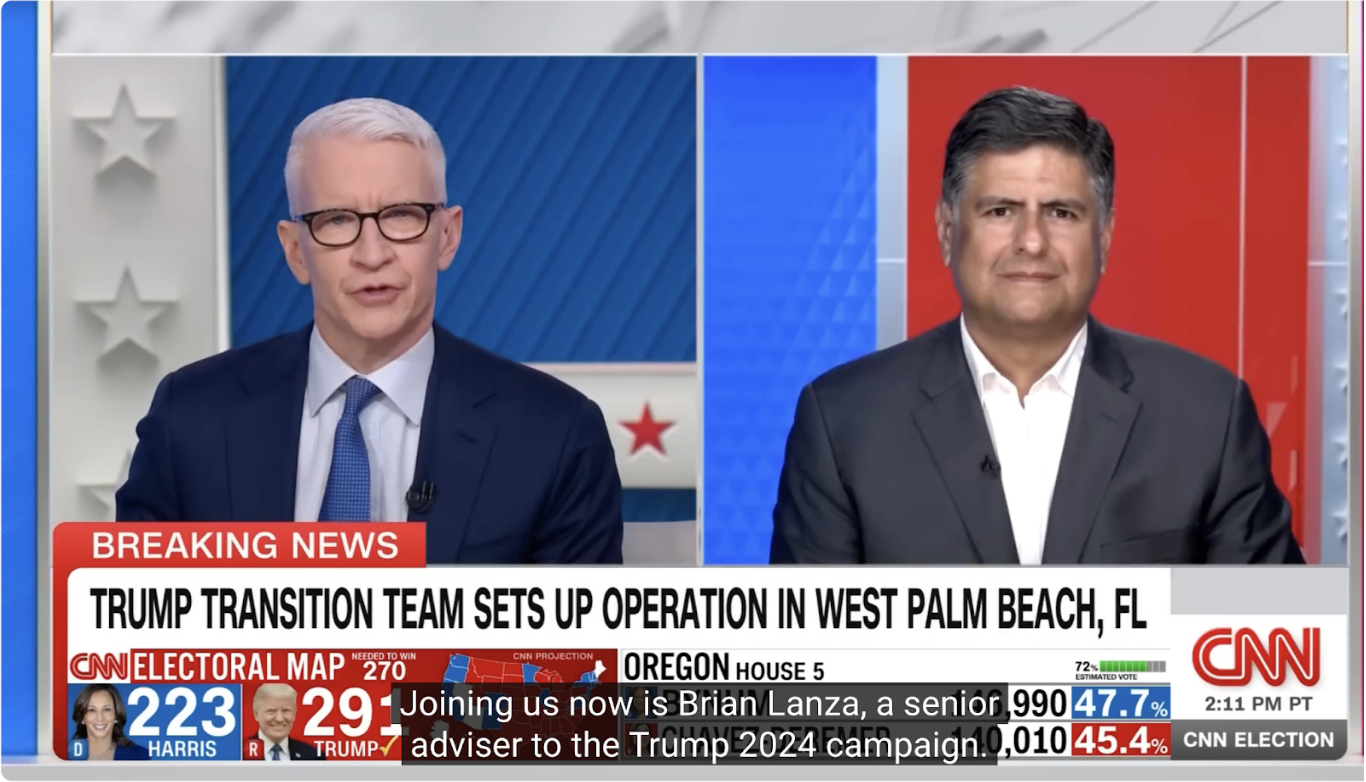
More Bayer ties to the White House
Another key White House aide with ties to Bayer’s legal network is Ryan Baasch, Trump’s deputy assistant to the President for economic policy. In this role, Baasch helps convert Trump’s economic agenda into coordinated federal policy. From 2016-2021, Baasch was an associate at Latham & Watkins, a law firm that represented Bayer on Roundup settlement issues and represented Monsanto in a case involving dicamba. The firm also represented Monsanto and CropLife America in a glyphosate warning case.
Another aide close to Trump in 2025, Trent Morse, was a senior associate at Ballard Partners from 2020 to 2022, then moved to Mercury Public Affairs as a senior vice president. As deputy assistant to the President and deputy director of presidential personnel for eight months, Morse was part of the team responsible for recruiting, vetting and recommending candidates for political appointments throughout the executive branch. He left the White House in August for a lobbying job.
USDA officials’ ties to Bayer
The U.S. Department of Agriculture oversees farm policy, crop systems, and biotechnology approvals, shaping the subsidies, research, and planting decisions that drive demand for Bayer’s seeds and chemicals. The agency has long faced criticism over its servility to the chemical industry, and the Trump administration is no exception. Current USDA officials with ties to Bayer and its chemical industry allies include:
- Stephen Vaden, deputy secretary of agriculture, is a former associate at Jones Day(2014–2017), a firm that represented Bayer on its acquisition of Monsanto, and Squire Patton Boggs (2011-2014), which represented Bayer and Monsanto in cases involving glyphosate and PCBs.
- Richard Fordyce,undersecretary for farm production and conservation, is the former agriculture business growth director for the public relations and marketing firm Osborn Barr Paramore (2021-2025), which was Bayer’s PR agency for years. A former director of the United Soybean Board, Fordyce was administrator of the Farm Service Agency in Trump’s first term.
- Scott Hutchins,undersecretary for research, education, economics & chief scientist, spent over 30 years at Dow AgroSciences (now Corteva), most recently as global R&D director. He served in this same USDA role in the first Trump administration.
- Pat Swanson,administrator of the Risk Management Agency, was a director for the lobby groups American Soybean Association and the Iowa Soybean Association, where she advocated for Bayer’s pesticides.
- Bill Beam,administrator of the Farm Service Agency, served for nine years on the United Soybean Board, which collaborates with Bayer on research initiatives. Beam previously served as the deputy administrator for farm programs at the FSA (2018–2021).
- Peter Laudeman, senior policy advisor for trade and foreign agricultural affairs, is a former political affairs manager of Corteva Agriscience (formerly DowDuPont) from 2020-2022, and legislative assistant for the National Corn Growers Association from 2018-2020.
Bayer’s pursuit of federal preemption
Bayer’s case before the Supreme Court has high stakes for public health protections and the legal right of individuals to hold companies accountable in court.
Federal preemption – the idea that federal law can override state law in some circumstances – has long been a priority for chemical and food companies that want a single, often weaker, national standard for regulation and liability, while consumer and health groups argue that states must retain the right to set higher health and safety standards.
The issue is central to Bayer’s case before the Supreme Court: the company argues that because the EPA approved glyphosate, cancer claims tied to Roundup should be barred under state failure-to-warn laws. The federal government’s position on whether pesticide approvals preempt state laws has shifted across administrations, underscoring how much the outcome depends on who holds power, and who influences it.
In May 2025, two appellate attorneys with deep experience at the U.S. Department of Justice, Jennifer Scheller Neumann and Amelia Yowell, joined Holland & Hart LLP,a firm that provides legal and lobbying services. A month earlier, the firm had registered to lobby for Bayer.
Neumann spent 20 years at the DOJ’s Environment and Natural Resources Division, most recently as chief of the appellate section overseeing all appellate litigation involving federal environmental laws. She was a signatory on the DOJ’s 2019 amicus brief in the Ninth Circuit Court of Appeals supporting Monsanto (now Bayer). The brief argues that EPA’s approval of glyphosate preempts state failure-to-warm laws.
The Biden administration reversed that position in 2022, urging the Supreme Court to reject Bayer’s case on the premise that federal pesticide law should not preempt state failure-to-warn laws.The Trump Justice Department reversed it again in 2025 – arguing the Biden-era position was wrong and that juries shouldn’t second-guess EPA science.
Oral arguments before the Supreme Court are scheduled for April 27. A win for Bayer could turn EPA pesticide approvals into a nationwide liability shield, elevating the agency’s slow and often industry-dominated chemical assessment process into a final word on pesticide safety, at a time when peer-reviewed research continues to emerge linking pesticide exposure to cancer, neurological harm, and other chronic illnesses.
As Nathan Donley of the Center for Biological Diversity warned, such a precedent would mean that “the only thing that matters legally in determining a pesticide’s safety is what EPA claims to be true, even if those claims completely ignore the best available science.”
Slashing capacity at EPA
Bayer allies also pervade the U.S. agency charged with protecting health and the environment – in positions where they influence what chemicals and pesticides are approved and how these products are regulated. Chemical industry lobbyists now occupy the top four jobs at the EPA’s Office of Chemical Safety and Pollution Prevention (OCSPP), the division in charge of regulating chemicals and pesticides. EPA officials loosened ethics standards to allow it.
Douglas Troutman, assistant administrator at OCSPP, is the former co-CEO and chief lobbyist for the American Cleaning Institute (ACI), which represents major chemical manufacturers. Troutman worked at the lobby group for 17 years before joining the Trump administration.
Nancy Beck, principal deputy assistant administrator at OCSPP, was a senior director at the American Chemistry Council – a lobby group representing Bayer, Dow Chemical, DuPont and other chemical manufacturers – from 2012 to 2017. In Trump’s first EPA, she held advisory roles within the White House at NEC and OMB. Between Trump administrations she worked at Hunton Andrews Kurth, a law firm that offers, among other services, glyphosate litigation defense to companies facing lawsuits from cancer claims.
Lynn Ann Dekleva OCSPP’s deputy assistant administrator for new chemicals, also held this role during the first Trump administration. In between, she was a senior director at the lobby group American Chemistry Council.She is a 30-year veteran of DuPont chemical company, where she workedas a program manager and engineer.
Kyle Kunkler, OCSPP deputy assistant administrator for pesticides, is a former pesticide industry lobbyist. He was director of government affairs, with a focus on biotech and pesticides, for the American Soybean Association from 2020-2025, and prior to that spent three years managing government affairs on food and agriculture for the Biotechnology Innovation Organization lobby group. CropLife America, the main lobby group for the pesticide industry, gave him a “Rising Star” award in 2020.
 *Bayer was a gold sponsor at CropLife America 2021 where Beck was a featured speaker alongside her colleague Matt Leopold, who was EPA’s top lawyer during the first Trump administration. Hunter Andrews Kurth is a leading firm for pesticide litigation.
---
More EPA officials with ties to Bayer include:
Steven Cook, deputy assistant administrator for the Office of Land and Emergency Management, oversees Superfund sites. Bayer is associated with several Superfund sites due to its pesticide and chemical manufacturing. Cook spent over 20 years as the in-house corporate counsel for LyondellBasell, one of the world’s largest plastics and chemical companies. LyondellBasell has a 50/50 joint venture with Bayer (a propylene oxide and styrene monomer plant). LyondellBasell CEO Peter Vanacker is board chair of the American Chemistry Council.
Aaron Szabo,assistant administrator for air and radiation (appointed in July 2025) was a partner and lobbyist at CGCN Group (2018–2023), which has been registered to lobby for the American Chemistry Council during the past decade. From 2023 to 2024, he was a senior director and attorney at Faegre Drinker Biddle & Reath, where he represented chemical interests, including the ACC, before returning to the EPA in January 2025.
Alex Dominguez,deputy assistant administrator for mobile sources, was a registered lobbyist with Massie Partners, where he represented the National Corn Growers Association, a group whose members are consumers of Bayer’s seeds and pesticides. He worked in that role from 2023 to January 2025.
More Trump officials tied to Bayer
As assistant secretary of legislation at the U.S. Department of Health and Human Services, Gary Andresis a primary liaison between HHS and Congress. He was previously the senior executive vice president of public affairs at the Biotechnology Innovation Organization, the main trade group for biotech companies including Bayer. At BIO, Andres directed the lobbying strategy for the entire biotech sector, which included defending the regulatory framework for GMOs and associated agrichemicals. He previously worked at lobbying firm Dutko Worldwide which has represented Bayer.
Secretary of Transportation Sean Duffy also has ties to a Bayer lobby firm; he was senior counsel and advisory board member of BGR Group from 2019 to 2023 and was a registered lobbyist for the firm in 2020, though there is no record of him lobbying for Bayer.
13 lobby firms working for Bayer in Washington
Bayer’s direct lobbying spending is significant, but its political influence expands considerably when viewed alongside allied trade and commodity groups that together form a well-financed and coordinated lobbying network. In 2025, Bayer retained at least 13 lobby firms and at least 49 registered lobbyists registered to lobby for the company (including Bayer’s six in-house lobbyists) as of the fourth quarter, federal disclosures show.
Bayer spent at least $9.19 million on federal lobbying last year. While it is not among the highest-spending single corporations lobbying in D.C., the agribusiness sector ranked ninth with $219.9 million in lobbying expenditures in 2025 – the highest year on record for the sector. We include the sector total because Bayer’s influence is amplified by an integrated industrial agribusiness system that acts in concert – from pesticide-dependent commodity crops to factory farms and ultra-processed food production – to shape policy in its favor.
Within the sector, groups directly lobbying for favorable pesticide policies include trade groups representing pesticide manufacturers – the American Chemistry CouncilandCropLife America – and commodity groups such as the National Corn Growers Association and American Soybean Association that rely on Bayer’s products.
These four groups spent a combined $22 million on federal lobbying in 2025, with 12 more outside lobby firms and 79 more registered lobbyists in the fourth quarter.
Bayer’s lobbying activity last year was its highest in recent years, but lower than the company’s peak in 2016, 2017 and 2018, just before the Bayer/Monsanto merger and following the 2015 WHO cancer agency finding that glyphosate is a probable human carcinogen.
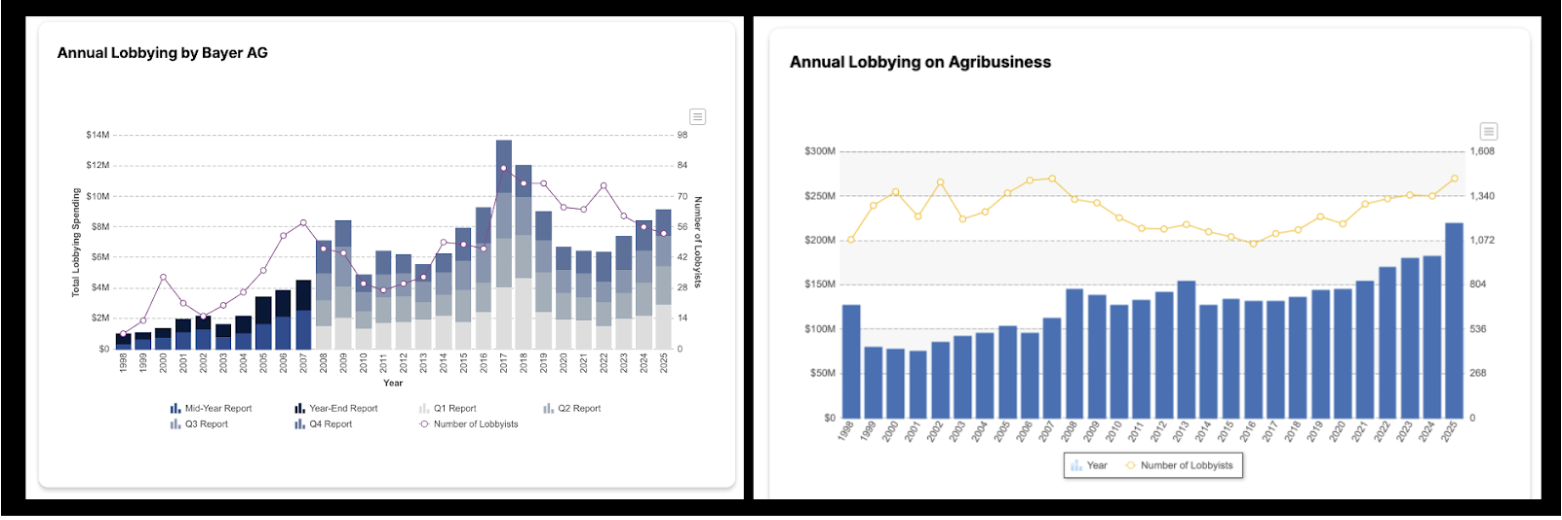 *Source: OpenSecrets
These numbers don’t reflect the whole picture of Bayer’s lobbying activities. The Lobbying Disclosure Act requires registration only after certain spending and activity thresholds are met, so public filings do not capture all of the paid influence work taking place in Washington.
They don’t reflect state-level activity, either. Pesticide related PAC spending surged in late 2024 as companies sought to limit damage awards in courts across the nation. In Iowa alone, Bayer spent a record amount last year trying to pass a state immunity bill critics called the Cancer Gag Act.
Read more about Bayer’s lobby force in our Bayer Lobby Tracker.
More lobbyists tied to Trump
Political scientists have long documented how lobbying shapes public policy by securing access to decision-makers, and helping corporations turn their priorities into laws and regulations. These dynamics help explain how companies like Bayer can translate access in Washington into concrete policy wins.
More than 30 people in leadership positions at lobby firms retained by Bayer have direct ties to Trump’s current or former administrations or presidential campaigns, our analysis shows. Many of these lobbyists are not personally registered to lobby for Bayer, but may be assisting in ways that do not trigger lobby registration, for example, advising the firm’s Bayer lobbyists.
As noted earlier, Ballard Partners – the firm that employed both Susie Wiles and Pam Bondi, and is run by one of Trump’s biggest political fundraisers – is a fundamental connection for Bayer o Trump’s orbit. In addition to Brian Ballard and Daniel McFaul, the two lobbyists at the firm who are registered to lobby for both Bayer and the American Chemistry Council, other partners at Ballard have connections to Trump:
Hunter Morgen, a D.C.-based partner in the firm, served over three years in senior positions during the first Trump administration – as special assistant to the President and senior advisor for policy and strategy in the White House working on trade and immigration issues with Peter Navarro and Stephen Miller. Prior to his White House role, Morgen was policy advisor for the State Department in the Office of Policy and Planning. He previously worked on Trump’s 2016 presidential campaign and transition team. In 2020, Trump appointed Morgen to the Presidential Council on Improving Federal Civil Architecture. Morgen – along with Brian Ballard, Daniel McFaul, Syl Lukas (a senior partner at Ballard) and Susie Wiles – were included among a list of donors invited to an October 2025 gala for Trump’s new $250 million East Wing ballroom.

Mike Rubino, another D.C. partner at Ballard, was among the first hires on Trump’s 2016 presidential campaign where he was a senior advisor directing operations in ten states and winning nine of them, according to his bio. He joined the first Trump administration as a senior official at HHS before leaving for the private sector where he worked alongside Corey Lewandowski, who is currently a key figure at the Department of Homeland Security.
Ballard D.C. Partner William Russell was the aide responsible for Trump’s daily travel and logistics for nearly four years of the first administration. Russell also worked on Trump’s 2016 and 2024 campaigns.
Brian Hughes, a partner at Mercury Public Affairs– the other lobby firm that previously employed Susie Wiles – was NASA chief of staff from May to December 2025. He joined Mercury in January 2026. Brian Hughes was Trump’s Florida campaign manager in 2024 and communications director for Trump’s transition team. Danielle Alvarez, another partner at Mercury, held communications and advisory roles in Trump’s 2020 and 2024 campaigns.
Other Bayer lobby firm ties to Trump’s White House include:
Amy Swonger, a principal at Invariant– a firm registered to lobby for Bayer – worked in the Executive Office of the President for most of Trump’s first term, as assistant to the president and as director and deputy director of legislative affairs.
Jordan Bonfitto,a director at Invariant, was a policy advisor at the National Economic Council in Trump’s first White House, focused on the agricultural and biotech portfolios. From February to October 2025, Bonfitto was the chief of staff for marketing and regulatory programs at the USDA under Secretary Brooke Rollins. He joined Invariant in November.
Other notable Bayer lobby firm ties to Trump:
Holland & Hart, a lobby firm Bayer retained in April 2025, employs former EPA Administrator Andrew Wheeler, who held the top job at EPA for part of Trump’s first term. Wheeler is a partner at the firm and head of federal affairs. Troy Lyons, a registered lobbyist for Bayer and senior director of federal affairs at Holland & Hart, held senior roles in Trump’s first EPA working under both Wheeler and Trump’s first EPA Administrator Scott Pruitt.
At BGR Government Affairs, several senior lobbyists have ties to Trump. Managing Director David Urban was a senior advisor on Trump’s 2016, 2020, and 2024 campaigns; Practice Head and Principal William Crozer left the firm during Trump’s first term to serve as special assistant to the president and deputy director of the White House Office of Intergovernmental Affairs; and PrincipalJoseph Lai was aspecial assistant to the President for legislative affairs (2017-2019), where he led the outreach and vote-counting efforts to confirm Justices Gorsuch and Kavanaugh, as well as other major appointees.
Akin Gump Strauss Hauer & Feld, longtime lobbyists for Bayer and Monsanto, also has notable advisors and partners with ties to Trump. Geoff Verhoff, senior advisor at the firm, served on the Trump-Pence victory finance leadership committee 2017-2021 and was the vice chair of the RNC Finance Committee in those years. Partner Kelly Ann Shaw, was deputy assistant to the President for international economic affairs and the U.S. lead negotiator (Sherpa) for the G7, G20, and APEC in 2018 and 2019. Senior Advisor Anna Abramdeputy commissioner for policy, legislation and international affairs at the FDA from 2017 to 2021.
For more ties between Bayer’s lobby firms, the Trump administration and other routes of influence see our lobby tracker:
This analysis of Bayer-Trump connections reflects only what is visible in public records. Additional financial, political, or personal ties – including undisclosed funding streams, if they exist – may remain hidden. This story is a work in progress. We will update it. You can help by sending us what you may know about ties between Bayer and the Trump administration, including the federal agencies. Contact Stacy Malkan via Signal or email stacy@usrtk.org.
Updates made February 26:
- Added another USDA official (Peter Laudeman) with ties to Bayer.
- Added total number of lobbyists and lobby firms retained by four trade and commodity groups that work closely with Bayer: American Chemistry Council, CropLife America, National Corn Growers Association and American Soybean Association.
Categories: Monsanto/Bayer, Pesticides Tags: Primary Article
===
---
pesticide-use-and-cancer-risk-rise-together-across-americas-heartland
MANY PIX GFX NO LNX
Investigative / Enterprise:Health
Pesticide use and cancer risk rise together across America’s heartland
America’s farmers and farmworkers, their families and neighbors, are being diagnosed with cancer at rates higher than the national average. A growing body of research indicates that pesticides are partly to blame.
by Ben Felder, Investigate Midwest
February 18, 2026
Why you can trust Investigate Midwest
Lisa Lawler wasn’t surprised when diagnosed with breast cancer in 2025. Her mother had breast cancer and died in 2016. It seemed like cancer had become a common diagnosis for many of her neighbors and friends.
“With how many people seem to get cancer in our community, you just assume you will get it,” said Lawler, who lives in rural Hardin County, Iowa. “But no one really talks about what’s causing it.”
After 10 rounds of radiation and a surgery to remove the tumor, Lawler’s cancer was in remission. Last year, she took a test to determine if her cancer was likely genetic, meaning a high chance of recurrence, which could lead her to have her entire breast removed.
She was surprised by the results.
“The genetic test they ran for me was one that covered 81 genes that are typically related to breast cancer,” Lawler said. “After the test, they told me my cancer is likely not genetic, but likely environmental, based on these 81 genes.
“Your next thought is, then what’s in the environment that caused my cancer?”
Increasingly, pesticides are being blamed for rising cancer rates across America’s agricultural communities.
Hardin County, home to around 800 farms, has a pesticide use rate more than four times the national average and a cancer rate among the highest in the state.
Most of the 500 counties with the highest pesticide use per square mile are located in the Midwest. Sixty percent of those counties also had cancer rates higher than the national average of 460 cases per 100,000 people, according to an analysis of data from both the U.S. Geological Survey and the National Cancer Institute.
Last year, Investigate Midwest, in partnership with the University of Missouri, investigated the link between agrichemicals and cancer in Missouri, finding that many were rural communities that already lacked access to healthcare.
This story was produced as part of the Pulitzer Center’s StoryReach U.S. Fellowship.
Investigate Midwest expanded on that coverage by analyzing data across the country, along with interviewing more than 100 farmers, environmentalists, lawmakers and scientists as part of a partnership with the Pulitzer Center’s StoryReach U.S. Fellowship. The result was the picture of a nation at a crossroads in dealing with this public health crisis that has not just been ignored by state and federal health officials, but aided.
This story was also supported by the Fund for Investigative Journalism.
“Cancer is everywhere and it’s an experience that is unfortunately all too common,” said Kerri Johannsen, senior director of policy and programs at the Iowa Environmental Council, a Des Moines-based nonprofit that has been studying the state’s growing cancer rate.
Agrichemicals have helped America become a crop-producing power, increasing yields of commodity crops — such as corn and soybeans — used for food, fuel and animal feed.
Sprayed from airplanes, drones, tractors and handheld devices, these chemicals can drift through the air or run off into nearby rivers and streams.
And for decades, some farmers and pesticide users have developed neurological and respiratory issues. Thousands of lawsuits have alleged that pesticides and the companies that make them were to blame.
Kerri Johannsen, senior director of policy and programs at the Iowa Environmental Council
Pesticide manufacturers often rejected those claims while sometimes concealing research by their own employees that raised similar concerns. These companies — such as Bayer, Syngenta, Corteva and BASF — have also spent millions to lobby federal and state lawmakers for laws that would limit their legal liability and continue to allow them to sell agrichemicals.
“This is one of the most transparently reviewed products ever,” said Jessica Christiansen, the head of crop science communications for Bayer, speaking about her company’s production of Roundup, a glyphosate-based pesticide. “This product is so well studied … been on the market for over 50 years with thousands and thousands of studies. There is no linkage to cancer, there just isn’t.”
Under the Trump administration, the Environmental Protection Agency and U.S. Department of Agriculture have also hired dozens of former pesticide executives and lobbyists, some of whom have already pushed for deregulation of their industry. The Department of Health and Human Services has also altered its own reports to downplay the harm of pesticides.
Two states — North Dakota and Georgia — recently passed laws limiting their residents’ ability to sue pesticide companies, and at least a dozen other states will consider similar laws in the coming months.
“We’ve gotten to a point in the U.S. … where we’ve stopped treating pesticides as if they are dangerous tools,” said Rob Faux, who manages a small Iowa farm and has advocated against pesticide liability shield laws. “Instead, these companies tell these stories that these pesticides are completely safe and we are encouraged to use them anytime. We’ve been convinced that we must use them or we are not going to have enough food to eat.”
In Iowa, a state with heavy pesticide use — 53 million pounds last year — and the nation’s second-highest cancer rate, doctors and health officials have been sounding an alarm for years.
The state has become ground zero in the fight to limit the impact of pesticides on health and the environment. Farmers have gathered at the state Capitol to advocate for increased laws and funding to address the rising cancer rate. That advocacy likely helped defeat a bill last year that would have protected pesticide makers from some lawsuits.
I call myself a Republican, but this is not about politics; this is about money, about the almighty dollar.”
Bill Billings, a resident of Red Oak, Iowa, who was diagnosed with cancer in 2024
“I believe the groups wanting this (bill) to go through didn’t expect any substantial resistance, but there was enough resistance,” said Faux, who also works for the Pesticide Action and Agroecology Network, a nonprofit advocating for less agrichemical use.
The Iowa bill was strongly opposed by environmental and health organizations, which have traditionally been left-leaning. But there was also strong opposition from many conservative residents and farmers.
“I call myself a Republican, but this is not about politics; this is about money, about the almighty dollar,” said Bill Billings, a resident of Red Oak, Iowa, who was diagnosed with cancer in 2024.
Initially, doctors told Billings, then 61, he would likely be dead in a matter of months after discovering lymphoma in his lungs. A health enthusiast and hospital administrator, Billings had been a regular user of Roundup, the popular Bayer pesticide used on farms and residential properties.
“The cancer specialist said, very directly, (my) cancer is a result of being exposed to chemicals,” Billings said. “In my records, it literally says that I have cancer as a result of exposure to Roundup and agrochemicals.”
Billings was prescribed a five-drug regimen, along with chemotherapy. In September, he was declared cancer-free.
Last year, he hired a lawyer to file a lawsuit against Bayer.
“The irony is … Bayer Pharmaceuticals makes one of the drugs that treated my cancer,” Billings said. “It’s disturbing to find out you are in this financial circle — not only as a consumer, but as a patient.”
Bill Billings, his home, and surrounding neighborhood in Red Oak, Iowa, photographed Jan. 21, 2026. photos by Geoff Johnson, for Investigate Midwest
Research increasingly links pesticides to growing cancer risk
Cancer is a complex disease and can be caused by numerous environmental and genetic factors. Some links have been clear — such as smoking and lung cancer — while other forms can be impossible to trace back to an original cause.
But scientific research linking pesticides with certain types of cancers has been growing.
“Our findings show that the impact of pesticide use on cancer incidence may rival that of smoking,” scientists wrote in a 2024 study, which was published in Frontiers in Cancer Control and Society.
The study linked pesticides to prostate, lung, pancreas and colon cancers. Pesticides have also been associated with lymphoma and Parkinson’s disease, the study claimed.
Many doctors in agricultural communities say the link with pesticides is hard to deny.
“Iowa has a super high rate (of cancer) and when you look at all of our modifiable risk factors … tobacco, obesity, too many calories, highly processed foods, lack of physical activity, alcohol consumption, getting vaccinated for HPV, sun exposure, and so on, Iowa doesn’t really stand out dramatically at any of those,” said Dr. Richard Deming, medical director at MercyOne Cancer Center in Des Moines. “But one thing that distinguishes Iowa from other states is our environmental exposure to agricultural chemicals.”
Richard Deming, medical director at MercyOne Cancer Center in Des Moines
Deming and other health experts also point to Iowa’s high radon levels, a naturally occurring radioactive gas produced by uranium and radium.
The state also has high levels of fertilizer-derived nitrate in its water, which has been associated with increased cancer risk.
“But we use tons of ag chemicals that make it quite likely that the volume of these chemicals is contributing to what we’re seeing in Iowa in terms of the increased incidence of cancer,” Deming said.
A direct correlation can be difficult to determine, as cancer development times can range from months to decades. Overlaying cancer rates onto a map, however, highlights the nation’s top crop and vegetable growing regions, where pesticide use is highest.
The Midwestern states of Iowa, Illinois, Nebraska and Missouri — leading corn-growing states — had the highest rates, while rates were also high in California and Florida, high fruit-growing states.
Lawler, who developed breast cancer in Hardin County, grew up on her family’s 400-acre farm, where her father grew corn and used 2,4-D, a pesticide made by Dow Chemicals. She and her siblings moved out of state after high school, but Lawler returned in 2010.
Pesticides have become indispensable in farming, Lawler acknowledged, but she wishes more people would ask questions about the risks.
“We change products all the time when we learn about the health impacts,” Lawler said.
These family photos show Lisa Lawler with her mother and siblings over the years. Lawler was recently diagnosed with breast cancer; her mother later died after a cancer diagnosis. The family believes years of farm pesticide and herbicide exposure may have contributed. All photo provided by Lisa Lawler.
As lawsuits mount, Bayer pushes state laws to limit liability
In early 2022, Rodrigo Santos had just been promoted to the head of Bayer’s crop sciences division, a prestigious position within the German-based chemical company. But a global pandemic, climate change and a pending war in Ukraine were disrupting the global production and sale of crops — a direct hit to the company’s pesticide sales.
“The global food system is in crisis,” Santos wrote in a column for the World Economic Forum, going on to say that the world needed to grow more food without a significant increase in the amount of land devoted to crops.
But beyond the pandemic and war, another crisis presented an existential threat to one of the company’s top-selling products. Roundup, the glyphosate-based weed killer produced by Monsanto, which Bayer bought in 2018, had been blamed for causing cancer in thousands of lawsuits.
In 2019, a California jury ordered Bayer to pay $2 billion in one lawsuit (the amount was later reduced). Since then, more than 65,000 lawsuits have been filed against the company, according to Bayer, and the company has agreed to pay more than $12 billion in settlements.
Since purchasing Missouri-based Monsanto, Bayer’s stock price has dropped more than 90% over five years.
This investigation looks at the relationship between pesticide use and rising cancer rates across the heartland. It’s the first in a series and part of a larger reporting effort that takes time, data, and sustained work.
In recent years, Bayer executives, including Santos, openly discussed discontinuing glyphosate production. We are “evaluating all the alternatives that we have for the business,” Santos told investors last year when asked about a possible sale of its Roundup division.
But while Bayer publicly said it was reconsidering its glyphosate business, a review of lobbying disclosure statements, campaign finance records, state legislative records and other documents reveals the world’s largest pesticide company remains committed to expanding its sales.
Under the Federal Insecticide, Fungicide, and Rodenticide Act, the EPA regulates the warning labels on pesticide products. While state-level lawsuits have claimed that federal labeling is insufficient, pesticide companies, including Bayer, have argued that federal regulations should trump state laws.
Bayer, along with other corporate agriculture groups, has pushed for bills in more than a dozen states that would codify the view that federal labeling regulations are sufficient warning, effectively voiding state-level lawsuits.
Jessica Christiansen, head of crop science communications for Bayer
Christiansen, the head of crop science communications for Bayer, disputed that these laws will stop lawsuits and said courts have yet to begin interpreting those that have passed.
“Folks can still sue a company, and they should if there’s a problem,” Christiansen said. “But the litigation industry has a lot to lose with these (bills) that are out there.”
Founded by Bayer, the Modern Ag Alliance has lobbied for these bills and promoted opinion articles downplaying the health impacts of pesticides.
“If farmers lose access to crop protection products because of misguided ideological agendas, U.S. agriculture would be upended, potentially forcing many family farms to shut down and driving up food costs for every American,” said Elizabeth Burns-Thompson, executive director of the Modern Ag Alliance.
The Modern Ag Alliance has spent more than a quarter of a million dollars on state lobbying since 2024.
In Idaho, the organization spent one in four lobbyist dollars last year. In Iowa, Bayer has spent $209,750 on lobbying since 2023, double what the company spent in the previous decade.
Most of the bills came up short in 2025, but Georgia and North Dakota passed liability shields that will complicate local lawsuits.
Georgia’s Senate Bill 144, which took effect Jan. 1, received some bipartisan support but was mostly approved by the Republican majority and opposed by Democrats.
Similar bills have been filed in at least 10 states for this year’s legislative sessions.
In 2024, the Iowa bill was passed by the state Senate with a 30-to-19 vote. Ahead of a vote in the House last year, farmer and environmental groups lobbied against the bill.
The session ended without the House taking up a vote. The bill could return in 2026, but Faux, the Iowa farmer, said he also worries about it being “snuck into” another bill or budget agreement.
“I don’t think we can just assume this fight is over,” Faux said.
In other states, backlash seemed to stop liability shield bills before they got started.
Rep. Dell Kerbs, R-Oklahoma
In Oklahoma, Rep. Dell Kerbs, a Shawnee Republican, authored a pesticide liability shield bill he said was meant to end “frivolous” lawsuits against pesticide makers.
“What’s happened in our country is we have … judges that have decided they need to be in the labeling business,” Kerbs said when introducing his bill at a Feb. 11, 2025, hearing of the House agriculture committee.
State Rep. Ty Burns, another Republican, asked Kerbs why he chose to author the bill.
“I was first approached by Bayer,” Kerbs responded.
“But this is a labeling bill; it is not an immunity bill. It is just clarifying on EPA labeling regulations,” Kerbs added. “There is nothing that prevents a lawsuit from any single person. This is not giving a free pass to kill people. This simply is saying that a frivolous lawsuit to potentially pad the pocket of somebody who was not reading the label is not a justification to add that to a label through a state district court.”
But when Burns asked Kerbs about opposition to the bill, especially from many farmers, Kerbs denied receiving any complaints.
“That is hard to believe,” Burns told Kerbs, “because I have been bombarded.”
The bill was never presented to the House for a vote.
After early promises, MAHA walks back pesticide oversight
While liability shield laws have been largely advanced by Republican lawmakers, the push to further regulate pesticides has transcended partisan lines.
Both left-leaning environmental groups and conservative health movements, which have targeted agrichemicals and some vaccines, have called for reducing or eliminating the use of pesticides.
Health and Human Services Secretary Robert F. Kennedy, Jr. has been a longtime critic of pesticides. In a May 2025 report, his Make America Healthy Again commission linked pesticide overuse to children’s health issues, which drew praise from both political camps.
Health and Human Services Secretary Robert F. Kennedy Jr. makes remarks at an event announcing the MAHA (Make America Healthy Again) Commission on May 22, 2025, in the East Room of the White House. photo by Joyce N. Boghosian, The White House
George Kimbrell, co-executive director of the Center for Food Safety, which has advocated for stronger pesticide regulations, called the initial report a “baby step” forward and said he was encouraged after decades of inaction by the federal government.
“Going back my entire career, 20-plus years now of doing this work, it doesn’t matter if it’s a Democratic administration or a Republican administration, they have been beholden to and done the wishes of the pesticide industry,” Kimbrell told Investigate Midwest last year. “So, this is a unique moment where … there’s a chance that there could be some positive change in terms of responsible oversight for these toxins.”
Corporate agriculture groups heavily criticized the report, including the American Farm Bureau Federation and CropLife America, a national organization representing many large agrichemical companies, including Bayer, Corteva Agriscience and Syngenta.
Many of those groups and companies had been large financial backers of Trump. But Kennedy downplayed any concerns that the president would avoid taking a hard position against pesticide companies because of that support.
“I’ve met every president since my uncle was president, and I’ve never seen a president (like Trump), Democrat or Republican, that is willing to stand up to industry when it’s the right thing to do,” Kennedy said at a May 22, 2025, MAHA commission meeting as the president sat smiling to his right.
Three months later, Kennedy’s MAHA commission published its final report, which contained no calls to further regulate pesticides. In fact, it called for the federal government to work with large agrichemical companies to ensure public “awareness and confidence” in the EPA’s current pesticide regulations.
The U.S. Department of Health and Human Services did not respond to a request for comment from Kennedy.
MAHA-Report-The-White-House
Many of the groups that expressed optimism over the initial report were outraged over the change.
“This report is … a clear sign that Big Ag, Bayer, and the pesticide industry are firmly embedded in the White House,” said David Murphy, the founder of United We Eat and a former finance director for Kennedy’s presidential campaign.
The Trump administration has employed several pesticide executives, researchers and lobbyists at the EPA and the U.S. Department of Agriculture.
Kyle Kunker, who was a registered lobbyist for the American Soybean Association, an organization that has advocated for the legal liability shield laws at the state level, was hired last year to oversee pesticide policy at the EPA.
Three weeks later, the EPA recommended expanded use of dicamba-based herbicides, which federal courts had previously restricted. The EPA proposal was closely aligned with the position of the American Soybean Association.
In 2025, the EPA also hired Nancy Beck and Lynn Ann Dekleva, both of whom worked with the American Chemistry Council.
Last month, a coalition of MAHA supporters called for the removal of Lee Zeldin, administrator of the EPA.
Lee Zeldin, administrator of the Environmental Protection Agency, testifies during his Senate Environment and Public Works confirmation hearing on Jan. 16, 2025. photo by Tom Williams, CQ Roll Call via AP Images
Recent EPA decisions around pesticides “will inevitably lead to higher rates of chronic disease, greater medical costs, and tremendous strain on our healthcare system,” the group stated in a petition circulating online.
Several prominent MAHA influencers have joined the petition, posting anti-pesticide messages on social media under handles such as The Glyphosate Girl and the Food Babe. “The EPA is acting like the Everyone Poisoned Agency,” wrote Kelly Ryerson, on her Glyphosate Girl Instagram feed.
As the EPA advances pesticide use, the Trump administration has also asked the U.S. Supreme Court to rule that federal labeling laws invalidate state-level lawsuits.
“After careful scientific review and an assessment of hundreds of thousands of public comments, EPA has repeatedly determined that glyphosate is not likely to be carcinogenic in humans, and the agency has repeatedly approved Roundup labels that did not contain cancer warnings,” Trump’s solicitor general wrote in an amicus brief with the Supreme Court.
However, one of the studies the EPA has often cited in claiming pesticides are safe was recently retracted due to concerns about its authorship and potential conflicts of interest.
The report, published in 2000 by the scientific journal Regulatory Toxicology and Pharmacology, claimed Roundup “does not pose a health risk to humans.” The report has been the foundation for numerous other studies, court cases and policy decisions.
The journal retracted the study last year, noting that court cases had revealed that Monsanto employees had contributed to the study. “This lack of transparency raises serious ethical concerns regarding the independence and accountability of the authors of this article and the academic integrity of the carcinogenicity studies presented,” the retraction stated.
“This is just one example of how the current process of certifying these chemicals is broken in the U.S.,” said Colleen Fowle, water program director at the Iowa Environmental Council. “At the very least, we’re hoping that this (retraction) eliminates this specific research article from being cited in the future and concentrates more on independent peer-reviewed research as our basis to determine the safety of glyphosate.”
---
---}:
GUK AP 2 26
The Environmental Protection Agency on Friday reapproved the weedkiller dicamba for use on genetically modified soybeans and cotton. It is a pesticide that has raised widespread concern over its tendency to drift and destroy nearby crops.
The agency said dicamba was critical for farmers who would otherwise have their crops threatened by fast-growing weeds. To ensure the pesticide is used safely, the agency said it imposed strong protections and limits on its use.
Dicamba is a common weedkiller that can be sprayed on top of genetically engineered crops. It kills the weeds but doesn’t hurt the crops. It has been in use for decades, but it has become more widespread on farms in recent years.
Advocates sharply criticized the agency, saying it was moving forward after courts blocked similar efforts in 2020 and 2024. Allowing its use on these two common crops would drastically expand how much is applied and increase harm, advocates say.
Kelly Ryerson, an activist with the Make American Healthy Again (Maha) movement that has forged a fragile political allegiance with the Trump administration, said she was disheartened by the decision.
“A top priority of mine was to have the use of dicamba for over-the-top applications permanently discontinued because” of their harm, she said. “New restrictions on use are not sufficient, and will perpetuate the chemical treadmill where many farmers are trapped.”
The EPA said growers want the weedkiller and they need to be supported – and that it was not a Maha versus EPA issue.
The agency said concerns about dicamba drifting to places where it was not intended were real and must be managed. It set limits on how much can be applied per acre, how much can be applied on hot days and established buffer zones to prevent harm to nearby crops. If followed, the chemical can be used without threatening humans or the environment, according to EPA.
The American Soybean Association applauded the decision, saying clear rules would help farmers prepare for the next growing season and control destructive weeds.
Environmental groups said dicamba drift has damaged immense acreage, devastating vegetable farms, trees and other critical plants.
“When push comes to shove, this administration is willing to bend over backward to appease the pesticide industry, regardless of the consequences to public health or the environment,” said Nathan Donley, environmental health science director at the nonprofit Center for Biological Diversity.
Environmentalists said the EPA’s use restrictions were insufficient, allowing application for too much of the time and for too many days of the year. The buffer the agency uses to prevent harm to nearby plants had already proved ineffective, they said.
Researchers have been working to better understand its health risks. A 2020 study in the International Journal of Epidemiology found that dicamba exposure was linked to an increased risk for some cancers, including liver cancer and a type of leukemia affecting the blood and bone marrow.
Bayer, a manufacturer of dicamba, said the federal registration would allow them to now seek state approvals. They will launch training for applicators in the coming weeks.
---
---
gmail 2 23
documents show how **Monsanto, Bayer** led attacks on scientists, journalists - USRTK.org
USRTK.org
“You can't be afraid of the absolute hand-to-hand combat, metaphorically.” — Marc Morano, Committee for a Constructive Tomorrow.
---
---
https://usrtk.org/our-investigations/jon-entine-genetic-literacy-project/
no lnx pix
Posted on July 14, 2022 by Gary Ruskin
Genetic Literacy Project is an influential front group that partners with Bayer and other chemical companies to promote GMO foods and pesticides and argue for deregulation.In 2020, Bayer paid Genetic Literacy Project $100,000 for its work “to prevent legislative overreach in genetic engineering,” according to the group’s IRS form 990. Donor’s Trust, the secretive funding vehicle that funds attacks on climate science, is also a donor.
Prior to 2020, the Genetic Literacy Project claimed not to accept corporate funding, despite emails and internal corporate documents showing how the group assisted pesticide companies with their product defense efforts. We discuss the evidence here, and describe how GLP plays a leading role in efforts to attack and discredit scientists and journalists who raise concerns about chemical industry products.
Origins as Monsanto’s PR firm
Jon Entine, founder and director of Genetic Literacy Project, is also the founder and principal of ESG MediaMetrics, a public relations firm that had Monsanto as a client in 2011 when the firm registered the GeneticLiteracyProject.org domain.....
==
https://www.alternet.org/2021/03/roundup-cancer/
loki IMI
glyphosate is a broad-spectrum herbicide used to kill weeds and grasses that compete with food crops. First registered for use in the United States in 1974 by agrochemical giant Monsanto under the brand name Roundup, it is one of the most widely used weedkillers in the nation, from large-scale industrial farms to lawns and home gardens. The chemical is extremely effective at killing weeds, especially when used on Monsanto's "Roundup Ready" crops, such as soy, corn, canola, alfalfa and cotton that have been genetically modified to be resistant to glyphosate. More than 90% of corn, soybeans and upland cotton grown in the U.S. have been engineered to be resistant to herbicides like Roundup, according to the U.S. Department of Agriculture.
But a growing volume of scientific research has pointed to the negative impact that glyphosate has on human and environmental health. In 2014, for example, researchers at the International Agency for Research on Cancer (IARC) in Lyon, France, the cancer research arm of the World Health Organization, conducted a meta-analysis of more than 40 studies covering nearly three decades of research on the relationship between non-Hodgkin lymphoma (NHL), a type of cancer, and occupational exposure to agricultural pesticides. They concluded that there is "consistent evidence of positive associations" between glyphosate and an increased risk of NHL. The following year, IARC classified glyphosate as "probably carcinogenic to humans," noting that "Case-control studies of occupational exposure in the USA, Canada, and Sweden reported increased risks for non-Hodgkin lymphoma that persisted after adjustment for other pesticides."
More recently, a meta-analysis published in 2019 conducted by researchers from the University of California at Berkeley, the University of Washington in Seattle and the Icahn School of Medicine at Mount Sinai in New York found that glyphosate exposure raises cancer risk by 41%.The study's senior author Lianne Sheppard, a biostatistician and environmental and occupational health scientist at the University of Washington, told CNN that she was "convinced" of glyphosate's carcinogenic properties.
The sheer amount of glyphosate that has been used across the globe is stunning. In 2014, farmers sprayed enough of the herbicide to cover every acre of cropland in the world with nearly a half-pound of it, according to a 2016 study published in Environmental Sciences Europe. "No herbicide in the history of the world has ever been used this heavily," said the study's author Charles Benbrook, an agricultural economist. "It's a completely unprecedented case."
Since the IARC classification in 2015, several countries have banned or restricted the use of glyphosate. Last year, Austria became the first nation in the European Union (EU) to vote to ban its use completely (though the European Commission (EC) blocked the planned ban). Germany announced that it will be phased out by 2023. Nearly 20 other countries currently have some legislation around glyphosate, including France, the Netherlands, Italy, Belgium, Saudi Arabia, Thailand and Vietnam. The EC has approved its use in the EU until December 2022.
In the United States, individual states and municipalities have also moved to ban or restrict its use. In 2017, California became the first state to issue an official warning about glyphosate by adding the chemical to its Proposition 65 list of cancer-causing chemicals. Dozens of counties, cities and townships across the nation have adopted some sort of restrictions that limit or ban the use of glyphosate. Every single state has a Change.org petition requesting its governors to ban glyphosate. Several environmental, public health and consumer advocacy groups, including Friends of the Earth Action, Food & Water Action, Progress America and Corporate Accountability have sponsored a public petition urging the Environmental Protection Agency to ban the use of glyphosate.
There are also rising concerns about glyphosate's impact on wildlife and the natural environment. In 2019, researchers at the University of Florida published a study on the persistence of glyphosate in the environment. They found that the chemical accumulates in topsoil and has been detected in groundwater and surface water due to pesticide runoff from farms. "Owing to the relatively high mobility of glyphosate, the likelihood of a rise in surface and groundwater content in tandem with herbicide use is high," the study authors concluded. "Hence, potential routes of exposure into the environment, as well as the consequent implications on animals and humans, need to be explored more thoroughly."
Other research has revealed that exposure to glyphosate can impact the metabolism and reproductive functions of a variety of wildlife, including mussels, crayfish and other aquatic invertebrates. Studies also suggest that glyphosate exposure can harm the navigational ability and gut bacteria of bees, which are critical for crop and plant pollination. Researchers have also found that the herbicide causes neurological harm to mosquitoes, which are an important food source to a myriad of other species, including bats, birds, reptiles, amphibians and other insects, and also serve as plant pollinators.
Still, much more research is needed to know the full impacts of glyphosate on wildlife and the natural environment. "We've barely begun to investigate the microbiomes of animals and soil as possible targets for glyphosate toxicity," Nico van Straalen, an ecotoxicologist at Free University Amsterdam in the Netherlands, told Environmental Health News in 2019. And that's why the current body of research should trigger the use of the precautionary principle, a philosophical and legal approach used to pause the use of a new product or process when its ultimate impacts are unknown or disputed.
"When an activity raises threats of harm to human health or the environment, precautionary measures should be taken even if some cause and effect relationships are not fully established scientifically," said the International Federation of Gynecology and Obstetrics (FIGO), a nongovernmental organization focusing on women's health, in a 2019 statement. The group, which holds official consultive status with the United Nations, added, "We recommend that glyphosate exposure to populations should end with a full global phase out."
But while the pressure to eliminate glyphosate from store shelves and the food system in general mounts in tandem with the research revealing its negative effects, the market forces supporting its continued use are strong. Roundup is the bestselling weedkiller, accounting for 25% of all herbicides sold worldwide.
In 2015, Monsanto "made nearly $4.76 billion in sales and $1.9 billion in gross profits from herbicide products, mostly Roundup," notes financial blogger Maxx Chatsko on the Motley Fool. Unsurprisingly, Monsanto mounted a massive disinformation campaign to hide Roundup's potential link to cancer. "We now know they had pet journalists who pushed Monsanto propaganda under the guise of 'objective reporting,'" Tim Litzenburg, a partner with the law firm Kincheloe, Litzenburg & Pendleton who represents several plaintiffs suing Monsanto over Roundup, told the Guardian in 2019. "At the same time, the chemical company sought to amass dossiers to discredit those journalists who were brave enough to speak out against them."
In 2016, Bayer, a German multinational pharmaceutical company, took over Monsanto. But the $63-billion acquisition has been called a "merger failure" primarily due to the more than 13,000 legal claims concerning the fact that Monsanto did not warn farmers and consumers of its product's potential carcinogenic properties.
Even if glyphosate is banned on a large scale, the majority of farmers will turn to other herbicides, the effects of which will likely also be debated. "It's probable [the glyphosate issue] would have happened with whatever herbicide had been associated with the [genetically engineered] crop revolution," said Benbrook. "It just happened to be glyphosate."
And then there's Mother Nature, who in the end, always wins. Perhaps the ultimate solution is to eliminate chemicals from the way we grow our food and move toward organic farming, which not only has the potential to be scaled up to compete with industrial farming but is much less harmful to human and environmental health—if only the political will were there to make the transition. The Rodale Institute, a nonprofit that supports organic farming research, says that "the myth that organic food can't feed the world isn't just wrong, it's downright counterproductive."
"Plants will evolve resistance to anything," Franck Dayan, a weed scientist at Colorado State University in Fort Collins, told ScienceMag. "Whatever we do, we'll have to face the way nature works."
FROM YOUR SITE ARTICLES
- 'This decision is grave': How the Trump White House gave the green ... ›
- Bombshell documents reveal Monsanto colluded with Republicans ... ›
RELATED ARTICLES AROUND THE WEB
- Roundup Maker to Pay $10 Billion to Settle Cancer Suits - The New ... ›
- Does Roundup Cause Cancer? ›
- What you need to know about a popular weed killer's alleged link to ... ›
==
---
https://www.ecowatch.com/monsanto-glyphosate-studies-2645479132.html
A new investigation revealed that Monsanto funneled money to secretly fund academic studies that warned of catastrophic consequences to farmers if glyphosate was banned in the UK, according to research from the German watchdog LobbyControl, as The Guardian GUK reported.
The two studies in question come from 2010 and 2014, which was before the German chemical and pharmaceutical giant Bayer bought Monsanto in 2018. Upon learning of the secret funding, Bayer said the failure to disclose it violated the company's principles, according to The Guardian.
"This is an unacceptable form of opaque lobbying," said Ulrich Müller at LobbyControl, as The Guardian reported. "Citizens, media and decision-makers should know who pays for studies on subjects of public interest. The studies also used very high figures for the benefits of glyphosate and for possible losses in case of a ban. These extreme figures were then used to spin the debate."
However, the authors of the two studies said that the funding did not influence their findings. The 2010 study, called How Valuable is Glyphosate to UK Agriculture and the Environment? touted glyphosate for "a wide range of benefits to users." It said that glyphosate binds to soil and rarely leaches into groundwater. It does mention that glyphosate is sometimes found in surface water, but far below levels that would register as toxic. It then goes on to discuss how a ban of glyphosate would upend UK farming and gardening.
The 2014 study followed a similar line of reasoning. The study, titled Glyphosate Use on Combinable Crops in Europe: Implications for Agriculture and the Environment, also mentioned that glyphosate is highly water soluble and does not readily leach into soil or water and is found in less than 1 percent of water samples. It then goes on to assess "the value of glyphosate use across wheat, winter barley and oilseed rape in Europe."
And yet, one of the lead researchers Sarah Wynn said the funding did not influence her research. She told The Guardian, "As with other companies in our field, it is entirely normal for external organizations to fund research studies. However, it has always been our core principle that our research is never influenced in any way by those that fund us."
Wynn and her colleagues, unsurprisingly, came down in favor of continued glyphosate use. The research concluded, "the loss of glyphosate would cause very severe impacts on UK agriculture and the environment," as The Guardian reported. In the 2014 study they concluded that Europe would see a 20 percent fall in wheat and rapeseed production if glyphosate were banned.
Other researchers came to a different conclusion, noting that farming practices would change. The Andersons Centre at Oxford Economics challenged the conclusion of the Monsanto-funded studies.
In its report on a glyphosate ban in the UK, it said, "The Andersons Centre believe that this may be rather high given the mitigation efforts and the rotational changes discussed elsewhere. A similar process has been undertaken for all the major crops grown in the UK, using the best available data and knowledge of industry experts."
The 2010 and 2014 studies were instrumental in the lobbying efforts of the National Farmers Union and others to successfully campaign against a European ban of glyphosate in 2017, as The Guardian reported. The new revelations have spurred the National Farmers Union to note the source of the funding on its glyphosate information.
The National Farmers Union was not alone in using the research. Industry lobbyings groups the Glyphosate Task Force (now renamed the Glyphosate Renewal Group), also used the research, as did the Crop Protection Association, according to The Guardian.
related
EU Approval of Glyphosate Based on Review That Plagiarized ... ›
Monsanto Behind GOP Effort to Defund Cancer Researchers ›
EPA Ignored Scientific Research Showing Monsanto's Glyphosate ... ›
Glyphosate and cancer: The EPA may be wrong about dangers of ... ›
glyphosate monsanto science public health agriculture
---
==
https://www.ecowatch.com/bayer-monsanto-lawsuit-2645411206.html
Carey Gillam
A California shareholder of Bayer AG on Friday filed a lawsuit against the companies' top executives claiming they breached their duty of "prudence" and "loyalty" to the company and investors by buying Monsanto Co. in 2018, an acquisition the suit claims has "inflicted billions of dollars of damages" on the company.
Plaintiff Rebecca R. Haussmann, trustee of the Konstantin S. Haussmann Trust, is the sole named plaintiff in the suit, which was filed in New York County Supreme Court. The named defendants include Bayer CEO Werner Baumann, who orchestrated the $63 billion Monsanto purchase, and Bayer Chairman Werner Wenning, who announced last month he was stepping down from the company earlier than planned. The suit claims that Wenning's decision came after Bayer improperly obtained a copy of the then-draft shareholder lawsuit "through corporate espionage. ...The lawsuit also claims that Bayer's recent announcement of an audit of its acquisition actions is "bogus" and "part of the ongoing cover-up and intended to create a legal barrier to this case to protect Defendants from their accountability…"
The action is a shareholder derivative complaint, meaning it is brought on behalf of the company against company insiders. It seeks compensatory damages for shareholders and disgorgement of "all compensation paid to the Bayer Managers and Supervisors who participated in bringing about this Acquisition…" The suit also seeks return of funds paid to banks and law firms involved in the acquisition.
The defendants include not only Baumann and Wenning, but also some present and former Bayer directors and top managers, as well as BOFA Securities, Inc., Bank of America, Credit Suisse Group AG and the law firms of Sullivan & Cromwell LLP and Linklaters LLP.
A Bayer spokesman did not respond to a request for comment.
The lawsuit comes a little more than a month before Bayer's April 28 annual shareholders' meeting in Bonn, Germany. At last year's annual meeting, 55 percent of shareholders registered their unhappiness with Baumann and other managers over the Monsanto deal and the subsequent loss of roughly $40 billion in market value.
Bayer's purchase of Monsanto has been clouded by tens of thousands of lawsuits alleging Monsanto's glyphosate-based herbicides cause non-Hodgkin lymphoma and that the company deceived customers about the risks. Bayer proceeded with the acquisition even after the International Agency for Research on Cancer in 2015 classified glyphosate as a probable human carcinogen with a positive association to non-Hodgkin lymphoma, and despite knowledge of the spreading legal claims.
Bayer then completed the Monsanto purchase just two months before the first Roundup cancer trial ended with a $289 million verdict against the company. Since that time two more trials have ended in similar findings against the company with verdicts totaling more than $2 billion, though the trial judges in each case have lowered the verdicts. All are now on appeal.
Bayer has said there are more than 45,000 plaintiffs currently making similar claims. The company has been working to settle the lawsuits for a figure widely reported to be around $10 billion but has thus far not been successful in putting an end to the litigation.
The lawsuit claims that during 2017 and 2018, as the filing of new Roundup cancer lawsuits was escalating, the ability of Bayer management to conduct due diligence into Monsanto and the litigation risks was "severely restricted." As a result, "Bayer could not conduct the kind of intrusive and thorough due diligence into Monsanto's business and legal affairs called for under the circumstances."
The suit claims that Monsanto did not disclose a material risk from Roundup and failed to quantify any potential financial impact. Monsanto's executives "had every incentive to minimize the Roundup risk in order to get Bayer to close the deal," the lawsuit states.
The shareholder lawsuit claims that "these types of mass-tort cases… can destroy a company."
The lawsuit points to the fact that Monsanto's glyphosate herbicides are now being restricted and/or banned in many parts of the world, including in Germany.
"The Monsanto Acquisition is a disaster. Roundup is doomed as a commercial product," the lawsuit states.
Reposted with permission from U.S. Right to Know.
bayer epa food glyphosate herbicides pesticides roundup science
---
https://www.ecowatch.com/glyphosate-cancer-epa-2644989354.html
PresidentDonald Trump's Environmental Protection Agency on Thursday wrapped up a regulatory review of the safety of the weedkiller glyphosate and found the chemical poses no risk to human health — a decision that was immediately decried by advocates as another indication of the closeness between the administration and private sector interests.
"The Trump EPA's assertion that glyphosate poses no risks to human health disregards independent science findings in favor of confidential industry research and industry profits," Lori Ann Burd, the Center for Biological Diversity's director of environmental health. "This administration's troubling allegiance to Bayer/Monsanto and the pesticide industry doesn't change the trove of peer-reviewed research by leading scientists finding troubling links between glyphosate and cancer." The EPA came to the conclusion after reviewing the chemical's effects on humans, but the determination is unlikely to change views on either side of the conflict over the chemical's safety.
"A whole lot of people will disagree" with the EPA, The conclusion reaffirms the agency's stance on glyphosate, the key ingredient in Bayer AG's Roundup, despite judgments by U.S. juries that have found that use of the weedkiller was responsible for plaintiffs' cancer in some trials.
...
In 2015, the World Health Organization's cancer arm classified glyphosate as "probably carcinogenic to humans."
There are reportedly tens of thousands of lawsuits against Bayer/Monsanto for the chemical's cancer links, and the company is considering settling the claims for between $10 and $12 billion.
Thursday's decision is not expected to have an effect on those suits. But the message the EPA is sending, the Center for Biological Diversity's Burd said, is clear.
"The EPA's pesticide office is clearly willing to bend over backwards, including disregarding its own guidelines for evaluating cancer risks, to give the industry what it wants," said Burd.
As Common Dreams has reported, Trump's EPA has been criticized by advocates for years for its closeness to Bayer/AG and its treatment of glyphosate.
Media strategist Jen Degtjarewsky gave a blunt assessment on the president's environmental record in the context of Thursday's ruling.
"It's open season on clean air, water, and soil," said Degtjarewsky.
==
==
REPORTER’S NOTE
Behind Big Pesticide’s Playbook
The introduction three decades ago of a new class of insecticides called neonicotinoids — derived from nicotine — dazzled farmers: It promised insect-killing efficiency with precision application. Before long, neonics became one of the most widely used insecticides, applied to agricultural crops, ornamental trees, and home gardens in every corner of the globe.
Problems began almost immediately. Neonicotinoids have been blamed for killing bees. But while the European Union moved to ban the insecticide, little has been done in the U.S.
What’s different here? Industry lobbying documents and emails obtained by The Intercept show a vast strategy by the pesticide industry to influence academics, beekeepers, and regulators, and divert attention away from the potential harm caused by pesticides and push the public into focusing only on other factors that could harm bees and other insects.
As a result, the pesticide industry has largely prevailed and continues to reap massive profits. Revenue has doubled over the past decade; the global neonic industry generated $4.42 billion in 2018. And in the meantime, the effects are being seen in massive die-offs of several insect species; the poison is even reaching birds and potentially large mammals. Certain species are nearing extinction.
==
no lnx many
Lee Fang
January 18 2020,
IN SEPTEMBER 2009, over 3,000 bee enthusiasts from around the world descended on the city of Montpellier in southern France for Apimondia — a festive beekeeper conference filled with scientific lectures, hobbyist demonstrations, and commercial beekeepers hawking honey. But that year, a cloud loomed over the event: bee colonies across the globe were collapsing, and billions of bees were dying.
Bee declines have been observed throughout recorded history, but the sudden, persistent and abnormally high annual hive losses had gotten so bad that the U.S. Department of Agriculture had commissioned two of the world’s most well-known entomologists — Dennis vanEngelsdorp, a chief apiary inspector in Pennsylvania, then studying at Penn State University, and Jeffrey Pettis, then working as a government scientist — to study the mysterious decline. They posited that there must be an underlying factor weakening bees’ immune systems.
At Le Corum, a conference center and opera house, the pair discussed their findings. They had fed bees with extremely small amounts of neonicotinoids, or neonics, the most commonly used class of insecticides in the world. Neonics are, of course, meant to kill insects, but they are marketed as safe for insects that aren’t being directly targeted. VanEngelsdorp and Pettis found that even at nonlethal doses, the bees in the trial became much more vulnerable to fungal infection. Bees carrying an infection will often fly off to die, a virtuous form of suicide designed to protect the larger hive from contagion.
“We exposed whole colonies to very low levels of neonicotinoids in this case, and then challenged bees from those colonies with Nosema, a pathogen, a gut pathogen,” said Pettis, speaking to filmmaker Mark Daniels in his documentary, “The Strange Disappearance of the Bees,” at Apimondia. “And we saw an increase, even if we fed the pesticide at very low levels — an increase in Nosema levels — in direct response to the low-level feeding of neonicotinoids.”
The dosages of the pesticide were so miniscule, said vanEngelsdorp, that it was “below the limit of detection.” The only reason they knew the bees had consumed the neonicotinoids, he added, was “because we exposed them.”
Bee health depends on a variety of synergistic factors, the scientists were careful to note. But in this study, Pettis said, they were able to isolate “one pesticide and one pathogen and we clearly see the interaction.”
The evidence was mounting. Shortly after vanEngelsdorp and Pettis revealed their findings, a number of French researchers produced a nearly identical study, feeding minute amounts of the same pesticide to bees, along with a control group. The study produced results that echoed what the Americans had found.
Drifting clouds of neonicotinoid dust from planting operations caused a series of massive bee die-offs in northern Italy and the Baden-Württemberg region of Germany. Studies have shown neonicotinoids impaired bees’ ability to navigate and forage for food, weakened bee colonies, and made them prone to infestation by parasitic mites.
In 2013, the European Union called for a temporary suspension of the most commonly used neonicotinoid-based products on flowering plants, citing the danger posed to bees — an effort that resulted in a permanent ban in 2018.
In the U.S., however, industry dug in, seeking not only to discredit the research but to cast pesticide companies as a solution to the problem. Lobbying documents and emails, many of which were obtained through open records requests, show a sophisticated effort over the last decade by the pesticide industry to obstruct any effort to restrict the use of neonicotinoids. Bayer and Syngenta, the largest manufacturers of neonics, and Monsanto, one of the leading producers of seeds pretreated with neonics, cultivated ties with prominent academics, including vanEngelsdorp, and other scientists who had once called for a greater focus on the threat posed by pesticides.
[Automobiles pass Syngenta AG's headquarters at dawn in Basel, Switzerland, on Feb. 4, 2015. Syngenta, the world's largest maker of crop protection chemicals, forecast stable earnings this year as the benefits of a cost-cutting program offset unfavorable currency shifts. Photographer: Philipp Schmidli/Bloomberg via Getty ImagesSyngenta AG’s headquarters in Basel, Switzerland, on Feb. 4, 2015. Photo: Philipp Schmidli/Bloomberg via Getty Images]
The companies also sought influence with beekeepers and regulators, and went to great lengths to shape public opinion. Pesticide firms launched new coalitions and seeded foundations with cash to focus on nonpesticide factors in pollinator decline.
“Position the industry as an active promoter of bee health, and advance best management practices which emphasize bee safety,” noted an internal planning memo from CropLife America, the lobby group for the largest pesticide companies in America, including Bayer and Syngenta. The ultimate goal of the bee health project, the document noted, was to ensure that member companies maintained market access for neonic products and other systemic pesticides.
CLA Pollinator Issue Management Plan
10 pages
The planning memo, helmed in part by Syngenta regulatory official John Abbott, charts a variety of strategies for advancing the pesticide industry’s interests, such as, “Challenge EPA on the size and breadth of the pollinator testing program.” CropLife America officials were also tapped to “proactively shape the conversation in the new media realm with respect to pollinators” and “minimize negative association of crop protection products with effects on pollinators.” The document, dated June 2014, calls for “outreach to university researchers who could be independent validators.”
The pesticide companies have used a variety of strategies to shift the public discourse.
“America’s Heartland,” a PBS series shown on affiliates throughout the country and underwritten by CropLife America, portrayed the pollinator declines as a mystery. One segment from early 2013 on the crisis made no mention of pesticides, with the host simply declaring that “experts aren’t sure why” bees and butterflies were disappearing.
Another segment, released in January 2015, quickly mentions pesticides as one of many possible factors for honeybee deaths. A representative of the “North American Bee Care Program,” Becky Langer, appeared on the program to discuss the “exotic pests that can affect the bees.”The program does not mention Langer’s position as a spokesperson for Bayer focused on managing fallout from the bee controversy.
:{:{}:
}:
Michael Sanford, a spokesperson for PBS KVIE, which produces “America’s Heartland,” wrote in an email to The Intercept that “consistent with strict PBS editorial standards and our own,” sponsors of the show provided no editorial input.
Bayer’s advocacy, designed to position the firm as a leader in protecting bee health, included a roadshow around the country, in which Bayer officials handed out oversized ceremonial checks to local beekeepers and students. The firm hosts splashy websites touting its leadership in promoting bee health and sponsors a number of beekeeping associations.
Meanwhile, Bayer has financed a series of online advertisements that depict individuals who fear that its pesticide products harm nontarget insects as deranged conspiracy theorists.
Honeybees have captured almost all the attention for the dangers of neonics, but they are hardly the only species in decline because of the chemical.
Other forms of influence have been far more covert.
Communications staff with CropLife America compiled a list of terms to shape on search engine results, including “neonicotinoid,” “pollinators,” and “neonics.” One of the consulting firms tapped to coordinate the industry’s outreach, Paradigm Communications, a subsidiary of the public relations giant Porter Novelli, helped lead the effort to shift how pesticide products were portrayed in search engine results.
A slide prepared by Paradigm Communications showcases its push to decouple Google search results for bee decline with neonic pesticides.
The greatest public relations coup has been the push to reframe the debate around bee decline to focus only on the threat of Varroa mites, a parasite native to Asia that began spreading to the U.S. in the 1980s. The mite is known to rapidly infest bee hives and carry a range of infectious diseases.
CropLife America, among other groups backed by pesticide companies, has financed research and advocacy around the mite — an effort designed to muddy the conversation around pesticide use. Meanwhile, research suggests the issues are interrelated; neonics make bees far more susceptible to mite infestations and attendant diseases.
Bayer even constructed a sculpture of the Varroa mite at its “Bee Care Center” in North Carolina and at its research center in Germany, hyping its role as the primary force fueling the decline of pollinators.
[pix FILE -- A model of honeybee with a varroa mite on its back at Bayer's Bee Care Center in Monheim am Rhein, Germany, Nov. 19, 2013. Scientists and biotechnology companies are developing a way to kill insects, like the mite, which is believed to be partly responsible for the mass die-offs of honeybees, by disabling their genes. (Joanna Nottebrock/The New York Times) -- EDITORIAL USE ONLYA model of honeybee with a Varroa mite on its back at Bayer’s Bee Care Center in Monheim am Rhein, Germany, on Nov. 19, 2013. Photo: Joanna Nottebrock/The New York Times via Redux]
The stunningly successful campaign has kept most neonic products in wide circulation in commercial agriculture as well as in home gardens. The result is a world awash in neonics — and massive profits for companies such as Syngenta and Bayer, which now counts Monsanto as a subsidiary.
Millions of pounds of the chemical are applied to 140 commercial crops every year. In the U.S., nearly all field-planted corn and two-thirds of soybean use neonic-coated seeds. The chemical is found in soil samples from coast to coast, in waterways and in drinking water. Neonics, which are water soluble, have been detected in the American River in California, the River Waveney in England, tap water in Iowa City, and hundreds of other streams and rivers across the world. In Brazil last year, after President Jair Bolsonaro’s government approved dozens of new pesticides, the use of neonics caused the death of more than 500 million bees across the country.
In August, a study publishing in peer-reviewed journal PLOS One found that the American landscape has become 48 times more toxic to insects since the 1990s, a shift largely fueled by the rising application of neonics.
Honeybees have captured almost all the attention for the dangers of neonics, but they are hardly the only species in decline because of the chemical. Studies have tied neonics to the disappearance of native bees, butterflies, mayflies, dragonflies, amphipods, and a range of waterborne insects, as well as earthworms and other insect invertebrates. Several species of bumblebees in the U.S. and Europe are approaching extinction, a die-off researchers say is tied to the use of neonics and other pesticides.
In September, a study released in the academic journal Science revealed that migrating songbirds suffered immediate weight loss following the consumption of only one or two seeds treated with neonics. Previous research had linked disappearing insect life to dwindling food sources for birds in the Netherlands, but the Science study provided the evidence that bird species were directly affected by the chemical.
Another groundbreaking study published in Nature’s Scientific Reports showed that neonics are likely causing serious birth defects in white-tailed deer, the first time research has shown that the chemical compound could endanger large mammals.
“Bees are the canary in the cornfield,” said Lisa Archer, from Friends of the Earth. “The science linking pesticides to the extinction crisis has grown.”
Scientists are only now taking a closer look at the potential impact of neonics on humans and other mammals.
“Bees are the canary in the cornfield,” said Lisa Archer, the food and agriculture program director at Friends of the Earth. “The science linking pesticides to the extinction crisis has grown.”
Dave Goulson, a professor of biology at the University of Sussex, told The Intercept, “I think perhaps we are reaching a tipping point where people finally begin to appreciate the importance of insects, the scale of their decline, and that blitzing the landscape with pesticides is not sustainable or desirable.”
Bayer and Syngenta reject any claim that their neonic products are harming the environment.
“Neonicotinoid products are critically important tools for farmers, and are approved for use in more than 100 countries due to their strong safety profile when used according to label,” said Susan Luke, a spokesperson for Bayer Crop Science North America, in a statement to The Intercept. “This is why Bayer continues to strongly support their continued safe use, even though the manufacture of neonic products is not a major part of our business.”
“Research claims that have been made questioning neonic safety all share common flaws, such as exposure levels that far exceed real-world scenarios, and the flawed idea that exposure to substances in the environment necessarily means harm,” adds Luke. “It does not, otherwise no one would go swimming in chlorine or drink caffeinated coffee.”
“Since neonicotinoids were introduced in the 1990s, honey bee colonies have been increasing in the United States, Europe, Canada and indeed around the world,” Chris Tutino, a spokesperson for Syngenta, claimed in a statement to The Intercept. He added that “most scientists and bee experts agree that bee health is affected by multiple factors, including parasites, diseases, habitat and nutrition, weather and hive management practices.”
Tutino, in his email, noted that the neonic compound thiamethoxam, used in popular Syngenta products such as Cruiser and Dividend, had undergone “extensive tests evaluating effects on pollinators,” and providedlinks to five studies, all of which were produced by Syngenta consultants or employees.
Neither company responded directly to questions about the role of neonic products in fueling declines of butterflies, dragonflies, and other insect species beyond bee populations. Both companies highlighted company funding for honeybee health research.
The chemical industry’s comments were disputed by Willa Childress, an organizer with Pesticide Action Network North America.
While it’s true, Childress noted, that managed honeybee hive populations are growing, that is because of the commercial value of honeybees in pollinating a vast array of American agriculture. Beekeepers on average now lose around 40-50 percent of hives every year, well up from historical averages of 10 percent. Many commercial beekeepers are forced to constantly divide hives and buy queens to maintain hive populations, with many relying on government subsidies to scrape by.
“So no, honeybees aren’t doing ‘better than ever,’” said Childress. “And the scientists do agree that multiple interacting factors are driving pollinator decline, including, as chemical companies neglect to mention, pesticide use.”
“Honeybees will not go extinct in our lifetimes,” noted Childress. But, she added, “data on native bees and wild pollinators is far more ‘apocalyptic’ than even the most concerning reports on honey bee losses. Unprecedented numbers of wild pollinators are facing extinction — and we have very limited data on a number of other pollinators that are at risk.”
NOT LONG AGO, action in the U.S. to restrict neonics seemed imminent.
The pressure began to build in 2010 after Tom Theobald, a beekeeper in Boulder, Colorado, obtained an internal Environmental Protection Agency report showing that the agency’s own scientists had sharply criticized the research used to permit the sale of one of the most popular lines of neonic products.
In 2003, Bayer had secured the temporary right to use clothianidin, a neonic used widely for corn and canola, from the EPA — under the condition that the company conduct a “chronic life cycle study” showing how use of the neonic would affect honeybees by the end of the following year.
The Bayer-funded study, led by Cynthia Scott-Dupree, an environmental sciences professor at the University of Guelph in Ontario, placed hives in clothianidin-treated fields of canola and hives in untreated fields of canola. The tests found little variation between the two sets of hives, but researchers later pointed out that the hives in the study were placed only 968 feet apart from one another. Honeybees forage for pollen up to six miles from their hives.
Scott-Dupree was later appointed the “Bayer CropScience Chair in Sustainable Pest Management” at the University of Guelph. Regulators in Canada and at the EPA used the study to clear clothianidin for unconditional use. Internally, however, EPA scientists expressed concerns.
The memo, written by two EPA scientists, noted that the previous Bayer-funded study failed baseline guidelines for pesticide research and warned that clothianidin posed a “major risk concern” to “nontarget insects (that is, honey bees).”
A dizzying array of research began pointing to problems with neonics. Despite claims that the compound represents a form of precision agriculture, a growing body of research shows that the chemical strays far from targeted crops, often traveling with the wind during planting operations, remaining in the soil for long periods of time, leaching into waterways, and causing acute problems for a wide variety of insect and animal life.
In 2014, Rep. Earl Blumenauer, a Democrat from Oregon, introduced legislation to compel the EPA to take steps to suspend the pesticides. That year, in response to growing controversies around bee decline and the demands for greater accountability over loosely regulated pesticide use, President Barack Obama issued an executive memorandum calling attention to the “significant loss of pollinators, including honey bees, native bees, birds, bats, and butterflies.”
Activists picketed the White House demanding action. Beekeepers and environmentalist groups filed lawsuits challenging the registration status of major neonic products, claiming that EPA had violated its own protocols when licensing products from Bayer and Syngenta. The U.S. Fish and Wildlife Service announced a decision to phase out neonics in wildlife refuge areas in the Pacific region.
Around the country, legislators in states across the country proposed bills to restrict neonics. In Minnesota, a bill was signed into law to prevent nurseries from marketing plants as pollinator-friendly if they had been treated with neonics.
For a while, the movement seemed to be gaining traction, which some hoped would lead the U.S. to mirror the EU in moving to regulate the widely used insecticide.
In the end, little changed. The settlements related to the lawsuits removed small-market neonics. The private-public partnerships that grew out of the Obama memorandum lacked any enforcement mechanism to restrict neonic use in agriculture. President Donald Trump rescinded the U.S. Fish and Wildlife Service rule. Minnesota legislators quickly repealed the labeling requirement a year after it was passed.
After a hearing in which he pointed to pesticides, Jeffrey Pettis told the Washington Post that he was criticized him for failing to follow “the script.”
In almost every other state, with the exception of Vermont, Connecticut, and Maryland, lobbyists from the pesticide and agribusiness industry successfully killed any significant restriction on neonic products. The scientific community, once focused on studying the impact of pesticides, became splintered, with many of the leading voices going to work for industry or industry-backed nonprofits.
Critics of neonics were quickly sidelined. In April 2014, the House Agriculture Subcommittee on Horticulture, Research, Biotechnology, and Foreign Agriculture — then chaired by Rep. Austin Scott, a Georgia Republican — convened a hearing to discuss the pollinator crisis. The event featured David Fischer, a Bayer official, and Jeff Stone, lobbyist for commercial nurseries. Both men used the hearing to warn against any restrictions on neonics in response to bee decline. The third, Dan Cummings, a representative of the Almond Board, a trade group for almond growers, focused on the threat of the Varroa mite.
A fourth witness, the Department of Agriculture researcher Jeffrey Pettis — the scientist who had collaborated with vanEngelsdorp — noted that unlike traditional pesticides, neonics are found in pollen, increasing exposure to bees. Under questioning from Scott, the committee chair, Pettis reiterated that even without mites, bees would still be in decline, and pesticides raise concern “to a new level.”
After the hearing, Pettis told the Washington Post that he spoke privately with Scott, who criticized him for failing to follow “the script.”
CropLife America, notably, celebrated the hearing performance for its heavy focus on nonpesticide-related factors for bee decline. “One thing that we hope was made clear during the hearing was the crop protection industry’s commitment to addressing this issue,” Jay Vroom, then the president of CropLife America, said in a statement.
Campaign finance records show that CropLife America, just weeks after the hearing, gave $3,500 to Scott, who then sponsored legislation to solve the bee crisis through exemptions to expedite the approval of pesticides used to control the Varroa mite.
And two months after the hearing, according to the Post, Pettis was demoted, losing his role managing the USDA bee lab in Beltsville, Maryland. Pettis later left the government and now serves as president of Apimondia.
[BROOKINGS,SD-JAN 11: Entomologist Jonathan Lundgren is a USDA scientist who is struggling to get out his research that may provide some answers to the dwindling honey bee population. (Photo by Michael S. Williamson/The Washington Post via Getty Images)BROOKINGS,SD-JAN 11: Entomologist Jonathan Lundgren is a USDA scientist who is struggling to get out his research that may provide some answers to the dwindling honey bee population. (Photo by Michael S. Williamson/The Washington Post via Getty Images)
Entomologist Jonathan Lundgren, who is researching answers for what might be causing the dwindling honeybee population, on Jan. 9, 2016.Photos: Michael S. Williamson/The Washington Post/Getty Images]
The Post also details the story of a prominent USDA scientist, Jonathan Lundgren, who researched the dangers posed by neonics to pollinators and spoke publicly about the issue. In 2015, Lundgren suddenly faced suspensions and an internal government investigation over misconduct, a push he believes was motivated by industry for his role in speaking out on pesticides.
“I guess I started asking the wrong questions, pursuing risk assessments of neonicotinoids on a lot of different field crop seeds used throughout the U.S. and how they were affecting non-target species like pollinators,” Lundgren told The Intercept.
The USDA did not respond to The Intercept’s request for comment. It told the Post that the suspensions had nothing to do with his research. They were for “conduct unbecoming a federal employee” and “violating travel regulations.”
Lundgren now runs Blue Dasher Farm in South Dakota, a research effort to develop ways to rotate diverse sets of crops as a way to increase yields and suppress pests naturally.There are few institutions, he noted, where researchers can pursue science independent of industry influence. “Universities have become dependent on extramural funds, entire programs are bankrolled by these pesticide companies, chemical companies,” he added.
The regulatory system in the U.S. assumes chemical products are generally safe until proven hazardous.
“Generally, we see the U.S. waiting longer than the EU to take action on a variety of pesticides and other chemicals,” said Childress, the organizer with Pesticide Action Network North America. Part of the divergence, Childress continued, stems from a regulatory system in the U.S. that assumes chemical products are generally safe until proven hazardous. In contrast, the EU tends to use the “precautionary principle,” removing products that may cause harm, and requiring proof of safety before allowing them to return to market.
Another major factor, Childress noted, is the widespread corporate capture of American regulatory institutions. The EPA, for instance, employs 11 former lobbyists — including its administrator, Andrew Wheeler,who previously worked for coal interests in opposition to climate regulations — in senior positions.
The pesticide industry also maintains a long history of underhanded methods to discredit its critics.
Monsanto deployed aggressive tactics to punish critics of Roundup,the most widely used herbicide in the world and the company’s marquee product over the last several decades. Emails released through ongoing litigation in California last year showed that the firm used its lobbyists to orchestrate a campaign in Congress to criticize and defund scientists with the World Health Organization’s cancer research affiliate, after that body had declared that glyphosate, the active ingredient in Roundup, is a “probable carcinogen.” Many of the documents detailing Monsanto’s role in shaping the public discourse around glyphosate were released during the course of class-action lawsuits filed by cancer victims who blame the company for their illnesses.
Syngenta became infamous after its tactics against University of California, Berkeley Professor Tyrone Hayes were reported. Hayes’s research showed that the company’s signature herbicide, atrazine, appeared to disrupt the sexual development of frogs.
The company dispatched people to follow and record Hayes at public speaking events, commissioned a psychological profile of the professor, and worked with a variety of writers to smear Hayes as “non-credible” and a liability to academics who considered working with him. The effort to sideline Hayes and his research, which included coordination with industry-friendly academics, was revealed in a series of court documents that were disclosed over litigation involving claims that Syngenta had polluted local water sources with atrazine.
In the two lawsuits against Syngenta and Monsanto, subpoenaed documents revealed that both Syngenta and Monsanto maintain a list of “third party stakeholders,” including free market think tanks and scientists the industry could turn to for messaging support.
Many of the think tanks and individuals included in the roster now play a prominent role in the neonic debate. The American Council on Health and Science,which has relied on corporate funding from Monsanto, Bayer, and Syngenta, has published over a dozen articles disputing the dangers posed by neonics.
In one email revealed through the Monsanto-Roundup litigation, Daniel Goldstein, a Monsanto official, wrote to colleagues in all-caps to support the council’s work: “I can assure you I am not all starry eyed about ACSH- they have PLENTY of warts- but: You WILL NOT GET A BETTER VALUE FOR YOUR DOLLAR than ACSH.” The bottom of the email included hyperlinks to articles criticizing demands to regulate both glyphosate and neonic pesticides.
The Heartland Institute, one of the think tanks in Syngenta’s third-party stakeholder list, which has received Bayer donations in the past, has published articles deriding research critical of neonics as “junk science.”
“The pesticide industry is using Big Tobacco’s PR tactics to try and spin the science about their products’ links to bee declines and delay action while they keep profiting,” said Archer, whose group, Friends of the Earth, has documented the lobbying tactics of pesticide makers.
WHEN NEONICS HIT the market three decades ago, they were the first new class of insecticide invented in nearly 50 years, and their use skyrocketed.
As early as the late 17th century, farmers found that they could grind tobacco plants and use nicotine extract to kill beetles on crops. Nicotine acts as an organic insecticide, binding to nerve receptors and causing paralysis and death in aphids, white flies, and other plant-eating insects.
Attempts to use nicotine for a mass-market pesticide, however, frustrated scientists. In early research, sunlight diluted the effectiveness of nicotine-based products. But that changed just over three decades ago, when Bayer scientists at Nihon Bayer Agrochem, the firm’s Japanese subsidiary, first synthesized neonicotinoids in the 1980s — a compound that not only withstood heat and sunlight, but could be applied to the root or seed of a plant and remain effective for that plant’s entire lifespan.
Neonics were hailed as the “Goldilocks compound” because they are “not too hard, not too soft, but just right.”
The new chemical came just in time. Farmers and regulators were seeking alternatives to another class of pesticides — organophosphates, nerve agents sprayed on crops — that had been found to cause cancer in humans. Initial studies of neonics showed that the compound was acutely toxic to insects but unlikely to cause harm to mammals.
As one scientist for Bayer described the invention in a 1993 Science magazine article hailing the introduction of the new class of chemicals, neonics were the “Goldilocks compound” because they are “not too hard, not too soft, but just right.”
And because seeds could be pretreated with neonics, which were absorbed and expressed through the tissue, nectar, and pollen, they could be also produced on an industrial scale, providing agriculture crops with an efficient insect-killing capability without the need for expensive spray treatments or constant reapplication.
In other words, farmers could soak the ground and seeds with enormous amounts of the compound to avoid problems from pests in the future. The delivery mechanism saved money for farmers but set the conditions for chronic overuse of the pesticides.
[Imidacloprid-layout-3-tint-1579299443Estimated agricultural use of imidacloprid. Information compiled from the U.S. Geological Survey’s Pesticide National Synthesis Project. Map: USGS National Water-Quality Assessment, The Intercept]
The first commercial neonic, imidacloprid, was registered with the EPA in 1994 and sold as a potato seed treatment. Business boomed as neonic products spread worldwide to Japan, France, Germany, and South Africa. In the U.S., it became a popular standard seed and root treatment for corn, cotton, soybeans, almonds, and a range of fruits and vegetables.
Neonics were even used for household applications. Bayer produced imidacloprid as a flea treatment on pets throughout the U.S. The Advantage line of flea control took off, with a marketing campaign featuring the Jack Russell terrier “Eddie” from the television show “Frasier” and a 30-foot inflatable flea in Times Square.
Chemical Week called the introduction of neonics a “renaissance for the U.S. insecticides industry” providing “environmentally friendly products.” The Columbus Dispatch, in an article for home gardeners about ways to deliver a “surgical strike” against pests, called for consumers to consider Bayer’s Merit soil treatment, which the paper called “virtually non-toxic.”
The swift adoption of the compound instantly made Bayer, which had previously profited largely from its pharmaceutical line of products, a worldwide player in the agrochemical industry.
“Imidacloprid is our most important product,” the head of Bayer’s pesticide division told investors in 2008.
In 2003, at a forum hosted by Goldman Sachs, Bayer listed Confidor, Premise, and Gaucho, several seed treatments based on neonic compounds, among its top-performing products in a presentation outlining the company’s performance metrics. Another investor presentation, given by Bayer executives in Lyon, France, projected rapid growth from the neonic products, estimating that the firm, which had sales of close to 400 million euros from the portfolio in 1998, would more than double to 850 million euros by 2010.
“Imidacloprid is our most important product,” Friedrich Berschauer, then-head of Bayer’s pesticide division, told investors during a conference call in 2008, according to a transcript of his remarks. Company disclosures underscore Berschauer’s remarks: During that fiscal year, the company reported 932 million euros in sales for its top two neonic compounds.
In 2009, the global neonic market brought in $2.1 billion dollars for the largest pesticide producers. Other agribusiness interests invested heavily in the market. Monsanto began offering neonic-based seed treatments through its popular Acceleron product for corn, soybeans, and cotton. Switzerland-based Syngenta rolled out two neonic seed treatments, Actara and Cruiser, quickly positioning itself as a leading insecticide firm alongside Bayer. Many of the early compounds of neonics are no longer patent-protected, allowing other businesses to compete for the market. Valent, BASF (which acquired part of Bayer’s neonic portfolio as a condition of its merger with Monsanto), and Sumitomo Chemical are also leading neonic producers.
The first restrictions on neonics in the EU, announced late in 2013, raised alarm in the industry.“The number for the full year as a consequence of the suspension is about $75 million,” noted John Mack, then-Syngenta’s chief executive officer on a call with investors the following year, referring to the decrease in revenue as a result of the decision. The executives were quick to point out, however, the full brunt of the restriction had been limited because many EU states obtained exemptions from the suspension rule.
In another call with investors, Mack declared that there “is no relationship between” the use of neonics “and the causality of bee decline,” and said he was certain regulators in the U.S. would not take the European approach.
Speaking with investors 2018, Liam Condon, a Bayer executive in charge of pesticide products, warned that the neonic ban in France alone had cost the firm 80 million euros. The wider restrictions imposed on the chemical, Condon continued, “drags our entire European results down.”
Bayer no longer breaks out individual product revenue in its investor reports. Previous financial reporting has suggested that neonics represent as much as 20 percent of its sales. The company’s annual report in 2018 showed that the company’s insecticide division produced more than 1.3 billion euros in revenue.
Werner Baumann, chair of Bayer’s board, announcing its acquisition of Monsanto in 2016, declared that the deal would create “a global leader in the agricultural industry,” delivering insecticides and seed treatments.
The global neonic market generated $4.42 billion in revenue in 2018, roughly doubling over the previous decade, according to new figures provided to The Intercept from Agranova, a research firm that tracks the industry.
[ pix Beekeepers take part in a demonstration at the Esplanade des Invalides in Paris on June 7, 2018, during a national day of action of French beekeepers. - The National Union of French Apiculture (Union Nationale de lApiculture Francaise - UNAF) and the French Federation of Professional Beekeepers (Federation Française des Apiculteurs Professionnels - FFAP) have called for a national day of action to ask the State and the President of the Republic to launch an exceptional support plan for French beekeepers and to restore a viable environment for bee colonies and pollinators. (Photo by FRANCOIS GUILLOT / AFP) (Photo credit should read FRANCOIS GUILLOT/AFP via Getty Images)Beekeepers take part in a demonstration at the Esplanade des Invalides in Paris on June 7, 2018, during a national day of action of French beekeepers. Photo: Francois Guillot/AFP/Getty Images]
THE EVIDENCE ENTANGLING neonicotinoids with bee die-offs began to surface almost as soon as they hit the market.
In the early 1990s, in France, several bee hives near fields planted with neonicotinoids collapsed suddenly, and beekeepers observed mass bee die-offs in the vicinity of sunflower fields treated with Bayer’s imidacloprid-based Gaucho.
The French beekeepers mounted a sustained pressure campaign, including demonstrations of hundreds marching in Paris and outside of Bayer’s factory in Cormery, in central France.
The beekeepers observed that their bees were disoriented and unable to forage, and weakened to a point where disease and parasitic infections spread rapidly, destroying thousands of hives. Beekeepers found bees trembling and dying on the ground, a syndrome they nicknamed “mad bee disease.” They blamed neonics, but Bayer maintained that the chemicals caused no harm.
“We don’t believe the insecticide poses any risks,” Peter Brain, a regulatory affairs official with Bayer, told reporters.
In 1999, facing mounting pressure from farmers, the French government moved to temporarily ban the use of imidacloprid, though other neonicotinoids continued to be used. Annual hive loss continued.
In 2008, officials in Italy, Germany, and Slovenia observed that the sowing of fields with neonic-treated seeds correlated with nearby mass bee die-offs. In one region of Germany, beekeepers reported the loss of 11,500 bee colonies following the planting of nearby canola fields with neonic-treated seeds. Similar observations across the continent led to the temporary restriction of commonly used neonic products in all three countries that year.
The following year, a group of 70 scientists, including prominent biologists, toxicologists, entomologists, and other specialists in Europe formed the Task Force on Systemic Pesticides, an ad hoc group to study neonics and other systemic pesticides. The task force worked to conduct research independent of industry.
Over the years, more and more research appeared to confirm that neonics were not only endangering nontarget insects. In the journal Science, a study confirmed that field-realistic applications of neonics reduced bumblebee fertility by 85 percent. The United Kingdom-based advocacy group BugLife released research that compiled years of academic studies showing that neonicotinoids appeared to be damaging the populations of honeybees, native bees, and other nontarget invertebrates.
The Task Force on Systemic Pesticides brought together over a thousand peer-reviewed studies, concluding that wide-scale use of neonics, along with fipronil, another popular systemic pesticide, were causing “widespread, chronic impacts upon global biodiversity.” The group noted that neonic pesticides linger for long periods in the soil and were found to be contaminating fields and waterways far from agricultural sites. The scientists called for an urgent reduction in the use of the chemicals.
Growing backlash against neonics pushed the EU into action. In 2012, the European Food Safety Authority, the leading pesticide regulator in the EU, released a risk assessment finding that the three most widely used neonicotinoids posed acute risks to bees. The finding set into motion an effort backed by most EU states to suspend the use of neonicotinoids on outdoor flowering plants for two years.
The mounting pressure created a need for the pesticide industry to push back with its own research. In fact, one of the greatest victories for the industry was its effort to cultivate the most influential bee scientists in the U.S.
[bees019034-1579302860Dennis vanEngelsdorp. Photo: David Yellen]
THE FIRST WAVE of headlines in the U.S. about the rapid decline of bees started in 2006 as beekeepers in Pennsylvania reported drastic hive losses.Other beekeepers also reported staggering losses over the winter that year, at an average ranging around 30 percent, wiping out more than a fourth of the 2.4 million colonies in the country.
The mysterious crisis was termed “colony collapse disorder” in the media. Dennis vanEngelsdorp, then-serving as Pennsylvania acting chief apiary inspector and studying at Penn State University, found himself at the center of the story. “It’s just causing so much death so quickly that it’s startling,” he told the Philadelphia Inquirer. He started with autopsies of dead bees in Pennsylvania, but soon came into contact with beekeepers in Georgia, Florida, and California reporting similar losses.
A team of other prominent bee experts, including vanEngelsdorp, Washington State University entomologist Walter “Steve” Sheppard, and other prominent scientists worked to investigate the crisis. “This is like C.S.I. for agriculture,” said one of the academics on the project, Columbia University’s W. Ian Lipkin, in an interview with the New York Times.
VanEngelsdorp, alongside Jerry Hayes, then-Florida chief apiary inspector and president of the Apiary Inspectors of America, pioneered an effort to survey beekeepers throughout the country to track colony collapse disorder. Bees were sent to his lab and examined for cause of death. VanEngelsdorp started a foundation, the Bee Informed Partnership, to formalize the survey and continue research into possible factors for the disorder.
In interviews with national news outlets, local media, and television stations across the country, vanEngelsdorp became an overnight celebrity. In 2008, he appeared prominently in the award-winning documentary “Silence of the Bees,” depicted as leading the research effort around collapsing bee colonies, and also recorded a well-received TED Talk, “A Plea for Bees.”
In his TED Talk, vanEngelsdorp stressed that honeybee colonies could be rebuilt, given that commercial bee farmers can split a hive into two or buy queens through the mail. But the danger of collapsing bee colonies went beyond the European honeybee, which is used widely for pollinating American agriculture. Native bees were also disappearing at an alarming rate, with no commercial effort to revive them. Bats were disappearing too, he lamented, “and there’s no money to study that.”
“Imagine if every one of three cows died. The National Guard would be out,” vanEngelsdorp said in 2013.
The following year, in September 2009, vanEngelsdorp appeared alongside Pettis at Apimondia. During this period in his career, vanEngelsdorp generally suggested in media interviews that several factors were likely to blame for bee loss. The decline, he told a local paper in Missouri in 2007, could be attributed to “mites and associated diseases, some unknown pathogenic disease and pesticide contamination or poisoning.” The research he presented at Apimondia concluded that “interactions between pesticides and pathogens could be a major contributor to increased mortality of honey bee colonies.”
In the following years, vanEngelsdorp used his voice to dismiss concerns with neonics in the media. His shift in rhetoric coincided with a push by the pesticide industry, in response to rising calls for pesticide restrictions to stem bee losses, began a push to rebrand itself as bee-friendly.
In 2013, he told one reporter, “Imagine if every one of three cows died. The National Guard would be out.” He continued: “Sure, neonics may be a problem some of the time. But not all, or in my humble opinion, most of the time.”
“The jury’s still out,” he told the Raleigh News & Observer, when asked about role of the pesticide in bee decline in 2014. The Associated Press quoted vanEngelsdorp declaring, “I am not convinced that neonics are a major driver of colony loss” in 2016. “In many cases, [neonicotinoids] are actually the safest alternative,” he was quoted as saying in another article, expressing skepticism over the push to ban the compound.
When asked about his seeming shift, vanEngelsdorp said in an email that his work focused on honeybees, but he is concerned with the threat posed to other pollinators and insect life. In Maryland, he wrote, high levels of mite infestations “would explain lots of [honey bee] mortality.”
“I should stress that I am speaking about honey bees, not native bees, and the effects of neonics on non-target non-honey bees (Honey bees have a reserve work force that can be lost without consequence as they are social organisms and other non-honey bee bees don’t) is much more pronounced and concerning,” vanEngelsdorp wrote.
Around that time, vanEngelsdorp joined Monsanto’s Honey Bee Advisory Council, a company-backed effort, and appeared at the company’s Honey Bee Health Summit in 2013 as a spokesperson. That same year, Project Apis m., a foundation heavily funded by Bayer, donated to vanEngelsdorp’s nonprofit, the Bee Informed Project, and has since provided at least $700,000 to the lab, according to public tax filings.
In an email, vanEngelsdorp said that although that he has received one grant funding stream from Bayer, that award came in last year and “it would be hard to argue it influenced past work.” The funding from Project Apis m. to vanEngelsdorp’s Bee Informed Project, he added, came from Costco, not the agricultural industry. Other corporate interests, including the Almond Board of California and the General Mills Foundation, have also directly funded the Bee Informed Project.
VanEngelsdorp said that his lab has never received direct funding from pesticide companies.
Bayer, as part of its Healthy Hives 2020 initiative, has dedicated at least $1.3 million to the project in collaboration with Project Apis m., which counts Bayer as one of its largest donors, though the company does not break down individual donor amounts.
The University of Maryland professor also explained that he felt conflicted about joining Monsanto’s advisory board, a position that ended in 2019.
“The purpose of this board is to help guide the development of new tools to help control Varroa, which I think, and the data suggest – are the biggest drivers of loss,” wrote vanEngelsdorp. “So it was a big struggle when I was asked to join the advisory board (which included several beekeepers), because – who wants to have an association with Big Ag?”
“Do I feel conflicted? – all the time,” vanEngelsdorp told The Intercept. ”But do I think my involvement with encouraging the development of a desperately needed new mite control skews my view of drivers of honey [bee] health. No. I think the data is clear.”
:{:{}:
}:
He added, “The world is a complicated place. Full of gray. I just have to believe the science will show truth, and hope we can get there by keeping things cordial, and respectful of the idea that people taking different paths towards the same end (save the bees) is not bad.”
“I’m an environmentalist – so have been and continue to be very concerned and vocal about protecting the earth and its biome,” he wrote. “I am certain that in all interviews on this topic I clearly say – the widespread use of neonic coated seeds is a short sighted, wasteful and environmentally unsustainable way of using this product. I strongly advocate for wise use. Use it when you know you need it and not unless you know you do.’ But that quote never gets picked up. But it’s what I think and have thought for a long time.”
Danielle Downey, the executive of Project Apis m., said the group is “transparent about where donated funds come from and what we use them for, keeping in mind donor privacy,” in a statement to The Intercept. “Project Apis m. does keep abreast of the science regarding bee health, which allows us to support industry-relevant projects.”
Downey did not take a position on regulating neonics, and noted that “regarding bans and regulations of pesticides, countries which apply different precautionary and risk assessment paradigms, may reach different outcomes.”
In 2013, vanEngelsdorp also edited a controversial paper authored by a group of consultants that claimed that thiamethoxam, a neonic produced by Syngenta, posed “a low risk to honey bees” when applied to oilseed rape and maize. In a section of its website titled “Bee Decline,” Syngenta cites the study to claim that “there is no direct correlation between neonicotinoid use and poor bee health.”
The paper, which was cited by Syngenta to apply for an exemption in the United Kingdom to the EU’s newly imposed moratorium on neonic products, was later widely panned. In a scathing article for Environmental Sciences Europe, a group of entomologists claimed that the vanEngelsdorp-edited study was not based on “truthful data and methodologies,” arguing that it used seed treatment at lower-than-recommended rates and that the experiment was poorly designed.
“Do I feel conflicted? – all the time,” vanEngelsdorp said. “The world is a complicated place. Full of gray. I just have to believe the science will show truth.]
Another group of scientists at the University of St. Andrews in Scotland also eviscerated the vanEngelsdorp-edited paper, noting that it used no formal statistical analysis and came to its conclusion by vaguely inspecting the data. They mocked the method as simply reflecting “the prior beliefs of those involved.” The House of Commons Library, in a briefing paper on neonics, noted that the thiamethoxam study faced criticism for lacking rigor, and that all five of authors of the study “were current or former employees of Syngenta or had been paid by Syngenta for their work.”
VanEngelsdorp also lent his name to a splashy advocacy effort on behalf of the pesticide industry. CropLife America, Bayer, and Syngenta launched the Honey Bee Health Coalition, a new group focused on research into the Varroa mite and other nonpesticide-related causes of bee decline. The group was officially coordinated by the Keystone Policy Center, a supposedly independent third party, in conjunction with beekeeper associations and environmentalists. Records show, however, that the Keystone Policy Center is largely funded by major corporations, including Bayer and Syngenta. And internal documents from the Honey Bee Health Coalition show that its communications to beekeepers were reviewed by its bloc of growers and pesticide company members, including DuPont, CropLife America, Syngenta, and the Agricultural Retailers Association. Farmers and beekeepers paid as little as $500 to join the organization while corporate members paid as high as $100,000 in dues.
Marques Chavez, a spokesperson for the Keystone Policy Center, which organizes the Honey Bee Health Coalition, noted in a statement to The Intercept that the group “supports honey bee health and tackles complex problems in agriculture and beyond by bringing diverse perspectives together.” The statement did not address the proportion of pesticide industry influence, but said that the group maintains a public charter that “outlines the structure and decision-making process utilized by the coalition to identify, refine, and finalize the idea and deliverables that reflect the diverse input and collaborative effort of our members.”
Jerry Hayes, the former Florida apiary inspector, joined Monsanto and became the company’s representative at beekeeper conferences around the country and helped pitch Monsanto’s research into genetic solutions for bees to skeptical beekeepers. Hayes also helped with the launch of the Honey Bee Health Coalition. He recruited vanEngelsdorp to serve as one of the first scientists on the coalition’s steering committee.
They weren’t only ones. The industry also recruited bee industry voices to be the face of the new rebranding. Richard Rogers, an academic consultant and former adjunct professor at Acadia University in Nova Scotia, produced Bayer-backed research in Canada in the early 2000s discounting the dangers posed to bees by neonics applied to potato plants on Prince Edward Island. Rogers was brought on to help lead the Bayer Bee Care initiative when the center was opened in 2012. Dr. Helen Thompson, a leading official environmental official in the United Kingdom who had opposed the E.U.’s directive to suspend the use of neonics, joined Syngenta.
Washington State University entomologist Sheppard was also among the other prominent bee scientists to accept the pesticide industry’s outreach. The same year of the launch of the Honey Bee Health Coalition, Sheppard joined Bayer for a roadshow the company sponsored called the Bee Care Tour. He later joined the company steering committee for its “Healthy Hives 2020” initiative.
Emails obtained by The Intercept show a friendly relationship between the pesticide firms and the recruited academics.
In one exchange, with David Fischer, the manager of Bayer’s Bee Care Center, vanEngelsdorp was asked how to respond to reporters on how to calculate annual hive loss. The Maryland academic suggested a method that diminishes any winter losses of hives by factoring in new hives that have been split off from strong hives, though he noted that such a method “‘lowers’ the loss rate” and has been rejected by European beekeepers.
[WSU-emailDaniel Schmehl, an official with Bayer, asked bee scientist Walter “Steve” Sheppard to provide quotes explaining why “the partnership with Bayer Bee Care Center is important for your bee research.” Screenshot: The Intercept]
Daniel Schmehl, an official with Bayer, asked Sheppard to provide quotes explaining why “the partnership with Bayer Bee Care Center is important for your bee research,” as well as other blurbs the company could use. Sheppard appears regularly on Bayer press releases and publications as part of the company’s commitment to bee health.
In another exchange, Rogers, the former adjunct Acadia University professor and now official with Bayer’s Bee Care Center, wrote in 2015 to Sheppard and Jamie Ellis, an associate professor at the University of Florida, to publish a “paper on the definition of a healthy honey bee colony.” Rogers noted that he had worked on a draft but suggested that, “for the best optics, maybe you or Steve, or someone other than a Bayer staff member should be the lead author.” Ellis agreed and wrote back that he “understood your concern about Bayer staff taking the lead.”
VanEngelsdorp’s shift away from concern about the role of neonics is captured in another documentary about the plight of the bees.
:{:{}:
}:
In 2015, the website FiveThirtyEight produced a mini-documentary series, including a feature on the “Fight to Save the Mighty Honeybee.” The film, which was accepted into the Sundance Film Festival, traces vanEngelsdorp in his lab and in the field, exclusively discussing the Varroa mite. Unlike his previous appearance in documentaries about bee decline, the video made no mention of neonics or any other pesticide stress to bee health.
Bayer was thrilled with the documentary. Sarah Myers, an event manager with the chemical company, asked vanEngelsdorp for permission to feature the video on the company’s website. VanEngelsdorp politely let the company know that he did not own the copyright and referred Myers to the producers at FiveThirtyEight’s parent company. Bayer’s Bee Care Center showcased the film.
In an exchange with Paul Hoekstra, a regulatory official with Syngenta, vanEngelsdorp was thanked for agreeing to speak to John Brown, a Canadian attorney helping fight a contentious lawsuit over the registration of neonics.
“I think they were using this group as a PR advantage, but by the same token we have no money in the beekeeping industry,” Hayes said.
The relationship has continued. Earlier this month, the American Beekeeping Federation hosted its 2020 convention. The largest sponsor of the event was Bayer, which showcased a series of talks at the conference to tout the company’s commitment to bee health. Sheppard was featured in a Bayer promotional video screened at the event. Among the presentations was an address by vanEngelsdorp about mites.
“My association with Bayer has had no influence on my research focus nor my research,” said Sheppard, in a statement to The Intercept that detailed his work helping Project Apis m. identify research proposals for honeybee health using over $1 million in funding from Bayer.
“I cannot speak for Bayer – but the projects funded with their money and administered through Project Apis m. appear to be completely unrelated to any effort to ‘prevent the restriction’ of the use of neonicotinoids,” wrote Sheppard. “I am not naïve enough to think such a major company does not have their own agenda for the promotion or support of their insect control products. However, and emphatically, in the case of the funds distributed by Project Apis m., no such connection was apparent to either Project Apis m. or myself.”
Jerry Hayes retired two years ago from Monsanto after the project he was hired to promote “just didn’t work out.” He now works as an editor at Bee Culture magazine.
In an interview, Hayes said that he was proud of the work the Honey Bee Health Coalition achieved, including the development of guides for beekeepers to manage Varroa infestations. And he views the effort to bring various stakeholders together in one coalition as a unique accomplishment. But he said that pesticide corporations were largely in the drivers’ seat.
“I think they were using this group as a PR advantage, but by the same token we have no money in the beekeeping industry,” said Hayes.
“These guys were funding the organization, they were funding meetings, all of us knew there were perhaps ulterior motives,” he noted. “Without those resources, we wouldn’t be down the road a little bit to making honeybees a little less endangered.”
Hayes said he had followed the controversies around neonics and was concerned about the growing number of studies showing the threat to nontarget insects. Though he’s concerned that restricting the chemical could reintroduce older pesticides with a greater risk to mammals, he added that the drive for profits have fueled the overuse of neonics.
“It all comes down to money. Bayer is taking care of stockholders,” said Hayes.
Hayes said he doesn’t believe vanEngelsdorp’s views on pesticides have been shaped by his ties to industry.
“He’s a good scientist,” said Hayes. “Science changes over time. I think that science progresses and data shows different things at times, but I don’t think Dennis is influenced by money from these other people.”
“But,” Hayes added, when “chemical companies want to support Dennis because if he can come up with solutions to honey bee health, it takes pressure off of them, doesn’t it?”
[HOMESTEAD, FL - MAY 19: John Gentzel, the owner of J & P Apiary and Gentzel's Bees, Honey and Pollination Company, works with his honeybees on May 19, 2015 in Homestead, Florida. U.S. President Barack Obama's administration announced May 19, that the government would provide money for more bee habitat as well as research into ways to protect bees from disease and pesticides to reduce the honeybee colony losses that have reached alarming rates. (Photo by Joe Raedle/Getty Images)The owner of J&P Apiary and Gentzel’s Bees, Honey and Pollination Company, works with his honeybees on May 19, 2015, in Homestead, Florida. Photo: Joe Raedle/Getty Images]
DESPITE A SOPHISTICATED lobbying campaign to defeat neonic restrictions, Maryland was one of the few states to pass a law banning neonic-based products in consumer products. Industry threw its weight against even this minor bill, which exempts neonics in landscaping and agriculture.
And vanEngelsdorp played a prominent role in nearly defeating the legislation.
In January 2016, the University of Maryland, College Park campus held a summit bringing corporate representatives and researchers together to talk about solutions to the bee crisis. Maryland, California, Massachusetts, and other states were considering restrictions on neonic products. The Obama administration had encouraged an approach that brought together a wide array of stakeholders, known as the Managed Pollinator Protection Plan, or MP3, method of resolving the issue.
State officials tapped the Keystone Policy Center — the same chemical industry-funded nonprofit in charge of CropLife America’s Honey Bee Health Coalition — to manage the process.
VanEngelsdorp, addressing the summit, presided over a PowerPoint that listed a Monsanto affiliation in small type at the bottom, according to Luke Goembel, an official with the Central Maryland Beekeepers Association.
The presentation, said Goembel, made the case that “Varroa mites, not pesticides, were the primary cause of hive losses” and included “an image of a vampire baby to represent a Varroa mite.” VanEngelsdorp, he said, made a mocking comparison, showing a graph with a chart showing the rise of pirate next to a chart showing the increasing loss of hives over time, an “attempt to present the concept ‘correlation does not prove causation,’” and to “ridicule the concern over increasing pesticide use.”
“I was shocked,” Goembel said, “because the journals are full of research that describes many avenues by which pesticides, especially neonicotinoids, almost certainly lead to hive losses.”
The summit included a broad range of speakers, but beekeeper activists complained the discussion was dominated by pesticide makers.
Speaker after speaker claimed that hive loss was only “due to Varroa mites, not pesticides,” according to Bonnie Raindrop, another official with the Central Maryland Beekeepers Association, who attended the event. Only a small percentage of the attendees, Raindrop said, were beekeepers, and those who did make it were separated from one another. The rest, she said, “were people who knew nothing about bees,” including lobbyists, lawn care professionals, and representatives of agribusiness.
“They had a very controlled format,” said Raindrop, “with one beekeeper at each table, the rest industry people, and we were asked to make recommendations for what the MP3 policy should look like.”
Both Raindrop and Goembel brought up the role of neonicotinoids and other systemic pesticides killing bees, but said other participants at the summit shot them down.
The Keystone Policy Center moderators kept the conversation focused largely on mites, “and said beekeepers weren’t doing their due diligence to control mites using chemicals,” she added.
Asked about the beekeeper’s criticism of the Maryland summit, the Keystone Policy Center’s spokesperson, Chavez, said in a statement that the event “involved outreach to a wide variety of stakeholders” and encouraged the public to view the final report produced from the event.
One month after the summit, legislators in Annapolis, Maryland, took up a bill to ban consumer neonics. During the House of Delegates debate over the legislation, a panel of opponents — including representatives from Republican Gov. Larry Hogan’s administration, pesticide industry representatives, and the owner of commercial nursery — repeatedly cited the survey taken by the Keystone Policy Center at the summit as evidence that researchers did not think pesticides were a problem.
Several cited vanEngelsdorp by name, claiming the University of Maryland professor had provided research showing that neonicotinoids did not pose a threat to Maryland hives.
At the hearing, state delegate Clarence Lam, a Democrat, noted that hundreds of peer-reviewed scientific articles identified neonicotinoids as a prime driver of bee decline and scoffed at the industry attempt to use the MP3 summit as a counterexample.
“Presenting data like this is pretty specious,” Lam said. “It’s marginally better than presenting data from a Facebook poll and saying this is what the data shows and this is what the science shows.”
In the end, the industry blitz failed, and, later in 2016, Maryland passed the Pollinator Protection Act. A similar measure passed that year in Connecticut to limit the use of neonics on flowering plants, and last year, Vermont enacted restrictions on consumer use of neonics.
Regulators in Oregon, after outcry following an incident in which 50,000 bees suddenly died in a Target parking lot as the result of the spraying of a neonic-based pesticide, have moved to prevent the use of neonics on linden trees. But in most of the country, there are largely no limitations on the chemical. California regulators also announced an effort to freeze new applications by pesticide companies that would expand the use of neonics.
Gary Ruskin, the co-director of U.S. Right to Know, a watchdog group following pesticide industry influence, which shared some of the emails obtained via records requests between industry and academics with The Intercept, said, “vanEnglesdorp’s close ties to the pesticide industry raise serious questions about the worth and reliability of his research.”
“As companies are increasingly threatened by scientific findings, they search for ways to blunt any independent science that may detract from profits,” Ruskin said. “One great way to do this is to co-opt scientists from public universities, who typically enjoy the public’s trust.”
In one of the emails revealed by Ruskin’s group, vanEngelsdorp wrote to Fischer, the manager of Bayer’s Bee Care Center, apparently irritated that Bayer had published confidential research from his lab, and claiming the data had been misused and posted without his permission.
“Tech team data is confidential so it should not be published — especially by a chemical company!” vanEngelsdorp wrote.
In a response, Fischer removed the line from Bayer’s blog. He also reminded the University of Maryland academic that Bayer had invested significant financial resources into the relationship and made it a priority for the company.
“We value our work with you and other researchers and stakeholders who have committed themselves to addressing this significant problem,” Fischer wrote.
“As you are aware, perception is everything,” vanEngelsdorp responded.
Nick Surgey contributed research.
RELATED
Angela Ramirez looks out the window of her home in Waukegan, Ill. on Jan. 2, 2020. Ramirez, who was diagnosed with breast cancer, lives less than six miles away from two factories that emit ethylene oxide, a gas known to cause cancer. Pat Nabong for The Intercept.Trump’s Gutting of Toxics Regulations Will Mean Higher Profits for Polluters and Higher Cancer Rates for the American PeopleEmails Show Monsanto Orchestrated GOP Effort to Intimidate Cancer ResearchersU.S. Lobbyists Prepare to Seize “Historic Opportunity” in Tory-Led Brexit to Shred Consumer Safeguards, Raise Drug PricesToxic PFAS Chemicals Found in Artificial Turf
CONTACT THE AUTHOR:
Lee Fang
lee.fang@?theintercept.com
@lhfang
https://theintercept.com/2020/01/18/bees-insecticides-pesticides-neonicotinoids-bayer-monsanto-syngenta/
==
==
https://www.ecowatch.com/bayer-secret-list-of-monsanto-critics-2636999291.html
no lnx
Bayer Apologizes Over Secret List of Monsanto Critics
Deutsche Welle 3 hours ago BUSINESS
O. Andersen / Getty Images / AFP
Germany's Bayer, which bought the U.S. agrochemical firm Monsanto, issued an apology on Sunday following reports that its American subsidiary drew up a list of those critical of the firm's practices.
"After an initial analysis, we understand that such a project raised concerns and criticism," Bayer said in a statement. "This is not the way Bayer would seek dialogue with different stakeholders and society, so we apologize."
The Leverkusen-headquartered firm said it would hire a law firm to carry out an external investigation into the matter.
The French prosecutor said Friday it had opened a probe after newspaper Le Monde filed a complaint.
The French daily alleges that Monsanto built up a file of about 200 names, including journalists and lawmakers who are skeptical about the company and its products, in the hope of influencing their positions on pesticides.
The charge is that the information was collected illegally.
Paris police are investigating the possible "collection of personal information by fraudulent, unfair or illicit means."
Naming Names
Le Monde and one of its journalists complained that they were on the list drawn up since 2016 and allegedly leaked by U.S. public relations firm FleishmanHillard.
The name of France's former Environment Minister Segolene Royal is also said to be on the list. She told AFP it "says a lot about the methods of lobbyists ... they carry out spying, infiltration, seek to influence, sometimes financially, I imagine."
PR firm FleishmanHillard said on Friday it would investigate the allegations.
French public broadcaster France Televisions announced Sunday that it would also file charges.
Monsanto's Roundup.
Lawsuits Over Monsanto's Roundup
Monsanto produces the broad-spectrum glyphosate-based herbicide Roundup. The firm and new owner Bayer deny that Roundup causes cancer.
However, last August, a U.S. jury found Bayer liable because Monsanto had not warned users of alleged cancer risks linked to Roundup.
The U.S. Environmental Protection Agency (EPA) issued a new decision in April that glyphosate, the active ingredient in Roundup, which is made by Monsanto, does not cause cancer or other health problems if used according to instruction labels.
Bayer Chief Executive Officer Werner Baumann is facing increased shareholder pressure over the litigation it inherited from Monsanto. It is the named defendant in U.S. lawsuits concerning Roundup filed by 13,400 people.
Bayer shares have fallen about 40 percent since the $63 billion (€56 billion) Monsanto purchase was completed last June.
Reposted with permission from our media associate Deutsche Welle.
RELATED ARTICLES AROUND THE WEB
Bayer apologizes for Monsanto PR firm's media list | The Japan Times ›
---
EPA Considers 300,000-Acre Expansion for Bee-Toxic Pesticide
The Center for Biological Diversity Thursday urged the U.S. Environmental Protection Agency to deny Bayer CropScience's request to allow the highly bee-toxic pesticide flupyradifurone to be sprayed on tobacco in states like Kentucky and North Carolina.
==
==
What Would a Monsanto-Bayer Merger Really Grow?
By Courtney Lindwall
A megamerger between two of the world's biggest agricultural corporations looms on the horizon. The seed and pesticide giant Monsanto is inching closer to uniting with the German pharmaceutical and chemical company Bayer—a consolidation that could spell disaster for farmers, pollinators, and affordable, healthy food.
Here's why the Monsanto-Bayer merger is a toxic relationship:
One-Stop Shopping for Increased Pesticide Use
When the same people who sell seeds for pesticide-resistant crops also make the pesticides, there's a huge incentive for that company to encourage chemical-heavy growing practices, cashing in twice on farmers who become ever more dependent on its products. And when pests and weeds inevitably develop a resistance to those chemicals? More seeds. More pesticides.
If the merger gets the green light, the result is a megacorporation, not a recipe for competition and innovation. In the past, such monopolies have cost small farmers big-time. Take corn, for example. As the likes of Monsanto and other big ag companies gobbled up smaller seed sellers in recent decades, the cost of corn seed nearly quadrupled while corn prices are roughly the same as they were in 1996.
Bad News for Bees and Butterflies
As you likely know, pollinators are in trouble. Bees are dying off in record numbers (without them, our crops would take a serious hit) and monarch butterfly numbers have dropped nearly 90 percent in just the past two decades. While climate change and habitat loss are contributing to these declines, we can also point a finger at neonics and glyphosate—two types of pesticides commonly found in Bayer and Monsanto products. Americans are spraying more and more of these toxins on crops and lawns—we used 3.5 million pounds of neonics in 2011 alone (double the amount used just five years earlier)—and pollinators are paying the price.
Our Wallets Could Also Be Taking a Hit, Along With Our Health
As farmers pay more for seeds and Monsanto-Bayer rakes in more cash, American families could be forking over more money at the grocery store. One in eight families in the U.S. already struggle to put dinner on the table, and climate change threatens to disrupt food production worldwide. Further, the World Health Organization classifies glyphosate, the widely used herbicide found in Monsanto's Roundup, as a probable carcinogen, and increasing its use would only put more fieldworkers, consumers, and those living near farms at risk.
In these challenging times, we need a more diverse marketplace—one that values public health, the environment, and the rights of farmers—to spur innovation and encourage resilient food supplies. What we don't need is a megacorporation with the power (and the financial incentive) to lock in a food system that douses our food and soils with toxic chemicals.
...
==
https://www.ecowatch.com/bayer-monsanto-merger-2550813842.html
EU Approves Controversial Bayer-Monsanto Merger
The European Union approved Bayer's takeover of Monsanto, a major hurdle in the $66 billion merger that would create the world's largest integrated seed and pesticide conglomerate.
The European Commission said the German chemical-maker's takeover of the St. Louis-based agribusiness giant is "conditional on an extensive remedy package, which addresses the parties' overlaps in seeds, pesticides and digital agriculture."
==
http://www.alternet.org/news-amp-politics/these-corporations-have-biggest-influence-climate-policy
report's key findings:
- 35 of the 50 most influential are actively lobbying against climate policy. They include companies in the fossil fuel value chain (ExxonMobil, Valero Energy, Chevron), energy intensive companies (BASF, ArcelorMittal, Bayer, Dow Chemical and Solvay) and electric utilities with large amounts of coal generating capacity (Southern Company, Duke Energy and American Electric Power).
---
==
New Evidence Shows Bayer, Syngenta Tried to Influence Scientists on Bee Study
By Joe Sandler Clarke
Bayer and Syngenta repeatedly asked scientists to give them raw data on a major new study which found that neonicotinoid pesticides cause harm to bees before it was published, according to emails obtained under Freedom of Information Act (FOIA).
Both companies cited their position as co-funders to try to get information from researchers at the Centre for Ecology and Hydrology (CEH), including on experiments paid for by the government backed National Environment Research Council.
The pesticide giants also encouraged the academics to study their own research on bees, which showed no harm from their products, only to be rebuffed by the researchers.
Published last week in the prestigious journal Science, the CEH study made headlines for showing for the first time that neonicotinoids can cause harm to honey bees in real world conditions. It also showed that the nicotine-based chemicals can harm the reproductivity of wild bees.
Since publication, both companies have attacked the study and criticised CEH for the way it presented the findings.
The body is one of the leading centers for the scientific study of pesticides. But speaking to Energydesk, Bayer refused to say if it would continue to back research by CEH.
"There are a lot of questions coming out of this data and it will be a while before we have definitive answers about what we want to do next," said Dr. Julian Little, Bayer's head of government relations in the UK.
"It's a bit early to say of course we're going to be working with them, or we're definitely not going to be working with them. It will depend entirely on the situation going forward."
Landmark findings
The chemical companies spent around $3 million on research by CEH looking at the impact of neonics on honey bees and wild bees.
However, the emails reveal that disagreement between the companies and the researchers arose when Bayer and Syngenta made repeated efforts to get access to the raw data from experiments on wild bees, which was funded by National Environment Research Council.
On Jan. 11, a Bayer staff member wrote to professor Rosemary Hails at CEH to say, "As co-owner we believe we are entitled to unlimited, unrestricted and prompt access to all such data and information, including, but not limited to, the data called raw data."
The Bayer representative went on to express their frustration at CEH's refusal to hand over the data, despite repeated requests.
CEH refused to hand over the raw data on the wild bees experiment to the companies until after the peer review process, but did present the data on honey bees.
Frustration
Since publication, both companies attacked the study and criticized CEH for the way it had chosen to present its findings.
Bayer's Julian Little told Energydesk, "We're quite frustrated about how these results have been portrayed. The reality seems to be a long way away from the headline."
Discussing the emails, Little said, "As we funded the vast majority of the study, unsurprisingly we were keen on getting the information as soon as possible. Especially when there had already been significant delays in us being given that information.
"I'm not sure how that becomes a conspiracy theory. We asked for the information, they said they weren't going to give it to us until they had all the information published. No doubt we said that doesn't seem very fair, but they said that's the way it was going to be so we said 'OK.'"
Syngenta were similarly blunt when approached by Energydesk about the emails.
A company spokesperson said, "CEH appear to have responded to funding, interaction, and requests for data by drawing an even stronger negative conclusion regarding the impact of neonicotinoids on bees."
Disagreement
From the outset of the research, Bayer, Syngenta and CEH disagreed over the size and scope of the study.
Emails from 2014 between the three parties, obtained by the environmental organization Buglife, showed Bayer and Syngenta discussing the test's design, monitoring and data analysis with scientists from CEH.
At the time, MPs on the Environmental Audit Committee expressed concern about the pressure being applied to CEH by the two companies.
But Bayer stressed the scientific independence of CEH and their own arm's length role in the study. During a select committee enquiry on the impacts of neonicotinoids, Julian Little told MPs:
"We are not doing the work. The work is being overseen by the Centre for Ecology and Hydrology. Yes, we are putting the money up for it, but it is being done by independent scientists."
"They are working with both Defra and [the European Food Safety Authority] to ensure that those protocols are relevant and, of course, all the information that comes from those studies will be with the Centre for Ecology and Hydrology and I am certain it will be published at some point in the future," he continued.
However, the emails obtained in 2014 show that the chemicals companies looked to focus the study solely on honey bees, leaving out other pollinators, ostensibly to reduce costs.
Internal documents from that same year, obtained using FOI, show that CEH felt that limiting the research to honey bees would reduce the scientific scope of the study.
Professor Richard Pywell from CEH, co-author of the study, wrote in an email dated March 21, 2014, "Syngenta and Bayer have suggested that the study should focus on just Honeybees to reduce overall costs … CEH believe that this reduces considerably the scientific scope of the study and while we appreciate the potential saving in overall costs, we are concerned about the impact on the merit of the experiment."
"Complete freedom"
Speaking just before the findings were made public, Pywell told Energydesk that his organization was determined to keep the research independent and appointed an independent scientific advisory panel, chaired by Bill Sutherland from Cambridge University, to that end.
"From the outset, we made it very clear that we would have complete freedom to design and report this study as we saw fit. We've made all of the protocols and the data, once it's been published, available to everyone.
"The funders had no input on the paper we submitted for peer review. We only shared a copy with funders at the proof stage when it could no longer be changed. That was the agreement.They had no input, no influence. We only shared it with them at the proof stage."
"Some of the arguments around access to data were because CEH had funded the wild pollinator work and in the end we reached an agreement."
Asked if CEH would work with Bayer and Syngenta again, Pywell said, "We would do it again. We would welcome the opportunity to do something like this. Someone has to do it. We're just doing independent research."
==
http://www.alternet.org/environment/monsanto-and-bayers-chemical-romance-heroin-nerve-gas-and-agent-orange
Monsanto and Bayer's Chemical Romance: Heroin, Nerve Gas and Agent Orange
The proposed remarriage of two agrochemical giants with dark histories promises more bad things.
By Will Allen & Michael Colby / AlterNet February 21, 2017
Fifty years ago, the Monsanto and Bayer corporations were forced to separate in order to avoid violating basic antitrust regulations. U.S. courts declared that the two chemical giants, when operating together under the name Mobay, stymied market competition and comprised a monopoly that could not stand.
But that was then. Today, under a much different regulatory climate that all but rubberstamps such corporate monopolies, the Germany-based Bayer’s $66 billion offer to purchase Monsanto is being fast-tracked by U.S. regulators. The proposed mega-merger, or re-marriage, will result in nearly 30 percent of all worldwide pesticide and seed sales being controlled by the new partnership.
The merger faces federal antitrust scrutiny before it can be finalized, a process currently underway. It already passed its first test in January when it got the blessings of President-elect Donald Trump, who held an exclusive meeting with the CEOs of both corporations and emerged—not surprisingly—with his thumbs up. Trump’s exclusive meeting with these corporate titans came well before he had even bothered to name his selection to lead the U.S. Department of Agriculture, a not-so-subtle acknowledgement of where the true power lies when it comes to the politics of food.
In addition to market control, Bayer’s proposed purchase is aimed at steadying a reeling Monsanto, which is mired in turmoil from a long list of objectionable activities involving toxic pesticides and its increasingly unpopular genetically-modified organisms. Ironically, given its own sullied past that includes Nazi sympathizing and marketing heroin-laced cough syrup for children, Bayer is being portrayed as the one riding to the rescue of Monsanto’s poor public image. If anything, it’s a sign of just how low the Monsanto brand and reputation has plummeted, forcing it to try and improve its image by sidling up to Bayer, a participant in some of the cruelest crimes in human history.
While these types of mergers are nothing new to the agribusiness sector, where consolidation has been king for decades, last year’s proposed mega-mergers shattered the record for such deals. There were $125 billion worth of proposed agri-chemical mergers in 2016, nearly doubling the previous record of $65 billion in 2010. In addition to the proposed Bayer/Monsanto deal, there are also pending mergers between Dow and DuPont as well as Syngenta and the Chinese National Chemical Corporation.
This intense consolidation of the industrial agricultural sector, where only a few corporations control everything from seeds to fertilizers to pesticides, not to mention all the research and development that it also monopolizes, has been devastating to the U.S. farmer. Fewer choices for farmers has meant dramatically fewer farmers, squeezed out by the crushing duality of high-priced inputs and increasingly lower prices paid for farm goods, particularly commodities like dairy, corn, cotton, wheat and soybeans.
The Wall Street Journal recently published a sobering account of the pure economic calamities facing the American farmer, which now number less than 2 million, the lowest number since the 1800s. Its title didn’t beat around the bush: “The Next American Farm Bust is Upon Us.” The sad reality for farmers is that while billion-dollar mergers are taking place among their suppliers and buyers, on-farm income continues to plummet deeper into negative numbers. The USDA’s Economic Research Service predicted last year that on-farm income in the U.S. was projected to be around minus-$1,400 for 2017 (yes, that’s a negative number). But the Wall Street Journal points to figures closer to minus-$6,000, as news of even higher costs and lower farm-gate prices sink in.
The message is clear: If you want to farm, you better have a second (or third) job to make ends meet. Here’s how one Midwestern grain grower summarized his employment options to the Wall Street Journal: “Do I go work at Walmart as a greeter or as a parts man at the mechanics shop?”
It’s an economic reality far removed from the boardrooms contemplating billion-dollar mergers or the CEOs dining on gold plates at Trump Tower.
Bayer: A History of Shame
Corporate mergers and cartels have played a central role in Bayer’s history, beginning in 1904, when it joined with the other German giants BASF and AGFA, the largest chemical and film corporations in the world at the time, to form the first chemical cartel, often referred to as Baby Farben. Then, after Germany’s loss in the First World War, and under the leadership of Bayer’s Carl Duisberg, the nation’s entire chemical industry was merged to become IG Farben. It was instantly the world’s largest cartel at the time and the biggest corporation in Europe. IG Farben was also decidedly conservative and opposed the more liberal policies of the Weimar Republic. Instead, large donations from IG Farben corporations went to national conservative parties, and ultimately, to the Nazis.
At Bayer, and other IG Farben laboratories, research and development was carried out on numerous chemical war gases. The inventor of phosgene gas, Fritz Haber of BASF, successfully advocated for its use in World War I. Similarly, Bayer’s Duisberg was personally involved in the development of mustard gas and pushed successfully for its use in WWI, contrary to international law. Moreover, the inventor of sarin and tabun gasses, Gerhard Schrader, was the head of Bayer’s pesticides department after World War II. Sarin is the gas that was used in the 1995 Tokyo subway attack that killed 12 people, and more recently, against Syrian Sunni rebels, killing an estimated 1,200. And a subsidiary of IG Farben, BASF, supplied Zyklon B (the “final solution” cyanide gas) that was used in the Nazi gas chambers.
IG Farben was a central player in the conquests of the Third Reich. As countries were conquered, IG Farben followed the troops and took over considerable parts of the occupied nations’ chemical, coal and oil industries. The Bayer/IG Farben leadership had all joined the Nazi Party by 1937, playing leading roles in the orchestration of Nazi atrocities. In the war criminal trials in Nuremberg, the IG Farben cartel was also on trial.
“It is undisputed that criminal experiments were undertaken by SS physicians on concentration camp prisoners,” declares a passage from the Nuremberg findings. “These experiments served the express purpose of testing the products of IG Farben.”
These horrific experiments under Nazi directives were known about and approved by the highest echelons of IG Farben, as is documented by Joseph Borkin’s book, The Crime and Punishment of IG Farben. While many were convicted as war criminals in Nuremberg, none of the IG Farben executives served sentences longer than four years and all were able to continue their corporate careers. Fritz ter Meer, for example, convicted of plunder, spoliation, slavery and mass murder, became chairman of the Supervisory Board of Bayer in 1956 and held that position until 1964.
In one investigation by the U.S. Senate in 1945, and reported on by Borkin, the Bayer brass on trial asked for sentencing leniency based on the argument that the Auschwitz victims had “not been made to suffer particularly badly as they were to have been killed anyway by the Nazis, but also on the grounds that the experiments had a humanitarian aspect in that the lives of countless German workers were saved thereby.”
Following the Allied victory in the Second World War, Bayer was restricted in the production and marketing of its products in the U.S., France, England and other parts of Allied Europe. Moreover, U.S. regulators were attempting to seize Bayer’s chemical plants in the U.S. But in order to hide from its past and continue its corporate hegemony in the U.S., Bayer orchestrated a merger with Monsanto in 1954, giving rise to the Mobay Corporation. While Bayer may have been stripped of its coveted aspirin patent and other sales and marketing opportunities as a result of its Nazi collaboration, its newly reconstituted entity—Mobay—allowed them to remain an economic powerhouse in the U.S.
In 1964, however, the U.S. Justice Department had seen enough of the predatory practices of the Mobay Corporation. It filed an antitrust lawsuit against Mobay, and insisted that it be broken up. The suit argued that Mobay was seeking to discourage competition and that its economic concentration within the chemical industry was a clear and undeniable infringement of U.S. antitrust laws. In 1967, a federal judge ruled in the government’s favor and ordered Monsanto to sell all of its interest—50 percent—in Mobay back to Bayer.
While this effectively ended their corporate marriage, it didn’t impede their chemical romance.
In the years since the breakup, Bayer and Monsanto have unofficially rebounded and worked together to promote Agent Orange in Viet Nam. More recently, in a formidable one-two punch against Monarch butterflies, honeybees and bird populations, Monsanto supplied the Roundup and Bayer provided the neonicotinoids. And then, of course, there have also been human health consequences, water quality issues, and the economic strangulation of the American farmer as these two chemical titans waged their collective wars on bugs and nature.
While Bayer tries its best to put a soft-focus on its past, referencing its aspirin breakthrough of 1898, but forgetting about its heroin-based children’s cough syrup released about the same time, it is a history that should never be forgotten. It’s a sordid past made possible largely by the result of mergers and acquisitions, where corporate power became so great that it overwhelmed laws and simple human decency. At the very least, it cannot not be allowed to play the fair-haired child in its latest attempts to merge with the ethically challenged Monsanto.
---
http://www.ecowatch.com/monsanto-tribunal-2043486785.html
Starting tomorrow, 30 witnesses and legal experts from five different continents will testify before five international judges at the three-day Monsanto Tribunal in The Hague, Netherlands. Their testimonies will attempt to hold the agrochemical giant accountable for their alleged "crimes against humanity" and destruction of the environment, or "ecocide."
s have called Monsanto's Roundup "the source of the greatest health and environmental scandal in modern history."Monsanto Tribunal Facebook
This symbolic trial, which will be live streamed from Oct. 15, 8:30 a.m. GMT+2 on the tribunal website, will follow guidelines of the United Nations's international court of justice and will have no legal standing. Rather, its purpose is to gather legal counsel from the judges as well as legal grounds for future litigation.
"The aim of the tribunal is to give a legal opinion on the environmental and health damage caused by the multinational Monsanto," the tribunal organizers state on their website. "This will add to the international debate to include the crime of Ecocide into international criminal law. It will also give people all over the world a well documented legal file to be used in lawsuits against Monsanto and similar chemical companies."
Monsanto, which is inching closer to a $66 billion takeover from German pharmaceuticals giant Bayer, has faced a never-ending slew of health and environmental controversies over its products since, well, the beginning of the twentieth century....
==
http://www.ecowatch.com/whistleblower-lawsuit-chemical-companies-2005784783.html
...
:{BASF Corporation, Bayer Material Science LLC, Dow Chemical Company and Huntsman International LLC have been named in a False Claims Act (FCA) lawsuit:{ brought by New York law firm Kasowitz, Benson, Torres & Friedman LLP on behalf of the U.S. government.}:
}:
EcoWatch learned that the recently unsealed whistleblower lawsuit was served on the chemical companies on Wednesday. The lawsuit was originally filed under seal in federal court in Northern California.
Kasowitz brought this action on behalf of itself and the federal government to recover more than $90 billion in damages and penalties under the FCA, which imposes penalties for concealing obligations to the government.
According to a copy of the lawsuit seen by EcoWatch, "Each of these companies is separately liable to the United States Government for billions of dollars in civil reporting penalties, which continue to accumulate by tens of thousands of dollars daily, and for billions of dollars in similarly increasing breach of contract damages." ...
==
---
http://www.ecowatch.com/monsanto-tribunal-2043486785.html
Starting tomorrow, 30 witnesses and legal experts from five different continents will testify before five international judges at the three-day Monsanto Tribunal in The Hague, Netherlands. Their testimonies will attempt to hold the agrochemical giant accountable for their alleged "crimes against humanity" and destruction of the environment, or "ecocide."
s have called Monsanto's Roundup "the source of the greatest health and environmental scandal in modern history."Monsanto Tribunal Facebook
This symbolic trial, which will be live streamed from Oct. 15, 8:30 a.m. GMT+2 on the tribunal website, will follow guidelines of the United Nations's international court of justice and will have no legal standing. Rather, its purpose is to gather legal counsel from the judges as well as legal grounds for future litigation.
"The aim of the tribunal is to give a legal opinion on the environmental and health damage caused by the multinational Monsanto," the tribunal organizers state on their website. "This will add to the international debate to include the crime of Ecocide into international criminal law. It will also give people all over the world a well documented legal file to be used in lawsuits against Monsanto and similar chemical companies."
Monsanto, which is inching closer to a $66 billion takeover from German pharmaceuticals giant Bayer, has faced a never-ending slew of health and environmental controversies over its products since, well, the beginning of the twentieth century.
---
did deal
http://www.alternet.org/environment/dangers-monsantobayer-merger
The two multinationals that teamed up during the Vietnam War to poison millions of people with Agent Orange herbicide are looking to become one.
German's Bayer has announced a bid to buy St. Louis, Mo.-based Monsanto in a deal that would expand Bayer's GMO and pesticide holdings and add drugs to Monsanto’s global portfolio. Monsanto has rejected the latest bid, but the two are still in talks.
If Monsanto, the most hated GMO company in the world, joins hands with Bayer, one of the most hated Big Pharma corporations on Earth (whose evil deeds date back to World War I and the Nazi era), the newly formed seed-pesticide-drug behemoth would have combined annual sales of $67 billion. That’s a staggering figure. But here’s another, even more alarming: The new mega-chemical/seed company would control 29 percent of the world’s seed market and 24 percent of the pesticide market.
The Bayer-Monsanto merger is the third recent proposed consolidation in the agriculture markets in just months, following on the heels of proposed mergers between chemical and agritoxics titans Dow and DuPont, and ChemChina and Syngenta.
"All of a sudden we have three major transactions at the same time," Matt Arnold, an Edward Jones analyst, told the News Journal. "One would think that would prompt regulators to really dial up the scrutiny and think long and hard about whether that much consolidation is in the best interest of farmers and consumers."
Indeed, reports the Journal, all three proposed mergers face antitrust reviews by agencies in the U.S., Europe and China, reports the Journal, including by the Federal Trade Commission, U.S. Department of Justice, the European Commission and stockholders of the publicly traded companies.
Already shareholders have spoken out, terming the move "arrogant empire-building," reported Reuters. Shareholders also worry that the takeover would dilute Bayer’s core drug business currently flush with sales of its blood-thinner Xarelto and Eylea, a drug to treat blindness.
As noted, this is not the first time Bayer and Monsanto have teamed up. “During the Vietnam war, Bayer was involved in the development of Agent Orange production...carried out at the firm Mobay, founded jointly by Bayer and Monsanto,” says Coalition Against Bayer Dangers. The defoliant herbicide Agent Orange was sprayed over millions of acres in Vietnam for over a decade inOperation Ranch Hand, despite numerous scientific studies and thousands, later millions of medical cases linking the toxic chemical to birth defects and stillbirths in animals and humans.
Bayer: A History of Unsafe Drugs
Bayer and Monsanto both sell controversial toxic agricultural chemicals and GMO seeds. But if Bayer’s bid to take over Monsanto goes through, it would mark Monsanto’s first entry into Big Pharma.
Last year, Bayer was named the ninth largest drug company in the world on the basis of its yearly revenue of $25.47 billion. The drug giant, though, has been beset with drug safety scandals, including deaths, for at least three decades. Here are just a few of the scandals that made the news,...
=
==
agriz biz 5/16
http://www.latimes.com/business/la-fi-bayer-monsanto-20160519-snap-story.html
Bayer's potential acquisition of Monsanto Co. would create a giant seed and farm chemical company with a strong footprint in the U.S., Europe and Asia, combining two businesses with complementary geographical focus.
But Bayer might have to shed part of its business because of antitrust concerns. And the price tag on any deal would be huge: Monsanto's market value is around $42 billion.
Germany-based Bayer said Thursday in a short statement that its executives had met recently with their Monsanto counterparts “to privately discuss a negotiated acquisition” of the specialist in genetically modified crop seeds.
The news of a potentially costly deal sent Bayer shares tumbling 8.2%. Monsanto shares climbed 3.5%.
Both companies are familiar brands on farms around the globe. Bayer, whose farm business produces seeds as well as compounds to kill weeds, bugs and fungus, said the proposed acquisition would help it “create a leading integrated agriculture business.”
Monsanto, based in St. Louis, said it was reviewing Bayer's proposal. Neither company gave other details.
The possible deal had been rumored for a week, but these were the first comments from either company.
“A combination of both companies would create $67 billion of annual sales and the world's largest seed and crop-chemical company,” analyst Ulrich Huwald at Warburg Research wrote in a research note to investors. “However, the question is if Monsanto would be interested in a deal.”
Huwald said that “the businesses are geographically complementary, with Monsanto having a strong presence in North America and Bayer in Europe and Asia.”
A combination of the two would have 28% of the global market for pesticides and a strong presence in the U.S. corn and soybean seed business.
Huwald said that the two companies do overlap in their vegetable and cotton seed business, which could require divestments due to antitrust issues. Bayer might also have to sell parts of its weed killer business.
See the most-read stories this hour >>
Antitrust regulators scrutinize mergers and takeovers and have the authority to block them if they hinder free-market competition. If companies get too much control over a market, they can charge higher prices and have fewer incentives to innovate.
News of the talks follows a wave of consolidation in the chemical industry: DuPont and Dow Chemical agreed to combine last year, and ChemChina agreed to buy Syngenta of Switzerland in March after Monsanto's own bid for its Basel-based rival failed.
Monsanto has some 20,000 employees and produces seeds for fruits, vegetables and other crops including corn, soybeans and cotton, as well as the popular weed killer Roundup.
Its sales have suffered recently as falling crop prices have reduced farmers' spending on its genetically enhanced seeds. And the strong U.S. dollar has meant its products are more expensive overseas.
Bayer, headquartered in Leverkusen, Germany, specializes in healthcare and agriculture. It employs about 117,000 people worldwide and had sales last year of $52.22 billion
---
==
9/13 Bayer has just sued the European Commission to overturn a ban on the pesticides that are killing millions of bees around the world. A huge public push won this landmark ban only months ago -- and we can't sit back and let Big Pesticide overturn it while the bees vanish.
Bayer and Syngenta, two of the world's largest chemical corporations, claim that the ban is "unjustified" and "disproportionate." But clear scientific evidence showstheir products are behind the massive bee die-off that puts our entire food chain in peril.
Just last month, 37 million bees were discovered dead on a single Canadian farm. And unless we act now, the bees will keep dying.
==
The following contributions were reported by CAN Europe:[5]^
- Bayer (Germany)
- Support to climate deniers in US Senate: $43,200
- Support to Senators blocking cap and trade: $78,200
- BASF (Germany)
- Support to climate deniers in US Senate: $25,000
- Support to Senators blocking cap and trade: $50,500
---
Bee-killing pesticide companies are pretending to save bees
By John Upton
Even as bees drop dead around the world after sucking down pesticide-laced nectar, pesticide makers are touting their investments in bee research.
Nearly a third of commercial honeybee colonies in U.S. were wiped out last year, for a complicated array of reasons, scientists say: disease, stress, poor nutrition, mite infestations, and — yes — pesticides. Neonicotinoid pesticides seem to be particularly damaging to bees, so much so that the European Union is moving to ban them (but the U.S. is not).
Now the two main manufacturers of neonicotinoids, Bayer CropScience and Syngenta, are promoting their commitments to bee health, as is agro-giant Monsanto. From a feature story in the *St. Louis Post Dispatch*:
Monsanto Co., which two years ago bought an Israeli bee research company, hosts an industry conference on bee health at its headquarters in Creve Coeur this month. Bayer CropScience is building a 5,500-square-foot “bee health center” in North Carolina, and with fellow chemical giant, Syngenta, has developed a “comprehensive action plan” for bee health.
“The beekeeping industry has always crawled on its hands and knees to USDA and universities, begging for help,” said Jerry Hayes, a bee industry veteran recently hired by Monsanto to run its bee research efforts. “Now we have this very large company involved that knows how important bees are to agriculture.”
With a very large company involved, the bees are as good as saved, right?
Not surprisingly, the industry is downplaying the role of insecticides in bee deaths.
For example, Iain Kelly of Bayer CropScience does a suspiciously incomplete job of explaining the scary plight of bees during an interview with North Carolina Public Radio about the company’s new bee research center:
Kelly … says other insects and diseases are invading much of the bee’s natural habitat.
“They have real problems now with pests and pathogens, including viruses and fungal diseases,” Kelly says.
“We’ve lost a lot of the natural foliage for them as well, which is a big concern to beekeepers.”
Yeah, we know, this is a multi-faceted problem. But what about the pesticides? More on that from the Post-Dispatch:
Published last year, a study by Purdue University found that dead bees that had foraged in and around corn fields contained high levels of neonicotinoid compounds. The study was prompted by massive bee die-offs that happened in the spring, when corn planters were spewing neonicotinoid-containing dust.
“I know, definitively, that there’s a relationship between treated seed and spring die-offs,” said Christian Krupke, the study’s lead author. “It (neonicotinoids) blows out behind the planter and gets in the air, it lands on dandelions. It lands on the bees, even.”
While Krupke says there’s no direct link between neonicotinoids and Colony Collapse Disorder, he said, “anything that’s a stressor to bees is a concern now. We know they’re weaker because of it.”
The industry, however, flatly denies any link between bee health and the neonicotinoids it produces.
“There’s no scientific evidence linking neonics with bee health — period,” said Dave Fischer, director of environmental toxicity and risk assessment at Bayer CropScience.
Perhaps pesticide makers are hoping their happy PR buzz will distract us from the missing buzz of these critical pollinators.
==
Bayer and Syngenta Lobby Furiously Against EU Efforts to Limit Pesticides and Save Bees
by Rebekah Wilce [1] — April 22, 2013 - 6:53am
- Topics: Food [2], Corporations [3], Environment [4]
- Projects: Food Rights Network [5]
[6]
Bee populations have been declining rapidly worldwide in recent years -- in the U.S., they have declined by almost 50 percent [7] just since October 2012, according to The Ecologist. The problem is complex, with possible culprits including certain parasites (like Varroa mites), viruses, pesticides, and industrial agriculture. But two studies[8] published in early 2012 in the journal Science suggested a particularly strong connection between the use of a class of pesticides called neonicotinoids and the decline of both bumble bee and honeybee populations.
These and other studies led the European Food Safety Authority (EFSA) to recommend a two-year ban of the most controversial neonicotinoids by the European Commission: thiamethoxam, manufactured by Swiss company Syngenta [9]; and imidacloprid and clothianidin, manufactured by German company Bayer [10]. Private letters recently obtained and released by Corporate Europe Observatory (CEO) reveal that Bayer and Syngenta have engaged in furious lobbying [11] against these measures. So far, the proposed partial ban has failed to reach a qualified majority [12] of member states in the Standing Committee on the Food Chain and Animal Health.
(Readers may recall that the Center for Media and Democracy reported [13] in 2012 that Syngenta's PR team investigated the press and spent millions to spin news coverage in the face of growing concerns about potential health risks from its widely used weed-killer products containing atrazine.)
Anatomy of a Neurotoxin: Neonicotinoid Pesticides
Neonicotinoid insecticides have been used for years on corn, soy, wheat, and canola (called rapeseed in Canada and Europe). When they were introduced in the 1990s, they were initially welcomed [14] as much safer for humans, livestock and birds than other insecticides. Their most common use is as a seed treatment. Since they are a systemic pesticide, from the seed they enter each part of the growing plant, including the pollen. According to the Pesticide Action Network of North America (PANNA), 94 percent of U.S. corn seeds [15] are treated with either imidacloprid or clothianidin. That makes nicotinoids remarkably prevalent in pollen collected by bees.
Dave Goulson, professor of biology at the University of Sussex, was one of the authors of the spring 2012 Science study on neonicotinoids and bumble bees [16]. In the study, scientists exposed bumble bee colonies to the neonicotinoid imidacloprid. Compared to control colonies, treated colonies "had a significantly reduced growth rate and suffered an 85% reduction in production of queens..." Dr. Goulson told CMD:
"Exposure to these pesticides, which are essentially a neurotoxin, was affecting the ability of the bees to learn, to find their way home, to navigate, to collect food, and so on, which is hardly surprising if you realize they're neurotoxins. ... What we found, which was I must admit surprising in its extent, was that the treated nests did grow more slowly, but most dramatically, the effect on queen production was really strong. So we had an 85 percent drop in queen production of nests that were exposed just for that two-week period to pretty low concentrations of these pesticides compared to the control nests."
Results of the honeybee study published in the same issue were similar: honeybee foragers got lost [17] on their way back to hives after exposure to low doses of neonicotinoids.
Bayer and Syngenta Lobby to Prevent Ban
Earlier scientific studies had already induced Italy, Slovenia, and Germany to suspend approval of new neonicotinoid-treated seeds and ban certain uses of the pesticides. Then in March 2012, the European Commission mandated EFSA to deliver a scientific opinion on the report [18] that had led to Italy's suspension of neonicotinoid-treated corn seeds. After the April 2012 publication of the Science articles, the Commission asked EFSA to include them in its review. In June 2012, the French government announced that it would withdraw the registration of thiamethoxam.
[19]
Eventually, when EFSA concluded that it recommended the pesticides be banned and sent Syngenta an embargoed press release with its findings, the company claimed there were inaccuracies, threatened to "consider our legal options [22]" if the release was not changed by a deadline set by Syngenta. Then, when the release was published without the company's suggested changes, demanded access [22] to all documents related to the drafting of the press release "and in particular the name(s) of the civil servant(s) responsible for the decision to publish the Press Release setting aside Syngenta's comments."
Follow-up with a PR "Charm Offensive"
In the wake of EFSA's and the European Commission's recommendations [23] and the subsequent failure [12] of the European Member States to reach a qualified majority to put the ban in place effective July 2013, Bayer and Syngenta then launched what CEO called a "charm offensive to be seen as part of the solution rather than of the problem." For Syngenta, this consists of an upgrade of its PR sting "Operation Pollinator [24]," in which the company proposes to provide payments [25] to a few farmers to grow strips of flowers and other plants attractive to bees alongside their neonicotinoid-treated crops.
"This comprehensive plan will bring valuable insights into the area of bee health, whereas a ban on neonicotinoids would simply close the door to understanding the problem," Syngenta Chief Operating Officer John Atkin told *Greenwise Business* [26] in early April. "Banning these products would not save a single hive and it is time that everyone focused on addressing the real causes of declining bee populations."
Dr. Goulson responds that the answer is not so simple, but that "very probably" if neonicotoid pesticides were banned, "on average honeybees would be healthier and would be better able to cope with the other things that they're currently having to deal with..."
Next Steps
EU member states are likely to vote again on the proposed partial ban of neonicotinoids on either April 26 or May 2 [11], according to CEO, which notes: "Meanwhile, the pesticides industry is lobbying Member States hard to try to reach a qualified majority to reject the proposal outright and thus block the ban. The coming weeks' battle will be crucial: will industry interests prevail against bees' survival?"
But the issue of bees and pesticides is a global problem, and according to PRWatch contributor Jill Richardson, the extermination of honeybees, in particular, "could set off a global food crisis [27]." She reports that, in contrast with Europe's efforts to enact measures to save the bees, beekeepers in the United States "remain frustrated that the U.S. government is not as forward-thinking." In fact, the U.S. Environmental Protection Agency (EPA) is "allowing the use of a new, unregistered neonicotinoids called sulfoxaflor, and proposing a 'conditional registration' for it," according to Richardson.
In response, the U.S. environmental advocate group PANNA and others are suing the EPA [28] "for its failure to protect pollinators from dangerous pesticides." PANNA is asking supporters [29] to urge the U.S. Congress to "step up," call a hearing, and "fix a broken pesticide law that leaves EPA hamstrung."
Center for Media and Democracy • 520 University Avenue, Suite 260 • Madison, Wisconsin 53703
Phone: 608-260-9713 • Fax: 608-260-9714
---
Source URL: http://www.prwatch.org/news/2013/04/12066/bayer-and-syngenta-lobby-furiously-against-eu-efforts-limit-pesticides-and-save-b
Links:
==
grist:
Not only do manufacturers of bee-killing pesticides still insist that their products should be sold — now they are saying that everybody else needs to be doing more to help save the bees.
Syngenta and Bayer say that their poisonous products do not kill bees, despite a bevy of evidence suggesting otherwise. (The complex problem of colony collapse disorder, in which the pesticides are heavily implicated, is getting worse, by the way — not better.) Their neonicotinoid-based pesticides may soon be outlawed soon by the European Commission, and beekeepers and activists are suing the EPA as they push for a similar ban here.
But the chemical companies want us to know that they care deeply about these pollinators. And they have kind-heartedly published a plan they think could help the rest of us boost bee populations.
After all, if neonicotinoids are banned, they say, then we may never truly understand how they affect bees. Imagine living without that kind of knowledge.
Syngenta and Bayer, which say harmful effects of the pesticides on bees are unproven and that a ban would deal a blow to the EU economy, proposed a plan that includes the creation of more flowering field margins to provide habitats for bees.
They also proposed a field monitoring program to detect the neonicotinoids pesticides blamed for the decline of honeybees, measures to limit the exposure of bees to the products and more research into the impact of parasites and viruses.
“This comprehensive plan will bring valuable insights into the area of bee health, whereas a ban on neonicotinoids would simply close the door to understanding the problem,” Syngenta Chief Operating Officer John Atkin said in a statement.
===CMD's guest blogger, Jill Richardson, has done some ground-breaking reporting on the potential cause of the massive bee die-off. According to Jill's investigation, leaked U.S. Environmental Protection Agency (EPA) memos reveal that the agency gave conditional approval to pesticides now in wide use, without requiring adequate proof that they are safe to use around honeybees. In the wake of the new information, beekeepers are starting to blame the country's massive die-off of honeybees on the pesticides. A leaked EPA memo dated November 2, 2010, discusses Bayer CropScience's efforts to legalize use of its pesticide clothianidin on mustard seed and cotton crops.
EPA gave conditional approval for the chemical in 2003 and let Bayer start selling it, but told the company that they needed to complete further safety testing by a certain deadline to get full approval. The additional testing was to assure the chemical was safe to use around honeybees. Bayer failed to do the testing for years, and instead sought and received an extension of the conditional permit to use the chemical. When Bayer finally performed the study, they did it in another country, and on crops that aren't grown much in the U.S. Bayer also used bees that were located on a small patch of treated crops surrounded by thousands of acres on untreated crops -- a design that handed Bayer the result it wanted by making the chemical appear safe to use. EPA deemed the defective study acceptable and gave full registration to clothianidin in 2007. In November, 2010, when Bayer asked to extend use of the pesticide to more types of crops, EPA still did not comment on the inadequacy of Bayer's study. Beekeepers are incensed at this information, and along with others are asking why EPA allows pesticides to go onto the market before they have been adequately safety tested. They also wonder how sound the science around such studies can be when they are performed by the pesticide makers themselves.
Main Source:
---
UPDATE: 3/18/11 @ 10:30 p.m.
INSTITUTE, W.Va. (WSAZ) -- Bayer CropScience will not go forward with a plan to restart methyl isocyanate production at its plant, company managers announced Friday.
MIC is a toxic chemical that’s used in the process of developing Temik, an insecticide.
Bayer managers announced in January they planned to phase out production of MIC by the middle of next year. The move meant 220 jobs would be cut at the plant, in addition to 80 jobs at the company’s Woodbine, Ga. facility.
As a result of Friday���s announcement, company managers say the job cuts will happen sooner. However, the say the timeline is uncertain.
"The temporary restraining order that was put in place by the court was part of the overall picture that we're looking at with regards to timing of restart as well as being able to meet the needs of our customers," says Steve Hedrick, Bayer CropScience vice president.
The facility is in the midst of a government inspection by OSHA.
At the same time, a group of concerned citizens recently filed a lawsuit aimed at getting the company to stop producing MIC. A federal judge issued a temporary restraining order while the issue was studied.