Mark Brnovich ag az
pension plan?
primaried racist? horne! but brno team red raga
beat by masters, who will run against mark kelly astro gabby
going after true the vote?
armed pollwatchers?
miller 3 afl bs
---
pro pub an 10 24
- “In Trauma”: A key Trump adviser says a Trump administration will seek to make civil servants miserable in their jobs.
- Military: In private speeches, he laid out plans to use armed forces to quell any domestic “riots.”
- 1776 and 1860: He likened the country’s moment to those fractious periods in American history.
These highlights were written by the reporters and editors who worked on this story.
A key ally to former President Donald Trump detailed plans to deploy the military in response to domestic unrest, defund the Environmental Protection Agency and put career civil servants “in trauma” in a series of previously unreported speeches that provide a sweeping vision for a second Trump term.
In private speeches delivered in 2023 and 2024, Russell Vought, who served as Trump’s director of the Office of Management and Budget, described his work crafting legal justifications so that military leaders or government lawyers would not stop Trump’s executive actions.
He said the plans are a response to a “Marxist takeover” of the country; likened the moment to 1776 and 1860, when the country was at war or on the brink of it; and said the timing of Trump’s candidacy was a “gift of God.”
ProPublica and Documented obtained videos of the two speeches Vought delivered during events for the Center for Renewing America, a pro-Trump think tank led by Vought. The think tank’s employees or fellows include Jeffrey Clark, the former senior Justice Department lawyer who aided Trump’s attempts to overturn the 2020 election result; Ken Cuccinelli, a former acting deputy secretary in the Department of Homeland Security under Trump; and Mark Paoletta, a former senior budget official in the Trump administration. Other Trump allies such as former White House adviser Steve Bannon and U.S. Reps. Chip Roy and Scott Perry either spoke at the conferences or appeared on promotional materials for the events.
Vought does not hide his agenda or shy away from using extreme rhetoric in public. But the apocalyptic tone and hard-line policy prescriptions in the two private speeches go further than his earlier pronouncements. As OMB director, Vought sought to use Trump’s 2020 “Schedule F” executive order to strip away job protections for nonpartisan government workers. But he has never spoken in such pointed terms about demoralizing federal workers to the point that they don’t want to do their jobs. He has spoken in broad terms about undercutting independent agencies but never spelled out sweeping plans to defund the EPA and other federal agencies.
Vought’s plans track closely with Trump’s campaign rhetoric about using the military against domestic protesters or what Trump has called the “enemy within.” Trump’s desire to use the military on U.S. soil recently prompted his longest-serving chief of staff, retired Marine Gen. John Kelly, to speak out, saying Trump “certainly prefers the dictator approach to government.”
Other policies mentioned by Vought dovetail with Trump’s plans, such as embracing a wartime footing on the southern border and rolling back transgender rights. Agenda 47, the campaign’s policy blueprint, calls for revoking President Joe Biden’s order expanding gender-affirming care for transgender people; Vought uses even more extreme language, decrying the “transgender sewage that’s being pumped into our schools and institutions” and referring to gender-affirming care as “chemical castration.”
Since leaving government, Vought has reportedly remained a close ally of the former president. Speaking in July to undercover journalists posing as relatives of a potential donor, Vought said Trump had “blessed” the Center for Renewing America and was “very supportive of what we do,” CNN reported.
Vought did not respond to requests for comment.
"Since the Fall of 2023, President Trump’s campaign made it clear that only President Trump and the campaign, and NOT any other organization or former staff, represent policies for the second term,” Danielle Alvarez, a senior adviser to the Trump campaign, said in a statement. She did not directly address Vought’s statements.
Karoline Leavitt, his campaign’s national press secretary, added there have been no discussions on who would serve in a second Trump administration.
In addition to running his think tank, Vought was the policy director of the Republican National Committee’s official platform committee ahead of the nominating convention. He’s also an architect of Project 2025, the controversial coalition effort mapping out how a second Trump administration can quickly eliminate obstacles to rolling out a hard-right policy agenda.
As ProPublica and Documented reported, Project 2025 has launched a massive program to recruit, vet and train thousands of people to “be ready on day one” to serve in a future conservative administration. (Trump has repeatedly criticized Project 2025, and his top aides have said the effort has no connection to the official campaign despite the dozens of former Trump aides and advisers who contributed to Project 2025.)
Vought is widely expected to take a high-level government role if Trump wins a second term. His name has even been mentioned as a potential White House chief of staff. The videos obtained by ProPublica and Documented offer an unfiltered look at Vought’s worldview, his plans for a Trump administration and his fusing of MAGA ideology and Christian nationalism.
A Shadow Government in Waiting
In his 2024 speech, Vought said he was spending the majority of his time helping lead Project 2025 and drafting an agenda for a future Trump presidency. “We have detailed agency plans,” he said. “We are writing the actual executive orders. We are writing the actual regulations now, and we are sorting out the legal authorities for all of what President Trump is running on.”
Vought laid out how his think tank is crafting the legal rationale for invoking the Insurrection Act, a law that gives the president broad power to use the military for domestic law enforcement. The Washington Post previously reported the issue was at the top of the Center for Renewing America’s priorities.
“We want to be able to shut down the riots and not have the legal community or the defense community come in and say, ‘That’s an inappropriate use of what you’re trying to do,’” he said. Vought held up the summer 2020 unrest following George Floyd’s murder as an example of when Trump ought to have had the ability to deploy the armed forces but was stymied.
Vought’s preparations for a future Trump administration involve building a “shadow” Office of Legal Counsel, he told the gathered supporters in May 2023. That office, part of the Justice Department, advises the president on the scope of their powers. Vought made clear he wants the office to help Trump steamroll the kind of internal opposition he faced in his first term.
Historically, the OLC has operated with a degree of independence. “If, all of a sudden, the office is full of a bunch of loyalists whose only job is to rubber-stamp the White House’s latest policy directive, whose only goal is to justify the ends by whatever means, that would be quite dangerous,” said an attorney who worked in the office under a previous Republican administration and requested anonymity to speak freely.
Another priority, according to Vought, was to “defund” certain independent federal agencies and demonize career civil servants, which include scientists and subject matter experts. Project 2025’s plan to revive Schedule F, an attempt to make it easier to fire a large swath of government workers who currently have civil service protections, aligns with Vought’s vision.
“We want the bureaucrats to be traumatically affected,” he said. “When they wake up in the morning, we want them to not want to go to work because they are increasingly viewed as the villains. We want their funding to be shut down so that the EPA can't do all of the rules against our energy industry because they have no bandwidth financially to do so.
“We want to put them in trauma.”
Vought also revealed the extent of the Center for Renewing America’s role in whipping up right-wing panic ahead of the 2022 midterms over an increase in asylum-seekers crossing at the U.S.-Mexico border.
In February 2022, Arizona Attorney General Mark Brnovich released a legal opinion claiming the state was under “invasion” by violent cartels and could invoke war powers to deploy National Guard troops to its southern border. The legally dubious “invasion” theory became a potent Republican talking point.
Vought said in the 2023 speech that he and Cuccinelli, the former top Homeland Security official for Trump, personally lobbied Brnovich on the effort. “We said, ‘Look, you can write your own opinion, but here’s a draft opinion of what this should look like,’” Vought said.
The nonpartisan watchdog group American Oversight later obtained an email in which Vought pitched the “invasion” framework to Brnovich.
Brnovich wrote in an email to ProPublica that he recalled multiple discussions with Cuccinelli about border security. But he added that “the invasion opinion was the result of a formal request from a member of the Arizona legislature. And I can assure you it was drafted and written by hard working attorneys (including myself) in our office.”
In the event Trump loses, Vought called for Republican leaders of states such as Florida and Texas to “create red-state sanctuaries” by “kicking out all the feds as much as they possibly can.”
“Nothing Short of a Quiet Revolution”
The two speeches delivered by Vought, taken together, offer an unvarnished look at the animating ideology and political worldview of a key figure in the MAGA movement.
Over the last century, Vought said, the U.S. has “experienced nothing short of a quiet revolution” and abandoned what he saw as the true meaning and force of the Constitution. The country today, he argued, was a “post-constitutional regime,” one that no longer adhered to the separation of powers among the three branches of government as laid out by the framers.
He lamented that the conservative right and the nation writ large had become “too secular” and “too globalist.” He urged his allies to join his mission to “renew a consensus of America as a nation under God.”
And in one of his most dramatic flourishes, he likened the 2024 election to moments in America’s history when the country was facing all-out war.
“We are here in the year of 2024, a year that very well [could] — and I believe it will — rival 1776 and 1860 for the complexity and the uncertainty of the forces arrayed against us,” Vought told his audience, referring to years when the colonies declared independence from Britain and the first state seceded over President Abraham Lincoln’s election. “God put us here for such a time as this.”
Vought said that independent agencies and unelected bureaucrats and experts wield far too much power while the traditional legislative process is a sham. He extended that critique to agencies like the Department of Justice and the Federal Reserve, whose independence from the White House had long been protected by both political parties.
“The left in the U.S. doesn’t want an energetic president with the power to motivate the executive branch to the will of the American people consistent with the laws of the country,” he said in the 2024 speech. “They don’t want a vibrant Congress where great questions are debated and decided in front of the American people. They don’t want empowered members. They want discouraged and bored backbenchers.”
He added, “The all-empowered career expert like Tony Fauci is their model, wielding power behind the curtains.” Fauci was one of the top public health experts under Trump at the start of the COVID-19 pandemic and a key figure in coordinating the national response.
What sets Vought apart from most of his fellow conservative activists is that he accuses powerful organizations on the right of being complicit in the current system of government, singling out the Federalist Society for Law and Public Policy Studies, the conservative and libertarian legal network co-chaired by activist Leonard Leo. The society is widely seen as an instrumental force in cultivating young conservative lawyers and building a bench of future judges whose embrace of legal theories like originalism and textualism have led to decisions overturning abortion rights, environmental protections and social welfare policies.
Yet in his 2024 speech, Vought accused the Federalist Society and “originalist judges” of being a part of the problem, perpetuating the “post-constitutional structure” that Vought lamented by not ruling more aggressively to weaken or dismantle independent regulatory agencies that Vought and his allies view as illegitimate or unconstitutional. CHEVRON DEFERENCE?!
It was “like being in a contract quietly revoked two decades ago, in which one party didn’t tell the other,” he said. “At some point, reality needs to set in. Instead, we have the vaunted so-called Federalist Society and originalist judges acting as a Praetorian Guard for this post-constitutional structure.”
Echoing Trump’s rhetoric, Vought implicitly endorsed the false claim of a stolen 2020 election and likened the media’s debunkings of that claim to Chinese Communist propaganda.
“In the aftermath of the election, we had all these people going around saying, ‘Well, I don’t see any evidence of voter fraud. The media’s not giving enough [of] a compelling case,’” he said. “Well, that compelling case has emerged. But does a Christian in China ask and come away saying, ‘You know, there’s no persecution, because I haven’t read about it in the state regime press?’ No, they don’t.”
Vought referred to the people detained for alleged crimes committed on Jan. 6, 2021, as “political prisoners” and defended the lawyers Jeffrey Clark and John Eastman, who have both faced criminal charges for their role in Trump’s attempts to overturn the 2020 election. Federal law enforcement agencies, he added, “are keeping political opponents in jail, and I think we need to be honest about that.”
The left, Vought continued, has the ultimate goal of ending representative democracy altogether. “The stark reality in America is that we are in the late stages of a complete Marxist takeover of the country,” he said, “in which our adversaries already hold the weapons of the government apparatus, and they have aimed it at us. And they are going to continue to aim it until they no longer have to win elections.”
When Democrats called Trump an “existential threat to democracy,” they were not merely calling for his defeat at the ballot box, he said, but were using “coded language the national security state uses overseas when they are overthrowing other governments” to discourage the military from putting down anti-Trump protests should he win.
“They’re making Trump out to be a would-be dictator or an authoritarian,” he said. “So they’re actively working now to ensure, on a number of levels, that the military will perceive this as dictatorial and therefore not respond to any orders to quell any violence.”
Trump, Vought insisted, has the credibility and the track record to defeat the “Marxist” left and bring about the changes that Vought and his MAGA allies seek. In his view, the Democratic Party’s agenda and its “quiet revolution” could be stopped only by a “radical constitutionalist,” someone in the mold of Thomas Jefferson or James Madison. For Vought, no one was in a better position to fill that role than Trump.
“We have in Donald Trump a man who is so uniquely positioned to serve this role, a man whose own interests perfectly align with the interests of the country,” Vought said. “He has seen what it has done to him, and he has seen what they are trying to do to the country.
“That,” he added, “is nothing more than a gift of God.”
}
===
wiki 7 24
Jennifer Wright is an American lawyer and politician who served as an assistant Arizona attorney general from 2019 to 2023. She headed the attorney general's election integrity unit.
Career
Wright did computer programing work for the city of Phoenix, Arizona and served as the director of a financial corporation.[1] She conducted policy research for the Goldwater Institute and the Institute for Justice.[1] In 2010, she worked for U.S. representative J. D. Hayworth.[2]
Wright was a Republican and Tea Party-affiliated candidate in the 2011 Phoenix mayoral election.[3][4] Her candidacy was backed by the Arizona Freedom Alliance.[1] She garnered 16,739 votes (11.85%) and fundraised approximately US$54,000 (equivalent to $73,140 in 2023).[5] During the 2012 election, Wright was a ballot security supervisor and she co-chaired Verify the Vote Arizona which is associated with True the Vote.[6] In 2014, she managed election day operations.[6]
In August 2019, Wright joined the Attorney General's office as the assistant Arizona attorney general.[6] She headed the appeals and constitutional integrity section.[6][7] Her tweets during the 2022 Arizona elections generated controversy.[7] Wright's resignation letter was received on December 31, 2022, and she was removed from office on January 4, 2023.[8] On July 5, 2023, she submitted a US$2 million claim against the Attorney General's office and Kris Mayes.[9]
7 abc15
Nov 30, 2022
PHOENIX — The head of Arizona's Election Integrity Unity is facing scrutiny over tweets she made immediately following the election.
In the early morning hours of November 9th, the day after the election, Jennifer Wright started taking aim at the Maricopa County Elections Department.
Read More
She tweeted from her private account, "Incompetence on top of Incompetence". In another tweet, Wright wrote, "In all my years doing election work, it has never taken Maricopa this long to report election day results. Never. Never. Ever."
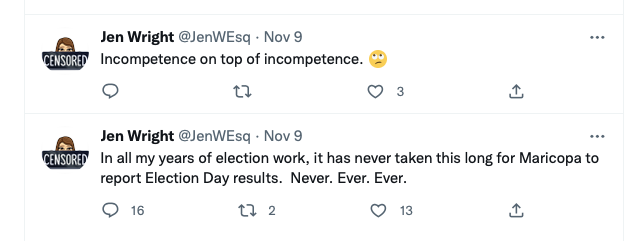
Ten days later, in her capacity as an assistant attorney general, Wright sent a letter to Thomas Liddy, the Civil Division Chief at the Maricopa County Attorney's Office.
Wright wanted an explanation of Maricopa's Election Day problems before the county certified its results.
Election Law and legal ethics expert Thomas Ryan believes at a minimum Wright should have recused herself from the investigation because her tweets amount to a conflict of interest. "It is highly inappropriate and unethical for such a person to be criticizing the county before they've been given a chance to respond to questions," Ryan said.
Then on November 25, Wright tweeted that her comments were out of frustration that no day-of votes were released in the hours after the polls closed.
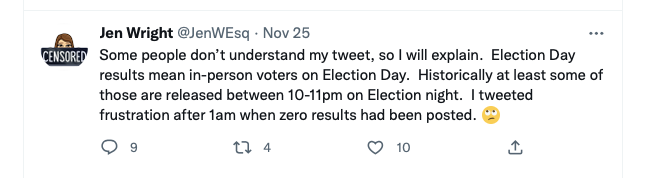
"It's hard to condone a prosecutor's action when they tip their hand when they're supposed to be close to impartial as you can get," said former Arizona Attorney General Terry Goddard.
Goddard doesn't believe politics is determining what the Attorney General's Office chooses to investigate related to the 2022 election. But Goddard and former Maricopa County Attorney Rick Romley felt compelled to send a letter to Attorney General Mark Brnovich and Wright requesting they launch an investigation of Cochise County Supervisors Peggy Judd and Thomas Crosby.
Both refused to certify the county election results by the November 28 deadline as required by state law. "They don't have any wiggle room this is not the opportunity to have a factual hearing on whether or not there are election problems. they have other venues where they can do that. but this is not that and so they broke the law," Goddard said.
Goddard says the Attorney General's Office has not yet responded to the request to investigate the Cochise County Supervisors.
Katie Connor, the spokesperson for the Arizona Attorney General's Office did not respond to whether Wright should recuse herself from investigating the Maricopa County Election.
Connor did say, "General Brnovich insists all Attorney General employees perform their duties in a professional and ethical manner. He respects their first amendment rights that do not end just because they work for a government agency."
===
{{ ===
https://podtail.com/en/podcast/drilled/the-anti-esg-campaign-gets-a-boost-from-raga/
no lnx
The Anti-ESG Campaign Gets a Boost from RAGA - Transcripts
June 13, 2023
Ever since the Securities and Exchange Commission announced its intention to make Environmental Social and Governance metrics actually mean something to investors, polluting industries have suddenly turned on ESG. Now that fight has a legal strategy, being carried out by the Republican Attorneys General Association.
Transcript: https://www.steno.ai/drilled/the-anti-esg-campaign-gets-a-boost-from-raga
Hello and welcome back to Drilled, I'm Amy Westervelt. We've talked before on this show about the growing backlash against taking environmental, social, and governance, or ESG, factors into consideration when it comes to investing. The watchdog group Documented first revealed last year that state treasurers were getting in on the action, kicking woke investment firms likeBlackRock out of their states. Back then I wondered when the attorneys general would show up to join the fray, and now sure enough, they are here. The Republican Attorneys General Association, RAGA, our old favorite, has come to play in the anti-ESG space. But first, a quick reminder, why all this upset about ESG all of a sudden in the first place? Good question. For a really long time, oil companies actually kind of loved ESG. It was all very loose and self-reported, and it gave them a way to unlock so-called green capital. But in 2021, the Securities and Exchange Commission, the SEC, looked around and went, huh, there are all these different SEG ratings, and some of them seem a little scammy, and no one knows what these disclosures even really mean. These are the kinds of things it's our job to clean up. So we are going to provide formal guidance on climate risk disclosure.
And that is when you start to see corporate interests, fossil fuel companies, and right-wing politicians lose their minds over ESG. Because all of a sudden, they couldn't just write whatever they wanted to in a report, they might have to actually disclose what their real climate risks are.
Speaker 5 00:02:16
Here is Jesse Coleman withDocumented. I think that a lot of this, both the legislative side, this legal strategy, the strategy of using state treasurers to pressure asset managers into attack climate disclosure, all of this is really mostly aimed at SEC scope three emissions disclosure requirements coming, you know, supposedly coming soon
Speaker 4 00:02:43
in the next couple of months, even. Wait, sorry, I'm gonna pause to define scope three. That means how your product's actually being used, not how you're making it, which is a big deal for especially heavy polluting industries
Speaker 5 00:02:58
like oil and gas companies, for example. Yeah, yeah, it's a really big deal. Whereas ESG, having a non-standardized ESG disclosure is no big deal to a major company. The SEC coming and saying, how much carbon emissions are you really responsible for? Not just, you know, what you're claiming you're responsible for, but if you're an oil company, for example, how much carbon are you actually putting in the atmosphere from everything that you've gotten from underground? What is your real impact? And that is a really big deal. It's probably one of the biggest climate policy issues in play right now. So, you know, in my opinion, a lot of this anti-ESG stuff, which doesn't make a lot of sense on its face, you know, these state bills that have passed in some states and been introduced in a ton of states, the actual thing that those bills are gonna do, they're not gonna have a really big impact. And sort of this antitrust stuff is very similar in the sense that, you know, the claims are kind of weak and it's hard to say exactly what the impact is gonna be specifically. But at the same time, it's building up all of this pressure and it's building up all of this political inertia that is all aimed at opposing, disclosing climate emissions. And that's what this SEC rule would do when it comes out, is that it would require publicly traded companies to disclose those emissions.
So, you know, in my opinion,
that's the real goal, is to keep that from happening. You may have heard Jesse mention there the words antitrust. That is where theRepublican Attorney's General Association comes into the picture. Back in June, 2021, a guy named Jason Isaac, who spearheads the Texas Public Policy Foundation's work on energy, went to a meeting of the American Legislative Exchange Council, ALEC, with an idea for a legal strategy that he thought could take ESG down.
Speaker 7 00:05:04
Documented shared audio from that meeting with us. Yes, so earlier, a couple months ago,our state affairs committee voted nine to nothing. So, broad bipartisan support, every single member voted in support to give the committee subpoena authority.
Speaker 6 00:05:16
So, they have sent out a couple months ago,
Speaker 7 00:05:24
our state some paper documents to find out where this collusion is happening. We anticipate truckloads of documents being delivered. And so, we look forward to the Texas Public Policy Foundation to going through those meticulously, because we believe that there is, and we actually partner with C. Boyden Gray, Boyden Gray Associates law firm out of Washington, D.C. Corporate collusion, liability risk for the ESG agenda to charge higher fees and rig the market. We believe that there's antitrust violations. This is really kind of geared towards our attorneys general to lay the foundation for antitrust violations on this corporate collusion. Find out the connections with the Glasgow Financial Alliance for net zero, which has over, I think, $100 trillion under managed assets in there. And there are the connections with the glad zero, this Paris Accord, which is net zero. So, I hope our committee gets a ton of paper back
Speaker 1 00:06:23
from these large financial institutions.
Speaker 7 00:06:28
Hope our committee gets in the courts and our attorneys generalaround the country filed antitrust violations.
Speaker 4 00:06:34
So, yeah, cartels colluding for decarbonization.What the hell is he talking about here?We're gonna try to answer that question right after this quick break. And we're back. So, after COP26 in Glasgow, insurers and asset managers, both formed groups focused on ESG. In both cases, these firms were saying, look, all sorts of environmental and social factors can impact our bottom line, and we would like to know what those risks might be so we can factor that into our decision-making around what to ensure and what to invest in. But according to Isaac, these firms talking to each other, issuing joint statements about what kind of information they'd like to see from companies, that's colluding to rig the market. In the wake of that 2021 ALEC meeting you heard Isaac talking at before, not only did Texas continue with the investigation Isaac mentioned, but Arizona Attorney General, Mark Bernovich, opened an investigation into ESG investing.And Raga coordinated a letter to various asset managers and politicians with more than a dozen attorneys general signed on, stating their concern that ESG investing might actually be an antitrust violation.
Speaker 5 00:08:13
Here's Jesse Coleman again. We started to see some of the bright lights of the Republican Attorneys General Association file various kinds of legal attacks on ESG issues, whether that's going directly after asset managers and asking them questions about their net zero commitments, or that's going directly after ratings agencies
Speaker 4 00:08:38
and saying that you're boycotting fossil fuels. And they seem to have coalesced around this idea of painting ESG as some sort of corporate collusion, you know, building an antitrust case. Can you explain what the thinking is there,
what they're trying to prove?
The allegation is that a lot of large asset managers get together in a shadowy cabal and they plan to collude to reduce carbon emissions. The reason these groups are alleging antitrust violations is that antitrust violations are very scary to companies. If a jury finds you guilty of an antitrust violation, it's very expensive. And it's a pretty hard bar to meet. And most experts are saying that the antitrust allegations that are coming from these people that are opposing climate policy, they probably don't have a leg to stand on, but a lot like slap suits and other kinds of legal tools that are used to silence people, just defending against the antitrust allegation is very, very expensive. So, you know, you see companies really backing away from participation in these kind of global groups that are trying to address climate emissions and trying to address investment
10:08
in the fossil fuel industry by large asset managers. In 2022, Alec once again held a meeting with a session on how to handle ESG at the state level. And again, the antitrust strategy was front and center. This time, Isaac was in the room cheering on new proponents of the strategy, including Will Hild with Consumers Research, which is funded by former Federalist Society President Leonard Leo, Paul Watkins, who used to work in the Arizona Attorney General's office and now runs an outfit called Fusion Law, advising on these sorts of strategies. Andy Puzder, former CEO of the Food Conglomerate that is home to Wendy's and Hardee's, and Catherine Gonzalez with the Heritage Foundation. Puzder kicked things off by comparing ESG investors
11:03
to, not kidding here, the Nazis. I wanna tell you, ESG investing is socialism in sheep's clothing. I mean, this is the challenge of your generation. My father's generation's challenge was the Nazis, who, by the way, were, of course, very proud socialists. The challenge of my generation was the communists, who were, of course, very committed socialists. The challenge of your generation is ESG investing, and it's more insidious than communism or the Nazis. It's the thing they're doing it. So ESG, Environmental Social and Governance. Like, how bad could that be, right? It sounds so innocuous, but it's a ruse. It's a ruse to conceal the fact that it's a direct threat to our founding principles.
11:53
It's a threat to our democracy. How bad could that be, right?
Speaker 4 00:11:55
It's a threat to our democracy.
Speaker 6 00:12:02
Hild and Watkins kept it focused on the litigation strategy. They get in rooms and they talk about they're gonna set a policy across the market. Now, it's been a while since I was in law school,
but when I was there, that was antitrust 101. And that's why you see U.S. senators saying this is potentially criminal antitrust liability.
Speaker 4 00:12:22
You see AG saying that they're going to investigate. And again,I have yet to speak with a single legal expert who thinks that this strategy could actually win in court. But like we said before, that is not necessarily the point. It's already having a chilling effect on investment firms and insurance companies in these net zero groups. And now that Republicans have control of the House, it's the focus of a series of oversight committee hearings too. The first one happened back in May and featured the attorneys general of Utah and Alabama as witnesses.
Speaker 1 00:13:00
Here'sSean Reyes, attorney general of Utah. But ever since the signing of the Paris Agreement, there's been anopen conspiracy to bypass Congress using the power of horizontal agreements by key players in our financial system. Some of these groups are Climate Action 100, the Glasgow Alliance for Net Zero, which include the largest asset managers, banks and insurance companies globally. These horizontal organizations seek to use their collective market power over tens of trillions in assets
to force burdensome changes on American companies.
amy: The Democrats witnessed during this hearing, Illinois State Treasurer Michael Frerichs gave a great and completely non-climate related example
of where ESG can safeguard profits. The more data we as investors have, the better informed our decisions are when selecting investments over the long term. ESG is about looking at a wider range of risks and value opportunities that could have a material financial impact on investment performance. For example, if you're investing in apharmaceutical company, it's thinking about whether that company has exposure to massive lawsuits because of its role in the opioid epidemic. Our approach is to integrate material ESG factors into investment decisions along with many other considerations. We are not ignoring traditional financial factors like profitability and credit worthiness. We are integrating more data into our decisions
to give us a better idea of risk and growth prospects. Frerichs also pointed out that limiting the information investors can get about the companies they're investing in
is the exact opposite of a free market idea. This pushback is anti-free market and anti-investor. It is misleading and it is harmful. It harms retirement savers, pensioners, working people, businesses, and it harms America. This coordinated campaign is focused on ESG investing. Most people don't know what ESG is. ESG is data. ESG is simply additional information that investment professionals use to assess risk and return prospects. It is about value, not about values. In order to maximize returns, an investor must be able to manage and mitigate risk. The more data we as investors have, the better informed our decisions are when selecting investments over the long term. ESG is about looking at a wider range of risks and value opportunities.
It could have a material financial impact
on investment performance. Last week, the House Oversight Committee held its second hearing on this subject,
calling on none other than Jason Isaac himself to testify. I'm Jason Isaac. I'm the director of LifePowered, a national initiative of the Texas Public Policy Foundation to raise America's energy IQ. And I live a high carbon lifestyle. And I think the rest of the world should too. That's why I refer to the ESG agenda as the China ESG agenda. It does very little to help Americans. It does everything to help the Chinese Communist Party. And again, making energy expensive, scarce and government controlled. This body, the United States Congress has not ratified the Paris Treaty. It is not the law of the land here in the United States, butto force an American entrepreneur to admit that his company will comply with that
is just mind blowing to me.
Whether the committee will hold a third hearing remains to be seen. I'm not sure the anti-ESG bench of experts rolls that deep. Plus, while these ideas might get folks at an ALEC meeting riled up, they're remarkably unpopular with American voters, including the majority of Republican voters. New Mexico rep Melanie Stansberry
made that point at last week's hearing. What I find particularly strange about this conversation is that over 63% of American voters actually oppose, directly oppose, any kind of government interference in investing strategies. And the vast majority of Republicans oppose it as well. And when you look at the bigger picture, when you look at what the American people are actually asking Congress to do, asking businesses in the private sector to do, almost 70% of Americans are in support of actions to address climate change,
to transition to a clean energy economy. Whether the SEC will be swayed by the antitrust argument remains to be seen.
That's it for this week. Thanks for listening, and we'll see you next time. Drilled is an original critical frequency production. Our producer is Sarah Ventre. Sound design, mixing, and mastering are by Peter Duff, who also wrote our original score. Our first amendment attorney is James Wheatman at the First Amendment Project. And the show is reported, written, and hosted by me, Amy Westervelt.
==
https://newrepublic.com/article/172636/esg-house-oversight-conspiracy
may 11 no lnx
QANON REBOOT
Republicans Are Truly Losing Their Minds Over ESG
Right-wingers at a House Oversight Committee hearing Tuesday insisted this boring investment strategy is some kind of global conspiracy.
Steve Marshall speaks at a podium in front of the Supreme Court building.
Alabama Attorney General Steve Marshall, who testified at Tuesday’s hearing on ESG, speaks to members of the press in October 2022.
On Tuesday, the House Oversight Committee convened a hearing on environmental, social, and governance, or ESG, investing criteria. For over a year now, Republicans have been trying to turn this obscure three-letter acronym into a full-fledged culture war.So far, the right has expressed its complaints about ESG via a word salad whose components don’t share much of a relationship either to reality or one another. This pattern persisted on Tuesday, when the word “cabal” was used at least three times in reference to allegedly “woke” investors.
ESG criteria, in reality, refer to the broad set of data that investors look at to determine a company’s impact on the world and the impact the world might have on it. In other words, it’s not just about whether a company is “good” according to some abstract set of values. It represents another way of factoring risk exposure into investment—something financiers have been doing for centuries.
“Elites from around the globe have formed alliances to coordinate together to implement woke climate policy.”
:{
}:
The two witnesses Republicans summoned to this week’s committee hearing weren’t economists or investment professionals, who might be familiar with these criteria or risk assessment in general, but attorneys general from Utah and Alabama, respectively: Sean Reyes and Steve Marshall. Whatever ESG actually means, to them and other anti-ESG crusaders, is mostly irrelevant. For those trying to understand their crusade, the hearing showed that it’s best to think of ESG as a canvas onto which the right projects its own plans and anxieties.
If you’ve heard of Marshall, it may well be because he’s spent considerable time since 2020 trying to overturn the results of that year’s presidential election, and shield other Republicans from accountability for spreading lies about it. Both he and Marshall joined fellow red states attorneys general in filing a brief with the Supreme Court supporting Trump’s claims about election fraud. Marshall, for his part, was serving as head of the Rule of Law Defense Fund that year, which sent out robocalls encouraging Trump supporters to flock to the Capitol on January 6.RLDF—whose donors include the Edison Electric Institution and the Judicial Crisis Network—is also a sister organization of the Republican Attorneys General Association, or RAGA, which Marshall was appointed chair of after continuing to deny, in 2022, that Joe Biden won the 2020 election.
:{
}:
Generous RAGA donors have included Koch Industries, Chevron, Exxon, Fox, andTikTok. ProPublica recently reported that companies that initially withdrew funds from RAGA over its role in the January 6 attack are back, including Amazon, Walmart, and JPMorgan Chase’s PAC. Overall, RAGA revenues jumped 68 percent in 2022.
In his testimony, Marshall—who chairs a secretive organization pushing a clandestine political agenda through undemocratic means—accused a “cabal of global elites” of being “clearly connected through various alliances” to try to force an ESG agenda onto an unwilling public. Reyes similarly accused “woke investors” like Blackrock of being part of an “organized syndicate of pressure” that is engaged in an “open conspiracy to bypass Congress.” Answering big policy questions like decarbonization, he argued, “is the role of the people’s elected representatives in a democracy—including each of you in Congress, state elected officials, and local leaders—not unelected bureaucrats or foreign governments.”
In other words, someone who’s spent the last several years attempting to overturn the results of a democratic election took to the Capitol on Tuesday to accuse an ill-defined set of actors of trying to sidestep democracy by asking companies if climate-fueled droughts, floods, and fires (for instance) might have some impact on their operations.And while claiming only to want investors to adhere to fiduciary duty, Republicans failed to mention that much of Wall Street’s wariness around investing in new fossil fuel production has nothing to do with a “woke” agenda: Before the pandemic, energy companies on the S&P 500 were underperforming every other sector on that index, and had spent a decade lagging behind as they binged cash on rapid drilling through the shale boom. Its fortunes have changed in recent years, but investors and oil and gas industry managers themselves are urging modesty on exploration and production precisely so that they can make more money.
“People don’t like men. People don’t like people with a European background, that sort of thing.”
“Elites from around the globe have formed alliances to coordinate together to implement woke climate policy,” Marshall said in his opening statement. “These schemes undermine our system of government because unelected elites are making policy decisions outside of democratic processes.” The footnote on that sentence in his pre-written testimony references Consumers Research, which is funded by millions of dollars in undisclosed donations and advised by right-wing legal guru Leonard Leo.
Republicans on the committee responded enthusiastically to this opening salvo. Wisconsin Republican Glenn Grothman asked Marshall whether “ESG” might influence decisions over who companies hire or put on corporate boards. “Right now there’s certain disfavored groups in our society,” Grothman mused. “People don’t like men. People don’t like people with a European background, that sort of thing. Could this be something where you’re encouraging businesses not to hire or promote people from certain unfavored groups.” In a moment dripping with irony, Texas Representative Pete Sessions decried “activist government making decisions on behalf of free people” in service of his larger point, supporting efforts to limit financial institutions’ decision-making power—and even what kind of data can be made available to them—in order to curb the spread of ESG.
It would be a fool’s errand to try to find much coherence in the right’s screeds against supposedly woke investors—who don’t really seem to exist. But today’s Oversight hearing might have accidentally illustrateda good rule of thumb: Whatever Republicans accuse the “ESG movement” of doing is something they’re probably already doing themselves.
Kate Aronoff @KateAronoff
Kate Aronoff is a staff writer at The New Republic.
=== }}
===
an 2 23 maya
Former Arizona Attorney General Mark Brnovich, a Republican, left office earlier this year without sharing findings from an investigation into Maricopa County's 2020 election seeking evidence of fraud, which he spearheaded, The Washington Post reports.
Now, per Arizona's KPNX News, the state's newly-elected Attorney General Kris Mayes, a Democrat, has released the findings from last year Brnovich failed to provide, provinghis allegations of fraud to be untrue.
A memo from September 2022 states, "These allegations were not supported by any factual evidence when researched by our office. Some of the information was mischaracterized... while some were wholly false."
READ MORE:Trump made 'secret' $1M donation to failed Arizona election 'grift disguised as an audit': report
According to The Post, the former attorney general refused to "respond to questions about his conduct of the probe, his decision not to release additional documents or differences between his public statements and his office's private findings."
"The people of Arizona had a right to know this information before the 2022 election," said Mayes. “Maricopa County election officials had a right to know that they were cleared of wrongdoing. And every American had a right to know that the 2020 election in Arizona, which in part decided the presidency, was conducted accurately and fairly."
Two years prior, The Post reports:
Brnovich quickly affirmed then-President Trump’s loss in Arizona in November 2020, angering fellow Republicans. And he went on to resist Trump’s efforts to overturn the vote. Yet he flirted with claims of fraud as he courted GOP support over the subsequent two years, trumpeting his interim report on a far-right radio show and saying, 'It’s frustrating for all of us, because I think we all know what happened in 2020.'
READ MORE:'They took photographs': Armed 'vigilantes' intimidate Arizona voters at mail-in ballot drop boxes
:{According to The Post, Brnovich :(style="background-color:#ff9900;"):}:never disclosed the full findings, leaving those suspicious of his accusations with questions and concerns.
READ MORE: 'Hyper-partisan attack': Arizona Republicans pushing new voting bills based on conspiracy theories
A spokesperson for the attorney's general office, Richie Taylor, told The Post "records released this week represent a fraction of the thousands of pages produced by investigators and attorneys during the investigation, including additional material from drafts of reports and interviews and correspondence with witnesses and election officials."
Taylor says "Mayes's staff is reviewing those documents and is redacting sensitive information before making them public in the coming months."
READ MORE: Elections expert says Kari Lake tweet 'looks like a felony'
The Washington Post's full report is available at this link (subscription required). KPNX News' report is here.
===
https://www.politico.com/news/2022/10/14/arizona-ag-true-the-vote-00061973
no lnx
KYLE CHENEY and NICHOLAS WU
10/14/2022
The office of Arizona Attorney General Mark Brnovich is asking the FBI and IRS to investigate True the Vote, a conservative vote-monitoring nonprofit Donald Trump has repeatedly touted for its efforts to raise doubts about the legitimacy of the 2020 election.
:{
}:
Reginald Grigsby, an investigator with Brnovich’s office, described a series of questionable interactions with the group’s leaders and suggested there may be evidence of financial improprieties if the agencies pursued them.
:{
}:
“Given TTV’s status as a nonprofit organization, it would appear that further review of its financials may be warranted,” Grigsby wrote.
:{
}:
The letter, dated Friday, is particularly remarkable coming from the office of Brnovich, a Republican who once vied for Trump’s support in a Senate GOP primary bid that hinged on false claims about the 2020 election results.
The IRS and the FBI’s Phoenix field office did not immediately respond to requests for comment. A True the Vote spokesperson could not immediately be reached for comment.
Grigsby urged the federal agencies to pursue the group after what it described as multiple suspicious interactions with leaders Catherine Engelbrecht and Gregg Phillips. Grigsby said the pair met with state investigators three times since early 2021 and promised to provide data it said would prove widespread fraud in the 2020 election — but the evidence never arrived.
:{
}:
Even though the group never turned over the promised data, Grigsby wrote, it began publicly claiming that it had given the state a hard drive — a claim Grigsby indicated the group also made to the Arizona Senate and to the Phoenix office of the FBI.
“Not only is this patently false, TTV acknowledged via correspondence and during a meeting with them that they had not given us the information but that they would,” he wrote.
True the Vote propagated claims of vote fraud by relying on geolocation data, which became the central focus of the movie “2000 Mules.” Trump has cited the movie as proof the election was stolen, and he’s praised the group’s work. But the movie’s claims have been sharply called into question by federal investigators and researchers who have tested its theories.
Former Attorney General Bill Barr delivered a forceful rebuke of the movie’s premise in testimony to the Jan. 6 select committee. He told the panel that in any metropolitan area, geolocation data would likely show “hundreds” of people who passed by drop boxes on multiple occasions.
“The premise that if you go by a box, five boxes or whatever it was, you know that that’s a mule is just indefensible,” Barr said, adding, “It didn’t establish widespread illegal harvesting,” Barr said.
Despite Barr’s mockery of the premise, Trump has promoted its claims both online and during his public events.
In an April 2022 meeting, Grigsby said the group claimed to have evidence of “243 mules” who had stuffed ballot boxes in Arizona. But they presented no hard evidence to back it up, he said.
In his most recent meeting with the group on June 1, Grigsby said Engelbrecht and Phillips indicated they had shared all their data with the FBI and were working with the bureau as informants. But he said the FBI’s Phoenix field office quickly confirmed this to be false and said the group had, in turn, told FBI agents to contact Brnovich’s office to obtain their data.
:{
}:
Grigsby also flagged the nonprofit status of the organization, noting the “considerable sums of money” they had raised while alleging massive voter fraud and promises to provide law enforcement with the information — even as they remained unable to provide the information.
Jon Stewart grills a Republican attorney general over former President Donald Trump's election lies in an upcoming episode of his Apple TV+ series.
The former "Daily Show" host confronted Arizona Attorney General Mark Brnovich about his actions to placate conservatives in his state who insist the 2020 election was stolen from the former president, and the GOP official justified his efforts by pointing out "millions" of Americans "think" fraud cost Trump a second term, reported The Daily Beast.
“There’s people that believe in angels, but that doesn’t mean you launch an investigation that angels changed ballots,” Stewart says.
The new episode of "The Problem with Jon Stewart" premiers Friday focusing on the midterm elections, and he leans hard on Brnovich to agree Trump lost the election fair and square.
“The fact is, the election in Arizona was well-run, not fraudulent, and not stolen from Donald Trump, according to even your investigation,” Stewart says, but Brnovich remains noncommittal. “Why is it so hard to just say yes to that?”
“Why can’t you say that the election in 2020 was not stolen or fraudulent?” Stewart asks. “This is blowing my mind.”
Watch the video below or at this link.
an ah 9 22
Although some progressives believe that President Joe Biden’s plan to cancel some student loan debt doesn’t go far enough, a long list of Republicans — from U.S. senators to right-wing think tanks to state attorneys general — have accused the president of overreaching and are looking for ways to undermine Biden’s plan. The National Review’s Charles C.W. Cooke is even calling for Congress to “impeach and convict President Biden.”
Student loan debt has become a major problem in the United States, where it isn’t uncommon for students to graduate from college with six-figure debts that they will spend decades paying off with interest. This debt affects a variety of decisions that college graduates make as young adults, from deciding whether or not to have kids to being able to buy a house. Some older Baby Boomers, according to common complaints from Millennials and members of Generation Z, fail to comprehend the severity of the problem — as they graduated from college at a time when tuition was much more affordable than it is now.
Journalists Tony Romm, Jeff Stein and Danielle Douglas-Gabriel take a look at GOP reactions to Biden’s student loan debt plan in an article published by the Washington Post on September 1, stressing that some of those Republicans are considering lawsuits.
READ MORE: Joe Biden could have gone much further on student loans
“Republican state attorneys generaland other leading conservatives are quietly exploring a slew of potential lawsuits targeting President Biden’s plan to cancel some student debt — challenges that could limit or invalidate the policy before it takes full effect,” the Post reporters explain. “In recent days, a number of GOP attorneys general from states including Arizona, Missouri and Texashave met privately to discuss a strategy that could see multiple cases filed in different courts around the country, according to a person familiar with their thinking who spoke on the condition of anonymity to describe the confidential talks.”
Romm, Stein and Douglas-Gabriel continue, “Other influential conservatives — including Sen. Ted Cruz (R-Tex.) and allies of the Heritage Foundation, a conservative think tank — are mulling their own options as they ratchet up criticism of Biden’s debt-relief plan, two additional people familiar with the matter said. And a conservative advocacy group founded by a major Trump donor said it would file a lawsuit against the policy.”
The Post interviewed John Malcolm, who serves as director of theHeritage Foundation’s Meese Center.The Heritage Foundation, founded in 1973, has been around 49 years — and its Meese Center was named after Edwin Meese, who served as U.S. attorney general during President Ronald Reagan’s second term and is now 90.
Malcolm told the Post, “The conservative public interest law firms in our network are exploring filing lawsuits against this. They are doing background legal research, trying to find out who might be the most suitable clients for them. They have to find a client with the standing and the gumption to take on a lawsuit. There are several groups in our network who are exploring that right now.”
READ MORE: 'For whom and why?' is the real question behind student loan forgiveness
Biden’s plan would forgive up to $10,000 in federal student loan debt, or as much as $20,000 if the former student also received Pell Grants. Some liberals and progressives were hoping to see larger amounts of student loan debt forgiven, but the centrist Biden believes that $10,000 or $20,000 is a step in the right direction.
The Post interviewed some former college students who have a lot of student loan debt, and they were appalled that Republicans oppose even the modest amounts that Biden favors.
One of those interviewees was 31-year-old Ohio resident Michael Loomus, who dropped out of the University of Toledo and has been struggling to pay down the $11,400 that he owes. Loomus told the Post, “It just seems they are continuously trying to keep borrowers in debt. I don’t make a lot of money.… and before this, it just felt like I’d never pay off my loans.”
READ MORE: 'We should be proud': Education secretary explains why student loan forgiveness is an 'investment'
https://azdem.org/if-you-cant-beat-em-hire-em-azsen-edition/
3/22
to compete with fake elector Jim Lamon, Blake Masters just put one on his payroll
PHOENIX — In the latest desperate attempt to out-election conspiracy theory the GOP Senate primary field for “kingmaker” former President Donald Trump’s heart (read: endorsement), Blake Masters just hired fringe Arizona GOP bigwig Greg Safsten to join his campaign.
In addition to promoting the GOP’s Maricopa County “audit,” Safsten was an active participant in the fake elector scam, co-conspiring with Masters’ opponent, Jim Lamon, in an attempt to override millions of Arizona votes. And yes, this is the same fake elector scam that Masters’ other opponent, Mark Brnovich, is refusing to investigate in the hopes that his cooperation will score him points — and a quick dollar — with Trump.
But Masters — a Silicon Valley sweetheart who has the backing (and $10 million pledge) of tech tycoon Peter Thiel — couldn’t just hire any fake elector. He picked Safsten, a like-minded hypocrite so clearly beholden to big tech that the Arizona GOP voted to nominate Trump for his 2020 re-election bid via a blockchain app under his leadership. Blake Masters also called for the U.S. to have a strategic reserve of Bitcoin.
“This latest move by Blake Masters confirms what we already knew: He was bred by big tech, is funded by big tech, and is now staffed by big tech,” said ADP spokesperson Hannah Goss. “What’s more, Masters just made it crystal clear that this primary field is in a race to the bottom to prove who is most focused on an election that occurred nearly two years ago instead of on the issues that matter most to Arizonans right now — and all to win the approval of one man: Donald Trump.
an raw 7 22
Republicans may have blown their hopes for beating a recently elected Democratic senator through the actions of one man, Arizona Republic columnist Laurie Roberts wrote on Monday.
"When the story on Arizona’s 2022 election is written, surely one of the sorriest chapters will be the collapse of Mark Brnovich.
A year ago, Arizona’s attorney general looked to be the Republican Party’s best shot at reclaiming the Senate seat that Republicans had held since 1969 – until voters sent appointed Sen. Martha McSally packing in 2020," she wrote. "In the end, Mark Brnovich faced one obstacle he couldn’t overcome: Mark Brnovich."
McSally lost the 2020 special election to fill the rest of John McCain's term to Democrat Mark Kelly.
"Last week, Brnovich dropped into third place in a Republican race that he might well have won had he simply stayed in his own lane and run as himself, a traditional conservative Republican," she wrote. "Early on, Brnovich was that rare Republican who was willing to tell the truth about the 2020 election, risking the wrath of his base by acknowledging that there was no grand conspiracy to defeat Trump in Arizona."
Roberts wrote that instead of running as a traditional conservative Republican, Brnovich started "pandering to far-right Republicans who were never going to vote for him."
As longtime Republican strategist Chuck Coughlin told Roberts, “He kept trying to court a portion of the electorate that was never going to be his."
Roberts noted that Georgia Gov. Brian Kemp and Secretary of State Brad Raffensperger ran as traditional conservative Republicans and "defeated Trump-backed candidates peddling their stolen election schtick."
Roberts thinks Brnovich's choices will likely result in Kelly being elected to a full term.
"This is a race that should be the Republicans’ to win given history, an eight-point turnout advantage and a Democratic president whose approval ratings rank somewhere between dismal and I-didn’t-know-you-could-go-that-low.
Yet here they are, poised to nominate Blake Masters, a hard-right Trump pick who has no hope of knocking out Mark Kelly becasue he cannot credibly move to the middle where this race will be decided," she wrote.
https://insideclimatenews.org/todaysclimate/how-mass-shootings-ecofascism-and-climate-change-got-tied-together/
kris t
two recent mass shootings in communities of color are renewing fears among environmental groups and climate activists that a growing number of young men are adopting racist right-wing ideologies to explain the worsening climate crisis and justify extreme violence.
On Tuesday, a gunman walked into an elementary school in the predominantly Latino city of Uvalde, Texas, killing 19 children and 2 adults in the worst school-related mass shooting since the one at Sandy Hook Elementary. Less than two weeks prior, a shooter targeted Black shoppers at a supermarket in Buffalo, New York, killing 10 and injuring three more.
While the motivations behind the Uvalde shooter, who was killed by police at the scene, remain unclear, the Buffalo shooter posted a manifesto online that was rife with racist underpinnings. That includes the mention of “ecofascism,” a theory that blames immigrants—particularly immigrants of color—for causing overpopulation and environmental degradation in Western nations.
“For too long we have allowed the left to co-opt the environmentalist movement to serve their own needs,” 18-year-old Payton Gendron, the alleged shooter in Buffalo, wrote in his 180-page document. “The left has controlled all discussion regarding environmental preservation whilst simultaneously presiding over the continued destruction of the natural environment itself through mass immigration and uncontrolled urbanization.”
Climate activists, many who have been tracking the proliferation of ecofascism among far-right groups, say the Buffalo shooting is just the latest in what appears to be a growing movement in the United States and Europe. In fact, Gendron pulled much of the language in his manifesto from the screeds of past shooters.
In 2019, a gunman walked into two mosques in Christchurch, New Zealand, killing 51 Muslim worshippers. Later that year, another man entered a Walmart in El Paso, Texas, and shot 46 people, killing 23—most of them Latino. Both shooters, who were also young white males like Gendron, cited ecofascism to justify their actions.
Once relegated to the fringes of society, ecofascism has found its way into mainstream discourse in recent years. Its origins, in many ways, trace back to the Tanton network, a collection of more than a dozen anti-immigration groups founded or funded by John Tanton, a wealthy ophthalmologist from Michigan. Tanton, who was once a leader of the Sierra Club, believed that the root cause of environmental destruction is overpopulation by the “wrong” sorts of people.
Tanton died in 2019, but his legacy has lived on through others. In 2019, Tucker Carlson, the conservative pundit for Fox News, alluded to the concept of ecofascism on air with a member of the Heartland Institute, a right-wing think tank that has long perpetuated misinformation on climate change. “Isn’t crowding your country the fastest way to despoil it, to pollute it, to make it a place you wouldn’t want to live?” Carlson mused in the interview.
In 2021, Arizona’s Republican Attorney General Mark Brnovichfiled a lawsuit against the Department of Homeland Security, alleging that the Biden administration’s immigration policies were harming his state’s environment by allowing immigrants to “drive cars, purchase goods, and use public parks and other facilities,” resulting in “the release of pollutants, carbon dioxide, and other greenhouse gases into the atmosphere.”
And a growing number of scholars say eco-fascist ideas are now swirling around right-wing circles as a way to address climate change while also advocating for anti-immigration policy. The groups are “always twisting” climate research “to support some rhetoric that we certainly were not aiming to support,” Jenny Rowland-Shea, deputy director for Public Lands at the Center for American Progress, a progressive think tank, told the Christian Science Monitor. Her own research was used for “criticizing immigrants and people of color and saying they were responsible” for environmental damage, she said.
While right-wing groups blame immigrants for their environmental problems, research has long shown that it’s really the world’s affluent who are contributing most to the climate crisis.
A 2020 report by Oxfam found that from 1990 to 2015—a period when humans doubled the amount of carbon dioxide in the atmosphere—the wealthiest 1 percent of the world’s population accounted for more than twice as much carbon emissions as the poorest half of the Earth’s population.
Still, the continued emergence of ecofascism is particularly worrisome given that worsening storms, droughts and other consequences of climate change are already displacing more people from their homes and sending refugees into neighboring countries. At the U.S.-Mexico border, climate change is contributing to a record-high backlog of immigration cases, ICN’s Aydali Campa reported last week.
“It is getting to the point where, around the world, we see the climate change impacts overriding a lot of people’s ability to adapt,” said Rebecca Carter, the acting director of climate resilience practice at the World Resources Institute, a global research non-profit based in Washington. “Whether it’s because they don’t have access to what they need, or because things are so severe that there really are not solutions to the challenges they’re facing.”
https://www.alternet.org/2020/12/republican-ags/
With the Trump operation's legal effort to overturn the November election going nowhere, nearly 20 Republican attorneys general have decided to throw their support behind Texas AG Ken Paxton's desperate—and, according to analysts, doomed-to-fail—Supreme Court lawsuit against four key battleground states that have certified President-elect Joe Biden's victories.
Filed on Tuesday and enthusiastically celebrated in right-wing circles, Paxton's lawsuit (pdf) baselessly alleges "significant and unconstitutional irregularities" in Georgia, Michigan, Pennsylvania, and Wisconsin and pleads with the high court to delay next week's scheduled certification of presidential electors for those four states.
That the lawsuit was mocked as "utter garbage" and "factually untethered" by legal experts did not dissuade 18 Republican attorneys general, led by Missouri AG Eric Schmitt, from expressing support for Paxton's effort.
As of this writing, the Republican attorneys general of Alabama, Arkansas, Florida, Indiana, Kansas, Louisiana, Mississippi, Montana, Nebraska, North Dakota, Oklahoma, South Carolina, South Dakota, Tennessee, Utah, and West Virginia have backed Schmitt's amicus brief(pdf) in support of the Texas lawsuit. Arizona Attorney General MarkBrnovich has filed a separate brief (pdf) "respecting" the Texas suit.
The New York Times reported that Trump asked Sen. Ted Cruz (R-Texas) on Tuesday to argue the case if the Supreme Court hears it, and Cruz has agreed.
Late Wednesday, Trump—who has openly pleaded with the Supreme Court to undo Biden's decisive victory—filed a brief with the high court seeking to intervene in support of Paxton's lawsuit. Kristen Clarke, president and executive director of the Lawyers' Committee for Civil Rights Under Law, said the president's filing "reads like a rally speech."
"Were the Supreme Court to agree to hear this meritless suit brought by Texas," Clarke added, "we might as well toss the Constitution."
More than 3,000 Americans died from covid today, a new record, and instead of saving thousands of lives 18 GOP stat… https://t.co/tuKGOs12Mi
— Ari Berman (@Ari Berman)1607565108.0
The Supreme Court—to which Trump successfully appointed three right-wing justices over his four years in office—has not yet decided whether to take up the case, despite viral right-wing social media posts to the contrary.
In a blog post, Richard Hasen, a law professor at the University of California, Irvine, called Paxton's complaint "a press release masquerading as a lawsuit." He elaborated:
Texas doesn't have standing to raise these claims as it has no say over how other states choose electors; it could raise these issues in other cases and does not need to go straight to the Supreme Court; it waited too late to sue; the remedy Texas suggests of disenfranchising tens of millions of voters after the fact is unconstitutional; there's no reason to believe the voting conducted in any of the states was done unconstitutionally; it's too late for the Supreme Court to grant a remedy even if the claims were meritorious (they are not).
While Paxton's lawsuit will almost certainly fail, observers warned that the willingness of so many top state law enforcement officials to back the effort to overturn the presidential election highlights the threat the right will continue to pose to democracy long after Trump leaves office.
"The president will leave the White House on January 20. The conservative attorneys who have become radicalized under his influence, however, will remain in power across the country," Slate's Mark Joseph Stern wrote Wednesday. "Paxton's suit asks the Supreme Court to throw out every vote in four states won by Joe Biden—Georgia, Michigan, Pennsylvania, and Wisconsin—then direct each state's legislature to declare Trump the winner."
"This act would constitute the single biggest incident of voter nullification in American history," Stern continued. "Paxton alleges that all four states illegally expanded mail voting, permitted egregious fraud, then concealed evidence that Democrats stole the election. There is no basis in truth for his factual claims and no basis in law for his legal theories."
Clarke of the Lawyers' Committee for Civil Rights Under Law added on Twitter, "This is what anti-democratic conduct looks like."
FROM YOUR SITE ARTICLES
- Republican attorneys general go to war for Trump - Alternet.org ›
- Watch: Dem congressman kicks off Barr hearing with expert tear ... ›
- 'Bill Barr is un-American': The AG's ex-boss explains his 'twisted ... ›
RELATED ARTICLES AROUND THE WEB
- Republican state AGs ask U.S. Supreme Court to hear mail-in ballot ... ›
- Republican AGs tell judge to drop Michael Flynn's case, stay out of ... ›
- DOJ, Republican AGs Ask Supreme Court To Strike Down ACA ... ›
wohl of wall st grifter
https://www.alternet.org/2020/05/arizona-may-jail-right-wing-fraudster-who-accused-democrats-of-sexual-assault/
db new civ rts move
j Wohl — the 22-year-old right-wing fraudster who unsuccessfully lobbed fake sexual assault allegations at Special Counsel Robert Mueller, former Democratic presidential candidates Pete Buttigieg and Elizabeth Warren, and infectious disease expert Dr. Anthony Fauci— may soon be getting some comeuppance thanks to Arizona Attorney General Mark Brnovich....
https://www.prwatch.org/news/2019/12/13517/gop-state-attorneys-general-fight-environmental-regulations-fossil-fuel-companies
alex k
As Republican Attorneys General faced 2018 re-election bids and continued their legal challenges to Obama-era environmental regulations, fossil fuel companies poured millions of dollars into the Republican Attorneys General Association (RAGA), a political nonprofit that spends money to elect GOP AGs. That trend has continued into this year. From 2017 through mid-2019, oil, gas, and coal companies, trade associations, fossil fuel utilities, and industry executives donated over $6.7 million to RAGA, a CMD investigation has found. Fifty-five companies and trade groups and four executives made these donations.
Giving the most money to RAGA since 2017 are oil and natural gas exploration company Noble Energy ($1,020,000), oil refining and materials conglomerate Koch Industries ($755,000), natural gas energy supplier NextEra Energy Resources ($500,855), and oil and gas drillers Anadarko Petroleum ($500,000) and PDC Energy ($350,000).
RAGA's $9.6 million haul in the first half of 2019 dwarfs that of 2015, the last similar fundraising period. That amount includes contributions to RAGA’s related entities such as the Rule of Law Defense Fund, a 501(c)(4) dark-money group founded in 2014 and funded by Koch-linked political groups, the Edison Electric Institute, the Judicial Crisis Network, and the Federalist Society in past years.
In addition to helping elect Republican candidates, the corporations' donations to RAGA score them personal meetings with GOP attorneys general. At four private events each year at luxury hotels, industry lobbyists, lawyers, and executives get exclusive access to the attorneys general, and the AGs have been happy to oblige the corporations’ wishes. Numerous GOP AGs have launched lawsuits attacking Obama-era environmental regulations such as the Clean Power Plan, the Clean Air Act, the Waters of the United States rule (WOTUS), and ozone caps.
Other perks for annual RAGA donors include access to additional RAGA events, policy conference calls, monthly political briefings, passes to the annual Edmund Randolph Club retreats, and the option to pitch topics and be panelists at conferences. One RAGA event this year, in April, was an oil and gas summit to Houston.
In some cases, oil and gas corporations extend their communications with attorneys general beyond RAGA events. For example, former Oklahoma Attorney General Scott Pruitt had secret meetings with industry lobbyists and challenged EPA regulations by sending letters to the agency that appeared to be written by Pruitt’s office but were actually authored by lobbyists for oil and gas exploration company Devon Energy. Pruitt filed 14 legal challenges to environmental regulations during his tenure as Oklahoma AG.
CMD sued Pruitt for access to thousands of emails between Pruitt's office and energy interests and sued to stop the emails' destruction. The correspondence records led to national coverage of Pruitt's close relationships with Devon Energy, the American Fuel & Petrochemical Manufacturers trade association, the Koch-backed Americans for Prosperity, and other industry interests.
Pruitt became Trump's director of the EPA in 2017, but his fellow Republican AGs continue to fight Obama's environmental regulations in the courts, buoyed by election support from RAGA.
In early 2017, as Democratic AGs began to sue the Trump administration, RAGA ramped up its electoral operation, ending a longstanding agreement with its Democratic counterpart to refrain from targeting the other party's incumbent AGs.
Arizona
In the 2018 Arizona elections, Republican Attorney General Mark Brnovich faced a Democratic challenger, and voters weighed in on a ballot measure to require utility companies to generate 50 percent of their electricity from renewable sources by 2030. Brnovich ran against the measure and was buoyed by Pinnacle West Capital--the holding company that owns Arizona Public Service, the state's largest public utility--which gave $200,000 to RAGA in the 2018 election cycle. Pinnacle West PAC also donated $7,000 to the Brnovich campaign, and CEO Don Brandt gave $2,500.
RAGA put nearly $3.7 million into Arizona state elections in the 2018 cycle, giving $2.9 million to Arizona for Freedom PAC, which spent most of that on ads, and over $750,000 to the RAGA Arizona PAC, which transferred the money to the state Republican Party.
Democratic challenger January Contreras had backing from the Democratic Attorneys General Association and the Tom Steyer-linked outside group Clean Energy for a Healthy Arizona, which spent several million dollars supporting her, but she lost a close race to Brnovich.
Far more expensive was the ballot measure campaign, the most costly in Arizona's history. Pinnacle West poured $32.3 million into political group Arizonans for Affordable Electricity, which campaigned against the measure, and Clean Energy for a Healthy Arizona, financed mostly by Steyer's NextGen Climate Action, spent $24 million in favor. The measure lost by a big margin.
In 2015, Brnovich and Arizona Public Service joined the multi-state lawsuit against Obama's Clean Power Plan. After Trump was elected, in late 2016, Brnovich joined 23 other states in a letter urging the new president-elect to withdraw the Clean Power Plan.
Also in 2015, Brnovich led a coalition in suing the EPA over restrictions on ozone, which coal company Murray Energy had also legally challenged.
Colorado
Colorado's outgoing Republican Attorney General Cynthia Coffman had joined other states in challenging the Clean Power Plan, and 2018 GOP candidate George Brauchler also opposed the greenhouse gas restrictions and pledged not to challenge the Trump administration's actions. Brauchler favored the White House's "Affordable Clean Energy Rule" to replace the Clean Power Plan, while Democratic candidate Phil Weiser supported the restrictions and called attention to Brauchler's "pro-industry approach to energy extraction."
RAGA spent over $5.1 million backing Brauchler through Colorado Freedom, a RAGA state affiliate set up by RAGA's chief financial officer, Lee Russell. Weiser, who won the race, criticized Colorado Freedom for being a "dark money" group funded, via RAGA, by "mostly out-of-state corporations" including Koch Industries.
Some of the same fossil fuel companies that financed RAGA including Anadarko Petroleum, Extraction Oil and Gas, Noble Energy, and PDC Energy also gave millions of dollars to another outside group, Protect Colorado, which spent a massive $40 million advocating the oil and gas industry's interests around two ballot measures.
Michigan
The 2018 AG race in Michigan was another open contest between candidates with a stark contrast on energy policy. Republican candidate Tom Leonardran with explicit support for an aging Enbridge oil pipeline, while Democrat Dana Nessel pledged to shut it down in her first act as attorney general.
Enbridge did not donate to RAGA in the 2018 cycle, but ExxonMobil, with which it co-owns multiple pipelines, gave over $125,000. This year, Enbridge contributed $25,000 to RAGA.
RAGA spent at least $1.5 million backing Leonard and gave $6,800 to the Leonard campaign, but Nessel won the race. Under Nessel, Michigan has joined other Democratic states to challenge Trump initiatives including its Clean Power Plan replacement. She also withdrew the state from the Republican challenge to the Clean Power Plan and from a Murray Energy lawsuit against EPA clean air regulations, which the state had joined as a petitioner.
In the next AG race, in 2022, RAGA will very likely harness cash from its fossil fuel donors in an attempt to reinstate a pro-industry Republican.
Texas
In the Longhorn State, Attorney General Ken Paxton, RAGA's chair in 2019, ran for re-election against Democrat Justin Nelson in 2018. Like other Republican AGs seeking new terms, Paxton got major support from RAGA, which made $650,000 in direct donations to his campaign as well as $21,500 in in-kind contributions for research. Paxton won the race by 3.6 percent of the vote.
Paxton's RAGA biography boasts that he has sued the Obama administration 22 times. The suits include challenges to the Clean Power Plan, the EPA's "Regional Haze" rule, methane emission standards, and restrictions on coal mining near waterways.
This year, Paxton sued ExxonMobil over a fire at its chemical plant that injured 37 people, the fourth fire that has occured at the Bayton, Texas plant this year. But his lawsuit, filed at the state level, could upend two suits by the county in county court, putting Paxton in charge of the whole operation. Some, wary of his fossil fuel-friendly history, worry he might go easy on the oil giant.
2019 Races
In 2019, Republicans flipped two state AG offices and held onto another. In Kentucky, RAGA made its biggest ad pre-booking expenditure ever: $3.25 million benefiting GOP candidate Daniel Cameron, who would go on to win the race. Coal is a major industry in the state, but the election centered more on health care and the opioid crisis.
In Mississippi, successful AG candidate Lynn Fitch got a $150,000 in direct campaign donations as well as more than $76,000 worth of in-kind contributions from RAGA’s Mississippi PAC, according to state campaign finance data.
In Louisiana, Republican Jeff Landry won re-election. In January, Landry railed against EPA regulations in an op-ed, criticizing the Clean Power Plan and fuel efficiency increases and praising Trump for cutting numerous environmental standards. RAGA has elected Landry to be its 2020 chair.
2020 Races
Ten states have AG elections in 2020, including Utah, where Republican Sean Reyes will seek re-election. Under Reyes, Utah became the first state in a 10-state coalition to challenge Obama's Waters of the United States rule, which expanded the definition of protected waters under the 1972 Clean Water Act.
In 2017, along with a number of other GOP AGs including Landry and Paxton, Reyes signed a letter to Pruitt's EPA urging it to "respect the states" regarding WOTUS.
"The 2015 WOTUS Rule is a clear example for federal overreach that infringed on the States' traditional role as primary regulators of land and water resources within their borders," said Reyes in August of this year, after a federal district court maintained an injunction against the WOTUS rule that Reyes and other GOP AGs sought. In October, the EPA and the Army Corps of Engineers officially repealed the rule, reinstating the less strict standards that were in place before the rule
CMD sued Reyes for withholding public records about his involvement in RAGA and the Rule of Law Defense Fund, generating local and national coverage of RAGA's pay-to-play arrangement with corporations, including fossil fuel companies. The suit is still pending.
Nine other states--Indiana, Missouri, Montana, North Carolina, Oregon, Pennsylvania, Vermont, Washington, and West Virginia--also have AG races in 2020.In Indiana and Missouri, Republican incumbents are seeking re-election. Indiana AG Curtis Hill, like his fellow GOP AGs, has advanced energy industry interests, leading 15 states in two 2018 friend-of-the-court briefs seeking dismissal of California and New York's lawsuits against the industry over its effect on climate change. Coffman, Paxton, Reyes, and Landry were among the other signatories of the briefs.
Meanwhile, RAGA has supported the AGs’ efforts. In 2018, it publicized Arkansas AG Leslie Wheeler's appearance on a Fox News show during which she discussed her opposition to the Clean Power Plan. RAGA's Rule of Law Defense Fund hosted a panel in October 2019, featuring South Carolina AG Alan Wilson, about strategies to combat climate change legislation.
==
...In fact, the Republican Primary for Attorney General may be the ugliest race of any election year in Arizona history. And we are basing that solely on how ugly it already is here in 2013. Familiar faces, familiar tactics, hypocrisy by the boatload, and two candidates who are likely to get lost in all of the mud. Oh yes, and a Democrat nominee hoping all of this comes to pass.
The offending group is the ironically named Arizona Public Integrity Alliance. Don’t bother trying to find out who is paying for their work because their donors are secret. Their Vice President and spokesperson is Tyler Montague who, when we last saw him, was working with liberal bomb-thrower and racial demagogue Randy Parraz to recall conservative Republican Russell Pearce and replace him with Jerry Lewis.
Their target is Republican Attorney General Tom Horne. Their tactic is smear. They want you to know that Tom Horne has been accused of having an affair, was accused of giving jobs to “cronies”, was investigated by the FBI, and took campaign contributions from law firms who do business with the AG’s office.
They are spending a lot of money on ads and mailers designed to soften up Horne before the Republican primary and, to avoid campaign finance laws, they are disguising their attacks as issue ads in support of a newfound agenda to pass two reforms to the AG’s office. One of their early ads has already had to be pulled and redone because it was proven factually inaccurate.
What isn’t clear is if they simply hate Horne, they want to elect his Republican challenger Mark Brnovich, or they want to elect the Democrat candidate Felicia Rotellini. Because AZPIA’s donors are secret, we can’t know where their money is coming from. But Montague’s history of working with Democrats to elect more liberal candidates is well established, and the AZPIA’s attacks are basically rehashes of the Democrat Party’s talking points about Horne.
Republicans across Arizona are rightfully worried about Horne losing the general election to Rotellini in 2014. But they are ignoring that Horne has a largely solid record as AG and that Arizona remains a solidly red state. Rotellini and her allies outspent Horne and his allies in 2010 and he won anyway. It is quite probable that a united Republican Party would be able to defend Horne’s office in 2014. But smear campaigns fronted by Republicans and funded by dark money a year before the election promises to muddy both Republican candidates to the point where neither can recover. Then Arizonans will get to see what Chicago style politics really look like with Rotellini in charge.
==
https://www.azag.gov/press-release/ag-brnovich-statement-u-s-supreme-court-grants-stay-blocking-epa-clean-power-plan
AG Brnovich Statement: U. S. Supreme Court Grants Stay Blocking EPA Clean Power Plan
For Immediate Release:February 09, 2016
Contact: Mia Garcia (602) 339-5895 or Mia.Garcia@azag.gov
AG Brnovich Statement: U. S. Supreme Court Grants Stay Blocking EPA Clean Power Plan
PHOENIX – Attorney General Mark Brnovich issued the following statement today after the U.S. Supreme Court granted an application for a stay blocking the EPA Clean Power Plan from going into effect. Arizona is part of a 26-state coalition led by West Virginia and Texas fighting against federal overreach.
“This is a huge victory for Arizona,” said Attorney General Mark Brnovich. “The Clean Power Plan is an abuse of power, it’s regulation without representation. This is a tremendous step in stopping the Obama administration's unconstitutional mandates and protecting Arizona jobs and ratepayers.”
The Attorney General’s Office Federalism Unitpartnered with the Arizona Corporation Commission to file the multi-state lawsuit against the EPA. The Stay will remain in effect until a federal appeals court in Washington rules on the plan, which could be later this year. Under the stay, the EPA won’t be able to enforce a September 6, 2016 deadline for Arizona and other states to either submit their emission reduction plans or request a two year extension.
For additional information, members of the media may contact Mia Garcia, Director of Media Relations at (602) 339-5895 or Mia.Garcia@azag.gov.
For a copy of the U.S. Supreme Court's Order, CLICK HERE.
RAGA: backed horne?
Arizona won a successful challenge against the National Labor Relations Board which challenged the state’s constitutional amendment guaranteeing workers’ rights to vote by secret ballot on whether to join a union. This case set valuable precedent which will allow these issues to be resolved at the state, and not federal, level.
Attorney General Alan Wilson (SC), with the help of other state Republican AGs, played a pivotal role in defeating the NLRB’s politically-motivated attempt to disallow Boeing’s business expansion in South Carolina.
The RAGA dark money ads will undoubtedly attack Democratic candidate Felecia Rotellini, who is running a very strong campaign. I predict they will be bunch of lies about Rotellini, wrapped in some charming sexism. Another thing you should know about this RAGA outfit is that none other than Sean Noble, the Dark Money kingpin, has provided substantial funding to it via his American Future Fund. Sean Noble so happens to be none other than Mark Brnovich’s campaign manager. Isn’t that cozy?
Mark Brnovich is an American lawyer and politician from the state of Arizona who currently serves as Attorney General of Arizona. A member of the Republican Party, he was elected to the office on November 5, 2014, defeating Democratic nominee Felecia Rotellini
Biography
Brnovich received a bachelor's degree in political science from Arizona State University and his juris doctor from the **University of San Diego** School of Law.[1]
Brnovich worked for the Goldwater Institute and the **Corrections Corporation of America**, and served as Assistant U.S. Attorney for the District of Arizona and Assistant Attorney General of Arizona.[1][2] He was appointed the director of the Arizona Department of Gaming[by brwer?] in 2009. He served in the role through 2013, when he resigned to run for Attorney General of Arizona in the2014 election.[1] He defeated incumbent Tom Horne in the Republican Party primary election[3] and Felecia Rotellini in the general election.[4]
References:{:(style="margin-right:0.25em"):}:[edit:{]}:
- ^ :{Jump up to::(style="-webkit-user-select:none;top:-99999px;clip:rect(1px 1px 1px 1px);overflow:hidden;position:absolute !important;padding:0px !important;border:0px !important;height:1px !important;width:1px !important"):}:^a b(https://en.wikipedia.org/wiki/Mark_Brnovich#cite_ref-run_1-1) c(https://en.wikipedia.org/wiki/Mark_Brnovich#cite_ref-run_1-2) "Former Arizona gaming chief will run for attorney general". azcentral.com. Retrieved November 5, 2014.
- :{Jump up:(style="-webkit-user-select:none;top:-99999px;clip:rect(1px 1px 1px 1px);overflow:hidden;position:absolute !important;padding:0px !important;border:0px !important;height:1px !important;width:1px !important"):}:^ "Mark Brnovich, ex-Department of Gaming director, to run for Arizona attorney general". KNXV. RetrievedNovember 5, 2014.
- :{Jump up:(style="-webkit-user-select:none;top:-99999px;clip:rect(1px 1px 1px 1px);overflow:hidden;position:absolute !important;padding:0px !important;border:0px !important;height:1px !important;width:1px !important"):}:^ Wingett Sanchez, Yvonne (August 27, 2014). "Horne concedes attorney general race to Brnovich". Arizona Republic. Retrieved August 27, 2014.
- :{Jump up:(style="-webkit-user-select:none;top:-99999px;clip:rect(1px 1px 1px 1px);overflow:hidden;position:absolute !important;padding:0px !important;border:0px !important;height:1px !important;width:1px !important"):}:^ "Brnovich projected to win AG". November 4, 2014. Retrieved November 5, 2014.
External links:{:(style="margin-right:0.25em"):}:[edit:{]}:
- Arizona Attorney General Mark Brnovich official state government site
| Legal offices | Legal offices | Legal offices |
|---|---|---|
Preceded by |
2015–present | Incumbent |
|
<ul style="margin: 0px; padding: 0px; list-style-image: url(" data:image="data:image" svg="svg" xml="xml" c="C" fxml="Fxml" version="version" d="D" encoding="encoding" utf-8="UTF-8" f="F" e="E" a="A" csvg="Csvg" http="http" fwww.w3.org="Fwww.w3.org" f2000="F2000" fsvg="Fsvg" width="width" height="height" ccircle="Ccircle" cx="cx" cy="cy" r="r" fill="fill" display="display" inline="inline" white-space="white-space" nowrap="nowrap" line-height="line-height" inherit="inherit" xmlns="xmlns" xmlns:data="data"><font size="4"></font><li class="nv-view" style="margin: 0px; display: inline; word-spacing: -0.125em;"><font size="4"><font size="4"><font size="4"><font size="4"><font size="4"><font size="4"><font size="4"><font size="4"><font size="4"><font size="4"><font size="4"><font size="4"><font size="4"><font size="4"><font size="4"><font size="4"><font size="4"><font size="4"><font size="4"><font size="4"><font size="4"><font size="4"><font size="4"><font size="4"><font size="4"><font size="4"><font size="4"><font size="4"><font size="4"><font size="4"><font size="4"><font size="4"><font size="4"><font size="4"><font size="4"><font size="4"><font size="4"><font size="4"><font size="4"><font size="4"><a href="https://en.wikipedia.org/wiki/Template:Current_Arizona_statewide_political_officials" title="Template:Current Arizona statewide political officials" style="text-decoration: none; background: none;"><abbr title="View this template" style="border: none; cursor: inherit; font-variant: small-caps; background: none transparent;">v</abbr></a></font></font></font></font></font></font></font></font></font></font></font></font></font></font></font></font></font></font></font></font></font></font></font></font></font></font></font></font></font></font></font></font></font></font></font></font></font></font></font></font></li><li class="nv-talk" style="margin: 0px; display: inline; word-spacing: -0.125em;"><a href="https://en.wikipedia.org/wiki/Template_talk:Current_Arizona_statewide_political_officials" title="Template talk:Current Arizona statewide political officials" style="text-decoration: none; background: none;"><abbr title="Discuss this template" style="border: none; cursor: inherit; font-variant: small-caps; background: none transparent;">t</abbr></a></li><li class="nv-edit" style="margin: 0px; display: inline; word-spacing: -0.125em;"><a class="external text" href="https://en.wikipedia.org/w/index.php?title=Template:Current_Arizona_statewide_political_officials&action=edit" style="text-decoration: none; padding: 0px !important; background: none !important;"><abbr title="Edit this template" style="border: none; cursor: inherit; font-variant: small-caps; background: none transparent;">e</abbr></a></li></ul> Current statewide political officials of Arizona |
|
<ul style="margin: 0px; padding: 0px; list-style-image: url(" data:image="data:image" svg="svg" xml="xml" c="C" fxml="Fxml" version="version" d="D" encoding="encoding" utf-8="UTF-8" f="F" e="E" a="A" csvg="Csvg" http="http" fwww.w3.org="Fwww.w3.org" f2000="F2000" fsvg="Fsvg" width="width" height="height" ccircle="Ccircle" cx="cx" cy="cy" r="r" fill="fill" display="display" inline="inline" white-space="white-space" nowrap="nowrap" line-height="line-height" inherit="inherit" xmlns="xmlns" xmlns:data="data"><font size="4"></font><li class="nv-view" style="margin: 0px; display: inline; word-spacing: -0.125em;"><font size="4"><font size="4"><font size="4"><font size="4"><font size="4"><font size="4"><font size="4"><font size="4"><font size="4"><font size="4"><font size="4"><font size="4"><font size="4"><font size="4"><font size="4"><font size="4"><font size="4"><font size="4"><font size="4"><font size="4"><font size="4"><font size="4"><font size="4"><font size="4"><font size="4"><font size="4"><font size="4"><font size="4"><font size="4"><font size="4"><font size="4"><font size="4"><font size="4"><font size="4"><font size="4"><font size="4"><font size="4"><font size="4"><font size="4"><font size="4"><a href="https://en.wikipedia.org/wiki/Template:U.S._state_attorneys_general" title="Template:U.S. state attorneys general" style="text-decoration: none; background: none;"><abbr title="View this template" style="border: none; cursor: inherit; font-variant: small-caps; background: none transparent;">v</abbr></a></font></font></font></font></font></font></font></font></font></font></font></font></font></font></font></font></font></font></font></font></font></font></font></font></font></font></font></font></font></font></font></font></font></font></font></font></font></font></font></font></li><li class="nv-talk" style="margin: 0px; display: inline; word-spacing: -0.125em;"><a href="https://en.wikipedia.org/wiki/Template_talk:U.S._state_attorneys_general" title="Template talk:U.S. state attorneys general" style="text-decoration: none; background: none;"><abbr title="Discuss this template" style="border: none; cursor: inherit; font-variant: small-caps; background: none transparent;">t</abbr></a></li><li class="nv-edit" style="margin: 0px; display: inline; word-spacing: -0.125em;"><a class="external text" href="https://en.wikipedia.org/w/index.php?title=Template:U.S._state_attorneys_general&action=edit" style="text-decoration: none; padding: 0px !important; background: none !important;"><abbr title="Edit this template" style="border: none; cursor: inherit; font-variant: small-caps; background: none transparent;">e</abbr></a></li></ul> Attorneys general of the United States |
  | This article about an Arizona politician is a stub. You can help Wikipedia by expanding it. |
- 20th-century American lawyers
- Arizona lawyers
- Arizona Republicans
- Arizona State University alumni
- Living people
- University of San Diego School of Law alumni
- Arizona Attorneys General
- American people of Serbian descent
- Arizona politician stubs
==
raga bs
Mark met his wife Susan while they both worked as prosecutors for the Maricopa County Attorney’s Office. Mark worked in the Gang/Repeat Offender Unit and prosecuted many difficult and high profile cases from 1992 to 1998. Mark went on to work at the Arizona Attorney General’s Office (1998-2003) and represented the Arizona Department of Gaming, where he developed an expertise in gambling law.
Mark previously served as the Director of the Goldwater Institute’s Center for Constitutional Government, and authored numerous studies, articles, and briefs advocating for free markets and individual liberty. He also briefly served as a Senior Director for the Corrections Corporation of America before returning to his roots as a prosecutor and public servant. Mark has served as an Assistant United States Attorney where he prosecuted public integrity crimes, as well as, crimes occurring in Indian Country.
He left the U.S. Attorney’s Office to serve the people of Arizona as the Director of the Arizona Department of Gaming, a law enforcement agency that investigates illegal gambling activity and coordinates efforts with tribal regulators to ensure the integrity of tribal gaming.
Mark and Susan have two children, who attend charter schools in Phoenix. They have two dogs and enjoy hiking, dinner with friends and family, as well as, various sporting activities. Mark is also a huge Grateful Dead fan.
Mark was sworn into office as Arizona Attorney General on January 5, 2015.
==