THIEL 2
bad margin main
SEE THREE
see palantir
see clearview facial recognotion
see surveillance capitalism
see disaster capitalism IPO
capt 817 also 819
fixed format, lost a bit of text
---
on facebook bd STAKE IN CAMBR ANAL?!
---
STANFORD INTERNET OBSERVATORY KILLED/SCALP
no lnx?
peter Thiel is a billionaire serial entrepreneur, venture capitalist, and the most prominent supporter of President Trump in Silicon Valley. And in a world where money is power, Thiel is not afraid to wield his power.
On Oct. 28, 2015, several months before Thiel was revealed to be the funder of a lawsuit that bankrupted renegade media company Gawker, which had covered his political activities negatively and outed him as gay in 2007, the Stanford grad (BA ’89, JD ’92) giddily told several Stanford undergraduates in a private meeting at his San Francisco home about his imminent destruction of what he called a “universally reviled organization.” Four undergrads present at the meeting confirmed the story, a seemingly out-of-character — however vague — disclosure from the quite private Thiel. But why would he divulge such a thing to a small group of students? And why was he meeting with them in the first place?
*
Thiel has become a national figure of controversy for, among other things, claiming that “the extension of the franchise to women…render[s] the notion of ‘capitalist democracy’ into an oxymoron,” saying, “I no longer believe that freedom and democracy are compatible,” funding a fellowship that specifically tries to get undergraduates to drop out of college, and donating $1.25 million to Donald Trump’s campaign a week after a tape was released in which the then-candidate discussed how he could grope young female actresses and get away with it.
But 30 years ago, as a sophomore at Stanford, Thiel was a lightning rod for a much smaller-scale reason: He co-founded (with Norman Book ’91) the Stanford Review. The Review, a campus publication often associated with conservatism and libertarianism, was created to, as Thiel wrote in his first editor’s note, “present alternative views on a wide range of current issues in the Stanford community,” “create a forum for rational debate,” and “challenge those who, after reading this paper, still disagree with us…to respond in kind — with rational argumentation and workable solutions of your own.”
Thiel’s articles in The Review and the articles he published as its first editor-in-chief, many of which are available in Stanford Libraries’ Special Collections & University Archives, as well as interviews with over a dozen current and former Review affiliates paint a picture of Thiel as a committed political fighter whose work and outlook today can be traced directly to his college years.
But even further, Thiel’s legacy — and presence — remains with The Review, now an established contrarian institution on campus, to this day. Thiel continues to meet with the publication’s editors, and he is substantially more open with them about his beliefs than he is with the general public, including on highly controversial issues like race and immigration. And across the Bay Area, many of The Review’s alumni, spearheaded by Thiel, have built a relatively small but tight-knit network that extends across three decades and has a net worth that extends into the billions.
Most Stanford students who follow campus politics are quite familiar with The Review. Its often controversial articles are widely shared and discussed, allowing for the paper’s style and voice to become pretty recognizable. Reading over its original volumes from 30 years ago, the paper’s consistency in tone and topic is immediately evident.
In its first few volumes (it generally has two volumes per academic year), The Review condemns a “vocal few” who have monopolized discussion, and it presents itself as an alternative to a stifling, overwhelmingly left-wing campus orthodoxy. In various articles, Thiel and the editorial board critique how the phrase “open-mindedness” seems to them to merely refer to “those who agree with one position.” They advocate that Stanford should focus on “institutionalized liberalism” rather than “the supposed ‘institutionalized racism.’” And they argue that the university should not abolish the then-existing ‘Western Culture’ literature program but rather “actually strengthen the current program’s focus on the West.”
The fate of the ‘Western Culture’ academic program, which was soon to be replaced with a ‘Cultures, Ideas, and Values’ program that mandated more works by female and non-white authors and also mandated more non-white faculty teach in it, was then a major flashpoint of controversy on campus and an inspiration for founding The Review.
The Review presents itself as a renegade paper, calling out perceived left-wing censors on campus while offering itself as a contrarian outlet willing to engage with out-of-fashion ideas and ideologies like conservatism and libertarianism. The paper includes articles about both national political issues as well as campus controversies, some quite somber and some excitedly mischievous.
Having founded The Review at the end of his sophomore year, Thiel was also the paper’s editor-in-chief his junior and senior years, during which he included an editor’s note with each volume, generally reflecting on his vision for the paper as a vehicle for stirring the pot and breaking up politically correct platitudes.
Thiel’s editor’s notes are titled, in chronological order, Stanford Review Is Here to Stay, Open or Empty Mind?, Institutionalized Liberalism, Western Culture and its Failures, Welcome to the Farm, Is the West Worth Defending?, Stanford and the Real World, and The Importance of Being Honest. At least one volume is missing from the archive, so presumably he wrote more.
He also wrote an Editor’s Farewell to end his tenure as founding editor-in-chief. In that, he wrote: “Finally, to the many friends I’ve made through putting out this paper, thanks for everything. I’m sure we’ll keep in touch.”
Thiel left Stanford’s campus in 1992, but The Review exists to this day. How has it lasted for 30 years while countless other student organizations have formed and dissipated, often in the span of a single year?
One reason was articulated in the National Review by former Stanford Review staffer Michael New (Ph.D ’02):
Why is it that [campus conservative] papers like the Stanford Review and the Dartmouth Review have enjoyed continuity while most others have not? The simple reason is that both the Stanford Review and the Dartmouth Review succeeded in developing reliable networks of alumni donors early in their history. Of course, the fact that Review founder Peter Thiel went on to found PayPal has certainly helped the paper’s financial condition. However, the success of Thiel and other undergraduates at developing a solid fundraising base placed The Review on solid financial footing well before the dotcom boom of the late 1990s.
Historically, New is correct that the paper has been quite effective at raising money for a relatively small student publication (a typical volume has around eight to 10 people in editor positions and another dozen or so writers), and Review archives show that the paper had an “Alumni Relations Director” position as early as 1990, only three years after its founding.
Annual donations received by the Stanford Review, according to available ProPublica nonprofit data.
The Review is incorporated as a 501(c)3 nonprofit that first filed in 1990 and maintains that status to this day. Its 1997-2010 IRS filings are accessible online through ProPublica’s NonProfit Explorer.
In the IRS filings available, The Review averages donations of about $65,000 per fiscal year, with the bulk of its expenses going to printing and shipping its volumes on campus and to alumni and contributors. (Over the past few years, it has moved online and only occasionally prints issues for the campus.)
The Review also generates income from investment returns and advertisement sales, but donations account for over 97 percent of the publication’s revenue.
Another reason for The Review’s longevity is that, on a campus that has a reputation for being pre-professional, the publication is a locus for debate over politics and ideas. Jennifer Burns, a historian of modern conservatism, believes that the relative lack of undergraduate institutions for political and philosophical conversation at Stanford means that The Review has an outsize impact on campus dialogue. Burns said she has also noticed that, in classes, Stanford students hesitate to claim conservative identity, for fear of peer disapproval.
The Review, by contrast, is unafraid to be judged, taking on campus liberals as well as Stanford’s small but highly vocal far left in spite of frequent (and sometimes vicious and personal) backlash. And while The Review does publish some moderate pieces, its right-wing articles are its historical hallmark and tend to get the most attention.
In recent years, The Review has tackled Western Civ curricula, endowment divestment campaigns, and sexual assault policy, among other hot-button issues.
But although The Review is often described as a “conservative” or “libertarian” paper — and these adjectives are not wrong; the paper has even described itself as “the conservative voice of Stanford” in the past — ideological descriptors do not adequately capture how the modern paper conducts itself or sees its purpose.
Anna Mitchell ’18, the current editor-in-chief, sees the paper “as a voice for thoughtful and contrarian perspectives on Stanford-related issues.” “I don’t see The Review as innately conservative and libertarian,” she said. “I think that The Review’s institutional voice is consistent not because our members hold a particular political view but because they share skepticism toward the status quo of campus political opinions. It happens that college campuses tend to be very liberal, so our arguments are usually more right-wing.”
Asked about what she thought was The Review’s greatest accomplishment, Devon Zuegel ’16, a former editor-in-chief, pointed to a 1995 episode in which the paper successfully sued Stanford over its speech code. The code banned insults based on race and sex, and the Santa Clara County Superior Court struck down the code as “unconstitutionally broad and based on content.” Robert Corry (JD ’94), a member of The Review who helped to bring the case to court, described the victory as — in language quite consistent with The Review’s historical mission statement — “a victory for academic freedom and free speech.”
Virtually every Review and former Review member I asked emphasized the paper’s role as a counterbalance to orthodoxy (Zuegel and Harry Elliott ’18, also a former editor-in-chief, both used the phrase “Devil’s Advocate”) rather than fealty to a particular set of beliefs. Several also noted that the modern Review is ideologically varied, containing not just social traditionalists or techno-libertarians but centrists and liberals as well. Elliott believes that “The Review attracts a particular kind of person. It’s a very particular sort of ‘contrarian’ who’s willing to walk into a room full of people who large numbers of people on campus at least subtly say are hateful.”
The Review takes their contrarian role sufficiently seriously that three former editors noted that it has occasionally published articles over the past few years that the authors themselves didn’t agree with. One former editor disapprovingly referred to the practice as “intellectual dishonesty,” while others saw it as part of The Review’s stated task of representing unpopular thought in campus discourse.
Does The Review have a limit on how far it will go against the grain? In fall 2016, it ultimately decided against sponsoring notorious provocateur Milo Yiannopoulos, but the decision was not made lightly. Mitchell, who was against sponsoring Yiannopoulos because she says she “[does] not believe that being provocative is a virtue in itself and didn’t think that Milo brought enough original thought to justify an invitation,” described The Review as “very internally divided” over the issue.
Elliot Kaufman ’18, a former Review managing editor, criticized Yiannopoulos in the National Review the following summer. Kaufman quoted an “influential editor” of The Review as saying, in favor of an invitation, “Best-case scenario is that the SJWs [Social Justice Warriors, a pejorative term for confrontational and highly vocal leftists on social issues] freak out and we get another Berkeley,” a reference to a riot by militant leftists in response to UC Berkeley’s Yiannopoulos event that injured several people and caused an estimated $100,000 in damages.
It’s honestly amazing he still meets with us for dinner every quarter.”
Thiel himself has not shied away from Yiannopoulos, meeting with him and contributing a blurb for Yiannopoulous’ new book, Dangerous: “If you don’t use your freedom of speech, one day you might find that it’s gone. Buy this book while it’s legal.”
While The Review has had a continuous presence on campus since its inception, one former editor admitted that the paper has had periods of lulls in the past, and that in those times he could imagine that Thiel would not have been satisfied with what it was doing.
This is because, although The Review is a student-run publication and Thiel has not been the editor-in-chief since 1989, by no means has Thiel vanished from The Review’s orbit. As one former editor put it, “it’s honestly amazing he still meets with us for dinner every quarter.”
After Stanford Law, Thiel worked as a lawyer at the prestigious, traditional firm Sullivan and Cromwell, which he has often described as a place where everyone inside was trying to get out and everyone outside was trying to get in. He quickly left corporate law and worked as a trader for Credit Suisse, then returned to the Bay Area in 1996 to work in the booming and less constricting technology sector, starting a fund called Thiel Capital Management.
Thiel co-founded payments processor PayPal in 1998 to achieve, as early PayPal executive and former Review editor-in-chief Eric Jackson ’98 has described it, “global currency liberation”; PayPal’s success made Thiel a multimillionaire. He then founded a hedge fund named Clarium Capital in 2002 and co-founded data analysis firm Palantir in 2003. In 2004, Thiel became one of the earliest investors in Facebook; Facebook’s success made Thiel a billionaire. Thiel is an active venture capitalist, having co-founded the firms Founders Fund, Valar Ventures, and Mithril Capital, and he has by all accounts become one of the most powerful and financially successful people in Silicon Valley. Thiel has invested in over a hundred technology companies, many of which have become titans, including LinkedIn, Lyft, Spotify, Reddit, Airbnb, and SpaceX.
He also continues to meet with the undergraduates who staff the paper he founded, generally its editors.
Highlighting both the intimacy and exclusivity of these gatherings, one email invitation to such an event in 2015, shared by a former editor, reads in part: “Hi, We will be having a Review dinner at Peter Thiel’s house next Wednesday…This is not an open invite; please do not talk about this opportunity with anyone else, especially at the [Review staff] meetings.”
Thiel’s influence on the autonomous Review’s on-campus activity should not be overstated: Students are always in control of the paper, and Thiel does not attempt to orchestrate their conduct. The great majority of The Review’s activity involves its independent writing and reporting on the issues of the day and its weekly meetings, which often feature boisterous political debates. (Amy Shen ’18, the current executive editor, says she enjoys the meetings as a place where “you are judged on the basis of your ideas and nothing else.”)
But Thiel does occasionally host dinners and reunions with Review editors at local restaurants as well as his home in San Francisco, give suggestions of issues to focus on, donate money, and de facto lead a burgeoning network of alumni concentrated in Silicon Valley, many of whom have worked with or for Thiel directly.
As one former editor put it, “[Thiel] sees The Review as his people.”
Speaking about Thiel, many Review and ex-Review affiliates insisted on anonymity. They clearly respect him. Mackenzie Yaryura ’17, a former editor-in-chief, says, “my only experience is that [Thiel’s] been really welcoming, really interesting, being willing to answer questions and share knowledge.”
To what degree does Thiel still care about The Review’s activities on campus?
One former editor believed “he obviously had zero interest in getting to know us as individuals. He was there to figure out what was going on on the campus.” Harry Elliott voiced that “to be honest the thing which most Review alums are really interested in, not just or specifically Peter, is: they want to know what the issues de jour are, what the average Stanford student is like, and what we are doing to try and ensure that viewpoints that are usually not heard as heard.” A third former editor agreed that, as Thiel is obviously busy and does not have time to keep up with campus goings-on, meeting with The Review was a way of staying in touch. Several people agreed that while Thiel is certainly not going to babysit The Review, he does want it to continue with its founding mission.
Thiel tends to reveal much more about his own views and activities with Review affiliates than he does with the public. Mary Carolyn Manion ’19, a former Review editor, attended an event with Thiel where he discussed politics, economics, and technology, including topics like a “network for Trump-supporting Silicon Valley types who were not going to go public…because of the California culture.” Thiel did not elaborate on specific names.
At The Review’s 30th Anniversary event, hosted on Stanford’s campus the January weekend of Donald Trump’s inauguration, Thiel spoke about his involvement in the presidential transition. As per the accounts of six Review editors, Thiel discussed how he had offered to take the lead on developing a spreadsheet to fill jobs in the new administration and claimed to be deeply involved in the transition’s internal workings. (In February, Politico reported that “Peter Thiel’s fingerprints are all over the administration.”) He seemed optimistic about Trump.
On every major platform he’s built in his life, whether fighting a government authority or an upstart competitor, [Thiel] tends to come up with ideas and dig in deep to them, and he doesn’t walk away.”
At the event, Thiel was asked how he knew that Trump was going to win. After all, wasn’t it extremely risky to go all-in for Trump when he was down in the polls and Silicon Valley strongly supported Clinton? Thiel replied that, two weeks before the election, some of his closest advisors and confidants wondered to him if they had backed the wrong horse and if it was too late to back off supporting Trump. Thiel, according to his own retelling, responded, “Are we allowed any knowledge other than social scientific knowledge?” And he argued that while the polls did seem to indicate that Trump would lose, he was more confident in his personal assessment of how the world works than the polls. Thiel’s confidence, of course, was vindicated when Trump won.
A former editor described Thiel’s response as “very much in character” for him: “On every major platform he’s built in his life, whether fighting a government authority or an upstart competitor, he tends to come up with ideas and dig in deep to them, and he doesn’t walk away.”
In Oct. 2016, shortly after Thiel donated $1.25 million to Trump, Thiel publicly apologized for passages in his 1995 book The Diversity Myth, such as claiming that some alleged date rapes were “seductions that are later regretted,” saying in a statement, “More than two decades ago, I co-wrote a book with several insensitive, crudely argued statements. As I’ve said before, I wish I’d never written those things. I’m sorry for it. Rape in all forms is a crime. I regret writing passages that have been taken to suggest otherwise.” But three months later, during the after-party of the 30-year anniversary event at Thiel’s home, according to a former editor, Thiel stated that his apology was just for the media, and that “sometimes you have to tell them what they want to hear.”
Thiel was long perceived as a libertarian, but in recent years, as his support for Trump illustrates, his politics have taken a more futurist-nationalist flavor that critics have described as bordering on authoritarian and white nationalist. Only a few days before Trump’s Inauguration and The Review’s anniversary event, Thiel attended the pro-Trump and heavily alt-right-attended “Deploraball,” which had been in part organized by Jeff Giesea ’97, a former Review editor-in-chief who once worked at Thiel Capital Management.
Also, a former editor relayed to me that Thiel told The Review during the 30th anniversary after-party that he is “funding” American Greatness and American Affairs, two ‘Trumpist’ journals founded to provide intellectual ammunition to Trump’s replacement of the movement conservative old guard. Thiel also mentioned that he had met Michael Anton, a prominent ‘Trumpist’ writer who now works as a national security staffer for Trump, in a reading group that focused on philosopher Leo Strauss.
A former editor reported that at the same event in 2015 where Thiel obliquely referenced the imminent destruction of what turned out to be Gawker, he also endorsed cutting immigration to the United States by “80 percent,” but at the same time supported increasing “high-skilled” immigration. Another former editor described Thiel’s views on immigration as “foundationalist”: “He believes that the people who come into a country are the identity of that country, and a decision to change the people who come in irrevocably alters the identity of that country.” (Thiel was born in Germany, and his parents immigrated to the US when he was one year old; he also lived in South Africa and what is now Namibia for part of his childhood.)
Another former Review editor told me that in fall 2014, also at Thiel’s home, during a discussion of Charles Murray’s controversial book on IQ, The Bell Curve, Thiel wanted to “entertain” the thought of there being a biological reason for racial gaps in test scores. The editor said Thiel cited the ancient Chinese administration, which he described as a situation in which the people who scored higher on tests got more power and were more sexually successful, and he seemed curious about the idea that a civilization could, over time, end up being more intelligent than others.
We contacted Thiel’s office with all the quotes sources attributed to him to see if he would elaborate on or dispute any of them; through a spokesperson, Thiel declined to comment on any of them.
There is another way in which Thiel interacts with Review affiliates: across Silicon Valley, many of them work with or for him.
The “PayPal Mafia,” a term for PayPal founders and prominent multimillionaire executives whose post-PayPal careers include founding and investing in dozens of prominent tech companies, is stacked full of Review alumni, including Ken Howery ’98, David Sacks ’94, and Eric Jackson ’98 (all former Review editors-in-chief) as well as Keith Rabois ’91 (a former Review opinion editor), and Premal Shah ’98 (a former Review staffer).
Other early executives at PayPal from The Review include Paul Martin ’04, a Review business manager who dropped out of school to join the company in 2000; Nathan Linn ’93 (a former Review editor-in-chief); Aman Verjee ’96 (another former editor-in-chief); and Norman Book ’91 (a former managing editor and Thiel’s Review cofounder).
Norman Book and Peter Thiel, co-founders of The Review, taking questions about the paper’s earliest days, at the 25th anniversary reunion event.
In Jackson’s book The PayPal Wars, he describes Martin’s 2003 departure from PayPal: Thiel and Sacks “vigorously tried to convince Paul to change course. Though both officers were duty-bound to try to retain such a valued employee, I sensed they also had a personal desire not to lose Paul. He was the first Stanford Review alumnus to leave PayPal, something Peter took to heart, especially since the ten alumni from the newspaper had played a vital role in shaping the direction of the company.”
While the nine Review alumni above are all significant figures in Thiel’s circle, an alumnus who was then merely an intern at PayPal would turn out to be perhaps Thiel’s most frequent collaborator.
Joe Lonsdale ’03, also a serial entrepreneur and venture capitalist, has been described as “the living embodiment of Silicon Valley” and a “protégé” of Thiel. In 2002, Lonsdale interned at PayPal. After graduating, he worked at Thiel’s Clarium Capital Management and then launched a meteoric career. He has founded or cofounded companies Addepar, Backplane, OpenGov, and Shogun and venture capital firms Anduin Ventures, Formation 8, and 8VC. (Thiel is an investor in Addepar, Backplane and OpenGov, and Thiel and Lonsdale have both invested in several companies including Oculus Rift, Caplinked, Flexport, and Radius.)
But he is best known for being a co-founder, along with Thiel, of data analysis juggernaut Palantir, whose valuation has reached $20 billion. A third co-founder of Palantir, Stephen Cohen ’05, is also a former Review editor-in-chief, meaning that three out of the five founders of one of Silicon Valley’s crown jewels ran the same student newspaper. (A fourth, Nathan Gettings, was a former PayPal executive, and the fifth, Alex Karp (JD ’92), was a social theory Ph.D who knew Thiel from Stanford Law, where they were roommates).
In total, I have identified 24 current and former Review affiliates, spanning the paper’s entire history, who have held positions at Palantir, including a board member (Adam Ross ’95) and the company’s first employee (Alex Moore ’05).
In a PowerPoint presentation giving an overview of The Review, on a slide titled “Perks of Staff,” one of the bullet points listed is “priority at dinners and lunches with faculty and alumni.” Lonsdale has remained particularly involved with the on-campus Review community, hosting lunches and recruiting. Over the summer, an email went out on The Review’s listserv advertising an internship at Argive, a Lonsdale-funded nonprofit, that noted that “[we] suspect we’ll find some great candidates through the Stanford Review.”
Lonsdale is the co-founder and chairman of a currently 13-person startup, Shogun, where Anthony Ghosn ’15, who has worked at Formation 8 and 8VC, is the co-founder and CEO and Brandon Camhi ’16, who has worked at Thiel’s hedge fund and OpenGov, is the Vice President of Marketing. Both Ghosn and Camhi are former Review editors-in-chief. On Ghosn’s LinkedIn profile, Joe Lonsdale wrote a recommendation that reads in part: “I met Anthony while he was at the Stanford Review and was impressed…I hired him to be my chief of staff when he was a Junior at Stanford.” And when asked about how he had hired employees for Shogun, Ghosn began, “It’s all network.”
Lonsdale has also served as a Board Member of the Seasteading Institute, which Thiel funded, and invested in startups of other Review alumni. He is married to Tayler Cox ’09, now Tayler Lonsdale ’09, a former Review executive editor.
(In 2014, Lonsdale was banned from campus after an undergraduate he had been dating accused him of rape and Stanford found that he had “engaged in sexual misconduct and harassment.” In 2015, “as a result of new evidence that came to light during litigation,” Stanford determined that Lonsdale did not violate Title IX and lifted Lonsdale’s ban. The undergraduate, who had filed a civil suit against him, dropped her suit, and Lonsdale dropped his countersuit.)
In the past seven years, many current Review affiliates or recent graduates have worked or interned at various other Lonsdale properties, especially OpenGov (five affiliates) and Formation 8 (four recent affiliates, plus Gideon Yu ’98, a former Review business manager who is a founding member of Formation 8 and former CFO of Facebook).
Besides Lonsdale, there are a wide variety of connections between Review alumni. With respect to Thiel’s other companies, I have found 14 Review alumni who have worked for Thiel Capital Management and Clarium Capital Management, including several vice presidents; five who have worked for Founders Fund, including a cofounder, Howery; two at Valar Ventures; and three more who worked at PayPal who joined after the first few years. Many other Review alumni have worked at a wide variety of nonprofits Thiel has funded, like The Independent Institute, OpenAI, and the Thiel Foundation; or worked at companies in which Thiel has invested.
Review alumni fill the investor and executive ranks at companies like Yammer and Caplinked. Several Review alumni have published books, including The PayPal Wars, at World Ahead Media, founded by Book and Verjee. Review alumni have been roommates, invested in each other’s companies, and collaborated on political activities; the full spreadsheet of activities I was able to catalogue can be found here.
Overall, I identified almost 300 employment and investing relationships between Review affiliates to 60 different institutions that are founded by Thiel or Lonsdale or otherwise feature multiple Review alumni prominently, virtually all of which are in Silicon Valley.
Of the 58 people who have served as Review editor-in-chief, at least 25 have worked or interned for at least one company founded or cofounded by Peter Thiel or Joe Lonsdale; most of those 25 have actually worked for several. This pattern is, if anything, stronger in recent years: of the last eight editors-in-chief, six have worked or interned for a company founded by Thiel or Lonsdale.
Outside of Silicon Valley, a few Review alumni have worked on the Trump transition team, over which Thiel claimed to have great influence, and now work in Trump’s administration. Two connections have been noticed: the Wall Street Journal reported that Kevin Harrington, a former Review staffer who attended Stanford as a graduate student in the late 1990s and worked at Clarium Capital, worked on the transition at the Commerce Department. ProPublica reported that Candice Jackson ’98, a former news editor who published a book with World Ahead Media, now works in the Department of Education.
I also found that Tristan Abbey ’08, a former editor-at-large who has worked at Clarium Capital and Founders Fund, worked on the transition at the Department of Energy and went on to work as a senior analyst there, and that Paula Stannard (JD ’90), who was an assistant editor under Thiel, was on the transition at the Department of Health and Human Services and now serves as a senior counselor there.
Building a trusted network team is not a passive habit of Thiel’s; it is a mantra he repeatedly discusses in his startup advice book Zero to One. When giving in-person advice to a startup in which he was investing several years ago, Thiel reportedly told the company’s employees to come up with the three smartest people they knew because “we should try to build things through existing networks as much as possible.”
There is an alumni Board of Directors of The Review made up of both recent and veteran alumni; in the past, Thiel has been the chairman (though he is not on the board currently) and David Wallace ’91, Book, and Rabois have each been president. According to his LinkedIn, Verjee has been the Chairman since 2004. The board helps communicate with alumni and signs off on each new editor-in-chief, though the approval is basically a formality. Review members told me that most current members do not really interact with the board specifically.
One of the great aspects of The Review [is] that it tries to maintain ongoing connections, which for quite a few Reviewers have turned into important business connections.”
Alec Rawls (a former econ grad student who dropped out before finishing the degree) wrote for The Review throughout the late 1990s and into the 2000s and was at one point the opinion editor. He has since been on the board for 13 years, including serving as its treasurer. Discussing the board, Rawls (the son of notable moral and political philosopher John Rawls) recalled, “The board has worried at times, especially during the early Obama years, whether the student members were too cowed by Obama’s popularity on campus and were keeping their heads down,” and he claimed that the board has to “monitor the content of The Review, keep track of who is actually conservative and who isn’t, and try to make sure that the members who aren’t actually conservative don’t get the reins of the student organization.”
Rawls also noted, “I met Peter and other first-generation figures [after Thiel left Stanford] at Review dinners and reunion events, which is one of the great aspects of The Review: that it tries to maintain ongoing connections, which for quite a few Reviewers have turned into important business connections.”
“Of course there’s a Review network,” says Devon Zuegel, “and of course there is a connection between the group’s mission and the types of projects those people go on to do together afterwards! There’s also a Stanford Daily network, a Stanford Triathlon network, an EBF network, and a Stanford in Government network. Each of these organizations has their own goals and style, and that spirit is carried on as people do things with the friends they’ve made there afterwards.”
In interviews, some recent Review editors knew a good bit about the alumni network, but some other editors and many staffers seemed to be only vaguely, if at all, aware of how extensive it is.
The Review, a complex, heterogeneous, and committed group, was founded with the motto fiat lux (“let there be light”). For 30 years, it has fought Stanford’s liberal and left majority, and over that time it has built a history and network quite impressive for a publication of its size. And in Silicon Valley, Review alumni have built an infrastructure that spans many billions of dollars in both company market value and personal wealth.
One former editor told me, “the guy in charge of The Review [Thiel] has become an icon, and I think we all kind of respect that he continues to meet with us.” As I was concluding an interview, the editor explained to me that he or she could not be quoted directly for various comments because “these people run the world.”
As one of the people who runs the world correctly announced in his first editor’s note 30 years ago, the Stanford Review is here to stay.
Fiat lux.
[read more=”Click here to read X. The Review: In Their Own Words” less=”Hide X. The Review: In Their Own Words”]
In the course of reporting this story, I interviewed over a dozen current and former Review affiliates, many of whom I talked with at length. The following is a collection of quotes from Review affiliates I interviewed discussing the publication and Thiel’s role in it. Interviews were done in person, over the phone, or through email.
On Thiel:
My personal contacts with Peter have been limited to meeting him a few times at Review events. I have read a lot of what he has written. I would say that he sits squarely within, one of the two main types of Review participants over the years. He’s a philosophical libertarian who is willing to fight. The other Review strain has been religious Christians, and people who are not familiar with these groups might be surprised to find out how many very religious Christians, what I would call fundamentalist Christians, are philosophical libertarians. I have known MANY through The Review.
Alec Rawls, former opinion editor
On Silicon Valley and the Review network:
I think a lot of what makes The Review successful is also what makes particularly companies in the tech space successful. You spot something basically unquestioned or unchallenged in some way and you at least probe why that is the case and you are willing to see things without the dogma that weighs other people down. In some industries, that’s more successful than others. It certainly has enormous obvious apparent benefits in finance and in venture capital in particular and in the way you approach startups…
…The thing I would say is that there are like-minded individuals. The Review attracts a particular kind of individual and those individuals tend to do pretty well in certain spaces where the skills of thinking outside the box, being willing to challenge dogma and not be afraid to speak truth to power are useful, and it is often the case they find themselves aligning particularly well with companies that share similar values that perhaps not surprisingly often come from The Review itself. So technology comes to mind and I wouldn’t go much further than that.
Harry Elliott ’18, former editor-in-chief
Obviously [Thiel]’s not meddling in the day-to-day affairs, and he’s not really following what’s happening on campus…The reason the network exists at all is because this tends to exist for any sort of minority, and it’s weird calling a group of predominantly white people a minority, but in some sense, when there’s a group of people that share an uncommon characteristic and they’re in the relative minority, they tend to stick together…It’s like, you have this group of thinkers who are fairly unorthodox in terms of the college context, and they find solace and comfort and companionship in one another, but also there’s a certain sort of willingness to say what hasn’t been said, or explore what hasn’t been explored…So that’s why I think there’s such a strong network, because, you know, there is this culture of being on the fringe, and that’s hard to come by in society these days.
Former editor
“When writing for The Review, is there sometimes an element of performance? A couple people have told me that they wrote articles for The Review that they didn’t actually believe the thesis of but they thought it was important that the viewpoint should be represented even if they didn’t themselves hold that viewpoint.”
The Review will put up a front, but you have to remember that it’s a collection of pretty diverse individuals to be quite honest. Most of the meetings are debates and they can get really fierce. There are people who are classic Republicans and there are people who voted for Obama, and who are very liberal characters. Some EICs [editors-in-chief] have actually been very liberal in their own personal beliefs [but served] for the sake of that dialogue.
Former editor
On internal debates and alternative perspectives:
We [The Review] have really intense debates over things. People paint The Review picture as one sort of person or one sort of idea; [in reality,] each individual writer has really different ideas…A big thing we tried to push is that if you disagree with a Review article, write it and publish it in The Review!
Mackenzie Yaryura ’17, former editor-in-chief
“What do you see as the mission of The Review? Is this something that you think has changed over the years? And potentially a similar question: Does The Review have a consistent institutional voice?”
The mission of The Review is to voice thoughts that are worth considering but absent in the broader campus discourse. There are a lot of good ideas that are ignored by the broader intellectual community due to their controversial nature, their complexity or strangeness, or just plain bad luck, and that’s a shame. When any group is in broad alignment on any question, it risks missing out on valuable ideas outside of that consensus. Now of course not all controversial, wacky, or unlucky ideas are good ones — the consensus can be and is right on a lot of things — but it’s worth pushing the boundaries of what that is instead of blindly accepting it. This is valuable for the fact that it may help us get a bit closer to the truth. It is also valuable in its own right as an intellectual exercise. Stanford is a university, after all. The role of college in my view is to expand your understanding of the world, and not just the part with which you’re comfortable.
Devon Zuegel ’16, former editor-in-chief
To give voice to unheard (or underheard) opinions). To my understanding this hasn’t changed. I think pursuing that goal is the “institutional voice” – beyond that, staff is pretty heterodox.
Philip Clark ’18, former editor-in-chief
On past Review volumes:
I always had things to say and continued to write opinion columns, sometimes a lot, sometimes a little, for quite a few years, which allowed me to meet whole generations of Review editors and writers. Many of the volumes were hilarious. It is not for no reason that the left tries to shut down opposing speech. In any direct contest of ideas they get annihilated and The Review was full of people who loved to annihilate leftist idiocies. It didn’t require any kind of extremism. It just required rationality, and a contest between rationality and irrationality inevitably raises irresistible opportunities for humorous wit, which at times became a Review specialty. Aman Verjee and Bruce Gibney were masters of the craft, but many partook. Other volumes were staid. Every group had its own personality.
Alec Rawls, former opinion editor
“Under your tenure as editor-in-chief, The Review was at the center of campus discourse. You were named [by Stanford Politics] the number one ‘politico’ on campus. Do you view that as a success in terms of The Review’s mission?”
I think it is important for The Review to be in the center of discourse especially when you identify a time when you have an editorial staff that is willing to face the public to some extent and say ‘this is what we believe’ and make that clear. A Review that has sufficient power and sufficient strength of message to be able to combine the two can make a genuine difference in the way that people think about stuff. And I don’t think that’s going to be available to Review members all the time and I don’t think it’s something The Review should strive to all the time but sometimes the pieces come together. I like to think we change campus substantially for the better.
Harry Elliott ’18, former editor-in-chief
“Clearly there is at least some fraction of campus that objects quite loudly and harshly to The Review. Do you think most Stanford students have a good understanding of what The Review is about?”
No, I don’t think they do. Many Stanford students seem to see The Review as a bastion of rich white male conservatives who just want to publish articles that stir everyone up and hurt minorities. I don’t think this is accurate at all. Just by the nature of social media, The Review gets the most attention for its most contentious articles. But we publish many more moderate articles- for example, while our piece opposing ethnic housing last year received much backlash, we also published a piece praising ethnic housing that received much less attention. Also, The Review is very diverse. Members hail from New York to Michigan, and hold very different opinions. Discussions are heated and thoughtful- I haven’t found a higher caliber of discussion anywhere else at Stanford. People in The Review tend to be well-read and skeptical, not ideologues. I joined The Review for the people and the discussion, and I think it’s unfortunate that people judge The Review without ever having attended a meeting or reading a fair selection of articles.
Anna Mitchell ’18, current editor-in-chief
I think the answer to that question is a bit cyclical. There have definitely been periods when swaths of campus appreciated the stories and initiatives we put out and times when that was not as much the case. We maintain editorially consistent standards on our side, but the nature of voicing underheard opinions is that not all of them will be wildly popular.
Philip Clark ‘18, former editor-in-chief
The most thoughtful people I knew did have a good understanding of The Review’s mission to expand the universe of discourse on campus. Ours is a meta discussion, an argument that debate on campus is far too constrained to a limited range of ideas. Many of my closest friends were people who disagreed with me vehemently on object level issues (e.g. the role of guns in society) but appreciated that I wanted to learn more about the issue, where they were coming from, and about myself. In return I deeply value that in others, more than any one view someone holds on a specific political issue…In my four years at Stanford, the campus reception of the publication varied quite a bit. This was in part because of variance in The Review’s nuance and ability to communicate its message and also in part because of changes in the student body, broader community, and current events. Overall, I’d say that most students did have a good understanding of what The Review is about, while a vocal minority did not.
Devon Zuegel ’16, former editor-in-chief
[/read]
Update, Nov. 27, 10pm: The Review’s 2010-2016 tax forms were filed using a Form 990-N (e-Postcard), available here, meaning that the Review had less than $50,000 in revenue during those years. Also, Alec Rawls is listed as the “Principal Officer” from 2013 through 2016.
Update, Mar. 08, 8pm: A reference to Keith Rabois as a former Review executive editor was corrected to former opinion editor. The linked Review network spreadsheet was updated to reflect even more connections after the original publication of this article. New editor’s notes written by Thiel, including his farewell, were also recently discovered and added in part II of this article.
ABOUT THE AUTHOR
Andrew Granato ’17 was a contributing editor at Stanford Politics until his graduation in June 2017. He majored in economics and pursued his interests in economics and politics through organizations like Stanford in Government and the Stanford Economics Association. At Stanford Politics, he wrote on a variety of topics, including social mobility and class at Stanford and the Bay Area’s housing crisis. He is currently pursuing a career in academic economics.
---
---
big lawsuit
scary link?
[### United States : GEOINT champion Umbra at centre of ...

Intelligence Online
https://www.intelligenceonline.com › 2023/11/29 › geo...](https://www.intelligenceonline.com/corporate-intelligence/2023/11/29/geoint-champion-umbra-at-centre-of-dispute-between-investors-with-historic-ties-to-far-right,110113116-eve)
Nov 29, 2023 — Charles Johnson, a controversial former political operative, alleges that investment manager Hal Lambert and his firm Point Bridge Capital ...
---
splc
Hatewatch reviewed a trove of emails, first reported on by Buzzfeed, that detailed the relationship between the NYPD and Clearview AI. Clearview AI founder Ton-That put the NYPD and the non-profit group Thorn in contact after meetings with Ashton Kutcher, Thorn’s cofounder. Kutcher and Ton-That discussed possible investment, according to a former associate of Ton-That who spoke to Hatewatch.
Ton-That sent the email to NYPD Lt. Felix Rivera and a person whose name and email were redacted by the NYPD’s Records Access Office.
Ton-That, March 19, 2019, 6:23 p.m. ET: Hi [redacted], Felix Rivera can tell you more about how he’s used our software to solve cases.
A source close to Thorn confirmed that someone introduced Thorn and Clearview AI in 2019. Demi Moore and Kutcher founded Thorn in 2012. Thorn uses facial recognition technology for its Spotlight program, which is designed to help law enforcement identify victims of child sex trafficking. Thorn claims officers in “all 50 states and Canada” use Spotlight.
The introduction “went nowhere,” the source told Hatewatch in a call. There “were concerns with how that technology was deployed, and there was no interest in working with Clearview AI.” Still, the email further demonstrates Clearview AI’s ambitions to integrate itself in law enforcement operations across the U.S.
It is unclear if Rivera responded to Ton-That’s email. Thorn no longer has emails related to the introduction, according to the source, who declined to elaborate. Hatewatch requested further emails from the NYPD, but a records officer said there were no more emails to release.
Hatewatch emailed an NYPD spokesperson for a comment on the email. The spokesperson referred Hatewatch to its policy on facial recognition technology adopted in March 2020 and said their “previous practices did not authorize the use of services such as Clearview AI nor did they specifically prohibit it.”
Ton-That responded to Hatewatch’s request for comment via email, saying the “questions relate to old assertions regarding myself and my company. There are factual inaccuracies and these questions are irrelevant with regard to the myriad crimes we have assisted law enforcement in solving over the years.”
Ton-That did not respond to a follow-up request asking him to point out the purported factual inaccuracies in Hatewatch’s reporting.
‘Terrifying’ app
Clearview has links to the authoritarian hard right, and Ton-That associates with white supremacists, as HuffPost previously reported. Privacy experts have raised alarm about the company because it amassed a reservoir of over 3 billion images by scraping photos from the web, without the consent of those photographed.
Research shows facial recognition technology is prone to racial bias. One study found it produces “higher rates of false positives for [Asian, Indigenous and Black people] at a factor of “10 to 100 times,” depending on the technology.
Clearview AI began as Smartcheckr in 2017. Extremist Charles “Chuck” Johnson claimed involvement in the company’s facial recognition algorithm that January, HuffPost reported.
Hatewatch and others have documented Johnson’s activism in detail. An associate of reactionary billionaire Peter Thiel, he has repeatedly collaborated with white supremacists and helped amplify a Russian intelligence-backed plot to sway the French elections in May 2017 through his now-defunct website GotNews.
Johnson set up a far-right crowdfunding platform, WeSearchr, in 2017. Former Breitbart editor Katie McHugh shared messages from the WeSearchr Slack channel, a nexus for far-right figures including Ton-That, Johnson, neo-Nazi Andrew Auernheimer and more, with HuffPost and Hatewatch.
Johnson said in the messages he hired Ton-That to create facial recognition software and that the software could be used to “identify every illegal alien in the country.”
Johnson confirmed to Hatewatch that he views himself as a co-founder of Clearview AI. Ton-That has denied this. Johnson, who challenges his designation as an extremist, also told Hatewatch that Ton-That met with Kutcher in early 2019 about a possible investment in the company. Johnson was “against the meetings,” which he claimed led to Ton-That introducing Thorn and the NYPD.
Clearview AI began seeking funding from investors in 2018,The New York Times reported. The company secured an initial seed investment of $1 million in July 2018 from backers including “Thiel, the venture capitalist David Scalzo and Hal Lambert.” Lambert is the creator of MAGA ETF, an investment fund that tracks companies aligned with Republican beliefs.
Investors and Schwartz’s friends had versions of Clearview AI on their phone in 2018, according to The New York Times.
Kutcher referenced a facial recognition “beta app” on his phone during an appearance on YouTube program “Hot Ones” that premiered Sept. 26, 2019. He called the app “terrifying.”
Kutcher is a successful investor, and co-founded Sound Ventures and A-Grade Investments, two venture capital firms.
Hatewatch contacted Kutcher’s publicist and Sound Ventures for comment on the alleged meeting with Ton-That. Neither responded. Sound Ventures denied it invested in Clearview AI to Business Insider in 2020.
Hatewatch attempted and failed to find up-to-date contact information for A-Grade Investment. Thorn did not respond to a follow-up request for comment on Johnson’s claims.
NYPD connection
Clearview AI has ingrained itself in law enforcement culture by offering trials to departments and bureaus from local to federal levels. The FBI agreed to pay Clearview AI $18,000 for a licensing contract on Dec. 31, 2021, according to public records. The Army, Justice Department and Immigration and Customs Enforcement (ICE) have also signed contracts with Ton-That’s company.
The contract between ICE and Clearview AI, signed on Sept. 3, 2021, totals $500,000, records show.
The NYPD began speaking to Clearview AI about a trial period for its technology in October 2018. Richard Schwartz, a longtime New York political player and former aide to mayors Rudy Giuliani and Ed Koch, began arranging meetings with Deputy Inspector Christopher Flanagan. Schwartz mentioned his ties to former NYPD Commissioner Bill Bratton and former Deputy Commissioner Jack Maple when arranging meetings. Ton-That also attended.
Schwartz, Oct. 17, 2018, 5:55 p.m. ET: “Hi Inspector Flanagan, A pleasure meeting you. My partner, Hoan, and I would very much like to meet with you on our facial-recognition app, as Greg suggested. I am personally highly committed to the success of the NYPD as I served as Mayor Giuliani's Senior Advisor and introduced him to [Bratton] and [Maple]. Please let me if there's a date that's convenient for you.”
Flanagan, Oct. 18, 2018, 10:58 a.m. ET: I would be interested in meeting up. Does Tuesday Oct 23 work?
Schwartz, Oct. 19, 2018, 08:56 a.m. ET: Good Morning Inspector Flanagan. Just wanted to follow up on your kind email from yesterday regarding a meeting on Oct. 23. Hoan and I are free anytime that day between 10:45 am and 4 pm. What works for you? Look forward to getting together.
Flanagan, Oct. 19, 2018, 10:06 a.m. ET : 11:00 is good. Our office is at 300 Gold street [84th Precinct] in Brooklyn or I can stop by your office on my way in. Either is fine with me.
Emails show Ton-That visited NYPD at least three more times before Ton-That signed a contract for an NYPD trial of Clearview AI that ran from December 2018 to March 2019.
Officers continued using Clearview AI long after the trial period ended, the emails show. NYPD Det. Damon Gergar wrote to Clearview AI to get a trial version in Dec. 2019.
Gergar, Dec. 17, 2019, 9:09 a.m. ET: Hi! I’m a detective with the NYPD and on a Homeland Security Investigations task force where I conduct mostly child pornography and pedophile investigations. Other members of my team investigate a wide variety of other crimes. I was wondering what I need to do to get a trial version of clearview? We would love to test it out, if possible. You can reach me at 914-[redacted], also. Thanks so much!
Clearview, Dec. 19, 2019, 10:37 a.m. ET: Hi Damon Gergar, you have been invited to Clearview! To active your account please click the button below”
Gergar and Clearview AI fostered a collaborative relationship that went beyond the NYPD. Gergar referred three ICE employees to Clearview AI, the emails show.
The first ICE referral was sent to Clearview AI on Jan. 6, 2020, at 1:32 p.m. ET. The next was a special agent, whose name is redacted, on Jan. 14, 2020, at 1:34 p.m. ET. Another came on Jan. 21, 2020, at 12:17 p.m. ET.
That same day, Gergar sent Ton-That his resume.
Gergar, Jan. 15, 2020, 10:54 a.m. ET: Hi, Hoan! Let me know if you receive this and what you think. Thanks so much.
NYPD officers continued using and requesting access as late as Jan. 2020, according to an email sent from NYPD and U.S. Homeland Security Det. Lynn McCarthy to Jessica Garrison, Clearview AI’s vice president of government affairs.
McCarthy, Jan. 22, 2020, 2:48 p.m. ET: Hi, I am hoping to obtain access to Clearview, the facial recognition program. The program assisted to identify a subject of a case that we are currently working on. Thank you in advance.
The NYPD spokesperson told Hatewatch, “A facial recognition match is merely a lead; no one has ever been arrested solely on the bases of a computer match alone.”
Nora Benavidez, senior counsel and director of digital justice and civil rights at advocacy organization Free Press, responded to Hatewatch’s request for comment on the email and Clearview AI’s relationship with the NYPD by saying it “was troubling from the start.”
Benavidez concluded:
---
an 2 22
Conservative technology mogul and billionaire investor Peter Thiel has announced that he is stepping down from the board for Facebook and Instagram's parent company, Meta. Thiel, who is considered one of the earliest investors in Facebook, will continue to serve in the capacity of board director until Meta's upcoming annual shareholders' meeting. At that point, he will not seek to be re-elected.
According to The Wall Street, Thiel will now be focusing his efforts on helping the Republican Party elect candidates who align with former President Donald Trump's political agenda. Speaking to Bloomberg, an insider familiar with the situation and Thiel's departure revealed which Republican candidates Thiel will be focused on helping.
“He thinks that the Republican Party can advance the Trump agenda and he wants to do what he can to support that,” a source close to Thiel told Bloomberg. “His focus will be on supporting Blake Masters,JD Vance and others who support the Trump agenda.”
In a press release following the announcement of Thiel's departure, Facebook CEO Mark Zuckerberg applauded him for his work. “Peter has been a valuable member of our board and I’m deeply grateful for everything he has done for our company,” Zuckerberg said. “Peter is truly an original thinker who you can bring your hardest problems and get unique suggestions.”
Thiel also spoke highly of Zuckerberg saying, “His talents will serve Meta well as he leads the company into a new era."
---
---
https://www.alternet.org/2021/10/peter-thiel/
igor salon
Billionaire Republican donor Peter Thiel is bankrolling election conspiracists and primary challengers against Republicans who backed Donald Trump's impeachment after the Jan. 6 Capitol riot, including an Arizona Senate candidate who is literally on his payroll.
Thiel, the Facebook board member who co-founded PayPal and later the controversial data-mining company Palantir, has long been a top Republican benefactor, donating millions to GOP candidates and political action committees. But in the wake of Trump's 2020 defeat, Thiel has grown more aggressive in his political investments, dropping more than $20 million to support two far-right Senate candidates and helping to fund primary challengers against Rep. Liz Cheney, R-Wyo., and other Republicans who called for Trump's removal after the deadly riot.
"He wants to be the patron of the Trump wing of the Republican Party," said Max Chafkin, a Bloomberg reporter and author of "The Contrarian: Peter Thiel and Silicon Valley's Pursuit of Power." Thiel is focused on building out "Trumpism after Trump," Chafkin said in an interview with Salon, describing the tech billionaire as "in many ways further to the right than Trump."
Thiel, who donated $1.25 million to back Trump in 2016, has made an even bigger splash this election cycle with a $10 million donation to back his protégé Blake Masters, who plans to run for the Republican nomination in next year's Arizona Senate election. Masters is uniquely connected to Thiel, serving as the chief operating officer of Thiel Capital, the billionaire's venture capital fund, and co-writing Thiel's book "Zero to One."
While candidates like Virginia's Glenn Youngkin have stepped away from their corporate careers to run for office, Masters appears to still be on Thiel's payroll. He earned $775,000 from Thiel Capital last year and received more than $340,000 in royalty payments from the sales of "Zero to One," according to a personal finance disclosure that was first reported by Insider. Masters did not respond to questions from Salon about whether he still collects a salary from Thiel's company, but still lists himself as the firm's COO on his LinkedIn page.
Thiel last month hosted a fundraiser for Masters' campaign at his Los Angeles home that cost up to $5,800 to attend.
Saving Arizona PAC, the Thiel-funded effort that has already spent nearly $1.7 million in Arizona, has launched ads attacking state Attorney General Mark Brnovich, Masters' principal GOP opponent, for rejecting Trump's lie that voter fraud cost him the election.
"Mark Brnovich says President Trump is wrong on voter fraud. Really? Brnovich failed to convene a grand jury, certified Biden as president. Now he's nowhere to be found, making excuses … instead of standing with our president," .
Brnovich was one of multiple state officials, including Republican Gov. Doug Ducey, who certified the election results. The ad does not explain why Brnovich should have convened a grand jury. There has been no evidence of widespread fraud in Arizona or any other state, and courts have repeatedly rejected challenges by Trump allies seeking to overturn Biden's win.
The PAC also blasted Brnovich on Twitter, arguing that he is "nowhere to be found in the fight against voter fraud."
Masters is the "only candidate who will demand fair and transparent elections," the PAC said.
The Saving Arizona PAC recently made yet another six-figure ad buy attacking Brnovich for not being Trumpy enough.
Masters, who was endorsed by Trump's former national security adviser Robert O'Brien this week, has walked a fine line when discussing the presidential election. He has stopped short of claiming that the election was stolen outright, but has boosted conspiracy theories on Twitter about "dead people voting," Dominion voting machines and fears about election "integrity," echoing a trope employed by numerous other Republicans who have tried to distance themselves from the voter fraud lie while still trying to appease Trump loyalists.
After the dubious so-called audit in Arizona's Maricopa County actually showed Biden gaining a handful of votes compared to the official total, Trump and other Republicans began to claim that the audit had turned up serious questions about the election administration. In fact, Republican audit officials testified to Congress last week that the county held a "**free, fair and accurate election."Masters, however, sided with TrumpWorld throughout the process, teasing the release of the audit report, echoing Trump's claims about "fake" polls and "anti-Trump disinformation," and making the evidence-proof argument that "no matter what the audit finds, we know this election wasn't fair."
Masters later demanded action from Brnovich in response to the audit, though he did not say exactly what he wanted the state attorney general to do.
"The AZ audit findings have been referred to the Attorney General," Masters tweeted. "The ball is now in Brnovich's court. He has a track record of doing the bare minimum, so let's pay attention, and we'll see if the Republican establishment is serious about election integrity."
Masters also demanded that Ducey immediately "call a special session" to impose new voting restrictions, even though Ducey had already signed a bill to restrict mail ballots and purge the state's popular early voting list in the spring.
"Get the legislature back to work so they can tighten up our election laws," Masters tweeted. "Starting with universal voter ID for every kind of ballot — nothing less is acceptable."
Masters did not respond to questions from Salon about whether he believes Biden legitimately won Arizona, or what he would like Brnovich to do in response to the "audit" results.
The attacks on Brnovich come as Masters seeks to close a massive early polling deficit against the attorney general. A Republican poll conducted last month showed Brnovich leading Masters, by 41% to 6%. Another September poll from OH Predictive Insights also showed Masters polling at just 6% and performing the worst of any candidate against incumbent Sen. Mark Kelly, a Democrat.
"It's clear Blake Masters is threatened by AG Brnovich," Joanna Duka, a spokeswoman for Brnovich, said in a statement to Salon.
Thiel has also dropped another $10 million to back J.D. Vance, another longtime business associateand the author of "Hillbilly Elegy," in Ohio's Senate race. As with Masters, Thiel has a long business relationship with Vance, who got his start in venture capital working at Thiel's Mithril Capital Management, which is named after a fictional metal in "The Lord of the Rings." Vance later got an investment from Thiel to help start his own venture fund, Narya Capital, which is named after one of the Elven rings in J.R.R. Tolkien's fantasy classic. Both men recently invested in the right-wing video platform Rumble.
Masters and Vance are "kind of extensions of Peter Thiel," Chafkin said, describing them as "hardcore ideologues" who are more disciplined and coherent than Trump, but largely focused on the same issues.
Vance has tried to stay away from election conspiracies but defended rioters at the Jan. 6 Capitol attack as mostly "super peaceful." Thiel's allies have generally avoided directly claiming that the 2020 was rigged, but have continued to raise irrelevant or baseless questions about the result.
"They're trying to walk a line and come up with some kind of intellectually respectable version of The Big Lie," Chafkin said, adding that the Thiel-backed candidates have tried to "cozy up" to hardcore Trump backers and "be perceived as friendly to them."
Thiel himself has also cultivated relationships in TrumpWorld. He developed close ties to former Trump campaign chief and White House strategist Steve Bannon, whom Chafkin described as Thiel's "ideological" ally who shares his views on the "deep state." Thiel routed his big 2016 donation to back Trump through the super PAC controlled by Rebekah Mercer, also a major donor to far-right Republicans. Mercer was a longtime patron of Bannon and his projects and has joined Thiel in funding Vance's Ohio campaign. Mercer has spent **millionsto support some of the leading proponents of Trump's election lies, as well as election objectors who fueled the Capitol riot.
More recently, Thiel met with Trump at the ex-president's Bedminster, New Jersey, resort and began funding candidates in support of the former president's revenge tour against pro-impeachment Republicans, according to Politico.
Thiel donated the maximum $5,800 to Harriet Hageman, the Trump-backed primary challenger to Rep. Liz Cheney, R-Wyo. Hageman has continued to claim that there are "legitimate questions about what happened during the 2020 election" and supported the Arizona "audit."
Thiel has also donated to Joe Kent, the Trump-backed primary challenger to Rep. Jaime Herrera Beutler, R-Wash., who also voted to impeach Trump after the riot. Kent spoke at the recent "Justice for J6" rally in Washington in support of the Capitol rioters charged in the attack. He vowed to lead a "full congressional inquiry" into the 2020 election if elected. Kent was among a group of Trump supporters who filed lawsuits last month in Washington state accusing multiple counties of "flipping votes" and calling for a "full forensic audit" of the election.
Thiel's funding for candidates pushing election lies is "totally consistent" with his embrace of Trumpism, Chafkin said. Though Thiel ultimately decided not to donate to Trump in 2020 out of frustration about the former president's "perceived competence," the billionaire has sought candidates who will pursue Trump's hardline policies on immigration, relations with China, regulation of tech companies, "political correctness" and globalization.
On all those issues, Thiel "basically agrees" with Trump, Chafkin said. "He wants to be involved in this movement and what you're seeing now is he's making that play. He's trying to be the main patron to his part of the Republican Party."
---
https://www.propublica.org/series/the-secret-irs-files
https://www.propublica.org/article/lord-of-the-roths-how-tech-mogul-peter-thiel-turned-a-retirement-account-for-the-middle-class-into-a-5-billion-dollar-tax-free-piggy-bank
quite long
no lx grads animation
billionaire Peter Thiel, a founder of PayPal, has publicly condemned “confiscatory taxes.” He’s been a major funder of one of the most prominent anti-tax political action committees in the country. And he’s bankrolled a group that promotes building floating nations that would impose no compulsory income taxes.
The Secret IRS Files: Trove of Never-Before-Seen Records Reveal How the Wealthiest Avoid Income Tax]
But Thiel doesn’t need a man-made island to avoid paying taxes. He has something just as effective: a Roth individual retirement account.
:{:{}:
}:
Over the last 20 years, Thiel has quietly turned his Roth IRA — a humdrum retirement vehicle intended to spur Americans to save for their golden years — into a gargantuan tax-exempt piggy bank, confidential Internal Revenue Service data shows. Using stock deals unavailable to most people, Thiel has taken a retirement account worth less than $2,000 in 1999 and spun it into a $5 billion windfall.
To put that into perspective, here’s how much the average Roth was worth at the end of 2018: $39,108.
And here’s how much $5 billion is: If every one of the 2.3 million people in Houston, Texas, were to deposit $2,000 into a bank today, those accounts still wouldn’t equal what Thiel has in his Roth IRA.
What’s more, as long as Thiel waits to withdraw his money until April 2027, when he is six months shy of his 60th birthday, he will never have to pay a penny of tax on those billions.
ProPublica has obtained a trove of IRS tax return data on thousands of the country’s wealthiest people, covering more than 15 years. This data provides, for the first time, an inside look at the financial lives of the richest Americans, those whose stratospheric fortunes put them among history’s wealthiest individuals.
What this secret information reveals is that while most Americans are dutifully paying taxes — chipping in their part to fund the military, highways and safety-net programs — the country’s richest citizens are finding ways to sidestep the tax system.
One of the most surprising of these techniques involves the Roth IRA, which limits most people to contributing just $6,000 each year.
The late Sen. William Roth Jr., a Delaware Republican, pushed through a law establishing the Roth IRA in 1997 to allow “hard-working, middle-class Americans” to stow money away, tax-free, for retirement. The Clinton administration didn’t want to give a fat tax break to wealthy people who were likely to save anyway, so it blocked Americans making more than $110,000 ($160,000 for a couple) per year from using them and capped annual contributions back then at $2,000.
Yet, from the start, a small number of entrepreneurs, like Thiel, made an end run around the rules: Open a Roth with $2,000 or less. Get a sweetheart deal to buy a stake in a startup that has a good chance of one day exploding in value. Pay just fractions of a penny per share, a price low enough to buy huge numbers of shares. Watch as all the gains on that stock — no matter how giant — are shielded from taxes forever, as long as the IRA remains untouched until age 59 and a half. Then use the proceeds, still inside the Roth, to make other investments.
About a decade after the creation of the Roth, Congress made it even easier to turn the accounts into mammoth tax shelters. It allowed everyone — including the very richest Americans — to take money they’d stowed in less favorable traditional retirement accounts and, after paying a one-time tax, shift them to a Roth where their money could grow unchecked by Uncle Sam — a Bermuda-style tax haven right here in the U.S.
To identify those who have amassed fortunes in retirement accounts, ProPublica scoured the tax return data of the ultrawealthy for IRA accounts valued at more than $20 million. Reporters also examined Securities and Exchange Commission filings, court documents and other records, including a memo detailing Thiel’s wealth that was included in his 2005 application for residency in New Zealand.
Among this rarefied group, ProPublica found, the term “individual retirement account” has become a misnomer. Rather than a way to build a nest egg for old age, the accounts have morphed into supercharged investment vehicles subsidized by American taxpayers. Ted Weschler, a deputy of Warren Buffett at Berkshire Hathaway, had $264.4 million in his Roth account at the end of 2018. Hedge fund manager Randall Smith, whose Alden Global Capital has gutted newspapers around the country, had $252.6 million in his.
Buffett, one of the richest men in the world and a vocal supporter of higher taxes on the rich, also is making use of a Roth. At the end of 2018, Buffett had $20.2 million in it. Former Renaissance Technologies hedge fund manager Robert Mercer had $31.5 million in his Roth, the records show.
Buffett didn’t respond to questions sent by email. Mercer couldn’t be reached for comment, and his accountants and attorneys didn’t respond to requests to accept questions on his behalf. Smith also couldn’t be reached for comment, and an employee at his hedge fund repeatedly hung up when ProPublica reporters identified themselves. Other representatives for Smith and his hedge fund didn’t respond.
In a written statement, Weschler said his retirement account relied on publicly traded investments and strategies available to all taxpayers. Nevertheless, he said he supports reforming the system.
“Although I have been an enormous beneficiary of the IRA mechanism, I personally do not feel the tax shield afforded me by my IRA is necessarily good tax policy,” he wrote. “To this end, I am openly supportive of modifying the benefit afforded to retirement accounts once they exceed a certain threshold.”
A spokesman for Thiel accepted detailed questions on Thiel’s behalf, then never responded to phone calls or emails. Messages left at Thiel’s venture capital fund were not returned.
While the scope and scale of such accounts has never been publicly documented, Congress has long been aware of their existence — and the ballooning tax breaks they were garnering for the ultrawealthy. The Government Accountability Office, the investigative arm of Congress, for years has warned that the wealthiest Americans were accumulating massive retirement accounts in ways federal lawmakers never intended.
At the same time, Congress has slashed the IRS’ budget so severely that the agency’s ability to ferret out abuses has been stymied. Money was so tight that at one point in 2015 the agency couldn’t afford to enter critical data about IRAs from paper tax filings into its computer system.
Over the years, a few politicians have tried, and failed, to crack down on the tax breaks the ultrarich receive from their giant IRAs.
In 2016, Sen. Ron Wyden, an Oregon Democrat, floated a detailed reform plan and said, “It’s time to face the fact that our tax code needs a dose of fairness when it comes to retirement savings, and that starts with cracking down on massive Roth IRA accounts built on assets from sweetheart, inside deals.”
“Tax incentives for retirement savings,” he added at the time, “are designed to help people build a nest egg, not a golden egg.”
But Wyden soon abandoned his proposal; there was no chance the Republican-controlled Senate would pass it.
Meanwhile, Thiel’s Roth grew.
And grew.
At the end of 2019, it hit the $5 billion mark, jumping more than $3 billion in just three years’ time — all of it tax-free.
Thiel, a fan of J.R.R. Tolkien, by then had brought his Roth under the auspices of a family trust company called Rivendell Trust. In “The Lord of the Rings,” Rivendell is a secret valley populated by elves, a misty sanctuary against forces of darkness. Thiel’s earthly version resides in a suburban Las Vegas office complex, across from a Cheesecake Factory, and is staffed by a small group of corporate lawyers.
And thanks to the Roth, Thiel’s fortune is far more vast than even experts in tallying the wealth of the rich believed. In 2019, Forbes put Thiel’s total net worth at just $2.3 billion. That was less than half of what his Roth alone was worth....
---
just in news for something else
Billionaires who bankrolled Trump donate $10 million to super PAC supporting 'Hillbilly Elegy' author's Ohio campaign
March 17, 2021
The Mercer family and PayPal co-founder Peter Thiel are backing a possible Senate run by "Hillbilly Elegy" author J.D. Vance after bankrolling former President Donald Trump.
---
crypto-fascist musk follows theel and fless to texas 1220
---
1220 medium
"Competition is for losers”: How Peter Thiel helped Facebook embrace monopoly
“Only one thing can allow a business to transcend the daily brute struggle for survival,” Peter Thiel wrote in his bestselling 2014 book, Zero to One.That one thing, Thiel stated outright, is “monopoly profits.”
In the book, which was embraced as a business bible in Silicon Valley and beyond, Thiel made the case for monopoly as the ultimate goal of capitalism. Indeed, “monopoly is the condition of every successful business,” he asserted. With it, you’re free to set your own prices, think long-term, innovate, and pursue goals other than mere survival. Without it, you’re replaceable, and your profits will eventually converge on zero. Thiel went on to describe economists’ valorization of competition as “a relic of history” — an “ideology” that “pervades our society and distorts our thinking.” His core thesis was summarized in a 2014 Wall Street Journal op-ed headlined “Competition Is for Losers.” Thiel apparently liked that phrase: It was also the title of a talk he gave at Stanford that same year.
Thiel’s disdain for competition influenced a generation of founders, funders, executives, and even media pundits. (“Peter Thiel’s Zero to One might be the best business book I’ve read,” The Atlantic’s Derek Thompson wrote in a 2014 review.) The book helped justify the market dominance held even then by Google in search, Apple in smartphones, Amazon in e-commerce, and Facebook in social networking while urging every ambitious technologist to dream of creating their own wildly profitable monopoly.
Thiel’s views on monopoly and competition likely shaped the thinking of Mark Zuckerberg long before the publication of Zero to One. Thiel was Facebook’s very first outside investor: In 2004, the year the company was founded, he took a 10% stake in Facebook and joined its board. Sixteen years later, he is still on the board and is often described as a friend and mentor to Zuckerberg. And you can see Thiel’s influence in Zuckerberg’s own quotes, which are now coming back to haunt him. In a 2008 email, Zuckerberg wrote, “It is better to buy than compete.”
But the current wave of Big Tech antitrust scrutiny represents a reckoning for Thiel’s ideas and for the industry that embodies them.
The Pattern
- The battle to break up Facebook is on. This week, the Federal Trade Commission and 46 state attorneys general filed antitrust suits against the company that could permanently alter the shape of the internet. They charge that Facebook’s acquisitions of Instagram and WhatsApp, coupled with policies that excluded rivals from its platform, were a clear effort to monopolize “personal social networking.” And they are seeking to break up Facebook by forcing it to divest Instagram and WhatsApp, which have become massive platforms in their own right since Facebook bought them in 2012 and 2014, respectively....
---
---
INCUBATOR BABY, W/ THIEL ingram party? coulter? AND STEPHEN MILLER
...
CASE V: UNDERGRADUATE STUDENT GROUPS
Although the Federalist Society and conservative domination of the legal system represent conservative philanthropy’s most consequential achievements, other kinds of higher education philanthropy have contributed to right-wing political success. Conservative activists and philanthropists have underwritten right-wing undergraduate student activism that advocates free market ideology on college campuses. One of the earliest organized efforts was Young Americans for Freedom,founded by a group of some 90 young activists at conservative publisher William F. Buckley Jr.’s Connecticut estate in September 1960.55 (Young Americans for Freedom is not to be confused with Young America’s Foundation, discussed below. For clarity, I refer to both organizations by their full names).
Typically portrayed in the literature as a right-wing analogue of Students for a Democratic Society (SDS), Young Americans for Freedom was in fact largely reliant on existing power centers within the nascent American conservative movement for organizational and financial support.56
Although Young Americans for Freedom predated the rise of dedicated conservative philanthropic giving by nearly a decade, it provided an important blueprint for the success of subsequent generations of conservative student activism. Young Americans for Freedom was a conservative mass-membership organization that owed its successes to its closeness to existing conservative organizations, institutions, and funders, in particular the National Review, William F. Buckley Jr., and Martin Liebman, a public relations luminary and direct mail pioneer. These older conservatives cultivated Young Americans for Freedom’s founding members to serve as movement leaders. Douglas Caddy, for instance, an early Young Americans for Freedom activist, wrote for conservative publications while an undergraduate at Georgetown and later took a position at Liebman’s public relations firm, where he worked as a full-time organizer for Young Americans for Freedom. Although not as substantial as later organized philanthropic efforts, support for Young Americans for Freedom established a blueprint for future conservative student activism, above all the importance of a pipeline for conservative student leadership to move through.57
In fact, Young Americans for Freedom’s eventual inability to provide such a career pipeline under the Nixon administration limited its influence.58 Large-scale philanthropic support for conservative student organizations on campus accelerated in the 1970s alongside the proliferation of available funding for conservative institution-building writ large. Compared with the scholarship on Young Americans for Freedom, there is a considerable gap in the scholarly literature on post-1970s conservative student groups and their funders. One of the few exceptions is the work of sociologists Amy J. Binder and Kate Wood, Becoming Right: How Campuses Shape Young Conservatives, which provides a good introduction to several major conservative student activist groups in the 2000s, including Young America’s Foundation, the Leadership Institute, and the Intercollegiate Studies Institute (ISI). 59
Binder and Wood distinguish between the “populist” Leadership Institute and Young America’s Foundation, which focus mainly on cultivating firebrand conservative activists, and more “refined” and elitist organizations like ISI, although functionally these distinctions can be blurred.Most of the detail from Wood and Binder’s book comes from college students, organizers for conservative groups, and senior officials, all of whom emphasize the importance of financing. Groups like Young America’s Foundation and the Leadership Institute essentially function as conduits for conservative foundation money to be distributed to campus activists. In 2014 alone Young America’s Foundation controlled more than $59 million in assets and distributed nearly $23 million in funds.60
Its major donors include the Richard and Helen DeVos Foundation (Richard’s daughter-in-law, Betsy, is the current secretary of education in the Trump administration), Charles and David Koch, the Bradley Foundation, and the Olin family (distinct from the Olin Foundation, which closed its doors in 2005).61
Young America’s Foundation often supports campus activists by underwriting the speaking fees, transport, and hotel costs of conservative and/or pro–free market speakerson campus, and by subsidizing conferences and networking opportunities for conservative campus activists.62
The Leadership Institute has a similar mission and similar funding sources, and actively seeks to support conservative campus-based groups and, above all, campus publications. Alumni of conservative campus newspapers who have gone on to prominent positions in conservative and mainstream media include New York Times opinion columnist Ross Douthat (Harvard Salient), National Review writers Rich Lowry
(Virginia Advocate), Jay Nordlinger (Harvard Salient), and Ramesh Ponnuru (Princeton Tory), syndicated columnist and far-right political figure Ann Coulter (Cornell Review), talk show host Laura Ingraham (Dartmouth Review), Washington Free Beacon editor-in-chief Matthew Continetti (Columbia Daily Spectator), QVC network president Michael George (Northwestern Review), and Silicon Valley tycoon Peter Thiel (Stanford Review).63
Binder and Wood quote a pseudonymous student at a satellite campus of a land-grant university in the western United States, who told them that “[Leadership Institute] contacted him out of the blue [and] immediately offered him $750 for use on his newspaper.”64 It should also be noted that Young America’s Foundation and Leadership Institute alumni have gone on to prominent positions in the American Right in the 2010s, including White House advisor and architect of the Trump administration’s draconian immigration policy Stephen Miller (Young America’s Foundation) and media provocateur James O’Keefe (Leadership Institute). 65
This poses another counterfactual: would a similar conservative leadership cadre have developed absent support from organizations like Young America’s Foundation and the Leadership Institute? Ultimately, it seems unlikely that conservative organizations operating independently on college campuses without any kind of overarching political and financial coordination would have developed such a wide-ranging and politically disciplined leadership class. For instance, the broad support that conservative philanthropy has provided to conservative firebrand Dinesh D’Souza, now a bestselling author, suggests that a vibrant conservative ecosystem, both on and off campus, is crucial for cultivating conservative leaders. The Olin Foundation and the Institute for Educational Affairs first supported D’Souza through his right-wing campus newspaper, Dartmouth Review, in the early 1980s. After graduating from Dartmouth, D’Souza secured a John M. Olin Fellowship at the American Enterprise Institute, where he helped popularize the phrase “political correctness” to decry early 1990s campus culture. It seems fair to say that D’Souza owes much of his success to Olin, which can likely be said for many lesser-known conservative thinkers and writers who have reliably promoted free enterprise and pro-capitalist views.66
---
Fox News have a competitor in the near future? Billionaire venture capitalist Peter Thiel is reportedly eyeing the possibility of creating a conservative cable news network,BuzzFeed reports — and the billionaire’s representatives have allegedly recruited the Trump-allied Mercer family to assist with funding.
The information was reportedly given to BuzzFeed by “two sources familiar with the situation.”
According to the report, the prospect of a right-wing cable news network has been on Thiel’s mind for quite some time. He is alleged to have had talks with Roger Ailes, the former CEO of Fox News, before Ailes' death in May 2017 — a tidbit of information that came from Michael Wolff's upcoming book, "Fire and Fury: Inside the Trump White House."
Wolff's book claims both Ailes and Thiel were concerned that “Trump could bring Trumpism down.” The two were planning to meet in May, according to BuzzFeed's account, but Ailes passed away before the meeting happened. BuzzFeed says that the book suggests that had Ailes not died, right-wing commentators Bill O’Reilly and Sean Hannity could have been part of the network, too.
Neither Thiel nor Ailes’ late wife, Elizabeth, commented on the BuzzFeed News report.
If true, the prospect of a news network would be an interesting move for Thiel, who has had his own quarrels with the media. The Paypal co-founder and early Facebook investor — who has publicly supported Trump, and spoke at the Republican National Convention in 2016 — financed Hulk Hogan's lawsuit against Gawker Media, helping to purposely bankrupt the online magazine.
Thiel had a personal vendetta against Gawker, but denied that he wished to get revenge on the magazine for negative publicity. “It’s less about revenge and more about specific deterrence,” he told The New York Times in a 2016 interview about the lawsuit. “I saw Gawker pioneer a unique and incredibly damaging way of getting attention by bullying people even when there was no connection with the public interest.”
Of particular interest is the Mercer family’s supposed involvement. Robert Mercer, a hedge fund tycoon, was one of Trump’s top campaign donors. After it was revealed that Robert Mercer had helped fund right-wing firebrand Milo Yiannopoulos and Breitbart News, Mercer stepped down as CEO of his firm and disputed claims that he supported Yiannopoulos's views.
“Actions of and statements by Mr. Yiannopoulos have caused pain and divisiveness undermining the open and productive discourse that I had hoped to facilitate,” Mercer wrote in an open letter. “I was mistaken to have supported him, and for several weeks have been in the process of severing all ties with him.”
Mercer reportedly also removed himself from his connections with Breitbart and Steve Bannon at this time too, according to the New York Times.
Yet would a right-wing cable news network run by Thiel and Mercer be that different from Fox News? It's tough to say.
---
https://www.foxnews.com/media/tech-billionaire-peter-thiel-warns-against-socialism-plans-to-endorse-trump-in-2020
wow 6 ways to sign up]
no lnx
FOX NATIONPublished September 19, 2019
Tech billionaire Peter Thiel warns against socialism, plans to endorse Trump in 2020
By Yael Halon | Fox News
Get Fox Nation
Tech visionary Peter Thiel warns against socialism, plans to endorse Trump in 2020
Tech visionary Peter Thiel warns against socialism, plans to endorse Trump in 2020
In a new episode of "Uncommon Knowledge," available now on Fox Nation, billionaire Silicon Valley investor and PayPal co-founder Peter Thiel sat down with author Peter Robinson to discuss everything from his disdain for politics and the 2020 election, to his thoughts on education and its role in society today.
Commenting on a recent essay he authored in which he referred to politics as a divisive "field of battle," Thiel reiterated his message, calling the political process "deeply adversarial."
Original Shows and Documentaries that Celebrate America every day.
Fox Nation is an entertaining streaming service featuring your favorite Fox News personalities, with original shows and documentaries that celebrate America.
PETER THIEL: SILICON VALLEY CLUELESS ABOUT PATRIOTISM TODAY
"I would like us to be honest about how terrible politics is," he said. "As someone who is generally libertarian, I would like to live in a world that is less conflict, less politics."
Peter Thiel accuses Google of working with China, not US militaryVideo
"I think we must always resist this naive form of politics," Thiel continued, "that politics is just this mechanistic process where we take a poll and we get to some syrupy answer that everyone can agree with...that's not what politics is about at all," he said.
With that said, Thiel plans to endorse Trump in 2020, he explained, and issued particular warnings against 2020 Democrats Elizabeth Warren and Bernie Sanders — both of whom are running on a socialist platform.
EXCLUSIVE: PETER THIEL TALKS TO TUCKER CARLSON
"I think the president will get reelected...but the socialists are not to be underestimated," saidThiel, expressing concern over low-interest rates that could potentially lead to a "redistribution of capital."
"It doesn't mean that zero percent interest rates lead directly to socialism, but I find the rates alarming as low as they are," he said.
Later in the segment, Thiel shared his perspective on education, encouraging students to drop out of college to pursue a career in science and tech-related industries.
In 2010, the billionaire launched the Thiel Fellowship, offering gifted students a total of $100,000 over two years, as well as guidance and other resources, to drop out of school and pursue other work — such as scientific research, creating a startup, or developing a social movement.
The fellowship's motto: "Some ideas can't wait."
Peter Thiel calls for top universities to lose non-profit statusVideo
CLICK HERE TO GET THE FOX NEWS APP
Asked what advice he'd give to students starting out, Thiel encouraged them to put less of an emphasis on education and "really focus more on the future."
"The reasonable advice I would give my former self 30 years ago would be to think a lot harder about the future. Don't think of education as a substitute to the future — try to think concretely about what you want to do," he said.
To hear Thiel's full remarks, including his perspective on artifical intelligence, religion, philosophy and more, join Fox Nation and watch the full episode of "Uncommon Knowledge," available today.
CLICK HERE TO SIGN UP FOR A FOX NATION FREE TRIAL
Fox Nation programs are viewable on-demand and from your mobile device app, but only available only for Fox Nation subscribers. Go to Fox Nation to start a free trial and watch the extensive library from Tomi Lahren, Pete Hegseth, Abby Hornacek, Laura Ingraham, Greg Gutfeld, Judge Andrew Napolitano and many more of your favorite Fox News personalities.
Yael Halon is a reporter for Fox News.
Fox Nation
Conversation
489 Comments
---
no lnx many
Tech billionaire Peter Thiel is searching for new political allies. He’s found one in Kansas.
A Silicon Valley outsider has spent almost $1 million to reshape a US Senate race in America’s heartland.
By Theodore Schleifer@teddyschleifer Jul 27, 2020,
Kris Kobach on the left and Peter Thiel on the right.
Kris Kobach and Peter Thiel have struck an unlikely alliance. Drew Angerer/Getty Images; Adam Jeffery/NBC/Getty Images]
At his Park Avenue penthouse — 62 floors high and with a sparkling nighttime view of the Manhattan skyline — billionaire Peter Thiel last fall introduced to his friends an immigration hardliner who he would back with over $1 million to try and transform the Republican Party.
The guest of honor was not President Donald Trump. It was Kris Kobach.
Thiel, a California venture capitalist, and Kobach, who is running in Kansas for the Republican nomination for the US Senate, were quite far from Kansas that evening. But the alliance between the two iconoclasts has reshaped the race in that state, giving Kobach a puncher’s chance to beat the GOP establishment — possibly upsetting Republicans’ hopes to hold their Senate majority.
In the months since that fundraiser, Thiel has pumped $850,000 into a super PAC behind Kobach — and that could be just the start if he wins. The investment in Kobach is Thiel’s most significant political bet since he risked his standing in Silicon Valley to support Donald Trump in 2016. And the wisdom of that bet will be tested just next week, when Kobach faces the voters of Kansas in a race that polls show to be tight.
If Kobach is elected, it could give Thiel a loyal ally in the Senate because of how powerful he is proving to be in the race. That alliance becomes all the more key if Trump loses this fall, which would weaken the Washington influence of Thiel, a board member at Facebook and a founder of Palantir, which has deep ties to the government.
Patrick Miller, a political scientist at the University of Kansas who is closely following the primary, told Recode Thiel’s money was “absolutely critical to Kobach being a viable candidate.”
“I don’t want to overstate it and say that Kobach wouldn’t have a campaign without him. But I think the money that that super PAC is putting into the race — primarily through this one rich guy — is absolutely the lifeblood of the pro-Kobach campaign at this moment,” Miller said. “You take that money away and Kobach doesn’t have a lot of campaign left.”
Thiel and Kobach, neither of whom returned requests for comment, are not personally close. Friends of Thiel’s say his support of Kobach hasn’t come up in recent conversations. But Thiel likes to “collect” politicians who he finds well-credentialed and intellectual, particularly those who fight with the elites or the media.
“He has a really strong preference for people who stick their middle finger up to the status quo and conventional wisdom,” said a person familiar with Thiel’s political thinking. “There is nobody who I think was more obviously sticking his middle finger up at conventional wisdom quite like Kris Kobach.”
Both with a zest for the controversial, the litigious, and the troll, Kobach and Thiel have also each collected enemies in their political crusades. They both inveigh against identity politics, the Washington establishment, and a globalism that doesn’t put America first.
Kobach has said Thiel first reached out to him in 2005, which is when Kobach, then a lawyer, began challenging a California state law that gave in-state tuition to undocumented immigrants. A self-professed libertarian, Thiel, who was born overseas and is himself an immigrant, has long had sharply restrictionist views on immigration; back in 2008, he reportedly donated $1 million to NumbersUSA, a hardline immigration group which today is a prominent backer of Kobach’s.
Kobach, as Kansas’s secretary of state from 2011 to 2019, emerged during the ensuing decade as one of the most polarizing figures in national politics, urging the GOP to more seriously investigate voter fraud (of which there is limited evidence) and to crack down on illegal immigration. He had, however, always been seen as a fringe player. That was until Trump arrived.
Kobach has since advised Trump’s administration on implementing a “Muslim registry” that would have specifically tracked immigrants to the US from Muslim-majority countries. He’s also weighed in for the administration on voting issues, wasconsidered for Cabinet posts by a transition committee on which Thiel served, and earned Trump’s endorsement during his unsuccessful bid for governor of Kansas in 2018.
That race was when the Thiel-Kobach bond was tied. Thiel secretly put somewhere between $250,000 and $500,000, delivered in two tranches, into an outside group backing Kobach’s gubernatorial bid, according to a person familiar with the gifts. Some details of Thiel’s stealth donations in that race were previously reported by the Kansas City Star.
For Thiel, the Harvard graduate in Kansas fits in with a new crop of Ivy League-bred, pugilistic Republicans Thiel has cultivated as friends. Despite his proud support for Trump in 2016, Thiel’s influence in Trump’s orbit has faded and he has reportedly soured on the president, not even yet making a donation to his campaign in the 2020 cycle, compared to the over $1 million he spent to back Trump four years ago. Nowadays, Thiel has instead grown closer to rising stars such as Josh Hawley, the Missouri senator who has made a name for himself by fiercely going after Google, which the tech billionaire wants to investigate.
Thiel’s only checks to candidates this cycle have gone to Tom Cotton, another ambitious, Harvard-educated GOP senator, and Kobach. Unlike Hawley, though, Kobach has barely, if ever, weighed in on tech issues.
But part of their alliance can be explained by more personal reasons. A key lubricant binding Thiel to his new candidate is Ann Coulter, the conservative provocateur who last week called Democrats the “antifa party.” She is close with Thiel, and is a Kobach super-fan.
Asked by Recode why she thought Thiel and Kobach felt such a kinship, Coulter took a dig at the GOP establishment and offered that “it might have something to do with Kobach having twice the I.Q. of Mitch McConnell.”
Coulter and Thiel have been fellow rabble-rousers in the conservative movement since at least 2010, when Thiel introduced her to speak to “Homocon,” a conference for gay conservatives held at his apartment. Coulter would even dedicate one of her books to him the following year. The two remain close, attending Hollywood parties together.
It was Coulter who co-hosted that Kobach fundraiser at Thiel’s apartment last fall, an event that brought Kobach before wealthy people like GOP power broker Rebekah Mercer and Erik Prince, the founder of the military contracting firm Blackwater.
“You couldn’t turn around last night without stepping on a billionaire,” Coulter said of the Thiel event in one radio interview.
All that billionaire money has drawbacks, though. While there is a history of rich out-of-staters spending big money to influence Kansas politics, Thiel’s involvement poses a vulnerability.
“Kris’s support comes from those who don’t care about the people of Kansas. He is relying solely on help from Democrats, Hollywood, and New York City,” said Eric Pahls, the campaign manager for Rep. Roger Marshall. Marshall, currently a US representative for Kansas, is the main Republican rival Kobach faces in the primary for the Senate seat.
Thiel made the decision to donate to the super PAC, called Free Forever, after meeting with its leadership in New York last year and hearing a pitch on Kobach’s chances and why the Senate race wouldn’t turn out like the governor’s race, according to a source familiar with the matter. The tech billionaire has no direct decision-making power at the super PAC — he is merely briefed on the ads and other content it produces after it’s made. But Thiel is pleased enough that he’s cut at least three successive checks to the group, the most recent for a half-million dollars last month.
The expectation that Thiel will sink in even more money — rumors swirl in Kansas politics about the precise size of Thiel’s budget — has kept rival campaigns on their toes.
The super PAC Thiel is backing has spent more than four times what Kobach’s campaign itself has spent on television and radio ads,according to data shared with Recode by the media tracking firm Medium Buying. The heavy amount of mailers sent by the PAC have run the gamut of attacking Marshall as “anti-American” for being insufficiently tough on immigration, alleging that he voted to fund “Rosie O’Donnell summer camp,” “global warming musicals,” and “transgender plays,” and promising that Kobach will “stop the next Ruth Bader Ginsburg.” Thiel may not be making decisions, but the messaging feels Thiel-esque.
If Kobach wins next week, he’ll have a tough general election on his hands, too. Even more Thiel money would almost certainly be needed.
And if Thiel does donate more in the fall, he will likely end up spending more money on Kobach’s behalf than he had on behalf of his previous bet: Trump.
==
disaster and surveil capitalism together at last: or at least again
https://crooksandliars.com/2020/04/meet-palantir-surveillance-company-founded
crooks no lnx
no vid
Politics 4/25/20
Meet Palantir: A Surveillance Company Founded By Trump Crony Thiel To Track COVID-19
As if we don’t have enough to worry about from Trump and the coronavirus already, there’s a data-mining company called Palantir, founded by gazillionaire crony Peter Thiel, digging up and providing information about us and COVID-19 to the federal government.
By NewsHound Ellen
Reporter Spencer Ackerman appeared on AM Joy today to expand on a frightening article in The Daily Beast about Thiel and Palantir’s involvement in the creation of a government coronavirus data platform.
A top donor to conservative causes and the first outside investor in Facebook, Thiel was, according to The Wall Street Journal, instrumental in pushing the social networking giant to allow politicians to lie in advertisements on the platform. It’s a policy that many outside observers believe will help the Trump campaign—which Thiel has again pledged to support.
Palantir, which Thiel helped found—and still retains a sizeable stake in — has watched its already-lucrative government business skyrocket in the Trump era.
Now, as Ackerman explained to host Joy Reid, Palantir is integrating data for the Department of Health and Human Services “from a staggering amount of data sets from around the country.”
ACKERMAN: Palantir isn’t saying anything on the record about this contract, Joy. What we’ve found is that Palantir is building the Department of Health and Human Services a platform to integrate data from a staggering amount of data sets from around the country. HHS says 187 data sets, basically things like supply chain management for hospitals, bed space in hospitals dealing with coronavirus, information as well on where new instances of the outbreak may be and their intensity. What we don't have a clear picture on is what access Palantir itself will have to that information.
Reid noted that Palantir has previously worked for HHS to detect Medicare fraud, for the FBI in criminal probes, the Department of Homeland Security to screen air travelers and to keep tabs on immigrants. Given Thiel’s stance against truth on Facebook, Reid pointed out, “This is not a guy who's on the side of the public.”
Ackerman agreed.
All of the data that we generate from nearly everything we do, particularly in an economic sphere these days, all of it being digital,
...ACKERMAN: Palantir is basically the weaponization of what Shoshana Zuboff at Harvard Business School calls surveillance capitalism
has a huge amount of implication for our privacy. And what that really means, it has a huge implication for our freedom.
Palantir has built, with CIA start-up money from its In-Q-Tel investment arm, a really incredible suite of tools that a variety of both law enforcement, intelligence, military, commercial and civilian government sector entities use to monitor a tremendous amount of what we do. The implications of this are really profound and they're only going to grow the more data we all generate.
…
Under Donald Trump, it's really been super-sized. They've gotten something like upwards of $800 million already in federal contracting money, and this one particular tool they're sending to HHS, this thing called Foundry, we found a contract for that basically a drop in the bucket for Palantir, $7.5 million, but now what we all have to find out is where that data actually goes and what happens to that data when they no longer need it. The history of surveillance over the past generation is that once you build these tools and the government has them, they don't want to give them up, and they migrate into being a permanent fixture of government life and activity.
That’s the same HHS, by the way, where the coronavirus response team is led by a former dog breeder and the spokesman is a racist conspiracy theorist.
What could go wrong?
---
https://theintercept.com/2017/02/22/how-peter-thiels-palantir-helped-the-nsa-spy-on-the-whole-world/
many lnx graph/pix
HOW PETER THIEL’S PALANTIR HELPED THE NSA SPY ON THE WHOLE WORLD
Documents provided by NSA whistleblower Edward Snowden reveal Palantir’s role in creating the U.S. government’s international spy machine.
Sam Biddle
February 22 2017
DONALD TRUMP HAS inherited the most powerful machine for spying ever devised. How this petty, vengeful man might wield and expand the sprawling American spy apparatus, already vulnerable to abuse, is disturbing enough on its own. But the outlook is even worse considering Trump’s vast preference for private sector expertise and new strategic friendship with Silicon Valley billionaire investor Peter Thiel, whose controversial (and opaque) company Palantir has long sought to sell governments an unmatched power to sift and exploit information of any kind. Thiel represents a perfect nexus of government clout with the kind of corporate swagger Trump loves. The Intercept can now reveal that Palantir has worked for years to boost the global dragnet of the NSA and its international partners, and was in fact co-created with American spies.
Peter Thiel became one of the American political mainstream’s most notorious figures in 2016 (when it emerged he was bankrolling a lawsuit against Gawker Media, my former employer) even before he won a direct line to the White House. Now he brings to his role as presidential adviser decades of experience as kingly investor and token nonliberal on Facebook’s board of directors, a Rolodex of software luminaries, and a decidedly Trumpian devotion to controversy and contrarianism. But perhaps the most appealing asset Thiel can offer our bewildered new president will be Palantir Technologies, which Thiel founded with Alex Karp and Joe Lonsdale in 2004.
Palantir has never masked its ambitions, in particular the desire to sell its services to the U.S. government — the CIA itself was an early investor in the startup through In-Q-Tel, the agency’s venture capital branch. But Palantir refuses to discuss or even name its government clientele, despite landing “at least $1.2 billion” in federal contracts since 2009, according to an August 2016 report in Politico. The company was last valued at $20 billion and is expected to pursue an IPO in the near future. In a 2012 interview with TechCrunch, while boasting of ties to the intelligence community, Karp said nondisclosure contracts prevent him from speaking about Palantir’s government work.
[pix: Alexander "Alex" Karp, co-founder and chief executive officer of Palantir Technologies Inc., speaks during the WSJDLive Global Technology Conference in Laguna Beach, California, U.S., on Wednesday, Oct. 26, 2016. The conference brings together an unmatched group of top CEOs, founders, pioneers, investors and luminaries to explore tech opportunities emerging around the world. Photographer: Patrick T. Fallon/Bloomberg via Getty ImagesAlex Karp, co-founder and CEO of Palantir Technologies, speaks during the WSJDLive Global Technology Conference in Laguna Beach, Calif., on Oct. 26, 2016. Photo: Patrick T. Fallon/Bloomberg/Getty Images]
“Palantir” is generally used interchangeably to refer to both Thiel and Karp’s company and the software that company creates. Its two main products are Palantir Gotham and Palantir Metropolis, more geeky winks from a company whose Tolkien namesake is a type of magical sphere used by the evil lord Sauron to surveil, trick, and threaten his enemies across Middle Earth. While Palantir Metropolis is pegged to quantitative analysis for Wall Street banks and hedge funds, Gotham (formerly Palantir Government) is designed for the needs of intelligence, law enforcement, and homeland security customers.
Gotham works by importing large reams of “structured” data (like spreadsheets) and “unstructured” data (like images) into one centralized database, where all of the information can be visualized and analyzed in one workspace. For example, a 2010 demo showed how Palantir Government could be used to chart the flow of weapons throughout the Middle East by importing disparate data sources like equipment lot numbers, manufacturer data, and the locations of Hezbollah training camps. Palantir’s chief appeal is that it’s not designed to do any single thing in particular, but is flexible and powerful enough to accommodate the requirements of any organization that needs to process large amounts of both personal and abstract data.
A Palantir promotional video.
Despite all the grandstanding about lucrative, shadowy government contracts, co-founder Karp does not shy away from taking a stand in the debate over government surveillance. In a Forbes profile in 2013, he played privacy lamb, saying, “I didn’t sign up for the government to know when I smoke a joint or have an affair. … We have to find places that we protect away from government so that we can all be the unique and interesting and, in my case, somewhat deviant people we’d like to be.” In that same article, Thiel lays out Palantir’s mission with privacy in mind: to “reduce terrorism while preserving civil liberties.” After the first wave of revelations spurred by the whistleblower Edward Snowden, Palantir was quick to deny that it had any connection to the NSA spy program known as PRISM, which shared an unfortunate code name with one of its own software products. The current iteration of Palantir’s website includes an entire section dedicated to “Privacy & Civil Liberties,” proclaiming the company’s support of both:
Palantir Technologies is a mission-driven company, and a core component of that mission is protecting our fundamental rights to privacy and civil liberties. …
Some argue that society must “balance” freedom and safety, and that in order to better protect ourselves from those who would do us harm, we have to give up some of our liberties. We believe that this is a false choice in many areas. Particularly in the world of data analysis, liberty does not have to be sacrificed to enhance security. Palantir is constantly looking for ways to protect privacy and individual liberty through its technology while enabling the powerful analysis necessary to generate the actionable intelligence that our law enforcement and intelligence agencies need to fulfill their missions.
It’s hard to square this purported commitment to privacy with proof, garnered from documents provided by Edward Snowden, that Palantir has helped expand and accelerate the NSA’s global spy network, which is jointly administered with allied foreign agencies around the world. Notably, the partnership has included building software specifically to facilitate, augment, and accelerate the use of XKEYSCORE, one of the most expansive and potentially intrusive tools in the NSA’s arsenal. According to Snowden documents published by The Guardian in 2013, XKEYSCORE is by the NSA’s own admission its “widest reaching” program, capturing “nearly everything a typical user does on the internet.”
A subsequent report by The Intercept showed that XKEYSCORE’s “collected communications not only include emails, chats, and web-browsing traffic, but also pictures, documents, voice calls, webcam photos, web searches, advertising analytics traffic, social media traffic, botnet traffic, logged keystrokes, computer network exploitation targeting, intercepted username and password pairs, file uploads to online services, Skype sessions, and more.” For the NSA and its global partners, XKEYSCORE makes all of this as searchable as a hotel reservation site.
But how do you make so much data comprehensible for human spies? As the additional documents published with this article demonstrate, Palantir sold its services to make one of the most powerful surveillance systems ever devised even more powerful, bringing clarity and slick visuals to an ocean of surveillance data.
[An office building occupied by the technology firm Palantir in McLean, Virginia on October 11, 2014. Photo Credit: Kristoffer Tripplaar/ Sipa USAAn office building occupied by the technology firm Palantir in McLean, Va., on Oct. 11, 2014. Photo: Kristoffer Tripplaar/Sipa USA/AP]
PALANTIR’S RELATIONSHIP WITH government spy agencies appears to date back to at least 2008, when representatives from the U.K.’s signals intelligence agency, Government Communications Headquarters, joined their American peers at VisWeek, an annual data visualization and computing conference organized by the Institute of Electrical and Electronics Engineers and the U.S. National Institute of Standards and Technology. Attendees from throughout government and academia gather to network with members of the private sector at the event, where they compete in teams to solve hypothetical data-based puzzles as part of the Visual Analytics Science and Technology (VAST) Challenge. As described in a document saved by GCHQ, Palantir fielded a team in 2008 and tackled one such scenario using its own software. It was a powerful marketing opportunity at a conference filled with potential buyers.
In the demo, Palantir engineers showed how their software could be used to identify Wikipedia users who belonged to a fictional radical religious sect and graph their social relationships. In Palantir’s pitch, its approach to the VAST Challenge involved using software to enable “many analysts working together [to] truly leverage their collective mind.” The fake scenario’s target, a cartoonishly sinister religious sect called “the Paraiso Movement,” was suspected of a terrorist bombing, but the unmentioned and obvious subtext of the experiment was the fact that such techniques could be applied to de-anonymize and track members of any political or ideological group. Among a litany of other conclusions, Palantir determined the group was prone to violence because its “Manifesto’s intellectual influences include ‘Pancho Villa, Che Guevara, Leon Trotsky, [and] Cuban revolutionary Jose Martí,’ a list of military commanders and revolutionaries with a history of violent actions.”
The delegation from GCHQ returned from VisWeek excited and impressed. In a classified report from those who attended, Palantir’s potential for aiding the spy agency was described in breathless terms. “Palantir are a relatively new Silicon Valley startup who are sponsored by the CIA,” the report began. “They claim to have significant involvement with the US intelligence community, although none yet at NSA.” GCHQ noted that Palantir “has been developed closely internally with intelligence community users (unspecified, but likely to be the CIA given the funding).” The report described Palantir’s demo as “so significant” that it warranted its own entry in GCHQ’s classified internal wiki, calling the software “extremely sophisticated and mature. … We were very impressed. You need to see it to believe it.”
The report conceded, however, that “it would take an enormous effort for an in-house developed GCHQ system to get to the same level of sophistication” as Palantir. The GCHQ briefers also expressed hesitation over the price tag, noting that “adoption would have [a] huge monetary … cost,” and over the implications of essentially outsourcing intelligence analysis software to the private sector, thus making the agency “utterly dependent on a commercial product.” Finally, the report added that “it is possible there may be concerns over security — the company have published a lot of information on their website about how their product is used in intelligence analysis, some of which we feel very uncomfortable about.”
A page from Palantir’s “Executive Summary” document, provided to government clients.
However anxious British intelligence was about Palantir’s self-promotion, the worry must not have lasted very long. Within two years, documents show that at least three members of the “Five Eyes” spy alliance between the United States, the U.K., Australia, New Zealand, and Canada were employing Palantir to help gather and process data from around the world. Palantir excels at making connections between enormous, separate databases, pulling big buckets of information (call records, IP addresses, financial transactions, names, conversations, travel records) into one centralized heap and visualizing them coherently, thus solving one of the persistent problems of modern intelligence gathering: data overload.
A GCHQ wiki page titled “Visualisation,” outlining different ways “to provide insight into some set of data,” puts succinctly Palantir’s intelligence value:
Palantir is an information management platform for analysis developed by Palantir Technologies. It integrates structured and unstructured data, provides search and discovery capabilities, knowledge management, and collaborative features. The goal is to offer the infrastructure, or ‘full stack,’ that intelligence organizations require for analysis.
Bullet-pointed features of note included a “Graph View,” “Timelining capabilities,” and “Geo View.”
A GCHQ diagram indicates how Palantir could be used as part of a computer network attack.
Under the Five Eyes arrangement, member countries collect and pool enormous streams of data and metadata collected through tools like XKEYSCORE, amounting to tens of billions of records. The alliance is constantly devising (or attempting) new, experimental methods of prying data out of closed and private sources, including by hacking into computers and networks in non-Five Eyes countries and infecting them with malware.
A 2011 PowerPoint presentation from GCHQ’s Network Defence Intelligence & Security Team (NDIST) — which, as The Intercept has previously reported, “worked to subvert anti-virus and other security software in order to track users and infiltrate networks” — mentioned Palantir as a tool for processing data gathered in the course of its malware-oriented work. Palantir’s software was described as an “analyst workspace [for] pulling together disparate information and displaying it in novel ways,” and was used closely in conjunction with other intelligence software tools, like the NSA’s notorious XKEYSCORE search system. The novel ways of using Palantir for spying seemed open-ended, even imaginative: A 2010 presentation on the joint NSA-GCHQ “Mastering the Internet” surveillance program mentioned the prospect of running Palantir software on “Android handsets” as part of a SIGINT-based “augmented reality” experience. It’s unclear what exactly this means or could even look like.
Above all, these documents depict Palantir’s software as a sort of consolidating agent, allowing Five Eyes analysts to make sense of tremendous amounts of data that might have been otherwise unintelligible or highly time-consuming to digest. In a 2011 presentation to the NSA, classified top secret, an NDIST operative noted the “good collection” of personal data among the Five Eyes alliance but lamented the “poor analytics,” and described the attempt to find new tools for SIGINT analysis, in which it “conducted a review of 14 different systems that might work.” The review considered services from Lockheed Martin and Detica (a subsidiary of BAE Systems) but decided on the up-and-comer from Palo Alto.
Palantir is described as having been funded not only by In-Q-Tel, the CIA’s venture capital branch, but furthermore created “through [an] iterative collaboration between Palantir computer scientists and analysts from various intelligence agencies over the course of nearly three years.” While it’s long been known that Palantir got on its feet with the intelligence community’s money, it has not been previously reported that the intelligence community actually helped build the software. The continuous praise seen in these documents shows that the collaboration paid off. Under the new “Palantir Model,” “data can come from anywhere” and can be “asked whatever the analyst wants.”
Along with Palantir’s ability to pull in “direct XKS Results,” the presentation boasted that the software was already connected to 10 other secret Five Eyes and GCHQ programs and was highly popular among analysts. It even offered testimonials (TWO FACE appears to be a code name for the implementation of Palantir):
[Palantir] is the best tool I have ever worked with. It’s intuitive, i.e. idiot-proof, and can do a lot you never even dreamt of doing.
This morning, using TWO FACE rather than XKS to review the activity of the last 3 days. It reduced the initial analysis time by at least 50%.
Enthusiasm runs throughout the PowerPoint: A slide titled “Unexpected Benefits” reads like a marketing brochure, exclaiming that Palantir “interacts with anything!” including Google Earth, and “You can even use it on a iphone or laptop.” The next slide, on “Potential Downsides,” is really more praise in disguise: Palantir “Looks expensive” but “isn’t as expensive as expected.” The answer to “What can’t it do?” is revealing: “However we ask, Palantir answer,” indicating that the collaboration between spies and startup didn’t end with Palantir’s CIA-funded origins, but that the company was willing to create new features for the intelligence community by request.
On GCHQ’s internal wiki page for TWO FACE, analysts were offered a “how to” guide for incorporating Palantir into their daily routine, covering introductory topics like “How do I … Get Data from XKS in Palantir,” “How do I … Run a bulk search,” and “How do I … Run bulk operations over my objects in Palantir.” For anyone in need of a hand, “training is currently offered as 1-2-1 desk based training with a Palantir trainer. This gives you the opportunity to quickly apply Palantir to your current work task.” Palantir often sends “forward deployed engineers,” or FDEs, to work alongside clients at their offices and provide assistance and engineering services, though the typical client does not have access to the world’s largest troves of personal information. For analysts interested in tinkering with Palantir, there was even a dedicated instant message chat room open to anyone for “informally” discussing the software.
The GCHQ wiki includes links to classified webpages describing Palantir’s use by the Australian Defence Signals Directorate (now called the Australian Signals Directorate) and to a Palantir entry on the NSA’s internal “Intellipedia,” though The Intercept does not have access to copies of the linked sites. However, embedded within Intellipedia HTML files available to The Intercept are references to a variety of NSA-Palantir programs, including “Palantir Classification Helper,” “[Target Knowledge Base] to Palantir PXML,” and “PalantirAuthService.” (Internal Palantir documents obtained by TechCrunch in 2013 provide additional confirmation of the NSA’s relationship with the company.)
One Palantir program used by GCHQ, a software plug-in named “Kite,” was preserved almost in its entirety among documents provided to The Intercept. An analysis of Kite’s source code shows just how much flexibility the company afforded Five Eyes spies. Developers and analysts could ingest data locally using either Palantir’s “Workspace” application or Kite. When they were satisfied the process was working properly, they could push it into a Palantir data repository where other Workspace users could also access it, almost akin to a Google Spreadsheets collaboration. When analysts were at their Palantir workstation, they could perform simple imports of static data, but when they wanted to perform more complicated tasks like import databases or set up recurring automatic imports, they turned to Kite.
Kite worked by importing intelligence data and converting it into an XML file that could be loaded into a Palantir data repository. Out of the box, Kite was able to handle a variety of types of data (including dates, images, geolocations, etc.), but GCHQ was free to extend it by writing custom fields for complicated types of data the agency might need to analyze. The import tools were designed to handle a variety of use cases, including static data sets, databases that were updated frequently, and data stores controlled by third parties to which GCHQ was able to gain access.
This collaborative environment also produced a piece of software called “XKEYSCORE Helper,” a tool programmed with Palantir (and thoroughly stamped with its logo) that allowed analysts to essentially import data from the NSA’s pipeline, investigate and visualize it through Palantir, and then presumably pass it to fellow analysts or Five Eyes intelligence partners. One of XKEYSCORE’s only apparent failings is that it’s so incredibly powerful, so effective at vacuuming personal metadata from the entire internet, that the volume of information it extracts can be overwhelming. Imagine trying to search your Gmail account, only the results are pulled from every Gmail inbox in the world.
MAKING XKEYSCORE MORE intelligible — and thus much more effective — appears to have been one of Palantir’s chief successes. The helper tool, documented in a GCHQ PDF guide, provided a means of transferring data captured by the NSA’s XKEYSCORE directly into Palantir, where presumably it would be far easier to analyze for, say, specific people and places. An analyst using XKEYSCORE could pull every IP address in Moscow and Tehran that visited a given website or made a Skype call at 14:15 Eastern Time, for example, and then import the resulting data set into Palantir in order to identify additional connections between the addresses or plot their positions using Google Earth.
Palantir was also used as part of a GCHQ project code-named LOVELY HORSE, which sought to improve the agency’s ability to collect so-called open source intelligence — data available on the public internet, like tweets, blog posts, and news articles. Given the “unstructured” nature of this kind of data, Palantir was cited as “an enrichment to existing [LOVELY HORSE] investigations … the content should then be viewable in a human readable format within Palantir.”
Palantir’s impressive data-mining abilities are well-documented, but so too is the potential for misuse. Palantir software is designed to make it easy to sift through piles of information that would be completely inscrutable to a human alone, but the human driving the computer is still responsible for making judgments, good or bad.
A 2011 document by GCHQ’s SIGINT Development Steering Group, a staff committee dedicated to implementing new spy methods, listed some of these worries. In a table listing “risks & challenges,” the SDSG expressed a “concern that [Palantir] gives the analyst greater potential for going down too many analytical paths which could distract from the intelligence requirement.” What it could mean for analysts to distract themselves by going down extraneous “paths” while browsing the world’s most advanced spy machine is left unsaid. But Palantir’s data-mining abilities were such that the SDSG wondered if its spies should be blocked from having full access right off the bat and suggested configuring Palantir software so that parts would “unlock … based on analysts skill level, hiding buttons and features until needed and capable of utilising.” If Palantir succeeded in fixing the intelligence problem of being overwhelmed with data, it may have created a problem of over-analysis — the company’s software offers such a multitude of ways to visualize and explore massive data sets that analysts could get lost in the funhouse of infographics, rather than simply being overwhelmed by the scale of their task.
If Palantir’s potential for misuse occurred to the company’s spy clients, surely it must have occurred to Palantir itself, especially given the company’s aforementioned “commitment” to privacy and civil liberties. Sure enough, in 2012 the company announced the formation of the Palantir Council of Advisors on Privacy and Civil Liberties, a committee of academics and consultants with expertise in those fields. Palantir claimed that convening the PCAP had “provided us with invaluable guidance as we try to responsibly navigate the often ill-defined legal, political, technological, and ethical frameworks that sometimes govern the various activities of our customers,” and continued to discuss the privacy and civil liberties “implications of product developments and to suggest potential ways to mitigate any negative effects.” Still, Palantir made clear that the “PCAP is advisory only — any decisions that we make after consulting with the PCAP are entirely our own.”
What would a privacy-minded conversation about privacy-breaching software look like? How had a privacy and civil liberties council navigated the fact that Palantir’s clientele had directly engaged in one of the greatest privacy and civil liberties breaches of all time? It’s hard to find an answer.
Palantir wrote that it structured the nondisclosure agreement signed by PCAP members so that they “will be free to discuss anything that they learn in working with us unless we clearly designate information as proprietary or otherwise confidential (something that we have rarely found necessary except on very limited occasions).” But despite this assurance of transparency, all but one of the PCAP’s former and current members either did not return a request for comment for this article or declined to comment citing the NDA.
The former PCAP member who did respond, Stanford privacy scholar Omer Tene, told The Intercept that he was unaware of “any specific relationship, agreement, or project that you’re referring to,” and said he was not permitted to answer whether Palantir’s work with the intelligence community was ever a source of tension with the PCAP. He declined to comment on either the NSA or GCHQ specifically. “In general,” Tene said, “the role of the PCAP was to hear about client engagement or new products and offerings that the company was about to launch, and to opine as to the way they should be set up or delivered in order to minimize privacy and civil liberties concerns.” But without any further detail, it’s unclear whether the PCAP was ever briefed on the company’s work for spy agencies, or whether such work was a matter of debate.
There’s little detail to be found on archived versions of Palantir’s privacy and civil liberties-focused blog, which appears to have been deleted sometime after the PCAP was formed. Palantir spokesperson Matt Long told The Intercept to contact the Palantir media team for questions regarding the vanished blog at the same email address used to reach Long in the first place. Palantir did not respond to additional repeated requests for comment and clarification.
A GCHQ spokesperson provided a boilerplate statement reiterating the agency’s “longstanding policy” against commenting on intelligence matters and asserted that all its activities are “carried out in accordance with a strict legal and policy framework.” The NSA did not provide a response.
Anyone worried that the most powerful spy agencies on Earth might use Palantir software to violate the privacy or civil rights of the vast number of people under constant surveillance may derive some cold comfort in a portion of the user agreement language Palantir provided for the Kite plug-in, which stipulates that the user will not violate “any applicable law” or the privacy or the rights “of any third party.” The world will just have to hope Palantir’s most powerful customers follow the rules.
Documents published with this article:
GCHQ VisWeek 2008 Conference Report
Palantir Executive Summary
NDIST Cyber Defence
Mastering the Internet
The Tale of Two Sources
TWO FACE on GCHQ Wiki
XKEYSCORE Helper Notes
SDSG Integrated Analytics Workshop
Listen to Jeremy Scahill’s interview with Sam Biddle on Episode 4 of Intercepted (begins at 32:05).
---
https://www.alternet.org/2020/07/senate-hopeful-kris-kobach-bankrolled-by-billionaire-peter-thiel-says-coronavirus-numbers-are-being-cooked-to-hurt-trump/
no lnx
Senate hopeful Kris Kobach — bankrolled by billionaire Peter Thiel — says coronavirus numbers are ‘being cooked’ to hurt Trump
Written by Alex Henderson July 28, 2020
With Republicans in fear of losing the U.S. Senate in November, the last thing they need is for far-right extremist Kris Kobach to win the state’s GOP senatorial primary this summer and put the seat in play for Democrats. And Kobach’s recent comments on COVID-19 are a prime example of why Democrats believe they could defeat him in the general election: Kobach is claiming that the coronavirus death count is being exaggerated as part of a conspiracy to hurt President Donald Trump. Regardless, Kansas’ former secretary of state continues to pursue the nomination, and he has a major ally in tech billionaire and venture capitalist Peter Thiel.
On the YouTube program “National File,” Kobach said of the pandemic, “I believe that the numbers are being cooked.”
According to researchers at Johns Hopkins University in Baltimore, the COVID-19 pandemic has killed more than 654,300 people worldwide and over 148,000 in the United States. Truth be told, that 148,000+ figure is probably too low — as the death count in the U.S. focuses on hospital deaths and doesn’t take into account all of the Americans who have died from COVID-19 in their homes and were never hospitalized. But Kobach nonetheless insists that the pandemic isn’t as deadly as Trump’s critics are making it out to be.
On the July 13 edition of K-File, Kobach claimed, “The books are being cooked, and the purpose, at least on the political left, is to use those numbers to scare the public and to scare the political leadership into shutting down. Now, they want to continue the government shutdown for — the business shutdown — with government pressure, for as long as they can. If they can slow it down by using masks as a signal that things are not back to normal— and therefore, you should not go out, you should not buy, you shouldn’t open up your business yet — whatever, but the reason is obvious.”
Such claims are a prime example of why Democrats believe they could defeat Kobach if he wins the Republican senatorial primary in Kansas and makes it to the general election — especially in light of the fact that Democrats defeated him once before. In Kansas’ gubernatorial election in 2018, Kobach (who served as chairman of the Kansas Republican Party from 2007-2009 and as Kansas’ secretary of state from 2011-2019) lost to a Democrat: centrist Laura Kelly, now Kansas’ governor. And as deep red as Kansas is, Kobach’s defeat in 2018 demonstrated that a Democrat can win a statewide race in that state if the GOP nominee is extreme enough.
But as extreme as Kobach is, he has found a major ally in Thiel. According to Vox’s Theodore Schleifer, Thiel held a fundraiser for the Republican in Manhattan and has since “pumped $850,000 into a super PAC behind Kobach.”
Schleifer reports, “If Kobach is elected, it could give Thiel a loyal ally in the Senate because of how powerful he is proving to be in the race. That alliance becomes all the more key if Trump loses this fall, which would weaken the Washington influence of Thiel — a board member at Facebook and a founder of Palantir, which has deep ties to the government.”
Patrick Miller, who teaches political science at the University of Kansas, believes that Thiel has become indispensable to Kobach’s Senate campaign. Miller told Vox, “I don’t want to overstate it and say that Kobach wouldn’t have a campaign without him. But I think the money that that super PAC is putting into the race — primarily through this one rich guy — is absolutely the lifeblood of the pro-Kobach campaign at this moment. You take that money away, and Kobach doesn’t have a lot of campaign left.”
Kobach is running for the U.S. Senate seat being vacated by Republican Sen. Pat Roberts, who is retiring. In the primary, he is up against Rep. Roger Marshall — and the GOP strategists who fear that Kobach, if nominated, would lose to a Democrat are rallying around Marshall aggressively and hoping to God he becomes the nominee. Scott Reed, a political strategist for the U.S. Chamber of Commerce, told Politico, “A Kobach victory would definitely put the Republican majority in jeopardy because it would add another state that would need serious resources.”
According to Steven Law, president of the Senate Leadership Fund, Senate Minority Leader Chuck Schumer is hoping that Kobach becomes the nominee because he believes that Kobach would be easier to defeat than Marshall. Law told Politico, “The latest ad from Schumer’s Kansas pop-up PAC shows that they want to start the general election early by going after Marshall, and we aren’t going to let them get the jump on us.”
==
==
720
in THE RUN-UP to the 2020 election, former Vice President Joe Biden’s campaign is putting together a foreign policy team for a potential future administration. Among those described as being part of the team is Avril Haines, former deputy director of the CIA during the Obama administration. According to an NBC News report from last week, Haines has been tapped to work advising on policy, as well as lead the national security and foreign policy team.
In addition to her past national security work and impressive presence in the D.C. think tank world, Haines has in the past described herself as a former consultant for the controversial data-mining firm Palantir. Haines’s biography page at the Brookings Institute, where she is listed as a nonresident senior fellow, boasted of this affiliation until at least last week, when it suddenly no longer appeared on the page.
The nature of the consulting work that Haines did for Palantir is not clear. As of press time, requests for comment to her, the Biden campaign, Palantir, and Brookings were not answered. Prior to being removed from the Brookings page, the connection to the data-mining company was listed alongside a long list of other affiliations that were similarly pared down.
the affiliation — and its apparent disappearance — raises questions for a campaign that has posed itself as the antithesis to President Donald Trump’s far-right governance. Co-founded by a far-right, Trump-supporting tech billionaire, Palantir, whose business has benefited from a slew of government contracts, has been accused of aiding in the Trump administration’s immigration detention programs in the U.S. and helping the Trump administration build out its surveillance state.
“Palantir’s information technology systems have given the Trump administration the ability to carry out mass deportations that have been tearing apart and terrorizing our immigrant communities,” said Yasmine Taeb, senior policy counsel at Demand Progress, a group that marshals support for causes ranging from human rights to transparency.
Haines’s biography on the Brookings site was captured by the Wayback Machine, which archives websites, on May 9. At that time, the page showed the Palantir affiliation. A printout of the Google cache of the page as recorded on June 20 — the same day that Biden’s campaign announced Haines as an adviser — shows the affiliation. By June 25, the Google cache shows the Palantir affiliation has disappeared; it is not clear when between those dates the listing was removed.
Related
Peter Thiel’s Palantir Was Used to Bust Relatives of Migrant Children, New Documents Show
The ties to the Trump administration aren’t the only aspect of Palantir’s history that raises questions. The company has also been accused in the past of plotting to intimidate journalists involved in reporting documents released by WikiLeaks. And Palantir has also provided services to police — another move that appears to put the company out of step with the current political moment. The company also aided the National Security Agency by creating the tools to facilitate worldwide spying.
The firm’s co-founder, Peter Thiel, is a billionaire libertarian financier with close links to the Republican Party. A rare, prominent Silicon Valley supporter of Trump’s 2016 presidential bid, Thiel spoke at the Republican National Convention that year. He has emerged as a generous contributor to a variety of right-wing causes across the country. In 2020, however, the Daily Beast reported that Thiel has been privately grumbling about Trump’s handling of the coronavirus crisis and has so far withheld public or financial support for the president’s reelection campaign. Thiel’s political giving in this cycle has been limited to supporting Kris Kobach, a Kansas politician, Trump ally, and immigration hard-liner who is running for the U.S. Senate.
In recent months, the Biden campaign seems to have capitalized from Trump’s collapsing national popularity. Polls across the country, including in key battleground states, show Biden taking impressive leads over the incumbent. As his campaign gains relative momentum, the composition and affiliations of his transition team is looking more like an early indicator of how he would govern once in office.
---
https://www.huffpost.com/entry/peter-thiel-new-zealand-bunker-coronavirus_n_5e6f9ac9c5b6dda30fce44ba
no lnx
HuffPost
Which Tech Bro Is Fleeing Coronavirus On This 'Lord Of The Rings' Plane?
An investigation.
By Molly Redden
[pix Napster founder Sean Parker and venture capitalist Peter Thiel.]
Two handy things to know, when you’re reporting on an ultraweathy individual, is whether that person owns a private jet, and where that jet has been. So last year, when an editor assigned me to report on tech billionaire and major right-wing donor Peter Thiel, I set out to find his plane.
Strange! I know. But there was a point to the exercise, and it wasn’t to figure out where the elites of Silicon Valley go on vacation.Thiel is worth an estimated $2.3 billion. He has deeply held political beliefs — he is a major skeptic of multicultural democracy and a supporter of President Donald Trump — and a vast fortune he accrued by founding PayPal and investing in Facebook. He has few obligations to disclose how he spends his money to realize his political vision. Over the years, reporters have discovered him using shell companies and other clandestine means to finance a dystopian facial recognition company, spread scientifically dubious ideas and influence political races. The true extent of his influence remains unknown.
Tracing Thiel’s clout, in other words, is extremely difficult. The uber-rich have endless tools to maintain such secrecy. They channel their billions with the invisibility of deep ocean currents through offshore accounts and dark money groups, leaving the public with little ability to divine how they are shaping governance, policy, public opinion and life in general for the rest of us.
But even the 1% has to deal with the DMV. (Maybe. Who knows.) And anyone who owns a plane has to register that aircraft with the Federal Aviation Administration. If you know a plane’s tail number — the unique identifier the FAA assigns to every United States aircraft — you can plug it into various databases and watch the plane soar around the globe in real time. In the past, reporters have used that information to identify which masters of the universe attended a secretive Koch brothers summit, and to crack open the CIA’s terrorist rendition program. Watching the flight path of Thiel’s plane might allow me to divine which donor summits he attends, or which politicians borrow or ride his plane and generally benefit from his patronage.
In a time of global crisis — say, when a deadly coronavirus is sweeping the planet at pandemic speeds — I might even be able to see where Thiel takes cover.
That is, after all, exactly what the richest of the rich are doing. As COVID-19 spreads around the world, they’re swapping their villas for yachts and chartering private jets to avoid catching the contagion from the general public.They are arranging private, VIP medical care, and a New York heiress is reportedly retreating into a “medical bunker” she built for these exact circumstances. Thiel doesn’t have a bunker, exactly, but he does have a multimillion-dollar estate in New Zealand, the preferred doomsday destination for the world’s wealthiest individuals. Friends of Thiel’s have said they plan to escape there with him when society finally collapses.
I don’t know if he’s en route. But I’m pretty positive Thiel owns a jet. And I’m somewhat confident I may have found it. That jet took off Thursday night from Los Angeles International Airport en route to the Hawaiian Island of Lanai, before it was diverted to the nearby island of Maui. On Friday, the jet reached Lanai. On Monday afternoon, it’s scheduled to return to Los Angeles.
Is he shuttling friends to safety?
Did Peter Thiel just make the first leg of his escape?
A Plane, A Plan
There’s no reporting that proves Thiel even owns a private jet, but the evidence is highly suggestive. In 2016, The New Yorker reported that Sam Altman, the president of the tech incubator Y-Combinator, has a doomsday plan that involves a remote secure location, Thiel and a plane: “If the pandemic does come, Altman’s backup plan is to fly with his friend Peter Thiel, the billionaire venture capitalist, to Thiel’s house in New Zealand.”
Prepping for the end of civilization in one’s own luxury bunker has become quite trendy among the rich, especially among billionaires from Silicon Valley — who, for some reason, have a particular flair for imagining an apocalyptic near-future. Beautiful, remote New Zealand is especially attractive to prepper Americans because the primary language is English.
Is this the first leg of Peter Thiel’s escape?
Thiel acquired New Zealand citizenship under eyebrow-raising circumstances in 2011 (he did not meet its general residency requirements, but he sure gave New Zealand charities a lot of money) and owns a $4.8 million estate there with a newly constructed panic room. For Thiel, there is the added charm that New Zealand is where Peter Jackson filmed “The Lord of The Rings.” Thiel loves “The Lord of the Rings.” He’s given several of his companies cheeky names inspired by J.R.R. Tolkien’s novels: Valar Ventures, Mithril Capital. Palantir Technologies, his spooky data analytics firm of which the CIA is a client, is named after a set of sinister seeing-stones.
Altman’s plan to rely on Thiel to fly and house him in a time of global crisis suggests that the jet they plan to use is Thiel’s. But here’s a more straightforward argument: If you were worth an estimated $2.3 billion, wouldn’t you own a private jet?
A Code Name
The FAA’s database of private aircraft contains tens of thousands of registrations. The primary ways to search for a specific plane are by looking up the plane’s serial number, its registrant (i.e. the person or company who owns the plane), or its tail number, also known as the N-number.
But searching the registry for Thiel’s name and those of his companies didn’t yield any promising results.
Another journalist, who has more experience covering the rich and powerful, told me that if Thiel owned a jet, it was likely registered to a shell company set up specifically for the purpose of keeping his plane’s information private. My search would be “confounded,” this person said, unless I came across the name of said shell company, or if one of Thiel’s dumber friends had posted a selfie with the plane’s tail number in view.
Both seemed unlikely. Thiel is notoriously privacy-obsessed. After the website Gawker outed him to the general public in 2007, Thiel went on a secret annihilation campaign and bankrolled the Hulk Hogan lawsuit that bankrupted Gawker in 2016.
I was crestfallen. And then I wasn’t. Like a clap of thunder, I realized I knew exactly what Thiel would name his private jet holding company. I opened up a fresh browser tab and searched “lord of the rings eagles.”
I’ve never read Tolkien’s novels. But even I know that there are mythical giant eagles that rescue the main characters, Talmudic debates about why Frodo couldn’t just ride the eagles to Mount Doom, and, given the immense volume of Tolkien lore needed to sustain these debates, names for the eagles.
According to Wikipedia, the eagle Gwaihir rescued Frodo and Sam from Mount Doom after the Battle of the Black Gate. But, and I mean no offense to the war hero, “Gwaihir” doesn’t exactly roll off the tongue. By contrast, Wikipedia tells me “The Lord of Eagles in the First Age, said in The Silmarillion to be the ‘mightiest of all birds that have ever been,’ with a wingspan of thirty fathoms (54.9 meters, or 180 feet) and a beak of gold,” was named Thorondor.
I typed “Thorondor” into the FAA registry. One result was for a company that registered a four-seat Cessna in Tennessee. The other was for Thorondor LLC, which holds the registration for a top-of-the-line Gulfstream G550 business jet.
Thorondor LLC’s address is listed as care of Apercen Partners, a law firm that performs tax planning and compliance services for venture capitalists, hedge funders, entrepreneurs and “high net-worth individual clients” in Palo Alto, California, the heart of Silicon Valley.
Reader, I gasped.
A Twist
For weeks after my discovery, I watched as Thorondor rocketed around the globe, and I began to log the places it had flown in the past.
As tracking planes goes, this wasn’t easy. There are several websites where one can look up a plane’s flight history using the tail number, but all of these returned some version of the same message when I looked up Thorondor’s tail number: “This aircraft is not available for public tracking per request from the owner/operator.” Classic Thiel.
In a few online forums of plane enthusiasts, however, plane watchers (and they are legion) had logged the unique call sign associated with Thorondor’s tail number. Whoever had blocked the tail number on these websites had failed or forgotten to block the call sign, which became my window into Thorondor’s world.
Thorondor flew to the exact destinations one would expect Thiel’s plane to fly. It took constant trips between San Francisco, the tech capital of the nation, and Los Angeles, where Thiel moved in 2018. The plane took occasional jaunts to executive airports near Washington, D.C., and New York City. And several times a year, it flew from California to New Zealand, usually by way of Hawaii. In the course of my reporting, I discovered that Apercen Partners or its attorneys were also the registrants for several Thiel-linked nonprofits.
Thorondor. The Lord of Eagles in the First Age, said in The Silmarillion to be the “mightiest of all birds that have ever been,” with a wingspan of thirty fathoms and a beak of gold.
Wikipedia]
And yet there were times when Thorondor wasn’t where it should have been. On a Friday in August, when Thiel appeared live on “Fox & Friends” in New York, the plane appears to have flown from Los Angeles to Fiji. In September, when Thiel and Ann Coulter hosted a political fundraiser in Thiel’s Park Avenue apartment, the plane was apparently parked in California.
Could it be that the plane I was shadowing belonged to another Silicon Valley billionaire — one with highly similar tastes in travel, fantasy novels and money managers?
It seemed unlikely. Thiel’s is such a unique mind. He relishes in the subversiveness of being one of Silicon Valley’s most outspoken conservatives, as when he declared that his move to Los Angeles was a bid to escape San Francisco’s liberal monoculture. He is also a great admirer of René Girard, a French philosopher who posits that all human behavior is based on imitation. Knowing this gives you a leg up on those who don’t. “You might not be able to escape imitation entirely,” Thiel has said, “but if you’re sensitive to the way it drives us then you’re already ahead of most.”
Yet no sooner did I entertain this thought — that Thiel is not so different from his fellow tech titans — than I came up with alternative theories of who owns Thorondor. Chief among them is Napster founder Sean Parker. Parker (Justin Timberlake played him in “The Social Network”) has patronized Apercen Partners to administer his main philanthropic foundation, public records show. He’s owned homes in San Francisco and Los Angeles and has business investments and relationships in New Zealand, including an investment with “The Lord of the Rings” director Peter Jackson.
This brings us to Parker’s 2013 wedding. For his nuptials, Parker spent $4.5 million transforming parts of Big Sur into a wooded fantasyland. He hired “Lord of the Rings” costume designer Ngila Dickson to style the wedding party and his guests, and he offered actor Ian McKellen a reported $1.5 million to officiate the wedding dressed as Gandalf. McKellen declined, saying, “Gandalf doesn’t do weddings.” Parker later paid a settlement of $2.5 million for what the California Coastal Commission claimed was potential destruction to old-growth redwood forest from all the digging, bulldozing and building of fake ruins. (The bride wore Elie Saab.)
Now there’s a guy who would name his private jet holding company Thorondor LLC.
I reached out to Apercen Partners to ask who owned the jet. The firm didn’t respond. I reached out to a representative for Thiel to ask if the jet was his, and got no response. I reached out to a representative for Parker with the same question and got no response.
I discovered that the jet once flew to a secret conservative confab held by the American Enterprise Institute on an island resort in Georgia. Very Thiel-y! But I searched in vain for a comprehensive copy of that year’s guest list, and along the way, I learned that Parker had been a guest in a previous year. I saw flights that placed Parker and the plane on different sides of the country, based on Parker’s public appearances. I dug up the incorporation documents for Thorondor LLC in Delaware — no additional clues. I toyed with the idea of staking out Teterboro, the preferred executive airport of greater New York, until a plane-watching enthusiast advised me that the only public viewing spot is highly monitored by the police.
At the end of all that, I have no idea who owns this very distinctive plane. What I do know is that theirs is a lucky lifestyle, one of frequent trips between beautiful destinations and carefree access to transpacific travel, even at a time of global pandemonium.
I wish them all the best.
==
---
https://twitter.com/olgaNYC1211/status/1248436809870249989/photo/1
ton-that hack malware phish ggl pAx dickinson bix insider, weeve stormer
==
https://www.huffpost.com/entry/clearview-ai-facial-recognition-alt-right_n_5e7d028bc5b6cb08a92a5c48
long many lnx pix docs?
Far-Right Helped Create The World’s Most Powerful Facial Recognition Technology
Clearview AI, which has alarmed privacy experts, hired several far-right employees, a HuffPost investigation found.
By Luke O’Brien
04/07/2020
Advanced facial recognition technology poses a mortal threat to privacy. It could grant the government, corporations and even average citizens the ability to capture a photo of anybody and, with a few keystrokes, uncover all kinds of personal details. So when The New York Times published an exposé about a shadowy facial recognition firm called Clearview AI in January, it seemed like the worst nightmare of privacy advocates had arrived.
Clearview is the most powerful form of facial recognition technology ever created, according to the Times.With more than 3 billion photos scraped surreptitiously from social media profiles and websites, its image database is almost seven times the size of the FBI’s. Its mobile app can match names to faces with a tap of a touchscreen. The technology is already being integrated into augmented reality glasses so people can identify almost anyone they look at.
Clearview has contracts with Immigration and Customs Enforcement and the U.S. Attorney’s Office for the Southern District of New York, BuzzFeed reported earlier this year, and FBI agents, members of Customs and Border Protection, and hundreds of police officers at departments nationwide are among its users.
With the coronavirus pandemic increasingly throwing the country into chaos and President Donald Trump moving to expand domestic surveillance powers ? in theory, to better map disease spread ? Clearview has sought deeper inroads into government infrastructure and is now in discussions with state agencies to use its technology to track infected people, according to The Wall Street Journal.
Even if you’ve never heard of Clearview, you likely have an online presence — maybe a friend or a relative has posted a photo of you to Facebook — which means you’re probably in its database. Clearview’s CEO and co-founder, Cam-Hoan Ton-That, and his associates chose to mass-violate social media policies against scraping accounts to build an image warehouse of unprecedented size, as several outlets have noted recently.
What hasn’t been reported, however, is even scarier: Exclusive documents obtained by HuffPost reveal that Ton-That, as well as several people who have done work for the company, have deep, longstanding ties to far-right extremists. Some members of this alt-right cabal went on to work for Ton-That.
Clearview stated that it had immediately parted ways with some of these people when HuffPost reached out for comment for this story, but the pervasive links between the company and the alt-right can’t be simply dismissed as a few bad apples.
Big Brother, it turned out, was wearing a MAGA cap.
A Mysterious Hacker
Little is known about Ton-That, a 31-year-old Australian hacker who moved to San Francisco in 2007. He made a name for himself two years later by unleashing a computer worm that phished the login credentials of Gmail users. Ton-That showed no remorse after journalists traced the worm to him— he simply set up another phishing site.
By 2015, he had joined forces with far-right subversives working to install Trump as president. They included Mike Cernovich, a Trump-affiliated propagandist who spearheaded the near-deadly Pizzagate disinformation campaign; Andrew “weev” Auernheimer, a neo-Nazi hacker and the webmaster for The Daily Stormer; and Pax Dickinson, the racist former chief technology officer of Business Insider who went on to march with neo-Nazis in Charlottesville, Virginia.
In this far-right clique, two of Ton-That’s associates loomed larger than most thanks to their close connection to billionaire Peter Thiel, a Facebook board member and Trump adviser: Jeff Giesea, a Thiel protégé and secret funder of alt-right causes, and Charles “Chuck” Johnson, a former Breitbart writer and far-right extremist who reportedly coordinated lawfare against media organizations with Thiel. And according to new documents obtained by HuffPost, Johnson appears to have received funding from Thiel for a startup that the Southern Poverty Law Center would label a “white nationalist hate group.” (Johnson has filed suit against HuffPost in Texas over a January 2019 article about his visits to members of Congress to discuss “DNA sequencing.”)
People involved with Clearview appear to have gone to great lengths to conceal their links to the company and each other. Johnson, for instance, does not appear on any of the incorporation documents and has left little public trace of his association with Ton-That beyond a Facebook post. But multiple far-right sources who know Johnson told HuffPost that he and Ton-That were in close contact at least as early as 2016, and that Johnson told them he was working with Ton-That on facial recognition.
Johnson told one source late that year that he viewed the technology as a way to potentially “identify every illegal alien in the country.” In early 2017, Johnson introduced Ton-That to another source, saying he was a gifted coder he’d hired to build the facial recognition tool. Around the same time, Johnson stated on Facebook that he was “building algorithms to ID all the illegal immigrants for the deportation squads.”
Video and private messages obtained by HuffPost confirm that Johnson and Ton-That were collaborating on far-right schemes in 2016; by early 2017 at the latest, they were in contact about scraping social media platforms for the facial recognition business. At least two people who worked for Johnson took jobs with and worked for Clearview until late March, when the company claims to have severed ties with them after HuffPost reached out with questions.
Thiel himself has an obvious interest in mass surveillance: Palantir, his data-mining behemoth, aggregates enormous amounts of personal information about immigrants and undocumented workers, and it provides the analytical tools for ICE raids. In 2017, Thiel became one of Clearview’s earliest investors. He did not respond to questions sent to him and his spokesperson.
Like other tech products scaled in dodgy ways, Clearview may have grown too big to rein in. Every time police use Clearview, they upload images of people they’re trying to identify ? even child sex abuse victims ? to Ton-That’s unregulated and ever-expanding database, where they are stored indefinitely.
No federal laws exist to govern the use of facial recognition. “The weaponization possibilities of this are endless,” Eric Goldman, co-director of the High Tech Law Institute at Santa Clara University, told the Times.
Clearview also appears to spy on law enforcement searches. After a Times reporter had police officers run her photo through the app, the officers received calls from Clearview representatives asking if they were speaking to a journalist. The potential for abuse is vast.
“The fear is that the kind of authoritarian control this [tool] will grant will wind up in the hands of the wrong people,” said Liz O’Sullivan, the technology director at the nonprofit Surveillance Technology Oversight Project.
Like, for instance, a Clearview contractor who is fond of disseminating Third Reich propaganda about Jews. The same extremist, with whom Ton-That now claims to have parted ways, was instrumental in helping sow disinformation from Kremlin operatives in 2016 to assist the Trump campaign. A Clearview “investigator” who appeared to work for the company until late March is part of a D.C.-based white nationalist crew that gathers in secret.
Yet another Clearview employee who left the company after an inquiry from HuffPost is a Croatian-born extremist who wrote in 2015 that he “wholeheartedly endorse[s] racism, racialism, ethnocentrism, Islamophobia, Eurocentrism and anti-Semitism.” Writing under a pseudonym on various blogs, he had embraced the possibility of balkanizing America, which could allow authoritarian states such as Russia or China to fill the power vacuum.
“For a stable and sustainable global order to exist,” he wrote, “the United States Government as we know it must be destroyed.”
A White National Convention
In July 2016, far-right extremists descended on Cleveland for the Republican National Convention. The alt-right’s intellectual figurehead, Richard Spencer, was there, as was Cernovich. So was Johnson, who at the time was running GotNews, a site that employed white nationalists to crank out race-baiting content for Trump supporters. Peter Brimelow, the publisher of the white nationalist VDARE, showed up. British political saboteur Milo Yiannopolous attended a “twinks for Trump” party that featured anti-Muslim speakers such as Pamela Geller and Geert Wilders.
One night, Spencer attended a dinner with Johnson and other members of the far-right at an upscale Italian restaurant. He found himself sitting at a table with Ton-That, a striking figure with long black hair. The hacker arrived at the dinner with Johnson after they’d caused a minor fracas. They’d harassed Michelle Fields, a former Breitbart reporter who’d had her arm roughly grabbed at a Trump rally a few months earlier by the candidate’s then-campaign manager, Corey Lewandowski. At the RNC, Johnson chased after Fields in the street until her fiancé shoved him away. The incident was captured in a video uploaded to Johnson’s GotNews YouTube channel. In the background, you can see Ton-That with Johnson, laughing as Fields scrambles away. (Fields worked for HuffPost at the time.) Over dinner that night, the hacker was more subdued.
“He was smart,” Spencer told HuffPost of Ton-That. “He was into this esoteric reactionary sphere stuff. I remember he was talking about celibacy and the priestly order being celibate and thinking for the group and not having mundane concerns.He was into quasi-Catholic neo-trad[itional] reactionary type stuff.”
The neoreactionary movement, also known as “NRx” or “Dark Enlightenment,” is a geeky subset of the racist, misogynistic far-right that has festered in Silicon Valley’s libertarian circles for over a decade, especially within the cryptocurrency community. Its members revere Thiel, microdose LSD and gussy up totalitarian ideas with a pseudo-intellectualism that creates a moral pretext for them to undermine ? “engineer,” they might say ? democracy. With tech skills and access to vast wealth, they have an influence that has eluded the bookish young men in Spencer’s orbit. Ton-That had been affiliated with this neoreactionary confederacy since before the 2016 RNC.
The movement’s high priest, Curtis Yarvin, is a programmer who goes by “Mencius Moldbug” and has a cryptocurrency startup funded by Thiel. Yarvin, who seemingly endorses slavery and has written approvingly of apartheid, has argued the U.S. would be better off if ruled by a CEO-king. To make this happen, he advocates for a soft coup. Among neoreactionaries, Trump is often referred to as the “God-Emperor” who will restore order to an immigrant-flooded nation under the thumb of a progressive media-academic complex ? “global Jewry,” in neo-Nazi-speak.
Giesea, whose ties to Thiel go back decades, organized the dinner in Cleveland. As a student, he edited Thiel’s libertarian newspaper, The Stanford Review. He later worked for Thiel’s first hedge fund, and then for Koch Industries’ public affairs office. Thiel put up seed money when Giesea started his own company.
Ahead of the 2016 election, Giesea worked closely with Cernovich to help organize a social media insurgency that could direct the far-right’s energy toward a singular purpose: getting Trump elected. Their network amplified extremists, besmirched opponents and disseminated Kremlin-boosted disinformation.
Jeff Giesea talks politics in a Periscope video.]
In a “How to Fund the Alt-Right” guide posted online in 2016 under an alias Giesea used, donors were encouraged to give money to white nationalist and neo-Nazi organizations. (“Not me at all,” Giesea said. “I don’t know who did that.”) The guide stressed the importance of anonymity and recommended donors use Bitcoin and PayPal, the online money transfer company founded by Thiel.
Spencer said Giesea donated $5,000 ? the maximum amount that didn’t require donor disclosure to the IRS ? to his white nationalist organization, the National Policy Institute, in 2016. (“No comment,” Giesea said.) Spencer told HuffPost that he later came to feel as if Giesea was trying to use the energy of the alt-right for political subversion and profit.
Auernheimer, the neo-Nazi hacker, described Giesea in a private Discord chat as a “major investor providing help to racists … a hugely connected dude … with lots of business interests who was supporting [T]rump stuff.” (“That’s not true,” Giesea said.)
At Giesea’s dinner in Cleveland, conversation turned, inevitably, to building the ethnostate, according to Katie McHugh, a former Breitbart editor who attended the event and has since renounced far-right extremism. A group of Hispanic waiters in earshot looked on warily. Someone at the table apologized to them. The waiters laughed nervously. Then the extremists, Ton-That among them, set out into the night to put their plans into motion.
Chuck Johnson’s Online Hatefest
If you were a hip far-right elitist in 2016, the online place to be was a Slack channel Johnson set up for WeSearchr, a now-shuttered crowdfunding platform he had launched. In private messages between Johnson and McHugh from 2015, Johnson described a meeting with Thiel that year to pitch his crowdfunding idea.
“Thiel gave me all the money I need,” Johnson said. “[W]rote me a check on the spot.”
Thiel declined to comment.
WeSearchr raised bounties for alt-right causes and would soon earn the designation of “white nationalist hate group” from the SPLC.
Johnson had a well-deserved reputation as a troll, but he was also a central node in a web of extremists. And he had many enemies ? the social media companies that took away his platforms, the news outlets that exposed him, the liberal society that he was convinced had allowed minorities to get into Harvard at his expense.
“When I met Chuck, I wondered why we weren’t weaponizing people like him,” Giesea told BuzzFeed.
Giesea belonged to Johnson’s WeSearchr Slack. So did Cernovich. And so did Ton-That.
Altogether, there were about 400 people in the channel, according to McHugh, who was a member and provided HuffPost with several dozen messages from the channel. The group was a who’s who of racist political saboteurs and moneyed terraformers of society, with a sprinkling of alt-right celebrities like George Zimmerman, who joined the channel in June 2016 and was auctioning off the weapon he used to kill Trayvon Martin. Johnson, who had deemed Zimmerman a “great man,” published a GotNews post to drive up the price of “the mighty gun that slain the dindu.”
Far-right politics brought George Zimmerman and Chuck Johnson together, as illustrated by this social media post of the two discovered by Little Green Footballs, a blog that has been tracking Johnson for years.]
Ton-That shared his far-right views in the WeSearchr Slack, as well as online more broadly. He has since deleted his social media accounts, but archives of his Twitter exchanges from 2015 and 2016 show him spreading anti-liberal talking points and Islamophobia, as well as amplifying figures like Yiannopolous.
He was clearly reading/listening to pretty trashy conservative media, and/or pretty trashy conservative people.
Ben Wheeler, a coder in New York, about Clearview co-founder Cam-Hoan Ton-That
Ben Wheeler, a coder in New York who met Ton-That in 2015 through programmer pals, called out the Australian for tweeting far-right conspiracies in the run-up to the 2016 election.
“He had some very inaccurate takes on [Hillary] Clinton, he was clearly reading and talking to people in the Breitbart vein,” Wheeler wrote in a message to HuffPost. “[A]s an example of her corruption, he pointed to the ways he said the Clintons used Chelsea Clinton’s wedding to embezzle money. I looked that up and it was one of those almost certainly false claims from one untrustworthy source. He was clearly reading/listening to pretty trashy conservative media, and/or pretty trashy conservative people.”
One of these people was likely Andrew Auernheimer, the webmaster for The Daily Stormer, the most popular neo-Nazi website. Another member of the WeSearchr Slack channel and a close collaborator with Johnson, Auernheimer devoted ample time to boosting both Johnson’s crowdfunding platform and his extremist friends.
Aurenheimer told HuffPost that he had “never heard of” Ton-That.But in 2015, he appeared to interact publicly with him on Twitter to bemoan the number of liberals in academia, a conversation HuffPost was able to piece together by looking at replies to the two alt-right members that remain online.
Auernheimer spoke often of his desire to slaughter Jewish children, start a race war and destroy the United States. He landed in federal prison in 2013 on identity fraud and hacking charges. After his conviction was vacated on a jurisdictional technicality, he reentered society with a giant swastika on his chest. He declared himself a neo-Nazi on The Daily Stormer and called for government agents and their families to be assassinated. He left the country and vowed revenge on America. “I plan on coming back with an army, be it human or automaton,” he wrote. He now claims to be based in Transnistria, a breakaway region of Moldova aligned with Moscow and beyond the reach of U.S. extradition treaties.
Andrew “weev” Auernheimer publicly declared himself a neo-Nazi in 2014 in a post on The Daily Stormer, which included this picture.]
Like Ton-That, Auernheimer also had an interest in biometrics. Around the time of the 2016 RNC, he told a friend that he was “working on facial recognition, specifically about black people.” When contacted by HuffPost, Auernheimer clarified that he’d been “building a racial, not facial, recognition project [that] took characteristics from the entire body, not just the face.” At the time, the system had been too costly to mount on drones, he said, but he planned to revisit the idea soon. Auernhemier could not provide any proof to support his statements. Ton-That told HuffPost that Clearview had nothing to do with the neo-Nazi.
“I never met him and he did no work for the company,” Ton-That said.
But Auernheimer had worked closely with Johnson for years, and he, too, claimed a connection to Thiel. A month after being released from prison in 2014, Auernhemier told a hacker friend in direct messages that he was “meeting with Peter Thiel’s right hand.” (Auernheimer denied making this claim, but HuffPost authenticated the messages with their recipient. Thiel didn’t respond to questions for this story.)
That same year, Auernheimer teamed up with Johnson to mine the leaked database of the Ashley Madison infidelity website for kompromat. They partnered again in 2015 to publish covertly recorded smear videos of Planned Parenthood officials. (Auernheimer told HuffPost he and Johnson “have nothing to do with each other” and are “radically opposed politically and socially.” HuffPost obtained numerous friendly emails they had exchanged.)
Johnson frequently collaborated with Giesea as well. In one especially inglorious caper, they arranged for Bill Clinton’s sexual assault accusers and Barack Obama’s Trump-supporting half-brother Malik to appear at the 2016 general election debates. “Malik Obama, getting him to endorse Trump, they brought him to Giesea’s apartment and just gave him cash,” Spencer said. “At least, that’s what Giesea told me.” (“I don’t recall any of that,” Giesea told HuffPost.)
When HuffPost reached Malik Obama in Kenya to ask if he’d taken money from Johnson and his associates to promote Trump, Obama responded by saying, “Donald Trump is the best president America ever had and Charles Johnson is my friend.”
But Johnson always had bigger plans than Malik Obama. He’d filled his black book with the names of far more important people whose coattails he could ride: Republican Sen. Ted Cruz of Texas; xenophobic commentator Ann Coulter; Blackwater founder Erik Prince; high-profile attorney Alan Dershowitz — and Ton-That, whose technical ability offered Johnson a different pathway to power. They were the same age, with the same focus, fighting the same internet culture war.
In one WeSearchr Slack exchange, Johnson linked to an article about the aggressive stock trading habits of Rep. Judy Chu (D-Calif.), calling her “one of the best day traders ever.”
“Of course,” Ton-That replied, “it’s a chink.”
They also agreed on target selection.The WeSearchr Slack members reserved a good portion of their animus for Gawker, a publication that had aggressively covered Thiel and his business interests. Thiel had furtively bankrolled numerous lawsuits against the blog ? the most notable being an invasion of privacy case filed by former professional wrestler Terry “Hulk Hogan” Bollea after Gawker published a portion of sex tape he was in.
The alt-right backed Thiel to the hilt. WeSearchr co-founder Pax Dickinson urged members of Johnson’s Slack channel to compile a list of Gawker employees and feed it to neo-Nazi trolls on far-right websites such as 4chan. “Let them do the contacting,” Dickinson wrote of the trolls, seemingly aware that his plan could lead to harassment.
Johnson had his own vendetta against Gawker, which had covered him critically and in one instance mocked him over a rumor that he defecated on a floor in college. Johnson had sued Gawker for defamation and later reached a confidential settlement with the blog. “In a just world, I’d have them killed,” Johnson said of Gawker and its CEO, Nick Denton. “But we are not there yet.”
Johnson, however, was in a position to crowdfund a WeSearchr bounty to sniff out plagiarism at Gawker, an ultimately fruitless quest. Ton-That, whom Gawker had also covered critically after his phishing scams seven years earlier, jumped at the chance.
“[W]ho else is working on gawker plagiarism & wants to collaborate?” he messaged the channel at the beginning of June 2016. “[I]’m scraping all their articles right now.”
On June 10, 2016, Gawker filed for Chapter 11 bankruptcy and put up its assets for sale. A few days later, Cernovich posted a photo of Ton-That and Johnson having a meal, both of them flashing the “OK” sign that has become a popular hand gesture for white nationalists in the Trump era.
Chuck Johnson and Hoan Ton-That flash the “OK” sign over a meal in 2016.]
When BuzzFeed confronted Ton-That about the photo, he claimed he was “only making the Okay sign in the photo as in ‘all okay.’” That August, Ton-That messaged the WeSearchr channel with an idea to crash a “funeral” party Gawker employees were throwing to mourn the demolition of their publication. “Wish I had a hulkomania shirt,” he wrote.
It was during this period of his life, ensconced among extremists online and off, that Ton-That began building the company that would become Clearview.
In 2016, the Australian hacker brought on two unnamed engineers to help him on the project, according to The New York Times. Ton-That refused to give HuffPost their names. One helped design a program to scrape images of faces from a range of sites and social media platforms, often in violation of their policies. The other created a facial recognition algorithm.
The Birth Of ‘Smartcheckr’
On election night, Ton-That partied with Johnson and Dickinson in New York amid a sea of red MAGA caps. Two days later, Johnson posted a news story from The Sun to his Facebook. It included a photo of Dickinson and Ton-That celebrating bawdily. “My business partners are in the Sun and I feel left out,” Johnson wrote.
Far-right extremist Pax Dickinson celebrates Donald Trump’s election in 2016 with Hoan Ton-That in New York City.]
Johnson was very likely referring to a business that was registered in New York a few months later and followed the same naming convention as WeSearchr: Smartcheckr. The company would eventually rebrand as Clearview, as Ton-That later told the Times.
In January 2017, Johnson indicated on Facebook that he was “building algorithms to ID all the illegal immigrants for the deportation squads.” Soon, he was boasting to friends and acquaintances that he was working on a powerful facial recognition tool.
Chuck Johnson dropped hints on Facebook in January 2017 that he was working on a facial recognition project.
A person who used to be close to Johnson and requested anonymity out of concern for their safety told HuffPost that they saw him “with a whole bunch of really important people” at Trump Hotel in spring 2017, “and he was going on and on about this facial recognition software he had hired people to build.” Johnson, they added, was with one of these hires ? “some coding wizard” with long hair in a ponytail. “He kept introducing him as a prodigy who was building the software,” the source recalled. When HuffPost showed the source photos of Ton-That, they confirmed he was the man with Johnson. “If it’s not him, that’s his twin.”
Not long after the election, McHughgot a call from Johnson. “He told me they had a way to identify every illegal alien in the country,” she said. “He brought up facial recognition technology and demanded I call Stephen Miller because he knew Stephen Miller was a true believer.”
It’s unclear if Johnson ever spoke to Miller, the architect of Trump’s brutal immigration policy. But around the same time, Johnson was working behind the scenes with Giesea and Thiel ? a member of the transition executive committee ? to recommend alt-right candidates for science and technology appointments with the incoming administration, according to Forbes. A person close to Trump’s transition confirmed to Politico that Johnson participated in transition-related meetings.
By this point, Johnson had a well-documented track record of bigotry and dirty tricks. In 2015, he’d been permanently ? and noticeably ? suspended from Twitter after requesting funds to “take out” a Black civil rights activist. In 2016, he’d gone on an alt-right podcast called “Fash the Nation” to talk at length about the evolutionary traits of “Jews” and “Blacks.” (“They’re dumber,” Johnson said of African Americans.)
In January 2017, Johnson hosted a Reddit “Ask Me Anything” session during which he was asked for his thoughts on “the Holocaust, WW2, and the JQ in general.” (The “JQ,” or “Jewish Question,” is a term anti-Semites, including Hitler, have used for over a century as shorthand for their conspiracy theory that Jews have too much control over society.) “I do not and never have believed the six million figure,” Johnson wrote. “I think the Red Cross numbers of 250,000 dead in the camps from typhus are more realistic but I confess to having complicated views on the subject. I think the Allied bombings of Germany were a war crime. I agree with [Holocaust revisionist] David Cole about Auschwitz and the gas chambers not being real. Why were their [sic] swimming pools there if it was a death camp?”
Two weeks after Johnson’s Holocaust denial on Reddit, SMARTCHECKR, LLC was registered in New York. The address associated with it belonged to Richard Schwartz, who had been a top aide to Rudy Giuliani when he was mayor of New York City. Schwartz would later admit to being one of the founders of Smartcheckr.
Thiel was one of the company’s earliest investors. “In 2017, Peter gave a talented young founder $200,000, which two years later converted to equity in Clearview AI,” Thiel’s spokesman, Jeremiah Hall, said in a statement. Hall didn’t specify which founder he meant and did not respond to questions for this story.
Emails and messages obtained by HuffPost show that Ton-That and Johnson were in touch about Smartcheckr in 2017. In one email thread, Johnson and his associates at GotNews discussed a dogwhistle post they were putting together about a racially motivated mass shooting in Fresno, California, that had been committed by a Black man who was Muslim. Tyler Bass, a GotNews writer, wondered if there was an easy way to scrape “an entire Facebook page quickly ... the next time another American goes apeshit and before Facebook pulls it down out of shame.” He added Ton-That to the conversation, who replied quickly. “I’m working on this for smartcheckr,” the hacker wrote. “Plan to make these tools available for our guys.”
A Series Of Troubling Hires
Bass was one of Ton-That’s guys. He had become interested in hacker culture as a young man, and he was arrested on a computer harassment charge in Virginia in 2013 that either the alleged victim or the prosecutor declined to pursue.
Bass later morphed into a committed racist. By 2017, he was asking around about a writing job with American Renaissance, a heavyweight white nationalist organization. He already belonged to a white nationalist crew called the “DC Helicopter Pilots,” according to McHugh, who dated him in 2017. The group was a Washington-area chapter of The Right Stuff, an influential pro-Trump organization that attracts neo-Nazis. Members of the DC Helicopter Pilots ? likely a reference to Chilean dictator Augusto Pinochet’s practice of executing dissidents by throwing them out of helicopters ? met regularly, at least once to eat swastika-shaped cookies. One chapter leader was a State Department official assigned to the Bureau of Energy Resources who advocated for a nuclear-armed white ethnostate.
A few weeks after the deadly Unite the Right rally in Charlottesville in August 2017 ? which Bass told McHugh that he attended with his 8-year-old son ? he found a job as an “investigator” doing “remote software testing” at Smartcheckr.
HuffPost obtained five of Bass’s résumés spanning from May 2017 to the present. He claimed to have assembled “devastating opposition dossiers on open-borders figures and activists” while working for Johnson and said he created “counternarratives for third-party reporters to mold mass perception.” His résumés also say he helped Johnson vet candidates for the Trump administration transition team. The administration declined to comment.
Another early Smartcheckr hire was Douglass Mackey, an otherwise unremarkable Middlebury graduate who’d washed out of a job in finance and became an alt-right superstar in 2016 under the alias “Ricky Vaughn.” The advocate of “global white supremacy” was so effective at disseminating pro-Trump, anti-Semitic propaganda and Kremlin-originated disinformation that MIT Media Lab named his Twitter account on a list of top influencers on the election, ahead of NBC News and the Drudge Report.
A photo posted by neo-Nazi Christopher Cantwell identifying Douglass Mackey, left.]
In 2017, Mackey and an unidentified partner pitched Smartcheckr to the racist Republican candidate Paul Nehlen, who was vying for the Wisconsin seat of retiring House Speaker Paul Ryan. Nehlen, another member of Johnson’s WeSearchr Slack channel, was quickly radicalizing from outlandish bigotry to white nationalist extremism. He’d soon appear on David Duke’s radio show to talk about machine-gunning migrant children.
In a proposal Mackey sent Nehlen, Smartcheckr promised to micro-target potential voters and donors for $2,500 per month. The company would do oppo research by tapping “unconventional databases.” Ton-That’s “proprietary search and facial recognition technology” would allow for analysis of voters’ social media and their views on various issues.
Nehlen said on a podcast that he gave Mackey access to his Facebook through Business Manager, a tool for managing pages and accounts, for three months. “He didn’t post anything,” he said. “He didn’t do anything. He was suggesting that he was going to be able to grow my audience or whatever. He did nothing.”
Ton-That told BuzzFeed that Mackey only worked “for 3 weeks as a consultant to Smartcheckr, which was the initial name of Clearview.” He denied any knowledge of Mackey’s Ricky Vaughn persona — even though Mackey was also a member of the WeSearchr Slack channel, where he used the handle “Richard Vaughn” and the same avatar that he did on Twitter. Ton-That claimed Mackey had been referred to him by a “liberal Democrat.” But Johnson posted a video in October 2016 in which he called Mackey a “friend of mine, a guy that I’ve talked to on the phone, a good guy.” Mackey did not respond to emails from HuffPost.
Ton-That also claimed Mackey sent an “unauthorized proposal” to Nehlen and that “the technology described in the proposal did not even exist.” And yet Johnson had been bragging about the technology for the better part of a year. Bass was already troubleshooting Smartcheckr’s “flagship product,” according to his résumé.
In early 2018, still angry about getting ripped off, Nehlen disclosed that Mackey was Ricky Vaughn — something that was previously known only to high-ranking members of the alt-right. One of them, Christopher Cantwell, posted the Smartcheckr proposal Mackey sent Nehlen on his website. Twitter and other platforms lit up with white nationalist chatter.
“[O]ne of my closest pals just got his life ruined,” Auernheimer said of Mackey in The Daily Stormer forum.
Andrew Auernheimer was upset after Mackey’s identity was revealed.
Smartcheckr employees and associates scrambled to hide their connections to the company and each other after the incident. Schwartz, the former Giuliani aide, sanitized his LinkedIn profile. Smartcheckr used a reputation management service to suppress information about itself and Schwartz by clouding Google search results with fake webpages, according to a source close to the company.
Richard Schwartz listed himself as a Smartcheckr co-founder on LinkedIn until it was revealed that Mackey was a white suprema
Richard Schwartz listed himself as a Smartcheckr co-founder on LinkedIn until it was revealed that Mackey was a white supremacist.
Schwartz did not respond to questions from HuffPost.
Eventually, the commotion subsided. Ton-That and Smartcheckr tightened up operational security. They’d incorporated Clearview AI in Delaware through a third-party registered agent the previous year and would shift to that name for the facial recognition business.
“Thank ... goodness the panicked speculation about Smartcheckr is dying down,” Bass emailed McHugh. “Still, it’s not going to be great. If you have any thoughts on how to tailor things going forward in light of Mackeygate, as you offered, please let me know.”
Clearview Hits The Bigtime
In January 2018, Ton-That surfaced at the “Night for Freedom” party Cernovich organized in New York. Up on stage, Gavin Mcinnes, the Canadian founder of the neo-fascist Proud Boys gang, joked about “faggots” and the genitalia of transgender women. Pizzagate-peddler and neo-Nazi collaborator Jack Posobiec turned up. So did Canadian cult leader Stefan Molyneux and James O’Keefe, who in 2009 made a Thiel-financed video that mocked people of color.
McHugh was standing in a cluster of people when Ton-That materialized out of the crowd. It had been almost two years since she’d seen him at the far-right dinner in Cleveland. They chatted briefly. “Hoan told me things were going well for him,” McHugh said. “Especially with his company.”
The hacker melted back into the party. McHugh never saw him again.
Things certainly were going well. By the time of Cernovich’s event, Clearview had found more investors, including Ton-That’s former boss at AngelList, Naval Ravikant, and Kirenaga Partners, a small venture capital firm in New York. The firm’s founder, David Scalzo, told the Times that “there’s never going to be privacy” and shrugged about the possibility that technology “might lead to a dystopian future or something.”
Another early investor was Hal Lambert, a Texas money manager and major GOP fundraiser who is close with Ted Cruz and claimed to be on Trump’s inaugural committee. Lambert had also invested early in Anduril, a Thiel-backed defense contractor that is building autonomous surveillance systems to police the southern border. Lambert has railed against the political left and the news media, most recently appearing on Fox Business Network to downplay the danger of coronavirus and accuse journalists of stoking fear.
When reached by phone, Lambert expressed surprise to hear about anti-democratic extremists associated with Clearview. But he admitted to knowing Johnson. He also said he’d known Ton-That prior to Clearview because the coder “worked on some data stuff” for the investor. Lambert declined to provide further details, citing “proprietary” work.
Throughout 2018 and into the following year, Ton-That worked with Schwartz to sign up law enforcement agencies for Clearview. The company claimed to have “mountains” of data in its “proprietary image database.” The Clearview team started aggregating every mugshot taken in the U.S. over the last 15 years, according to emails obtained by OneZero. Schwartz peddled the tech at law enforcement conferences. Ton-That set up bogus LinkedIn profiles to run ads that hyped the technology, according to BuzzFeed.
To help drum up more business, Clearview recruited Jessica Medeiros Garrison, a former executive director of the Republican Attorneys General Association and a Daily Caller contributor. The company also retained Paul Clement, the former U.S. solicitor general and perennial right-wing consideration for the Supreme Court, as its attorney.
Clearview brought on high-powered attorney Paul Clement to represent the company.
Meanwhile, law enforcement agencies were signing up for Clearview: the Indiana State Police, the New York State Police, the Chicago Police Department, the Atlanta Police Department, police departments in New Jersey and Florida, and the Department of Homeland Security. So did the Intelligence and Counterterrorism Division of the Texas Department of Public Safety, a contract that has not been previously reported. Clement sent a letter to the Atlanta Police Department last summer stating that “over 200 law enforcement agencies around the nation” were using Clearview. That number would triple within months, according to The New York Times.
Clement provided a legal cover for police to sidestep civil rights concerns, writing that Clearview didn’t violate the Fourth Amendment because the mere act of posting anything to social media removed any expectation of privacy.
Clement also anticipated the argument that facial recognition has baked-in racial bias problems. A majority of algorithms tested in 2019 by the National Institute of Standards and Technology falsely identify female and darker-skinned faces at much higher rates than white male faces. Clearview was simply more accurate than existing technology, Clement wrote. (The company appears to have shunned an independent audit of its technology and did not participate in the NIST test.) Moreover, he added, Clearview used “non-race-based algorithms” to minimize bias. Clement offered no evidence in his letter to support either claim.
On his April 2018 résumé, Bass wrote that he was identifying “prostitution and gang connections of subjects on 24-hour deadlines.” Clearview promotional materials state the company “began solving crimes using newly developed facial-recognition technology” in 2018, meaning that Ton-That and his employees may have had the ability to snoop on police searches and criminal investigations and harvest images of suspects for their database for almost two years.
The company also found a big client in Rudin Management Company, a multibillion-dollar real estate firm for which Bass did “background screenings of tenants and hires.” He started hiding his employer on his résumé. He worked, he said, for “Confidential.”
On his résumés, Bass took increasing steps to conceal his connection to Ton-That’s company.
On his current résumé, Bass highlights that he used his “familiarity with the Spanish language” at Rudin Management, an indication that Clearview and the real estate firm may have had a white nationalist vetting Spanish-speaking people for jobs and housing. Bass now claims to work directly for Rudin Management, which Rudin Management says is untrue.
“The individual in question was never employed by Rudin Management,” a spokesperson said. But Rudin did use Ton-That’s company to screen people, according to the spokesperson: “We utilized Smartcheckr’s services for a period of time to conduct routine background checks based on publicly available information.”
Rudin Management refused to provide further details, but the firm previously told BuzzFeed that it also used a surveillance camera system developed by Clearview that works with the facial recognition technology.
Bass declined to speak with HuffPost.
A Radical Liaison To Law Enforcement
As Clearview continued to sign up police departments, the far-right extremists at the company interacted more with law enforcement. In an email from December 2019 obtained by BuzzFeed, Clearview employee Marko Jukic pitched a free trial of the technology to a nationwide police listserv: “We invite you to test the limits for yourself.”
Jukic had for years used an alias derived from his surname to spread racism and anti-democratic ideas, praise Vladimir Putin and even write approvingly about a potential collapse of the United States government. Born in Croatia, Jukic identified as an extremist Catholic traditionalist and had spent most of his childhood bouncing around the world with his Croatian mother and American father, a political officer with the U.S. State Department.
He dropped out of Northwestern University in 2016. Soon enough, he went to work for Johnson and became an active member of the WeSearchr Slack channel. He coordinated with Ton-That on the Gawker-scraping project and tweeted about radical organizing with the former director of the Thiel-funded Machine Intelligence Research Institute.
Marko Jukic and Chuck Johnson in Cleveland during the 2016 Republican National Convention.]
In his early adulthood, Jukic, who just turned 24, published many thousands of extremist words on neoreactionary blogs. He declared that “diversity, equality, tolerance and the rest of the lot of contemporary progressive values are indisputably corrosive to civilization as they are today practiced.” He expressed homophobic, misogynistic and racist views. “[I]f you spend a few hours letting your disenchanted friends and family know that it’s OK to use the word ‘nigger’ [and] point out that democracy is a miserable failure,” he wrote, “you will have accomplished far more concrete good in the world than you would have by spending a few hours doing almost anything else.”
He was opposed to multiculturalism and wrote that Jews did not belong among people of European heritage. “The answer to the Jewish question,” he wrote, “is quite simple: segregation and separation. ... [U]nlike progressives, neoreactionaries do not believe one can abolish the laws of nature and turn diversity into a strength, least of all using the State. Diversity engenders animosity and eventually violence, and is thus a weakness.” Genocide wasn’t a solution, Jukic wrote, “unless you have the biggest bully around on your side.” By that, he meant the power of the state.
“In context that is a quote urging far right extremists to avoid Jewish people and to disavow anti-Semitic violence,” Jukic said.
Jukic was prone to flights of wild-eyed neoreactionary fancy, imagining a future where a king ruled America and would tackle “welfare spending” by sending the military and heavily armed militias to “pacify” the “ghettos” with lethal force. Journalists who set foot in occupied zones would be assassinated. “[V]iolence most definitely is the answer,” he wrote. He supported the “generous use” of racial profiling to curb immigration, as well as a wall along the Mexico border equipped with high-tech cameras and drones.
In much of his writing, he looked to the ethnonationalism of Putin’s Russia for inspiration and speculated about a Russian empire that encompassed Hawaii and extended to San Francisco.
In his vision of a new geopolitical order, the first step, Jukic wrote, was to dismantle and balkanize what he described as the “uniquely evil” United States. To neoreactionaries, that meant replacing democracy with some form of authoritarianism. Two years later, however, he’d decided that balkanization or civil war in America was impossible because “America’s diversity problem is not regional, but national and ubiquitous.”
“This is not unwarranted pessimism but the sober reality that has to be accepted before any real goals can be achieved,” he wrote about a month later. “Just because the United States cannot Balkanize does not mean it cannot collapse into chaos, however.”
Jukic emailed HuffPost a statement in which he claimed his posts were “exercises in theatrical hyperbole and comedic satire.” He was, he said, a young man trying to shock his reader. His talk of balkanization was little more than an off-the-books 4chan-fueled college bull session. He said he no longer believed that “America’s severe societal problems” would lead to governmental collapse, although he still felt the political process remained “fundamentally broken.” And he’d “always disavowed” political violence, he said.
“I wrote a number of purposely inflammatory things as a teenager and young adult to test boundaries,” Jukic said in his statement. “I never meant any harm, but I admit my insouciance and prodigious imagination would not always give that impression. It’s something that I put firmly in the past many years ago already of my own accord, long before being contacted for this article, and I intend to keep it that way. Those quotes do not represent my thinking or views in the present day.”
But many of Jukic’s posts appeared about two years before he says he started working at Clearview. Richard Spencer’s Radix Journal syndicated some of his writing. Other far-right extremists took Jukic seriously and engaged him in long conversations about radical politics.
As far-fetched as Jukic’s vision seemed, he’d thought deeply about his tactics and eschewed the open activism the alt-right had embraced, most notably in Charlottesville. Instead, he endorsed the neoreactionary concept of “passivism”: lie low, create hidden networks, quietly build the “machinery” to subvert the system. “Victory will not be won at the ballot box,” Jukic wrote in 2016. “Donald Trump will need to build his own regime, his own state, and make it so good that the existing regime defects to it in fear and awe of his power. He’ll need his own NYT, his own State Department, his own CIA, his own Harvard.”
Three years later, Jukic was pitching Clearview to law enforcement.
Subverting Democracy
After the Times published its investigation into Clearview in January, New Jersey’s attorney general ordered all police in the state to stop using its tool. Two Democratic senators introduced legislation to put a moratorium on facial recognition use by government officials and contractors until Congress could regulate the technology. Other lawmakers questioned Clearview about the company having licensed its technology to organizations in authoritarian countries such as Saudi Arabia, Singapore and United Arab Emirates.
Social media companies fired off cease-and-desist letters demanding that Clearview stop scraping photos and data. The company was hit with multiple lawsuits by people who alleged that Clearview illegally collected their biometric information, including a class-action suit in New York federal court. Another class-action in Virginia federal court alleged that Clearview had violated the Virginia Computer Crimes Act, the same law Bass was arrested for allegedly violating in 2013 and for which he was never prosecuted. Vermont’s attorney general filed a lawsuit against Clearview last month, alleging that the company had broken state laws by collecting images of Vermonters, including children, without their consent.
Clearview raced to do damage control. A “user code of conduct” materialized on the firm’s website, along with a promise that the technology would have no consumer applications and be available only to law enforcement and “select security professionals.” But that wasn’t true ? Clearview was aggressively courting companies and private clients such as Macy’s, Bank of America and Walmart, according to a list leaked to BuzzFeed.
Clearview also allowed investors and Trump-affiliated elites to play around with its app and unregulated database.The company set up an account for the company of former Trump campaign spokesman Jason Miller. His company has run almost 20 searches, according to BuzzFeed. John Catsimatidis, the billionaire Trump donor and owner of Gristedes Foods, the largest grocery store chain in Manhattan, tested the facial recognition technology at one of his supermarkets in an effort to catch shoplifters, according to The New York Times. But Catsimatidis, who is friends with Schwartz, also used the app to snoop on a man he spotted on a dinner date with his daughter.
And Johnson appears to still be involved with the company. On a flight to Boston in January, the far-right extremist befriended a passenger and showed off a facial recognition app that could only have been Clearview, according to BuzzFeed.
Ton-That bobbed and weaved through television interviews, letting more details slip while asserting a First Amendment right to access anything posted on social media. A number of banks were using Clearview, he told CNN, but he declined to name them. He admitted to meeting with legislators but didn’t say what they’d discussed. He declined to name them, too. Most of all, he downplayed the dangers of his technology.
“This is not a 24/7 surveillance system,” he said.
Another Clearview attorney, Tor Ekeland, emerged to field media requests. Ekeland was also Auernheimer’s lawyer and had made his name by getting the neo-Nazi out of federal prison. He did not respond to a request for comment.
Another round of damage control ensued after HuffPost reached out to Jukic with questions last week. Ton-That said through a spokesperson on March 27 that Clearview had severed ties with both Bass and Jukic.
“I was shocked by and completely unaware of Marko Jukic’s online writings under a different name,” Ton-That said. “As soon as those writings were brought to my attention, we took steps to separate him from the company.”
But Ton-That almost certainly knew Jukic’s neoreactionary pen name. In Slack channel messages and emails between the two that date back to 2016, Jukic used the same alias as he did on Social Matter, a prominent, now-defunct neoreactionary blog run by a former Daily Caller writer who later took a job at a Thiel-funded think tank.
In a statement to HuffPost, Ton-That professed his love for America ? in large part, he said, because of his adopted country’s diversity. He said he found white supremacist and anti-Semitic views “abhorrent.” He shared an insight into his background that could apply to many intelligent, wayward young men who stumble into hateful online echo chambers.
“I grew up in Australia, but truthfully, I grew up on the Internet,” Ton-That said. “I grew up without television or movies as cultural touchstones. I learned about the world, its inhabitants and ideas online. It’s where I learned my craft to program and code, and how to navigate the vast variety of information, thoughts and views. It had not always been a straight path, and it had not always served me well. There was a period when I explored a range of ideas—not out of belief in any of them, but out of a desire to search for self and place in the world. I have finally found it, and the mission to help make America a safer place. To those who have read my words in the Huffington Post article, I deeply apologize for them.”
When HuffPost contacted Johnson in late March, he pretended to be an undercover U.S. intelligence operative who’d been recruited out of high school. “Would prefer being kept out of whatever you are doing,” he said. “Nearly got me killed by a foreign government last time.” Johnson said his government contract prohibited him from talking to the press. He then spoke at length with HuffPost, and said if this article ran, “you’ll wind up hurting our country as China, Russia, Israel, and Britain all roll out facial recognition products which curtail our liberties.”
The next day, a man using the pseudonym “John Smith” called from a VoIP line with a West Palm Beach number after HuffPost insisted that Johnson have a credible person verify his claims. “Smith” refused to say where he worked but offered vague reassurances that the government had vetted “the DNA” of the Clearview team and found no “red flags.” That team, according to Smith, included Johnson, whom Smith described as “not a significant equity holder” in Clearview. When asked again if Johnson had a stake in Clearview, Smith said, “I believe so. I don’t know for sure.”
Johnson later texted HuffPost. “I’ve done my part,” he wrote. “Marko and Hoan do good work on behalf of our country.” Johnson refused to answer any questions about his involvement in the company or his relationship with Ton-That, who did the same when first contacted by HuffPost but eventually distanced himself from Johnson.
“Charles Johnson is not an executive, employee, consultant, and doesn’t have a board seat at Clearview Ai,” Ton-That told HuffPost a week after his first statement. He refused to disclose whether Johnson had an equity stake in the company.
But the money behind Clearview and the company’s opaque origins are bound to raise more eyebrows, especially during a health crisis in which a hard-right Trump administration could expand domestic surveillance in ways that would be hard to unwind. Clearview’s secretive founders have already shown a callous disregard for the privacy of American citizens. Even more concerning are their connections to a dark strain of political extremism now coursing through Silicon Valley and Washington.
In April 2016, Johnson announced himself as an extremist in a GotNews video. “What is the alt-right?” he said. “I guess I’m sort of on the ground floor here given that I’m friends with Curtis Yarvin aka Mencius Moldbug.”
To read Yarvin is, in the neoreactionary godfather’s own words, to find “instructions” for a quiet “fascist coup” in America, one that might take 25 years, maybe 50. What Yarvin calls a “reboot” of America would dissolve the government and “terminate democracy.” All in the name of a stable new world order.
If you squint, you can almost see it underway, as techno-authoritarians who openly deride modern America as an obsolete operating system build-out, through their own companies and the complicity of law enforcement, an all-seeing eye unbound by the statutes that constrain the government’s use of personal data. Does the Trump adviser behind many of these efforts — the German-born American billionaire with a third citizenship quietly purchased from New Zealand ? really have the best interests of every American in mind?
More than a decade ago, Thiel committed a statement to print that should adjoin his every mention in the press.
“I no longer believe that freedom and democracy are compatible,” the Clearview investor wrote in a 2009 essay for the Cato Institute.
He meant it.
---
==
https://medium.com/team-human/the-anti-human-religion-of-silicon-valley-ac37d5528683
The Anti-Human Religion of Silicon Valley
How an esoteric Russian religion still fuels the digital apocalypse
There is a Silicon Valley religion, and it’s one that doesn’t particularly care for people — at least not in our present form. Technologists may pretend to be led by a utilitarian, computational logic devoid of superstition, but make no mistake: There is a prophetic belief system embedded in the technologies and business plans coming out of Google, Uber, Facebook, and Amazon, among others.
It is a techno-utopian and deeply anti-human sensibility, born out of a little-known confluence of American and Soviet New Age philosophers, scientists, and spiritualists who met up in the 1980s hoping to prevent nuclear war — but who ended up hatching a worldview that’s arguably as dangerous to the human future as any atom bomb.
I tell the story in my new book, ");">Team Human, because it’s one I have yet to see documented anywhere else. I pieced it together through interviews with some of the people involved in the Esalen “track two diplomacy” program. The idea was to forge new lines of communication between the Cold War powers by bringing some of the USSR’s leading scientists and spiritualists to the Esalen Institute to mix with their counterparts in the United States. Maybe we all have common goals?
They set up a series of events at Esalen’s Big Sur campus, where everyone could hear about each other’s work and dreams at meetings during the day and hot tub sessions into the night. That’s how some of the folks from Stanford Research Institute and Silicon Valley, who would one day be responsible for funding and building our biggest technology firms, met up with Russia’s “");">cosmists.” They were espousing a form of science fiction gnosticism that grew out of the Russian Orthodox tradition’s emphasis on immortality. The cosmists were a big hit, and their promise of life extension technologies quickly overtook geopolitics as the primary goal of the conferences.
Self-actualization through technology meant leaving the body behind — but this was okay since, in keeping with the gnostic tradition, the body was the source of human sin and corruption.
The cosmists talked about reassembling human beings, atom by atom, after death, moving one’s consciousness into a robot and colonizing space. The cosmists pulled it all together for the fledgling American transhumanists: They believed human beings could not only transcend the limits of our mortal shell but also manifest physically through new machines. With a compellingly optimistic have-your-cake-and-eat-it-too gusto, the cosmists told America’s LSD-taking spiritualists that technology could give them a way to beat death.
Self-actualization through technology meant leaving the body behind — but this was okay since, in keeping with the gnostic tradition, the body was the source of human sin and corruption. The stuff robots and computers could reproduce was the best stuff about us, anyway.
The idea that lit up the turned-on technoculture was that technology would be our evolutionary partner and successor — that humans are essentially computational, and computers could do computation better. Any ideas that could be construed to support this contention were embraced. And so Stanford professor René Girard — whose work had much broader concerns — was appreciated almost solely for his assertion that human beings are not original or creative but purely imitative creatures. And, even more thrilling to future tech titans like ");">**Peter Thiel, that the apocalypse was indeed coming, but it was the humans’ own damn fault.
No less popular to this day are the “");">captology” classes of Stanford’s B.J. Fogg, who teaches how to design interfaces that manipulate human behavior as surely as a slot machine can. According to the department’s website, “The purpose of the Persuasive Technology Lab is to create insight into how computing products—from websites to mobile phone software—can be designed to change people’s beliefs and behaviors.” Toward what? Toward whatever behaviors technologies can induce — and away from those it can’t.
As a result, we have Facebook using algorithms to program people’s emotions and actions. We have Uber using machine learning to replace people’s employment. We have Google developing artificial intelligence to replace human consciousness. And we have Amazon extracting the life’s blood of the human marketplace to deliver returns to the abstracted economy of stocks and derivatives.
The anti-human agenda of technologists might not be so bad — or might never be fully realized — if it didn’t dovetail so neatly with the anti-human agenda of corporate capitalism. Each enables the other, reinforcing an abstract, growth-based scheme of infinite expansion — utterly incompatible with human life or the sustainability of our ecosystem. They both depend on a transcendent climax where the chrysalis of matter is left behind and humanity is reborn as pure consciousness or pure capital.
We are not being beaten by machines, but by a league of tech billionaires who have been taught to believe that human beings are the problem and technology is the solution. We must become aware of their agenda and fight it if we are going to survive.
==
ref
https://www.businessinsider.com/peter-thiel-on-rene-girards-influence-2014-11
Peter Thiel explains how an esoteric philosophy book shaped his worldview
Nov 10, 2014,
Billionaire Peter Thiel is as well known for being the cofounder of PayPal and the first outside investor in Facebook as he is for his free thinking.
He outlines many of his contrarian views, such as why successful companies should strive to be monopolies, in his book "Zero to One."
Thiel has previously said that the contemporary French philosopher René Girard has had a tremendous impact on his life, and he told author and investor Tim Ferriss that he considers "Things Hidden Since The Foundation of the World" to be Girard's masterpiece.
Girard's main concept is "mimetic theory," which states that most of human behavior is based upon imitation. The imitation of desires leads to conflict, and when a buildup of conflict threatens to destroy all involved, they use a scapegoat to return to balance.
Much of Girard's work delves into Christian theology, which has also had a profound effect on Thiel.
We had a chance to ask Thiel how his favorite Girard work has shaped his worldview, career, and even his faith. Here's what he said.
Business Insider: When did you first read "Things Hidden Since the Foundation of the World"? Has your interpretation of Girard's philosophy changed as you've gotten older?
Peter Thiel: I first read "Things Hidden" when I was an undergraduate at Stanford. Girard ranges over everything: every book, every myth, every culture — and he always argues boldly. That made him stand out against the rest of academia, which was and still is divided between two approaches: specialized research on trivial questions and grandiose but nihilistic claims that knowledge is impossible.
Girard is the opposite of both: He makes sweeping arguments about big questions based on a view of the whole world. So even when you set aside the scandalous fact that Girard takes Christianity seriously, there is already something heroic and subversive about his work.
"Things Hidden Since the Foundation of the World" is an intimidating book. Girard warns on the very first page that he has "deliberately left out all concessions to the reader." However hard it seems at first, Girard's philosophy always stresses a few key points. Simplest of all is the idea that imitation is at the root of all behavior.
I've noticed that it takes a long time to really sink in. You can understand what his words mean as philosophical concepts without understanding how those concepts play out in life. It's hardest of all to see how they apply to yourself. I would say that there is no difference in my interpretation of Girard at the level of ideas, but now I have a better sense of how deep his ideas go.
BI: You've mentioned that you are conscious of your desire to not become distracted by competition in your pursuits. How much has Girard's theory of mimetic desire and its negative outcomes influenced this approach?
"Things Hidden" has significantly shaped the way Thiel thinks.
PT: According to Girard, imitation is inescapable. As a rule, we do what we do just because other people are doing it, too. That's why we end up competing for the same things: the same schools, the same jobs, the same markets. Economics will tell you that competition dilutes profits, and that’s one big reason to question it.
Girard gives at least two more reasons: (1) competitors tend to become obsessed with their rivals at the expense of their substantive goals, and because of that (2) the intensity of competition doesn't tell you anything about underlying value. People will compete fiercely for things that don't matter, and once they're fighting they'll fight harder and harder. You might not be able to escape imitation entirely, but if you're sensitive to the way it drives us then you're already ahead of most.
BI: How have you seen both the theories of mimetic desire and the scapegoat mechanism manifested in Silicon Valley?
PT: When the payments company Square came out with its flagship credit card reader, competitors jumped in one after the other to do the same thing with triangles or half-moons instead of squares. That's the comical example I cite in "Zero to One." A more dangerous phenomenon is the desire for the same position within a company: startups are small, they move fast, and roles are fluid, so there is lots of potential for conflict.
As for scapegoating, what happened to Bill Gates during the antitrust prosecution of Microsoft is a great example of the tendency to gang up and blame one person.
BI: How has Girard's interpretation of Christianity affected the way you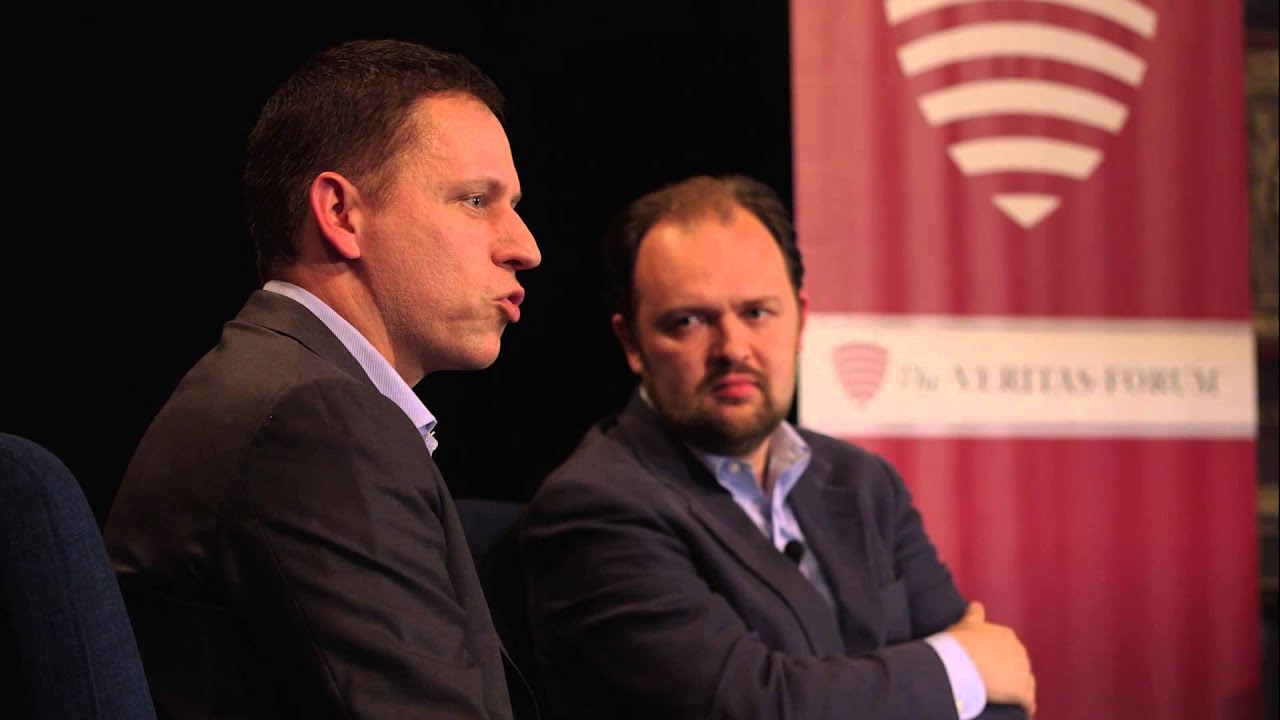 ? Has your spirituality influenced the ways you've decided you would like to leave an impact on humanity?
PT: To see the difference Girard makes, consider the Book of Revelation. It's the last thing in the New Testament. It's very strange. What could it mean to someone today? There are two common views: Secularists see a bunch of crazy gibberish that should be ignored or mocked; fundamentalists see an authentic prophecy of divine vengeance.
Girard says there is another, deeper answer: The destruction that Revelation describes is real, but we can't blame it on an angry, violent deity. We have created weapons capable of violence on a biblical scale. In the event of apocalypse, we will be responsible. Blaming the gods for our own violent acts is what humans have done throughout the whole history of religion.
But as Girard reads them, the Gospels reveal that God is not violent. He has no need to get into a fight. He is not our rival. What God actually is and what it means to be created in God's image is not something to capture in a sound bite, but it certainly begins with creation and continues with life.
BI: Is there a particular section of "Things Hidden Since the Foundation of the World" that has especially influenced you or that you suggest readers new to Girard become familiar with?
PT: There's not an easy way into "Things Hidden." It's not obscure; it's just densely packed. The best place to start reading Girard might be with whatever part of culture you're most interested in, because he's probably written about it.
If you like classic novels, read his first book, "Deceit, Desire and the Novel." If you're interested in mythology, read "Violence and the Sacred." If you like Shakespeare, read "Theater of Envy." If you know the Bible, read "I See Satan Fall Like Lightning." If you want a view of his whole career over time, look at "The Girard Reader." And if you want to immerse yourself in all his ideas at once, stick with "Things Hidden."
SEE ALSO: Billionaire Peter Thiel Explains Why He Would Tell His Younger Self To Be Less Competitive
NOW WATCH: Peter Thiel Explains Why Mentorship Is Tricky For Tech Companies
==
https://theintercept.com/2019/12/27/the-intercept-2019-technology/
bunch of stories
thiel on border
==
==
AMY GOODMAN: I’d like to go back to October, when New York Congressmember Alexandria Ocasio-Cortez questioned Facebook CEO Mark Zuckerberg about Cambridge Analytica.
REP. ALEXANDRIA OCASIO-CORTEZ: Did anyone on your leadership team know about Cambridge Analytica prior to the initial report by The Guardian on December 11, 2015?
MARK ZUCKERBERG: Congresswoman, I believe so, in that some folks were tracking it internally.
REP. ALEXANDRIA OCASIO-CORTEZ: And —
MARK ZUCKERBERG: I’m actually — as you’re asking this, I do think I was aware of Cambridge Analytica as an entity earlier. I just — I don’t know if I was tracking how they were using Facebook specifically.
REP. ALEXANDRIA OCASIO-CORTEZ: When was the issue discussed with your board member Peter Thiel?
MARK ZUCKERBERG: Congresswoman, I don’t — I don’t know that offhand.
REP. ALEXANDRIA OCASIO-CORTEZ: You don’t know. This was the largest data scandal with respect to your company, that had catastrophic impacts on the 2016 election. You don’t — you don’t know?
AMY GOODMAN: So, that’s AOC, Congressmember Alexandria Ocasio-Cortez, questioning Jeffrey [sic] Zuckerberg. Brittany Kaiser, was he telling the truth?
BRITTANY KAISER: I have found that during multiple rounds of questioning, that he —
AMY GOODMAN: Mark Zuckerberg, that is.
BRITTANY KAISER: — that Mark Zuckerberg continues to deny the amount of strategies that he is aware of, the amount of data abuses that he is aware of. And just saying that “My team will get back to you,” without being honest with the public, is a massive disaster, not only for his own PR, but for our democracies and for moving forward in a productive manner.
AMY GOODMAN: And explain what Ocasio-Cortez was getting at when she was talking about Peter Thiel.
BRITTANY KAISER: So, Peter Thiel, as far as I am aware, was the head of Trump’s technology advisory council. There were multiple meetings where Alexander Nix, the former CEO of Cambridge Analytica, was either being invited or attempting to be invited to those meetings, through the Mercers, through Kellyanne Conway, through Steve Bannon.
AMY GOODMAN: And you were with Rebekah Mercer, right, on Trump inauguration night?
BRITTANY KAISER: Absolutely. The Mercers and a lot of other people who had played a very large role in the funding and in the campaigning for Donald Trump were reaching as far as they possibly could to technology tools in order to achieve their goals.
==
https://www.rollingstone.com/politics/politics-features/dark-money-republican-party-americans-for-job-security-peter-thiel-devos-904900/
washTON — Anonymous campaign cash is as much a fixture of American politics nowadays as yard signs and awkward photos of presidential contenders eating corn dogs. Dark money may have existed well before Citizens United, but that 2010 Supreme Court decision opened the floodgates for untraceable money to soak our elections. It also left voters clueless about who was putting up the hundreds of millions of dollars spent by groups with anodyne names like Priorities USA and Americans for Prosperity.
One of the most infamous players in the dark-money game was an outfit by the name of Americans for Job Security.Founded by a Republican political operative close to Rick Perry, Americans for Job Security acted like a laundromat for wealthy donors. Instead of giving directly to a candidate or campaign and having their names disclosed, they donated to Americans for Job Security, which scrubbed their identity and spent their millions to elect Republicans across the country and push right-wing policy proposals. The group dropped $5 million in 2010 to elect dozens of new House Republicans and another $15 million in 2012 to try to defeat President Obama. It also funneled tens of millions more to state-level campaigns, including to fund the opposition to two 2012 California ballot measures to raise taxes on the very rich and weaken labor unions.
RELATED
The Trump Campaign Is Duping People Into Thinking Models Support His Re-election
Offshore Wind Energy Could Generate Enough Electricity to Power the World. Will the U.S. Get on Board?
On Friday, the mystery of who bankrolled Americans for Job Security was finally solved. After losing a seven-year legal battle, the now-defunct group revealed where its money had came from — a rare victory for clean-government groups and an even more rare glimpse at the internal workings of a dark-money juggernaut. According to documents turned over to Citizens for Responsibility and Ethics in Washington, Americans for Job Security’s donor list is a who’s-who of 1-percenters.
The biggest givers include: Investor Charles Schwab ($8.8 million); Amway co-founder and Christian conservative mega-donor Richard DeVos and wife Helen ($2 million); Peter Thiel, the libertarian investor and Trump supporter: ($500,000); casino tycoon Sheldon Adelson and wife Miriam ($500,000).
Other notable names on the donor rolls are Treasury Secretary Steven Mnuchin, former Trump cabinet secretary Linda McMahon, and members of the Fisher of the family that co-founded the Gap. The donor list also features major corporations including oil and natural gas companies Continental Resources ($1 million) and Devon Energy ($3 million), U.S. Sugar Corp ($750,000), casino conglomerate Wynn Resorts ($500,000), and Quicken Loans ($250,000).
Still, even with the new disclosures, the actual source of much of the group’s funding still remains unclear. Americans for Job Security lists as donors other nonprofit groups like Michigan Citizens for Fiscal Responsibility, Wellspring Committee, and the Koch-aligned Center to Protect Patient Rights. Think of these groups as all part of a daisy chain of nonprofits used to funnel secret money into elections.
Noah Bookbinder, executive director of Citizens for Responsibility and Ethics in Washington, tells Rolling Stonethat this is the first time that the courts forced a major dark-money group to open its books after running afoul of the nation’s campaign finance laws. “There has been this history of abuse post-Citizens United where a lot of these groups have been spending the vast majority of their money to influence politics, which is not something you’re allowed to do without registering as a political committee and disclosing your donors,” he says. “We’ve finally gotten to a place where the law was enforced.”
Bookbinder also notes that Hensel Phelps Construction, which has received billions of dollars in government contracts over a period of decades, gave $2.9 million to Americans for Job Security in 2010. At the very least, Bookbinder says, the disclosure of Hensel Phelps’ donations shows how companies with a direct financial stake in government policy have tried to influence the lawmakers who shape that policy while leaving the public in the dark.
Dark-money groups have poured nearly $1 billioninto U.S. politics since 2010, according to the Center for Responsive Politics. The biggest spenders range from the NRA’s Institute for Legislative Action, the U.S. Chamber of Commerce, and the Koch-backed Americans for Prosperity on the right end of the political spectrum to Majority Forward and the League of Conservation Voters on the left. The data show that right-leaning dark-money groups have outspent left-leaning ones in the past four election cycles.
Neil Reiff, a campaign finance lawyer who represents candidates and nonprofit groups, says he expects CREW’s legal victory over Americans for Job Security to serve as a cautionary tale for other dark-money outfits. “If the courts are moving the goalposts, I think people running outside groups are going to take notice — absolutely,” Reiff says.
To stem the tide of dark money, Democratic lawmakers have introduced multiple bills but each one of those has languished in the U.S. Senate under Majority Leader Mitch McConnell. Earlier, this year all 47 Senate Democrats threw their weight behind the For the People Act, a package of anti-corruption reforms similar to those passed by the Democratic-controlled House. McConnell has blocked that legislation as well.
Rep. Jason Crow (D-Colo.), a freshman member, introduced the End Dark Money Act as his first piece of legislation, which would reverse a Republican decision to defund the IRS’s efforts to dark-money nonprofit groups more transparent to the public. Crow says the influence of unlimited and undisclosed campaign money is an issue that comes up in town halls and constituent meetings but also among his colleagues in Congress who fear retribution from anonymous donors if they step out of line if they defy the president or the party leadership.
“Regardless of whether we’re talking about health care, gun violence, or climate change, so much of this goes back to the corrupting influence of money in politics,” Crow tells Rolling Stone. “We’ve got to clean up that system. These dark-money groups are a huge component of that.”
In This Article: Campaign Fundraising
---
https://www.alternet.org/2019/10/heres-how-techno-utopianism-decayed-into-alt-right-madness/
no lnx
Here’s how techno-utopianism decayed into alt-right madness
Written by Amanda Marcotte / Salon October 9, 2019
New Yorker writer Andrew Marantz put his sanity on the line in order to take a deep dive into two parallel worlds: the reactionary universe of the alt-right, and the technological triumphalist paradigm of Silicon Valley. The latter is responsible for selling us a utopian vision of the internet that would (supposedly) bind humanity, yet which instead has stoked political division and created, indirectly, the alt-right. In “Antisocial: Online Extremists, Techno-Utopians, and the Hijacking of the American Conversation,” Marantz offers readers an explanation as to how social networks created by idealist techies were co-opted by a rat’s nest of bigots, trolls, and fascists, who exploited the supposed “neutrality” of platforms to spread hate.
Marantz spoke to Salon about his new book and how the internet is changing democracy. This interview has been lightly edited for length and clarity.
This is a book about how the advent of social media really opened up the social and political discourse in this country to the people that Hillary Clinton aptly deemed a “basket full of deplorables.”
I think the deplorable part was more apt than the basket part. But, yeah.
How much do you think tech matters in the rise of not just the alt-right, but Donald Trump?
Tech matters hugely for the rise of Trumpism and for nationalist populism around the world. That’s not to say that it’s the only source of energy for those movements, and it’s also not to say that there aren’t huge benefits to opening up discourse in all kinds of ways.
I don’t want to paint a monochromatic picture or say that tech has only led to deleterious outcomes or antisocial outcomes, but I think for too long there was this tacit assumption among tech bros, and also just among the general public, that on the whole the internet would make the world more open and connected and set us all free and make it more fair and tolerant and generally be pro-social. And I think we’ve seen pretty definitively that that hasn’t entirely been the case.
What I like about your book is you really do talk about some of the historical antecedents to the rise of social media. This is something that I’ve been boring my friends with, pointing out, you know, it’s not like the printing press didn’t lead to violence, too.
Exactly, right. In fact, it led to many of the same kinds of violence, antisemitism, bigotry, and misinformation. None of this is new. It’s just that we’ve kind of forgotten those lessons of history.
As you said, the tech industry was very idealistic, promoting the idea that social media would connect people, would help spread good ideas. The Arab Spring was a big marketing event for social media, even as it was a real thing in the real world. Why do you think there was an unwillingness to look at the possibility that it would also give rise to hate speech, violence, bigotry, things like that?
Part of it is just that it’s uncomfortable and unpleasant to think about bigotry and hate speech. So people would rather not do it.
I’ve faced that even while reporting this book. I like to think that the book is engaging and even darkly funny. But I’ve had people indicate that they are scared to read it, because they would just rather not think about this stuff.
I think that the only way out is through, which is why I used James Baldwin as an epigraph. Nothing can be changed until it’s faced.
I happen to think this stuff isn’t as depressing as people worry it’ll be, but that’s a separate topic. But yeah, it’s not fun to think about.
Also, we tend to get stuck on this dichotomy of optimism versus pessimism, and I think that’s just the wrong way of thinking about these things. A more useful frame than either optimism or pessimism is what I refer to as contingency.
Tell me more about that.
I borrowed that concept from the philosopher Richard Rorty, who wrote one of my favorite books called “Contingency, Irony, and Solidarity.” And contingency, boiling it down a lot, just means we don’t know what’s going to happen. We can’t have a teleological view of the future. We can’t assume that things are pre-ordained to happen in a certain way. We have to look at the facts as they are and make an informed judgment about whether we’re going to inevitably have a more perfect union and inevitably make progress.
Often we just assume that those things will just happen inevitably. A more contingent view of history would suggest that they don’t happen automatically, and they don’t happen at all if you don’t work for them to happen.
In this book, you often explore your own emotions about institutions versus the “disruption” of the tech industry, and express some longing I think for some of the gatekeeping power that old institutions had before the time of social media. Having gone through the entire process of writing and publishing and now marketing this book, where do you fall on that scale right now?
I see it as a trade-off. By no means do I want to pretend that the whole gatekeeper model was perfect or even very good. It was flawed in all kinds of ways. It was run by upper middle-class white men who didn’t have a very nuanced view of the country for the most part. There were all kinds of problems with corporate control. Nothing about our past should be construed as a golden age.
It’s just that when you tear down all those structures, and don’t even try to even pretend to think about what’s going to replace them, or you replace them with something worse, then the problems don’t get better. They get worse.
Before even there was a term, the alt-right, feminists and social justice activists were observing that social media was allowing uglier forms of bigotry to flourish. A lot of the blame was kind of put on the white maleness of the tech industry, that there was a blindness of the people running it. How much do you give credence to that?
I definitely give credence to it. I think the basic critique that you can’t really readily empathize with people if you don’t have representation of all people within your company, I think is an apt critique.
But I don’t think that it would solve everything if the tech companies had diversity and inclusion statistics that accurately reflected the country. I think that would help, but I think the problems are deeper and more systemic than that.
The discourse around this particular problem has often been one of ignorance, right? There’s a sense that a lot of the white male leaders of the tech industry have progressive values.
Some of them.
On the other hand, you ran into Peter Thiel, at the DeploraBall.Do you think that’s an element of the problem right now? That we just have bad actors in tech leadership?
Well, my critique of Peter Thiel in the book was not based on his support for Trump, although I find his support for Trump extremely regrettable. My critique of him was based on the fact that I tried to engage him in a dialogue about the fundamental problems at Facebook, which arguably could not have become as successful as it is without his early investment. And instead of answering my critiques, he just left and didn’t respond to me at all. And didn’t respond to followup questions during the fact checking process.
So my critique of him is really more substantive. I mean there are lots of Trump supporters in the country, Peter Thiel being one of them. I can debate with them or decry their views,but really my issues with Thiel are that he got rich off of Facebook. I’m just curious whether he knew that there would be all these negative impacts on our society, in addition to the positive ones. And if he did know, why he didn’t do more to stop it?
Shifting over to the systematic issue, in this book you analyzed the concept of virality, which you frame in a Darwinian sense. Could you explain that more for some of the readers of Salon?
...
==
==
https://theintercept.com/2019/03/09/anduril-industries-project-maven-palmer-luckey/
no lnx
DEFENSE TECH STARTUP FOUNDED BY TRUMP’S MOST PROMINENT SILICON VALLEY SUPPORTERS WINS SECRETIVE MILITARY AI CONTRACT
Lee Fang
March 9 2019, 5:00 a.m.
In partnership with
A STARTUP FOUNDED by a young and outspoken supporter of President Donald Trump is among the latest tech companies to quietly win a contract with the Pentagon as part of Project Maven, the secretive initiative to rapidly leverage artificial intelligence technology from the private sector for military purposes.
:{:{}:
}:
Anduril Industries is the latest venture of Palmer Luckey, the 26-year-old entrepreneur best known for having founded the virtual reality firm Oculus Rift. Luckey began work on Project Mavenlast year, along with efforts to support the Defense Department’s newly formed Joint Artificial Intelligence Center, according to documents viewed by The Intercept.
The previously unreported Project Maven contract could be a boon for Anduril’s bottom line. Founded in 2017, the company has said it seeks to remake the defense contracting industry by incorporating the latest innovations of Silicon Valley into warfighting technology.
Last year, Google’s involvement with Project Maven stirred a controversy inside the tech giant. The company had signed a contract with the Defense Department to develop artificial intelligence that could interpret video images in order to improve drone targeting. But after the contract’s disclosure sparked an internal rebellion among employees, Google allowed its contract to expire. The Google flap and the wider military drive to adopt commercial artificial intelligence technology unleashed a fierce debate among tech companies about their role in society and ethics around advanced computing.
Anduril Industries is developing virtual reality technology using Lattice, a product the firm offers that uses ground- and autonomous helicopter drone-based sensors to provide a three-dimensional view of terrain. The technology is designed to provide a virtual view of the front lines to soldiers, including the ability to identify potential targets and direct unmanned military vehicles into combat. The first phase of the research has been completed, according to the documents reviewed by The Intercept, with initial plans to deploy virtual reality battlefield-management systems for the war in Afghanistan. (Anduril and the Pentagon did not respond to requests for comment.)
“We’re deployed at several military bases. We’re deployed in multiple spots along the U.S. border. We’re deployed around some other infrastructure I can’t talk about.”
Luckey dropped hints about Anduril’s involvement in the project last November in Lisbon, Portugal, at the Web Summit, a technology conference. “We’re deployed at several military bases. We’re deployed in multiple spots along the U.S. border,” Luckey said, cryptically adding: “We’re deployed around some other infrastructure I can’t talk about.” He also discussed how he hoped the military would apply Anduril’s technology.
“What we’re working on is taking data from lots of different sensors, putting it into an AI-powered sensor fusion platform so that you can build a perfect 3D model of everything that’s going on in a large area,” Luckey said. “Then we take that data and run predictive analytics on it, and tag everything with metadata, find what’s relevant, then push it to people who are out in the field.”
“Practically speaking, in the future, I think soldiers are going to be superheroes who have the power of perfect omniscience over their area of operations, where they know where every enemy is, every friend is, every asset is,” he said. Luckey said he thinks it is “unlikely” that soldiers of the future will directly carry weapons in the field; instead, they would remotely operate machines and weapons from far away.
Anduril previously garnered attention for its efforts to help U.S. Customs and Border Protection create a “virtual wall” at the U.S.-Mexico border. The initial 10-week demonstration used Anduril’s Lattice technology to monitor a stretch of land along the Rio Grande Valley. The system reportedly helped the government identify and apprehend 55 unauthorized individuals crossing the border.
The company has also publicly acknowledged work to develop perimeter defense monitoring around two U.S. Marine bases.
Anduril’s pitch deck, the presentation it provided to solicit investors, imagines a future of warfighting by means that might look like science fiction to the average observer. The company is pushing battlefield management technology capable of utilizing long-range bombers and swarms of military attack drones. The firm has reportedly rented a warehouse in Oakland, California, to develop at least one remote-control tank, designed for fighting California wildfires.
Palmer Luckey, co-founder of Oculus VR Inc., smiles during the Wall Street Journal D.Live global technology conference in Laguna Beach, California, U.S., on Monday, Nov. 12, 2018. The WSJ D.Live conference brings together investors, founders, and executives to foster innovation and drive growth within the tech industry. Photographer: Patrick T. Fallon/Bloomberg via Getty Images Palmer Luckey, founder of Anduril Industries, smiles during the Wall Street Journal D.Live global technology conference in Laguna Beach, Calif., on Nov. 12, 2018. Photo: Patrick T. Fallon/Bloomberg via Getty Images]
A Defense Contractor in Flip Flops
Palmer Luckey stands out among other defense industry executives. In contrast to the buttoned-down image of executives at Lockheed Martin or Northrop Grumman, he typically appears in public wearing flip-flops and a partially unbuttoned Hawaiian shirt. And he stands out in other ways: Unlike other tech industry leaders, Luckey is unabashedly partisan. Being an avowed supporter of the Republican Party has made him a lightning rod in Silicon Valley.
In contrast to the buttoned-down image of executives at Lockheed Martin or Northrop Grumman, Palmer Luckey typically appears in public wearing flip-flops and a partially unbuttoned Hawaiian shirt.
The son of car salesman, Luckey was homeschooled by his mother in Long Beach, California. He got his start by parlaying his passion for tinkering with video game-optimized home computers into a virtual reality business. Using funds raised on Kickstarter, Luckey developed a new model for virtual reality headsets at age 17. Four years later, he sold Oculus Rift to Facebook for over $2 billion, earning him an estimated fortune of around $700 million.
During the 2016 election, Luckey posted on pro-Trump forums on Reddit, encouraging community members to develop memes critical of Hillary Clinton. He donated $10,000 to a group called Nimble America, which paid for a billboard stating that Clinton was “Too Big to Jail.”
Amid the ensuing controversy, Palmer lost his job at Facebook, which has adamantly denied that he was let go over his political views. According to the Wall Street Journal, however, Palmer retained an employment lawyer and negotiated a $100 million payout corresponding to bonuses and stock options that he would have had if he had stayed on at Facebook.
In a detailed profile of Anduril, Wired magazine reported that Luckey was first inspired to develop a military technology company through an event hosted by billionaire investor Peter Thiel, another Silicon Valley conservative. At a 2016 retreat in Canada, Luckey met Trae Stephens, a former intelligence official who works at Thiel’s venture capital firm, Founders Fund.
The pair bonded over an interest in reshaping defense contracting using the incentives and structures of the tech startup scene. Stephens had previously worked at Palantir, the secretive data-crunching company backed by Thiel, which is known for its work on behalf of spy agencies and the military. (Both Palantir and Anduril are references to the classic fantasy trilogy “Lord of the Rings”; Anduril is the unbreakable sword used by one of the series’s protagonists.)
Thiel’s high-profile support for Trump during the 2016 election gave him influence with the new administration. Stephens, the Thiel deputy, was appointed to the group on Trump’s transition team that dealt with the new administration’s move into the Defense Department. By March 2017, Luckey had left Facebook and was ready to work with Stephens on launching a new company focused on weapons systems.
The Military-Tech Complex
Anduril needed talent, political connections, and an injection of capital. Enter the Founders Fund, Thiel’s venture capital firm. Several Palantir alumni quickly joined up. Stephens came on as Anduril’s chair and another Founders Fund partner provided seed funding. Other executives followed suit, including Brian Schimpf, the former director of engineering at Palantir, who now serves as chief executive at Anduril.
The timing of Anduril’s founding was fortuitous in many ways. Under the Obama administration, the government had begun massive efforts to swiftly incorporate commercial technology into its security efforts. In 2015, both the Department of Homeland Security and the Defense Department opened satellite offices in Silicon Valley as beachheads to coordinate partnerships with the private sector. The Defense Department opened a Defense Innovation Unit office in Mountain View, California, where Google is based. And the Homeland Security opened its Silicon Valley Innovation Program in Menlo Park, California.
In 2017, as part of an initiative that had begun the previous year, the Defense Department also unveiled the Algorithmic Warfare Cross-Functional Team, known as Project Maven, to harness the latest artificial intelligence research into battlefield technology, starting with a project to improve image recognition for drones operating in the Middle East.
This wave of outreach from the government provided a unique entry point for Anduril, which partnered with the Department of Homeland Security’s satellite office to successfully pitch its test project for the virtual wall. As Luckey recently explained to Defense and Aerospace Report, a trade publication, he also worked closely with the Pentagon’s Defense Innovation Unit, crediting its former director, Raj Shah, with making his company possible.
The Defense Innovation Unit, said Luckey, proved “that people in Silicon Valley could actually get stuff into production, actually do work with the government.” He added, “I don’t think that I would have started this company if it wasn’t for the work of people like Raj Shah doing great work and proving that you actually could get into it.”
Lobbying and Political Donations
Building out major government contracts is an inherently political endeavor — something that appears not to be lost on Luckey. Publicly filed lobbying disclosures show that Anduril paid $290,000 last year to Invariant, a lobbying firm founded by Heather Podesta, a Democratic fundraiser known for her extensive relationships in Washington, D.C., including with Hillary Clinton. The lobbying effort focused on shaping the border security appropriations issued by Congress, as well as on educating lawmakers on “artificial intelligence and autonomous systems and their application to military force protection,” according to the filings.
Luckey donated $100,000 to Trump’s inauguration through a company he founded and gave over $670,000 to congressional Republican campaign funds over the last two years.
Luckey also opened his wallet to the powers that be in Congress and the White House. He donated $100,000 to Trump’s inauguration through a company he founded and gave over $670,000 to congressional Republican campaign funds over the last two years.
Rep. Will Hurd, R-Texas, a former CIA agent turned moderate border-district lawmaker, received a $2,700 donation. Hurd worked to help Anduril find a volunteer land owner to test its sensor technology along the border, according to Wired. Hurd later sponsored legislation to finance a virtual border wall likely using Anduril’s technology.
Among his political largesse, Luckey donated to political action committees supporting Trump, the senior lawmakers on the defense and appropriations committees, and a number of controversial conservative lawmakers, including Rep. Steve King, R-Iowa, who has defended white supremacy and questioned the contributions of nonwhite people to society.
In previous interviews, Luckey has sharply criticized traditional defense contracting, noting that the iPhone and other commercial technology innovations were developed with massive incentives, rather than the “cost-plus” model preferred by the Pentagon. That approach has seen the Defense Department negotiate with contractors to provide a fixed price for expenses and profits, one that, in Luckey’s telling, has limited the military’s ability to encourage the kind of breakthrough technologies needed for the future of war.
In a white paper filed with the Defense Department’s National AI Strategic Plan last year, Anduril urged officials to consider the ambitious approach by the government in China with regard to AI technology. China, an Anduril employee wrote in the paper, has provided a “multibillion-dollar national investment initiative to support ‘moonshot’ projects, start-ups and academic research in A.I.”
Even as it seeks to shake up the model for contracts, though, Anduril is also embracing the traditional approach.
In November, the company announced its first major revolving-door hire. Anduril brought on Christian Brose, a former top staffer with the Senate Armed Services Committee, which oversees defense spending, as its head of strategy. Brose formerly worked under the late Sen. John McCain, R-Ariz., and served as a speechwriter to then-Secretary of State Condoleezza Rice. Two months later, Anduril formally joined the National Armaments Consortium, a nonprofit that facilitates bids by traditional defense contracting firms for business with the military.
Scott Sanders, head of operations for Anduril Industries, prepares a Lattice Modular Heli-Drone for a test flight at the Red Beach training area, Marine Corps Base Camp Pendleton, California, Nov. 8, 2018. The Lattice Modular Heli-Drone was being tested to demonstrate its capabilities and potential for increasing security. (U.S. Marine Corps photo by Cpl. Dylan Chagnon) Scott Sanders, head of operations for Anduril Industries, prepares a Lattice Modular Heli-Drone for a test flight at the Red Beach training area, Marine Corps Base Camp Pendleton, Calif., on Nov. 8, 2018. Photo: Cpl. Dylan Chagnon/U.S. Marine Corps]
No “Digital Geneva Convention”
As the military worked to bring in leading Silicon Valley firms as contractors, the resulting relationships have sparked massive resistance from workers, many of whom have argued that they became engineers to make the world a better place, not a more violent one.
After the The Intercept and other media outlets revealed that Google had been quietly tapped to work on Project Maven, applying its AI technology to help analysts identify drone targets on the battlefield, thousands of workers protested the contract.
The uprising led Google to announce that it would not renew its contract with the military on the initiative. Microsoft, too, faced internal opposition as the company prepared work on a $480 million contract with the Army to develop augmented reality headsets for soldiers.
The ethical debates that have rocked large technology companies — Amazon, Salesforce, and others have similarly faced worker protests over contracts on immigration enforcement — have presented Anduril with an opportunity.
Despite the various protests around Silicon Valley, Anduril’s brash attitude has not prevented it from recruiting top engineering talent. In its white paper filed with the Defense Department’s National AI Strategic Plan last year, Anduril boasted that it has recruited engineers from top tech firms like General Atomics, SpaceX, Tesla, and Google.
In an opinion column for the Washington Post, Luckey and Stephens sharply criticized Google for abandoning the U.S. government by rejecting Project Maven. “We understand that tech workers want to build things used to help, not harm,” the pair wrote. “We feel the same way. But ostracizing the U.S. military could have the opposite effect of what these protesters intend: If tech companies want to promote peace, they should stand with, not against, the United States’ defense community.”
What was left out of the column, however, was that, as the piece went to print, Anduril was beginning its own work on Project Maven.
In Anduril, Luckey is presenting a company that is unapologetic about its work capturing immigrants or killing people on the battlefield.
In interviews and public appearances, Luckey slammed engineers for protesting government work, arguing that those claiming conscious opposition to military work are among a “vocal minority” that empowers American adversaries abroad. Moreover, he said that the Defense Department has failed to connect with top tech talent because many engineers are “stuck in Silicon Valley at companies that don’t want to work on national security.”
In Anduril, Luckey is presenting a company that is unapologetic about its work capturing immigrants or killing people on the battlefield. The U.S., Luckey argued in a previous interviews, “has a really strong record of protecting human rights” and should be trusted to use AI without any ethical constraints.
“The biggest threats are not going to be Western democracies abusing these technologies,” he told the audience at the Web Summit in Lisbon. The real enemies are China and Russia, both of which have invested in AI military technology.
China is not only investing in AI, but has unfair advantages to develop the technology using its entire population as a data training set through use of mass surveillance to run experiments. In contrast, Luckey told Defense and Aerospace Report, the U.S. can train its AI software “in industry, in enterprise, in national security.” The U.S., Luckey went on, could test AI “using our current military advantage to train future AI developments and we need to start using our current military advantage.” He called for employing these technologies in ongoing “large-scale conflicts” around the world.
Asked in Lisbon about a digital Geneva Convention or another ethical rulebook to govern the use of AI weaponry, Luckey was forthright in his rejection of the idea.
“That’s not really going to solve the problem,” he said. “I have no hopes that a digital Geneva Convention, whatever it will be, will prevent China from using surveillance tools to watch every citizen in their country. I have very little confidence that it will prevent Russia from building autonomous systems that can acquire and fire on targets without any kind of human intervention whatsoever.”
Ethics experts have criticized the development of AI-based weapons, noting that the lethal autonomous weapons could be hijacked by hackers, kill without clear explanation, or lead to catastrophic accidental conflict if weapons are used as escalation in response to an incident that appears to be an act of war. Moreover, as humans are removed from face-to-face combat, the dehumanization of lethal decisions could lead to more killing.
Luckey hasn’t proffered any direct answers to the questions being raised over the use of artificial intelligence in warfighting. Anduril, however, has stated that it will not sell to Russia or China, but would be willing to sell its products to U.S. allies. A request for comment about whether the company would sell to Saudi Arabia, the United Arab Emirates, or other undemocratic U.S. allies was not returned.
Among the many Palantir alumni who joined Anduril, one name sticks out to those concerned with abuse of civil liberties and human rights. In May of last year, the firm hired former Palantir executive Matthew Steckman.
Steckman took a lead role in the HBGary Federal scandal in 2011. In the scandal, a cache of hacked emails showed that Palantir and two other defense contractors had cooked up a plot to spy on journalists, trade unions, and activists on behalf of the U.S. Chamber of Commerce, the largest pro-business lobby in America. The plot included hacking target computers and using social media analysis to monitor the behaviors of a large set of left-leaning figures and journalists viewed as sympathetic to Wikileaks, including The Intercept’s Glenn Greenwald. In negotiations with the Chamber’s law firm, Steckman wrote at the time that he and another Palantir executive were “spearheading this from the Palantir side.”
After the plan was revealed, Palantir briefly placed Steckman on leave. He is now at work as head of corporate and government affairs at Anduril.
One thing is clear: Luckey wants to win — in every way imaginable. The U.S.’s goal, Luckey said at the Web Summit, should be dominance and beating other foreign adversaries to control the best artificial intelligence technology. “You have to be the leader,” he said. “Technological superiority is a prerequisite for ethical superiority.”
Nick Surgey contributed research.
==
omg no lnx
https://yyy.theguardian.com/news/2018/feb/15/why-silicon-valley-billionaires-are-prepping-for-the-apocalypse-in-new-zealand
The long read
Why Silicon Valley billionaires are prepping for the apocalypse in New Zealand
How an extreme libertarian tract predicting the collapse of liberal democracies – written by Jacob Rees-Mogg’s father – inspired the likes of Peter Thiel to buy up property across the Pacific
by Mark O'Connell
Thu 15 Feb 2018 01.01 EST Last modified on Tue 18 Dec 2018 06.56 EST
If you’re interested in the end of the world, you’re interested in New Zealand. If you’re interested in how our current cultural anxieties – climate catastrophe, decline of transatlantic political orders, resurgent nuclear terror – manifest themselves in apocalyptic visions, you’re interested in the place occupied by this distant archipelago of apparent peace and stability against the roiling unease of the day.
If you’re interested in the end of the world, you would have been interested, soon after Donald Trump’s election as US president, to read a New York Times headline stating that Peter Thiel, the billionaire venture capitalist who co-founded PayPal and was an early investor in Facebook, considered New Zealand to be “the Future”. Because if you are in any serious way concerned about the future, you’re also concerned about Thiel, a canary in capitalism’s coal mine who also happens to have profited lavishly from his stake in the mining concern itself.
Thiel is in one sense a caricature of outsized villainy:he was the only major Silicon Valley figure to put his weight behind the Trump presidential campaign; he vengefully bankrupted a website because he didn’t like how they wrote about him; he is known for his public musings about the incompatibility of freedom and democracy, and for expressing interest – as though enthusiastically pursuing the clunkiest possible metaphor for capitalism at its most vampiric – in a therapy involving transfusions of blood from young people as a potential means of reversing the ageing process. But in another, deeper sense, he is pure symbol: less a person than a shell company for a diversified portfolio of anxieties about the future, a human emblem of the moral vortex at the centre of the market.
It was in 2011 that Thiel declared he’d found “no other country that aligns more with my view of the future than New Zealand”. The claim was made as part of an application for citizenship; the application was swiftly granted, though it remained a secret for a further six years. In 2016, Sam Altman, one of Silicon Valley’s most influential entrepreneurs, revealed to the New Yorker that he had an arrangement with Thiel whereby in the eventuality of some kind of systemic collapse scenario – synthetic virus breakout, rampaging AI, resource war between nuclear-armed states, so forth – they both get on a private jet and fly to a property Thiel owns in New Zealand. (The plan from this point, you’d have to assume, was to sit out the collapse of civilisation before re-emerging to provide seed-funding for, say, the insect-based protein sludge market.)
In the immediate wake of that Altman revelation, Matt Nippert, a reporter for the New Zealand Herald, began looking into the question of how exactly Thiel had come into possession of this apocalypse retreat, a 477-acre former sheep station in the South Island – the larger, more sparsely populated of the country’s two major landmasses. Foreigners looking to purchase significant amounts of New Zealand land typically have to pass through a stringent government vetting process. In Thiel’s case, Nippert learned, no such process had been necessary, because he was already a citizen of New Zealand, despite having spent no more than 12 days in the country up to that point, and having not been seen in the place since. He didn’t even need to travel to New Zealand to have his citizenship conferred, it turned out: the deal was sealed in a private ceremony at a consulate handily located in Santa Monica.
When Nippert broke the story, there was a major public scandal over the question of whether a foreign billionaire should be able to effectively purchase citizenship. As part of his application, Thiel had agreed to invest in New Zealand tech startups, and had implied that he would use his new status as a naturalised Kiwi to promote the country’s business interests abroad. But the focus internationally was on why Thiel might have wanted to own a chunk of New Zealand roughly the size of lower Manhattan in the first place. And the overwhelming suspicion was that he was looking for a rampart to which he could retreat in the event of outright civilisational collapse.
Because this is the role that New Zealand now plays in our unfurling cultural fever dream: an island haven amid a rising tide of apocalyptic unease. According to the country’s Department of Internal Affairs, in the two days following the 2016 election the number of Americans who visited its website to enquire about the process of gaining New Zealand citizenship increased by a factor of 14 compared to the same days in the previous month. In particular, New Zealand has come to be seen as a bolthole of choice for Silicon Valley’s tech elite.
In the immediate aftermath of Trump’s election, the theme of American plutocrats preparing for the apocalypse was impossible to avoid. The week after the inauguration, the New Yorker ran another piece about the super-rich who were making preparations for a grand civilisational crackup; speaking of New Zealand as a “favored refuge in the event of a cataclysm”,billionaire LinkedIn founder Reid Hoffman, a former colleague of Thiel’s at PayPal, claimed that “saying you’re ‘buying a house in New Zealand’ is kind of a wink, wink, say no more”.
Everyone is always saying these days that it’s easier to imagine the end of the world than the end of capitalism. Everyone is always saying it, in my view, because it’s obviously true. The perception, paranoid or otherwise, that billionaires are preparing for a coming civilisational collapse seems a literal manifestation of this axiom. Those who are saved, in the end, will be those who can afford the premium of salvation. And New Zealand, the furthest place from anywhere, is in this narrative a kind of new Ararat: a place of shelter from the coming flood. [van JONES KATRINA FREE MKT EVACUATION PLAN]
Early last summer, just as my interests in the topics of civilisational collapse and Peter Thiel were beginning to converge into a single obsession, I received out of the blue an email from a New Zealand art critic named Anthony Byrt. If I wanted to understand the extreme ideology that underpinned Thiel’s attraction to New Zealand, he insisted, I needed to understand an obscure libertarian manifesto called The Sovereign Individual: How to Survive and Thrive During the Collapse of the Welfare State. It was published in 1997, and in recent years something of a minor cult has grown up around it in the tech world, largely as a result of Thiel’s citing it as the book he is most influenced by. (Other prominent boosters include Netscape founder and venture capitalist Marc Andreessen, and Balaji Srinivasan, the entrepreneur best known for advocating Silicon Valley’s complete secession from the US to form its own corporate city-state.)
The Sovereign Individual’s co-authors are James Dale Davidson, a private investor who specialises in advising the rich on how to profit from economic catastrophe, and the late William Rees-Mogg, long-serving editor of the Times. (One other notable aspect of Lord Rees-Mogg’s varied legacy is his own son, the Conservative MP Jacob Rees-Mogg – a hastily sketched caricature of an Old Etonian, who is as beloved of Britain’s ultra-reactionary pro-Brexit right as he is loathed by the left.)
I was intrigued by Byrt’s description of the book as a kind of master key to the relationship between New Zealand and the techno-libertarians of Silicon Valley. Reluctant to enrich Davidson or the Rees-Mogg estate any further, I bought a used edition online, the musty pages of which were here and there smeared with the desiccated snot of whatever nose-picking libertarian preceded me.
It presents a bleak vista of a post-democratic future. Amid a thicket of analogies to the medieval collapse of feudal power structures, the book also managed, a decade before the invention of bitcoin, to make some impressively accurate predictions about the advent of online economies and cryptocurrencies.
The book’s 400-odd pages of near-hysterical orotundity can roughly be broken down into the following sequence of propositions:
:{:{}:
}:
1) The democratic nation-state basically operates like a criminal cartel, forcing honest citizens to surrender large portions of their wealth to pay for stuff like roads and hospitals and schools.
:{:{}:
}:
2) The rise of the internet, and the advent of cryptocurrencies, will make it impossible for governments to intervene in private transactions and to tax incomes, thereby liberating individuals from the political protection racket of democracy.
:{:{}:
}:
3) The state will consequently become obsolete as a political entity.
:{:{}:
}:
4) Out of this wreckage will emerge a new global dispensation, in which a “cognitive elite” will rise to power and influence, as a class of sovereign individuals “commanding vastly greater resources” who will no longer be subject to the power of nation-states and will redesign governments to suit their ends.
:{:{}:
}:
The Sovereign Individual is, in the most literal of senses, an apocalyptic text. Davidson and Rees-Mogg present an explicitly millenarian vision of the near future: the collapse of old orders, the rising of a new world. Liberal democracies will die out, and be replaced by loose confederations of corporate city-states. Western civilisation in its current form, they insist, will end with the millennium. “The new Sovereign Individual,” they write, “will operate like the gods of myth in the same physical environment as the ordinary, subject citizen, but in a separate realm politically.” It’s impossible to overstate the darkness and extremity of the book’s predictions of capitalism’s future; to read it is to be continually reminded that the dystopia of your darkest insomniac imaginings is almost always someone else’s dream of a new utopian dawn.
Davidson and Rees-Mogg identified New Zealand as an ideal location for this new class of sovereign individuals, as a “domicile of choice for wealth creation in the Information Age”. Byrt, who drew my attention to these passages, had even turned up evidence of a property deal in the mid-1990s in which a giant sheep station at the southern tip of the North Island was purchased by a conglomerate whose major shareholders included Davidson and Rees-Mogg. Also in on the deal was one Roger Douglas, the former Labour finance minister who had presided over a radical restructuring of New Zealand economy along neoliberal lines in the 1980s. (This period of so-called “Rogernomics”, Byrt told me – the selling off of state assets, slashing of welfare, deregulation of financial markets – created the political conditions that had made the country such an attractive prospect for wealthy Americans.)
Thiel’s interest in New Zealand was certainly fuelled by his JRR Tolkien obsession: this was a man who had named at least five of his companies in reference to The Lord of the Rings, and fantasised as a teenager about playing chess against a robot that could discuss the books. It was a matter, too, of the country’s abundance of clean water and the convenience of overnight flights from California. But it was also inseparable from a particular strand of apocalyptic techno-capitalism. To read The Sovereign Individual was to see this ideology laid bare: these people, the self-appointed “cognitive elite”, were content to see the unravelling of the world as long as they could carry on creating wealth in the end times.
I was struck by how strange and disquieting it must have been for a New Zealander to see their own country refracted through this strange apocalyptic lens. There was certainly an ambient awareness that the tech world elite had developed an odd interest in the country as an ideal end-times bolthole; it would have been difficult, at any rate, to ignore the recent cascade of articles about Thiel acquiring citizenship, and the apocalyptic implications of same. But there seemed to have been basically zero discussion of the frankly alarming ideological dimension of it all.
It was just this ideological dimension, as it happened, that was the focus of a project Byrt himself had recently got involved in, a new exhibition by the artist Simon Denny. Denny, a significant figure in the international art scene, was originally from Auckland, but has lived for some years in Berlin. Byrt described him as both “kind of a genius” and “the poster-boy for post-internet art, whatever that is”; he characterised his own role in the project with Denny as an amalgamation of researcher, journalist and “investigative philosopher, following the trail of ideas and ideologies”.
The exhibition was called The Founder’s Paradox, a name that came from the title of one of the chapters in Thiel’s 2014 book, Zero to One: Notes on Startups, or How to Build the Future. Together with the long and intricately detailed catalogue essay Byrt was writing to accompany it, the show was a reckoning with the future that Silicon Valley techno-libertarians like Thiel wanted to build, and with New Zealand’s place in that future.
These were questions I too was eager to reckon with. Which is to say that I myself was interested – helplessly, morbidly – in the end of the world, and that I was therefore interested in New Zealand. And so I decided to go there, to see for myself the land that Thiel had apparently set aside for the collapse of civilisation: a place that would become for me a kind of labyrinth, and whose owner I was already beginning to mythologise as the monster at its centre.
...
==
Big Peter Thiel donation shows he’s still with Trump
Billionaire entrepreneur was top donor to the Trump Victory Committee
By Levi Sumagaysay
lsumagaysay@bayareanewsgroup.com
Tech billionaire investor Peter Thiel has again put his money where his mouth is: He’s still with Trump.
With $250,000, Thiel was the biggest donor to the Trump Victory Committee in the most recent quarter, a new Federal Election Commission filing shows.
:{:{}:
}:
The donation, dated July 10, appears to be the first donation by Thiel to the organization since the 2016 presidential campaign, when he forked over more than $1 million. He also donated $101,700 to the Republican National Committee July 10, according to a previously released FEC filing.
Thiel, of PayPal Mafia fame and one of Silicon Valley’s most high-profile supporters of President Donald Trump, was joined in this round of donations by United States Steel, which gave $100,000, and Trump attorney Mark Kasowitz, who gave $50,000, and a plethora of retired individuals from around the nation.
Overall, the Trump campaign raked in in $18.1 million last quarter through his campaign committee and two joint committees with the Republican National Committee. He has raised about $106 million since he came into office, according to the Washington Post.
It is unclear what kind of role, if any, Thiel plays in the Trump administration. He played a role during the presidential transition, but there have been reports that he later became critical of the president. Earlier this year, he said during a newspaper interview that “It’s been a crazier two years than I would have thought… There are all these ways that things have fallen short.” But he said he had no regrets about supporting Trump, because “It’s still better than Hillary Clinton or the Republican zombies.” Over the summer, Thiel compared Silicon Valley — which conservatives decry as too liberal — to North Korea, calling it a “oneparty state.” In the July-September quarter, the Victory campaign transferred money to the Republican National Committee, plus spent money on travel expenses, marketing and about $120,000 on the digital consulting services of Parscale Strategy.
Brad Parscale was the digital media director for Trump’s 2016 presidential campaign who famously said on “60 Minutes” that Facebook “embeds” — employees who help campaigns use the company’s ad-targeting tools more effectively — helped propel Trump to victory. Parscale is now leading Trump’s 2020 campaign.
A spokesman for Thiel — who was Facebook’s first outside investor and remains a board director of the social media giant — didnot return a request for comment.
==
problem?
https://YYY.theguardian.com/media/2016/jun/05/peter-thiel-gawker-lawsuits-james-okeefe-acorn
thrasher june 2016
Peter Thiel's Gawker war not his first brush with a high-priced vendetta
Billionaire’s investment in conservative James O’Keefe’s ‘sting’ video may have had a long-term – and negative – impact on progressive causes
Steven W Thrasher
Peter Thiel has been a longtime conservative champion, backing GoProud, a now defunct lobbying body for gay Republicans sick of the ‘centrist’ Log Cabin Republicans. Photograph: Getty Images for New York Times
Watching Peter Thiel, the libertarian billionaire, waging war on Gawker Media has reminded me that there was a time when Thiel himself backed another controversial media figure famed for causing outrage in his pursuit of the “truth” – conservative “film-maker” James O’Keefe.
:{:{}:
}:
Thiel, who has been in the news in the past week for underwriting the legal fees of Hulk Hogan’s lawsuit against Gawker, has sparked a heated debate about the free speech implications of a billionaire using his cash to muzzle media organizations.
:{:{}:
}:
But he has also used his money to fund people who set out to greatly harm progressive causes including public media, housing for poor people, and rational perceptions about immigrants and voting.
:{:{}:
}:
In 2009 Thiel invested in O’Keefe, a conservative agitator whose undercover videos (some dishonestly edited to present things that never happened or just plain wrong) were used to undermine liberal causes.
:{:{}:
}:
Before admitting to backing Gawker’s biggest lawsuit, Thiel was best known – as much as the billionaire was known at all outside Silicon Valley – as an early investor in companies such as PayPal and Facebook.
:{:{}:
}:
He also has been a longtime champion of conservative causes, backing GoProud, a now defunct lobbying body for gay Republicans sick of the “centrist” Log Cabin Republicans.
:{:{}:
}:
But his early investment in O’Keefe (who has since pleaded guilty to breaking into a US senator’s office and paid $100,000 to a victim of his smears) may have had the most long-term – and negative – impact.
:{:{}:
}:
:{:{}:
}:
Jeff Bezos on Peter Thiel: 'Seek revenge and you should dig two graves'
Read more
Shortly after I began working as a writer at the Village Voice in 2009, O’Keefe was in the news for making his first breakout “sting” video, which seemed to show him dressed as a pimp and conservative blogger Hannah Giles dressed as a prostitute. They appeared to approach various offices of Acorn (the Association of Community Organizers for Reform Now, one of the most powerful grassroots organizations for poor brown and black people which did important work with voter registration and housing access) to ask for their assistance in avoiding taxes, which they seem to get.
:{:{}:
}:
Eventually, the videos were debunked – but not until they had done tremendous damage. As I wrote in 2010:
:{:{}:
}:
O’Keefe had carefully edited his tapes and left out, for example, that he was decked out in college preppie clothes, not pimp-wear. At least one Acorn office threw him out, and at least two knowingly played along with his ruse. (The San Diego office called the cops after he left, and the Philadelphia office filed a police report.) The upshot was that after his edited tapes became public, Congress quickly voted to strip ACORN of all federal funds. The organization effectively went out of business before the bill could take effect or be thrown out in court.”
:{:{}:
}:
O’Keefe later made outrageous, selectively edited videos that would lead to significant outcomes, like the ousting of NPR’s CEO, even though that video was thoroughly debunked when the raw video was seen. But going back to 2009, I got a tip that O’Keefe was not “absolutely independent”, as he claimed, but that he had received funding from one Peter Thiel for a video he’d made earlier in the year called “Taxpayers Clearing House”.
:{:{}:
}:
:{:{}:
}:
O’Keefe’s Thiel-backed Taxpayer’s Clearing House video
The opening of Taxpayers Clearing House is pretty racially offensive. As Wagner’s Ride of the Valkyrie plays, O’Keefe rides around in a van that looks like the Publisher’s Clearing House Prize Patrol, a well-known American sweepstakes that surprises entrants with a $1m prize. He approaches unsuspecting black and brown people in their homes, duped into thinking they are going to win money when he rings their bell. Instead, he presents them with a bill for $28,000 – the portion of their bill, he says, for the 2008 bailout of Wall Street banks. The whole thing is framed to make minorities look stupid, dumb and greedy.
:{:{}:
}:
:{:{}:
}:
Sign up to the Media Briefing: news for the news-makers
Read more
Asked about Thiel’s involvement, his spokesman James O’Neill, that the billionaire had provided O’Keefe with “about $10,000” to make the video through a “small-government group”. He also denied Thiel had involvement with the Acorn videos, adding that he’d only “watched them on YouTube” and “he shares the view that taxpayer money should not promote human trafficking”. (No taxpayer money was ever used to promote human trafficking.)
:{:{}:
}:
This incident reveals a few things about Thiel’s reach, the scale of his attacks on liberal politics, and the effectiveness of both outside the domains of traditional press and presidential politics.
:{:{}:
}:
While Thiel did not directly fund the Acorn videos, he funded the film-maker who did shortly before they were made; those videos not only managed to destroy Acorn, but they helped Republicans keep voting to defund it for years after it was dead and to convince that Acorn had stolen the election for Obama in 2008.
:{:{}:
}:
Would O’Keefe have been able to get that video made, as widely seen, and effectively considered but for Thiel’s startup funding? It’s a counterfactual. But if we are to take seriously the idea that Thiel’s initial half-million-dollar investment in Facebook entitles him to a portion of the value of the company that dominates so much everyday life today, we must also seriously consider that his startup investment in O’Keefe has had a handsome return on investment, too.
:{:{}:
}:
The only living Trump supporter in Silicon Valley
John Naughton
Read more
Fast forwarding to the Gawker case, Thiel ominously told the New York Times that he “refused to divulge exactly what other [media lawsuit] cases he has funded but said, ‘It’s safe to say this is not the only one.’” So there are an unknown number of media lawsuits he has going on. In 2009, the already billionaire mogul was willing to give a paltry $10,000 to an unknown video troublemaker, who has done a great deal of damage to progressive politics. How many things is he involved with? Only Thiel knows, and we can only wait to find out.
:{:{}:
}:
It’s fitting that Thiel funded the crude Taxpayers Clearing House video in 2009. Shortly after O’ Keefe’s video came out, for the libertarian Cato institute complaining that: “Since 1920, the vast increase in welfare beneficiaries and the extension of the franchise to women – two constituencies that are notoriously tough for libertarians – have rendered the notion of ‘capitalist democracy’ into an oxymoron.” With that in mind it makes ideological sense that he should align himself with O’Keefe, both early warriors in the backlash against the Voting Rights Act that grew during the Obama years.
:{:{}:
}:
Thiel is a Trump delegate. Trump too has warned he’ll crack down on the press if elected. But the power of a billionaire like Thiel doesn’t just expose problems with the freedom of the press in general or Gawker specifically. It is easy to argue that Gawker’s woes are of its own making – Thiel and others, (said by some to have triggered his initial rage), and publishing sex tapes without permission isn’t exactly going to win a lot of public sympathy (disclosure – I’ve written for them a couple of times years ago and have friends who work there).
:{:{}:
}:
What Thiel has exposed is that the problem with American politics (and America in general) is capitalism. Unfettered capitalism lets the Thiels of the world do what they want, largely when they want, and largely legally. If a plutocrat , they probably can. If they want to circumvent even America’s toothless gun restrictions by , they can do that, too. We are almost powerless to stop anything we have learned about Peter Thiel; he has the money and power to legally stave off financial competitors, fund foot soldiers to strike down community organizers, and (almost as an afterthought) deeply influence the media and presidential politics.
:{:{}:
}:
This is what American capitalism creates.
:{:{}:
}:
==
---
Tech Firms
ICE also contracts with technology and software companies, including Silicon Valley firms and defense contractors, for tools to help track, arrest and monitor those suspected of violating immigration laws.
Palantir Technologies, a data analytics firm, has never reported a profit since its founding in 2003. The company has come to rely on lucrative, long-lasting contracts with government agencies, including ICE, seeking to make use of its tools.
Since 2014, Palantir has received just under $100 million in ICE funding for both case management software and a customized data analytics tool called FALCON-SA, which helps ICE track and arrest individuals suspected of being in the country illegally.
Palantir’s largest contract — $53 million to provide software services — was awarded in 2014 during the height of the Central American refugee crisis and is ongoing through 2019. The company’s most recent ICE contract was $250,000 for the purchase of another software program called Gotham.
The bulk of Palantir’s political spending can be attributed to Peter Thiel, the group’s founder, who contributed about $1.3 million in 2016 to groups supporting Trump’s election and $100,000 to the president’s inauguration.
Thiel’s support for the president during the campaign ultimately landed him a spot on Trump’s transition team.
Palantir is also heavily invested in the D.C. influence culture through its lobbying activities, which peaked last year at $1.4 million. The majority of the money was directed toward securing government contracts.Thiel and Palantir’s lobbying appears to have paid dividends beyond the contracts awarded by ICE.
The company also won an $876 million defense contract this year.
Microsoft,another tech giant fulfilling contracts for ICE, has recently encountered backlash from employees over its relationship with the controversial agency. In an open letter first published by The New York Times, more than 100 employees argued that the contracting work was a “clear abdication of ethical responsibilities.”
Other major ICE contractors include big names in defense contracting.
Booz Allen Hamilton has been a perennial ICE contractor, having received contracts to support the Law Enforcement Systems and Analysis division, which is the main data analysis office ensuring the agency’s detainee processing and enforcement systems are working efficiently. Peter Thiel is giving up on Silicon Valley and moving his firm to Los Angeles, and according to the Wall Street Journal, his reasons are politically motivated.
Thiel has told friends he’s frustrated with the Bay Area’s reluctance to accept his conservative beliefs. Per the Journal:
Mr. Thiel has grown more disaffected by what he sees as the intolerant, left-leaning politics of the San Francisco Bay Area, and increasingly pessimistic about the prospects for tech businesses amid greater risk of regulation, they said.
“Silicon Valley is a one-party state,” Thiel said in January, at Stanford University. “That’s when you get in trouble politically in our society, when you’re all in one side.”
He’s also considering giving up his spot on Facebook’s board of directors, where he’s drawn public criticism from his co-directors for his views.
Thiel was a prominent donor to Trump's presidential campaign and served on the Trump administration’s transition team as an adviser. The president has told Thiel that the two will be "friends for life."
Media critic and NYU professor Jay Rosen provided the perfect response to Thiel’s woe-is-me complaint: Many "Silicon Valley is inhospitable to conservatives" stories should be "the conservative movement is inhospitable to science and fact-based debate" stories. xx pt is relocating... xa...face="Times New Roman" color="#000000">===
guard no link
Watching Peter Thiel, the libertarian billionaire, waging war on Gawker Media has reminded me that there was a time when Thiel himself backed another controversial media figure famed for causing outrage in his pursuit of the “truth” –conservative “film-maker” James O’Keefe.
Thiel, who has been in the news in the past week for underwriting the legal fees of Hulk Hogan’s lawsuit against Gawker, has sparked a heated debate about the free speech implications of a billionaire using his cash to muzzle media organizations.
But he has also used his money to fund people who set out to greatly harm progressive causes including public media, housing for poor people, and rational perceptions about immigrants and voting.
In 2009 Thiel invested in O’Keefe, a conservative agitator whose undercover videos (some dishonestly edited to present things that never happened or just plain wrong) were used to undermine liberal causes.
Before admitting to backing Gawker’s biggest lawsuit, Thiel was best known – as much as the billionaire was known at all outside Silicon Valley – as an early investor in companies such as PayPal and Facebook.
He also has been a longtime champion of conservative causes, backing GoProud, a now defunct lobbying body for gay Republicans sick of the “centrist” Log Cabin Republicans.
But his early investment in O’Keefe (who has since pleaded guilty to breaking into a US senator’s office and paid $100,000 to a victim of his smears) may have had the most long-term – and negative – impact.
Jeff Bezos on Peter Thiel: 'Seek revenge and you should dig two graves'
Read more
Shortly after I began working as a writer at the Village Voice in 2009, O’Keefe was in the news for making his first breakout “sting” video, which seemed to show him dressed as a pimp and conservative blogger Hannah Giles dressed as a prostitute. They appeared to approach various offices of Acorn (the Association of Community Organizers for Reform Now, one of the most powerful grassroots organizations for poor brown and black people which did important work with voter registration and housing access) to ask for their assistance in avoiding taxes, which they seem to get.
Eventually, the videos were debunked – but not until they had done tremendous damage. As I wrote in 2010:
O’Keefe had carefully edited his tapes and left out, for example, that he was decked out in college preppie clothes, not pimp-wear. At least one Acorn office threw him out, and at least two knowingly played along with his ruse. (The San Diego office called the cops after he left, and the Philadelphia office filed a police report.) The upshot was that after his edited tapes became public, Congress quickly voted to strip ACORN of all federal funds. The organization effectively went out of business before the bill could take effect or be thrown out in court.”
O’Keefe later made outrageous, selectively edited videos that would lead to significant outcomes, like the ousting of NPR’s CEO, even though that video was thoroughly debunked when the raw video was seen. But going back to 2009, I got a tip that O’Keefe was not “absolutely independent”, as he claimed, but that he had received funding from one Peter Thiel for a video he’d made earlier in the year called “Taxpayers Clearing House”.
O’Keefe’s Thiel-backed Taxpayer’s Clearing House video
The opening of Taxpayers Clearing House is pretty racially offensive. As Wagner’s Ride of the Valkyrie plays, O’Keefe rides around in a van that looks like the Publisher’s Clearing House Prize Patrol, a well-known American sweepstakes that surprises entrants with a $1m prize. He approaches unsuspecting black and brown people in their homes, duped into thinking they are going to win money when he rings their bell. Instead, he presents them with a bill for $28,000 – the portion of their bill, he says, for the 2008 bailout of Wall Street banks. The whole thing is framed to make minorities look stupid, dumb and greedy.
Asked about Thiel’s involvement, his spokesman James O’Neill, told me that the billionaire had provided O’Keefe with “about $10,000” to make the video through a “small-government group”. He also denied Thiel had involvement with the Acorn videos, adding that he’d only “watched them on YouTube” and “he shares the view that taxpayer money should not promote human trafficking”. (No taxpayer money was ever used to promote human trafficking.)
This incident reveals a few things about Thiel’s reach, the scale of his attacks on liberal politics, and the effectiveness of both outside the domains of traditional press and presidential politics.
While Thiel did not directly fund the Acorn videos, he funded the film-maker who did shortly before they were made; those videos not only managed to destroy Acorn, but they helped Republicans keep voting to defund it for years after it was dead and to convince half of Republican voters in 2012 that Acorn had stolen the election for Obama in 2008.
Would O’Keefe have been able to get that video made, as widely seen, and effectively considered but for Thiel’s startup funding? It’s a counterfactual. But if we are to take seriously the idea that Thiel’s initial half-million-dollar investment in Facebook entitles him to a portion of the value of the company that dominates so much everyday life today, we must also seriously consider that his startup investment in O’Keefe has had a handsome return on investment, too.
Fast forwarding to the Gawker case, Thiel ominously told the New York Times that he “refused to divulge exactly what other [media lawsuit] cases he has funded but said, ‘It’s safe to say this is not the only one.’” So there are an unknown number of media lawsuits he has going on. In 2009, the already billionaire mogul was willing to give a paltry $10,000 to an unknown video troublemaker, who has done a great deal of damage to progressive politics. How many things is he involved with? Only Thiel knows, and we can only wait to find out.
It’s fitting that Thiel funded the crude Taxpayers Clearing House video in 2009. Shortly after O’ Keefe’s video came out, Thiel wrote an essay for the libertarian Cato institute complaining that: “Since 1920, the vast increase in welfare beneficiaries and the extension of the franchise to women – two constituencies that are notoriously tough for libertarians – have rendered the notion of ‘capitalist democracy’ into an oxymoron.” With that in mind it makes ideological sense that he should align himself with O’Keefe, both early warriors in the backlash against the Voting Rights Act that grew during the Obama years.
Thiel is a Trump delegate. Trump too has warned he’ll crack down on the press if elected. But the power of a billionaire like Thiel doesn’t just expose problems with the freedom of the press in general or Gawker specifically. It is easy to argue that Gawker’s woes are of its own making – outing Thiel and others, (said by some to have triggered his initial rage), and publishing sex tapes without permission isn’t exactly going to win a lot of public sympathy (disclosure – I’ve written for them a couple of times years ago and have friends who work there).
What Thiel has exposed is that the problem with American politics (and America in general) is capitalism. Unfettered capitalism lets the Thiels of the world do what they want, largely when they want, and largely legally. If a plutocrat wants to build a private island free from government influence, they probably can. If they want to circumvent even America’s toothless gun restrictions by supporting a 3D printer for guns, they can do that, too. We are almost powerless to stop anything we have learned about Peter Thiel; he has the money and power to legally stave off financial competitors, fund foot soldiers to strike down community organizers, and (almost as an afterthought) deeply influence the media and presidential politics.
This is what American capitalism creates.
---
==
http://www.alternet.org/right-wing/noxious-combination-racism-alt-right-and-upper-class
...Racism has always permeated this country up and down the income scale. And in our era of extreme concentration of economic and political power, emboldening just a few men at the top can be tremendously dangerous.
Take, for example, three of the country’s highest-flying financiers: Robert Mercer, Peter Thiel, and Daniel Loeb.
Mercer, the Co-CEO of the $50 billion Renaissance Technologies hedge fund, is also one of three owners of Breitbart News, the outlet Trump strategist (and former Breitbart editor) Steve Bannon has described as a “platform for the alt-right.”
With Mercer’s financial support, Breitbart has become a significant media force. While readership is down from its peak during the election campaign, the site attracted 11 million unique visitors in May of this year.
Breitbart celebrated Trump’s fiery press conference with a red banner headline: “POTUS Comes Roaring Back with Press Smackdown at Trump Tower.” For years now, the site has helped build the base of support for last Saturday’s rampage by posting numerous articles defending symbols of the Confederacy such as the Robert E. Lee statue that was the focus of the Charlottesville rally.
In “Hoist It High And Proud: The Confederate Flag Proclaims A Glorious Heritage,” for example, columnist Gerald Warner lashed out at campaigns to remove flags from government property that represent the forces which declared war on the United States to protect the institution of slavery. These anti-flag efforts, Warner declared, were part of a liberal agenda of “cultural genocide.”
Trump’s press conference performance helped legitimize Breitbart and its co-owner Mercer, who gave $15.5 million in support of the president’s election campaign, according to the Center for Responsive Politics.
Billionaire venture capitalist Peter Thiel is another close Trump ally who doesn’t seem to mind hobnobbing with the alt-right. According to the New York Times, Thiel donated $1.25 million through a combination of super PACs to Trump’s campaign and served on his transition team. The former Paypal CEO made a fortune as an early investor in Facebook and today Forbes estimates his net worth at $2.7 billion.
According to The Economist, Thiel’s early political activism involved crusading against efforts to promote multiculturalism and diversity at Stanford University. Then in a 2009 essay for the Cato Institute, he declared that he no longer believed that “freedom and democracy are compatible” and lamented the extension of voting rights to women because they tend to not lean libertarian.
And so it’s hardly surprising that Thiel felt comfortable accepting an invitation to speak at a September 2016 conference in Turkey hosted by the ultra-right Property and Freedom Society. According to the Southern Poverty Law Center, the annual confab has often featured white nationalists, including Richard Spencer, one of the stars of the Charlottesville rally. Thiel canceled this speaking gig around the time of his address to the Republican National Convention. But he did find time to attend the DeploraBall, a gathering of far-right activists and conspiracy theorists during Trump’s inauguration. In the wake of the Charlottesville catastrophe, Thiel has declined to respond to media requests for comment.
Another Wall Street mega-billionaire, hedge fund tycoon Daniel Loeb, has been doing his part to normalize white supremacist rhetoric in 2017 America. Twice now he’s gone on record attacking teachers union leaders and politicians opposed to charter schools by claiming they’ve done more to harm people of color than the KKK. Yes, in his mind supporting traditional public schools is worse than lynching. Loeb also once used the Yiddish slur for blacks, “schwarze,” to refer to a competing CEO who happened to be of Indian ancestry.
...
==
https://www.democracynow.org/2017/1/18/scahill_blackwater_founder_erik_prince_the
...
SCAHILL: Right, well, Robert Mercer, the billionaire hedge funder, his daughter Rebekah ran one of the most important super PACs to Trump, Make America Number 1 super PAC. And Trump—and Erik Prince and his mother, Elsa, were two of the largest contributors to one of the most significant super PACs that supported Donald Trump. Erik Prince is very close to Robert Mercer. Prince was also at the "Heroes and Villains" party that Mercer threw in Long Island after the election. And, in fact, there’s a picture that Peter Thiel, the right-wing billionaire who destroyed Gawker—a picture of Peter Thiel, Donald Trump and Erik Prince, that Peter Thiel says is not safe for the internet. But it’s clear that Erik Prince, through Betsy DeVos, through Robert Mercer and through his very right-wing paramilitary crowd, has the ear of President-elect Donald Trump. And our understanding, from a very well-placed source, is that Prince has even been advising Trump on his selections for the staffing of the Defense Department and the State Department.
AMY GOODMAN: We’re going to have a post-show discussion and post it online at democracynow.org. That’s Jeremy Scahill, co-founder of The Intercept.
---
no link
When the technology investor Peter Thiel takes the stage just before Donald J. Trump at the Republican convention this week, he will become the most prominent public face of a species so endangered it might as well be called extinct: the Silicon Valley Trump supporter.
Nobody knows what Mr. Thiel, a co-founder of PayPal, will say (he declined an interview), but in the tech industry, his appearance at the convention is being greeted with more apprehension than excitement. Venture capitalists have a special term for investment opportunities that offer the potential for a big return but also carry a great deal of risk: high beta. For Silicon Valley’s political aspirations, Mr. Thiel’s speech is the ultimate high-beta performance.
On the one hand, an emissary from tech will have a national platform to push the industry’s agenda and, more important, its worldview. By the end of Mr. Thiel’s speech on Thursday night, it’s possible he will have succeeded in showing off an ideology that is rarely encountered in public — the hands-off-my-stuff, techno-libertarian vision that is a hobbyhorse of Mr. Thiel and a few other Silicon Valley bigwigs.
And if Mr. Trump wins the White House, Mr. Thiel will have a direct line to a chief executive who hints at a penchant for making big things happen for his supporters. In 2004, Mr. Thiel made a $500,000 investment in Facebook, the earliest big bet on what was then one of many social networks. Facebook succeeded beyond anyone’s guess, and Mr. Thiel’s half million turned into close to half a billion; he now sits on the company’s board. In some ways, the bet on Mr. Trump is a similar long-shot play that could pay off “big league,” as the Republican nominee might say.
Peter Thiel, Tech Billionaire, Reveals Secret War With Gawker MAY 25, 2016
video
Campaign 2016: 365 Days in 3 Minutes JULY 18, 2016
On the other hand, this could end quite badly.
Mr. Thiel, who was last in the news for his financial support of Hulk Hogan’s legal fight against Gawker Media, has a slate of political views that stand out of line with most in tech, and perhaps most Americans. He once wrote that “the 1920s were the last decade in American history during which one could be genuinely optimistic about politics.” After that, he suggested, things went south because, among other things, women were given the right to vote. Meanwhile, Mr. Trump’s views — on issues including immigration, encryption, antitrust regulation and free trade — as well as his overall tone and temperament have been met with steely opposition by many in tech.
Republican Convention Night 3: Analysis
Here’s how we analyzed the third night of the Republican National Convention, which featured Mike Pence, Ted Cruz and more.
The danger, then, is that not only could Mr. Thiel’s public embrace of Mr. Trump backfire on him, but it could also become another plot point in the larger story line that Silicon Valley is exclusionary and narrow-minded and that its innovations are advancing global inequality.
What’s more, the speech could spoil what had been growing areas of overlap between the Republicans and the tech industry. In the Obama years, much of Silicon Valley has become very close to Democrats. This year there was an opportunity for a Republican to make overtures to tech — but with Mr. Trump, that chance seems to have passed.
“Where Trump has stood on immigration reform, or how he called for a boycott of Apple, or on a number of other issues, it almost seems like he’s gone out of his way to smite Silicon Valley leaders on the issues they care about,” said Mason Harrison, a Silicon Valley Republican who has worked for several presidential campaigns, including Mitt Romney’s and John McCain’s. Mr. Harrison said he would vote this year for Gary Johnson, the Libertarian Party’s presidential candidate.
Mr. Harrison was one of the few Silicon Valley Republicans willing to chat openly about their options this year. Virtually every prominent Republican in the industry whom I called declined to comment or was willing to speak only anonymously about the strained connection between the tech industry and the Republican Party.
To people who work in the industry, the diminished state of the Republican Party among techies may not come as a surprise. Though Silicon Valley has a reputation for libertarian leanings, most people in the industry tend to identify with Democrats. Both in votes and in fund-raising, President Obama trounced Mr. Romney and Mr. McCain in Silicon Valley.
Greg Ferenstein, author of “The Age of Optimists,” a book about tech and politics, has studied start-up founders’ political views. He has found that while founders tend to support some libertarian points of view (they are for free trade and tend to be skeptical of labor unions), they are generally aligned with Democrats on many major policy areas. They are for increased immigration, for greater environmental protections, for more government spending on research and infrastructure, and for health care mandates like the one in the Affordable Care Act, among other ideas.
People in Silicon Valley “are supporting policies that are very much pro-capitalism and pro-government at the same time,” Mr. Ferenstein wrote last year. He added, “No, Silicon Valley is not a libertarian hotbed; rather, we are witnessing the rise of an entirely new type of Democrat.”
A few Republicans in tech told me they had been enthusiastic that this year’s slate of presidential candidates could remake the Republican brand among techies. Jeb Bush, Chris Christie, Marco Rubio, John Kasich and Rand Paul all seemed personally comfortable with tech (Governor Bush’s 2006 official portrait shows him standing next to his cherished BlackBerry), and several had expressed interest in addressing crucial policy issues that were of concern to some in the industry. For instance, appointments at the Federal Trade Commission, the Federal Communications Commission and the Department of Labor might have given the industry some of what it wanted on issues having to do with labor rulings and privacy and antitrust investigations.
Then Mr. Trump won the nomination and the Republicans’ brand in Silicon Valley fell through the floor. Though he runs a popular Twitter account, the New York businessman is widely seen as a tech ignoramus by people in the industry. Last year, in response to the threat posed by terrorists’ recruiting people online, Mr. Trump said he would enlist the Microsoft co-founder Bill Gates to help him “close up” essential parts of the internet — an idea that was mocked as ridiculously unworkable. He also said he would force Apple to make iPhones in the United States, has threatened Amazon with an antitrust investigation and proposed boycotting Apple because of its standoff with the government over encryption — none of which won him friends in tech.
A bigger problem than Mr. Trump’s policy ideas was his tone. Though Silicon Valley has well-known problems with diversity in its work force, people here pride themselves on a kind of militant open-mindedness. It is the kind of place that will severely punish any deviations from accepted schools of thought — see how Brendan Eich, the former chief executive of Mozilla, was run out of his job after it became public that he had donated to a campaign opposed to gay marriage. Mr. Trump’s comments about immigrants, women and so many other groups have made him a kind of kryptonite in Silicon Valley.
Mr. Thiel, a billionaire known for his unusual positions, does not appear to be too bothered by kryptonite. And some on the right said they were open to hearing what Mr. Thiel had to say in defense of Mr. Trump.
“This is our democratic process, and I don’t think we should try to shout down Peter Thiel because he’s not saying the same thing that everyone else here is saying,” said Garrett Johnson, a co-founder of the Lincoln Initiative, a tech-policy research group. But Mr. Johnson, an African-American Republican who said he was also voting for the Libertarian candidate this year, said he doubted that Mr. Thiel could persuade him to support Mr. Trump.
“As a black guy in Silicon Valley, I just find it very hard to support a candidate who has been called racist,” Mr. Johnson said.
Email: farhad.manjoo@nytimes.com; Twitter: @fmanjoo
---
https://www.engadget.com/2016/12/22/peter-thiels-startup-helps-authorities-track-illegal-immigrant/
Data-mining and analytics firm Palantir, co-founded by Gawker-bankrupting tech billionaire Peter Thiel, remains a secretive purveyor of intelligence-gathering tools. While a May report revealed the company's struggles retaining blue chip commercial clients, it still retains contracts with some government agencies. Recently-released documents uncoverthat the company has quietly provided assistance to US Customs and Border Protection (CBP) by contributing to an info analysis system that draws information from multiple law enforcement databases. This existing relationship could assist Trump in his stated plans to ramp up the US' immigration vetting process.
Training documents suggest that Palantir has lent its tech to the CBP's program, called the Analytical Framework for Intelligence (AFI), which draws and analyzes information from an array of federal, state and local law enforcement databases. That info can be quite personal, from names and addresses to known associations, travel itineraries, immigration records, and even physical traits like fingerprints or tattoos. Just how central AFI is to CBP's intelligence is unknown. But the government body lends the program out to other law enforcement agencies, according to a Department of Homeland Security (DHS) report released last September. Those include: The Immigration and Customs Enforcement's (ICE) office of Enforcement and Removal Operations, the Transportation Security Administration's (TSA) Office of Intelligence & Analysis and the US Coast Guard's Office of Intelligence.
All this information comes from heavily redacted AFI documents the Electronic Privacy Information Center (EPIC) obtained through a lawsuit. While the program was known and avowed -- it has a brief listing on the DHS's website -- the documents reveal Palantir's relationship and suggest how the company contributed to its development. While AFI was initially created to help CBP "identify, apprehend, and prosecute individuals who pose a potential law enforcement or security risk, and to improve border security," according to a 2012 report, it has grown from a search-and-analysis tool to become its own database of material to increase efficiency.
Ultimately, the program uses algorithms to create risk profiles of individuals. These mathematical formulas were what EPIC sued CBP last year to obtain. In the process, the agency released the documents, though they are so redacted that Palantir's specific role and contributions aren't clear. But there's enough to say that Palantir is involved with AFI, EPIC attorney John Tran said, and the company played "an active role in management and upkeep of the system."
"AFI generates risk assessments for travellers," Tran told The Verge. "But we don't know how the scores are being generated and what the factors are. What if there's an error? Users should have an opportunity to correct the error, users should have an opportunity understand what goes into generating the score."
These concerns are amplified by reports shortly after the presidential election that Palantir cofounder Peter Thiel had joined Trump's transition team. Even more alarming was Thiel's refusal to confirm that he'd signed an ethics agreement acknowledging that he wouldn't financially benefit from transition activities, The Verge pointed out.
Among the databases that AFI draws from is the National Security Entry-Exit Registration System (NSEERS), a Bush-era index of information on foreign nationals from mostly Muslim countries who registered with the US government. This is the "Muslim registry" that Trump either wants to reinstate or replicate, despite members of the tech industry outright refusing to help build such a database. Whether one is built with help from Palantir is uncertain, but the tools it already provided could help Trump track individuals his administration deems immigration risks anyway.
Source: The Verge
In this article: AFI, AnalyticalFrameworkForIntelligence, cbp, culture,CustomsAndBorderProtection, dhs, immigration, palantir, PeterThiel, security
--
Peter Thiel's startup helps authorities track illegal immigrants - Engadget
https://www.engadget.com/.../peter-thiels-startup-helps-authorities-track-illegal-immig...
1.
Documents suggest Palantir could help power Trump's 'extreme ...
www.theverge.com/2016/12/.../palantir-peter-thiel-trump-immigrant-extreme-vetting
1.
How Silicon Valley's Palantir wired Washington - POLITICO
www.politico.com/story/2016/08/palantir-defense-contracts-lobbyists-226969
1.
Tech investor Thiel explains decision to speak at RNC | TheHill
thehill.com/policy/.../287804-tech-investor-thiel-explains-decision-to-speak-at-rnc
1.
DHS ordered me to scrub records of Muslims with terror ties | TheHill
thehill.com/blogs/.../268282-dhs-ordered-me-to-scrub-records-of-muslims-with-terror
1.
Missing: thiel track contract
ACT - DHS Eagle II Contract Holder
www.actnow.com/contracts/dhs-eagle-ii
1.
Former DHS employee ADMITS Obama forced them to SCRUB ...
therightscoop.com/former-dhs-employee-admits-obama-forced-them-to-scrub-record...
1.
How Palantir Is Taking Over New York City - Gizmodo
gizmodo.com/how-palantir-is-taking-over-new-york-city-1786738085
1.
Killer App | Washingtonian
https://www.washingtonian.com/2012/01/31/killer-app/
1.
How The CIA Made Google - MintPress News
www.mintpressnews.com/cia-made-google/201521/
2.
http://www.exposedbycmd.org/research-cited/thiel-gain-trump-transition/
http://www.politico.com/story/2016/12/peter-thiel-trump-transition-benefits-232233
Now many of the companies he’s supported over the years stand to benefit, at least indirectly, as Thiel works to shape Donald Trump’s emerging Cabinet as a member of the president-elect’s transition executive committee.
Since he arrived here at Trump Tower last month, Thiel has worked behind the scenes alongside his close, longtime aides to identify potential candidates for key tech-facing jobs in Trump’s new government. That’s a boon to Silicon Valley, where many tech giants hope to spare themselves from new regulation in Washington. But it’s an even bigger coup for Thiel, 49, whose vast corporate web touches companies like PayPal and Palantir, both of which he co-founded, and Facebook, where he sits on the board of directors.
As a result, experts say Thiel's unique role raises serious ethical red flags, a conundrum not unlike the conflicts of interest that the president-elect himself faces.
Thiel should "disqualify himself from any transition matter, [and] one would assume that would include appointments ... which may directly conflict with his financial interests,” said Norm Eisen, former ethics czar for the Obama White House. “For me, it raises some very substantial concerns.”
Thiel officially joined the transition team Nov. 11 as a member of Trump's executive committee. Five days later, the president-elect unveiled an ethics agreement that required anyone joining the transition or administration to refrain from lobbying for five years after serving. That restriction ultimately led to an exodus — some by force, others by choice — of current and prospective lobbyists from the transition’s early ranks throughout November.
But the contract also requires participants to “disqualify myself from involvement in any particular transition matter which to my knowledge may directly conflict with a financial interest of mine, my spouse, minor child, partner, client or other individual or organization with which I have a business or close personal relationship.” Thiel, despite his many investments, has not revealed if he or one of his top aides on the transition, Blake Masters, has signed the agreement, which only has invited further criticism.
“I think this is going to be an administration ridden by conflicts of interest, starting with the president’s own,” Eisen said. “I think it’s fair to ask whether Mr. Thiel has signed the code, whether he’s following the code and how.”
Thiel's spokesman, Jeremiah Hall, did not respond to multiple questions about whether Thiel and his aides have signed the ethics agreement. In a statement, Hall merely said: "Peter's team wants talented people to work in government. Everyone on the team abides by the rules in pursuing that goal."
Thiel visited Trump Tower again Monday afternoon, after joining the president-elect at a VIP-studded costume party last weekend in Long Island, dressed as Hulk Hogan, whose lawsuit against Gawker Thiel had helped fund. Asked about his role in the transition Monday, Trump senior adviser Kellyanne Conway said Thiel had “a number of meetings,” before adding: “He’s got a brilliant mind. He’s been a very valuable supporter of our efforts.”
Thiel plans to join Trump's senior aides — including Reince Priebus, the incoming president’s chief of staff, and Jared Kushner, Trump's adviser and son in law — in a meeting next week with tech company leaders at Trump Tower, a source familiar with the effort told POLITICO on Tuesday.
Palantir — which makes up about half of Thiel's $2.9 billion net worth, as calculated by Bloomberg — may pose the most significant ethical headache for Thiel and the transition. The big-data giant was valued at more than $20 billion as of October and its customers include the Pentagon, CIA and other national security agencies. The privately held company has aggressively bid for new business in Washington, even suing the Army in a case over a $200 million contract that it won in October.
Thiel is Palantir's chairman, and his primary investment firm, Founders Fund, is one of the earliest, most prominent backers of the company, whose name is derived from J.R.R. Tolkien's literature. Thiel remains close to Palantir's co-founder, Joe Lonsdale, a prominent Republican fundraiser for the likes of House Speaker Paul Ryan and others, and the venture capitalist has consulted Lonsdale as part of his work on the transition, multiple sources told POLITICO.
Adding to the overlap, Trump’s transition aides last week tapped Trae Stephens, another partner at Founders Fund who is focused on government startups, to join the team that’s plotting out the future of the Defense Department under the Trump administration. It's also unclear if Stephens, who previously worked at Palantir, has signed the ethics agreement prohibiting him from focusing on areas related to his investments.
A spokesman for Palantir — and aides for the other Thiel investments referenced in this story — did not respond to requests for comment. Founders Fund has 129 active investments, according to data compiled by Bloomberg, and recently invested in an immunotherapy company and a logistics firm that coordinates local deliveries on demand.
Former Utah Gov. Michael Leavitt, a Republican who led Mitt Romney's potential transition in 2012, said Thiel shouldn’t automatically face criticism for bringing his expertise to the task at hand.
“During the transition process, many people make recommendations based on their interests and/or experiences,” Leavitt said in an email to POLITICO, adding he didn’t have the full details of Thiel’s role. “Up until the inauguration, such situations do not constitute a conflict any more than a person campaigning for a particular candidate because it would be good for their purposes. After the inauguration, the rules change.”
ExxonMobil CEO Rex Tillerson is pictured. | Jay Westcott/POLITICO
Dems vow to turn Tillerson hearing into Exxon referendum
By ANDREW RESTUCCIA
For Thiel, his position on the transition team is the culmination of yet another high-stakes investment bet. A longtime libertarian who backed the likes of Rand Paul and Ted Cruz in the Senate and Carly Fiorina in 2016 for president, Thiel switched his allegiances last summer to Trump. By July, Thiel had endorsed Trump on stage at the Republican convention, and he later donated more than $1 million toward efforts to help elect him.
Thiel long has maintained he does not want a role for himself in government. Asked at an event in Washington in October if he might ever enter politics, he said he would “occasionally get involved, but don’t want to make it a full-time thing.”
Even in a part-time capacity now aiding Trump and his transition, however, Thiel has an unparalleled opportunity to advance his most ambitious technology gambits.
Take Thiel’s primary investment arm, Founders Fund: It has led or participated in investment rounds in SpaceX, led by a fellow PayPal founder, Elon Musk. In an industry valued globally at more than $330 billion, SpaceX competes aggressively for key NASA contracts against longtime aviation giants, and it’s lobbied for years for new opportunities for commercial space providers to perform missions that long have been funded and completed by government. Demand for public-private partnerships in the space sector is likely to increase in the next administration, and that would benefit SpaceX, said Eric Stallmer, president of the Commercial Spaceflight Federation, whose member companies include SpaceX.
So too has Thiel’s fund been a player in financial tech firms, like the mobile-payments company Stripe and the student-lending giant SoFi. Both companies this year hired their first Washington lobbyists, according to government ethics records, as agencies like the Consumer Financial Protection Bureau and the Treasury Department under the Obama administration have eyed new regulation of the nascent "fintech" industry.
And Founders Fund is an original backer of sharing-economy giants, like Airbnb and Lyft, which for years — and in multiple states, and even continents — have been fighting for the permission to operate, while warding off housing, labor and safety regulations that might raise their costs of business.
In these and other instances, experts say there is unavoidable overlap between Thiel’s work on the transition and his vast investments in companies at the forefront of some of the most disruptive elements of the changing U.S. economy.
“Given how unusual it is to have someone from this sector at this level of participation right now, it will give him enormous influence …. both to shape the policy but personally to emerge as a political figure in a way he hasn’t been,” said Julian Zelizer, a political analyst and political science professor at Princeton University.
Another Thiel-backed venture-capital firm, Mithril Capital Management, has a stake in Helion Energy, a startup that is trying to create a cold-fusion reactor. Helion has also gotten grants from the Energy and Defense departments.
Others point to Thiel’s investments in Oscar Health, a portal for insurance enrollment formed in the wake of the Affordable Care Act. If Trump and fellow Republicans succeed in gutting or replacing Obamacare, it could spell trouble for the firm’s founder, Josh Kushner, the brother of Trump's son-in-law Jared Kushner. Jared Kushner is also the architect of Trump’s insurgent campaign and a tech investor in New York in his own right.
And like many in Silicon Valley, some of Thiel’s other investments originate with the Defense Advanced Research Projects Agency, the Pentagon’s high-tech research arm that played a central role in the creation of the internet itself.
For example, Thiel has backed Qadium, a startup created by former DARPA engineers that aims to safeguard government computers against cyberattacks. The firm, which launched in 2014, has drawn more than $6.5 million in grants and other aid from the Defense Department, federal records show, one of the agencies Thiel and his team now are assisting on the transition.
“The idea that he’s not going to make any policies that affect his financial interests [is] unbelievable,” said Lisa Graves, the executive director of the Center for Media and Democracy who served as a deputy assistant attorney general at the Justice Department during the Clinton administration. With Thiel, she explained, the benefit of his involvement — and his financial interests — also will “continue beyond the transition.”
“The potential for rewards for changing policies, to benefit Thiel, are enormous,” she said.
Insiders at Clarium Capital, the $5.3 billion hedge fund run by Facebook investor Peter Thiel, are buzzing about their boss's $1 million donation to NumbersUSA, an anti-immigrant group. The donation is an open secret within Clarium, and it has enraged several staff members who joined Clarium because they believed Thiel shared their libertarian ideals. When I asked Thiel if he'd made the donation, an underling passed on a nondenial saying the company didn't comment on "gossip and heresy." A typo — he meant to say "hearsay" — but a suggestive one. Thiel has fallen under the sway of Robertson "Rob" Morrow III, a Christian right-wing thinker who haspersonally donated to NumbersUSA, and persuaded Thiel to make his own, much larger donation.Morrow is a controversial figure within Clarium, a hedge fund Thiel founded after leaving PayPal, the payments company he cofounded and sold to eBay for $1.5 billion. Morrow was once chief investment officer at the San Francisco-based company, but was pushed out of Thiel's inner circle after he had a nervous breakdown on the trading floor. Morrow slowly worked his way back into Thiel's good graces, and was assigned to run the company's then-small New York office. Recently, his influence over Thiel and Clarium has grown. Earlier this year, Morrow wrote a paper called "The Bull Market in Politics." His thesis was that "government influence — over trade policy, social programs, decisions of war and peace — becomes much more important" to investors. One key policy area: immigration, where Morrow thinks there is a rising consensus for restrictions. A politically driven drop in immigration has broad economic implications, especially on the housing market; with less population growth, housing prices will continue to suffer for much longer than most anticipate. But Morrow is not merely forecasting the market. He has cajoled his influential boss to spend money to make his forecast a reality. A NumbersUSA spokesman called me to deny that Thiel had made a donation. But the money trail out of Clarium is clear, insiders say, and it would be a simple matter for Thiel to have arranged to make his donation through a third party like DonorsTrust, a conservative foundation through which charitable grants can be directed. The reason why Thiel would want his donation to be anonymous is simple: Even while he's betting against immigration with his hedge fund, he's making money off of immigrant-run startups in Silicon Valley. However Thiel is getting the money to NumbersUSA, it has specific goals: upgrading NumbersUSA's computer system; hiring a full-time fundraiser to solicit large donations from the wealthy; and hiring Luntz Maslansky Strategic Research to run focus groups on public attitudes toward immigration. So Thiel, like many wealthy sorts, is getting into politics. What's interesting about this is his shift from outspoken Libertarian. At PayPal, he had ambitions of using his payments startup to undermine illiberal economies and create a new world financial order. Many of his employees, first at PayPal and then at Clarium, were attracted by this powerful (if outlandish) vision. That he's now fallen under the sway of a right-wing Christian conservative is a bit crushing to the true believers Thiel attracted to his cause. Thiel once aimed to overturn the system. Now he just wants to work within it. As much as his anti-immigration views render him noxious to the Northern California mainstream, his turning away from an embrace of freedom make him an enemy to the rebellious thinkers he's hired.
==
A source within Clarium Capital, Facebook investor Peter Thiel's multibillion-dollar hedge fund, claims that Thiel has just donated $1 million to NumbersUSA, the largest anti-immigration group in the U.S. Another source denies that Thiel made the donation — but Rob Morrow, a principal at Clarium and close Thiel associate, has backed the group with a small donation of $1,000 or less. NumbersUSA likes to position itself as an "immigration reduction" organization; it seeks to roll back legal immigration limits to pre-1965 levels. Morrow's support of the cause is inevitably embarrassing for Thiel.That's because Thiel, who practically makes a fetish of finding the best talent wherever he can, has benefitted from immigration personally. He was born in Germany, and his tech fortunes are due in large part to the genius of Ukrainian-born programmer Max Levchin, his cofounder at PayPal who is now CEO of Slide. But Morrow is unlikely to suffer any consequences from his support of the cause. A right-wing intellectual and financial analyst, Morrow, too, has made a lot of money for Thiel. Much of Clarium's breathtaking performance over the years stems from his prescient thinking on the decline of the dollar and the mortgage bubble.
==
Facebook board member Peter Thiel is facing a firestorm of criticism in the aftermath of revelations that he secretly financed a legal vendetta against Gawker Media. The case has raised a number of corporate social responsibility (CSR) issues, and the intense media scrutiny is beginning to undercut Thiel’s carefully-crafted image as a venture capital wizard with a golden touch.
The Gawker case also resulted in a burst of interest in Thiel’s attachment to libertarian principles. That includes his position as a key financial backer of Ron Paul’s failed bid for the presidential nomination in 2012, his current iteration as a designated delegate for presidential candidate Donald Trump and, most recently, a revelation about his association with a libertarian group connected to the white nationalist movement.
Peter Thiel and the Gawker case
Those of you new to the topic can check the TriplePundit archive for a brief recap of the Gawker case. The backstory is that Thiel has portrayed himself as a white knight, acting in support of privacy rights for people without the means to fight back against media bullies.
As this storyline goes, Thiel is a victim who happens to be wealthy enough to strike back, and his pursuit of Gawker is a philanthropic effort to help deter other media bullies from stepping over the line.
However, more recently the media has focused its attention on evidence that Thiel orchestrated a network of lawsuits aimed at shutting down Gawker not over privacy invasion issues, but because insider reporting by Gawker’s Valleywag site was undercutting his selling points as a venture capitalist.
Thiel’s efforts came to a successful conclusion in March, and last week, Gawker announced that it would file for Chapter 11 bankruptcy.
However, plenty of other media outlets survived to pick up the story, and the public is now being treated to a regular drum-roll of reasons why Thiel should not have a seat on Facebook’s board of directors.
Peter Thiel and white nationalists
In the latest development, on June 9 the Southern Poverty Law Center (SPLC) put out a press release under the title, “PayPal Co-Founder Peter Thiel to Address White Nationalist-Friendly ‘Property and Freedom Society’ Conference in September.”
Thiel will share the platform with Hans-Hermann Hoppe, who founded the Society in 2006. SPLC cites this example of Hoppe’s writings on the topic of immigration, in which he wishes for a pre-modern approach to border management:
“… to post signs regarding entrance requirements to the town, and once in town for entering specific pieces of property (no beggars or bums or homeless, but also no Moslems, Hindus, Jews, Catholics, etc.); to kick out those who do not fulfill these requirements as trespassers …”
Also attending the conference (to be held in Bodrum, Turkey) is the head of the U.K.’s Libertarian Alliance, Sean Gabb. Here’s the SPLC take on Gabb:
“Gabb has spoken at far-right gatherings in the U.K., such as the Traditional Britain Group and at the H.L. Mencken Club. He often writes for the white nationalist website VDARE, run by English white nationalist Peter Brimelow, who is himself a regular at the Property and Freedom annual gatherings.”
SPLC notes that one guest at the Society’s 2013 conference was New Century Foundation head Jared Taylor. Here is SPLC’s rundown on Taylor:
“Taylor once wrote: ‘Blacks and whites are different. When blacks are left entirely to their own devices, Western civilization — any kind of civilization — disappears.'”
According to SPLC, featured speakers at the inaugural meeting of the Society included these guys:
“… Paul Gottfried, the American white nationalist who founded the H.L. Mencken Club, along with Tom Sunic, another white nationalist and an ex-Croatian diplomat who spends his time speaking at racist gatherings on both sides of the Atlantic.”
Sunic is also the head of the white nationalist American Freedom Party.
With heroes like these …
Thiel’s association with the international white nationalist movement might come as a shock to the general public, but SPLC points out that his penchant for anti-immigrant talk can be traced straight back from his college days, through to his funding of conservative filmmaker James O’Keefe and on up to the Gawker affair.
Thiel’s support for noted libertarian Ron Paul’s 2012 presidential nomination bid also raised some eyebrows. Paul’s perspective,which associates have called racist, gained him many friends among a web of hate groups, and he is a frequent topic of SPLC coverage.
What should be sending eyebrows through the roof, though, is Thiel’s position as a designated delegate to the Republican National Convention for presumptive Republican presidential nominee Donald Trump.
Trump has made attacks on the media part and parcel of his over-the-top campaign. His candidacy has also occasioned a flurry of excitement in the international white nationalist movement, as chronicled in an expansive article published by the American Freedom Party.
Here is the snippet focusing on Sinic, in which he sums up many of the other comments included in the article:
“Tom Sinic, who said that he knows [American white nationalist and former Klansman] David Duke ‘very well’ and respects ‘many things he has to say,’ said the term ‘white supremacist’ is simply used to discredit opponents. Instead, he calls himself a ‘cultural pessimist.’ He’s confident that a Trump presidency would lead to people currently scared of being labelled fascists for their views to speak more freely.”
Mainstream white nationalists aren’t the only ones who are excited by Trump’s candidacy. SPLC also draws attention to the emerging alt-right movement. Though difficult to define, the movement revolves around white identification issues. SPLC cites this example:
“Many white nationalists who consider themselves part of the Alt-Right are big fans of Thiel and his attack on Gawker, which white nationalists see as part of the ‘cucked’ mainstream media. On May 31, Milo Yiannopoulos, an editor for Breitbart News, which in the past year has functioned as the media arm of the Alt-Right movement, praised Thiel calling him ‘the hero Silicon Valley needed.’”
… Who needs villains?
In the meantime, Facebook certainly isn’t doing itself any favors. At the Recode conference earlier this month in California, company COO Sheryl Sandberg strongly endorsed Thiel’s right to “think differently than other people” in a June 1 article appearing in Forbes. That phrase certainly gains a new resonance after the June 9 SPLC report.
In the same Forbes interview, Sandberg extolled Thiel’s different thinking as a desirable character trait:
“… We have very independent board members with very independent thoughts that they share publicly.”
“Those strong people make really good board members because they have strong views, and they’re not afraid to think differently than other people, which has served Facebook well …”
Sandberg also referred to another controversy this spring, in which Facebook took fire from conservatives for supposedly shutting conservative-friendly news out of its Trending Topics links. The dustup ended with a meeting between the two sides.
The result, Forbes suggests, is that Facebook will be more likely to promote conservative ideas in the future:
“We want the continuing dialogue on what we think makes the platform work for them,” she added, noting that the political figures at the meeting were highly interested in discussing how to best promote their ideas on the platform. “People believe Silicon Valley has a liberal bias, so we understood the concern.”
http://www.triplepundit.com/2016/06/wake-gawker-case-peter-thiel-drags-facebook-white-nationalist-territory/
---
capt 6/16. also before
==
http://www.theatlantic.com/technology/archive/2016/07/who-is-peter-thiel-rnc-2016-trump/492380/
no links
Twelve years ago, Peter Thiel made the luckiest gamble of his life.
He bought 10 percent of a startup founded by a scrappy Harvard kid for $500,000. It was that company’s first infusion of outside cash, and it helped it grow incredibly fast. The firm’s signature product, built around the kid’s idea of how identity should work online, picked up 4 million users in 2005 and another 6.5 million in 2006.
In 2012, Thiel cashed out those original shares. They now fetched more than $1 billion. To this day, he remains on the board of that company: Facebook, Inc.
Until this week, that famous bet—the “most lucrative angel investment in history”—was the main reason that most Americans would have ever heard of Peter Thiel. Along with his co-founding of PayPal, it’s why his character appeared on screen in The Social Network and a big part of why The New Yorker profiled him in 2011. But now he is stepping into a new and much more prominent role in the American republic. Thiel will speak first on Thursday evening at the 2016 Republican National Convention, where—according to early reports—he will endorse Donald Trump.
“Many people are uncertain in this election year, but most Americans agree that our country is on the wrong track,” he told Wired. “I don’t think we can fix our problems unless we can talk about them frankly.”
Thiel is a real American character, down to his endless contradictions. Born in Frankfurt, Germany, Thiel’s father moved the family to Ohio when he was very young. Thiel is a committed Christian who hates what he calls “the ideology of the inevitability of the death of every individual,” by which he means bodily death. Accordingly, he is investing millions in an “immortality project.” Finally, he is openly gay, speaking at a convention that has endorsed aggressively anti-LGBT policies.
Thiel attended Stanford University for philosophy and law. Like Newt Gingrich, Thiel is a self-conscious intellectual, fond of Leo Strauss, Ayn Rand, and René Girard. His failure to secure a Supreme Court clerkship under Justice Antonin Scalia led him to the technology industry. He founded PayPal during the first tech boom, aiming to start a pan-global currency. In 2004, he founded Palantir, a startup-like contractor that works with large corporations and national-security agencies. Now he controls four massive financial funds, including a general hedge fund and a venture-capital pool.
For most of the last decade, Thiel has fashioned himself as an old-fashioned libertarian with a techno-futurist bent. Like many Republicans, he supports paring back regulation—but his crusade against government goes much further than that. He has invested in “sea-steading” operations, which seek to create new floating city-states on enormous ships that float beyond national borders. He preaches that interplanetary space travel is important not because there is some universal human drive to discover, but because other planets don’t have laws yet.
Many California-based designers and developers have a techno-libertarian bent, even if most of them ultimately pull the level for Democrats. But Thiel goes further in his ideology than almost anyone else—including in his support for Trump. Last week, more than 140 CEOs, investors, and leaders from across the sector publicly denounced Donald Trump’s candidacy. And earlier this year, Mark Zuckerberg, the CEO of Facebook, criticized Trump, though he avoided saying his name. “Instead of building walls, we can help build bridges,” Zuckerberg said, alluding to Trump’s most famous policy proposal.
But maybe Thiel’s support for Trump shouldn’t come as a surprise. Survey his ideas over the past two decades and unrelated events come into focus. Peter Thiel emerges as a kind of richer, suaver Donald Trump.
First, Thiel seems to believe that the post-1970s economy has left most Americans behind. Talking to The New Yorker in 2011, he implied that older elites had grown out of touch with regular Americans to a dangerous degree. Most college-educated Boomers benefitted from postwar affluence in a way that their less educated peers did not, he said. Sounding almost like a leftist, he blamed the globalized Information Age for consolidating wealth (including his) and destroying manufacturing jobs. “You have dizzying change where there’s no progress,” he said.
Second, Thiel loathes political correctness, and has said so for years.“I always think the biggest political problem we have is the problem of political correctness, properly understood,” Thiel told Glenn Beck two years ago. Before his widely praised book on business strategy came out in 2014, his only prior published work was The Diversity Myth, an attack on 1990s multiculturalism.
Third, both men are connoisseurs of litigation. Trump has been involved in 3,500 lawsuits, an unprecedented number for a presidential nominee.He has filed roughly 1,900 of those suits. Meanwhile, Thiel is dumping tens of millions into a secret war to bankrupt the news site Gawker and drive it out of business. Media law experts say that Thiel’s actions are unprecedented in American Constitutional law. Meanwhile, Trump has said that he would like to make it easier to sue journalists.
Like Trump, too, Thiel savors narrowing in on the truly ludicrous comment and saying things that make people wonder, “did he really say that?” In a 2009 essay for the Cato Institute, he appeared to express doubts over whether it was a good idea to give women the right to vote:
The 1920s were the last decade in American history during which one could be genuinely optimistic about politics. Since 1920, the vast increase in welfare beneficiaries and the extension of the franchise to women—two constituencies that are notoriously tough for libertarians—have rendered the notion of “capitalist democracy” into an oxymoron.
Pay attention to the words in the sentence and you’ll see that Thiel never says outright that women should not be allowed to vote. Rather, he says that women tend to favor government intervention, and—since Thiel opposes government intervention in the economy—letting women vote therefore effectively ended “capitalist democracy.” The reader can draw their own conclusions about what the right policy correction should be. “It would be absurd to suggest that women’s votes will be taken away or that this would solve the political problems that vex us,” he later added.
This is the fourth Trumpian streak in Thiel: He’ll spout somethingcontrarian or outrageous seemingly just to say it. Two years ago, he told Glenn Beck that idea that human activity alters the climate is “more pseudoscience” than science. (97 percent of climatologists, and every major U.S. scientific organization, disagree with him.) Yet during the Paris conference on climate change last year, he published an editorial in The New York Times calling for enormous reinvestment in nuclear energy. (Though that too was sly: Thiel is careful never to endorse climate change in the op-ed.)
This contrarianism has come back to bite Thiel, as Packer reported in 2011. In September 2008, Thiel bucked common wisdom and assumed that government bailouts would mollify the markets. He commanded his hedge fund to invest heavily in global stocks—and lost just as heavily as they tumbled. In 2009, he bet against common wisdom again and shorted the market—causing him to lose big, again, and miss out on a historic recovery.
Now, though, he is playing with something far graver other people’s money. Despite Thiel’s reported libertarianism, he supports a candidate who has called for an unprecedented rollback on religious freedoms in this country. And despite his aversion to nation states and geopolitics (or maybe because of it), he supports a candidate who would toss NATO out the window and recklessly endanger world peace.
Thiel will be cool about it, no doubt. This might be the best investment he’s made since that fateful August bet on Facebook. He’ll be well positioned close to a new American president and the much less stable world order he brought about—although an order where there will still be business to conduct. It’s nice, too, thatas the 243rd wealthiest person in the world, Thiel may be rich enough to escape whatever horrors befall the average American in a post-NATO world.
Or this could be a career-staining stumble for him. Libertarians are on the ascent across the country: Among Millennials, the second-most popular presidential candidate isn’t Trump, but Gary Johnson of the Libertarian Party. Instead of becoming their standard-bearer, Thiel, the seer of Silicon Valley, has permanently allied himself with the orange oligarch of Manhattan. We’ll know in five months whether it was a wise choic
==
The hits just keep coming for prominent Donald Trump supporter and Facebook board member Peter Thiel. On Monday, Thiel penned an op-ed for The New York Times that earned him a quick, brutal smackdown from a sitting Congresswoman. On Tuesday, Spanish media titan Univision acquired Gawker Media — Thiel’s longtime nemesis — which could guarantee a far bigger audience for any future critiques the Gawker crew levels at the Silicon Valley tycoon.
On Wednesday, coincidentally — or not — Univision published a scathing op-ed by a Republican activist. The target was Trump, but the subject matter could just as easily apply to Peter Thiel and any other prominent Trump supporter.
The Univision op-ed by Rosario Marín
The new op-ed appeared on August 17 under the title, “Why this Republican is endorsing Hillary Clinton.” It was written by Republican insider Rosario Marín.
Marín’s life story embraces many hallmarks of the immigrant experience, including being labeled a slow learner in high school before gaining fluency in English. She went on to become the first Mexican-born U.S. Treasury Secretary, a position she achieved under Republican President George Bush.
Marín never mentions Donald Trump by name in the op-ed, but there is no mistaking who she means by this:
“… But since July 2015, when a certain candidate, upon entering the political arena, showed his contempt for Mexican immigrants by stating they were drug dealers, rapists and murderers, I have voiced my disgust and have warned one and all of the perilous threat he was to our party, our nation and the world.”
Many other influential Republicans have denounced Trump. This op-ed is significant, though, because Marín is among the very few Republicans who have gone the next step beyond merely issuing a proclamation against Trump. She publicly and unequivocally pledged to vote for Hillary Clinton this fall:
“My party and its standard bearer leave me no choice; On November 8, I will vote for Hillary Clinton.”
So, what does this have to do with Peter Thiel?
The trickle of Republicans against Trump has swelled into a flood, but so far Peter Thiel has declined to comment.
That’s not particularly odd, considering the apparently important position that Thiel arranged for himself in the Trump campaign.
Thiel emerged as a California delegate for Trump without fanfare during the primary season. Within a few short months, he managed to secure a high-profile speaking role at the Republican National Convention.
Those of you who follow tech news may be a bit surprised to see Thiel’s name linked so publicly to the Trump campaign. Virtually no other Silicon Valley A-lister has publicly endorsed Donald Trump for president.
However, the two men do share a healthy antipathy toward the media.
Thiel’s affinity for Trump is also consistent with the last presidential candidate he endorsed, Ron Paul, whose career has been marked by anti-immigrant and outright racistpositions.
The main difference is that Paul pivoted during his ill-fated runs for the presidency, and by the 2008 campaign he softened his nativist stance to the point of disappearance.
Nevertheless, it’s a bit of a stretch to believe that Thiel had no idea about Paul’s well-documented past when he became the candidate’s most important financial backer during the 2012 election cycle.
Back in 2008, Thiel also reportedly donated $1 million to the anti-immigrant group Numbers USA.
Peter Thiel’s support for Trump is also consistent with his apparent affection for Ezra Pound, the influential American poet and fascist sympathizer who became Mussolini’s mouthpiece during World War II.
Also of interest is Thiel’s planned speaking engagement this September at a conference held by the white nationalist Property and Freedom Society. The organization’s founder, Hans Hoppe, has this to say about border control:
“… to post signs regarding entrance requirements to the town, and once in town for entering specific pieces of property (no beggars or bums or homeless, but also no Moslems, Hindus, Jews, Catholics, etc.) …”
So, when Rosario Marín says this about Trump…
“… I will stand up for my community against the menace of a tyrannical presidency that does not value the countless contributions of immigrants across its beautiful and bountiful history.”
…she also appears to have Trump supporters like Peter Thiel in mind.
http://www.triplepundit.com/2016/08/new-univision-op-ed-nails-donald-trump-dings-peter-thiel/
==
https://www.thenation.com/article/ron-paul-wants-abolish-cia-his-largest-donor-builds-toys-it/
Ron Paul Wants to Abolish the CIA; His Largest Donor Builds Toys for It
Why does 76 percent of the civil libertarian’s Super PAC money come from billionaire Peter Thiel, whose Palantir Technologies helps the government spy on citizens?
By Mark AmesFEBRUARY 23, 2012
If there’s one thing that distinguishes Ron Paul from the rest of the GOP field, it’s his principled stand against American empire and his ardent defense of individual liberties. Paul’s opposition to wars, bloated defense budgets and government espionage of US citizens has made him a hero among some young conservatives. His seemingly rock-solid principles and radicalism has even drawn some on the left; unlike even left-wing Democrats, Paul has said he wants to abolish both the CIA and the FBI to protect individual “liberty.”
So it should come as a shock and disappointment to his followers that Ron Paul’s single largest donor—his Sheldon Adelson, as it were—founded a controversial defense contractor, Palantir Technologies, that profits from government espionage work for the CIA, FBI and other agencies, and which last year was caught organizing an illegal spy ring targeting American political opponents of the US Chamber of Commerce, including journalists, progressive activists and union leaders. (Palantir takes its name from the mystic stones used by characters in Tolkien’s Lord of the Rings to spy one another.)
According to recently filed FEC disclosure documents, Ron Paul’s Super PAC has received nearly all of its money from a single source, billionaire Peter Thiel. So far, Thiel has contributed $2.6 million to Ron Paul’s Super PAC, Endorse Liberty, providing 76 percent of the Super PAC’s total intake.
Thiel, a self-described libertarian and opponent of democracy who made his fortune as the founder of PayPal, launched Palantir in 2004 to profit from what the Wall Street Journal described as “the government spy-services marketplace.” The CIA’s venture capital firm, In-Q-Tel, was brought in to back up Thiel as one of Palantir’s first outside investors. Today, Palantir’s valuation is reported to be in the billions.
A recent Businessweek profile explained how Palantir makes its money—and why Ron Paul’s followers should be bothered:
Depending where you fall on the spectrum between civil liberties absolutism and homeland security lockdown, Palantir’s technology is either creepy or heroic. Judging by the company’s growth, opinion in Washington and elsewhere has veered toward the latter. Palantir has built a customer list that includes the U.S. Defense Dept., CIA, FBI, Army, Marines, Air Force, the police departments of New York and Los Angeles, and a growing number of financial institutions trying to detect bank fraud. These deals have turned the company into one of the quietest success stories in Silicon Valley—it’s on track to hit $250 million in sales this year—and a candidate for an initial public offering. Palantir has been used to find suspects in a case involving the murder of a U.S. Immigration and Customs Enforcement special agent, and to uncover bombing networks in Syria, Afghanistan, and Pakistan. “It’s like plugging into the Matrix,” says a Special Forces member stationed in Afghanistan who requested anonymity out of security concerns. “The first time I saw it, I was like, ‘Holy crap. Holy crap. Holy crap.’”
It gets worse: the technologies and know-how acquired over years of spying on suspected foreign terrorists and threats were turned to private, political use against US citizens. In what became known last year as the “Chamber-Gate” scandal, Palantir was outed by Anonymous as the lead outfit in a private espionage consortium with security technology companies HBGary and Berico; the groups spent months “creating electronic dossiers on political opponents of the Chamber through illicit means.”
According to ThinkProgress, Palantir “may have used techniques and technologies developed under military contracts in their pro-Chamber campaign.”
Thiel’s Palantir and its two intelligence contractor partners—collectively named “Team Themis” after the Roman goddess of law and order—proposed to the Chamber’s lawyers a plan that involved illegal cyber-espionage against the Chamber’s enemies, including targeting activists’ families and children. Among those targeted: ThinkProgress, union leaders, MoveOn, Brad Friedman and Glenn Greenwald, whose support for Wikileaks reportedly rankled Chamber member Bank of America.
Ron Paul came out vocally supporting WikiLeaks and Assange, positions that made Paul popular among young libertarians and progressives. Just weeks before PayPal announced it had cut off funding for Wikileaks, Thiel’s stake in PayPal was reportedly worth $1.7 billion (he sold the company to eBay in 2002).
Thiel has funded a number of far-right-wing causes over the years: He was an early investor in conservative filmmaker James O’Keefe’s career, funding a video called “Taxpayer’s Clearing House,” which shows O’Keefe duping working-class minorities into believing they’d won a sweepstakes, only to stick them with a tax bill for the bailouts. O’Keefe, of course, later produced the infamous ACORN and Planned Parenthood videos and was also charged with entering a federal building under false pretenses in an attempt to wiretap the offices of US Senator Mary Landrieu. Thiel was a member of the right-wing Federalist Society while at Stanford Law School, and he co-authored an anti–affirmative action book, The Diversity Myth: Multiculturalism and Political Intolerance on Campus—a book that belittles “imaginary oppressors” of minorities, blames homophobia on homosexuals and attacks domestic partnerships. Thiel himself is gay.
In a recent article published in the libertarian Cato Unbound, Thiel came out against democracy and majority rule, and blamed women’s suffrage for ending “freedom”:
The 1920s were the last decade in American history during which one could be genuinely optimistic about politics. Since 1920, the vast increase in welfare beneficiaries and the extension of the franchise to women—two constituencies that are notoriously tough for libertarians—have rendered the notion of “capitalist democracy” into an oxymoron.
Thiel also funds a libertarian project headed by Milton Friedman’s grandson, Patri Friedman, called the “Seasteading Institute,” which designs offshore “libertarian utopias.” Patri Friedman also denounced democracy as “ill-suited for a libertarian state.”
If Ron Paul is serious about his principled defense of Americans’ individual liberties and his opposition to war-profiteering and government espionage against its own citizens, then why does his main Super PAC rely so heavily on one of the worst violators of Paul’s core principles?
What exactly is Ron Paul talking about when he warns his followers that America is becoming a “fascist system”? In his recent speech, Paul defined this “fascist system” as “a combination of government and big business and authoritarian rule and the suppression of the individual rights of each and every American citizen.” Can Paul really oppose such “fascism” while his campaign is bankrolled by one of the chief protagonists and beneficiaries of the very system Ron Paul claims to oppose?
MARK AMES Mark Ames is the founding editor of the eXile and author of Going Postal: Rage, Murder and Rebellion: From Reagan’s Workplaces to Clinton’s Columbine. He is an editor at The eXiled Online and a regular guest on MSNBC’s The Dylan Ratigan Show.
==
interesting rationales/bs
Why would Peter Thiel, the avowed libertarian, allow Palantir to take an investment from the CIA?
Randy Vollrath, SaaS B2B eCommerce PM
774 Views
...from the beginning the libertarian saw Palantir as an antidote to–not a tool for–privacy violations in a society slipping into a vise of security. “It was a mission-oriented company,” says Thiel, who has personally invested $40 million in Palantir and today serves as its chairman. “I defined the problem as needing to reduce terrorism while preserving civil liberties.”
He sees it as a way to protect individual rights, starting with protecting the country.
From: How A 'Deviant' Philosopher Built Palantir, A CIA-Funded Data-Mining Juggernaut
Also:
Thiel, who sits on the board and is an avowed libertarian, says civil liberties advocates should welcome Palantir. “We cannot afford to have another 9/11 event in the U.S. or anything bigger than that,” he says. “That day opened the doors to all sorts of crazy abuses and draconian policies.” In his view, the best way to avoid such scenarios in the future would be to provide the government the most cutting-edge technology possible and build in policing systems to make sure investigators use it lawfully.
From: Palantir, the War on Terror's Secret Weapon
Updated 6 Jul 2014 • View Upvotes
Related Questions
More Answers Below
What was Peter Thiel's contribution to Palantir?
How was the Palantir equity divided between the founders and Peter Thiel?
What does Peter Thiel think of the direction Palantir has gone?
Which people are attending the Palantir dinner with Peter Thiel next week?
What will it take for Palantir to accept a buyout from Microsoft?
Anonymous
434 Views
Libertarians believe that the free market and private enterprise can solve problems much better than big government. Palantir is a private company, so taking investments from the CIA and doing government work much more efficiently and better is pretty much exactly in line with Libertarian ideals.
Written 6 Jun 2014 • View Upvotes
Related Questions
Why does Peter Thiel invest in Quora and Stripe by himself, but not Founder's Fund?
Did Peter Thiel want out of the Facebook investment? Why?
Did Founders Fund actually invest in Facebook, or was it just Peter Thiel's personal angel investment?
How much influence does Peter Thiel have over what Founders Fund invests in?
What will it take for Palantir to accept a buyout from Oracle?
What are requirements to get seed money from Peter Thiel?
What does Peter Thiel think of Quora?
How does Peter Thiel's Founders Fund differ from other VCs?
Why hasn't Peter Thiel invested in any Bitcoin startups?
Where did Peter Thiel invest in Israel?
Why doesn't Peter Thiel mention Joe Lonsdale in his book (at all, much less as a co-founder of Palantir)?
Was Peter Thiel's Facebook investment one of the most famous investments in history?
What are the biggest take aways from the Palantir-Propeller deal?
Does the CIA allow tattoos?
How did Rypple get Peter Thiel to invest?
---
6/13
http://www.covertbookreport.com/the-nsa-cia-venture-capital-and-peter-thiel/
hhmn conspir blog?
Edward Snowden’s complex world is unraveling and transforming. Snowden, you will recall is the former employee of Booze Allen Hamilton, a private company used by the secretive National Security Agency.
What is not recognized is that Snowden’s revelations about the collection of meta-data, every electronic communication in the country – is nothing new. The NSA and other agencies have been doing it for years, even while they denied it. But the thing Snowden has brought to the table is how much of the work is being done by private corporations with virtually no government oversight. Snowden claims, and nobody seems to deny that just about anyone employed by these private snoops has access to the personal communications millions of innocent civilians in the United States, as well as the rest of the world. What is not clear yet is if these private contractors have the ability to trade on such information without the knowledge of government authority.
The other revelation related to Snowden’s disclosure is that social networking companies like Facebook or search engines like Google are the source of the data-mining, as well as phone companies.
And here lies the intersection of private companies and the surveillance state.
Probably nobody represents this fusion of private/state cooperative surveillance better than Peter Thiel. Thiel is the German-born son of a chemical engineer that moved to California. He was a high-school whiz kid that was obsessed with the “Star Wars” movies and Tolkien’s “The Lord Of The Rings. At Stanford, he distanced himself from perceived diversity issues by founding “The Stanford Review”, the premier conservative paper of the college and according to critics it “set out to provoke and offend”.
This accusation followed Thiel as he donated $1 million to an allegedly racist group:
“Insiders at Clarium Capital, the $5.3 billion hedge fund run by Facebook investor Peter Thiel, are buzzing about their boss’s $1 million donation to NumbersUSA, an anti-immigrant group. The donation is an open secret within Clarium, and it has enraged several staff members who joined Clarium because they believed Thiel shared their libertarian ideals. When I asked Thiel if he’d made the donation, an underling passed on a nondenial saying the company didn’t comment on “gossip and heresy.” A typo — he meant to say “hearsay” — but a suggestive one. Thiel has fallen under the sway of Robertson “Rob” Morrow III, a Christian right-wing thinker who has personally donated to NumbersUSA, and persuaded Thiel to make his own, much larger donation.
NumbersUSA is a front organization for anti-immigrant, racist, John Tanton who founded the nativist Federation for American Immigration Reform. The Tanton and NumbersUSA agenda is basically nativist xenophobia with a good dose of anti-Latino hysteria.”
Thiel represents the schizophrenic nature of Libertarian ideology: on one hand, he proposed (along with Milton Friedman’s grandson Patri) to build huge floating Libertarian islands 200 miles off the coast. They would be out of the reach of U.S. tax authorities and the law in general. Sort of a rich man’s “Lord Of The Flies”, with servants that need not have wage or safety guarantees.
On the other hand, Thiel is embedded in the surveillance culture. After creating PayPal, he moved on to help Mark Zuckerberg develop Facebook, a gift to intelligence agencies and marketing firms. Of course, Facebook is on the front line of companies rolling information into NSA files.
For a Libertarian, Thiel doesn’t mind making money off Uncle Sam. Thiel’s more recent company is Palantir, a data mining outfit that uses a software program called “Prism”. Interestingly, “Prism” is also the software name that Edward Snowden disclosed as a NSA tool. From “The Atlantic Wire”:
“On a Friday full of tech-land denials and government distancing and no real answers about how the NRA’s sweeping spy program actually works, Palanatir — the “Mysterious Silicon Valley Company Helping the NSA Spy on Americans” — now insists that its own “Prism” system for database mining has nothing to do with the NSA’s data-mining “PRISM” program, but that’s not going to calm many privacy fears, either. “Palantir’s Prism platform is completely unrelated to any US government program of the same name,” the company wrote in a statement provided to The Atlantic Wire. “Prism is Palantir’s name for a data integration technology used in the Palantir Metropolis platform (formerly branded as Palantir Finance). This software has been licensed to banks and hedge funds for quantitative analysis and research.” It’s true that Palantir Metropolis used to go by the name Palantir Finance, according to this Quora thread. And the link describing Palantir’s Prism platform falls under the “Metropolis Dev” section. But the coincidence, as well as the company’s strong ties to the CIA, have been hard to ignore.”
Palantir was a product of Thiel sponsered by In-Q-Tel:
“In-Q-Tel of Arlington, Virginia, United States is a not-for-profit venture capital firm that invests in high-tech companies for the sole purpose of keeping the Central Intelligence Agency, and other intelligence agencies, equipped with the latest in information technology in support of United States intelligence capability.[4]”
So Palantir, along with an unknown number of hi-tech firms, is a CIA “start-up” company. The software program “Prism”, if it was indeed the same name as another company’s product, would surely be the subject of lawsuits which are absent from the issue. In that case, Palantir’s denial that it’s Prism software is not being used by the NSA is suspect.
Again, from The Atlantic Wire:
“Not only do the NSA’s PRISM program and Palantir’s Prism program share a name, but Palantir seemingly markets pretty much the exact service the NSA would need to gain direct access to databases without a backdoor from tech companies. The startup’s own Prism overview describes the product as “a software component that lets you quickly integrate external databases into Palantir,” which sounds a lot like what the Post said the NSA needed to make PRISM work: “From inside a company’s data stream the NSA is capable of pulling out anything it likes.” One of the first “examples” Palantir gives of how to use its Prism system has to do with “Connecting to Databases.”
————————————–
Thiel represents hypocrisy unleashed. A “Libertarian” in the anarcho-capitalist mode that has no issue with helping the Government – strike that – private corporations glean every word, text and keystroke transmitted in the United States. His ungoverned floating island paradises as well as his willingness to be a snoop illustrate the fine line between the cult of Libertarianism and the emerging Fascism of a computer-driven surveillance state.
The raw fact that the collective bureaucracy intended to manage the affairs of the American people in an equitable way (Government) has been bought and paid for by corporations should worry all of us. In a narrow focus we see that private contractors are reaping billions of dollars managing the private information of all U.S. citizens. This appears to be going on without Government oversight, and no one knows how much information is being used by private companies for investment purposes, industrial espionage, or blackmail.
We may have gone past the point of no return in the surveillance state, and just about everyone agrees that the country needs to be protected.
But with the information in the hands of private contractors with no penalties for abusing the system, there are huge problems.
If the genie is out of the bottle, it needs to be overseen by Uncle Sam. endit
---
http://readwrite.com/2014/09/12/peter-thiel-reddit-ama/
readwrite
cheeky boy:
Thiel, at turns smug, acerbic and brilliant, has opinions on most everything. I first met him a few weeks before I graduated from law school and after he had pulled off the sale of PayPal to eBay for $1.5 billion. Why did he bother to accept a random lunch invitation from a nobody?
I don’t know. But that’s part of Thiel’s odd and endearing genius.
Now a successful hedge fund operator and angel investor, Thiel regularly gets asked his opinion on most everything. And he doesn’t hold back. Most recently, he took to Reddit to answer questions on everything from the CIA’s role in Palantir to Facebook’s effect on the global advertising market. Here are some of the best moments.
Though, alas!—there’s nothing about the effect of cicada populations on sesame seed futures markets.
On Whether Palantir Is A Front For The CIA …
No, the CIA is a front for Palantir.
On Companies Having A Social Mission …
A sense of mission is critical, but I think the word “social” is problematically ambiguous: it can mean either (1) good for society, or (2) seen as good by society.
In the second meaning, it leads to me-too copycat companies. I think the field of social entrepreneurship is replete with these, and that this is one of the reasons these businesses have not been that successful to date.
On Net Neutrality …
We’ve had these debates about net neutrality for over 15 years. It hasn’t been necessary so far, and I’m not sure anything has changed to make it necessary right now.
And I don’t like government regulation: We need the US government to regulate the internet about as much as we need the EU to regulate Google—I suspect the cons greatly outweigh the pros, especially in practice.
On His Worst Ever Investment Decision …
Biggest mistake ever was not to do the Series B round at Facebook.
General lesson: Whenever a tech startup has a strong up round led by a top tier investor (Accel counts), it is generally still undervalued. The steeper the up round, the greater the undervaluation.
On Women In Technology…
If we want to have more women in tech, it is not enough to get more women engineers and executives—we need more women founders, because it is the founders of companies that set the cultural tone for so much that happens in Silicon Valley.
On Starting A Company…
Start with focusing on a small market and dominate that market first.
==
And then there are school districts. In the past two years, wealthy neighborhoods in several states have launched campaigns to break away from school districts that include poor communities. This has taken place in Louisiana, Georgia, Alabama, Texas, California and Tennessee, and some of the efforts have been successful.
Elsewhere, many affluent Americans prefer to live in exclusive neighborhoods. It's common for wealthy residents of Southern California and Silicon Valley to live in gated communities, which often employ private security rather than relying on public police officers. And the security may be for a good reason. In the non-gated Lindenwood neighborhood, near Silicon Valley, average home prices exceed $7 million. Vandals recently spray-painted black graffiti on the 1 percent's walls, garages and white picket fences.
In the last decade, several cities in Georgia have broken off from the state and become largely autonomous, with many locals citing a poorly run state government. The first city to do so was the affluent Sandy Springs, where almost all public services have since been privatized. Without needing to provide to poverty-stricken surrounding communities, Sandy Springs, where the average family income is $169,815, can now reportedly keep taxes lower and stay out of debt.
The tech world is particularly keen on leaving government behind to create its own utopia. Investor Peter Thiel has raised over $25,000 to build the world's first floating tech island, free from government constraints. Google CEO Larry Page wants to "set aside a part of the world" for regulation-free tech experiments. And Balaji Srinivasan, the co-founder of genetics company Counsyl, calls "Silicon Valley's Ultimate Exit" from civil society inevitable, and advocates for a techno-utopian island in the ocean. Meanwhile, the "campuses" of Google, Facebook, Apple and other Silicon Valley tech giants are essentially autonomous urban centers where an employee can see a dentist and take private buses to and from work.
...
---
==
http://www.salon.com/2014/09/11/meet_the_anti_gay_sexist_celebrity_genius_why_peter_thiel_is_grossly_overrated/
THURSDAY, SEP 11, 2014 05:30 AM PDT
Why celebrity “genius” Peter Thiel is grossly overrated
Fortune magazine says PayPal's co-founder is America's leading public intellectual. Come again?
MICHAEL LIND
Is wealthy Silicon Valley venture capitalist and PayPal co-founder Peter Thiel a world-class intellectual — one of the great geniuses of our time? This is what journalist Roger Parloff claims, in a puff piece in Fortune that sets a new standard in sycophancy:
A gifted rhetorician and provocateur with a bottomless pocketbook, Thiel has drawn upon his wide-ranging and idiosyncratic readings in philosophy, history, economics, anthropology, and culture to become perhaps America’s leading public intellectual today, assuming a mantle once held by the likes of Thorstein Veblen or Norman Mailer.
The Norman Mailer-Peter Thiel comparison may be apt. Norman Mailer was a shameless publicity hound who should have stuck to what he was good at — writing fiction.
But is Fortune correct that Peter Thiel can be compared to the early 20th-century American economist and social thinker Thorstein Veblen? Let’s compare the intellectual achievements of Thorstein Veblen and Peter Thiel.
Thorstein Veblen (1857-1929) was a brilliant satirical observer of modern capitalist society responsible for many coinages that have entered the English lexicon, like “the higher learning,” “the leisure class” and “conspicuous consumption.”
Like Thorstein Veblen, Peter Thiel knows something about coinages. He co-founded PayPal.
Thorstein Veblen and Peter Thiel have both been critics of American higher education. In “The Higher Learning in America”(1918), Veblen claimed that American higher education had been warped by the insistence of wealthy regents and their sycophants in the press and public that colleges and universities be run like businesses.
What are Peter Thiel’s contributions to debates about higher education in the U.S.? Here is the one, according to Fortune:
In 1995 he and Sacks published a book called The Diversity Myth, in which they argued that in the campus context, “those persons complaining about oppression are generally not the ones to have experienced it firsthand.” In one disturbing passage they come to the defense of a law student friend who in 1992 had shouted an antigay slur outside the cottage of a gay resident fellow as a protest against campus speech codes. The authors argue that the law student’s near-universal execration afterward, official and unofficial, was disproportionate to his offense.
Thiel’s contributions to American higher education go beyond defending students who shout anti-gay slurs on campus. Here is another of Thiel’s ideas about education, according to the Fortune profile:
Thiel’s most infamous charitable project has probably been his 20 Under 20 program, which provides gifted students between the ages of 18 and 20 with $100,000 to launch their own startups. …Former Harvard president Larry Summers called the program “the single most misdirected philanthropy in this decade,” according to TechCrunch, while Slate Group chairman Jacob Weisberg wrote in Newsweek, “Thiel fellows will have the opportunity to emulate their sponsor by halting their intellectual development around the onset of adulthood, maintaining a narrow-minded focus on getting rich as young as possible and thereby avoid the siren lure of helping others or pursuing knowledge for its own sake.”
Thorstein Veblen’s contributions to scholarship included political sociology as well as economics. In “Imperial Germany and the Industrial Revolution” (1915), Veblen argued that the combination of authoritarian and militarist traditions and modern industrialism in Germany and Japan would make them dangerous powers — an analysis borne out in World War II, following Veblen’s death in 1929.
Peter Thiel, like Thorstein Veblen, has contributed to political theory. In a 2009 essay for the libertarian Cato Institute’s Cato Unbound, Thiel argued that allowing women to vote had resulted in disaster:
Since 1920, the vast increase in welfare beneficiaries and the extension of the franchise to women — two constituencies that are notoriously tough for libertarians — have rendered the notion of ‘capitalist democracy’ into an oxymoron.
You have to give Thiel credit for pushing the intellectual envelope. I don’t know of anybody else who argues that lady suffragettes of the Model T Ford era doomed democratic capitalism to be replaced by totalitarian collectivism. Mainstream scholars in universities and think tanks have yet to wrestle with Thiel’s controversial thesis that modern countries are dying from bloated welfare states because women are allowed to vote. Perhaps he is ahead of his time.
The man whom Fortune calls “America’s leading public intellectual today” also has heterodox thoughts about the nature of political sovereignty. In his capacity as a “public intellectual,” as well as his capacity as a deep-pockets donor, Thiel has supported the “seastead” movement. Tired of losing elections to “statists” like Democrats and Republicans, libertarian “seasteaders” hope to renounce their U.S. citizenship and found their own sovereign, libertarian-only micro-states, to be built on repurposed oil derricks in international waters.
Now why didn’t Thorstein Veblen think of that?
What has the genius crowned by Fortune as “America’s leading public intellectual” been thinking lately?
Breakout Labs shines a spotlight on a contrarian contention Thiel has been advancing in essays, talks, and debates since about 2008, which has come to be known as the “tech stagnation thesis.” Thiel contends that the amazing advances we have seen in computer science and communications have masked ominously disappointing progress in energy, transportation, biotech, disease prevention, and space travel. That slowdown, he maintains, accounts for the near stagnation in real incomes and wages we have experienced since 1973, and for widening inequality in wealth distribution.
It may very well be true that the rate of technological innovation has slowed down. But is this an observation for which Peter Thiel should be given any credit? Is Fortune correct that this idea has “come to be known” as the “tech stagnation thesis” only since Peter Thiel began musing about it?
According to Fortune, Thiel arrived at this “contrarian contention … about 2008.” That’s odd. The thesis that the most recent wave of tech innovation was slowing, or would soon slow, was discussed in the 1990s by Neo-Schumpeterians like Carlota Perez, and more recently by economists Robert J. Gordon, Michael Mandel and Tyler Cowen, among many others. Cowen, himself a latecomer to the debate, wrote a book on the topic, “The Great Stagnation,” that was widely discussed. I have attended numerous discussions about this subject among experts, at which nobody mentioned Peter Thiel or alluded to the “Thiel tech stagnation thesis.” Nor to my knowledge have Thiel’s thoughts on this subject been cited anywhere in the extensive scholarly literature.
Perhaps in 2020 some billionaire app inventor or widget maker will start wondering whether the economy is suffering from “secular stagnation,” nearly a decade after Larry Summers started a worldwide debate on the subject among economic experts. And perhaps that vain plutocrat will find a business-press reporter as obliging as Roger Parloff to portray, as a startling original insight, the tycoon’s “new contrarian contention: secular stagnation!”
Fortune predicts that Thiel’s fame as a public intellectual will be increased even further (more than Veblen’s and Mailer’s?) by his newest book, co-authored by a Stanford law student (did Veblen and Mailer have “co-authors?”):
Later this month Thiel’s fame will probably balloon further when he publishes Zero to One: Notes on Startups, or How to Build the Future. The title refers to the distinction Thiel draws between transformative, “vertical” change—going from zero to one—and incremental, “horizontal” change—going from one to n. “If you take one typewriter and build 100, you have made horizontal progress,” he explains in the book’s first chapter. “If you have a typewriter and build a word processor, you have made vertical progress.”
Horizontal change: zero to one. Vertical change: one to n. This is an observation worthy of Chauncey Gardener in Jerzy Kosinski’s “Being There.”
The most comical portion of Roger Parloff’s inadvertently funny profile of Peter Thiel is the attempt to redefine “public intellectual” to include people like Thiel who found companies like PayPal:
[PayPal co-founder Reid] Hoffman had aspired to become a public intellectual, by writing books and essays as a philosophy professor, but now he was tweaking his plan. “I realized,” he says in an interview, “that if you generalized what a public intellectual does to [creating] media objects”—i.e., not just books and essays—“then one could possibly create software companies that had public intellectual impact.” These would have “the strength of commercial models,” he explains, and therefore also have the advantage of letting one “play the economic thing”—i.e., make money.
So public intellectuals aren’t necessarily insightful, wide-ranging thinkers who spend their days researching and pondering and have important things to teach their fellow citizens. They can also be creators of “media objects” including “software companies that had public intellectual impact.” And who needs to go to the trouble of authoring (not “co-authoring”) books and essays when you can “play the economic thing” — i.e., make money” and be treated by Fortune as an intellectual?
Peter Thiel wouldn’t be on any publication’s list of leading “public intellectuals” if he were a failed investor who worked in obscurity at a law firm or investment bank and, in his spare time, wrote defenses of anti-gay slurs and denunciations of female suffrage and endorsements of seasteading for the libertarian intellectual ghetto.
But we live in a decadent age in which worship of celebrities has all but demolished the standards for expertise that used to confine the audience for the opinions of billionaires and movie stars and sports stars to their unfortunate flunkies and suffering relatives. The Huffington Post just hired an NFL football player who, until he recently recanted, publicized 9/11 truther conspiracy theories as a “national security correspondent.” Here are some representative tweets:
“NO WAY 9/11 was carried out by ‘dying’ Bin Laden, 19 men who couldn’t fly a damn kite. STILL have NO EVIDENCE Osama was connected, like Iraq,” he tweeted on July 20, 2009.
“Ggrrrrrrrrrrrrr @ ppl who actually believe a plane hit the pentagon on 9/11 … hole woulda been ASTRONOMICALLY bigger, God bless lost lives,” he added.
So perhaps I am being unfair to Peter Thiel. If Donte Stallworth is a national security expert, then Peter Thiel is a leading public intellectual.
Michael Lind is the author of Land of Promise: An Economic History of the United States and co-founder of the New America Foundation.
==
http://www.nytimes.com/2016/06/11/business/media/gawker-bankruptcy-sale.html?_r=0
Gawker Media, the irreverent company that pioneered the wry tone and take-no-prisoners approach that came to embody a certain style of web journalism, put itself up for sale on Friday in an acknowledgment that its future as an independent news organization was in doubt.
Gawker said it had filed for Chapter 11 bankruptcy and would conduct a sale through an auction. The company is under significant financial pressure from a $140 million legal judgment in an invasion-of-privacy lawsuit by the former wrestler Hulk Hogan and facing a determined foe in the Silicon Valley billionaire Peter Thiel, who is funding legal cases against it.
Ziff Davis, a digital media company, has submitted an opening bid, which a person briefed on Gawker’s plans said was in the range of $90 million to $100 million. The person spoke on condition of anonymity to discuss the sale process. Gawker expects a sale to close by the end of the summer.
But even as Gawker took stock of its next steps, it remained, in typical fashion, defiant.
Hulk Hogan v. Gawker: A Guide to the Trial for the PerplexedMARCH 18, 2016
For Gawker, Legal Issues Beyond HoganMAY 31, 2016
Nick Denton, Gawker Founder, Assails Peter Thiel as ‘Vindictive’ FoeMAY 27, 2016
Peter Thiel, Tech Billionaire, Reveals Secret War With Gawker MAY 26, 2016
Gawker’s sites published posts assuring readers they were not going anywhere.
But even as Gawker took stock of its next steps, it remained, in typical fashion, defiant.
“Even with his billions, Thiel will not silence our writers,” Nick Denton, Gawker’s founder and chief executive, said on Twitter. “Our sites will thrive — under new ownership — and we’ll win in court.” (Mr. Denton, through a spokesman, declined further comment.)
Since its founding in 2002, Gawker has espoused a conversational tone that came to be mimicked across the internet and on social platforms like Twitter. Gawker and its affiliated sites — including the sports-focused Deadspin and Jezebel, which is aimed at women — have relentlessly and gleefully chronicled the lives of the powerful, and often delivered attention-grabbing, exclusive stories, some of them too over-the-edge for other publications. The company was also an incubator of talent: Employees went on to found websites like The Awl and work at publications like The New Yorker and Time.
Gawker also had many detractors, who said it often went too far and published items with little news value that aimed to embarrass individuals. But over the last year Gawker.com has been going through something of a cultural transformation. Mr. Denton has vowed to make the site nicer and Gawker has shifted to politics and away from coverage of the New York media world and celebrity gossip.
The decision to file for bankruptcy and put itself up for sale is the latest development for a company that has faced a seemingly unending barrage of bad news in the last year. There was the maelstrom last summer after Gawker published, and then removed, an article about a married male media executive who sought to hire a gay escort. That decision led to the resignations of two top editors. More recently, there was the lawsuit by Mr. Hogan, whose real name is Terry G. Bollea, which has roiled the company and raised questions about its path forward.
Hulk Hogan Awarded $115 Million in Privacy Suit Against Gawker MARCH 18, 2016
“It really was an incredibly bad year,” said Hamilton Nolan, a writer who has worked at Gawker for eight years. “I think they’ll study this in journalism schools one day as being the single worst year in media company history.”
In Gawker’s new offices in Manhattan on Friday, the mood was somber. Around noon, Mr. Denton and Heather Dietrick, the company’s president and general counsel, held a meeting to inform employees of the company’s plans and provide reassurance that Gawker would operate as usual during the sale process.
“They emphasized that the future is uncertain, but for now we’re going to keep doing what we do, and that was useful for people to hear,” said Alex Pareene, the editor in chief of Gawker.
Employees said that few people had known before the meeting of the company’s decision to file for bankruptcy. A keg of beer was brought in and pizzas were ordered.
“It was not a raucous or even particularly depressing affair,” Mr. Pareene said. “We’ve had more depressing meetings and we’ve had more argumentative meetings.”
...
Filing for Chapter 11 stays claims from creditors, including court judgments — meaning Gawker will not need to begin paying the $140 million that was awarded in March to Mr. Bollea.
It also allows companies more time and more control as they reorganize themselves. In its bankruptcy filing, Gawker listed $50 million to $100 million in assets and $100 million to $500 million in liabilities. The company still plans to appeal the case.
Also on Friday, a judge in Pinellas County Circuit Court in Florida granted Gawker’s request for a stay of the judgment against it in the lawsuit, pending an appeal. That decision essentially became redundant once Gawker filed for bankruptcy.
Weeks earlier, Mr. Thiel acknowledged in an interview with The New York Times that he was financially supporting Mr. Bollea’s lawsuit, as well as other lawsuits against the organization. Mr. Thiel, a founder of PayPal and one of the earliest investors in Facebook, was outed as being gay by one of Gawker’s blogs, the now-defunct Valleywag, nearly a decade ago. He said that Gawker published articles that “ruined people’s lives for no reason” and prompted his decision to finance cases against the company.
“It’s less about revenge and more about specific deterrence,” Mr. Thiel said of his supporting Gawker’s legal opponents. “I saw Gawker pioneer a unique and incredibly damaging way of getting attention by bullying people even when there was no connection with the public interest.”
A spokesman for Mr. Thiel did not return a request for comment on Friday. Gawker is also exploring at least one lawsuit against Mr. Thiel, according to the person briefed on Gawker’s plans.
The offer by Ziff Davis, whose online properties include IGN, Geek.com and AskMen.com, is what is known as a “stalking-horse bid,” essentially setting a floor in a court-supervised auction. Money from a sale would be held aside to cover creditor claims, including any damages after the appeals process.
In an internal memo obtained by The New York Times, Ziff Davis’s chief executive, Vivek Shah, said that under the terms of a potential agreement, the company would acquire Gawker Media’s properties but none of its liabilities. When discussing its plans for Gawker Media, he referred to the benefits of having all of the company’s sites, but conspicuously omitted any mention of Gawker.com.
He said the auction would most likely take place at the end of July. Other bidders, which will probably include other media publishers, are expected, particularly with the threat of assuming legal claims removed with the bankruptcy filing.
In January, Gawker sold a minority stake in the company to the investment company Columbus Nova Technology Partners, partly in preparation for the lawsuit by Mr. Bollea.
Mr. Bollea sued Gawker Media in 2012 over Gawker.com’s publication of a black-and-white tape that showed Mr. Bollea having sex with a woman who was at the time the wife of a friend of his.
In March, after a two-week trial, a Florida jury awarded $115 million in damages to Mr. Bollea. A jury later awarded $25 million more in punitive damages, bringing the total to $140 million.
On Friday, some Gawker employees remained hopeful that a new owner might mean a fresh start, but there was also perhaps a tacit acknowledgment that Gawker as everyone knew it could soon be a thing of the past.
“There’s not going to be the magical happy ending to the story,” Mr. Nolan said. “It doesn’t necessarily mean it’s going to be the worst ending to the story, but we’re not just going to go back to everything being how it was.”
Michael J. de la Merced, Nick Wingfield, John Koblin, Nick Madigan and Andrew Ross Sorkin contributed reporting.
A version of this article appears in print on June 11, 2016, on page A1 of the New York edition
=
==
In the leadup to Monday's annual Facebook shareholders meeting, the question was this: Would Peter Thiel, the secretive libertarian billionaire who funded a legal campaign that drove a liberal news organization to bankruptcy, be pushed off the company's board of directors? Would Facebook use its new perch as the most important company in journalism to send a message that the fourth estate should not be legally harassed by billionaires?
The answer was no. And it turns out, it was a strong, unequivocal no.
In voting for re-election of board members, Thiel received more "for" votes than all but one current member of the board, including Facebook founder and CEO Mark Zuckerberg, according to an SEC filing, With 6,044,350,047 "for" votes, Thiel had over 400 million more shares voting for him than for founder Mark Zuckerberg, and only 750,000 less than Netflix CEO Reed Hastings, who secured the most yes votes.
---
mayday pac
==
promoted to 2nd but mebbe shd be primary/evil OMG Hu right fdn
libertarian who says gov't shd stay out of our lives build friggin island but then sells PRIZM to CIA and CoC
http://www.thejanedough.com/peter-thiel-libertarians/
---
Halvorssen’s hard-right libertarian supporter
Rounding out the small stable of major donors to Human Rights Foundation is Peter Thiel, who contributed $535,000 to Halvorssen’s group through his personal foundation from 2007 to 2011.
Thiel earned his fortune as a venture capitalist, helping to found Paypal and investing in Facebook. He is also a right-wing libertarian ideologue who declared, as reported by the Southern Poverty Law Center in 2012, “I no longer believe that freedom and democracy are compatible.” Thiel went on to blame the extension of voting rights to women for “hav[ing] rendered the notion of ‘capitalist democracy’ into an oxymoron.”
Besides Halvorssen’s pet human rights project, Thiel has financed the notorious and now-discredited ACORN video sting by right-wing filmmaker James O’Keefe.
A February 2012 profile of Thiel published by Mark Ames in The Nation noted that the libertarian billionaire “co-authored an anti-affirmative action book, The Diversity Myth: Multiculturalism and Political Intolerance on Campus — a book that belittles ‘imaginary oppressors’ of minorities, blames homophobia on homosexuals and attacks domestic partnerships.”
Halvorssen presented Thiel with an award at the 2010 libertarian film festival, Libertopia, hailing him for “revolutioniz[ing] the monetary system.” The following year, he invited Thiel to speak at the Oslo Freedom Forum.
“I support the Human Rights Foundation and the Oslo Freedom Forum because their focus on dissidents engages the intellectual debate as well as the moral cause,” he remarked to the website The Street (“Peter Thiel Urges Investing in Human Rights,” 20 June 2011).
intifada
==
gawker outed theel
...
Trump’s infamous golden locks.
Attorney Charles Harder on Wednesday sent a letter to the news site on behalf of a hair treatment clinic charging that Gawker reporter Ashley Feinberg made “false and defamatory” statements in her piece, headlined "Is Donald Trump’s Hair a $60,000 Weave? A Gawker Investigation. "
Harder was behind wrestler Hulk Hogan’s successful defamation lawsuit against Gawker for publishing Hogan's sex tape. The $140 million the company was ordered to pay Hogan, whose real name is Terry Bollea, eventually pushed the media company to declare bankruptcy and put itself up for sale. That suit and others were funded by Silicon Valley billionaire Peter Thiel.
It is unclear what, if any, involvement Thiel had in this latest legal threat. The billionaire investor is a Trump supporter who will attend the Republican National Convention as a pledged delegate on Trump’s behalf.
According to Gawker’s J.K. Trotter, Harder’s letter requested that Gawker immediately remove the story on Trump's hair and issue a public apology. It also threatened legal action on behalf of the hair clinic, Ivari International, and its owner, Edward Ivari, who accused Gawker of invasion of privacy, intentionally inflicting emotional distress and interfering with the company’s business relations.
The letter, which Harder reportedly asked not be made public, said that Gawker’s actions exposed the company “to substantial monetary damages and punitive damages.”
Gawker’s investigation was kicked off by a tipster who claimed to know about Trump’s hair and said he relied on “microcylinder intervention,” an unusual treatment that cost tens of thousands of dollars for installation and maintenance. Feinberg found that the only company that uses this treatment is Ivari International, a clinic whose New York office was once located on the Trump Tower private floor reserved for Trump’s own office.
Trump has long claimed that his hair is his own.
Gawker president and general counsel Heather Dietrick wrote in the company's response to Harder that Ivari’s insistence the article be take down was “vastly overbroad,” given that he played a bit part in an article “about Donald Trump.”
Dietrick denied that any of the claims made in the story were libelous, noting that Harder took “no issue with the central thesis of the piece—that Mr. Ivari has worked on Donald Trump’s hair.”
==
Halvorssen’s hard-right libertarian supporter
Rounding out the small stable of major donors to Human Rights Foundation is Peter Thiel, who contributed $535,000 to Halvorssen’s group through his personal foundation from 2007 to 2011.
Thiel earned his fortune as a venture capitalist, helping to found Paypal and investing in Facebook. He is also a right-wing libertarian ideologue who declared, as reported by the Southern Poverty Law Center in 2012, “I no longer believe that freedom and democracy are compatible.” Thiel went on to blame the extension of voting rights to women for “hav[ing] rendered the notion of ‘capitalist democracy’ into an oxymoron.”
Besides Halvorssen’s pet human rights project, Thiel has financed the notorious and now-discredited ACORN video sting by right-wing filmmaker James O’Keefe.
A February 2012 profile of Thiel published by Mark Ames in The Nation noted that the libertarian billionaire “co-authored an anti-affirmative action book, The Diversity Myth: Multiculturalism and Political Intolerance on Campus — a book that belittles ‘imaginary oppressors’ of minorities, blames homophobia on homosexuals and attacks domestic partnerships.”
Halvorssen presented Thiel with an award at the 2010 libertarian film festival, Libertopia, hailing him for “revolutioniz[ing] the monetary system.” The following year, he invited Thiel to speak at the Oslo Freedom Forum.
“I support the Human Rights Foundation and the Oslo Freedom Forum because their focus on dissidents engages the intellectual debate as well as the moral cause,” he remarked to the website The Street (“Peter Thiel Urges Investing in Human Rights,” 20 June 2011).
---
http://www.huffingtonpost.com/2014/03/07/california-6-states_n_4890982.html
Draper told HuffPost that he initially dreamed up the proposal because California is so large that it has become "ungovernable."He said that his plan would help poor parts of the state because their unique needs would be better heard by smaller, local governments. He has until mid-July to collect the 807,615 signatures needed to get his proposal on the state's 2014 ballot. He hasn't started gathering signatures yet.
Perhaps nowhere in the U.S. is income inequality as extreme as in California. One in four of its citizens live in poverty. Yet the state has the highest number of ultra-rich people in the country. The state deeply needs the tax revenue from the wealthy to support those who are less well-off. Under Draper's plan, this critical tax revenue redistribution would be lost.
Splitting up the state would "widen the chasms in education, incarceration and wealth that are already greater than they were 25 years ago," said Larry Gerston, professor of political science at San Jose State University.
Draper isn't alone in wanting to segregate rich and poor. Airlines are increasingly offering their wealthy clients more physical distance from the masses in coach. United and Delta now have private airport suites for first-class travelers, and will drive high-end passengers from one gate to another in luxury cars.
And then there are school districts. In the past two years, wealthy neighborhoods in several states have launched campaigns to break away from school districts that include poor communities. This has taken place in Louisiana, Georgia, Alabama, Texas, California and Tennessee, and some of the efforts have been successful.
Elsewhere, many affluent Americans prefer to live in exclusive neighborhoods. It's common for wealthy residents of Southern California and Silicon Valley to live in gated communities, which often employ private security rather than relying on public police officers. And the security may be for a good reason. In the non-gated Lindenwood neighborhood, near Silicon Valley, average home prices exceed $7 million. Vandals recently spray-painted black graffiti on the 1 percent's walls, garages and white picket fences.
In the last decade, several cities in Georgia have broken off from the state and become largely autonomous, with many locals citing a poorly run state government. The first city to do so was the affluent Sandy Springs, where almost all public services have since been privatized. Without needing to provide to poverty-stricken surrounding communities, Sandy Springs, where the average family income is $169,815, can now reportedly keep taxes lower and stay out of debt.
The tech world is particularly keen on leaving government behind to create its own utopia.Investor Peter Thiel has raised over $25,000 to build the world's first floating tech island, free from government constraints. Google CEO Larry Page wants to "set aside a part of the world" for regulation-free tech experiments. And Balaji Srinivasan, the co-founder of genetics company Counsyl, calls "Silicon Valley's Ultimate Exit" from civil society inevitable, and advocates for a techno-utopian island in the ocean. Meanwhile, the "campuses" of Google, Facebook, Apple and other Silicon Valley tech giants are essentially autonomous urban centers where an employee can see a dentist and take private buses to and from work.
While Draper's plan is more democratic than building an island free of the world's problems, critics say it reflects the same mentality of "figure it out yourself" instead of "we're in this together." "It’s a way for some folks to get rid of the riffraff," Gerston said. "Let's do some surgery and cut out this part and that part so that now we only have this nice part that we like."
---
There’s been lots of talk lately on where Silicon Valley stands in terms of politics. As Washington and Silicon Valley become more closely tied, we’ve been forced to wonder: are the tech titans of California Republicans, Democrats, or something else? Paypal founder and Silicon Valley venture capitalist Peter Thiel spells it out for us.
Thiel spoke with CNET, which asked him about where tech bigwigs stand on the political fence. It depends what they do, he said:
“I think a lot of the engineers tend to be pretty libertarian in Silicon Valley. A lot of the nonengineering people tend to be more Democratic, if I had to give the cultural split.”
Who are those “nonengineering people” exactly? Executives, people like Thiel, but also people like lawyers:
“That includes company executives, it includes people who are lawyers, it includes people who work in other capacities, for all sorts of complicated reasons. The actual Silicon Valley demographic, the engineering part of it, is actually quite libertarian. The nonengineering part is more demographic. I think there’s a pretty big split between the technical or engineering people and everyone else.”
Hmm…libertarians and Peter Thiel? We’ve heard those two in a sentence before, haven’t we? As you’ll recall, Thiel is funding the Seasteading Institute, a project to create libertarian colonies at sea. Inevitably, Seasteading came up in conversation. Though Thiel didn’t explicitly say he was enticed by Seasteading’s libertarian ideals — he focused on the “technology” aspect — he did manage to get pretty Ayn Rand philosophy-ish on us:
“What attracted me to seasteading is, it’s linked to the technology question. We have this question about: Where in the world can one do new things? There’s a technological version of that, and there’s also a “Where can we build new communities and new societies?” All the critiques of utopianism apply to seasteading, just as they do to a lot of people in the tech industry. At the same time, I think there’s also a problem of giving up on all utopian ideas and having no theories about how things can be different or better.
TAGS: peter thiel politics | peter thiel seasteading | silicon valley libertarian | silicon valley politics
---
wired
tired of the United States and the other 190-odd nations on Earth?
If a small team of Silicon Valley millionaires get their way, in a few years, you could have a new option for global citizenship: A permanent, quasi-sovereign nation floating in international waters.
With a $500,000 donation from PayPal founder Peter Thiel, a Google engineer and a former Sun Microsystems programmer have launched The Seasteading Institute, an organization dedicated to creating experimental ocean communities "with diverse social, political, and legal systems."
"Decades from now, those looking back at the start of the century will understand that Seasteading was an obvious step towards encouraging the development of more efficient, practical public-sector models around the world," Thiel said in a statement.
It might sound like the setting for the videogame Bioshock, but the institute isn't playing around: It plans to splash a prototype into the San Francisco Bay within the next two years, the first step toward establishing deep-water city-states, or what it calls "seasteads" -- homesteads on the high seas.
Within the pantheon of would-be utopian communities, there's a particularly rich history of people trying to live outside the nation-state paradigm out in the ocean. The most ambitious was Marshall Savage's Aquarius Project, which aimed at nothing less than the colonization of the universe. There was also Las Vegas millionaire Michael Oliver's attempt to create a new island country, the Republic of Minerva, by dredging the shallow waters near Tonga. And the Freedom Ship was to be a mile-long portable country costing about $10 billion to construct.
None of these projects has succeeded, a fact that The Seasteading Institute's founders, Google's Patri Friedman and the semi-retired Wayne Gramlich, are keenly aware of throughout the 300-page book they've written about seasteading.
Instead of starting with a grand scheme worthy of a James Bond villain, the Institute is bringing an entrepreneurial, DIY mentality to creating oceanic city-states.
"There's a history of a lot of crazy people trying this sort of thing, and the idea is to do it in a way that's not crazy," said Joe Lonsdale, the institute's chairman and a principal at Clarium Capital Management, a multibillion-dollar hedge fund.
The seasteaders want to build their first prototype for a few million dollars, by scaling down and modifying an existing off-shore oil rig design known as a "spar platform."
This schematic illustrates the ballasting system that Wayne Gramlich imagines would keep the seastead from tipping over. The amount of water in the ballasts could be raised or lowered to move the seastead up and down.
Holl Liou/Wired.com
In essence, the seastead would consist of a reinforced concrete tube with external ballasts at the bottom that could be filled with air or water to raise or lower the living platform on top.
The spar design helps offshore platforms better withstand the onslaught of powerful ocean waves by minimizing the amount of structure that is exposed to their energy.
"You have very little cross-sectional interaction with waves [with] the spar design," Gramlich said.
The primary living space, about 300 square feet per person, would be inside the tube, but the duo envisions the top platform holding buildings, gardens, solar panels, wind turbines and (of course) satellites for internet access.
To some extent, they believe the outfittings for the seastead will be dependent on the business model, say aquaculture or tourism, that will support it and the number of people aboard.
"We're not trying to pick the one strategy because we think there will be multiple people who want one for multiple reasons," Gramlich said.
Dan Donovan, a long-time spokesman for Dominion, an energy company that operated Gulf of Mexico-based gas rigs, including Devils Tower, the world's deepest spar structure, said the group's plan wasn't too far-fetched. His company's off-shore rigs, which are much larger than the institute's planned seasteads, provided long-term housing for its workers.
"They were sort of like mobile homes. We could move them from one place to another," Donovan said. "People did live on them."
But even the institute members admit that their plans aren't far enough along to stand up to rigorous engineering scrutiny. Some engineers, Gramlich said, have been skeptical of their plan, particularly their desire to do it on the cheap.
"We have some legitimate doubting Thomases out there," Gramlich said.
But if the idea turns out to be just crazy enough that it works, Friedman, following in the footsteps of his grandfather, the Nobel Prize-winning economist Milton Friedman, envisions transforming the way that government functions.
"My dad and grandfather were happy arguing their ideas and were happy influencing people through the world of ideas," Friedman said. "I see a real need for people to go out and do something and show by example."
True to his libertarian leanings, Friedman looks at the situation in market terms: the institute's modular spar platforms, he argues, would allow for the creation of far cheaper new countries out on the high-seas, driving innovation.
"Government is an industry with a really high barrier to entry," he said. "You basically need to win an election or a revolution to try a new one. That's a ridiculous barrier to entry. And it's got enormous customer lock-in. People complain about their cellphone plans that are like two years, but think of the effort that it takes to change your citizenship."
Friedman estimates that it would cost a few hundred million dollars to build a seastead for a few thousand people. With costs that low, Friedman can see constellations of cities springing up, giving people a variety of governmental choices. If misguided policies arose, citizens could simply motor to a new nation.
"You can change your government without having to leave your house," he said.
Of course, one major role of government is to provide security, which would seem to be an issue on the open sea. But Friedman's not worried about defense beyond simple firearms because he thinks pirates will lack the financial incentive to attack the seasteads.
"More sophisticated pirates will take entire container ships that have tens of millions of dollars of cargo and 10 crew [members]," he said. "On a seastead, there's a much different crew-to-movable assets ratio."
In fact, his only worry is that a government will try to come calling and force their jurisdiction upon them. Toward that end, they are planning to fly a "flag of convenience" from a country that sells them, like Panama, to provide them with protection from national navies.
"If you're not flying a flag … any country can do whatever they want to you," he said.
Even if their big idea doesn't end up panning out, their story should live on in internet lore for confirming the dream that two guys with a blog and a love of Ayn Rand can land half a million dollars to pursue their dream, no matter how off-kilter or off-grid it might seem.
"Everything changed when we got the funding," Friedman said. "Before that, it was two guys with some ideas writing a book and blogging about their ideas.... Now that we've got some funding, it's something I plan to make a full-time job out of."
==
On Friday, the Seasteading Institute—a non-profit group cofounded by Peter Thiel and Patri Friedman (grandson to Ronald Reagan advisor Milton Friedman)—successfully closed itsIndiegogo campaign to design “the world’s first floating city” for “pioneers who wish to demonstrate new ways of living together.”
The campaign exceeded its $20,000 goal, raising $27,082 in tax deductible funds from 291 donors: a sum that will be matched, dollar-for-dollar, by the Thiel Foundation, the philanthropic organization best known for keeping kids out of school.
Peter Thiel Just Paid 20 Kids $100k to Not Go to College
Techno-libertarian VC king Peter Thiel just promised $2,000,000 to kids in love with software. For…
Read more
Thiel has personally backed this kind of matching funds arrangement for the Seasteading Institute before. However, Friedman, a man the New Yorker once described as an elfin “free-love libertarian,” was compelled to put some distance between himself and his billionaire patron a couple years back. In 2011, Friedman stepped down as CEO of the Institute just before a Details profile of Peter Thiel that quoted the following tweet from Friedman: "Explored BDSM in SF w/big group of friends tonight."
Facebook Billionaire Splits from his Libertine Pinup
They were going to build a fantasy island together, a floating libertarian utopia where outsiders…
Read more gawker.?com
This Indiegogo campaign makes it seem like the dinner party companions are as united as ever in their aquatic cause. For example, the highest category of donor (“Dolphin”) handed over $1,000 to win a conference call “or dinner if able to meet near San Francisco” with Friedman, who still serves as the Institute’s chairman of the board, as well executive director Randolph Hencken, an activist in the drug policy reform movement “since his early 20s, when he used ibogaine to kick heroin."
But this secessionist daydream isn’t just for Silicon Valley’s fringe players!
During the keynote speech at Google I/O in May, CEO Larry Page described a similar hope to “set apart a piece of the world” as a safe space for technologists—a Google Island, if you will—“where we can try out new things and figure out the effect on society,” unencumbered by outdated laws on technology.
In an n+1 article this summer, Friedman delineated the Institute's ultimate goal:
“If we can solve the engineering challenges of Seasteading, two-thirds of the Earth’s surface becomes open for these political start-ups,” explains Friedman, a self-styled cult leader who’s known to the community as just Patri. The Seasteaders have chosen as their motto “Let a Thousand Nations Bloom’—an apparent spin on “Let a Hundred Flowers Bloom,” a Maoist policy which encouraged dissidents to speak out and then used their views as a pretext to jail them.
Like so many technocratic pipe dreams these days, the Institute’s grand plan hinges on a pretty big “if.” Back in 2008, Friedman himself estimated that it could cost hundreds of millions to build a seastead for just a few thousand people. Now, seven years later, the proceeds from amateur investors who backed this crowdfunded campaign are going towards a white paper exploring “feasibility” of the idea—with any leftovers allocated toward "diplomacy" with countries that might "consider hosting a seastead within their territorial waters, while still granting the city substantial autonomy."
Time Magazine Wonders If "Google Can Solve Death"
Time magazine's new cover story is the about the ultimate tech company cage match: GOOGLE VS.…
Read more
The lack of tangible offerings didn’t stop the Seasteading Institute from taunting idealistic donors on Indiegogo to “put skin in the game”:
Becoming a "seasteader" means that you not only yearn for a better future for humanity, but are also willing to put skin in the game to demonstrate what a better future could look like. Giving to this campaign shows that you are above partisan bickering about how government "should be," and are ready to lead by example.
If this far out brand of futurism sounds foolhardy, well that only motivates Thiel. According tothe New Yorker:
Thiel is never happier than when others scoff at his ventures, but he’s prone to the mistaken belief that the contrarian view is always right. He defended the indefensible after the Rabois incident, in part, because it was a case of one against all. His dislike of George W. Bush didn’t soften until his poll numbers hit rock bottom, and the same is now true for Barack Obama. During the financial crisis, Thiel lost billions of dollars because he refused to behave like the rest of the world. If artificial intelligence and seasteading are our only hope, it isn’t because politicians and professors mock and fear them. Nor is it at all clear how much hope Thiel’s utopian projects really offer.
It’s hard to believe a white paper backed by the wisdom of the unaccredited crowd will make things any clearer.
To contact the author of this post, please email nitasha@gawker.com.
http://valleywag.gawker.com/peter-thiel-s-dream-of-a-lawless-utopia-floats-on-1368141049
==
ref'd
http://www.newyorker.com/magazine/2011/11/28/no-death-no-taxes
....
iel’s own story of progress began near the end of the golden age, in 1967, in Frankfurt, Germany. When Peter was one, his father, Klaus, moved the family to Cleveland. Klaus’s employment in various large engineering firms kept uprooting the family—South Africa and Namibia were other locations—and Peter attended seven elementary schools. The final one was near Foster City, a planned community, along the southern edge of San Francisco Bay, where the Thiels settled when he was in fifth grade. His parents banned TV until Peter was in junior high school. He grew up with the untrammelled self-confidence and competitiveness of a brilliant loner. He became a math prodigy and a nationally ranked chess player; his chess kit was decorated with a sticker carrying the motto “Born to Win.” (On the rare occasions when he lost in college, he swept the pieces off the board; he would say, “Show me a good loser and I’ll show you a loser.”) As a teen-ager, his favorite book was “The Lord of the Rings,” which he read again and again. Later came Solzhenitsyn and Rand. He acquired the libertarian faith in high school and took it close to the limit. (He now allows for government spending on science.)
Though Thiel is forty-four, it isn’t hard to imagine him in his late teens. He walks bent slightly forward at the waist, as if he found it awkward to have a body. He has reddish-brown hair with a trace of product on top, a long fleshy nose, clear blue eyes, and fantastically white teeth. He wears T-shirts and sneakers and prefers to hang out in coffee shops. He thought that the actor who played him, for thirty-four seconds, in “The Social Network” made him look too old, and too much like an investment banker. Although he’s acquired various luxuries that one associates with a twenty-first-century mogul, he lacks the firm taste that would allow him to spend money naturally. His most striking feature is his voice: something metallic seems to be caught in his throat, deepening and flattening the timbre into an authoritative drone. During intense moments of cerebration, he can get stuck on a thought and fall silent, or else stutter for a full forty seconds: “I would say it’s—it’s—um—you know, it is—yes, I sort of agree—I sort of—I sort of agree with all this. I don’t—um—I don’t—um—there is a sense in which it’s an unambitious perspective on politics.” Thiel expresses no ill will toward anyone, never stoops to gossip, and seldom cracks a joke or acknowledges that one has been made. In an amiably impersonal way, he is both transparent and opaque. He opens himself to all questions and answers them at length, but his line of reasoning is so uninflected that it becomes a barrier against intimacy.
Thiel’s closest friends date back to the early days of PayPal, in the late nineties, or even further, to his years at Stanford, in the late eighties. They are, for the most part, like him and one another: male, conservative, and super-smart in the fields of math and logical reasoning. These friendships were forged through abstract argument. David Sacks, who left PayPal in 2002 and now runs Yammer, a social-network site for businesses, met Thiel at Stanford, where they were members of the same eating club. The topics of conversation included evolutionary theory, libertarian philosophy, and the anthropic principle, which holds that observations about the universe depend on the existence of a consciousness that can observe. “He would demolish your arguments in five minutes,” Sacks said. “It was like playing chess. He was libertarian, but he would ask questions like ‘Should there even be a market for nuclear weapons?’ He would drill down and find the weakness in your argument. He does like to win.”
In the summer of 1998, Max Levchin, a twenty-three-year-old Ukrainian-born computer programmer, had just arrived in the Bay Area when he heard Thiel give a talk at Stanford on currency trading. The next day, they met for smoothies in Palo Alto and came up with the idea that became PayPal: a system of electronic payment designed to make e-commerce easy, consistent, and secure. “I’m addicted to hanging out with smart people,” Levchin said. “And I found myself craving more time with Peter.” While developing the first prototype for PayPal, Levchin and Thiel tried to stump each other with increasingly difficult math puzzles. (How many digits does the number 125100 have? Two hundred and ten.) “It was a bit like a weird courting process, nerds trying to impress each other,” Levchin said.
In 2005, Eliezer Yudkowsky, an artificial-intelligence researcher, met Thiel at a dinner given by the Foresight Institute, a nanotechnology think tank in Palo Alto. They argued about whether someone could have an anti-knack for playing the stock market—whether “reverse stupidity” could be a form of intelligence. Yudkowsky said, “I remember all my conversations with Peter as very pleasant, far-ranging experiences that I would be more tempted to analogize to a real-world I.Q. test than to anything else.”
Few people in Silicon Valley can match Thiel’s combination of business prowess and philosophical breadth. He pushed hard to build PayPal, against formidable obstacles, because he wanted to create an online currency that could circumvent government control. (Though the company succeeded as a business, it never achieved that libertarian goal—Thiel attributes the failure mainly to heightened concerns, after 9/11, that terrorists might exploit electronic currency systems.) At Stanford, he was heavily influenced by the French philosopher René Girard, whose theory of mimetic desire—of people learning to want the same thing—attempts to explain the origins of social conflict and violence. Thiel once said, “Thinking about how disturbingly herdlike people become in so many different contexts—mimetic theory forces you to think about that, which is knowledge that’s generally suppressed and hidden. As an investor-entrepreneur, I’ve always tried to be contrarian, to go against the crowd, to identify opportunities in places where people are not looking.”
Thiel’s friends value his openness to intellectual weirdness. Elon Musk, who went on from PayPal to found SpaceX, a company that makes low-cost rockets for space exploration, and Tesla, the electric-car manufacturer, said, “He’s unconstrained by convention. There are very few people in the world who actually use unconstrained critical thinking. Almost everyone either thinks by analogy or follows the crowd. Peter is much more willing to look at things from a first-principle standpoint.” Musk added, “I’m somewhat libertarian, but Peter’s extremely libertarian.”
Yet Thiel is hardly an unconstrained person. He seems uneasy with the world of grownup feelings, as if he were still a precocious youth. Someone who has known him for more than a decade said, “He’s very cerebral, and I’m not sure how much value he places on the more intimate human emotions. I’ve never seen him express them. It’s certainly not the most developed aspect of his personality.” The friend added, “There are some irreconcilable elements that remain unreconciled in him”—a reference to Thiel’s being both Christian and gay, two facts that get no mention in his public utterances and are barely acknowledged in his private conversations. Though he is known for his competitiveness, he has an equally pronounced aversion to conflict. As chief executive of PayPal, which counted its users with a “world domination index,” Thiel avoided the personal friction that comes with managing people by delegating those responsibilities. Similarly, he hired from a small pool of like-minded friends, because “figuring out how well people work together would have been really difficult.”
One of those friends was Reid Hoffman. As students at Stanford, Thiel and Hoffman had argued about the relative importance of individuals and society in the creation of property. Thiel liked to quote Margaret Thatcher: “There is no such thing as society. There are individual men and women.” Hoffman, who was far to the left of Thiel, countered that property was a social construct. In 1997, Hoffman put his beliefs about the primacy of social interactions into practice by starting SocialNet, an online dating service that Thiel calls “the first of the social-networking companies.” The model failed—users adopted fictional identities, which wasn’t the way most people wanted to connect on the Web—and Hoffman joined the board of PayPal, becoming the company’s vice-president of external relations.
In 2002, after PayPal was sold to eBay, Thiel turned to investing. He set up a hedge fund called Clarium Capital Management, starting with ten million dollars, most of it his own money. In the summer of 2004, Hoffman, who had recently founded LinkedIn, and Sean Parker, the Silicon Valley enfant terrible, introduced Thiel to Mark Zuckerberg, who was looking for a major investor in Facebook, then a site for college students. Thiel concluded that Facebook would succeed where similar companies had failed. His investment was a kind of philosophical concession to his friend Hoffman. Thiel explained, “Even though I still ideologically believed that it’s unhealthy if society is totalitarian or dominates everything, if I had been libertarian in the most narrow, Ayn Rand-type way, I would have never invested in Facebook.”
Clarium became one of the meteors of the hedge-fund world. Thiel and his colleagues placed bets that reflected his contrarian nature: they bought Japanese government bonds when others were selling, concluded that oil supplies were running out and went long on energy, and saw a bubble growing in the U.S. housing market. By the summer of 2008, Clarium had assets of more than seven billion dollars, a seven-hundred-fold increase in six years. Thiel acquired a reputation as an investing genius. That year, he was interviewed by Reason, the libertarian magazine. “My optimistic take is that even though politics is moving very anti-libertarian, that itself is a symptom of the fact that the world’s becoming more libertarian,” he said. “Maybe it’s just a symptom of how good things are.” In September, 2008, Clarium moved most of its operations to Manhattan.
The financial markets collapsed later that month. The fund began to lose money, and contrarianism became Thiel’s enemy. Expecting coördinated international intervention to calm the global economy, he went long on the stock market for the rest of the year—and stocks plummeted. Then, in 2009, he shorted stocks, and they rose. Investors began redeeming their money. Some of them grumbled that Thiel had brilliant ideas but couldn’t time trades or manage risk. One of Clarium’s largest investors concluded that the fund was a kind of Thiel cult, staffed by young intellectuals who were in awe of their boss and imitated his politics, his chess playing, his aversion to TV and sports. Clarium continued to bleed. In mid-2010, Thiel closed the New York office and moved Clarium back to San Francisco. This year, Clarium’s assets are valued at just three hundred and fifty million dollars; two-thirds of it is Thiel’s money, representing the entirety of his liquid net wealth. “Clarium is now a de-facto family office for Peter,” a colleague said. “He’s an exceptionally competitive person. He was on the cusp of entering the pantheon of world-class, John Paulson-esque hedge-fund managers in the summer of 2008, and he just missed it.”
Thiel took the first great humbling of his career well. No chess pieces were thrown. But, as his personal fortune declined, Thiel developed his pessimistic theory of a tech slowdown. He began to believe that, without a new technology revolution, globalization’s discontents would lead to increased conflict and, perhaps, a worldwide conflagration.
Thiel, who runs Founders Fund with Sean Parker and four others, poured his energy into a group of audacious projects that had less to do with financial returns than with utopian ideas. He invested in nanotechnology, space exploration, and robotics. Believing that computers with more brainpower than human beings would revolutionize life faster than any other technology, Thiel became the largest contributor to the Singularity Institute, a think tank, co-founded, in 2000, by his friend Eliezer Yudkowsky. The institute is preparing for the moment when a machine can make a smarter version of itself, and aims to insure that this “intelligence explosion” remains “human-friendly.” Thiel also gave three and a half million dollars to the Methuselah Foundation, whose goal is to reverse human aging. He became an early patron of the Seasteading Institute, a libertarian nonprofit group that was founded, in 2008, by Patri Friedman, a former Google engineer and Milton Friedman’s grandson. “Seasteading” refers to the founding of new city-states on floating platforms in international waters—communities beyond the reach of laws and regulations. The goal is to innovate more minimalist forms of government that would force existing regimes to change under competitive pressure. Thiel became an enthusiast of the idea, if not an actual candidate for resettlement on the high seas: he gave $1.25 million to Seasteading and, for a time, sat on its board.
The answer to the tech slowdown, Thiel concluded, was the lonely and audacious entrepreneur, seized with a burning vision and unafraid of the mindless herd. In 2009, Thiel posted an essay, “The Education of a Libertarian,” on the Cato Institute’s Web site. Sounding even more like an Ayn Rand hero than usual, he wrote, “In our time, the great task for libertarians is to find an escape from politics in all its forms—from the totalitarian and fundamentalist catastrophes to the unthinking demos that guides so-called ‘social democracy.’ . . . We are in a deadly race between politics and technology. . . . The fate of our world may depend on the effort of a single person who builds or propagates the machinery of freedom that makes the world safe for capitalism.” There was little doubt who the single person might be.
It was a rainy morning in Silicon Valley, and Thiel, in a windbreaker and jeans, was at the wheel of his dark-blue Mercedes SL500, trying to find an address in an industrial park between Highway 101 and the bay. The address was for a company called Halcyon Molecular, which wants to cure aging. Thiel, who is the company’s biggest investor and sits on its board, was driving with his seat belt off. “I oscillate on the seat-belt question,” he said.
I asked what the poles of the oscillation were.
“It’s uh—it’s the, uh—it’s the—it’s um—it’s probably, uh—it’s probably just that it’s not that—well, the pro-seat-belt argument is that it’s safer, and the anti-seat-belt argument is that if you know that it’s not as safe you’ll be a more careful driver.” He made a left turn and fastened his seat belt. “Empirically, it’s actually the safest if you wear a seat belt and are careful at the same time, so I’m not even going to try to debate this point.”
Thiel began telling the story of his first awareness of death. The memory seemed so fresh that it might as well have happened earlier that morning, but it took place when he was three years old, sitting on a cowhide rug in his parents’ apartment in Cleveland. He asked his father where the rug came from. A cow. What happened with the cow? It died. What did that mean? What was death? It was something that happened to all cows. All animals. All people. “And then it was sort of like—it was a very, very disturbing day,” Thiel said.
He never stopped being disturbed. Even in adulthood, he hasn’t made his peace with death, or what he calls “the ideology of the inevitability of the death of every individual.” For millions of people, Thiel believes, accepting mortality really means ignoring it—the complacency of the mob. He sees death as a problem to be solved, and the sooner the better. Given the current state of medical research, he expects to live to a hundred and twenty—a sorry compromise, given the grand possibilities of life extension.
In 2010, Luke Nosek, his friend and a partner at Founders Fund, told Thiel about a biotech startup that was developing a way to read the entire DNA sequence of the human genome through an electron microscope, potentially allowing doctors to learn everything about their patients’ genetic makeup quickly, for around a thousand dollars. Halcyon Molecular’s work held the promise of radical improvements in detecting and reversing genetic disorders, and Thiel decided to make Founders Fund the first outside investor. He took note of the talent and passion of the young scientists at Halcyon, and when they asked him for fifty thousand dollars he gave them a first round of five hundred thousand.
Thiel finally found Halcyon’s offices, parked, and hurried inside. In the hallway, a row of posters asked “WHAT IF WE HAD MORE TIME?” A picture of a futuristic library, a giant cage of bookshelves, was captioned “129,864,880 known books. How many have you read?” In the conference room, an all-hands meeting was going on: forty or so people, most of them in their twenties and thirties. They took turns giving slide presentations while Halcyon’s founder, William Andregg, asked the occasional question. Andregg, a lanky twenty-eight-year-old, was wearing cargo pants and a rumpled, untucked pink button-down shirt. One day, as an undergrad studying biochemistry at the University of Arizona, he made a list of all the things he wanted to do in life, which included travelling to other solar systems. He realized that he would not live long enough to do even a fraction of them. He plunged into gloom for a few weeks, then decided to put “cure aging” at the top of his list. At first, he was guarded about using the phrase, but Thiel urged him to make it the company’s message: some people might think it was crazy, but others would be attracted.
At the meeting, Thiel had no trouble following the technical jargon. During one particularly impenetrable presentation, he raised his hand. “I realize this is a dangerous question to ask, but what’s your over/under for prototype A?”
“Fifty per cent by the beginning of summer,” the scientist at the screen, laser pointer in hand, said. His hair and beard appeared to have been cut by a macaque. “Eighty per cent by the end of summer.”
“Very cool.”
When Thiel saw that I was lost, he scribbled on his yellow legal pad, “You attach big atoms (like platinum/gold) to DNA so it will show up under a microscope.”
As part of the weekly meeting, several staff members gave presentations about themselves. Michael Andregg, William’s brother and Halcyon’s chief technology officer, showed a slide that listed his hobbies and interests:
CRYONICS, IN CASE ALL ELSE FAILS
DODGEBALL
SELF-IMPROVEMENT
PERSONAL DIGITAL ARCHIVIZATION
SUPER INTELLIGENCE THROUGH A.I. OR UPLOADING
“Uploading,” I learned, means emulating a human brain on a computer.
On his way out, Thiel dispensed some business advice: by the following Monday, everyone in the company should have come up with the names of the three smartest people they knew. “We should try to build things through existing networks as much as possible,” he told the group. It was what he had done at PayPal. “We have to be building this company as if it’s going to be an incredibly successful company. Once you hit that inflection point, you’re under incredible pressure to hire people yesterday.”
The next stop, in another industrial park, a few miles away, was a company whose goal is to cure all viral diseases, by engineering “liquid computers”—systems of hundreds of molecules that can process basic information. If all goes according to plan, the liquid computers, introduced into cells, will recognize viral markers, causing cells with those markers to shut down by short-circuiting their operations. The company was at such an early stage that I was asked not to print the name. It consisted of three men and three women in their twenties, who were eating sandwiches and grapes in the kitchenette of a cramped office, above a lab that was packed with a DNA synthesizer, a flow cytometer, and other equipment. They were rebels from grad school—ideal finds for Thiel.
Last year, Brian, one of the two founders, was thirteen days away from defending his doctoral thesis in chemistry at the Scripps Research Institute, in La Jolla, when his adviser discovered that he was planning to leave academia and start a biotech company. “He got very upset and added a bunch of additional requirements to my graduation,” Brian said over lunch. “I had to quit and leave unfinished.” (Eventually, he completed his degree.) In Brian’s view, the best way to change the world was to start a company, “and just have everyone be properly motivated to get the goal done.” D.J., the other founder, was a refugee from Stanford. In his experience, even the best universities turned undergrads with Nobel-worthy ideas into conforming professionals.
In June, 2010, Brian and D.J. were camping out at a Motel 6 in Palo Alto and getting ready to drive to Pittsburgh, where they planned on starting the company at their alma mater, Carnegie Mellon. Before leaving, they spoke with Max Levchin, the programmer who was Thiel’s co-founder at PayPal. (Brian’s brother had interned for Levchin there.) Levchin introduced them to Thiel, who told them, “This isn’t a Pittsburgh company. This is a Silicon Valley company. Give me a week to convince you of that.” Brian and D.J. ended up starting their company in the Valley, with funding from Levchin and Thiel.
Thiel believes that education is the next bubble in the U.S. economy. He has compared university administrators to subprime-mortgage brokers, and called debt-saddled graduates the last indentured workers in the developed world, unable to free themselves even through bankruptcy. Nowhere is the blind complacency of the establishment more evident than in its bovine attitude toward academic degrees: as long as my child goes to the right schools, upward mobility will continue. A university education has become a very expensive insurance policy—proof, Thiel argues, that true innovation has stalled. In the midst of economic stagnation, education has become a status game, “purely positional and extremely decoupled” from the question of its benefit to the individual and society.
It’s easy to criticize higher education for burdening students with years of debt, which can force them into careers, like law and finance, that they otherwise might not have embraced. And a university degree has become an unquestioned prerequisite in an increasingly stratified society. But Thiel goes much further: he dislikes the whole idea of using college to find an intellectual focus. Majoring in the humanities strikes him as particularly unwise, since it so often leads to the default choice of law school. The academic sciences are nearly as dubious—timid and narrow, driven by turf battles rather than by the quest for breakthroughs. Above all, a college education teaches nothing about entrepreneurship. Thiel thinks that young people—especially the most talented ones—should establish a plan for their lives early, and he favors one plan in particular: starting a technology company.
Thiel thought about creating his own university, but he concluded that it would be too difficult to persuade parents to resist the prestige of the Ivies and Stanford. Then, last September, on a flight back from New York, he and Luke Nosek came up with the idea of giving fellowships to brilliant young people who would leave college and launch their own startups. Thiel moves fast: the next day, at TechCrunch Disrupt, an annual conference in San Francisco, he announced the Thiel Fellowships: twenty two-year grants, of a hundred thousand dollars each, to people under the age of twenty. The program made news, and critics accused Thiel of corrupting youth into chasing riches while truncating their educations. He pointed out that the winners could return to school at the end of the fellowship. This was true, but also somewhat disingenuous. No small part of his goal was to poke a stick in the eye of top universities and steal away some of their best.
Founders Fund, Clarium Capital Management, and Thiel’s foundation are housed together on the fourth floor of a stylish brick-and-glass building at the edge of San Francisco’s Presidio Park, with views of Alcatraz and the Golden Gate Bridge. The building is on the grounds of the San Francisco headquarters of Lucasfilm, and its first floor is decorated with statuary of Darth Vader and Yoda. As it happens, Thiel’s favorite movie was “Star Wars.”
After Thiel’s visits to the biotech startups, he was scheduled to interview the few of the fifty or so applicants, from a pool of six hundred, who had made the final cut for his fellowships. The first candidate to sit down at the dark-stained conference table was a Chinese-American, from Washington state, named Andrew Hsu. A nineteen-year-old prodigy, he still had braces on his teeth. At five, he had been solving simple algebra problems; at eleven, he and his brother co-founded a nonprofit group, the World Children’s Organization, that provided schoolbooks and vaccinations for Asian countries; at twelve, he entered the University of Washington; until recently, he had been a fourth-year Ph.D. candidate in neuroscience at Stanford, and he hoped to start a company that makes educational video games based on the latest neuroscientific research. “My core goal is to disrupt both the education and the game sectors,” he said, sounding like Peter Thiel.
Thiel expressed concern that the company would attract people with a nonprofit attitude, who felt that “it’s not about making money, we’re doing something good, so we don’t have to work as hard. And I think this has been an endemic problem, parenthetically, in the clean-tech space, which has attracted a lot of very talented people who believe they’re making the world a better place.”
“They don’t work as hard?” Hsu asked.
“Have you thought about how to mitigate against that problem?”
“So you’re saying that might be a problem just because the company has an educational slant?”
“Yes,” Thiel said. “Our main bias against investing in these sorts of companies is that you end up attracting people who just don’t want to work that hard. And that, sort of, is my deep theory on why they haven’t worked.”
Hsu caught Thiel’s drift. “Yeah, well, this is a game company. I wouldn’t call it an educational startup. I would say it’s a game startup. The types of people that I want to bring in are hard-core game engineers. So I don’t think these are the types of people that would slack off.”
Hsu would get a Thiel Fellowship. So would the Stanford sophomore from Minnesota, who had been obsessed with energy and water scarcity since the age of nine, when he tried to build the first-ever perpetual-motion machine. (He didn’t want to be named.) “After two years of being unsuccessful, I realized that even if we solved perpetual motion we wouldn’t use it if it was too expensive,” he told Thiel. “The sun is a source of perpetual energy, yet we’re not harnessing that. So I became obsessed with cost reductions.”
At seventeen, he had learned about photovoltaic heliostats, or solar trackers—“dual-access tracking mirrors that direct sunlight to one point.” If he could invent a cheap-enough way to produce heat using heliostats, solar energy could become financially competitive with coal. At Stanford, he started a company to work on the problem, but the university refused to count his hours on the project as academic units. So he went on leave and applied for a Thiel Fellowship.
I asked the candidate if he worried about losing the benefits of a university education. “I think I’m getting the best possible things out of Stanford,” he said. “I’m staying in this entrepreneurial house called Black Box. It’s about twelve minutes off campus. And so that’ll be really fun, because it’s really close to our office, and they have a hot tub and pool, and then just go to Stanford to see my friends on the weekends. You get all the best of the social but get to fundamentally work on what you love.”
A pair of Stanford freshmen—an entrepreneur named Stanley Tang and a programmer named Thomas Schmidt—came in next, with an idea for a mobile-phone application called QuadMob, which would allow you to locate your closest friends on a map, in real time. “It’s about taking your phone out and knowing where your friends are right now, whether they’re at the library or at the gym,” Tang, who came from Hong Kong, said. He had published a book called “eMillions: Behind-the-Scenes Stories of 14 Successful Internet Millionaires.” He went on, “On Friday night, every single week, I go to a party, and somehow you just lose your friends—people roll out to different parties. And I always have to text people, ‘Where are you, what are you doing, which party are you at?’ and I have to do that for, like, ten friends, and that’s just like a huge pain point.”
Tang was asked how QuadMob would change the world. “We’re redefining college life, we’re connecting people,” he said. “And, once this expands outside of college life, we’re really defining social life. We’d like to think of ourselves as bridging the gap between the digital and the physical world.”
Thiel was skeptical. It sounded like too many other venture startups looking to find a narrow opening between Facebook and Foursquare. It certainly wasn’t going to propel America out of the tech slowdown. The QuadMob candidates would not get a Thiel Fellowship.
In 1992, a Stanford law student named Keith Rabois tested the limits of free speech on campus by standing outside the dorm residence of an instructor and shouting, “Faggot! Faggot! Hope you die of AIDS!” The furious reaction to this provocation eventually drove Rabois out of Stanford. Thiel, who was in law school at the time, was also the president of the Stanford Federalist Society and the founder of the Stanford Review, a more highbrow, less bad-boy version of the notoriously incendiary Dartmouth Review. Not long after the incident, he decided to write a book with his friend David Sacks, exposing the dangers of political correctness and multiculturalism on campus. “Peter wanted to write a book pretty early on,” Sacks said. “If you had asked us in college, ‘Where do you think Peter’s going to end up?’ we would have said, ‘He’s going to be the next William F. Buckley or George Will.’ But we also knew he wanted to make money—not small sums, enormous sums. It’s sort of like if Buckley decided to become a billionaire first and then become an intellectual.”
“The Diversity Myth,” which appeared in 1995 (and remains Thiel’s only book), is more Dinesh D’Souza than “God and Man at Yale.” The authors line up example after example of the excesses of identity politics on campus, warning the country that a reign of intolerance, if not totalitarianism, is at hand. Characterizing the Rabois incident as a case of individual courage in the face of a witch hunt, they write, “His demonstration directly challenged one of the most fundamental taboos: To suggest a correlation between homosexual acts and AIDS implies that one of the multiculturalists’ favorite lifestyles is more prone to contracting the disease and that not all lifestyles are equally desirable.”
Thiel didn’t discuss with Sacks the personal implications of writing about the incident from a position hostile to homosexuality. “Peter wasn’t out of the closet back then,” Sacks told me. Thiel didn’t come out to his friends until 2003, when he was in his mid-thirties. “Do you know how many people in the financial world are openly gay?” he asked one friend, explaining that he didn’t want his sexual orientation to get in the way of his work.
Though the subject of homosexuality remains one that he doesn’t much like to discuss, Thiel says that he wishes he’d never written about the Rabois incident. “All of the identity-related things are in my mind much more nuanced,” he said. “I think there is a gay experience, I think there is a black experience, I think there is a woman’s experience that is meaningfully different. I also think there was a tendency to exaggerate it and turn it into an ideological category.” But his reaction against political correctness, he said, was just as narrowly ideological. “The Diversity Myth” now seems to cause Thiel mild embarrassment: political correctness on campus turned out to be the least of the country’s problems.
Thiel inherited the Christianity of his parents—he grew up as an Evangelical—but he describes his beliefs as “somewhat heterodox,” complicated by his cultural liberalism. “I believe Christianity is true,” he said. “I don’t sort of feel a compelling need to convince other people of that.” (It’s hard to think of another subject about which Thiel would say this.) Sonia Arrison, the author of “100 Plus,” a book on research into life extension, first met Thiel in 2003, when she heard him give a lunch talk about the failure of the U.S. Constitution. Eight years later, they are close friends, but she has no idea of his religious beliefs. “He won’t tell me what he is,” she said. “He thinks I should just know. He would never tell me whether he believes in God.”
Thiel compares the difference between faith and empiricism to the difference between technology and globalization: “Technology maps to miraculous supernatural creation, and globalization maps to naturalistic uniformitarian evolution. Technology involves the creation of radically new things that have not existed, and globalization maps to the continual copying of things that already exist.” As for being gay and Christian, Thiel said, “There obviously are all these things that are complicated about it, but I still don’t like the ideological thing that the correct response means that you have to give up your entire faith.”
Thiel’s friends say that these elements of his identity have no bearing on what matters most—his ideas. Thiel himself is not so categorical, but he fogs the subject up with elusiveness and irony: “I can come up with stories about how they’re factors, but I’m not sure they’re that interesting. The gay thing is that you’re sort of an outsider—there are things about it that are problematic, there are things about it that can be positive. But it also feels contrived. Maybe I’m more of an outsider because I was a gifted and introverted child,” not because he is gay. “Maybe it’s some complicated combination of all these things.” A knowing smile. “And maybe I’m not even an outsider.”
“Ideology” is one of Thiel’s least favorite words. Another is “politics.” Yet he has a long history of political involvement, beginning with the Stanford Review. After graduating from law school and clerking for a federal judge, he was turned down for a Supreme Court clerkship by Justices Antonin Scalia and Anthony Kennedy. The fortune that Thiel has since accumulated has given him an influential role in Republican Party politics. During the primary phase of the 2008 Presidential campaign, he gave money to Ron Paul, the libertarian representative from Texas; during the general election, he gave money to John McCain. He has raised funds for Senator Jim DeMint, of South Carolina, and Representative Eric Cantor, of Virginia—both champions of the anti-government Tea Party.
In 2009, he gave a ten-thousand-dollar grant to a conservative libertarian organization that, in turn, funded James O’Keefe, a young activist. O’Keefe subsequently made undercover sting videos in which employees of the advocacy group Acorn appeared to offer advice on how to cover up tax evasion, human trafficking, and child prostitution. Thiel said that he didn’t know in advance about the videos—which have been widely denounced for being misleading—but, through a spokesman, he told the Village Voice that he had no objection to them, since he opposes things like human trafficking. Last year, at his Manhattan apartment in Union Square, Thiel hosted a fund-raiser for the gay conservative group GOProud, with Ann Coulter as the featured speaker. (Also last year, he appeared at a fund-raiser for gay marriage, and he has given money to the Committee to Protect Journalists.) Thiel regularly gets himself in trouble with his public provocations, such as this passage from his “Education of a Libertarian” essay:
The 1920s were the last decade in American history during which one could be genuinely optimistic about politics. Since 1920, the vast increase in welfare beneficiaries and the extension of the franchise to women—two constituencies that are notoriously tough for libertarians—have rendered the notion of “capitalist democracy” into an oxymoron.
Although Michele Bachmann once described homosexuality as “personal enslavement,” and Rick Perry compares it to alcoholism, Thiel says that the Republican Party of 2011 is actually more open and tolerant than the party of George W. Bush and Karl Rove. Gay marriage is no longer a wedge issue in Republican campaigns, Thiel believes, and, as for the outright hostility toward gays among some conservatives, “there are a lot of people who have crazy emotional issues, and politics is a way to channel that.” Nor is he much troubled by the Party’s distrust of science. Thiel himself, perhaps out of sheer contrarianism, is uncertain about Darwinian evolution. “I think it’s true,” he said, “but it’s also possible that it’s missing a lot of things, and it’s possible it’s not the most important thing.” Global warming is also “probably true,” but the matter is too clouded by political correctness to be properly assessed. The closer science gets to politics, the more vague and less convincing Thiel’s thinking becomes.
Despite, or perhaps because of, all this activism, Thiel has recently begun to express a strong antipathy toward politics. He doubts that it can solve fundamental problems, and he doesn’t think that libertarians can win elections, because most Americans would not vote for unfettered capitalism. “At its best, politics is pretty bad, and at its worst it’s really ugly,” he said. “So I think it would be good if we had a less political world. I think it was Disraeli who said that all merely political careers end in failure.” (Actually, it was the Conservative British politician Enoch Powell, who said, even more depressingly, “All political lives, unless they are cut off in midstream at a happy juncture, end in failure.”) Thiel hasn’t backed a candidate for 2012. He is spending his time and money building the “machinery of freedom” outside politics, so that technology will win the race.
In late March, Thiel hosted a small dinner party. His house stands grandly between the Presidio and the bay, beside the illuminated dome and arches of the Palace of Fine Arts. A chessboard and a bookcase filled with sci-fi and philosophy titles were the main indicators of who lived there; otherwise, the living and dining rooms were decorated, with impeccable elegance, for no one in particular. Thiel’s assistants—blondes in black dresses—refilled wineglasses and called the guests to dinner. A menu at each place setting announced a three-course meal, with a choice between poached wild salmon and pan-roasted sweet-pepper polenta.
Thiel’s guests seemed as out of place in this candlelit formality as their host. There was David Sacks, Thiel’s friend from Stanford and the co-author of “The Diversity Myth,” and Luke Nosek, the biotech specialist at Founders Fund, and Eliezer Yudkowsky, the artificial-intelligence researcher. Yudkowsky, an autodidact who never went past the eighth grade, is the author of a thousand-page online “fanfic” text called “Harry Potter and the Methods of Rationality,” which recasts the original story in an attempt to explain Harry’s wizardry through the scientific method. Then there was Patri Friedman, the founder of the Seasteading Institute. An elfin man with cropped black hair and a thin line of beard, he was dressed in the eccentrically antic manner of Raskolnikov. He lived in Silicon Valley, in an “intentional community” as a free-love libertarian, about which he regularly blogged and tweeted: “Polyamory/competitive govt parallel: more choice/competition yields more challenge, change, growth. Whatever lasts is tougher.”
The two subjects of conversation were the superiority of entrepreneurship and the worthlessness of higher education. Nosek argued that the best entrepreneurs devoted their lives to a single idea. Founders Fund backed these visionaries and kept them in charge of their own companies, protecting them from the meddling of other venture capitalists, who were prone to replacing them with plodding executives.
Thiel picked up the theme. There were four places in America where ambitious young people traditionally went, he said: New York, Washington, Los Angeles, and Silicon Valley. The first three were used up; Wall Street lost its allure after the financial crisis. Only Silicon Valley still attracted young people with big dreams—though their ideas had sometimes already been snuffed out by higher education. The Thiel Fellowships would help ambitious young talents change the world before they could be numbed by the establishment.
I suggested that there was something to be gained from staying in school, reading great works of literature and philosophy, and arguing about ideas with people who have different views. After all, this had been the education of Peter Thiel. In “The Diversity Myth,” he and Sacks wrote, “The antidote to the multiculture is civilization.” I didn’t disagree. Wasn’t the world of libertarian entrepreneurs one more self-enclosed cell of identity politics?
Around the table, the response was swift and negative. Yudkowsky reported that he was having a “visceral reaction” to what I’d said about great books. Nosek was visibly upset: in high school, in Illinois, he had failed an English class because the teacher had said that he couldn’t write. If something like the Thiel Fellowships had existed, he and others like him could have been spared a lot of pain.
Thiel was smiling at the turn the conversation had taken. Then he pushed back his chair. “Most dinners go on too long or not long enough,” he said.
Escaping from politics is a libertarian’s right and a billionaire’s privilege. Thiel conceded, “There is always a question whether the escape from politics is somehow a selfish thing to do. You can say the whole Internet has something very escapist to it. You have all these Internet companies over the past decade, and the people who run them are sort of autistic. These mild cases of Asperger’s seem to be quite rampant. There’s no need for sales—the companies themselves are weirdly nonsocial in nature.” But, he added, “In a society where things are not great and a lot of stuff is fairly dysfunctional, that may actually be the thing where you can add the most value. You can say that’s an escapist impulse of sorts, or an anti-political impulse, but maybe it is also the best way you can actually help things in this country.”
nlike many Silicon Valley boosters, Thiel knows that, as he puts it, thirty miles to the east most people are not doing well, and that this problem is more important than the next social-media company. He also knows that the establishment has been coasting for a long time and is out of answers. “The failure of the establishment points, maybe, to Marxism,” he said. “Maybe it points to libertarianism. It sort of suggests that we’ll get something outside the establishment, but it’s going to be this increasingly volatile trajectory of figuring out what that’s going to be.”
Thiel is never happier than when others scoff at his ventures, but he’s prone to the mistaken belief that the contrarian view is always right. He defended the indefensible after the Rabois incident, in part, because it was a case of one against all. His dislike of George W. Bush didn’t soften until his poll numbers hit rock bottom, and the same is now true for Barack Obama. During the financial crisis, Thiel lost billions of dollars because he refused to behave like the rest of the world. If artificial intelligence and seasteading are our only hope, it isn’t because politicians and professors mock and fear them. Nor is it at all clear how much hope Thiel’s utopian projects really offer.
The theory of an innovation gap as the main cause of economic decline has a lot of explanatory power, but it’s far from axiomatic. Trains and planes have scarcely improved since the seventies, and neither have median wages. What is the exact relation between the two? The middle class has eroded during the same years when the productivity of American workers has increased. (“I don’t believe the productivity numbers,” Thiel said flatly, defying reams of evidence. “We tend to just measure input, not output.”) Why, then, should breakthroughs in robotics and artificial intelligence reverse this trend? “Yes, a robotics revolution would basically have the effect of people losing their jobs, as you need fewer workers to do the same things,” Thiel said. “And it would have the benefit of freeing people up to do many other things. There would be social-dislocation problems, but I don’t think those are the ones we’ve been having. We’ve had a globalization problem.”
But, if the production of silicon chips can be outsourced, wouldn’t the same thing happen with anti-aging pills? And, in a deregulated market, what will guarantee an equitable distribution of those pills? Technological breakthroughs don’t always lessen inequality, and can sometimes increase it. Life extension is a vivid example: as Thiel said, “Probably the most extreme form of inequality is between people who are alive and people who are dead.” Most likely, the first people to live to a hundred and twenty will be rich.
No technological change would have more effect on the living standards of struggling Americans than improvements in energy and food, which dominate the economy and drive up prices. “That’s not one I focus on as much,” Thiel admitted. “It is very heavily politically linked, and my instinct is to stay away from that stuff.” Such oversights are telling. In Thiel’s techno-utopia, a few thousand Americans might own robot-driven cars and live to a hundred and fifty, while millions of others lose their jobs to computers that are far smarter than they are, then perish at sixty.
The next great technology revolution might be around the corner, but it won’t automatically improve most people’s lives. That will depend on politics, which is indeed ugly, but also inescapable. The libertarian worship of individual freedom, and contempt for social convention, comes easiest to people who have never really had to grow up. An appetite for disruption and risk—two of Thiel’s favorite words—reflects, in part, a sense of immunity to the normal heartbreak and defeats that a deadening job, money trouble, and unhappy children deal out to the “unthinking herd.” Thiel and his circle in Silicon Valley may be able to imagine a future that would never occur to other people precisely because they’ve refused to leave that stage of youthful wonder which life forces most human beings to outgrow. Everyone finds justification for his or her views in logic and analysis, but a personal philosophy often emerges from some archaic part of the mind, an early idea of how the world should be. Thiel is no different. He wants to live forever, have the option to escape to outer space or an oceanic city-state, and play chess against a robot that can discuss Tolkien, because these were the fantasies that filled his childhood imagination.
At least Thiel’s fantasies are aimed at improving the world. “It seems like we’ve not been thinking about the right issues for a long time,” he said. “I actually think it is a big step just to ask the question ‘What does one need to do to make the U.S. a better place?’ That’s where I’m weirdly hopeful, in spite of the fact that a lot of things aren’t going perfectly these days. There is a very cathartic crisis that’s gone on, and it’s not clear where it’s going to go. But at least everyone knows things are rotten. We’re in a much better place than when things were rotten and everyone thought things were great.
==
James O'Keefe, the activist filmmaker who achieved sudden fame for a series of undercover videos recording ACORN workers, has repeatedly said that he is "absolutely independent" and received no outside funding to make his films.
But the Voice has learned that O'Keefe, in fact, has had heavyweight conservative backers who funded the young filmmaker as recently as a few months before his ACORN films were made.
The ACORN videos are actually just the latest of several films O'Keefe has produced and uploaded to YouTube. An earlier film posted in February, "Taxpayers Clearing House" featured nonwhite, working class people being duped by O'Keefe, who led them to believe they had won money in a sweepstakes.
That video was produced with the help of a grant -- said to be about $30,000 [Thiel's spokesman says closer to $10,000 -- see update] -- from Peter Thiel, one of the founders of PayPal and an early investor in Facebook -- an investment which made him a billionaire. Thiel is one of Silicon Valley's more interesting figures: a gay man (according to Gawker's "Valleywag") who has railed against the evils of "multiculturalism." He lives in San Francisco and today runs a hedge fund.
O'Keefe is now well known as the young man who dressed up as a pimp with a colleague, Townhall.com blogger Hannah Giles, who was dressed like a prostitute. The pair traveled around the country, seeking advice from ACORN workers about how to hide prostitution money for tax purposes. At five of the offices they visited, ACORN workers gave such advice while O'Keefe's hidden camera was rolling. The videos have cost ACORN the support of Congress, the U.S. Census and the White House, and the organization stands to lose tens of millions of dollars in government grants.
O'Keefe, meanwhile, has repeatedly claimed to be financially independent. In an interview with the New York Post shortly after the ACORN videos hit the Internet, O'Keefe claimed to be "absolutely independent." Giles said she had "drained my entire savings" to spend the summer making the undercover videos. O'Keefe estimated his budget at $1,300, and said that Giles had paid for her own plane ticket to California. The couple said they lived off of Power Bars and Subway sandwiches for two months.
But O'Keefe turns out to have a substantial history of being funded by conservative figures.
In February, a video called "Taxpayers Clearing House" was posted to YouTube. In it, O'Keefe and others drive around in a van with a logo on the side that looks like the "Publishers Clearing House" vehicle known for showing up and surprising sweepstakes winners with oversized checks. In O'Keefe's video, working class Blacks are shown jumping up and down in excitement - until they learn that O'Keefe is actually delivering a bill for $28,000, their share of the federal banks bailout.
O'Keefe told a friend, Liz Farkas, that he had approached Thiel with the idea for the video, and had walked away with "approximately $30,000" to produce it.
Farkas told the New York Times this week that she and O'Keefe, who met at Rutgers University, clashed over publishing incomplete transcripts from another sting involving an abortion provider.
Through a representative, Peter Thiel confirmed that he had funded "Taxpayers Clearing House" through a "small-government group," but denied having any involvement with the ACORN videos. The representative says Thiel first learned of the new O'Keefe videos after they hit the Internet, and having "watched them on YouTube...he shares the view that taxpayer money should not promote human trafficking."
Thiel, who co-runs the Founders Fund, is a hedge fund manager, web entrepreneur and venture capitalist worth $1.2 billion. Fortune magazine referred to him as the "don" of "the Pay Pal Mafia." Thiel is also co-author of The Diversity Myth: 'Multiculturalism' and the Politics of Intolerance at Stanford. He was also co-founding editor of the conservative Stanford Review and was a member of the Federalist Society, the conservative legal circle that has included Clarence Thomas, Robert Bork and Antonin Scalia.
"Is the new consciousness about race, gender, and sexual preference really the antidote to America's problems or a cause of them?" Thiel's book asks in its introduction. Another representative quote: "Multiculturalists like thinking of themselves as victims far too much to want to end their victimization. They need their imaginary oppressors to
give their lives meaning."
Thiel's book does not spare homosexuality. "Much [homosexual] behavior is being conducted in public, for the express purpose of shocking and offending others. The shock is then called 'homophobia' and is used as evidence of the oppression and victimization of homosexuals." The book (published in 1995) argues against Stanford instituting domestic partner benefits, complaining "even in purely economic terms, the costs are substantial...The end result is something of a random scrambling of people into "relationships," all claiming the right to live off of everyone else."
Though Thiel denies directly funding O'Keefe's latest videos, Thiel may have made them financially possible anyway. O'Keefe has, in the past, used support from one project to fuel another.
O'Keefe is a former member of the Leadership Institute, the conservative think tank that has turned out such graduates as Bush strategist Karl Rove, Christian Coalition leader Ralph Reed, Senator Mitch McConnell (R-Kentucky), Americans for Tax Reform President Grover Norquist, and "Talon News" fake White House blogger Jeff Gannon (real name: James Dale Guckert). The Institute has been involved in setting up conservative newspapers at colleges across the country, and gave O'Keefe a $500 "Balance in Media" grant to begin the Rutgers Centurion in 2005.
On his personal blog (quoted at Daily Kos, O'Keefe has taken the original link down), O'Keefe thanks "LI" for a $4,000 monitor to help him make his movies.
In the same way O'Keefe used equipment from the Leadership Institute to make his future films, he may have made use of Thiel's cash infusion for future projects, too. The "Taxpayers Clearing House" video that Thiel's money made possible was posted just a few months before O'Keefe and Giles set off on their summer adventure. The multiple ACORN videos were shot and produced over the course of more than two months, in San Diego, San Bernardino, Brooklyn, Baltimore and Washington, D.C. (plus an unknown number of other cities, like Philadelphia, where O'Keefe attempted to shoot but the sting failed).
O'Keefe declined to be interviewed by phone for this article, and did not respond to e-mailed questions. But he has not publicly explained how the help he's received from either the Leadership Institute or from Peter Thiel has influenced his filmmaking -- or how they may have made a summer traveling around the country for undercover stings possible.
UPDATE: Thiel's spokesman, James O'Neill, disputes Farkas' estimate of $30,000, saying that Thiel's contribution was only "about $10,000."
---
http://en.wikipedia.org/wiki/Peter_Thiel
College and law school
Thiel studied 20th-century philosophy as an undergraduate at Stanford University. He received his B.A. in Philosophy from Stanford in 1989 and acquired a J.D. from Stanford Law School in 1992.[8]
An avowed libertarian, he founded The Stanford Review in 1987 along with Norman Book. The Stanford Review became famous for challenging campus mores including political correctness and laws against hate speech. The Stanford Review is now the university's main conservative/libertarian newspaper.
Thiel formed friendships with other students at Stanford, many of whom contributed to the Stanford Review. These include Keith Rabois, David Sacks, and Reid Hoffman. Some of these friends later took up jobs at PayPal (co-founded by Thiel) and became part of the PayPal Mafia.
While studying at Stanford, Thiel also encountered Rene Girard, whose mimetic theory influenced him.
Career
Early career
Thiel clerked for Judge J.L. Edmondson of the United States Court of Appeals for the 11th Circuit.[citation needed] From 1993 to 1996, he traded derivatives for Credit Suisse Group.[9] He founded Thiel Capital Management, a multistrategy fund, in 1996.
PayPal
In 1998 Peter Thiel co-founded PayPal, an online payments system, with Max Levchin. The company later merged with X.com, then headed by Elon Musk. PayPal went public on February 15, 2002, and was sold to eBay for $1.5 billion later that year.[10] Thiel's 3.7 percent stake in PayPal was worth approximately $55 million at the time of the acquisition.[11]
According to Eric Jackson's account of PayPal in his book The PayPal Wars, Thiel viewed PayPal's mission as liberating people throughout the world from the erosion of the value of their currencies due to inflation. Jackson recalls an inspirational speech by Thiel in 1999:
"We're definitely onto something big. The need PayPal answers is monumental. Everyone in the world needs money - to get paid, to trade, to live. Paper money is an ancient technology and an inconvenient means of payment. You can run out of it. It wears out. It can get lost or stolen. In the twenty-first century, people need a form of money that's more convenient and secure, something that can be accessed from anywhere with a PDA or an Internet connection. Of course, what we're calling 'convenient' for American users will be revolutionary for the developing world. Many of these countries' governments play fast and loose with their currencies," the former derivatives trader [referring to Thiel] noted, before continuing, "They use inflation and sometimes wholesale currency devaluations, like we saw in Russia and several Southeast Asian countries last year [referring to the 1998 Russian financial crisis and 1997 Asian financial crisis, to take wealth away from their citizens. Most of the ordinary people there never have an opportunity to open an offshore account or to get their hands on more than a few bills of a stable currency like U.S. dollars. Eventually PayPal will be able to change this. In the future, when we make our service available outside the U.S. and as Internet penetration continues to expand to all economic tiers of people, PayPal will give citizens worldwide more direct control over their currencies than they ever had before. It will be nearly impossible for corrupt governments to steal wealth from their people through their old means because if they try the people will switch to dollars or Pounds or Yen, in effect dumping the worthless local currency for something more secure."[12]
Clarium Capital
Immediately after selling PayPal, Thiel launched a global macro hedge fund, Clarium Capital, pursuing a global macro strategy. In 2005 Clarium was honored as global macro fund of the year by both MarHedge and Absolute Return, two trade magazines. Thiel’s approach to investing became the subject of a chapter in Steve Drobny’s book, Inside the House of Money. Thiel successfully bet that the U.S. dollar would weaken in 2003, and gained significant returns betting that the dollar and energy would rally in 2005. After significant losses starting in 2009, Clarium dropped from $7 billion dollars in assets in 2008 to around $350 million in 2011.[13]
In 2004, well before the financial crisis of 2007–2010 bore him out in general terms, Thiel spoke of the dot-com bubble of 2000 having migrated, in effect, into a growing bubble in the financial sector. He specified General Electric, with its large financing arm, and WalMart as vulnerable. At the same time, he was "always talking about a real estate bubble". To illustrate, in 2004, he reported having backed away from buying Martha Stewart's Manhattan duplex for $7 million in the winter of 2003-2004.[9] While the apartment did sell in 2004 for $6.65 million to another buyer, it was on the market but unsold in early 2010 at $15.9 million,[14] and later at the reduced price of $13.9 million.[15]
In August 2004, Thiel made a $500,000 angel investment in the social network Facebook for 10.2% of the company and joined Facebook's board. This was the first outside investment in Facebook.[3][16]
In his book The Facebook Effect, David Kirkpatrick outlines the story of how Thiel came to make his investment: Former Napster and Plaxo employee Sean Parker, who at the time had assumed the title of "President" of Facebook, was seeking investors for Facebook. Parker approached Reid Hoffman, the CEO of work-based social network LinkedIn. Hoffman liked Facebook but declined to be the lead investor because of the potential for conflict of interest with his duties as LinkedIn CEO. He redirected Parker to Peter Thiel, whom he knew from their PayPal days (both Hoffman and Thiel are considered members of the PayPal Mafia). Thiel met Parker and Mark Zuckerberg, the Harvard college student who had founded Facebook and controlled it. Thiel and Zuckerberg got along well and Thiel agreed to lead Facebook's seed round with $500,000 for 10.2% of the company. Hoffman and Mark Pincus also participated in the round. The investment was originally in the form of a convertible note, to be converted to equity if Facebook reached 1.5 million users by the end of 2004. Although Facebook narrowly missed the target, Thiel allowed the loan to be converted to equity anyway.[17] Thiel said of his investment:
"I was comfortable with them pursuing their original vison. And it was a very reasonable valuation. I thought it was going to be a pretty safe investment."[17]
As a board member, Thiel was not actively involved in Facebook's day-to-day decision making. According to Sarah Lacy, Thiel's main advice to Zuckerberg in their initial years was "Just don’t fuck it up."[18] However, he did provide help with timing the various rounds of funding. Zuckerberg credited Thiel with helping him time Facebook's 2007 Series D to close before the 2007-2010 financial crisis. [19]
In September 2010, Thiel, while expressing skepticism about the potential for growth in the consumer Internet sector, argued that relative to other Internet companies, Facebook (which then had a secondary market valuation of $30 billion) was comparatively undervalued.[20]
Angel investor and venture capitalist
In 2005 Peter Thiel created the Founders Fund, a fund for angel investments and venture capital investments. Other partners in the fund include Sean Parker, Ken Howery, and Luke Nosek.
In addition to Facebook, Thiel has made early-stage investments in numerous startups (personally or through his venture capital fund), including Booktrack, Slide, LinkedIn, Friendster, Rapleaf, Geni.com, Yammer, Yelp, Inc., Powerset, Practice Fusion, Vator, Palantir Technologies, IronPort, Votizen, Asana, Big Think, and Quora. Slide, LinkedIn, Yelp, Geni.com, and Yammer were founded by Thiel's former colleagues at PayPal: Slide by Levchin, Linkedin by Reid Hoffman, Yelp by Jeremy Stoppelman, Geni.com, Yammer by David Sacks and Xero by Rod Drury. Fortune magazine reports that PayPal alumni have founded or invested in dozens of startups with an aggregate value of around $30 billion. In Silicon Valley circles, Thiel is colloquially referred to as the "Don of the PayPal Mafia", as noted in the Fortune magazine article.[21] Thiel's views on management are highly regarded, especially his famous observation that start-up success is highly correlated with low CEO pay.
Thiel founded Palantir Technologies funded by the CIA's venture capital arm In-Q-Tel.[22]
Views
Libertarianism
In 2004, it was reported that Thiel, "a libertarian, advise[d] several free-market think tanks, including the Pacific Research Institute in San Francisco. 'He believes in open markets and that self-interest can be harnessed in useful and productive ways,' sa[id] Sonia Arrison, the institute's director of technology studies."[3]
When asked about his political beliefs in a 2006 United Press International interview, Thiel stated, "Well, I was pretty libertarian when I started [in business]. I'm way libertarian now."[23][24]
Skepticism of democracy
In an article for an issue of Cato Unbound, a publication of the Cato Institute, Thiel wrote: "I no longer believe that freedom and democracy are compatible." He elaborated by saying that "Since 1920, the vast increase in welfare beneficiaries and the extension of the franchise to women — two constituencies that are notoriously tough for libertarians — have rendered the notion of “capitalist democracy” into an oxymoron."[25] Thiel's essay sparked immediate controversy and was criticized as misogynistic, racist, and utopian by many people including Jacob Weisberg and Amanda Marcotte.[26][27][28] Thiel later clarified several of his initial statements in a follow-up essay, stating that, "While I don’t think any class of people should be disenfranchised, I have little hope that voting will make things better."[29]
Free speech as check on state power
Peter Thiel professes that he is unable to engage in what he terms “unacceptable compromise politics", further spelling out his views in a piece for the Oslo Freedom Forum: "We tend to like a government very much when we believe we’re among its net winners. That makes it very hard to think clearly about whether any of its laws are just or unjust. And because power corrupts, any state unchecked by vigorous public scrutiny and a free press will attempt to become the judge in its own cause and the intermediary of all human interaction."[30]
Mimetic theory
Thiel met René Girard at Stanford and embraces mimetic theory. In an interview, Thiel said that his first impression of Girard mimetics was that it "is crazy...that it can't be true that imitation is this important and drives this many different things".[31] However, Thiel gradually came around to believing in mimetic theory. Thiel attributes his success at predicting bubbles and his past successes at contrarian thinking to the insights that mimetic theory provides into understanding the reasons behind herding and the bubble mentality.
Innovation, technology, and globalization: intensive versus extensive...
Other causes
The Thiel Foundation is a supporter of the Committee to Protect Journalists, which promotes the right of journalists to report the news freely without fear of reprisal.[51]
The Thiel Foundation is also a supporter of the Human Rights Foundation which organizes the Oslo Freedom Forum.[52]
The Thiel Foundation also supports Imitatio, which studies the problem of violence using Rene Girard's mimetic theory.
Political activities
Bilderberg Group
Thiel is listed as a member of the Steering Committee of The Bilderberg Group, a controversial group of influential business and government leaders who meet annually behind closed doors under a media blackout to discuss world issues.[53]
Support for political activism
Thiel, who is openly gay, has supported gay-rights causes such as the American Foundation for Equal Rights and GOProud.[54]
In 2009, it was reported that Thiel helped fund college student James O'Keefe's "Taxpayers Clearing House" video - a satirical look at the politics behind the Wall Street bailout.[55] O'Keefe went on to produce the ACORN undercover sting videos.[56]
Support for political candidates
In December 2007, Thiel endorsed Ron Paul for President.[57]
In 2010, Thiel supported Meg Whitman, who as CEO of eBay had purchased PayPal from Thiel and his co-founders and investors, in her unsuccessful bid for the governorship of California. He contributed the maximum allowable $25,900 to the Whitman campaign.[58]
In 2012, Thiel, along with PayPal co-founder Luke Nosek and Scott Banister, an early adviser and board member, put their support behind the Endorse Liberty Super PAC, alongside Internet advertising veteran Stephen Oskoui and entrepreneur Jeffrey Harmon, who founded Endorse Liberty in November 2011. Collectively Thiel et al. gave $3.9 million to Endorse Liberty, whose purpose was to promote Texas congressman Ron Paul for president in 2012. As of January 31, 2012, Endorse Liberty reported spending about $3.3 million promoting Paul by setting up two YouTube channels, buying ads from Google and Facebook and StumbleUpon, and building a presence on the Web.[59]
---
swtch
Peter A. Thiel "is a Research Fellow and Member of the Board of Directors at the Independent Institute. He is Founder and Managing Member of Clarium Capital Management, LLC, and Founder and former Chairman and Chief Executive Officer of PayPal, Inc. Past president of Thiel Capital International and chairman and Chief Executive Officer of Confinity, Inc., Mr. Thiel has worked as a derivatives trader at Credit Suisse Financial Products, a securities lawyer for Sullivan & Cromwell, speechwriter for former Education Secretary William J. Bennett, and a law clerk for Judge Larry Edmondson of the U. S. Court of Appeals.
"Mr. Thiel graduated Phi Beta Kappa from Stanford University, where he received an A.B. in philosophy and a J.D. from the Stanford University School of Law. He was also the founding editor of The Stanford Review, and president of the Stanford Federalist Society.
"Mr. Thiel is also co-author (with David Sacks) of the Independent Institute book, The Diversity Myth: Multiculturalism and Political Intolerance on Campus, and his articles have appeared in such publications as The Wall Street Journal, Stanford Magazine, National Review, Policy Review, Rocky Mountain News, Academic Questions, Washington Times, and San Francisco Chronicle. He has appeared on such television programs as Kudlow and Cramer (CNBC), Your World (Fox News), Firing Line (PBS), Debates Debates (PBS), Washington Journal (C-SPAN), and Bay-TV Prime (San Francisco)." [1]
Director, Pacific Research Institute [2]
Resources and articles
References
? Peter A. Thiel, Independent Institute, accessed July 31, 2007.
? Board of Directors, Pacific Research Institute, accessed July 2007.
---
Right-Wing Sugar Daddy #5: Peter Thiel
This super-wealthy technodork, who made his money cofounding the PayPal online payment service and being one of Facebook’s earliest investors, is using his cash to influence hearts and minds, albeit in a significantly different way from the previous right-wing sugar daddies we’ve examined. For instead of funding right-wing political campaigns, advertising blitzes and think tanks, Thiel is instead trying to influence his fellow libertarians to flee society, not change it.
Thiel officially lost faith in American society after the 2008 presidential election and he confessed on the Cato Institute’s Web site that he thought democracy and freedom were no longer compatible. The big reason for this, Thiel said, was that over the past century too many people went on welfare and women got the right to vote. Since welfare recipients and women are “two constituencies that are notoriously tough for libertarians,” Thiel reasoned, then “the notion of ‘capitalist democracy’” has become “an oxymoron. ”
To rectify this, Thiel sunk more than $500,000 into the hilariously bone-headed “Seasteading” project being headed up by Patri Friedman, the grandson of famous conservative economist Milton Friedman. With money from Thiel and other like-minded rich libertarians, the seasteading project aims to build large, floating, concrete platforms in international waters where libertarians can live without the greedy hands of Uncle Sam taking their hard-earned cash.
They also plan to make money for themselves by using these platforms as intranational havens for drugs and prostitution, since no legal authority would be able to arrest them out in the open waters. And presumably, women living on the platforms won’t have any say in how the seasteads are run, lest they transform these aquatic libertarian paradises into scummy socialist hellholes. Thiel is also interested in funding transhumanist life-extension projects, as he has given the Methuselah Foundation excess of $3.5 million to ensure that he and his buddies can haunt the Earth with their presence for at least the next few hundred years.
When you think about it, Thiel’s devotion to dopey libertarian escapism, while elitist and horribly sexist, actually makes him the most palatable of all the right-wing sugar daddies we’ve examined. Unlike Scaife, Adelson and the Wylys, Thiel doesn’t want to influence how we think about the world. Rather, he wants to flee the wretched mediocrity of his fellow fleshbags and escape to a no-girls-allowed cyber-treehouse out in the middle of the ocean. To which I say, “You go, Galt!” The only tragedy is that if Thiel succeeds he likely won’t bring any of his brethren with him to the seastead platforms. Because what America needs now more than ever is for a bunch of its self-appointed Atlases to go shrug themselves.
Brad Reed is a writer living in Boston. His work has previously appeared in the American Prospect Online, and he blogs at Sadly, No!.
---
PETER THIEL
Peter Thiel
Net Worth: $1.2 billion
Donations to ASWF: $100,000
The Techno-Libertarian
BACKGROUND: A self-described “staunch libertarian” who made his first millions as a co-founder of Pay Pal, 40-year-old Stanford-educated Peter Thiel has become a hedge fund billionaire by betting on rising oil prices and investing in dot-coms such as Facebook and LinkedIn. In the words of Wired journalist Alexis Madrigal, Thiel supports a “deep, crazy future, where you would be able to do whatever you want — radical freedom — the Internet as tool to absolutely transform both your body and the government.”
QUOTES:
“In the culture, everything’s forced toward a shorter time horizon. As a libertarian, I tend to blame the government for a lot of this, because socialized welfare, socialized health care, and socialized retirement programs all encourage people not to think about the future.” [Reason Magazine, 5/1/08]
---
PayPal Mafia
From Wikipedia, the free encyclopedia
Jump to: navigation, search
"PayPal Mafia" is an informal term for the community of American businesspeople and investors centered in Silicon Valley, who were founders or early employees of e-commerce service PayPal before founding a series of other technology companies.[1] The PayPal Mafia are often credited with inspiring Web 2.0, and for the re-emergence of consumer-focused Internet companies after the dot com bust of 2001.[2]
Contents
1 Background
2 The name
3 Membership
4 Analysis
5 See also
6 References
7 External links
Background
Max Levchin pitched his idea for a mobile device money transfer service to Peter Thiel at a breakfast meeting near Stanford University in 1998. Thiel invested and joined the company as co-founder. Later named PayPal after merging with an early competitor, the company grew to approximately 200 employees, hiring a number of people Levchin knew through the Computer Science department at the University of Illinois at Urbana-Champaign as well as some contacts of Thiel from The Stanford Review, a conservative and libertarian oriented magazine that Thiel started at Stanford.[3][4] The company grew to serve the broader market of electronic currency, used in particular for online auctions. It went public in 2002 and was bought by eBay later that year for $1.5 billion, after eBay gave up on its own competing service, BillPoint. The original PayPal employees had difficulty adjusting to eBay's more traditional corporate culture, resulting in a mass departure: within four years approximately half of the original 200 employees, and all but 12 or fewer of the first 50 employees, had left.[5] They remained connected as social and business acquaintances.[5] A number of serial entrepreneurs from the group worked with each other in the following years to form new companies, venture funds, and to make private equity investment in each other's companies, particularly in the fields of social networking service and other Web 2.0 online software services.
It is not uncommon for a company's employees to leave and start successful new companies of their own after their old company is acquired. However, the PayPal alumni are considered singularly prolific.[3] PayPal's $1.5 billion acquisition price was relatively small compared to other technology company acquisitions, yet with less buyout money than other companies, PayPal's former employees launched more successful companies in a shorter time than almost any other company in history. Their success has been attributed to a number of factors: their youth (many had never been in unsuccessful companies before starting PayPal, and were not interested in retiring on their company stock gains); the physical, cultural, and economic infrastructure of Silicon Valley, which facilitates rapid company formation and expansion; and the diversity of skill-sets among the former employees (which ensured that the social group has a full range of financiers, engineers, designers, operations experts, marketers and others available to help each other start new companies).[3] By hiring mostly people they already knew, PayPal's founders encouraged tight social bonds among friends who continue to trust and support one another despite their relatively short time together at PayPal.[3] The phenomenon has been compared to the founding of Intel in the late 1960s by engineers who had earlier founded Fairchild Semiconductor after leaving Shockley Semiconductor, Silicon Valley's first successful computer device company.[3]
Other aspects of PayPal's pre-eBay corporate culture were also unique. Company decisions were made according to reasoned arguments rather than executive experience. Low-level employees were allowed and even encouraged to criticize executive decisions and lobby for their own positions. All employees, not just managers, were made aware in detail of company finances and performance. Levchin and Thiel intentionally looked for a specific personality profile in their early hires. They hired workaholic engineers, often graduate school dropouts with anti-establishment leanings, and avoided hiring MBAs, consultants, or people they considered "frat boys" or "jocks". Many employees were multilingual. Recruited from the American Midwest, most were not initially interested in the San Francisco Bay Area's many social distractions. The company was male-dominated and nearly all employees were young men. An intensely competitive environment and a shared struggle to keep the company solvent despite many setbacks, contributed to a strong and lasting camaraderie.[3][6] All of these have been cited as contributing to the group work ethic that has led to success for so many of their newer start-up companies.
The name
The group's name for itself, "PayPal Mafia",[4][7] was already a minor cultural meme, but gained wide exposure due to a 2007 article in Fortune Magazine that used the term in its headline and featured most of the members posed at San Francisco's Tosca Cafe in gangster outfits. Others who were not present at the shoot were later photographed separately in gangster attire.[4][8][9][10]
Membership
The PayPal Mafia is not a formal organization, so there is no formal criterion for membership. Many of the group's members do acknowledge that it exists and use the name when referring to themselves. Some have formed various social networking service and other online community groups together.
Members include:
Founder and chief executive officer Peter Thiel, often called the "don" of the PayPal Mafia, earned approximately $68 million in the eBay buyout.[5] He made a $500,000 early investment in Facebook that was worth approximately $1 billion at the valuation established by Microsoft's investment in 2007.[4] He started The Founders Fund with fellow members Ken Howery and Luke Nosek in 2005. The Founders Fund and its principals collectively made early investments in SpaceX, Facebook, Geni.com, IronPort, Ooma, Quantcast, Rapleaf, slide.com, LinkedIn, Friendster, Yammer, Yelp, Inc., Powerset, Vator, Palantir Technologies, Joyent, and SmartDrive Systems, among others. He also founded Clarium Capital, a $2 billion hedge fund.[3] He was executive producer of Thank You for Smoking and co-wrote The Diversity Myth: 'Multiculturalism' and the Politics of Intolerance at Stanford.
Founder and Chief Technology Officer Max Levchin also invested in IronPort, a company founded by early PayPal investor Scott Banister, and made the founding $1 million investment in Yelp, Inc.[4]
Former Chief Operating Officer David O. Sacks later founded Geni.com and Yammer, and formed a movie production studio, Room 9 Entertainment, that produced Thank You for Smoking with funding from Thiel, Levchin, and Musk.[3]
Chief Financial Officer Roelof Botha later joined as a partner of Sequoia Capital, a venture capital firm that has funded many PayPal Mafia companies. Botha personally invested in YouTube, Facebook, Joost, Tokbox, and Xoom.
Engineers Steve Chen and Jawed Karim, and web designer Chad Hurley founded YouTube, after investigating why it was so difficult at the time to share videos online.[9]
Elon Musk, who was forced out after losing a fight to run the PayPal service on Microsoft servers, co-founded Tesla Motors, and also founded private space exploration company SpaceX[9] with $100 million of his own money.[3] He made a $10 million founding investment in SolarCity, where he served as chairman.[11] Proposer of the Hyperloop.
Eric M. Jackson, later wrote The PayPal Wars and became Chief Executive Officer of WND Books, the publishing arm of World Net Daily. He then went on to co-found CapLinked, focused on linking companies and investors.[12]
Russel Simmons, one of the first engineers, and Jeremy Stoppelman, Vice President of Technology, founded Yelp, Inc. in 2004,[3][5][8] after a luncheon at the Slanted Door restaurant hosted by Levchin. The conversation turned to why it was so hard to find a good dentist. Levchin discussed the idea with Simmons and Stoppelman on the walk back to Levchin's business incubator office and agreed the next day to fund their company proposal for local business reviews.[3] Yelp has a number of other PayPal Mafia members among its employees, advisers, and investors.[13][14]
Product manager Premal Shah became founding president of Kiva.org.[4]
Daniel Issen became Vice President of Engineering at AdBrite
Keith Rabois was an early executive who later held positions at LinkedIn and Slide, and invested in Tokbox, Xoom, Slide, LinkedIn, Geni, Room 9 Entertainment, YouTube, and Yelp. He is currently a partner at Khosla Ventures. He was the COO of Jack Dorsey's payment company Square.
Jared Kopf was an assistant to the PayPal CEO, helped found Slide, and later served as a Director of Clarium Capital before founding several other companies, including a behavioral targeting company, Adroll.
Former Executive Vice President Reid Hoffman founded LinkedIn in 2002, and was an early investor in Aviary,[15] Friendster, Six Apart, Zynga, IronPort, Flickr, Digg, Grockit, Ping.fm, Nanosolar, Care.com, Knewton, Kongregate, Last.fm, Ning, Technorati, Tagged[16] and a number of other Web 2.0 firms. When YouTube was first formed, Hoffman housed them in his LinkedIn office which had also been PayPal's office.[3] In 2009 he became a partner at venture capital firm Greylock Partners.[17]
Former Marketing Director Dave McClure has become a prominent super angel and created a startup accelerator called 500 Startups.[18]
Yishan Wong was recruited to PayPal by Jawed Karim.[19] Yishan became an engineering manager at PayPal, and later became one of the first engineering managers at Facebook. Yishan is currently the CEO of reddit.
Co-founder and former Vice President of Marketing and Strategy Luke Nosek is a partner at The Founders Fund with fellow members Peter Thiel and Ken Howery.[20]
Ken Howery was PayPal's first CFO and is a partner at The Founders Fund.[21]
Analysis
The PayPal Mafia were studied in considerable detail by journalist and writer Sarah Lacy in her book Once You're Lucky, Twice You're Good. Lacy attempted to explain the anomalously high success rate in Silicon Valley of the PayPal Mafia. While she conceded that the selection effect and the technical learning at PayPal played a role, she argued that the main factor behind the success of the PayPal Mafia was simply that their success at PayPal had given them the confidence to try again, even while the rest of Silicon Valley around them was getting burnt by the bursting of the IT bubble.
See also
Traitorous eight
References
^ Duke Harris (2009-10-22). "PayPal finally poised to enter Web 2.0". San Jose Mercury News.
^ Marcus Banks (2008-05-16). "Nonfiction review: 'Once You're Lucky'". San Francisco Chronicle.
^ a b c d e f g h i j k l Miguel Helft (2006-10-17). "It Pays to Have Pals in Silicon Valley". New York Times.
^ a b c d e f O'Brien, Jeffrey M. (November 26, 2007). "Meet the PayPal mafia". Fortune (CNN.com). Retrieved 2009-12-04.
^ a b c d Rachel Rosmarin (2006-07-12). "The PayPal Exodus". Fortune Magazine.
^ Dylan Tweney (2007-11-15). "How PayPal Gave Rise to a Silicon Valley ‘Mafia’". Wired Magazine.
^ "Thiel, Levchin And The PayPal Mafia". Fortune Magazine. 2007-11-15.
^ a b "More PayPal Mafia Mugshots". ValleyWag.
^ a b c "Why Elon Musk isn't in Fortune's PayPal Mafia picture". Valleywag.
^ "The Paypal Mafia Personified". Valleywag.
^ Ari Levy (February 21, 2012). "'PayPal Mafia' Gets Richer: Yelp and Facebook's IPOs will give another boost to Silicon Valley's influential PayPal alumni". BusinessWeek.
^ Secure.caplinked.com
^ Dan Fost (2008-05-21). "‘The Coffee Was Lousy. The Wait Was Long.’". New York Times.
^ Sarah Lacy (2008-04-07). "Something to Yelp About". BusinessWeek.
^ J.J. Colao (2012-03-02). "Aviary is Quietly Cornering a Billion-Dollar Market". Forbes.
^ Tagged.com
^ Scott Duke Harris (2009-11-02). "Greylock raises $575M fund, adds LinkedIn's Hoffman as partner". San Jose Mercury News.
^ "Where Are They Now? The PayPal "Mafia" Is More Powerful Than Ever". BusinessInsider.
^ "'How did Yishan Wong get recruited to PayPal?'". Quora.
^ http://www.foundersfund.com/team/luke-nosek
^ http://www.foundersfund.com/team/ken-howery
External links
note: links to other company websites and personal home pages may be found on the articles linked to above.
Room 9 Entertainment - Room 9 Entertainment official site
---
forbes:
For a FORBES magazine story I recently wrote on cyber-security software-maker Palantir Technologies, I spoke with billionaire Facebook investor Peter Thiel, who said that Palantir is “tracking like the really great tech companies, like Facebook or Google.” Thiel thinks the company is the “most undervalued company in Silicon Valley” and will be worth around tens of billions of dollars in a few years’ time. Of course, Thiel is Palantir’s largest stakeholder, and his venture capital firm The Founders Fund has bankrolled much of the startup’s initial costs. But beyond the hype is a company that has accidentally stepped into the middle of controversy, is attracting some of the brightest engineers from top schools, and is making more money than anyone suspects.
Let’s start with the controversy. Up until a few weeks ago, only “Lord of the Rings” nerds knew what a “palantir” was (a seeing stone the company is named after). But recently, Palantir has found itself in headlines for putting together a proposal, along with HBGary and Berico Technologies, to launch cyber-attacks and other “dirty tricks” against Wikileaks and its supporters, on behalf of Bank of America, and against website ThinkProgress on behalf of the U.S. Chamber of Commerce. Pro-Wikileaks hacker collective Anonymous found the proposal and emails by hacking into the account of HBGary’s chief executive.
Palantir responded by issuing an apology and severing ties with HBGary. It has also put the 27-year-old engineer Matthew Steckman — who may have been responsible for putting the offensive tactics on the proposal (according to the emails) — on leave and launched an internal investigation. Some have implied that Palantir’s senior staff must have known about the proposal, given the importance of the clients. But Palantir chief Alex Karp says that’s not how the company works: “The idea that a 27-year-old wouldn’t have the ability to make a decision about our proposal is very foreign to how we work. It would go further up the chain if it was a proposal, but it wasn’t.”
Indeed, the 330-person company is largely comprised of 27-year-old “forward deployed engineers” who are given a lot of free rein to make decisions. But in an industry like cyber-security, young engineers may not have the experience to make the best judgment calls. Even Karp concedes, “There was an oversight breakdown on the proposal phase of our work and we regret that.”
Palantir will need to do some PR clean-up, especially among its applicant pool. The company competes with the Googles and the Facebooks for top talent. Palantir’s Co-director of Engineering Bob McGrew, a third-year Stanford Ph.D. candidate in computational game theory, turned down a job at YouTube offered by co-founder Jawed Karim to go to Palantir. McGrew says the company’s save-the-world “mission” sets it apart. Stanford computer science student Jake Becker says Palantir’s exclusivity in hiring the best of the best makes the company an attractive employer. But Becker also says that the Wikileaks flap “is seriously damaging their reputation on campus.”
Meanwhile, competitors sniff and say that Palantir isn’t doing anything particularly new in the industry. “They are taking a different approach which is trying to bring the Silicon Valley-esque to the beltway,” says i2 CEO Bob Griffin. A primary competitor to Palantir, i2 is a 20-year-old company whose cyber-intelligence software is known as the Microsoft Word of the industry. “The reality is at the end of the day there is no different approach. It’s all the same: it is what is the tool that allows customers to do what they do best.”
Recently, i2 and Palantir settled a lawsuit, in which i2 accused its competitor of corporate espionage. Griffin says only that he was “very satisfied” with the settlement.
But these controversies will likely wash over in time. Some investors have been betting big on Palantir. The company’s last round of funding of $90 million last June, led by an unnamed private equity firm, valued the six-year-old company at a whopping $735 million. Dave Kellogg, former CEO of business intelligence software maker MarkLogic, speculates in a blog postthat “dumb money” might be involved here. “I think it means that… The company is trying to build and/or sustain a hype bubble and wants to be seen as hot. Most VC-backed companies do not disclose valuations,” he wrote. Kellogg also thinks Palantir is executing a “go big or go home” type strategy like PayPal did in its early days (Palantir was founded and backed by PayPal Mafia members), but he says he doesn’t see the same “landgrab market opportunity” here.
Other analysts and companies in the space agree, saying that Palantir’s revenues were probably around $25 million to $50 million last year. Gartner analyst John Pescatore says the market for “situational awareness tools” like Palantir’s is in the tens of millions of dollars, a fraction of the overall security intelligence services’ budgets, which are dominated by the likes of Raytheon, Boeing and Lockheed Martin.
But Karp says that he sees a “clear path” to $1 billion in revenue within the next five years. How close is he to that? Palantir’s 2010 revenue was “significantly north of $80 million”, said a highly reputable source familiar with the company who did not wish to be named. Karp says that Palantir’s revenues have been tripling every year since 2008 and that it became cash-flow positive in 2010.
Still $80 million or so is a long way from $1 billion. A lot will depend on how Palantir expands beyond its cyber-security niche. The signs could point either way here. It would not be a surprise if Bank of America did not end up using Palantir’s services anytime soon, given recent happenings. On the other hand, Palantir has already been able to line up a number of other top banks and hedge funds. One of these is JPMorgan Chase. Palantir signed a multi-year contract with the bank in December 2009 in the $5 million to $20 million range, and JPMorgan Chase Chief Information Officer Guy Chiarello gushes about the company, calling Palantir “the best bet I’ve made in quite a while.”
There’s no doubt that Palantir has a lot of bright young engineers working for them, but to really kick it up to the level of a Facebook or a Google, the company may need to start growing up.
---
http://www.dailykos.com/story/2013/06/07/1214494/-Palantir-s-PRISM-Software-casts-a-very-wide-Net
FRI JUN 07, 2013 AT 12:38 PM PDT
Palantir's PRISM Software casts a very wide Net
byjamessFollow
Under the guise of National Security, the Tech wizards at Palantir appear to be raking-in Billions -- turning your online life into easy to consume McNews Nuggents.
How much are you willing to bet they are getting it right? (Have you read your own comments page lately? No worries the CIA will do it you, free of charge.)
PRISM Is Also The Name Of A Product From Palantir, A $5 Billion Tech Startup Funded By The CIA
by Nicholas Carlson, businessinsider.com -- Jun. 7, 2013,
[...]
According to documents obtained by the Post, PRISM allows the NSA to tap directly into the central servers of 9 big Internet companies: Microsoft, Yahoo, Google, Facebook, PalTalk, AOL, Skype, YouTube, Apple.
A source told the Post that with PRISM, the NSA can "quite literally can watch your ideas form as you type."
[...]
One company that would be able to provide such tools is Silicon Valley tech firm called Palantir.
Not a lot is known about Palantir, a private company that does not say much about who it works with.
[...]
[U-h .. o-h. W-a-i-t .. W-h-a-t !?]
[larger image -- Team Themis-Palantir Proposal for the Chamber of Commerce.]
Palantir’s Software is so Good its First Client Was the CIA
by Sam Volkering, Technology Analyst, Money Morning -- May 26, 2013
[...]
Palantir sprung from an idea by Dr. Alex Karp, a Stanford graduate with a PHD in Social Philosophy. His idea, to create software that can ‘make sense of massive amounts of disparate data.‘
Teaming up with his friend (and PayPal founder) Peter Theil, they started Palantir.
Palantir’s first client was the US Central Intelligence Agency (CIA). They now provide their software to a range of industries. Financial, Medical, Government and Not-For-Profit.
‘Palantir software represents the intersection of data, technology and human expertise. Our data fusion platforms sit above traditional data systems and enable people to ask the questions they need answered in a language they understand.‘ – Palantir
Well are least with our personal Credit Ratings assigned to us by faceless remote monoliths, at least with them we can demand copies, we can try to correct the record -- when they get it wrong.
How about with our personal PRISM security ratings assigned to us by super-secret data-sniffing monoliths, where does one go to correct the record THEN? -- just in case they happen to get it wrong miss your ironic wit or sardonic satire?
Does PRISM Software have a built-in, automatic Snark-detector too? Twittering minds should really want to know.
Oh yes, now I remember, there was a strange espionage episode a few years ago, involving theChamber of Commerce and likely the Koch Brothers too, where the Palantir super-snooping claims were front and center:
HBGary, Themis, bloggers, and traditional media: What a tangled Web
by Joan McCarter for Daily Kos -- Feb 15, 2011
[...] it's a fascinating story, and not just a little disquieting. The Chamber of Commerce, of course, denies any involvement in the scheme, claiming "that HBGary's proposal 'was never discussed with anyone at the Chamber' and that 'the Chamber was not aware of these proposals until HBGary's e-mails leaked.'"
[Themis leaked emails ... documenting their COC project proposal ...]
And this is just from a small portion of the e-mails that have been read so far. The possibility of the damaging revelations to still come as the e-mails are sifted through seem limitless. But one important revelation to come out so far isn't necessarily that damaging to either the Chamber or BOA or Hunton Williams as much as it is to traditional media. This is revealed in the PowerPoint one of Team Themis -- Palantir -- created referencing Glenn Greenwald [...]
Are YOU remotely linked somehow within that Glenn Greenwald blurry web of influence? (How would you know? and/or Why should you care?)
Here's another PowerPoint explaining "the technology capabilities" that Team Themis was promising to deliver, not so many years ago:
Corporate Information Reconnaissance Cell
[ Slide Presentation ]
(pdf)
Team Themis
Purpose:
Develop a corporate information reconnaissance service to aid legal investigations through the open source collection of information on target groups and individuals that appear organized to extort specific concessions through online slander campaigns.
Solution:
Develop collection solutions for information on individuals and groups of interest
-- Standardize and store information in common DB for structured analysis
-- Analyze digital artifacts and social links within common visual framework
-- Report correlated information in individual and organizational profiles
[...]
[larger image -- Themis-Palantir system Intelligence Architecture.]
Here's the Sales Pitch that 'Team Themis' gave to its Corporate clients, before landing that killer gig with the CIA. It's the same "Information Reconnaissance" Plan, which as the leakedemails confirm, the Chamber of Commerce was in the midst of implementing, when the "ChamberLeaks Scandal" broke -- forcing the Chamber's many adamant denials. In which they insisted for weeks that: "We know NOTHING! Come on, Just trust us."
SOOO, "Pay no attention, to those Social Media 'infiltrators' behind those Internet Application windows, people ..." Afterall our data is just free for the taking. (Except for the astronomicContractor Collection Fees of course.)
Corporate Information Reconnaissance Cell (pdf)
November 3, 2010
Berico Technologies, LLC
HBGary Federal, LLC
Palantir Technologies, Inc.
Submitted to:
Hunton and Williams, LLP
Berico Technologies -- Be Smarter. Be Faster.
Corporate Information Reconnaissance Cell
Hunton & Williams, LLP
[Pg 2]
Background
Internet based communications, most predominately the growing spectrum of social media platforms, allow people to coordinate and communicate in a highly efficient and collaborative manner, even when vastly geographically distributed. These same services and technologies can also make it difficult to attribute information to specific entities. Anonymizing and misattribution technologies used to mask location and identity have become commonplace. In many cases, people and/or organizations use the inherent insecurity in Internet communications to conduct criminal or unethical activities. This represents a paradigm shift in the capability of individuals and small groups to conduct effective planning and execution of asymmetric operations and campaigns that can have major impacts on large organizations or corporations.
[...]
[Pg 5]
Data Collection
Team Themis consistently uses a combination of open source tools and data subscriptions combined with custom data collectors and pre-processors. Our unique methodology for collection is tailored for the social media environment; an iterative process of traditional data collection and social media link and artifact collection and analysis that allows us to link information correlations.
[...]
Primary information resources:
- Background Checks
- LexisNexis
- Other social media and location services
- Subject specific sites, blogs, and forums
- Well crafted search queries to search for digital artifacts
- Other digital information discovered or given access to during the investigation
Social media encompasses vast amounts of information, much of it potentially ambiguous, so comparative analysis between information sources is key to derive accurate intelligence. The key to successful open source Intelligence, Surveillance, and Reconnaissance (ISR) is to iterate that would not otherwise be apparent. through the lifecycle quickly and accurately for as much complete data collection as possible. We have significant experience in this type of analysis and our methodology has proven out in real operations.
If/when Hunston & Williams LLP needs or desires web-content production, Team Themis will create realistic, useable web content to engage specific audiences for the purpose of gathering relevant, in-depth information. Direct target engagement can provide valuable information that cannot be acquired through other means: the detailed, focused task encompasses persona creation, [...]
[Pg 6]
Data Integration
Team Themis developers and engineers will leverage their extensive knowledge of Palantir's development and data integration environments to integrate all relevant data in one single, robust analytics layer. All of the data collected will be integrated seamlessly into the Palantir analysis framework to enhance link and artifact analysis. The platform's powerful approach to data integration will enable enterprises to unify data schemas, thus allowing analysts to depict and query otherwise disparate pieces of information in a secure and collaborative environment. Thanks to Palantir's sophisticated data integration capabilities, analysts within the CIRC will also be able to ingest both structured and unstructured data and perform real-time entity resolution against user-defined criteria on the fly, culminating with the fusion of multiple data sources and enrichment of single-source data feeds.
Palantir's open and dynamic ontology capability will provide Hunton & Williams LLP theflexibility to store and contextualize all types of data for analysis. Team Themis will work closely with the customer to conceptualize and implement a tailored ontology thatconsiders the specific problem set and maps data into human-oriented models – this approach will drive effective decisionmaking grounded in deep understanding.
By providing high-value context and data enrichment, analysts will be empowered to develop robust link analysis between people, organizations, and/or other digital artifacts that will begin to form trends and allow statistical analysis. Team Themis will also develop specific helpers to further automate some data ingestion from commercial data sources as well as social media services and Google queries. [...]
[Pg 7]
Leverage the leading analytical platform. Team Themis will utilize the powerful Palantir platform as the centerpiece of the CIRC – empowering our collector/analysts with a cutting-edge analytical capability that enables rapid search and discovery, effective collaboration, and intuitive knowledge management.
Palantir is recognized as the market-leading analytical platform for counter-intelligence(CI), counter-terrorism (CT), counter-narcotics (CN), and counter-proliferation (CP), currently deployed across elements of the intelligence, defense, and law enforcement communities that include SOCOM, DIA, CIA, and JIEDDO. The platform's proven record of success is grounded in the Palantir philosophy of augmenting and empowering analysts with a flexible, intuitive set of tools and capabilities that allow for analysis of data across relational, temporal, and geospatial domains.
It's a Brave New World out there people ... well on second-thought really NOT so "Brave."
The Palantir-Themis way is really kind of despicable when to stop to think about it. It's like the grand implementation of so many Big Brother decider-type dreams. On auto-pilot.
Is Big-Data simply the trap-door to Big-Brother? And who's really bothering to watch the watchers?
And where do these Personal-Profile fishing expeditions ever end? Whenever; If ever.
Where is the Palantir opt-out button? ... or the Palantir Complaint Window?
Source
Unfortunately, Nowhere to be seen. Not in our brave new Themis-Palantir behind-the-scenes world ... SO for now, I'll just wish us all .. G-o-o-d .. L-u-c-k !
TAGS
AOLAppleBig Brotherbig dataChamber of CommerceChamberleaksCIACredit Scoresfacebookfree marketGlenn GreenwaldgoogleinternetMicrosoftNational InsecurityNo ComplaintsNSAPalantirPaltalkPersonal EffectsPersonal ProfilesPRISMskypesocial mediaSuper SnoopersTeam ThemisVirtual FootprintsYahooYouTube
---
SUN JUN 23, 2013 AT 11:19 AM PDT
HBGary, Palantir, Prism, Facebook & The Industrial Surveillance Complex
byLieparDestinFollow
Part 1 of several to come:
Lets begin a couple years back with the release of the hacked e-mails of defense contractor HBGary by Anonymous. Many readers will be familiar with these events as it was covered extensively on this site as well as many others. The Nation offers a refresher:
Two years ago, a batch of stolen e-mails revealed a plot by a set of three defense contractors (Palantir Technologies, Berico Technologies and HBGary Federal) to target activists, reporters, labor unions and political organizations. The plans— one concocted in concert with lawyers for the US Chamber of Commerce to sabotage left-leaning critics, like the Center for American Progress and the SEIU, and a separate proposal to “combat” WikiLeaks and its supporters, including Glenn Greenwald, on behalf of Bank of America— fell apart after reports of their existence were published online. But the episode serves as a reminder that the expanding spy industry could use its government-backed cyber-tools to harm ordinary Americans and political dissident groups.
“I think we need to highlight people like Glenn Greenwald. Glenn was critical in the Amazon to OVH [data center] transition and helped WikiLeaks provide access to information during the transition. It is this level of support we need to attack. These are established professionals that have a liberal bent, but ultimately most of them if pushed will choose professional preservation over cause, such is the mentality of most business professionals. Without the support of people like Glenn WikiLeaks would fold.”
HBGary was to be tasked with creating an army of sock-puppets to spread propaganda or infiltrate groups:
HBGary was part of a consortia that submitted a proposal to develop a “persona management” system for the United States Air Force, that would allow one user to control multiple online identities for commenting in social media spaces, thus giving the appearance of grassroots support or opposition to certain policies.
After the HBGary fiasco, the sock-puppet contracts where awarded to a firm called Ntrepid
Ntrepid Corporation, registered out of Los Angeles, bills itself as a privacy and identity protection firm in some job postings, and a national security contractor in others, but its official website was amazingly just one page deep and free of even a single word of description.
In spite of their thin online presence, Speaks said the firm was awarded $2,760,000 to carry out the “persona management” contract
Ntrepid also owns a product called Tartan. Those familiar with the Occupy crackdown may have heard of it:
In another document on Ntrepid letterhead, titled “Tartan Influence Model: Anarchist Groups,” Tartan is positioned as a software tool that can help combat domestic protestors who operate in “an amorphous network of anarchist and protest groups” and suggests that these groups are prone to violence. They name Occupy Wall Street and Occupy D.C. as part of the problem, and have “built Occupy networks through online communication with anarchists.” By identifying the threat of anarchistic, supposedly violent protestors, Tartan sells its services by saying their software “identifies the hidden relationships among organizers of seemingly unrelated movements… To mitigate the ability of anarchists to incite violence… Law enforcement must identify the complex network of relationships among anarchist leaders
HBGary later went on to be sold to ManTech International(itself a corruption hotbed with the Rick Renzi scandal in arizona). ManTech also owns MSM Security Services who do the background checks, etc for security clearances allowing people like Snowden to gain access to classified information. ManTech employees are now facing charges :
A federal contractor pleaded guilty to lying about conducting background checks on government employees - a crime that prosecutors say is becoming increasingly common.
The U.S. government had indicted Ramon Davila in 2011 for 24 separate offenses related to his work at ManTech MSM Security Services; Systems Application & Technologies; and USIS, which was formerly known as U.S. Investigations Services.
This means that a contractor like ManTech was able to issue its own security clearances to itself.
We will get back to more of this later but lets talk about Palantir Technologies for a moment. Palantir is another silicon valley defense contractor that started literally across the street from Facebook. Funny enough two key players in Facebook are now heavily involved with Palantir. Billionaire investor Peter Thiel and Sean Parker.
Palantir says it sells "software that allows organizations to make sense of massive amounts of disparate data," for purposes including "combating terrorism," and offers to bring "Silicon Valley to your doorstep." It's enjoyed early investments from the CIA, which might have something to do with its current napkin-valuation of around $5 billion, and now employs former top spooks like Michael Leiter. Palantir also happens to sell software called "Prism," which shares its namesake with an NSA spy program that also aims to bring Silicon Valley to snoop doorsteps around the Beltway. Palantir's Prism, according to a handy user manual published on TPM, "is a software component that lets you quickly integrate external databases"—exactly the kind of action that the NSA allegedly makes use of to suck up your Facebook browsing, Gmail inbox, and Google searches in realtime.
Palantir’s rise to prominence, now reportedly valued at $8 billion, came from initial investment from In-Q-Tel, the venture capital arm of the CIA, and close consultation with officials from the intelligence-gathering community, including disgraced retired admiral John Poindexter and Bryan Cunningham, a former adviser to Condoleezza Rice.
After the HBGary events Palantir issued an 'apology':
Palantir CEO Karp ended all ties to HBGary and issued a statement apologizing to “progressive organizations… and Greenwald … for any involvement that we may have had in these matters." Palantir placed an employee on leave pending a review by a third-party law firm. The employee was later reinstated
Laying the blame on a 27 year old engineer:
“The idea that a 27-year-old wouldn’t have the ability to make a decision about our proposal is very foreign to how we work. It would go further up the chain if it was a proposal, but it wasn’t.”
Indeed, the 330-person company is largely comprised of 27-year-old “forward deployed engineers” who are given a lot of free rein to make decisions. But in an industry like cyber-security, young engineers may not have the experience to make the best judgment calls. Even Karp concedes, “There was an oversight breakdown on the proposal phase of our work and we regret that.”
Makes you wonder what other oversight breakdowns have taken place. Regardless, Palantir escaped scrutiny and continues to be praised by those in charge:
Vice President Joe Biden and Office of Management and Budget Director Peter Orszag held a press conference at the White House announcing the success of fighting fraud in the stimulus by the Recovery Accountability and Transparency Board (RATB). Biden credited the success to the software, Palantir, being deployed by the federal government.[13] He announced that the capability will be deployed at other government agencies, starting with Medicare and Medicaid
.
After the HBGary hack journalist and satirist Barrett Brown began going through the document dump and writing about all that he found. Not much further down the road Anonymous spinoff AntiSec hacked security firm Strafor Global Intelligence and Barrett Brown immediately jumped on the story combing through the documents:
It’s obvious by looking at the most recent posts on Barrett Brown’s blog that while he is highly interested in Stratfor, it wasn’t the credit card information that motivated him. When those five million emails leaked, a product called TrapWire, which was created by a company called Abraxas, was revealed to the public at large. And it caused a media shitstorm. In 2005, the founder of Abraxas and former head of the CIA’s European division, Richard Helms, described TrapWire as software that is installed inside of surveillance camera systems that is, “more accurate than facial recognition” with the ability to “draw patterns, and do threat assessments of areas that may be under observation from terrorists.” As Russia Today reported, one of the leaked emails, allegedly written by Stratfor’s VP of Intelligence, Fred Burton, stated that TrapWire was at “high-value targets” in “the UK, Canada, Vegas, Los Angeles, NYC.”
Barrett Brown was doing some very serious investigating into a company called Cubic from San Diego, that was alleged to own TrapWire as a subsidiary of their firm. This is an allegation that they officially denied. However, these tax filings from 2010 that Barrett uncovered clearly state that Cubic had in fact merged with Abraxas Corporation. If you click through and take a look, you can see that Richard Helms’s name is right there on the top of the first page.
On those same tax-returns... a company called Ntrepid.
Brown also became especially interested in the firm Endgame Systems who was not happy about the HBGary leak:
“Please let HBGary know we don’t ever want to see our name in a press release"
One of its products, available for a $2.5 million annual subscription, gave customers access to “zero-day exploits”—security vulnerabilities unknown to software companies—for computer systems all over the world. Business Week published a story on Endgame in 2011, reporting that “Endgame executives will bring up maps of airports, parliament buildings, and corporate offices. The executives then create a list of the computers running inside the facilities, including what software the computers run, and a menu of attacks that could work against those particular systems.” For Brown, this raised the question of whether Endgame was selling these exploits to foreign actors and whether they would be used against computer systems in the United States.
These zero-day exploits where the exact thing planned to be used against Unions, Glenn Greenwald and whomever else may have sparked their ire. This also of course ties in directly with what Snowden was saying about hack attacks on universities and other civilian targets.
Defense News has more on Endgame and their program 'Bonesaw':
Endgame’s Bonesaw is marketed to U.S. intelligence agencies and large companies. It doesn’t hide its offensive capabilities as a tool for launching cyber weapons.
Marketing documents say “the Bonesaw platform provides a complete environment for intelligence analysts and mission planners to take a holistic approach to target discovery, reducing the time to create actionable intelligence and operational plans from days to minutes.”
“Bonesaw is the ability to map, basically every device connected to the Internet and what hardware and software it is,” says a company official who requested anonymity.
It of course does not end with Bonesaw:
Endgame’s next product is more advanced than Bonesaw. The application, called Velocity, is to provide access to this mapped-out Internet in real time as hardware is added and deleted, making cyber targeting more immediate, and increasingly laying bare the Internet.
Browns journalism and activism brough the ire of the federal government, and they came down hard. Extremely hard. Brown is facing:
facing up to 100 years in jail for three separate indictments. Two of the indictments—the threatening of an FBI officer in a YouTube video and the concealing of evidence—do not seem worthy of such a harsh sentence, considering a man in Houston recieved only 42 months for threatening to blow up an FBI building, and a former dentist got 18 months for threatening to kill an FBI agent. The third, however, pertains to Barrett Brown's pasting of a link in an Anonymous IRC chat room to a document full of credit card numbers and their authentication codes that was stolen from the security company Stratfor, in the midst of a hack that released over five million internal emails. Those emails were published to Wikileaks
This came through a convoluted series of events and intense pressure:
The FBI acquired a warrant for Brown’s laptop, gaining the authority to seize any information related to HBGary, Endgame Systems, Anonymous and, most ominously, “email, email contacts, ‘chat’, instant messaging logs, photographs, and correspondence.” In other words, the FBI wanted his sources.
When the FBI went to serve Brown, he was at his mother’s house. Agents returned with a warrant to search his mother’s house, retrieving his laptop. To turn up the heat on Brown, the FBI initiated charges against his mother for obstruction of justice for concealing his laptop computer in her house. (Facing criminal charges, on March 22, 2013, his mother, Karen McCutchin, pled guilty to one count of obstructing the execution of a search warrant. She faces up to twelve months in jail. Brown maintains that she did not know the laptop was in her home.)
By his own admission, the FBI’s targeting of his mother made Brown snap. In September 2012, he uploaded an incoherent YouTube video, in which he explained that he had been in treatment for an addiction to heroin, taking the medication Suboxone, but had gone off his meds and now was in withdrawal. He threatened the FBI agent that was harassing his mother, by name, warning:
“I know what’s legal, I know what’s been done to me.… And if it’s legal when it’s done to me, it’s going to be legal when it’s done to FBI Agent Robert Smith—who is a criminal.”
“That’s why [FBI special agent] Robert Smith’s life is over. And when I say his life is over, I’m not saying I’m going to kill him, but I am going to ruin his life and look into his fucking kids…. How do you like them apples?”
We have seen this kind of intense pressure on Aaron Swartz, 'the anthrax killer' (yeah right), and so many other government 'enemies'. The 'threat' clearly was not smart, but also clearly said it was not a death threat. However immediately the story was no longer about government surveillance and potential crimes but about 'crazy ol' Brown'.
All told, Brown is looking at century of jail time: 105 years in federal prison if served sequentially. He has been denied bail.
Brown has been sitting in jail ever since and the story was dropped until Snowden came along. And Michael Hastings.
About 15 hours before dying in a fiery car crash at about 4:30 a.m. in L.A. on June 17, journalist Michael Hastings sent an email to several colleagues that said the FBI was investigating him and he was "onto a big story."
Hey [words blurred out] — the Feds are interviewing my "close friends and associates." Perhaps if the authorities arrive "BuzzFeed GQ", er HQ, may be wise to immediately request legal counsel before any conversations or interviews about our news-gathering practices or related journalism issues.
Also: I'm onto a big story, and need to go off the [radar] for a bit.
All the best, and hope to see you all soon.
Buzzfeed editor Ben Smith has said that Hastings was working on a story on Barrett Brown.
This of course opens up all kinds of CT that I won't get into but at the same time wouldnt blame anyone else for diving right in.
So what does it all mean? Peter Ludlow at The Nation has some thoughts:
While the media and much of the world have been understandably outraged by the revelation of the NSA’s spying programs, Barrett Brown’s work was pointing to a much deeper problem. It isn’t the sort of problem that can be fixed by trying to tweak a few laws or by removing a few prosecutors. The problem is not with bad laws or bad prosecutors. What the case of Barrett Brown has exposed is that we confronting a different problem altogether. It is a systemic problem. It is the failure of the rule of law.
12:05 PM PT: Thanks to Lisa Lockwood for the link to Browns Project PM which details these firms/projects much more extensively.
Also this detail from the HBGary Hack is also relevant to Snowden:
At one point during the discussions about how to use their technologies to attack activists, Barr had met with Booz Allen Hamilton senior vice president Bill Wansley
ORIGINALLY POSTED TO LIEPARDESTIN ON SUN JUN 23, 2013 AT 11:19 AM PDT.
ALSO REPUBLISHED BY ANONYMOUS DKOS AND THE REBEL ALLIANCE.
TAGS
anonymousAntiSecBarrett BrownDODEndgamefacebookHBGarylulzsecMichael HastingsNSAPalantirPRISMRecommendedSnowdenSockpuppetssurveillance state
---
The Weekly Standard
THE MAGAZINE: From the August 13 Issue
Lights, Camera, Reaction
Thor Halvorssen's campaign to make Hollywood safe for non-leftists.
AUG 13, 2007 | By SONNY BUNCH
During the fourth season of HBO's hit comedy series Curb Your Enthusiasm, one of the subplots centered on the bumbling attempts of the show's star, Larry David, to take advantage of a rather unusual anniversary gift given to him by his wife: He can have an affair with any woman he wants, as long as he does it by the day of their anniversary (which also happens to coincide with the opening of Larry's Broadway debut in The Producers). Needless to say, this leads to a number of awkward encounters until finally, as time is about to run out--on the night of the show itself, in fact--the very attractive female lead in the musical invites Larry into her dressing room for a quick fling. The liberal New Yorker is game, making out with the starlet until he notices something not quite right: a picture of George W. Bush beside her vanity mirror. Disgusted, he turns away, deciding he'd rather let his gift expire than have sex with a Republican.
To many conservatives, this vignette neatly sums up Hollywood's ideological monomania: Left-wing politics trumps even a good old fashioned roll in the hay. For every Ronald Reagan extolling the greatness that is America, supporting individual rights at home and abroad, and arguing for freedom, the entertainment industry spawns twenty Alec Baldwins fulminating against American foreign policy, decrying big business's abuse of the environment, and threatening to move to Canada if Bush wins reelection. The truth is more complex, but evidence in support of the stereotype is not hard to find. When it comes time to donate money to political candidates, Democrats routinely squeeze their celebrity friends in Los Angeles for cash; in March, for example, Steven Spielberg hosted a fundraiser for Hillary Clinton that netted more than $1 million for her presidential campaign. Republicans can't count on that kind of juice.
It's not all bad news. A small segment of Hollywood was pushed rightward by 9/11, at least on national security issues; two years ago, the New York Times identified "former liberals and centrists like the actors David Zucker, Dennis Miller, James Woods and Ron Silver" as 9/12 Republicans. In the wake of Mel Gibson's The Passion of the Christ, a box office bonanza raking in $370 million, the town has seen an influx of Christian filmmakers (and Christian money: billionaire evangelical Philip Anschutz's Walden Media bankrolled The Lion, the Witch, and the Wardrobe, C.S. Lewis's Christian allegory, to the tune of $150 million). And since the early '90s, David Horowitz has hosted the Wednesday Morning Club, a group of conservatives who meet roughly once a month to hear a prominent conservative speak on the issues of the day.
But these efforts have done little to change the climate of political conformity, not to say paranoia, in Hollywood. In a recent trip to Los Angeles, I met with members of every industry sector, from actors to writers to agents to executives, all of whom described themselves as either conservative or libertarian or simply not left-liberal. All of them swore up and down that there is no such thing as a conservative blacklist, but few of them were willing to go on the record during our discussions. As one person put it over lunch, he had nothing to gain by outing himself as a libertarian. "It's a complication I don't need. . . . Why make my life more difficult?"
Enter Thor Halvorssen, founder of the Moving Picture Institute (MPI), which is one part film production company, one part salon. Halvorssen has spent the last several years shuttling back and forth between New York and Los Angeles, building a community in Hollywood that does more than sit around and listen to conservative luminaries pontificate. He is procuring funding for films--mostly documentaries--with an optimistic and freedom-loving outlook, while simultaneously creating a community of artists that will make more such pictures in the years to come. He's also hoping to introduce a little political diversity into a monocultural industry, so that those who toil in the lower echelons of Hollywood aren't afraid to show their true political stripes, be they liberal or libertarian, conservative or Communist.
If the name sounds familiar to WEEKLY STANDARD readers, it may be because the 31-year-old Halvorssen wears more than one hat. Through his Human Rights Foundation (HRF), he has been a prominent spokesman for the liberal opposition to Hugo Ch vez in Venezuela, where he was born (see his "Hurricane Hugo" in our August 8, 2005, issue). In an interview at the Moving Picture Institute's West Hollywood headquarters (located in an apartment once owned by Sheryl Crow, in a building once used by the Kennedy brothers to host their West Coast trysts), he talked about the circuitous path that has taken him from Venezuela to the film industry.
His grandfather was the Norwegian ambassador to Venezuela. His mother's family traces its roots to the founders of the South American nation. She is a distant relative of Sim n Bol -var; Crist bal Mendoza, the first president of Venezuela and the author of the Venezuelan declaration of independence, was her great-great-grandfather (imagine an American tracing his roots back to both Martha Washington and Thomas Jefferson and you'd be close). "My family's always been doing stuff regarding human freedom" and individual rights, he told me. Halvorssen planned on continuing that tradition.
He enrolled at the University of Pennsylvania. After growing up on a steady diet of Latin, ancient history, and other memorization-intensive subjects at the European boarding schools he attended, he found the American university system to be less of a challenge than he had hoped for. In four years he finished an undergraduate degree (with two majors and a minor) and a master's while graduating Phi Beta Kappa. But it was his experiences outside the classroom that were most formative. He was the editor of the Red and the Blue, an alternative conservative/libertarian weekly published by students and distributed on campus that had fallen out of favor with the college. The administration took issue with an article about Haiti, and denounced the publication as "bigoted, racist, and hateful." In early 1995, hundreds of copies of the magazine were thrown in the trash, funding was cut off, and the group was evicted from its office space. "We then threatened to sue," Halvorssen said, "and they settled out of court. We said 'just let us publish.' I was elected editor then; we published, and it was great, it was awesome, it was impacting the culture." It was around this time that Halvorssen met Dave Kalstein, a fellow student at Penn similarly interested in "impacting the culture."
"With Thor, it was more about bias within the history department," Kalstein told me in the house he rents, nestled under the famed Hollywood sign. "How come 99 percent of professors in the history department are registered Democratic?" One year was all it took for Halvorssen to realize that he would never fit into academia. "I found the environment to be so closed-minded and in some ways so not stimulating," he said. "This was not a community I wanted to be a part of." Upon graduation, he received an award for "protecting student speech" from the president of the university--an impressive piece of irony since he had once threatened to sue her for stifling his own.
alvorssen's tribulations with the Penn administration led him to create the Foundation for Individual Rights in Education (FIRE). With cofounders Alan Charles Kors and Harvey Silverglate, Halvorssen ran the most visible (and successful) organization dedicated to defending free speech on campus the country has ever seen. He also came to understand the importance of media relations: "I did massive amounts of television, from the O'Reilly Factor to Hannity and Colmes to CNN to PBS to National Public Radio." So after leaving FIRE, he spent some time as an independent consultant, traveling the country to help nonprofit groups increase their effectiveness. And his travels increasingly took him to Hollywood, where he began introducing himself around town in preparation for his next big project: the Moving Picture Institute.
"MPI was born out of the concept that maybe what we need is to create a community of people and encourage them," Halvorssen told me--a community that believes in "the concept that one should affirm life. By that I don't mean pro-life or pro-choice, I mean . . . that life is a good thing. That optimism is what makes it possible for us to, for instance, eliminate poverty." While building the organization, Halvorssen came across a kindred spirit intent on bringing the stories of campus bias he had dealt with on a regular basis at FIRE to the screen: Evan Coyne Maloney, a novice documentarian with little more than a camera, a website, and a gift for chronicling campus political correctness. "He makes his first film, which is not very fine tuned, Brainwashing 101, and then he makes Brainwashing 201 and I'm like 'Wow! Evan, I want to produce your film.'"
This wasn't the first time Halvorssen had gotten into the production game. A few years before, he and Kalstein had attempted to turn Arnaud de Borchgrave's Cold War thriller The Spike into a feature film, but nothing came of it. Maloney, though, had spent the previous three years as a full time employee of On the Fence Films (a group he cofounded with Stuart Browning, the head of a successful software company, and Blaine Greenberg, a California lawyer) gathering footage for a documentary about left-wing bias on college campuses called Indoctrinate U. After months in the editing room, Maloney and Browning were getting frustrated with the final product but knew the footage was there for a great documentary. In stepped Halvorssen. He injected some cash into the project and, more important, brought on board Chandler Tuttle, a talented editor who took the film apart and put it back together from the ground up.
"I looked at [Indoctrinate U], and I think that at the time there was a lot of frustration with where the project was," Tuttle told me. "We've got this great topic, and we've got Evan, who is very charismatic, but it just wasn't working. . . . Thor wanted me to look at it as a filmmaker and to get that perspective, because I think it had been mostly laypeople who had given their feedback." Tuttle had more experience in the world of film than everyone else involved with the production combined; he graduated from NYU's prestigious film school and worked for Focus Features, the boutique studio that distributed Brokeback Mountain, Lost in Translation, Eternal Sunshine of the Spotless Mind, and other critically acclaimed films. Tuttle took a week off from work and put together a much-improved product. For his efforts in improving and distributing the film, Halvorssen received a producer credit on Indoctrinate U.
Halvorssen was very specific about his relationship with the Moving Picture Institute. Though he founded it, works relentlessly on its behalf, and steers a good deal of talent its way, he's not professionally involved with the organization. "I'm not a staff member of MPI. I'm not even [on the board of] directors. I have no fiduciary responsibility; I can't determine where the money goes, which allows me to be involved in a whole bunch of productions without having any conflict of interest." His full time job is president and CEO of the Human Rights Foundation. He may be the first person to enjoy California because it allows him to be a workaholic. "One of the wonders of working out in L.A.," he says, "is that you can have a wonderful work day in New York that ends at 2 or 3 P.M. West Coast time, which means you can then work from 3 P.M. to 10 P.M." on other projects. The focus of the foundation is fighting the influence of dictators like Hugo Ch vez and Fidel Castro. One of his most memorable pieces on the Venezuelan strongman was an August 2004 Wall Street Journal op-ed about a riot organized by Ch vez's thugs: "Hilda Mendoza Denham, a British subject visiting Caracas for her mother's 80th birthday, was shot at close range with hollow-point bullets from a high-caliber pistol. She now lies sedated in a hospital bed after a long and complicated operation. She is my mother."
Regardless of his unofficial status at the Moving Picture Institute, Halvorssen is clearly the driving force behind the organization. "We are a production company, we are a film distribution company, we are a grant-giving education foundation, we are slowly going to become a historical archive, of sorts," he says smiling, by way of explaining the institute's mission. The MPI has picked up credits on a number of films, most of them documentaries. The Singing Revolution is a moving depiction of the nonviolent liberation of Estonia from the Soviet empire. Freedom's Fury examines the cultural significance of the December 1956 Olympic water polo match between the Soviet Union and Hungary, which took place shortly after the Soviets' bloody suppression of the Hungarian revolution. (Produced by Lucy Liu and Quentin Tarantino, Freedom's Fury grossed more than Spider-Man at the Hungarian box office.) Mine Your Own Business is a broadside against the hypocritical tendencies of the environmental movement. Hammer and Tickle is a funny little film that explores the impact of political humor in the Soviet Union.
Mine Your Own Business is a good illustration of MPI's place in the Hollywood food chain. The institute had nothing to do with the initial funding, filming, or editing of the movie. But once the picture was finished, it had nowhere to go. "We saw a fine cut, and we thought it was awesome," Halvorssen says, but "the film was dead in the water with television broadcast, with any kind of DVD distribution deal." Halvorssen pointed the filmmakers to the MPI. "We have paid for essentially all promotion, all distribution efforts, we gave [filmmakers Phelim McAleer and Ann McElhinney] fellowships as well, which is cash. . . . The film is now being distributed in Ecuador, Argentina; it's a film that's really making an impact, really making a difference."
Halvorssen also sees the MPI as a talent incubator. Chandler Tuttle could be considered Exhibit A in this regard. After his work on Indoctrinate U, the Moving Picture Institute made Tuttle a fellow, allowing him the financial freedom to leave Focus. He's since become involved with almost every aspect of MPI's operation: He has designed posters for the documentaries MPI is distributing; he helped edit and create visual graphics for Stuart Browning's response to Michael Moore's Sicko (a series of shorts on the health care industry viewable on the Internet and entitled Free Market Cure); he is writing and directing an adaptation of the Kurt Vonnegut short story "Harrison Bergeron," an MPI production with a budget nearing $100,000.
No single ideological label unites those under the MPI umbrella, and Halvorssen will place MPI interns and fellows wherever they can gain the experience and the knowledge necessary to be successful. He has already hooked interns up with people and production companies across the ideological spectrum, from the aforementioned 9/12 Republican David Zucker to Johnny Depp's outfit, Infinitum Nihil. Halvorssen is slowly amassing and nurturing a cadre of writers, actors, and directors who, whatever their other political differences, are at least dedicated to individual liberty.
Take Halvorssen's friend from Penn, Dave Kalstein, who was editor in chief of the Red and the Blue after Halvorssen's graduation. Kalstein tackled different stories, such as the administration's hostility towards fraternities. "I was trying to find more issues where I could approach people and put it on the cover of a magazine and have them be like, 'oh wow, I'm interested in fraternities.' And after they're done reading the article have them say 'I totally agree with what they're saying,' not even knowing that they've adopted the point of view that I wanted them to adopt. It's just a more elegant way of doing it and Thor was instrumental in getting me to understand it."
After graduating from Penn in 1999, Kalstein went to work for Elle, then GQ, and managed to sell a script to United Artists in 2005. At that point, Kalstein decided to stop "writing about fashion and blue jeans" and take the plunge--he headed out West to Hollywood. Kalstein and Halvorssen had the idea of turning The Spike into a feature, but since they didn't hold the rights, or the money to purchase the rights, Kalstein tackled the project "on spec." In other words, if de Borchgrave didn't like the final product, he could simply turn them down. Undaunted, Halvorssen provided the seed money. "He's like, 'Y'know, how about I loan you $10,000 to be able to live the life,' which at the time was, y'know, a lot of money," Kalstein recalls with a grin. "I refinanced my apartment in Philadelphia," Halvorssen explains, shaking his head. "Gave him a portion of the refi. Looking back on it, if I knew then what I know now about the film industry . . . it was absurd." But Halvorssen "gave Dave what essentially would have been the first MPI grant, except it came out of my refinance."
Though The Spike never materialized for Kalstein, he made a short film called Recess, about a group of kids trying to escape a dystopian boarding school in the future. Unable to figure out how to write it as a feature script, he turned it into a novel instead. Prodigy sold to Thomas Dunne Books, and Kalstein was then hired to adapt it for the screen (it's slated to shoot late this year or early next year in South Africa with a budget of $20 million). Kalstein has since been hired as a writer for the NBC update of The Bionic Woman and is developing a series for Showtime with his literary hero, Bret Easton Ellis. (Kalstein is also happy to report that, having hit the big time, he has repaid Halvorssen in full.)
Bringing the same ethic to his novel and scripts that he brought to the Red and the Blue, Kalstein isn't interested in making political polemics. Rather, he wants to make popular art that contains subtle political messages. Wrapped within the tautly paced boarding school thriller Prodigy, for example, one can find a number of different messages that resonate with folks outside the liberal-left cocoon of Hollywood. Writing about the establishment of the ultra-successful Stansbury Academy, a prestigious school that (a few decades hence) has developed a cure for AIDS and cancer (as well as a flying car), Kalstein fires off an anti-teachers' union broadside:
These educators--mostly the top teachers from the country's best elementary, middle, and high schools, along with some administration types--were fed up with the control and power the nation's teachers' unions exerted over the world of schooling at the start of the twenty-first century. The state of public schooling had become increasingly dire. Reading and comprehension levels were at an all-time low, despite the fact that the flow of information and knowledge were more readily available than at any other time in history. The problem was not the students' access or social skills. It was the teachers. They were being paid more than ever before, . . . working without accountability for their students' performance. Due to union labor laws, it had become virtually impossible to fire the teachers.
Kalstein points admiringly to a film he did not write but enjoyed immensely: Knocked Up, the box office smash about the relationship that grows between a slacker and a career-driven entertainment reporter whom he has, well, knocked up. Though Kalstein is pro-choice and believes the writer/director of Knocked Up, Judd Apatow, is as well, he says, "You can look at Knocked Up and say it's the biggest pro-life movie ever. It is, it's a total pro-life movie. . . . He gave a nuanced look at why they kept the baby. Why didn't they just abort it? Both the characters, they both took it seriously. . . . I don't care how brilliant the conservative is, I don't care how much money he's got, no pro-lifer will be able to make a better pro-life movie than Knocked Up. . . . You have to tell a great story first, and your ideas will come through the story."
"Art, if it's well done, can have far more of an impact," says Steve Schub, an actor and singer, in between bites of his chili dog outside of Carney's, a hot dog stand along the Sunset Strip. "If you can have one movie that speaks, like The Lives of Others--I mean, you can read as much as you want about what life in a Communist country would be like, but that movie is so incredible. . . . I wish that was an American film." Schub is another person who has been drawn into Halvorssen's web. "He's sort of [like] John Galt," Schub says of Halvorssen, referring to the Ayn Rand character from Atlas Shrugged. "I think he's doing a pretty good job of getting us to out ourselves [politically], to come out and work together." Schub is an example of the diversity of ideologies Halvorssen is hoping to reach. His Ayn Rand allusion is no coincidence: He described himself as a "radical Objectivist" ("conservatives can be as much of a threat to free speech as liberals can") to go along with Dave Kalstein ("a neoconservative") and Chandler Tuttle ("a libertarian"). Halvorssen eschews labeling himself ideologically, insisting instead he is only "a civil liberties and civil rights advocate. . . . I'm focused on free speech, I'm focused on issues of individual rights, I'm focused on issues of poverty." When Schub learned of Halvorssen's efforts to promote individual rights, he took a chance and sent him an email. The two struck up a conversation, and the Human Rights Foundation will sponsor Schub's "Afro-Celtic Yiddish ska" band, the Fenwicks, on a mini-tour this fall.
In addition to being a radical Objectivist, the 24 vet (he played "Samir" in the latest season) also happens to be the only actor who would speak to me on the record. He insists that there is no blacklist against those who don't conform to the left consensus, though he says that "it is just assumed that you are a liberal or that you are a leftist, or on the left on some level." It seems to annoy Schub that actors think anyone should care about their bringing "awareness" to an issue. "Why would I necessarily humor their idea on global warming, as opposed to [the ideas of] a plumber or a welder?" He thinks it can detract from the audience's appreciation of an actor's work if they know what he thinks about every little issue. "I think as an actor you want people . . . to know as little about you as possible. . . . With actors I love, I don't want to know what their agenda is in life because the whole idea is that you're supposed to seduce people into suspending their disbelief, just see the character." Schub is no slouch, technically; he's a member of the Actors Studio, the elite organization founded by Elia Kazan where professional actors go to work on their craft. And he's certainly committed to social change, though not in the same way that, say, George Clooney is. "I think that real change has to happen on a philosophical-cultural level, and that's where I think [the MPI's] focus is."
Since the Moving Picture Institute does not receive any sort of government funding, and isn't really in the business of turning out profitable films, it relies on private donations to keep the operation running. One of those donors is David Thayer, a hedge fund manager who was interested in "a counterpoint to the likes of Michael Moore and Oliver Stone." Considering "the way people's eyes kind of glaze over during public policy debates, this could be a much more effective way, and entertaining way . . . to get the point across," he says. In order to get that point across, however, people need to see the final product, always the most daunting obstacle for any documentary maker. In the case of Indoctrinate U, MPI has secured theatrical distribution for the film in select cities starting in October. Additionally, Halvorssen is working with a major entertainment company to create an MPI label to distribute Indoctrinate U and other films on DVD.
"I hope and I think they expect that ultimately it's going to be less of a struggle to get a movie like Indoctrinate U into mainstream distribution outlets," Thayer says. With any luck, Indoctrinate U will be the first, says Halvorssen. "There's a tactical aspect to Indoctrinate U," he told me. "There's never been a conservative documentary that's been put into theaters. . . . If Indoctrinate U succeeds . . . in theaters it's the first time it's been done. It'll open the floodgates."
That's what Halvorssen wants to do in the end: open the floodgates. Encourage talented people of like mind to come to Hollywood and make films that inspire the better angels of our nature. "Films show you how people can be heroic, how the everyday man can be heroic," he says, adding, "I have a mission, man. My mission is to make the world a little bit better." Whether it is through combating the injustices he sees taking place on a daily basis in Venezuela, or correcting the distortions of the American dream he sees in the popular culture, he seems to be doing just that.
Sonny Bunch is assistant editor at THE WEEKLY STANDARD.
---