team red
---
see AG, RAGA,team blue, RICO GW
SEE CLIMATE LAWSUITS HEALEY CITY SUBNAT?
13 tag is AG GOP?
~ aca
SEE MORRISEY AG MOFO
SEE CORP PERSON 3 1ST AMEND
see raga steven marshall voter suppression
coal, CPP
bak 9 22 html endit1
---
mo fo's
-=-=-=
-=-=
8 26
Trump's AG pick is letting a a 111-year-old corpse dictate your rights
Thom HartmannAugust 06, 2026
Todd Blanche is campaigning to become our real, confirmed Attorney General, presumably so he can better help Donald Trump, his corrupt family, and the 13 billionaires in his cabinet make off with as much of our money as they can.
Most recently, his campaign took him to the rightwing “religious” group Intercessors for America. When he was asked about progress in totally ending legal abortion in America, or at least Red State America, he told them:
“We don’t have complete victory yet, but we will have victory, and victory will be soon, and and it will be permanent.”
He added, later in the call:
“If states have said, ‘We are going to protect the unborn and we’re going to protect every life from the moment of conception,’ we’re putting practices and policies in place so that other states and other organizations can’t attack that. They can’t do things like they’re doing with mailing in mail-order drugs.”
So, how’s he going to pull this off? His sworn testimony before Congress may offer us a glimpse into the plan.
Ted Cruz asked him:
“18 USC 24 Section 1461, the Comstock Act, provides that every article or thing designed or adapted or intended for producing abortion is declared to be non-mailable. I have to admit that statutory text to me looks quite straightforward. It is not subtle. It is not difficult. It is straightforward. …
“[W]ill you commit that the Department will carefully evaluate every lawful action available to ensure the faithful enforcement of the Comstock Act and other Federal pro-life acts?”
Blanche answered: “Yes.”
How does he plan to “protect every life from the moment of conception”? Apparently, with the Comstock Act. And he may well have the backing of the six Republicans on the Supreme Court as their next step after their Dobbs decision.
Back during oral arguments before the Supreme Court in March of 2024, the Comstock Act was invoked repeatedly by Sam Alito, Clarence Thomas, and Erin Hawley, the wife of Republican Senator Josh Hawley, who was the lawyer arguing before the Court that the abortion drug, Mifepristone, should be banned nationwide.
Justice Sam Alito said:
“This [Comstock Act] is a prominent provision. It’s not some obscure subsection of a complicated, obscure law. Everybody in this field knew about it.”
Erin Hawley was emphatic:
“We don’t think that there’s any case of this court that empowers FDA to ignore other federal law. The Comstock Act says that drugs should not be mailed … either through the mail or through common carriers.”
And Clarence Thomas laid out the possibility of future litigation when he essentially threatened the lawyer for Danco Laboratories, the manufacturer of Mifepristone:
“How do you respond to an argument that mailing your product and advertising it would violate the Comstock Act?” He went on to note that the law “is fairly broad, and it specifically covers drugs such as yours.”
In other words, they want the Act enforced today.
So, what the heck is the Comstock Act and why are Republicans trying to revive it before the Supreme Court and in threatening letters to pharmacy chains?
You’ve probably never heard of Anthony Comstock, a Civil War Union soldier and New York Postmaster, who died in 1915. You need to learn about him and his legacy, however, as his long fingers are about to reach up out of the grave and wrap themselves around the necks of every American woman of childbearing years.
Anthony Comstock was a mama’s boy who hated sex. His mother died when he was 10 years old and the shock apparently never left him; women who didn’t live up to her ideal were his open and declared enemies, as were pornography, masturbation, and abortion. He was so ignorant of sex and reproduction that he believed a visible human-like fetus developed “within seconds” of sexual intercourse.
Comstock spent decades scouring the country collecting hard-core pornography, which he enthusiastically shared with men in Congress, and harassing “loose women.” For example, when he visited a belly-dancing show (then a new craze) in Chicago at the Cairo Theatre during the World’s Fair of 1893, he demanded the show be shut down.
As Amy Sohn, who wrote a brilliant Comstock biography titled The Man Who Hated Women, noted:
“Despite national controversy and Comstock’s intervention, ultimately the only alteration made to the fair’s belly dancing was costuming: the dancers swapped their gauze blouses for thin woolen undershirts. The vice hunter had lost in Chicago. But he would not forget the dancers, and would have four of them arrested and fined when they came to New York that winter. New York, after all, was Comstockland.”
Comstock lobbied for and shepherded through Congress a law passed on March 3, 1873 titled “An Act for the Suppression of Trade in, and Circulation of, obscene Literature and Articles of immoral Use.” Today we refer to it as the Comstock Act.
It’s language with regard to abortion is not at all ambiguous:
“Every obscene, lewd, lascivious, indecent, filthy or vile article, matter, thing, device, or substance … designed, adapted, or intended for producing abortion, or for any indecent or immoral use; and
“Every article, instrument, substance, drug, medicine, or thing which is advertised or described in a manner calculated to lead another to use or apply it for producing abortion, or for any indecent or immoral purpose; and
“Every written or printed card, letter, circular, book, pamphlet, advertisement, or notice of any kind giving information, directly or indirectly, where, or how, or from whom, or by what means any of such mentioned matters, articles, or things may be obtained or made, or where or by whom any act or operation of any kind for the procuring or producing of abortion will be done or performed, or how or by what means abortion may be produced, whether sealed or unsealed; and
“Every paper, writing, advertisement, or representation that any article, instrument, substance, drug, medicine, or thing may, or can, be used or applied for producing abortion, or for any indecent or immoral purpose; and
“Every description calculated to induce or incite a person to so use or apply any such article, instrument, substance, drug, medicine, or thing—
“Is declared to be nonmailable matter and shall not be conveyed in the mails or delivered from any post office or by any letter carrier.” (emphasis mine)
The penalty is also not ambiguous. Persons mailing information about abortion, or drugs or devices to produce an abortion:
“[S]hall be fined under this title or imprisoned not more than five years, or both, for the first such offense, and shall be fined under this title or imprisoned not more than ten years, or both, for each such offense thereafter.” (emphasis mine)
The Biden administration argued that the Comstock Act of 1873 was set aside almost a century ago.
And, indeed, in 1930, the Appeals Court for the Second Circuit ruled in Youngs Rubber Corp. v. C.I. Lee & Co that the law couldn’t apply to things sent through the mail that are legal, even if they were illegal at the time of the passage of the Comstock Act. (The case involved condoms manufactured by Youngs Rubber Company.)
“Such a construction,” the Court wrote, “would prevent mailing to or by a physician of any drug or mechanical device ‘adapted’ for contraceptive or abortifacient uses, although the physician desired to use or to prescribe it for proper medical purposes.”
The law has been amended by Congress four times (in 1955, 1958, 1971, and 1994), but the language above about abortion was never struck because legislators figured the 1930 appeals court’s ruling rendered it nugatory.
But don’t tell that to Trump’s appointee, Texas District Judge Matthew Kacsmaryk of Amarillo, who ruled in 2023 that Mifepristone was to be banned nationwide: he based a large part of his decision on the plain language of the Comstock Act.
Republican members of Congress agree, and want the Comstock Act enforced nationwide now. They think they don’t even need a ruling from the Supreme Court: they just need Todd Blanche to “enforce the law already on the books.”
In a letter sent to CVS (among other pharmacy chains), Mississippi Republican Senator Cindy Hyde-Smith and eight other Republican senators (Lankford, Daines, Braun, Rubio, Marshall, Risch, Crapo and Blackburn) wrote that the Biden interpretation (and that of Congress in 1955, 1958, 1971, and 1994) is wrong.
They explicitly asserted that the Comstock Act is still in effect and they want it enforced:
“We write to express our support and agreement with 21 [Republican] State Attorneys General,” they wrote “who have reminded you that Federal law in 18 U.S.C. 1461-1462 [the Comstock Act] criminalizes nationwide using the mail, or interstate shipment by any express company or common carrier, to send or receive any drug that is ‘designed, adapted, or intended for producing abortion.’”
The 1930 court ruling that lawmakers and judges had, for over 90 years, believed only applied the Comstock Act to items that were illegal (like child porn), Senator Hide-Smith wrote:
“[D]oes not protect CVS or any other individual or entity from being prosecuted within the five-year statute of limitations for the illegal mailing or interstate shipment of abortion drugs … even for conduct that occurs today.”
Keep in mind, under the plain language of the Comstock Act this could also apply to birth control pills, IUDs, and other things used to prevent pregnancy. And, of course, pornography and “masturbation devices” like vibrators.
The lawyer for Republicans defending Kacsmaryk’s ruling, Erin Hawley, went so far as to assert before the Fifth Circuit Court of Appeals that even physicians and pharmacies shouldn’t be able to receive Mifepristone or other drugs that could produce an abortion via the mail, FedEx, or UPS:
“What the Comstock law says is that it is improper to mail things that induce or cause abortions, which is precisely the action the FDA took in 2021 when it permitted the mailing of abortion drugs.”
If Hawley’s interpretation is enforced by Todd Blanche once he’s securely settled into his office with a vote by Republicans in the Senate, all abortions in the United States could be ended when drugs and suction and surgical devices designed specifically for the procedure can no longer be shipped to hospitals, clinics, or physicians’ offices.
This is no idle threat.
As Washington Post reporter Dan Diamond wrote for his Substack newsletter, anti-abortion activist Mark Lee Dickson, who’s helped several cities around the country put into law local versions of the Comstock Act, told him:
“If a future president were to enforce these federal statutes, then they could shut down every abortion facility in America.”
This is the specific goal of these mostly “Christian” religious fanatics: to completely outlaw all abortion and radically restrict access to birth control. And having Blanche start enforcing the law that’s already on the books, provoking a battle heading for the Supreme Court, is all it would take.
Such a case would, based on Blanche’s sworn testimony to the Senate, have Republicans, Clarence Thomas, and Sam Alito gleefully rubbing their hands in anticipation.
So, if you’re concerned about the future of abortion rights in America, it might be a good time to call your Senators — particularly if either is a Republican — and let them know your thoughts on Blanche’s nomination that’ll probably get a vote in the next two days.
-=-=
-=-=
To boost Trump, GOP attorneys general charge into battle over state election rules
By
Zachary Roth
-
March 18, 2024
A loose coalition of Republican-led states, often led by Alabama Attorney General Steve Marshall, shown above, has advanced a string of arguments that appear designed to lay the groundwork for GOP legal victories in the event of a contested presidential vote. (Stew Milne for Alabama Reflector)
With less than six months before voting begins, the legal jousting over the rules for the 2024 election is already underway. And former President Donald Trump’s campaign is getting support from allies who have stayed mostly under the national radar: red-state attorneys general.
In court filings made in recent months, these chief state legal officers have advanced a string of arguments — some strikingly far-reaching — that appear designed to lay the groundwork for Republican legal victories in the event of a contested presidential vote, or to otherwise boost Trump and the GOP.
Often led by Alabama Attorney General Steve Marshall, a loose coalition of Republican-led states has submitted briefs urging judges to:
Throw out certain mail ballots,
Weaken long-standing protections against racial discrimination in voting,
Green-light gerrymandered district maps,
And empower partisan state legislatures, rather than courts, to set election rules.
“These are all setting up an argument, potentially, to say that the 2024 election was flawed because of all these state practices that are questionable,” said Paul Nolette, a political science professor at Marquette University in Milwaukee who has written in depth on the role of state AGs. “The AGs just have been critical in pushing these arguments.”
Marshall’s office did not respond to a request to comment for this story. But last month Marshall also led a coalition of red states in submitting an amicus brief urging the Supreme Court to pause Trump’s election subversion trial tied to the events of Jan. 6, 2021 — a stance that aligned the group perfectly with the interests of the Trump campaign.
And in 2020, many of these same state AGs, including Marshall, sought to have the courts overturn Trump’s election loss.
An election decided in the courts?
The danger of outright election subversion this year appears to have receded somewhat, election law experts have said, thanks to important federal legislation and the results of the last midterms. But the chances that the election will be contested, and ultimately settled in the courts, remain very high.
In that scenario, advocates and experts say, these Republican AGs look well-placed to provide the kinds of conservative legal arguments that could prove pivotal, both by directly influencing court decisions and by infiltrating the broader public debate.
But many of these claims, democracy advocates warn — especially those that support new voting restrictions, reduce the power of minority voters, or undermine courts’ authority to set election rules — could threaten fair elections.
“A huge part of the overall anti-democracy movement is really based on continuing to find ways to use legal tactics as a jumping-off point to spread the election denier message,” said Lizzie Ulmer, senior vice president of strategy and communications for States United Democracy Center, a pro-democracy group.
“There are good and pro-democracy state AGs on both sides of the aisle. But the truth is there are AGs in office right now that have the potential to do real harm. And we’ve seen that in the past and we’re seeing it today.”
Growing politicization
The involvement of the Republican AGs in elections cases with national stakes marks the latest step in a decades-long trend toward AGs taking on more politicized roles.
In less polarized times, experts say, state AGs mostly presented as apolitical prosecutors, and frequently teamed up across party lines to tackle issues of public concern.
That began to shift in earnest during the George W. Bush administration, when Democratic AGs used a series of splashy lawsuits against Wall Street firms and corporate polluters, among others, to advance national policy and political goals — and to boost their own national profiles.
But in the Trump era, the shift has intensified. Several close observers said a key moment came in 2017, when Republicans sought to oust then-Virginia AG Mark Herring, a Democrat — ending a long-standing custom in which neither party spent money targeting incumbent AGs of the other party. Herring ultimately won re-election, but that cycle saw record campaign spending on AG races.
In Republican-led states, the politicization of AG offices reached its height around the 2020 election, centered around the Republican Attorneys General Association, an advocacy group for Republican AGs. In the leadup to the events of Jan. 6, 2021, the group’s fundraising arm, the Rule of Law Defense Fund, sent robocalls urging people to gather for a march to the U.S. Capitol to “stop the steal” and “protect the integrity of our elections.”
Marshall, the Alabama AG, served as chair of RLDF at the time, and has said he was unaware of the robocalls. He has declined to say whether RAGA or RLDF staff were at the Capitol on Jan. 6, and his office has denied public records requests by the Alabama Political Reporter for his calendars covering the period.
Along with other Republican AGs, Marshall sought to cast doubt on the 2020 election results, telling Newsmax not long after the vote: “We obviously have concerns about some of the issues, specifically of irregularities and fraud in other places.”
On Dec. 10, 2020, Marshall and other Republican AGs joined Trump for a meeting at the White House. A day earlier, Marshall had announced that Alabama would join a lawsuit filed by Texas Attorney General Ken Paxton seeking to overturn the results in Pennsylvania and three other states narrowly won by Joe Biden. Seventeen Republican-led states ultimately signed on to the Texas case.
Idaho AG disagreed
One state that didn’t join the suit was Idaho, whose AG at the time, Republican Lawrence Wasden, saw the Texas lawsuit as an improper attempt to use the AG’s office to make policy — and to interfere in other states’ business.
“The policy-making function under both the state and federal constitutions is clearly put in the hands of the legislative branch of government,” Wasden told States Newsroom. “The AG is an executive officer, and does not have those powers. That’s not how we should make public policy.”
After 20 years in office, Wasden lost his 2022 re-election bid in the Republican primary to former U.S. Rep. Raul Labrador — a defeat Wasden attributes to GOP voter anger at his decision not to join the Texas case. But he hasn’t wavered in his view that it was the right call.
“If Texas can control or influence the outcome of the election in Pennsylvania, then California can influence the election in Idaho,” Wasden said. “And that is not how federalism works.”
Labrador was elected attorney general later that year, and has signed Idaho on to several of the elections cases brought by Republican AGs.
As for Marshall, in 2021, he withdrew Alabama from the bipartisan National Association of Attorneys General, saying the group had “moved too far to the left.” The next year, Texas, Missouri, and Montana followed suit.
In 2022, Marshall declined to say, when asked under oath while testifying before Congress, that Biden was “duly elected,” answering only that “he is the president of this country.”
Months later, Marshall was elected chair of RAGA. Now, he’s leading the charge among Republican AGs on election cases with an eye on 2024.
Weakening voting protections
Marshall has battled on behalf of strict voting laws in his own state.
His office energetically, and successfully, fought off a 2020 court challenge to an Alabama law that bars people with past convictions from casting a ballot. In that year’s election, he also succeeded in getting the Supreme Court to block an effort to allow curbside voting, which voting advocates said could offer easier access for elderly and disabled voters .
But it’s Marshall’s work on behalf of Republicans looking to influence election rules far beyond the Yellowhammer State that could have an even greater impact.
In January, Marshall led a coalition of 17 red states that submitted an amicus brief supporting a bid by national Republicans to require Pennsylvania to reject mail ballots with incorrect or missing dates.
In Pennsylvania’s 2020 election, there were over 10,000 such ballots, and how the case is resolved could help determine the winner of this pivotal swing state, if the result is very close. Democrats have voted by mail at significantly higher rates than Republicans in recent elections.
But the impact could be broader still. A district court found last year that the missing or incorrect dates are irrelevant to establishing a vote’s legitimacy.
That means, the court ruled, that under the materiality provision of civil rights law — first included in the 1964 Civil Rights Act, then extended to cover non-federal elections in the Voting Rights Act the following year — a missing or incorrect date can’t be used as a reason to reject a vote.
In their brief, Alabama and the other states called the district court’s ruling “seriously misguided.”
They argued that the materiality provision should be read more narrowly, and doesn’t bar states from imposing reasonable ballot integrity measures. And, they claimed, the provision contains no “private right of action,” meaning it can be enforced only by the U.S. Justice Department, not by the civil rights groups involved in the Pennsylvania case.
By itself, making the materiality provision harder to use would likely have only a limited impact, since it hasn’t been among the tools most commonly used to protect voting rights, noted Cameron Kistler, counsel at Protect Democracy, a nonpartisan democracy advocacy group.
But, he said, it comes in the context of other ongoing conservative legal attacks on voting protections — including attempts to weaken the Voting Rights Act, and suggestions by the Supreme Court that it may lower the level of scrutiny it applies to voting laws that are accused of harming voters.
“The tools that you’d use to ensure free and fair elections are slowly being pulled away,” said Kistler. “When you take them all together, that’s when it starts to get really problematic.”
Voting Rights Act
As if to prove the point, a separate amicus brief submitted in December by Marshall’s office argued that Section 2 of the Voting Rights Act — the law’s most important plank, since the Supreme Court neutered Section 5 a decade ago — also contains no private right of action.
Marshall and his allies were urging a federal appeals court to reverse a ruling striking down Louisiana’s congressional map as a racial gerrymander under Section 2.
The notion that Section 2 contains no private right of action had until recently been seen by many advocates as outlandish. But a federal judge endorsed it in a separate 2022 case involving an Arkansas redistricting plan, brought by Arkansas Attorney General Tim Griffin, a Republican, who has signed his state on to several of Marshall’s amicus briefs. That decision was upheld on appeal in December.
Arkansas Attorney General Tim Griffin. (John Sykes/Arkansas Advocate)
The issue is likely to come before the Supreme Court. A ruling for Arkansas could dramatically limit the power of the VRA to stop racial discrimination in voting.
Separately, Marshall has sought to defend Alabama’s own redistricting plan. In arguing that the state should not have to draw a new map with an additional majority-Black district, his office adopted an interpretation of the VRA that, experts said, would have made it all but impossible to use for stopping racial gerrymanders.
Nicholas Stephanopoulos, a prominent election law scholar at Harvard Law School, has called Alabama’s approach to the question “directly contrary to 40 years of precedent.”
The claim was too extreme even for the conservative-dominated Supreme Court, which ultimately ordered Alabama to create a new map.
In response, Marshall signaled an agenda that went well beyond Alabama.
“There should be nothing more offensive to the people of our great state than to be sidelined in 2023 by a view of Alabama that is stuck in 1963,” he said in a statement. “This racial agenda is pressed by left-wing activists, not just in Alabama, but in any Republican state where it might advantage Democrats.”
And he compared the ruling, which aimed to empower Black voters, with Jim Crow.
“If this brazen and divisive commandeering is permitted without even a whisper of concern from other quarters, America’s congressional elections as we know them will never be the same,” Marshall continued. “We will be grouped together by race alone, with counties and cities split down the middle—the same way that we were so wrongfully segregated once before.”
Marshall also led a coalition of 18 GOP-led states that filed a 2021 amicus brief supporting Arizona’s defense of a law requiring voters who don’t sign their mail ballots to do so by 7 p.m. on election night.
The issue may seem minor, but Marshall’s brief invoked a far more fundamental question, arguing that state legislatures, not the courts, are in charge of setting election rules.
“The U.S. Constitution is unambiguous about the right of state legislatures to determine the manner of holding elections within their respective states,” wrote Marshall. “Accordingly, state legislatures, not federal courts, are vested with the legal authority to determine state election laws. Court attempts to micromanage election laws duly passed by state legislatures conflict with our constitutional structure and legal precedent.”
When North Carolina brought a version of this claim — known as the Independent State Legislature Theory — to the Supreme Court last year, experts warned that it could radically reshape election law, giving partisan state lawmakers almost unfettered power to make the rules. The Justices ultimately rejected the argument.
Why AGs enjoy influence
Advocates say it’s difficult to assess whether, and to what extent, courts are swayed by amicus briefs. But, they add, the role of state AGs as their state’s chief legal officer gives their claims an invaluable sheen of authority.
“State AGs are taken seriously because of the governmental role they play, in a way that parties, who do not have a governmental role, typically are not,” said Dax Goldstein, a senior counsel at States United Democracy Center. “So there’s a real difference between a sitting AG filing a brief and (Donald Trump lawyer) John Eastman filing a brief.”
In addition, since a 2007 Supreme Court ruling in a case where a group of states led by Massachusetts sued the George W. Bush administration’s Environmental Protection Agency, states have enjoyed more power than individual plaintiffs to bring lawsuits on public policy issues.
“States have a greater ability to bring legal challenges than private citizens do,” said Kistler. “So when you have these super active state officials with a greater ability to bring cases than private parties and a judiciary that’s willing to entertain the cases, it makes a difference.”
Nolette, the Marquette political scientist, noted that if the AGs’ series of briefs in election cases appear coordinated, it’s no accident.
“There’s a lot of strategy that goes into planning these far-reaching arguments,” Nolette said, adding that AGs of both parties use their partisan organizations — the Republican Attorney Generals Association, and the Democratic Attorney Generals Association — to align their efforts and figure out the venues where they might have the most chance of success.
“It’s almost like buying a lottery ticket, trying to boost the chances of those arguments taking hold somewhere,” Nolette continued. “And once they get one district court judge to agree with it, then it moves them to a different state of respectability. It’s like, well, a federal judge has agreed with us, so this is a legitimate argument, even if it was considered totally out there in previous years.”
Ralph Chapoco contributed to this report.
-=-=
---
1 26 GMAIL
Big Oil’s coordinated lobbying efforts to secure legal immunity from climate accountability lawsuits are ramping up. State-level bills aiming to block communities from taking the fossil fuel industry to court have been introduced in Oklahoma and Utah while lobbyists continue to push Congress for a liability shield that could force the rising bill for climate change onto taxpayers and set a harmful legal precedent that protects corporations instead of communities.
Communities across the country are coming together for a national Week of Action to Make Polluters Pay. During the week of January 26, communities will gather in the streets, coordinate letter writing campaigns, and raise attention to Big Oil’s push for legal immunity. See what events are happening near you. If you live in Minnesota or Washington State, you can also sign your state’s petition demanding No Immunity for Big Oil.
Upcoming bills in New York and Hawaiʻi would empower the states to sue Big Oil for fueling the insurance crisis. As climate-related extreme weather triggers higher insurance premiums across the country, states are looking to make the fossil fuel industry — not everyday Americans — pay for the climate damage they knowingly fueled for decades.
“Shouldn’t the entities that caused climate change contribute? Why do residents have to foot the whole bill for the situation we’re now in when they did not profit off it the way the polluters did?”
Hawaiʻi state Sen. Jarrett Keohokalole
Climate change has reduced U.S. incomes by 12% since 2000, a new study finds. Climate chaos — fueled by decades of Big Oil deception — has caused nationwide delays and disruptions to production and trade, leading to significant income loss.
CCI January 15, 2026
Big Oil and its allies have spent the past year quietly building a campaign urging Congress to give fossil fuel companies total legal immunity from the growing wave of climate deception lawsuits filed by communities demanding accountability for their climate lies. As of this week, they’re saying the quiet part out loud.
The American Petroleum Institute (API), the nation’s largest oil and gas trade association, said this week that one of its top 2026 priorities is to stop “state climate lawsuits.”
In his speech at its annual State of American Energy event, API President and CEO Mike Sommers claimed that the U.S. has reached “public consensus” on the need for increased oil production that is currently being “blocked by red tape, delay and endless lawsuits.”
The declaration comes after numerous news outlets have reported that the fossil fuel industry has been lobbying Congress for immunity from climate accountability lawsuits filed by 11 attorneys general and dozens of municipal and tribal governments across the U.S. While Big Oil defendants have been fighting to block and delay the cases at every turn, lawsuits from communities across the country continue to move through the courts and closer to discovery and trial.
“Big Oil is openly asking Congress for a ‘get-out-of-jail-free’ card because fossil fuel companies are desperate to avoid facing the evidence of their climate lies in court,” CCI President Richard Wiles said in response to API’s priorities. “Congress must make clear that any proposal to strip Americans of their right to hold corporations accountable for the damage they cause when they lie to the public about the harms of their products will be dead on arrival.”
Big Oil’s push to put itself above the law is already in the works. Last year, 16 Republican attorneys general proposed creating a “liability shield” for fossil fuel companies modeled on a 2005 law protecting gun manufacturers from lawsuits, and state-level immunity bills for the fossil fuel industry have already been introduced this year in Utah and Oklahoma.
These efforts are not without pushback. A Congressional appropriations bill introduced last year originally included language that would prohibit the District of Columbia from using any funds to enforce its consumer protection laws “against oil and gas companies for environmental claims,” clearly targeting D.C.’s ongoing climate accountability lawsuit against ExxonMobil, BP, Shell, and other oil majors. However, the latest version of the bill no longer includes the restrictive language that aimed to bar D.C. communities from accessing the courts.
“I think anyone in America who breathes the air around them and also believes in corporate accountability ought to be very concerned about these types of end-runs against accountability,” Jay Inslee, the former governor of Washington state, told *The Guardian.
---
---
ref 404 ag
5 pp ltr to bondi
2025.06.12%20--%20Letter%20to%20Dep%27t%20of%20Justice%20on%20Energy%20Actions
Dear Attorney General Bondi:
We, the undersigned Attorneys General, write to applaud the Department of Justice’s recent
actions to curtail the climate lawfare that has intensified our Nation’s energy crisis.
The energy industry is foundational to American flourishing. President Trump rightly
observed that our Nation “is blessed with an abundance of energy and natural resources that
historically powered our Nation’s economic prosperity.”1 The industry has created millions of
American jobs and annually generates billions of dollars in tax revenue. This money supports
schools, hospitals, and public infrastructure; it also helps ensure that everything from electricity to
transportation to consumer goods remains both available and affordable for all Americans.
Altogether, “[t]he development of domestic energy resources is of paramount public interest.”2
And traditional energy resources like “oil, natural gas, and coal provide 80% of American
energy.”3
President Trump’s recent Executive Orders recognize just how important the energy
industry is to American success. The President noted that the “burdensome and ideologically
motivated ‘climate change’ [and] energy policies” enacted by some States “weaken our national
security and devastate Americans by driving up energy costs for families coast-to-coast, despite
1 Unleashing American Energy, Exec. Order No. 14154, 90 Fed. Reg. 8353, 8353 (Jan. 29, 2025).
2 U.S. Dep’t of Energy, The Economic Benefits of Oil & Gas (2025), https://perma.cc/7R3GTZCP.
3 Nat. Res. Def. Council v. Kempthorne, 525 F. Supp. 2d 115, 127 (D.D.C. 2007).
...3
Unfortunately, the United States Supreme Court has declined up to this point to tackle these
modern-day climate lawsuits and anti-energy state laws head on. For instance, the Court has
recently denied petitions asking the Court to consider whether these state-law-based claims against
energy companies belong in federal court (as they undoubtedly do). Our own efforts before that
Court to protect the interests of our citizens in a strong American energy industry have largely been
rebuffed.14 Thus, we expect that only legislative and executive actions can provide real answers to
these continuing problems.
We therefore write to suggest additional steps the Department could take to effectuate the
President’s Executive Orders and assist our States in continuing the fight against anti-energy
interests. In particular, the Department could recommend legislation that would:
11 E.g., Patrick Brown, How Much Did Increasing “Climate Whiplash” Impact the Los Angeles
Fires?, Breakthrough Inst. (Jan. 29, 2025), https://perma.cc/UEH2-LYF9.
12 Climate Change Superfund Act, N.Y. S.2129-B, 2023–24 Session; Climate Superfund Act, Vt.
S.259, 2023–24 Session.
13 City of San Francisco v. Exxon Mobil Corp., No. 02-18-00106-CV, 2020 WL 3969558, at *20
(Tex. App. June 18, 2020).
14 E.g., Alabama v. California, 145 S. Ct. 757 (Mar. 10, 2025).
p2 notes
4 Protecting American Energy From State Overreach, Exec. Order 14260, 90 Fed. Reg. 15513,
15513 (Apr. 8, 2025).
5 Id. at 15513–14.
6 Ibid.
7 Press Release, U.S. Dep’t of Just., Justice Department Files Complaints Against Hawaii,
Michigan, New York and Vermont Over Unconstitutional State Climate Actions (May 1, 2025),
https://perma.cc/HSZ7-GK4H.
8 Press Release, U.S. Dep’t of Just., Justice Department Launches Anticompetitive Regulations
Task Force (Mar. 27, 2025), https://perma.cc/XGR5-EJYH.
9 E.g., S. Comm. On Com., Sci., & Transp. And H.R. Comm. on Oversight & Accountability,
Republican Staff, Report, Investigation into Sher Edling, LLP (Oct. 7, 2024),
https://perma.cc/4YNQ-GQXE.
10 Am. Energy Inst., The Environmental Law Institute’s Climate Judiciary Project (CJP) Is
Corruptly Influencing the Courts and Destroying the Rule of Law to Promote Questionable
Climate Science (2024), https://perma.cc/8TJT-JNZD.
These protective measures could complement other initiatives that could affirmatively
strengthen our American energy industry. Among other things, Congress and the Administration
could streamline required permitting for energy-related facilities (including related environmental
assessment requirements), extend current grant and tax-incentive programs limited to so-called
“green” energy to domestic energy producers, and continue peeling back anti-energy regulations
:{from past administrations.
Measures like these could be expected to re-empower American}:
industry, better enabling it to fend off unjustified attacks like that seen in recent years.
We unhesitatingly support President Trump’s goals to “restore American prosperity” and
“rebuild our Nation’s economic and military security” by unleashing American energy, and his
commitment to protecting American energy from state overreach. Ending the unlawful assault on
American energy is critical to achieving those objectives. We commend the Department for already
taking action to stop climate lawfare and hope that you will consider our suggestions to further
bolster your efforts.
Sincerely,
Mike Hilgers John B. McCuskey
Nebraska Attorney General West Virginia Attorney General
Steve Marshall Tim Griffin
Alabama Attorney General Arkansas Attorney General
James Uthmeier Chris Carr
Florida Attorney General Georgia Attorney General
Brenna Bird Kris Kobach
Iowa Attorney General Kansas Attorney General
Russell Coleman
Austin Knudsen
Kentucky Attorney General Montana Attorney General
Drew Wrigley Dave Yost
North Dakota Attorney General Ohio Attorney General
Ken Paxton Alan Wilson
Texas Attorney General South Carolina A
marty Jackley
South Dakota Attorney General
Ryan Schelhaas
Interim Wyoming Attorney General
---
---
gmail cci 1225
connecticut-is-closer-than-ever-to-putting-exxon-on-tria
December 1, 2025
Connecticut’s climate accountability lawsuit is one step closer to trial after a state judge last week rejected ExxonMobil’s attempts to strike the case, delivering a major win for the state’s effort to hold the oil giant accountable for its decades of climate deception.
“ExxonMobil is throwing the kitchen sink at us, trying every angle to invalidate our case,” Connecticut Attorney General William Tong said in a statement. “Once again, they have failed on every count.”
The lawsuit, filed in 2020, argues that Exxon’s historic and ongoing “campaign of deception” about the climate harms of fossil fuels violated the state’s consumer protection law and has inflicted “decades of avoidable harm” and “catastrophic consequences” on Connecticut’s people, infrastructure, and ecosystems. The storms hitting Connecticut’s coastline and flooding communities’ homes have been supercharged by climate change that Exxon knew it was fueling decades ago. By one estimate, sea-level rise caused by climate change created an additional $8.1 billion in damages during Hurricane Sandy, which hit Connecticut in 2012.
In a ruling Wednesday, Connecticut Superior Court Judge John B. Farley rejected all of Exxon’s claims that the state’s case was preempted by federal law, barred by the First Amendment, and other unfounded legal arguments.
“[T]he fundamental objective of the lawsuit,” Judge Farley wrote, is “to remedy the defendant’s alleged unfair and deceptive marketing practices.”
Connecticut’s case — which aims to make Exxon stop deceiving the public, disclose internal climate change research, disgorge profits made while engaging in illegal activity, and fund a “corrective education campaign” about climate change — now enters the discovery phase of litigation.
“Our case is simple and strong — ExxonMobil amassed billions of dollars in profits off a decades-long campaign of lies, and they must be held accountable,” Attorney General Tong said. “We are in the midst of discovery and are aggressively prosecuting this case in Connecticut to uncover and expose ExxonMobil’s lies and to hold the company accountable for the harm their deception has caused.”
As climate accountability cases like Connecticut’s move closer to trial, the oil and gas industry is trying to find ways to block accountability outside the courthouse. Fossil fuel companies are lobbying Congress for a legal shield that would block communities from being able to access the courts and limit the ability of state lawmakers to demand accountability for the industry’s illegal actions. In June, more than a dozen Republican attorneys general proposed creating a “liability shield” for fossil fuel companies modeled on a 2005 law protecting gun manufacturers from lawsuits, and the New York Times later confirmed that securing similar legal protections is a priority for the fossil fuel industry this Congress.
“Exxon and other Big Oil companies are desperate to avoid facing the evidence of their climate lies, but as this ruling makes clear, the people of Connecticut deserve their day in court,” CCI President Richard Wiles said about the ruling. “As the fossil fuel industry lobbies Congress for a ‘get-out-jail-free’ card in cases like Connecticut’s, it’s critical for elected officials to stand up and protect communities’ access to the courts.”
ref 1
September 9, 2025
Earlier this year, the Wall Street Journal reported that lobbyists for the oil and gas industry were “urging members of Congress to consider granting legal protection for oil companies against lawsuits over their contributions to climate change.”
Now the New York Times confirms that this lobbying campaign to secure legal immunity is a “priority” for the fossil fuel industry in the current Congress.
In a story about the Trump administration’s efforts to help Big Oil companies avoid paying for climate damages, Karen Zraick reports that:
There is also a brewing effort to get Congress to pass a federal shield law protecting fossil fuel companies from litigation, similar to the measure that immunizes gun manufacturers. In a letter to the Justice Department in June, 16 Republican state attorneys general asked the administration for such protections for the fossil fuel industry. [...] The liability shield they have proposed for fossil fuel companies is modeled on a 2005 law that protects gun manufacturers from litigation when their guns are used in crimes.
Communities across the country are paying nearly $1 trillion per year for damages from extreme heat, floods, wildfires, and rising seas and other extreme weather events that fossil-fuel driven climate change is making more intense, deadly, and destructive. Major oil and gas companies knew decades ago that their products would fuel these climate damages, but they orchestrated a Big Tobacco-style campaign of deception to mislead the public and protect their profits. More than 1 in 4 Americans now live in a state or community taking Big Oil companies to court to hold them accountable for this deception and make polluters pay for the harm they have caused.
A legal shield for Big Oil could forever shut the courthouse doors for all Americans, forcing the rising bill for climate change onto taxpayers, and setting a harmful legal precedent that protects corporations instead of communities.
“It’s a nonstop effort by the oil and gas industry to somehow get a get-out-of-jail-free card in regard to these cases,” CCI President Richard Wiles told The Times.
But as the paper noted, a growing number of voices are calling on Congress to make clear that Big Oil should not be above the law:
This year, nearly 200 nonprofit groups signed a letter to Democratic leaders asking them to oppose a liability shield.
And, over the summer, the National Association of Counties, which includes more than 3,000 counties, passed a resolution opposing “any legislation that would limit or pre-empt counties’ access to courts or give companies immunity from lawsuits over damages and costs.” The resolution noted that extreme weather events were straining municipal budgets and resources.
No industry should be above the law — especially one with a documented history of deceiving the public. Congress must oppose the fossil fuel industry’s lobbying efforts and keep the courthouse doors open for communities seeking accountability.
ref 2
...
• Reinforce and further confirm existing federal preemption 15 of state laws or causes of action that seek to impose liability on, or require payment from, energy companies for climate change or out-of-state greenhouse-gas emissions;
• Restrict federal funding for States that seek to impose liability on, or require payment from, energy companies for climate change or out-of-state greenhouse-gas emissions;
• Create a right of removal to federal district court for any suit involving claims that implicate climate or ambient greenhouse-gas-related harms;
• Stop activist-funded climate lawsuits with a liability shield protecting necessary and federally permitted and compliant activity, similar to the Protection of Lawful Commerce in Arms Act of 2005;
• Clarify that the Supreme Court’s original jurisdiction is mandatory, so that the Court cannot willfully ignore claims brought by one State against another State, including claims related to state climate laws and litigation; and
:{:{These protective measures could complement other initiatives that could affirmatively strengthen our American energy industry. Among other things, Congress and the Administration could streamline required permitting for energy-related facilities (including related environmental assessment requirements), extend current grant and tax-incentive programs limited to so-called “green” energy to domestic energy producers, and continue peeling back anti-energy regulations from past administrations. Measures like these could be expected to re-empower American industry, better enabling it to fend off unjustified attacks like that seen in recent years.}:
We unhesitatingly support President Trump’s goals to “restore American prosperity” and “rebuild our Nation’s economic and military security” by unleashing American energy, and his commitment to protecting American energy from state overreach. Ending the unlawful assault on American energy is critical to achieving those objectives. We commend the Department for already taking action to stop climate lawfare and hope that you will consider our suggestions to further bolster your efforts.}:
Sincerely, Mike Hilgers John B. McCuskey Nebraska Attorney General West Virginia Attorney General
Steve Marshall Tim Griffin Alabama Attorney General Arkansas Attorney General James Uthmeier Chris Carr Florida Attorney General Georgia Attorney General Brenna Bird Kris Kobach Iowa Attorney General Kansas Attorney General Russell Coleman Austin Knudsen Kentucky Attorney General Montana Attorney General Drew Wrigley Dave Yost North Dakota Attorney General Ohio Attorney General Ken Paxton Alan Wilson Texas Attorney General South Carolina Attorney General Marty Jackley South Dakota Attorney General Ryan Schelhaas Interim Wyoming Attorney General
---
---
defectors?
an 10 25
President Donald Trump is now finding fewer support from Republican state attorneys general (AGs) over his controversial deployment of National Guard troops to Chicago, Illinois.
Newsweek reported Thursday that while Trump had 22 Republican AGs sign onto an amicus (meaning "friend of the court") brief in support of deploying the National Guard to Washington D.C. filed in September, a new amicus brief has just 18 signatures from his own party's top law enforcement officials. The D.C. amicus brief had the backing of AGs from Alabama, Arkansas, Florida, Georgia, Idaho, Iowa, Indiana, Kansas, Louisiana, Mississippi, Missouri, Montana, Nebraska, Oklahoma, South Carolina, South Dakota, Texas and West Virginia.
But according to Newsweek's Robert Alexander, the Illinois amicus brief is missing the signatures of AGs from North Dakota's Drew Wrigley, Ohio's Dave Yost and Virginia's Jason Miyares. Alexander wrote that the absence of their names may signal the "first visible crack" in what had typically been a "united GOP front" backing Trump's "expansive view of presidential power."
"While the two filings use nearly identical legal arguments, the smaller roster suggests that some Republican legal officers are unwilling to endorse federal troops entering a state that didn’t request them, exposing quiet unease within the party’s legal ranks over the limits of Trump’s authority," he wrote.
Typically, a president can only deploy National Guard troops to a state if that state's governor explicitly requests it. 10 U.S.C. §12406 gives the president the power to do so in order to "execute the laws of the United States." But since Illinois Governor JB Pritzker never made such a request of Trump, that presidential power does not apply. Trump's deployment of National Guard troops to Memphis, Tennessee was not challenged despite opposition from Mayor Paul Young (D), as Governor Bill Lee (R) made the request.
The governor's legal team made a similar argument before a federal court earlier this week after Trump sent the Texas National Guard to Chicago, and said in September that he planned to take the administration to court in the event Trump sent the guard to the Prairie State against his wishes.
The Department of Justice is expected to soon file its response to Illinois' challenge. And regardless of how U.S. District Judge April Perry (appointed by former President Joe Biden) rules in the case, either side could appeal the decision to the 7th Circuit Court of Appeals.
Click here to read Newsweek's full report.
---
---
7 25 GMAIL
Read our_full blog post_on our website.
An attempt to defund the District of Columbia’s consumer protection lawsuit against Big Oil is part of a wider attack on climate accountability lawsuits
As Big Oil and its allies lobby to shield the fossil fuel industry from a growing number of climate deception lawsuits, Congress is now taking aim at a case filed by the nation’s capital.
Recently proposed legislation would prohibit the District of Columbia from using any funds to enforce its consumer protection laws “against oil and gas companies for environmental claims” — a clear attack on D.C.’s ongoing lawsuit against ExxonMobil, Chevron, BP, and Shell.
“The fossil fuel industry and its allies are trying to kill any and all lawsuits that would hold Big Oil companies accountable for their climate lies and the damage they’ve caused — and this assault on D.C.’s ability to enforce its own consumer protection laws is part of their playbook,” said CCI President Richard Wiles.
Read our full blog post on our website:
July 24, 2025
As Big Oil and its allies lobby to shield the fossil fuel industry from a growing number of climate deception lawsuits, Congress is now taking aim at a case filed by the nation’s capital.
Under a newly released appropriations bill, Congress would prohibit the District of Columbia from using any funds to enforce its consumer protection laws “against oil and gas companies for environmental claims.” The legislation clearly targets D.C.’s ongoing lawsuit against ExxonMobil, Chevron, BP, and Shell, which argues the companies violated D.C.’s consumer protection law by engaging in misleading acts and practices around the marketing, promotion, and sale of fossil fuel products. In April, a D.C. court rejected the Big Oil companies’ motions to dismiss the case, bringing it one step closer to trial.
“The fossil fuel industry and its allies are trying to kill any and all lawsuits that would hold Big Oil companies accountable for their climate lies and the damage they’ve caused — and this assault on D.C.’s ability to enforce its own consumer protection laws is part of their playbook,” said CCI President Richard Wiles.
The attack on D.C.’s case comes after 16 Republican attorneys general asked U.S. Attorney General Pam Bondi to help erect a “liability shield” for fossil fuel companies against climate lawsuits. Among its tactics, the attorneys general recommended that the federal government restrict funding for state and local governments that seek to make fossil fuel companies pay for climate damages.
:{:{CCI and nearly 200 other groups have urged Congress to support climate accountability and oppose immunity for Big Oil. Now a growing number of public officials are joining those calls. U.S. Delegate Eleanor Holmes Norton, who represents D.C. in Congress, vowed to fight the attack on D.C.’s lawsuit. The National Association of Counties, representing thousands of county officials across the U.S., is urgingCongress to reject any legislation that “would limit or preempt counties’ access to courts or give companies immunity from lawsuits over damages and costs.” }:
And Oregon’s congressional representatives called for President Trump to rescind an order that targeted state climate actions. “Governments, residents, businesses, and others must have access to legal and legislative remedies in order to hold fossil fuel companies accountable, seek justice, and make polluters pay for the damage they have caused,” they wrote.}:
“No industry should be above the law, especially one as powerful and harmful as Big Oil,” said CCI’s Wiles. “Members of Congress must reject this underhanded attempt to help Big Oil escape accountability and protect access to the courts for every community.”
REF 1 CCI
June 26, 2025
As communities across the country get closer than ever to putting Big Oil companies on trial for decades of climate lies, fossil fuel industry allies are ramping up their efforts to secure blanket immunity for the industry and protect oil companies from facing accountability for their harmful deception.
In a letter to U.S. Attorney General Pam Bondi, more than a dozen Republican attorneys general this month called on the Department of Justice to recommend legislation aimed at barring the courthouse doors for dozens of communities’ fighting to hold fossil fuel companies accountable for their ongoing climate deception and the harm it has caused. Earlier this year, the U.S. Supreme Court rejected a “desperate” and “highly unusual” request from many of the same attorneys general that sought to block states from suing Big Oil. Having failed to escape accountability in court, Big Oil lobbyists have reportedly been urging members of Congress to pass legal protections for the companies.
The new letter includes a laundry list of legislative recommendations, including creating a “liability shield” for fossil fuel companies “similar to the Protection of Lawful Commerce in Arms Act of 2005,” (PLCAA) — the notorious law that gave broad immunity to gun manufacturers and sellers from lawsuits for injuries “resulting from the criminal or unlawful misuse” of a firearm. Victims of gun violence and their families have said that PLCAA has taken away their constitutional right to be heard in court and has shut down avenues for accountability and the healing it can bring.
"This is simply the latest in a long line of desperate maneuvers to help the fossil fuel industry escape accountability in court for their well-documented climate deception and the astronomical damage it has caused,” said CCI President Richard Wiles about the letter. “They want dishonest and polluting corporations to be completely above the law, and if they get their way they would block access to the courts for communities, businesses, and their own constituents who have been harmed by Big Oil."
During a farcical Senate subcommittee hearing yesterday that sought to cast doubt on climate accountability cases, one of those attorneys general, Kris Kobach from Kansas, was pressed by U.S. Senator Richard Blumenthal about his opposition to lawsuits against Big Oil. Blumenthal pointed out that Connecticut and other states are suing ExxonMobil for lying about the harms of its products — just as Kansas is suing Pfizer for, in Kobach’s words, making “certain representations about their product that turned out to be contrary to the information they had.”
Under questioning, Kobach conceded that "I'm not saying the claims [against Big Oil] are wrongly brought." But when he tried to blame individuals for their fossil fuel use, Blumenthal, who successfully sued tobacco companies as Connecticut Attorney General, pointed out the flaw in that logic.
“I could take the words exactly that you’ve just uttered and substitute ‘tobacco,’ and they would be identical to what the tobacco industry was saying about our lawsuit at the time,” Blumenthal commented.
At the top of the hearing, Ranking Member Senator Sheldon Whitehouse of Rhode Island explained that climate accountability lawsuits come down to a simple question: Who should pay for climate damages? Taxpayers, or the fossil fuel companies responsible for the climate crisis?
KICKASS
Earlier this year, nearly two hundred groups, including CCI, called on members of Congress to oppose any efforts to shield Big Oil companies from legal accountability.
REF 2
July 23, 2025
Members of Oregon’s congressional delegation are urging President Trump to repeal an “unprecedented and illegal” executive order that aims to block local governments’ attempts to hold Big Oil companies accountable for climate deception and damages. The letter, signed by U.S. Senators Jeff Merkley and Ron Wyden along with five of Oregon’s six House representatives, comes as oil companies and their allies have ramped up their attempts to escape the growing number of climate accountability lawsuits filed against them.
“Our communities across the country are suffering grave threats to our public health, safety, and economic security as a result of Big Oil’s climate deception and pollution,” the letter says. “Governments, residents, businesses, and others must have access to legal and legislative remedies in order to hold fossil fuel companies accountable, seek justice, and make polluters pay for the damage they have caused.”
The administration’s April executive order called on U.S. Attorney General Pam Bondi to “expeditiously take all appropriate action” to stop climate accountability lawsuits that “could result in crippling damages” for fossil fuel companies. In response, the Justice Department sued Hawai’i and Michigan in an attempt to block those states from filing previously announced lawsuits against fossil fuel companies. In response, Hawai’i officially filed its climate deception lawsuit against Big Oil and Michigan Attorney General Dana Nessel vowed to move forward with her plan to sue fossil fuel companies, calling the Justice Department’s lawsuit “at best frivolous and arguably sanctionable.”
The Oregon letter also questions the legality of the administration’s actions, arguing that the executive order “threatens the ability of states and localities to hold polluters responsible for the costs of their actions.”
“Extreme weather events are already harming households across the country, and the impacts are only going to get worse,” the letter says. “Trillions of dollars will be needed for our country to adapt to the climate future, as well as to help people rebuild in the face of natural disasters. The question is who is going to be responsible for paying those costs: taxpayers, or the oil and gas companies that have profited from the crisis?”
More than one in four Americans live in a community suing oil companies for their climate deception. Oregon’s most populous county, Multnomah County, is suing ExxonMobil, Chevron, Shell, and other fossil fuel companies for knowingly fueling extreme weather events like the 2021 Pacific Northwest heat dome, which killed 69 county residents. In recent court filings, experts noted that Multnomah County was unaware that the heat dome was even possible because of the “misinformation fossil fuel producers have long used to deny or downplay the magnitude and timing of harmful climate change.”
“As members of Oregon’s congressional delegation, we will not stand idly by while this Administration attempts to undercut efforts to combat climate chaos,” Oregon’s congressional delegation letter states. “The Administration cannot only respect the principle of states' rights when it thinks the state is right. We urge you to repeal your executive order so that states are able to protect their citizens as they see fit.”
Oregon’s letter is signed by U.S. Senators Ron Wyden and Jeff Merkley, and U.S. Representatives Suzanne Bonamici, Maxie Dexter, Janelle Bynum, Val Hoyle, and Andrea Salinas.
---
---
---
---
an 2 25
In 2023, Target's Pride Collection became the subject of an intense legal battle between Republicans and Democrats. Seven GOP state attorneys general sent Target a letter attacking the merchandise as "obscene," claiming the company featured "anti-Christian" designs on t-shirts. But 15 state attorneys general, in a letter to Target CEO Brian Cornell, vowed to stand up for the retail chain and its gay-themed merchandise.
The letter read, "As Attorneys General with a strong commitment to protecting the civil rights of LGBTQIA+ individuals, we write to express our resolute and unequivocal support for the LGBTQIA+ community as well as our concern regarding recent events in Target stores involving intimidation and destruction of certain Pride-related merchandise and Target's resulting decision to remove some Pride merchandise from its stores."
READ MORE:'This will kill people': GOP blasted for gutting Medicaid to pay for $4.5 trillion tax cut
Now, in 2025, Florida Attorney General James Uthmeier is attacking Target's Pride Collection in a new lawsuit.
The lawsuit, according to Miami New Times reporter Alex DeLuca, accuses Target of "defrauding investors" with the merchandise and accuses the company of "not properly disclosing to investors the risk" of "offensive" products.
"In a 163-page lawsuit filed in federal court last week," DeLuca explains, "the (Florida) State Board of Administration, which manages Florida's pension fund and other investments, alleges that Target — which it describes as the 'self-proclaimed store of the boomer mom who drives a minivan and lives in the suburbs' — 'betrayed' its core customer base of 'working families and investors' by 'making false and misleading statements about Target's Environmental, Social and Governance (ESG) and Diversity, Equity, and Inclusion (DEI) mandates that led to its disastrous 2023 children-and-family themed LGBT-Pride campaign."
Attorney Ari Cohn, lead counsel for tech policy at the Foundation for Individual Rights and Expression (FIRE), is a scathing critic of Uthmeier's lawsuit.
READ MORE:'Grave moral evil': Republicans are moving to impeach judges over anti-DOGE rulings
In a February 20 thread on X, formerly Twitter, Cohn wrote, "This is asinine, performative buffoonery and an attack on the First Amendment Uthmeier has a problem with products (described in my article linked downthread) based on the messages they convey — all of which are First Amendment-protected, and none of which 'sexualize children.'"
Cohn also tweeted, "It's beyond question that these expressive items are protected, as is Target's decision to sell them. That Florida's retirement fund holds shares of Target is irrelevant and meaningless. Government does not gain the power to regulate speech because it's a shareholder."
READ MORE:WSJ blasts Trump for threatening swing state's economy with tariffs
===
===
AN 1 25
Ohio Attorney General Dave Yost and 17 other Republican attorneys general are questioning the temporary protected status for immigrants from 17 distressed countries. They’re asking officials in President Donald Trump’s explicitly anti-immigrant administration to review whether protections are necessary.
In a statement Tuesday, Yost said some have been allowed to stay in the United States even after it was “safe for them to return home.” However, he didn’t name a single such country — and publicly available reports make it hard to guess which places he might mean.
His office was asked if he could name a person with temporary protected status who could safely return to her or his home country. A spokeswoman responded that it wasn’t the attorney general’s job to make such determinations.
An immigrant advocate said the letter was another way to scare vulnerable immigrants into the shadows. It’s akin to last summer’s false claims by now-President Donald Trump, Vice President J.D. Vance and others that Haitians under temporary protected status in Springfield were stealing and eating their neighbors’ pets, she said. That led to dozens of bomb threats and reports of violence against immigrants.
“It’s about intimidation,” said Lynn Tramonte, founder of the Ohio Immigrant Alliance. “It’s about destabilization. These are authoritarian tactics where you make people unsafe in their homes and communities. It’s really sad. J.D. Vance himself brought violence to Springfield.”
Longstanding problems
Yost and the other attorneys general sent a letter to Kristi Noem, Trump’s head of the Department of Homeland Security. Now confirmed, Noem has the power to grant or revoke temporary protected status, or TPS. Her farewell address last week as North Dakota governor was peppered with starkly anti-immigrant rhetoric.
The Trump administration is giving immigration officers an expanded authority to rapidly deport immigrants, including people the Biden administration temporarily allowed into the country under parole authority, according to an internal memo, States Newsroom reported this weekend.
“TPS beneficiaries represent over 1 million immigrants residing in the States who are otherwise without legal status,” the attorneys general’s letter to Noem said. “Converting TPS into a license for long-term residency frustrates congressional aims and only increases the financial and governmental strain on States.”
In addition to Yost, attorneys general from Alabama, Georgia, Idaho, Indiana, Kentucky, Mississippi, Missouri, Montana, Nebraska, North Dakota, Oklahoma, South Carolina, South Dakota, Texas, West Virginia and Wyoming signed the letter to Noem.
The letter makes much of the fact that the word “temporary” is in the name of the designation, and that people from some countries have had temporary protected status for decades.
“Honduras, for instance, first received TPS after a hurricane hit in 1998 and DHS bases its current TPS designation on ‘persist[ing]’ conditions from that same event,” the letter said. “TPS extensions spanning decades have become routine.”
According to statutory language provided by Yost’s office, the Homeland Security secretary can grant TPS if she finds “that there exist extraordinary and temporary conditions in the foreign state that prevent aliens who are nationals of the state from returning to the state in safety.”
Tramonte said the attorneys general are misreading the law.
“It’s called ‘temporary protected status,'” she said. “It’s not called ‘short-term protected status.’ When a crisis happens, whether it’s a natural disaster or a political crisis, it takes years to recover. They’re fixating on the word ‘temporary’ as if that means short-term. But all that means is that Congress said we’re going to give you a break and not deport you because it’s dangerous to send you back.”
Harrowing conditions
In its 2023 report on human rights practices, the U.S. State Department had this to say about Honduras, the country the Republican AGs cite as being designated a TPS country for almost 27 years:
“Significant human rights issues included credible reports of: arbitrary or unlawful killings; torture or cruel, inhuman, or degrading treatment or punishment by government agents; harsh and life-threatening prison conditions; arbitrary arrest or detention; serious problems with the independence of the judiciary; serious restrictions on freedom of expression and media freedom, including threats against media members by criminal elements; serious government corruption; extensive gender-based violence, including domestic violence, sexual violence, and femicide; and crimes involving violence or threats of violence targeting lesbian, gay, bisexual, transgender, queer, or intersex persons.”
In fact, of the 17 countries designated for TPS, 11 have the State Department’s most severe travel warning — do not travel. Three have the next-highest, reconsider travel. And three have the second-lowest, exercise increased caution.
Reports for the latter countries — Cameroon, Nepal and El Salvador — indicate how dicey it might be to return there, especially if you’re not a tourist from a developed country.
Human Rights Watch’s World Report 2024 says that El Salvador had been stricken by gang violence, and then “a state of emergency (that was) adopted in March 2022 that suspended basic rights remains in force. Authorities have committed widespread human rights violations, including mass arbitrary detention, enforced disappearances, ill-treatment in detention, and due process violations.”
The Human Rights Watch report for Cameroon detailed “continued clashes between armed groups and government forces throughout Cameroon’s Anglophone and Far North regions severely impacted civilians, with cases of unlawful killings, abductions, and raids on villages increasing in the second half of the year.”
And the State Department’s 2023 report for Nepal described “significant human rights issues (including) credible reports of: arbitrary or unlawful killings, including extrajudicial killings; torture or cruel, inhuman, or degrading treatment or punishment by the government; arbitrary detention; serious restrictions on freedom of expression and media, including violence or threats of violence against journalists and unjustified arrests of journalists.”
Those are the TPS countries that the State Department deems to be the safest of the 17 to travel to. The letter the attorneys general wrote to Noem criticized former President Joe Biden for extending temporary protected status designations for Sudan, Ukraine, and Venezuela, in addition to El Salvador.
Ukraine has been devastated by war since Russian President Vladimir Putin invaded in 2022. Sudan has been torn by civil war since 2023, spurring the enlistment of child soldiers, sexual violence and other atrocities. And in Venezuela, the socialist government has made the economy so dysfunctional that 90% live in poverty, and it has the highest crime rate in the world.
Safe?
In a statement announcing that he and other Republican attorneys general called for a review of TPS designations, Yost, said some could safely return to their home countries.
“This program has been applied too loosely, allowing noncitizens to live here indefinitely, even after it’s safe for them to return home,” the statement quoted Yost, who last week announced a 2026 run for governor, as saying.
Asked if the Ohio AG could name one, his spokeswoman said that wasn’t his job.
“The Ohio Attorney General isn’t the person with authority to make TPS judgments, regardless,” the spokeswoman, Bethany McCorkle, said in an email. “That’s why the letter doesn’t call for the designation to be immediately lifted from any one nation.
“What the letter does ask is that the Secretary engage in a review of the country conditions and exercise her judgment regarding the status of countries that have been designated as ‘temporar[ily]’ protected for years — sometimes decades — based on the same insular events,” she added. “If conditions are currently unsafe in a certain country based on new/current factors that would reach the high bar set by Congress for TPS, then the Secretary would have discretion to give TPS on that basis.”
The call for an administration led by a vehemently anti-immigrant president to review and possibly deny immigrants’ protected status might be out of step with public opinion. A December poll sponsored by the National Immigration Forum and the Bulfinch group said that 73% of Americans agreed that immigration policies should protect the persecuted and keep families intact.
Tramonte, of the Ohio Immigrant Alliance, said the real point of the letter is to distract the public from the real cause of many Americans’ suffering.
“This gets them headlines, this gets them accolades from the people they’re trying to stir up,” she said. “They’re trying to distract from their bigger agenda, which is getting corporations bigger tax breaks and helping the wealthy while average people are having to work multiple jobs just to pay the rent.”
Ohio Capital Journal is part of States Newsroom, a nonprofit news network supported by grants and a coalition of donors as a 501c(3) public charity. Ohio Capital Journal maintains editorial independence. Contact Editor David Dewitt for questions: info@ohiocapitaljournal.com.
===
===
12 24
andrew ferguson va sol genl
clarence clerk
mcconnell mafia liar
virginia AG disinfo bd
rICHMOND, Va. ( abc 7News) — Virginia Attorney General Jason Miyares is leading a group of 20 State Attorneys General who are preparing to take legal action against President Joe Biden’s new Disinformation Governance Board, which was unveiled at a time when Elon Musk announced he was trying to purchase Twitter.
“It seems like some people in the Biden administration probably took George Orwell's Nineteen Eighty-Fourand they thought the Ministry of Truth was somehow a model when in reality, it was a warning to all of us, which is one of the bedrock principles of this country is your first amendment, and it should be protected and the federal government has such broad power that it shouldn't be in the position of a policing speech,” Miyares told 7News.
“I think it could have a chilling effect on what I call the marketplace of ideas. And the one thing about Americans is we feel like we have the freedom to debate and discuss and that's healthy for democracy. The federal government shouldn't be weighing in and possibly having a chilling effect on free speech. And the second is, there's no authority statutorily for them to create this new governing board.”
The Virginia Attorney General is also concerned about the credibility of President Biden’s appointee who is leading the board, Nina Jankowicz, a Virginia resident.
Miyares is calling her a far-left activist who isn’t neutral, and in a letter to the U.S. Department of Homeland Security, Miyares went as far as calling Jankowicz the “Mary Poppins of disinformation” referring to a TikTok video she published of herself singing a Poppins’ styled song.
“When Rudy Guiliani shared bad intel from Ukraine,” she said. “Or win TikTok influencers say COVID can’t cause pain. They’re laundering disinfo and we really should take note. And not support their lies with our wallet, voice, or voice. Oh!”
Nina Jankowicz on TikTok
Miyares is also concerned with what she said about some parents in Loudoun County, labeling some as dis-informers.
"Critical Race Theory has become one of those hot button issues that the Republicans and other dis-informers who are engaged in disinformation for-profit frankly, there are plenty of media outlets that are making off of it too,” said Jankowicz. “I live in Virginia. In Loudoun County, that's one of the areas where people have really honed in on this topic.”
“The third issue of concern on this is the fact that they claim this is going to be somehow an even-handed review of communications out in the public sphere, and then they appoint the person that's going to be, by all accounts, the referee of what’s fair, an individual that has directly attacked Virginians,” said Miyares. “She went after and criticized heavily concerned parents that were attending school board meetings bringing up a variety of different concerns, including in Loudoun and she was calling them peddlers of misinformation.”
DHS Secretary Alejandro Mayorkas is defending the work the Disinformation board is doing.
"What it will do is gather together best practices in addressing the threat of disinformation from foreign state adversaries from the cartels and disseminate that information to the operators,” said Mayorkas.
DHS Secretary Alejandro Mayorkas on CNN
And Mayorkas is defending Jankowicz.
“They say she is not neutral,” said CNN’s Dana Bash. “Your response?”
Read the letter from AG Miyares to DHS Secretary Mayorkas:
AG Miyares to DHS Secretary Mayorkas by Don Parker on Scribd
“Imminently qualified,” Mayorkas replied. "A renowned expert in the field of disinformation.”
“And neutral?” asked Bash.
“Absolutely so,” replied Mayorkas.
AG-Miyares-to-DHS-Secretary-Mayorkas#from_embed
rokita morrisey etc etc yost wilson reyes paxton landry schmidt marshall rutledge...brnovich NOT bailey?
===
===
alternet-lNO LNX
MAGA pastor who wants to end female voting rights compares women to 'pigs with gold nose rings'
Thom Hartmann October 26, 2024
The Hartmann Report, this little newsletter that Louise and I started in our living room and our old friend and business partner Nigel helps us administer, hits 100,000 daily readers this weekend. Over 90% of our growth has come about as the result of word-of-mouth; people sharing this newsletter with their friends, relatives, and coworkers. We are so honored to have your trust in our research and hard work, and really appreciate your sharing my articles with others. Thank you!
— The Massive Scale of Trump’s Deportation Plans. Trump and Vance are promising to deport 15 million people from America, a massive undertaking that will require a major departure from our traditions and laws providing for due process. “You go to the red state governors and you say, ‘Give us your National Guard.’ We will deputize them as immigration enforcement officers,” notorious racist and Trump ally Stephen Miller said recently. Those soldiers — not police officers — would then “go around the country arresting illegal immigrants in large-scale raids.”
Melissa Gira Grant wrote a brilliant piece about this obscenity for The New Republic that’s well worth a read, and it’s vital to remember that Trump is setting up something that appears inspired by Hitler’s early pogroms of the Jews. What will you do and say when they knock on your door — particularly if you have a last name that sounds Hispanic — and demand to see your citizenship papers? This is the world these bizarre men want to plunge us into, and, tragically, half the country appears to be just fine with it. What the hell has happened to our nation? I lay most of the blame at the feet of the billionaires like Murdoch, etc., who’ve been funding rightwing hate media for decades.
— One of the reasons our media so rarely reports on the obscene things that Trump says at his rallies is that they are terrified of his followers. A woman reporter showed up at a Trump rally and was assaulted by the fascists in attendance, as reported by the International Women’s Media Foundation. The Trump-cult followers surrounding her screamed, “I hope you’re murdered,” “I hope you’re dismembered,” and “I hope someone rapes you before they murder you,” along with other hateful epithets. This is typical of fascist movements: violence is always just a thin-scratch layer under the surface.
Now it appears that billionaires including Washington Post owner Jeff Bezos and LA Times owner Patrick Soon-Shiong have been intimidated by Trump (or are desperately sucking up to him) and so are preventing their newspapers from making an endorsement in this year’s presidential race. (I just canceled my Washington Post subscription.)
It took Adolf Hitler less than three months to cow and then largely shut down the media in Germany after he acquired power in January, 1933, although most newspapers had surrendered to him before then and voluntarily stopped reporting negative stories.
Reporters were interred in Dachau as early as March of that same year, along with progressive politicians and editorial writers who’d dared criticize him in the past.
Trump and his people trying to revisit this history is not the sign of a healthy republic; this is a bright red flashing warning about a country sliding into autocracy, as I described in detail in The Hidden History of American Oligarchy. Now that the MAGA movement has become a full-blown fascist movement, the question is: What will the GOP do with it after the election? Particularly if Trump loses? You can leave your comments here.
— Rightwing billionaire Elon Musk and his colleagues apparently believe they now have the Supreme Court votes necessary to overturn the 1935 Wagner Act that legalized labor unions. When Musk “interviewed” Trump on Xitter, the two joked about how impressed Trump was with Musk’s unwillingness to allow unions in any of his companies. “I love it,” Trump told his fellow oligarch. “You’re the greatest ... I mean, I look at what you do. You just walk in and you just say, ‘You wanna quit?’ They go on strike, I won’t mention the name of the company, but they go on strike and you say, ‘That’s OK, you’re all gone ... Every one of you is gone.’” Musk chuckled at that one, so Trump followed up by discussing putting Musk in charge of a government “efficiency” body that could lead the charge to bust the last of America’s unions among government workers:
“You are the greatest! You would be very good [on the proposed commission]. Oh, you would love it.” Musk has filed a lawsuit against the National Labor Relations Board (which enforces unions’ right to exist) claiming the entire agency is unconstitutional; a Trumpy federal judge has already agreed, temporarily blocking the agency’s ability to enforce the law, as the case now heads toward the six corrupt Republicans on the Supreme Court. Republicans and the billionaires who own them have been on a jeremiad against the ability of unions to exist ever since American workers first earned the right to organize in 1935. Will Musk and his Republican buddies succeed in finally gutting the last income protection the middle class has against greedy billionaires? Stay tuned.
— Republican attorneys general go to court to demand more pregnant 15-year-olds. This story sounds too bizarre to be true, but Missouri Republican Attorney General Andrew Bailey, Kansas Republican Attorney General Kris Kobach, and Idaho Republican Attorney General Raúl Labrador have filed a lawsuit in federal court — presumably aiming for an eventual hearing before the Supreme Court — claiming that their states are being harmed, population-wise, by the availability of abortion drugs that can be shipped into their states by mail.
They want shipping Mifepristone outlawed nationwide. The proof of the harm, they say, is that they are not seeing enough pregnant teenagers. The lawsuit is explicit (page 190): “Defendants’ efforts enabling the remote dispensing of abortion drugs has caused abortions for women in Plaintiff States and decreased births in Plaintiff States. This is a sovereign injury to the State in itself. … When data is examined in a way that reflects sensitivity to expected birth rates, these estimates strikingly ‘do not show evidence of an increase in births to teenagers aged 15-19,’ even in states with long driving distances despite the fact that ‘women aged 15-19 … are more responsive to driving distances to abortion facilities than older women.’”
They then claim that this “proof” that availability of mailed abortion pills are causing the drop in pregnancies among girls 15-19 years old is an “injury” to their states because it lowers their potential population. This is getting wild, but wait until the Supreme Court authorizes Red states to begin monitoring the menstrual periods of fertile girls and women; Alabama Republican Senator Katie Britt has already introduced federal legislation requiring companies selling devices that track ovulation to report their results to state agencies or a federal database, including police agencies nationwide, so pregnancies can be caught and tracked. Republicans won’t be happy until every girl in America grows up the way Amy Coney Barrett did in her People of Praise Catholic cult where she was referred to as a “Handmaiden.”
— And now, to the delight of Republican lawmakers and police the US government has bought a tool that can track you by your cellphone to abortion clinics anywhere in the country. Locate X is a product from Babel Street which our government has been using since the Trump administration; it’s capable of tracking every cellphone in the country with remarkable location accuracy. The folks at 404 Media did a trial run of it focused on tracking people to and from abortion clinics, and the process was startlingly easy. When Ted Cruz, JD Vance, and the rest of the GOP forced-birth crowd again gain control of the federal government, get ready. They’re chomping at the bit…
— Crazy Alert! Can anything get weirder than this? Tucker Carlson’s creepy “daddy speech” is stunning. Goddess only knows what happened to frozen-fish-stick heir Tucker Swanson Carlson in his childhood, but whatever it was, it’s showing. Earlier this week he introduced Trump at a rally with a sweet little speech about the former president’s future role overseeing our country and “spanking” all those uppity girls and women who’ve dared defy the Republican Party’s demand for more pregnancies and less talkback:
“There has to be a point at which dad comes home. Yeah, that’s right, dad comes home and he’s pissed. Dad is pissed! He’s not vengeful, he loves his children, disobedient as they may be. And when dad gets home, you know what he says? ‘You’ve been a bad girl. You’ve been a bad little girl and you’re getting a vigorous spanking right now. And no, it’s not going to hurt me more than it hurts you, not it’s not. I’m not going to lie. It’s going to hurt you a lot more than it hurts me.’” Honest, that’s what he said. And the crowd’s response wasn’t the shocked silence a rational person would expect; instead, when Trump appeared after this introduction, they started chanting, “Daddy’s here! Daddy’s here!” Where do they find these people? And how can anybody vote to put them in charge of our country?
— Even Crazier Alert! Famous MAGA pastor says American women are “pigs with gold nose rings,” wants to overturn the 19th Amendment right of women to vote, and says women who accuse men of rape but can’t absolutely prove it should be put to death. Say what?! Christian nationalist pastor Joel Webbon is a rising star in the GOP, and recently had some interesting things to say about American women. First, he claimed they’re far too pampered: “Pigs with gold nose rings.” Then he claimed it’s time to overturn the 19th Amendment and revoke women’s right to vote because that’s “the Christian thing to do.” Finally, to top it all off, the GOP’s top Christian guru argued women who claim rape but can’t prove it should be publicly executed to put an end to the Me Too movement.
“If you perjure yourself by bearing false witness accusing somebody else,” the minister told his followers, “whatever the penalty would have been for that person had they been found guilty, then that penalty should fall on your head for falsely accusing them. … If that were to occur and the just penalties were to be enforced, you, the false accuser, is now put to death. And that’s a public death. It’s a public sentence, publicly carried out, then the citizens of these United States of America, you know what they would do? #MeToo would end real fast. False accusing, playing the victim when you’re actually not; you know how to end that real fast? All you have to do is publicly execute a few women who have lied.” This guy isn’t an outlier; this is the direction the entire GOP has been going for years, and now, with Trump and Vance within a hair’s breadth of seizing the federal government, they feel empowered to be open and public about their positions. What would Jesus say? Nothing like Joel Webbon’s spouting off, I can guarantee you that…
---
aha doh THERE’S NO DISENCENTIVE TO BAD ACTORS
CNN
OMFG
CNN —
A prominent Latino advocacy group asked the US Justice Department on Monday to investigate Texas Attorney General Ken Paxton after his office launched a series of raids the group says was at the homes of Democratic activists and leaders on allegations tied to voter fraud.
In a letter to the Justice Department’s civil rights division, the president and the CEO of the League of United Latin American Citizens requested “immediate action” by the federal agency.
“We believe that his conduct constitutes a direct attempt to suppress the Latino vote through intimidation and harassment, in violation of the Voting Rights Act and other federal civil rights law,” LULAC President Roman Palomares and CEO Juan Proaño wrote in the letter.
The Justice Department confirmed to CNN it received the letter, but a spokesperson declined to comment further.
[
Related article Latino advocacy group wants federal investigation of Texas AG over home searches tied to voter fraud probe](https://www.cnn.com/2024/08/26/us/texas-latino-voting-rights-investigation)
So far no charges have been filed as a result of last week’s raids. Paxton’s office said search warrants were executed in Frio, Atascosa, and Bexar counties as part of what his office described as an election integrity probe dating back to 2022.
In a release last week, the attorney general’s office said its election integrity unit was investigating a referral from Audrey Louis, the district attorney in the state’s 81st judicial district, involving allegations of election fraud and vote harvesting.
“Secure elections are the cornerstone of our republic,” Paxton said in the release. “We were glad to assist when the district attorney referred this case to my office for investigation. We are completely committed to protecting the security of the ballot box and the integrity of every legal vote. This means ensuring accountability for anyone committing election crimes.”
Paxton’s office did not respond to a request from CNN on Monday about the investigation and its details.
In a statement to CNN on Tuesday, the district attorney said, “Prosecutors are very limited in discussing pending criminal cases.”
“This rule of professional responsibility ensures due process,” Louis said. “I cannot discuss the pending criminal investigation. I can confirm sending the request for an investigation and that our office takes the allegations of voter fraud seriously and will prosecute those responsible for undermining integrity in the election process regardless of who the person is or their party affiliation.”
Paxton has been accused of using intimidation tactics before.
He took up the voter fraud cause after President Joe Biden won the 2020 election, filing a federal lawsuit to overturn the results in four key swing states. The US Supreme Court threw that suit out and the State Bar of Texas sued Paxton in 2022 for misrepresenting claims of substantial voter fraud.
Earlier this year, Paxton took aim at an El Paso nonprofit that helps migrants, accusing it of facilitating illegal entry to the United States, alien harboring and human smuggling, before a judge halted his efforts to “run roughshod” over the group “without regard to due process or fair play,” the judge’s decision said.
He’s pursued the medical records of transgender youth – including those that some say are protected by patient privacy laws – seeking gender affirming care at out of state clinics.
And under the state’s strict abortion ban, he publicly named both a patient seeking an abortion and her doctor in an open letter threatening potential first degree felony prosecutions and civil penalties of $100,000.
[
Related article Judge rules against Texas AG in battle with nonprofit serving migrants](
https://www.cnn.com/2024/03/12/us/texas-judge-ken-paxton-migrant-nonprofit)
At a news conference Monday outside the attorney general’s office in San Antonio, members of LULAC and Democratic activists condemned the raids and criticized Paxton for launching what they called a campaign of intimidation against Latino voters.
“Attorney General Paxton is using his position of authority to harass and intimidate Latino nonprofit organizations, Latino leaders, and LULAC members,” Palomares said. “This is point-blank voter intimidation, and LULAC will fight for the right of very Latino to exercise their right to vote.”
Those whose homes were raided included Cecilia Castellano, a Democrat running for a state House seat, as well as a 73-year-old woman and an 80-year-old woman, LULAC said. Castellano is one of 12 Latinos in three south Texas counties targeted by Paxton, according to LULAC.
“You don’t go after our grandmothers. You don’t go after our great-grandmothers,” said Domingo Garcia, another leader at LULAC. “And you don’t go after them because they are just trying to vote.”
Castellano told CNN’s Laura Coates on Monday night that her phone was taken during the search of her home.
“I was shocked. I’m still shocked. … I’m more mad because my son was a few feet away,” Castellano said.
An investigator found evidence that the target of another warrant was hired to collect mail ballots for several candidates, an affidavit for a search warrant states.
CNN is not naming the person whose cell phone was seized under the search warrant – a longtime political operative in Frio County – because they have not been charged with a crime.
[
Related articleTexas attorney general targets Georgia clinic in another attempt to obtain private medical records of transgender youth](
https://www.cnn.com/2024/01/30/us/texas-transgender-records-georgia-clinic)
Under Texas law, it is illegal for a person who is not a relative or roommate of a voter to deliver that voter’s mail ballot unless the assistance is disclosed on the ballot. Being paid for “vote harvesting” is also illegal in Texas.
The sealed affidavit obtained by CNN says that, in addition to helping voters fill out mail ballot applications, some voters said in interviews with an investigator that they had received a ballot despite never filling out an application for one.
“Several interviews were conducted and witnesses who had voted by mail had confirmed that (the operative named in the affidavit) either influenced their vote, prepared their ballot, and/or took possession of their carrier envelope to mail their ballot,” the affidavit states.
CNN reached out to the individuals named in the affidavit, and messages were not immediately returned.
The affidavit also says Frio County election administrator Sylvia Santos was among those under “spot surveillance” by the attorney general’s office. It says the subject of the search warrant was seen receiving “what appeared to be sample ballots from Santos behind the election office on February 15, 2024,” suggesting those could have been used to indicate the subject’s preferred candidate to voters.
However, Santos told CNN on Tuesday that providing sample ballots is simply part of her job. “The only thing I can say is that anybody and everybody that calls or walks into this building and requests a sample ballot, I don’t question them,” Santos said.
Lidia Martinez, an 87-year-old activist and LULAC member who has long helped to register voters, told reporters at Monday’s news conference that armed officers with Paxton’s office showed up to her home at the break of dawn August 20 with a search warrant. She said they told her the search was related to fraud and questioned her for three hours. She said they also made her stand outside in her front yard, still in her nightgown.
[
Related article Texas AG sues a nonprofit that helps migrants, accusing it of ‘alien harboring.’ But the group calls the lawsuit ‘unfounded’](
https://www.cnn.com/2024/02/27/us/ken-paxton-migrants-nonprofit-texas)
“It was just embarrassing, intimidating, (and) harassment,” she said, growing emotional. “They searched everything in my house.”
She said she was questioned about other LULAC members, and she blasted the search as a “Gestapo-style” raid. Her devices, personal calendar, and voter registration materials were confiscated, according to LULAC.
“I don’t do anything illegal. I follow the rules of the elections office, and I have never done anything illegal as, as far as voter registration or mail by ballot or any of the things that they’re looking for,” she said. “I don’t know who’s doing it. And, and I don’t care to know; I’m not associated with them. I’m not guilty of it, but I’m being harassed. I’m sick.”
In the letter to the federal government, LULAC argued the recent raids reflected a broader pattern of voter intimidation in Latino and Black communities.
“Attorney General Paxton’s actions are not isolated incidents but are part of a concerted effort to suppress the growing political power of minority communities in Texas,” the letter stated. “These actions are reminiscent of past attempts to intimidate and disenfranchise voters through fear and coercion.”
*CNN’s Andy Rose, Hannah Rabinowitz and Lauren Mascarenhas contributed to this report.
---
am oversight
am oversight srch 7 24
May 31, 2023
Records Request to Florida Department of Education for Communications with Anti-Education Groups
Florida Department of Education
FOIA REQUEST
April 13, 2023
Records Request to Ohio Secretary of State for Communications with America First Policy Institute or America First Legal, and Communications Regarding Preservation of Election-Related Data
Ohio Secretary of State
FOIA REQUEST
May 5, 2022
Records Request to the Indiana Office of the Attorney General for Communications with America First Legal
Indiana Attorney General
FOIA REQUEST
May 5, 2022
Records Request to the Indiana Office of the Attorney General for Communications with Associates of America First Legal
Indiana Attorney General
FOIA REQUEST
May 5, 2022
Records Request to the Indiana Office of the Attorney General for Communications with Associates of America First Legal
Indiana Attorney General
FOIA REQUEST
May 5, 2022
Records Request to the Indiana Office of the Attorney General for Communications with America First Legal
Indiana Attorney General
FOIA REQUEST
May 3, 2022
Records Request to the Oklahoma Office of the Attorney General for Communications Concerning America First Legal
Oklahoma Attorney General
FOIA REQUEST
May 3, 2022
Records Request to the South Carolina Office of the Attorney General for Communications Concerning America First Legal
South Carolina Attorney General
FOIA REQUEST
May 3, 2022
Records Request to the Texas Office of the Attorney General for Communications Concerning America First Legal
Texas Attorney General
FOIA REQUEST
1 2 3 4 5 6 >>
---
p2
May 3, 2022
Records Request to the Montana Office of the Attorney General for Communications Concerning America First Legal
Montana Attorney General
FOIA REQUEST
May 3, 2022
Records Request to the Missouri Office of the Attorney General for Communications Concerning America First Legal
Missouri Attorney General
FOIA REQUEST
May 3, 2022
Records Request to the Florida Office of the Attorney General for Communications Concerning America First Legal
Florida Attorney General
FOIA REQUEST
May 3, 2022
Records Request to the Arkansas Office of the Attorney General for Communications Concerning America First Legal
Arkansas Attorney General
FOIA REQUEST
February 10, 2022
Louisiana AG Records Released in Response to Request for Communications with Anti-Immigration Groups
Louisiana Attorney General
AGENCY RECORD
January 26, 2022
LA AG Records Released in Response to Request for Communications About America First Legal
Louisiana Attorney General
AGENCY RECORD
November 22, 2021
Records Request to Utah Office of the Attorney General Seeking Communications with America First Legal
Utah Attorney General
FOIA REQUEST
November 22, 2021
Records Request to Mississippi Office of the Attorney General Seeking Communications with America First Legal
Mississippi Attorney General
FOIA REQUEST
November 22, 2021
Records Request to Kansas Office of the Attorney General Seeking Communications with America First Legal
Kansas Attorney General
FOIA REQUEST
<< 1 2 3 4 5 6 >>
p 3
November 22, 2021
Records Request to Georgia Office of the Attorney General Seeking Communications with America First Legal
Georgia Attorney General
FOIA REQUEST
November 18, 2021
Records Request to South Carolina Attorney General for Communications with Stephen Miller, Conservative Partnership Institute, and America First Legal
South Carolina Attorney General
FOIA REQUEST
October 27, 2021
Records Request to Missouri Office of the Attorney General Seeking Records Related to America First Legal
Missouri Office of the Attorney General
FOIA REQUEST
October 26, 2021
Records Request to South Carolina Senate for Communications with Heritage Foundation and Other Select Groups
South Carolina Senate
FOIA REQUEST
October 25, 2021
Records Request to Idaho Senate for Communications with Heritage Foundation and Other Select Groups
Idaho Senate
FOIA REQUEST
October 25, 2021
Records Request to Idaho House of Representatives for Communications with Heritage Foundation and Other Select Groups
Idaho House of Representatives
FOIA REQUEST
October 25, 2021
Records Request to Indiana Senate for Communications with Heritage Foundation and Other Select Groups
Indiana Senate
FOIA REQUEST
October 25, 2021
Records Request to Indiana House of Representatives for Communications with Heritage Foundation and Other Select Groups
Indiana House of Representatives
FOIA REQUEST
October 25, 2021
Records Request to North Dakota Sen. Myrdal for Communications with Heritage Foundation and Other Select Groups
North Dakota Senate
FOIA REQUEST
<< 1 2 3 4 5 6 >>
---
pix raga palos verdes 2023
Less than four months after becoming Iowa Attorney General, Brenna Bird ordered her office to stop paying for emergency contraception for rape victims. The attorney general’s office had previously covered the cost of Plan B pills, and in some cases abortions, for rape victims since 1990 as part of Sexual Abuse Examination Program. The program was created by the Iowa Legislature in 1979, and moved into the attorney general’s office 11 years later.
In April, when Bird’s order was first reported by Iowa Public Radio, a spokesperson for her office characterized it as just a delay in payment during an audit of all victim services provided by the attorney general’s office.
“As a part of her top-down, bottom-up audit of victim assistance, Attorney General Bird is carefully evaluating whether this is an appropriate use of public funds,” the spokesperson told IPR’s Natalie Krebs. “Until that review is complete, payment of these pending claims will be delayed.”
The audit is still not complete, but unsurprisingly, Bird appears to have already decided to not restart payments.
The attorney general was asked about her refusal to pay for the cost of emergency contraception for rape victims during this weekend. Responding to a question from moderator O. Kay Henderson, Bird acknowledged that “we did pause payments to entities like Planned Parenthood and others that were being reimbursed for abortions and for Plan B.”
Bird seemed to dismiss the idea that this may cause hardship for victims or be a problem for healthcare providers who assist them, saying “those services still remain available under Iowa law to victims. It’s just whether public funds will pay for them.”
Asked by Henderson if she intends to make the current refusal to pay a permanent policy after the formal conclusion of the audit, Bird replied, “I do, yes, once it’s done.”
Bird has made opposition to reproductive rights a priority since becoming attorney general in January. On Feb. 1, Bird joined 19 other Republican state attorneys general in an attempt to intimidate Walgreens and CVS by threatening the pharmacy chains with unspecified legal action if they followed new FDA regulations and made a prescription drug commonly used in medical abortion readily available. The next week, Bird and 21 other Republican state attorney generals submitted an amicus brief in support of a federal lawsuit by anti-abortion groups seeking a nationwide injunction on distribution of the same prescription medicine.
Democrat Tom Miller and Republican Brenna Bird — Emma McClatchey/Little Village
Bird ran on a strictly conservative platform in 2022 when she defeated Democrat Tom Miller, the longest-serving state attorney general in the country. It was her second time running for the office. In 2010, she was the Republican nominee for attorney general, but lost to Miller.
Bird grew up on her family’s farm near Dexter, Iowa. She was homeschooled before attending Drake University, and later the University of Chicago Law School. Her first job in politics was with Steve King. She worked for the then-congressman for seven years, starting in 2003 as his deputy chief of staff before being promoted to chief of staff.
During her Iowa Press appearance, Bird said believes the Iowa Supreme Court will uphold the severe abortion ban passed this month during a one-day special session. Although it is essentially identical to a 2018 ban struck down as unconstitutional, Bird said she believes what she misleadingly called the “heartbeat law” (the law would ban abortions prior to a heart being formed), because of “big changes since 2019 at the national level, notably the U.S. Supreme Court’s decision in the Dobbs case,” which overturned Roe v. Wade.
“So, we will be arguing to uphold the heartbeat law in Iowa’s Supreme Court in light of that new federal case law,” Bird said.
The ongoing legal challenge to the current ban relies on the right guaranteed by the Iowa Constitution, not federal law. So did the decision that imposed a permanent injunction on the previous version of the abortion ban.
Three days after Gov. Kim Reynolds signed the new abortion ban into law, a state district court judge issued a temporary injunction stopping it from being enforced. Abortion up to 20 weeks remains legal in Iowa. The Iowa Supreme Court has agreed to hear the governor’s appeal of the temporary injunction, but no date for a hearing has been set.
*This story originally appeared in LV Daily, Little Village’s Monday-Friday email newsletter. Sign up to have it delivered for free to your inbox.
*To suggest an update, email editor@littlevillagemag.com.
===
Read More
October 2, 2023
Attorney General Bird Leads Letter Opposing Biden Administration Radical Environmental Scheme for Development Projects
DES MOINES- Today, Attorney General Bird led a coalition of 24 states in a letter opposing a proposed Biden Administration rule that will illegally mandate social, environmental, and race-based regulations for infrastructure projects and stop development in its tracks. The Biden Administration’s woke environmental scheme is part of its larger...
Read More
october 2, 2023
Attorney General Bird Leads Letter Opposing Biden Administration Radical Environmental Scheme for Development Projects
DES MOINES- Today, Attorney General Bird led a coalition of 24 states in a letter opposing a proposed Biden Administration rule that will illegally mandate social, environmental, and race-based regulations for infrastructure projects and stop development in its tracks.
The Biden Administration’s woke environmental scheme is part of its larger radical climate change plan. With the new rule in effect, Americans will pay more for energy; face delays for projects such as new housing, power plants, roads, and bridges; and even have to cancel projects due to significant price hikes and delays.
This Biden Administration rule not only eliminates the common-sense Trump-era reforms that made development easier, but it goes even further than before. The new rule imposes expensive red-tape regulations for project developers and sets an illegal double standard. With the new rule in effect, projects that align with the Biden Administration’s radical climate change agenda will be favored, while projects that use traditional energy sources will face stricter regulations.
“The Biden Administration will stop at nothing to force its woke climate agenda on the rest of America,” said Attorney General Bird. “Environmental activists shouldn’t dictate how or when we can build a home or bridge. This rule is nothing more than another illegal power grab. And if left unchecked, the new rule will devastate important, job-creating infrastructure projects.”
A coalition of 17 governors, including Governor Kim Reynolds, also wrote to oppose the rule.
The proposed rule violates the Administrative Procedure Act and federal law requiring that significant legislation go through Congress, rather than unelected bureaucrats.
Iowa led the letter joined by Alabama, Alaska, Arkansas, Florida, Georgia, Idaho, Indiana, Kansas, Louisiana, Missouri, Mississippi, Montana, Nebraska, North Dakota, Ohio, Oklahoma, South Carolina, Tennessee, Texas, Utah, Virginia, West Virginia, and Wyoming.
Read the full letter here
ref 18 pp
...tember 29, 2023 Council on Environmental Quality 730 Jackson Place NW Washington, DC 20503 Re: Reconsideration of Council on Environmental Quality National Environmental Policy Act Implementing Regulations Revisions Phase Two (Docket ID CEQ– 2023–0003) The Attorneys General of Iowa and the 23 undersigned States respectfully submit these comments in response to the Council on Environmental Quality’s (CEQ) Revisions of the National Environmental Policy Act’s (NEPA) Implementing Regulations Revisions Phase Two (Proposed Rule).1 C
EQ’s Proposed Rule serves as a dramatic example of federal and administrative overreach. Rather than serve its long-term goals of collecting information about large development projects, the Proposed Rule injects major substantive considerations into the NEPA process. In doing so, the Proposed Rule turns NEPA on its head, and turns it farther away from the effective reform process started in 2020. This radical and illegal climate power grab goes far beyond CEQ’s delegated authority. Congress passed NEPA to achieve laudable goals: to reduce delays and promote better decision-making consistent with national environmental policy.2 Tasked with NEPA’s
...
p 13?
other requirements,” by contrast, will leave an agency unsure of when it has considered enough factors in its analysis. That uncertainty will lead to front-end delays and back-end litigation risk. How can a court determine whether an NGO plaintiff is correct that the agency didn’t consider enough of these “other requirements” in its initial planning? And even if a court adjudicated that issue, the guidance is vague enough that other courts in other jurisdictions could come to conflicting outcomes. Such a regulatory patchwork stands to create real harm, particularly given the lack of certainty for the Proposed Rule’s consistent application.
Similarly, references in the Proposed Rule to “meaningful” public engagement and public participation introduce a fuzzy, unpredictable, un-analyzable element into the NEPA process. The 2020 CEQ regulatory revision was largely motivated by a desire to streamline and simplify what had grown over the decades since NEPA’s enactment into a sprawling, byzantine, insiders’ game. Project reviews were taking too long, taking up too many pages, sprawling into subject areas beyond what Congress intended, and slowing down or deterring needed permits and other actions. Many, if not most, supporters of the NEPA amendments in the recent FRA intended to similarly streamline the process, as evidence by those amendments’ adoption of key aspects of the 2020 rule. But CEQ here is adding or restoring (from the original 1978 regulations) elements that will cause longer, broader-ranging reviews and less legal certainty. The Proposed Rule is therefore in tension not only with the original statute, but also with Congress’s intent in amending NEPA earlier this year.
respectfully submitted,
Brenna Bird
Attorney General of Iowa
Steve Marshall
Attorney General of Alabama
Treg Taylor
Attorney General of Alaska
Tim Griffin
Attorney General of Arkansas
Ashley Moody
Attorney General of Florida
Chris Carr
Attorney General of Georgia
Raúl R. Labrador
Attorney General of Idaho
Theodore E. Rokita
Attorney General of Indiana
Kris Kobach
Attorney General of Kansas
Jeff Landry
Attorney General of Louisiana
Andrew T. Bailey
Attorney General of Missouri
Lynn Fitch
Attorney General of
Mississippi
Austin Knudsen
Attorney General of Montana
Mike Hilgers
Nebraska Attorney General
Drew Wrigley
Attorney General of North
Dakota
Dave Yost
Attorney General of Ohio
Gentner Drummond
Attorney General of Oklahoma
Alan Wilson
Attorney General of South
Carolina
Jonathan Skrmetti
Tennessee Attorney General
Ken Paxton
Attorney General of Texas
Sean D. Reyes
Attorney General of Utah
Jason Miyares
Attorney General of Virginia
Patrick Morrisey
Attorney General of West
Virginia
Bridget Hill
Attorney General of Wyoming
===}:
an 7 24
Iowa Attorney General Brenna Bird filed an amicus brief Wednesday calling for the U.S. Supreme Court to take up Missouri Attorney General Andrew Bailey’s challenge of former President Donald Trump’s prosecution in the New York hush-money trial.
Bailey, a Missouri Republican, filed a lawsuit earlier in July against the state of New York, seeking to lift the gag order imposed on Trump during the trial where he was found guilty on 34 felony counts of falsifying business records to cover up hush-money payments during the 2016 presidential campaign season.
The lawsuit seeks to delay sentencing for Trump’s conviction in the case until after the November election, where the former president faces a rematch with President Joe Biden.
While Trump was found guilty in the New York criminal trial, the Supreme Court ruled in July that U.S. presidents have full immunity from criminal charges for official “core constitutional” acts while in office, but not for unofficial acts. The decision sent Trump’s election interference case, where he stands accused of scheming to overturn the 2020 presidential results, back to the lower courts.
The Missouri lawsuit, filed one day after the ruling on presidential immunity, claims the state of New York violated Missourians’ First Amendment rights by issuing a gag order in Trump’s criminal case and preventing voters from hearing the views of a presidential candidate in the 2024 election.
“This lawfare is poisonous to American democracy,” Bailey wrote in the lawsuit. “The American people ought to be able to participate in a presidential election free from New York’s interference. Any gag order and sentence should be stayed until after the election.”
Bird and Florida Attorney General Ashley Moody filed a brief supporting the Missouri lawsuit on Wednesday. Joined by Alaska and Montana, the state attorneys general argued that Trump is the “target of a prosecution by a New York County district attorney” in the hush-money case.
In a news release, Bird claimed New York District Attorney Alvin Bragg, a Democrat, has used the trial for political gain, citing a New York Times article on his statements about Trump.
“As a prosecutor, I know that politics has no place in criminal prosecutions,” Bird said. “I am calling on the U.S. Supreme Court to hear the case against New York’s political prosecution, gag order, and sentencing of President Trump that interfere with the presidential election. We must protect free and fair elections and the rule of law.”
The sentencing in the New York case has been delayed until Sept. 18 by New York Justice Juan Merchan, who oversaw the case, so the court has time to hear arguments about how the U.S. Supreme Court’s decision impacts state-level convictions.
Iowa Capital Dispatch is part of States Newsroom, a nonprofit news network supported by grants and a coalition of donors as a 501c(3) public charity. Iowa Capital Dispatch maintains editorial independence. Contact Editor Kathie Obradovich for questions: info@iowacapitaldispatch.com. Follow Iowa Capital Dispatch on Facebook and X.
---
===
3/24
wASHINGTON (AP) — A new Biden administration rule that sets tougher standards for deadly soot pollution faced a barrage of legal challenges Wednesday, as 25 Republican-led states and a host of business groups filed lawsuits seeking to block the rule in court.
Twenty-four states, led by attorneys general from Kentucky and West Virginia, filed a joint challenge stating that new Environmental Protection Agency rule would raise costs for manufacturers, utilities and families and could block new manufacturing plants and infrastructure such as roads and bridges. Texas filed a separate suit, as did business groups led by the U.S. Chamber of Commerce and National Association of Manufacturers.
“The EPA’s new rule has more to do with advancing President (Joe) Biden’s radical green agenda than protecting Kentuckians’ health or the environment, said Kentucky Attorney General Russell Coleman, who is leading the joint lawsuit along with West Virginia Attorney General Patrick Morrisey.
The EPA rule “will drive jobs and investment out of Kentucky and overseas, leaving employers and hardworking families to pay the price,” Coleman said.
READ MORE
Watchdog: EPA’s lead pipe fix sent about $3 billion to states based on unverified data
Racial bias did not shape Mississippi’s water funding decisions for capital city, EPA says
US’s largest public utility ignores warnings in moving forward with new natural gas plant
The soot rule is one of several EPA dictates under attack from industry groups and Republican-led states. The Supreme Court heard arguments last month on a GOP challenge to the agency’s “good neighbor rule,” which restricts smokestack emissions from power plants and other industrial sources that burden downwind areas.
Three energy-producing states — Ohio, Indiana and West Virginia — challenged the rule, along with the steel industry and other groups, calling it costly and ineffective. The rule is on hold in a dozen states because of the court challenges.
In opposing the soot rule, Republicans and industry groups say the United States already has some of the strictest air quality standards in the world — tougher than the European Union or major polluters such as China and India.
Tightening U.S. standards “wouldn’t improve public health, but it would put as many as 30% of all U.S. counties out of compliance under federal law, leading to aggressive new permitting requirements that could effectively block new economic activity,’' Coleman said.
The EPA rule sets maximum levels of fine particle pollution — more commonly known as soot — at 9 micrograms per cubic meter of air, down from 12 micrograms established a decade ago under the Obama administration.
Environmental and public health groups hailed the rule as a major step to improve the health of Americans, including future generations. EPA scientists have estimated exposure at previous limits contributed to thousands of early deaths from heart disease and lung cancer, along with other health problems.
EPA Administrator Michael Regan said the new soot rule, finalized last month, would create $46 billion in net health benefits by 2032, including prevention of up to 800,000 asthma attacks and 4,500 premature deaths. The rule will especially benefit children, older adults and those with heart and lung conditions, Regan said, as well as people in low-income and minority communities adversely affected by decades of industrial pollution.
“We do not have to sacrifice people to have a prosperous and booming economy,″ Regan said.
Biden is seeking reelection, and some fellow Democrats have warned that a tough new soot standard could harm his chances in key industrial states such as Pennsylvania, Michigan and Wisconsin.
The EPA and White House officials brushed aside those concerns, saying the industry has developed technical improvements to meet previous soot standards and can adapt to meet the new ones. Soot pollution has declined by 42% since 2000, even as the U.S. gross domestic product has increased by 52%, Regan said.
The new rule does not impose pollution controls on specific industries. Instead, it lowers the annual standard for fine particulate matter for overall air quality. The EPA will use air sampling to identify counties and other areas that do not meet the new standard. States would then have 18 months to develop compliance plans for those areas. States that do not meet the new standard by 2032 could face penalties, although EPA said it expects that 99% of U.S. counties will be able to meet the revised annual standard by 2032.
Industry groups and Republican officials dispute that and say a lower soot limit could put hundreds of U.S. counties out of compliance.
The U.S. Chamber of Commerce warned the White House in January that 43% of total particulate emissions come from wildfires, and called the pollution standard “the wrong tool to address this problem.’'
The EPA said it will work with states, counties and tribes to account for and respond to wildfires, an increasing source of soot pollution, especially in the West, where climate change has led to longer wildfire seasons, with more frequent and intense fires. The agency allows states and air agencies to request exemptions from air-quality standards due to “exceptional events,” including wildfires and prescribed fires.
Besides Kentucky, West Virginia and Texas, other states challenging the EPA rule include: Alabama, Alaska, Arkansas, Florida, Georgia, Idaho, Indiana, Iowa, Kansas, Louisiana, Mississippi, Missouri, Montana, Nebraska, North Dakota, Ohio, Oklahoma, South Carolina, South Dakota, Tennessee, Utah and Wyoming.
All three cases were filed before the U.S. Court of Appeals for the District of Columbia.
===
===
ymail 4 24
our best attempt at visually depicting a shadowy pollution-laden effort to influence U.S. courts. Look, we’re not illustrators, OK?
At the Society of Environmental Journalists conference this year, we heard about a promising legal case that experts believe actually has a real shot at holding the fossil fuel industry accountable for climate change.
City & County of Honolulu v. Sunoco LPis the first climate liability lawsuit against fossil fuel companies to be greenlit for trial, expected later this year. In it, Honolulu accuses several oil and gas giants of misleading its citizens about the environmental consequences of fossil fuels for decades, and seeks financial compensation for past, present, and future damages to the region.
As a trial comes closer, however, we learned that the lawsuit is facing more and more serious obstacles. Most notably, last week, a plethora of fossil fuel-funded groups–including the American Petroleum Institute–filed petitions asking the U.S. Supreme Court to step in and stop the trial from moving forward.
In addition, a whopping 20 Republican state attorneys generalalso filed a petition asking the Supreme Court to do the same. So it’s not just industry groups: nearly half of the country’s chief legal officers are asking the nation’s top court to intervene in a local government’s climate lawsuit.
How did this happen? If you only read Fox, or other conservative news, you’d likely believe that these state attorneys general were acting on behalf of their citizens, out of deep legal concern they all just so happened to share.
But this is not the whole story. In reality, the state AG petition is part of the organized effort by the fossil fuel industry to kill all formal efforts to hold corporations accountable for the climate crisis—both in the litigation space, and beyond.
RAGA: A legal group fueled by oil and gas
To understand how these 20 state attorneys general are connected to the fossil fuel industry, you first must understand The Republican Attorneys General Association, known as RAGA.
“RAGA is a pay to play group,” says Lisa Graves, the executive director of the watchdog group True North Research. “It was created to allow industries to wash money into RAGA, which RAGA then uses to fuel the election campaigns and ambitions of AGs.”
RAGA’s name is not on the Hawaii brief, and beyond its official X account posting a news story about it, it has not publicly admitted its involvement. But the self-described group of “conservative fighters,” which includes 28 Republican attorneys general among its members, has endorsed every single attorney general involved.
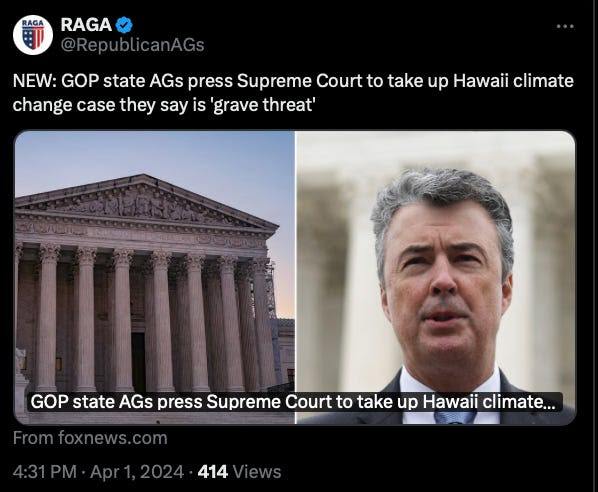 ||
A screenshot of RAGA’s post about the Hawaii case brief. Source: X
According to research by HEATED and the Center for Media and Democracy, all 20 state attorneys general that signed the amicus brief are not only featured on RAGA’s website, but many were elected with RAGA’s help.
The lead counsel for the amicus brief, Alabama attorney general Steve Marshall, was the organization’s chair in 2023. Three attorneys general have served on RAGA’s executive committee (Indiana, Mississippi, and Utah), and five have been chairs or vice chairs (Alabama, Georgia, Montana, South Carolina, and Utah).
At least six AGs won their elections with the support and funding of RAGA, including the attorneys general from Oklahoma, Missouri, Kentucky, Louisiana, Iowa, and Idaho. In a statement last year, RAGA celebrated “a 100 percent success rate for RAGA in the 2023 election cycle.” This included the election of Louisiana AG Liz Murrill, which the organization supported with “a substantial, statewide paid advertising campaign.”
“These AGs, their political futures are underwritten by RAGA,” Graves said. “And who underwrites RAGA? The fossil fuel industry, along with Leonard Leo.”
RAGA did not respond to our requests for comment; when HEATED called executive director Pete Bisbee, he said he doesn’t speak to journalists, referred us to a spokesperson, and hung up. (Bisbee has previously been under fire leading the organization that paid for robocalls encouraging former President Trump supporters to protest the election results at the Capitol on Jan 6.)
But public statements, donations, and recordings of private meetings reveal RAGA’s deep ties to the fossil fuel industry. In 2023 alone, RAGA received more than $15 million in donations, and more than $1 million of those contributions came from the fossil fuel industry, according to HEATED’s analysis of IRS tax forms. Over the last decade, RAGA has accepted more than $10 million from fossil fuel companies, electric utilities, and industry trade groups.
Among RAGA’s donors are Koch Industries, Exxon, Chevron, ConocoPhillips, the American Petroleum Institute, and American Fuel and Petrochemical Manufacturers (AFPM)—and these donors have pushed AGs to adopt an aggressive anti-climate strategy.
How RAGA connects fossil fuel companies to AGs
To connect AGs with the priorities of donors, RAGA offers different tiers of access for different amounts of donations. “It’s not technically money laundering, but it has that appearance,” Graves said.
RAGA members who pay annual fees of $25,000 can help shape the organization’s legal strategy via “online RAGA briefing rooms,” for example. And members who pay more than $125,000 are given access to private meetings with attorney generals and invitations to in-person events with them, according to documents obtained by*The New York Times* in 2014.
In 2016, the Center for Media and Democracy obtained audio from one of those events. Titled “Climate Change Debate: How Speech is Being Stifled,” the session included former Alabama attorney general Luther Strange; AFPM president Chet Thompson;and noted fossil-funded climate denier Myron Ebell.
Together, they talked about the importance of protecting ExxonMobil from lawsuits like Honolulu’s. “We’re facing a coordinated campaign to demonize, weaken and try to destroy the industry,” Thompson said.
But Thompson also said stopping climate liability lawsuits would not be enough to protect the fossil fuel industry. What the industry really needed, he said, was protection from nearly all federal environmental regulation.
What followed was years of litigation led by Republican attorneys general against every environmental regulation worrying Thompson, and more.
RAGA’s goal: industry capture of the U.S. legal system
In 2021, 20 AGs sued the EPA to block its power plant emissions rules, which Thompson specifically called out in the panel. West Virginia v. EPAultimately went to the Supreme Court, whose ruling significantly decreased the EPA’s authority to regulate emissions.
In 2023, 25 Republican AGs sued the Department of Labor over retirement funds that considered ESG factors, including fossil fuel divestment. Thompson had called out divestment in the panel, too.
In 2024, 10 Republican attorneys general, all members of RAGA, sued the SEC over its climate disclosure rules, which Thompson also called out in the session.
RAGA members have also brought lawsuits fighting the Clean Water Act, limits on vehicle emissions, and the LNG exports pause—all while being paid by the industries that profit from pollution.
But the suits brought by RAGA members aren’t limited to the federal government. They’re also trying to stop localities like Honolulu from trying climate liability cases in state courts. RAGA, and the corporations it defends, want these cases tried in federal courts, where Republican-appointed federal judges are more likely to rule in the fossil fuel industry’s favor.
In fact, the same funders who helped appoint ultra-conservative judges to federal courts also donate to RAGA. Among RAGA’s top donors is the dark money group The Concord Fund, which is affiliated with the Federalist Society’s co-chairman Leonard Leo. Leo is credited with playing moving the federal court system to the right, and was instrumental in appointing multiple conservative justices to the U.S. Supreme Court, including Justices Alito, Roberts, Gorsuch, Kavanaugh, and Coney Barrett.
That network of industry influence has purchased the current anti-regulatory legal environment—and RAGA plays an essential role. "These AGs are willing to let the planet burn as they continue to take funding through RAGA from this industry," Graves said.
Former Hawaii Supreme Court Justice Michael Wilson went one step further in describing the effect of RAGA in fighting climate change.
“The AGs are violating their public duty to protect the future of their citizenry,” he said. “This partisan political use of the rule of law is what has caused the judicial branch of government to descend to its lowest level of public approval in recorded history.”
Further reading:
- The Low-Key Republican Officials Quietly Dismantling All of Our Rights. Slate, April 2024
Key quote: ”This agenda to use the Supreme Court to strip us of our rights, to use the court to make it harder for us to deal with climate change, to use the court to roll back reproductive rights, gay marriage, and more. These are all part and parcel of Leo’s agenda and these attorneys general are on that agenda.”
- These Attorneys General Are Defending the Fossil Fuel Industry, Not Their States. The Equation, March 2023
Key quote: “According to the nonpartisan National Association of Attorneys General, a state attorney general’s job is to represent the public interest—not private, special interests—by, among other things, ‘enforcing federal and state environmental laws.’ Attorneys general in the five states most vulnerable to climate change, however, are doing the exact opposite: Instead of defending their constituents, they are defending the fossil fuel industry.”
- Lobbyists, Bearing Gifts, Pursue Attorneys General. The New York Times, October 2014
Key quote: “But success did not come in court or at a negotiating table. Instead, it came at the opulent Loews Santa Monica Beach Hotel in California, with its panoramic ocean views, where more than a dozen state attorneys general had gathered last year for cocktails, dinners and fund-raisers organized by the Democratic Attorneys General Association.”
---
===
===
{{{== note ccr 1st amend bs
desmog 4 24
fossil fuel interest groups have mobilized quickly to oppose a new rule issued by the Biden administration designed to speed up America’s transition to hybrid and electric vehicles.
The rule, which the U.S. Environmental Protection Agency (EPA) finalized on March 20, limits emissions from tailpipes on new cars, starting in 2027.
Well before the EPA finalized the new standard, powerful corporate lobbies like the American Fuel & Petrochemical Manufacturers (AFPM) had already promised to spend at least a million dollars campaigning against the rule by falsely portraying it as a “ban” on new cars. The group’s
 warn viewers that their freedoms and choices “will soon be taking a back seat to big government.”
The EPA predicts that the change would result in around two-thirds of new vehicle sales being hybrid or electric by 2032 — up from around eight percent today.
Beyond stopping more than 7 billion tons of carbon pollution, the agency predicts that the rule could save drivers more than $60 billion in fuel and maintenance costs, according to an EPA fact sheet that accompanied the final rule. The pollution reduction benefits would particularly benefit Black and brown communities because they are disproportionately likely to suffer from air pollution.
“These strongest-ever pollution standards for cars solidify America’s leadership in building a clean transportation future and creating good-paying American jobs,” EPA administrator Michael S. Regan said in a statement.
Compared to the EPA’s initial proposal, the final rule was scaled back to give car manufacturers more time to comply, but the New York Times still described the new standard as “one of the most significant climate regulations in the nation’s history.”
The heads of AFPM and the American Petroleum Institute (API) — the leading trade group for the oil and gas industry — declared in a joint statement that the rule “will unequivocally eliminate most new gas cars and traditional hybrids from the U.S. market in less than a decade.”
In February, AFPM had already begun portraying the rule as a “car ban” and announced a “seven-figure issue campaign” featuring TV and digital ads, as well as billboards and text messages. Some of the efforts target electoral swing states, including Michigan, Wisconsin, and Pennsylvania. The group also launched a website that warns readers, in all caps, to “keep the government’s hands off our cars!”
Despite the industry’s attempt to misleadingly brand the new standard, “this is not a ban of internal combustion engines,” Margaret Wooldridge, a professor of mechanical engineering at the University of Michigan, said in a statement.
Last year, AFPM spent nearly $7 million lobbying the federal government — more than any year in its history — according to OpenSecrets.
The top two bills the group reported lobbying for are designed to prevent the EPA from finalizing or enforcing vehicle emissions standards. Both bills passed the House last year. (Chevron, API, Koch Industries, and Marathon Petroleum are among the other industry groups and companies that lobbied for these bills last year.)
In addition to lobbying Congress and running million-dollar public influence campaigns, corporate trade groups have increasingly used lawsuits and the threat of costly, time-consuming litigation to stop or delay climate-related regulations.
Earlier this month, for instance, the U.S. Securities and Exchange Commission (SEC) finalized a long-delayed rule that requires public companies to disclose some of their emissions and climate risks that could impact their businesses. While the published rule was substantially weaker than what the SEC originally proposed, the U.S. Chamber of Commerce was among a handful of conservative interest groups that immediately challenged the measure in court.
Another recent EPA rule targeting methane emissions also met with opposition from Republican officials and oil and gas interests, according to Politico.
And on March 6, barely a month after the EPA finalized a separate rule limiting soot pollution, API, the National Association of Manufacturers, and the Chamber were among eight trade groups that sued the agency in the D.C. Circuit court.
‘Prepared to challenge it in court’
In a blog post, AFPM claims that the EPA “does not have authority to overhaul the U.S. economy or transportation system or compel — directly or otherwise — the use of EVs to address vehicle emissions.”
Similar objections to the authority of federal agencies to issue regulations have found a receptive audience among the Supreme Court’s conservative majority.
If the EPA doesn’t undo the tailpipe emissions rule, “our organizations are certainly prepared to challenge it in court,” the AFPM and API CEOs said in the joint statement that followed the announcement.
In attacking the rule, corporate interest groups like AFPM are following a well-trod path of fighting new climate regulations on every playing field they can find.
During the Trump administration, AFPM helped lead a successful effort to weaken previous EPA fuel efficiency standards. The group helped marshal Republican governors to advocate for the rollback, while also supporting Energy4US, a front group that encouraged Americans to flood the EPA with public comments, as DeSmog previously reported.
“One of the big advantages that oil industry lobbyists like AFPM have is money, and AFPM certainly isn’t afraid to use it,” Jesse Coleman, a senior researcher at the investigative outlet Documented, told DeSmog in an email.
“Million dollar ad campaigns are an unfortunately common way for groups like AFPM to pressure legislators and regulators by raising the political temperature on an issue. Litigation slows things further, leading to years of delays in implementation.”
---
REF DESMOG
March 21 (Reuters) - A U.S. judicial panel on Thursday consolidated at least nine lawsuits challenging the U.S. Securities and Exchange Commission's new rules requiring public companies to report climate-related risks in a venue favored by Republican-led states and a business group.
The St. Louis-based 8th U.S. Circuit Court of Appeals was chosen randomly via a lottery and will consider the legal challenges to the landmark rule, which aims to standardize public company disclosures about greenhouse gas emissions, weather-related risks and how they are preparing for the transition to a low-carbon economy.
The court, which has 10 Republican-appointed active judges and one appointed by a Democratic president, was the venue where nine Republican-led states including Iowa, Montana and North Dakota and the business lobbying group American Free Enterprise Chamber of Commerce filed their challenge.
Representatives for the Republican-led states and industry challengers did not immediately respond to requests for comment. The SEC declined to comment.
First proposed in 2022, the rules are part of Democratic President Joe Biden’s efforts to leverage federal agency rulemaking to address climate change threats.
They were approved by the SEC on March 6, and the first lawsuit seeking to block them was filed later that day.
The consolidated lawsuits include challenges filed by at least 25 Republican-led states, energy industry companies and business groups, including the U.S. Chamber of Commerce, the nation's largest business lobby, seeking to overturn the rules.
They have argued, among other things, that the disclosure requirements amount to back-door environmental regulations that go beyond the SEC’s legal authority.
Challengers on the other side of the issue like the environmental organization the Sierra Club and Natural Resources Defense Council have meanwhile said the rules do not go far enough to protect investors, and arbitrarily stripped the final version of stronger reporting requirement rules.
Representatives for the environmental groups said they look forward to arguing before the court.
The conservative-dominated 5th Circuit, the court where Texas and energy companies filed their challenges, temporarily paused the rules from going into effect on Friday.
The SEC is expected to ask the 8th Circuit to revisit that ruling. It had told the 5th Circuit a pause was unnecessary, since the rules have extended compliance deadlines that do not require disclosures before March 2026.}:
The agency has also said the rules "fit comfortably within" its authority to require disclosure of information important to investors, and that they would provide "consistent, comparable and reliable information" about climate risks.
The nine lawsuits were filed in six appeals courts. The 8th Circuit had previously set a deadline for the challengers who sued in that court to file their opening brief in May.
--
REF
March 6 (Reuters) - Ten Republican-led states have sued to challenge new federal rules that require U.S.-listed companies to report climate-related risks, a spokesperson for the West Virginia Attorney General's Office said on Wednesday, hours after the U.S. Securities and Exchange Commission approved the rules.
The states, which also include Georgia, Alabama and Alaska, filed the petition at the Atlanta-based 11th U.S. Circuit Court of Appeals, according to the spokesperson. The rules aim to standardize climate-related company disclosures about greenhouse gas emissions, weather-related risks and how they are preparing for the transition to a low-carbon economy.
The Sierra Club environmental group, meanwhile, said it was considering suing the SEC because it believed the new rules did not go far enough.
The SEC, Wall Street’s top regulator, said the information would give investors reliable information about financial risks companies face related to climate change.
An SEC spokesperson said in a statement that the agency crafts rules that are consistent with its legal authority, and that it will "vigorously defend" the climate disclosure rules in court.
First proposed in 2022, the rules are part of Democratic President Joe Biden’s efforts to leverage federal agency rulemaking to address climate change threats. Similar disclosure requirements have been adopted in Europe and in California.
West Virginia Attorney General Patrick Morrisey on Wednesday said during a press conference that the Biden administration is trying to act as a "puppeteer" using public companies to drive forward its climate agenda.
Republican-led states had been signaling their intent to challenge the rules for years, arguing in public comments in 2022 that they amount to back-door environmental regulations that go beyond the SEC’s legal authority.
They claimed then the rules would require companies to create, gather and disclose a “crushing” amount of material that goes well beyond the finance-based disclosures that investors need.
Anticipating legal challenges, the Biden administration had dropped more ambitious elements of the rules requiring companies to disclose “Scope 3” emissions, indirect emissions by suppliers or customers.
For many businesses, Scope 3 emissions account for 70% of their carbon footprint, according to the consulting firm Deloitte.
The final SEC rules also allow larger companies to determine whether emissions from their own operations and the power they purchase constitute information investors need to make decisions.
Morrisey said that despite changes to the proposed rule, the finalized rule was still defective and unconstitutional.
The Sierra Club, one of the largest environmental advocacy groups in the U.S., said in a statement it was considering filing a lawsuit to challenge the SEC's decision to remove the more robust reporting requirements. The group said it would also defend the SEC's legal authority to issue and implement the rules.
In California state court, litigation has been already been filed by business groups including the U.S. Chamber of Commerce challenging that state’s climate disclosure laws, which include Scope 3 emissions disclosure requirements. That lawsuit filed in January said the state’s laws will impose “massive” costs on businesses and violate free speech protections in the U.S. Constitution by compelling the disclosures.
===}}}:
===
2021
20210311_docket-20-1089_amicus-brief-3
oakland
Supreme Court of the United States
---
CHEVRON CORPORATION, et al.,
Petitioners,
v.
CITY OF OAKLAND, et al.,
Respondents.
---
On Petition for a Writ of Certiorari to
the United States Court of Appeals for the
Ninth Circuit
---
BRIEF OF INDIANA, ALABAMA, ALASKA,
ARKANSAS, GEORGIA, KANSAS, KENTUCKY,
LOUISIANA, MISSISSIPPI, MISSOURI,
MONTANA, NEBRASKA, OKLAHOMA, SOUTH
CAROLINA, SOUTH DAKOTA, TEXAS, UTAH,
AND WYOMING AS AMICI CURIAE
IN SUPPORT OF PETITIONERS
Office of the
Attorney General
302 W. Washington St.
Indianapolis, IN 46204
(317) 232-6255
Tom.Fisher@atg.in.gov
*Counsel of Record
THEODORE E. ROKITA
Attorney General
THOMAS M. FISHER*
Solicitor General
KIAN J. HUDSON
Deputy Solicitor General
JULIA C. PAYNE
Deputy Attorney General
Counsel for Amici States
Additional counsel listed with signature blocks
KEN PAXTON
Attorney General
State of Texas
SEAN D. REYES
Attorney General
State of Utah
BRIDGET HILL
Attorney General
State of Wyoming
ADDITIONAL COUNSEL
STEVE MARSHALL
Attorney General
State of Alabama
TREG R. TAYLOR
Attorney General
State of Alaska
LESLIE RUTLEDGE
Attorney General
State of Arkansas
CHRISTOPHER M. CARR
Attorney General
State of Georgia
DEREK SCHMIDT
Attorney General
State of Kansas
DANIEL CAMERON
Attorney General
Commonwealth of
Kentucky
JEFF LANDRY
Attorney General
State of Louisiana
LYNN FITCH
Attorney General
State of Mississippi
ERIC SCHMITT
Attorney General
State of Missouri
AUSTIN KNUDSEN
Attorney General
State of Montana
DOUGLAS J. PETERSON
Attorney General
State of Nebraska
MIKE HUNTER
Attorney General
State of Oklahoma
ALAN WILSON
Attorney General
State of South
Carolina
JASON R. RAVNSBORG
Attorney General
State of South Dakota
---
---
trump scotus immunity amicus
DAILY BEAST no lnx $
TRUMPLANDsubvertical orientation badge
The Unhinged Arguments the Supreme Court Is Fielding on Trump Immunity
BUNKER MENTALITY
“Friend of the court” arguments are coming from across the political spectrum—and are showing the potential consequences of siding with Trump on immunity.
Jose Pagliery
Political Investigations Reporter
Published Mar. 30, 2024
Retired American generals vehemently say that no, Donald Trump cannot deploy SEAL Team 6 to kill a political rival. Gun groups howl that the United States is turning into Communist China. And a convicted Jan. 6 rioter warns that President Joe Biden could someday get sued over the death of a jogger in Georgia.
These are among the 18 various groups that shared their wisdom with the Supreme Court earlier this month, filing amicus briefs on the same day that Trump told the high court why he should be able to dodge a federal prosecution for trying to overturn the 2020 election on false pretenses.
Department of Justice Special Counsel Jack Smith’s election interference case against Trump has finally reached the nation’s highest judicial authority, which will determine whether the business tycoon can be put on trial. The timing of the nine justices’ eventual decision will determine if the presumptive 2024 Republican presidential nominee is to face trial in court before Election Day in November.
But ahead of oral arguments next month, the Supreme Court is already getting inundated with all kinds of opinions about the main question in the case: whether a former president enjoys immunity for actions made while at the White House.
The Daily Beast reviewed the litany of uninvited legal arguments spanning 599 pages, ranging from breathless reiterations of Trump’s claims to head-turning warnings. Yet all bear the signs of a historic case that could determine the fate of the election, if not American democracy.
The most unusual and unexpected amicus brief comes from three former high-ranking military leaders: Retired Lt. Gen. Keith Kellogg, who served as Trump’s own acting national security adviser; Robert Wilkie, who served as Trump’s Veterans Affairs Department secretary; and retired Lt. Gen. William “Jerry” Boykin, who once led the Army’s elite commandos in Delta Force and Green Berets.
The three former military men felt it necessary to join together and address—in public and at the national level—one of the crazier Trump legal arguments: that Trump’s immunity from criminal prosecution is so beyond question that it would allow him to order the assassination of his political enemies.
“No—the president cannot order SEAL Team Six to assassinate his political rival and have the military carry out such an order,” they clarified, marking the first time former military leadership has ever had to utter such a phrase in court.
The trio went further, pointing out that a Reagan-era executive order already prohibits anyone acting on behalf of the United States government from taking part in an assassination. They dedicated a significant portion of their 18-page court filing to making clear that military officers would be legally justified in refusing to even carry out an official order from their commander-in-chief, an assertion rarely made by military brass—and one that underlies just how stark their concerns are at this point.
“That a person is a political rival of the president is neither a justification nor an excuse for an unlawful killing. And deliberately carrying out an order to murder such a person would be acting upon a premeditated design to kill or an intent to kill. Therefore, any officer engaged in murder on the orders of a president would be subject to the death penalty or life in prison—and the officer would know it,” they wrote.
Meanwhile, the vast majority of the other amici curiae—the so-called “friends of the court” who weighed in to give the Supreme Court their two cents—largely sided with Trump.
The right-wing nonprofit America’s Future—which screened a bonkers QAnon Hollywood conspiracy “documentary” at Mar-a-Lago earlier this week—joined forces with Gun Owners of America and similar firearms associations to warn the high court that Smith’s prosecution was making the United States look more like China, Russia, or Zimbabwe.
“The prosecution of President Trump by the Biden Administration has a parallel to a recent event in Communist China,” they wrote, recalling the way former Chinese President Hu Jintao has vanished from public view ever since he was mysteriously escorted out of a public ceremony where he had been sitting next to his successor, Xi Jinping.
The United States is heading down that same route, they warned, lamenting “the explosion of lawfare” aimed at Trump for doing what they deemed totally sensible political speech—an argument that rests, in part, on the gun-toting petitioners’ continued rejection of the 2020 election results. They referenced Trump’s “supposed” defeat in Arizona and Georgia.
The real danger here, though, is that while Trump is currently polling strong, the gun groups concede that “the effect of a conviction may be very different and could determine the outcome of the election.”
But it wasn’t the conglomeration of Second Amendment enthusiasts that made a veiled threat over the high court decision. That came from an Alabama electrical engineer who’s become a political financier.
In his court filing, Shaun McCutcheon describes himself as “a successful, self-made American businessman and constitutional patriot.” And he warned Supreme Court justices that the country’s MAGA loyalists aren’t going to suddenly start trusting the U.S. court system to select fair-minded jurors.
“The former President’s tens of millions of supporters cannot reasonably be expected to accept the typical legal fictions of voir dire under such extreme circumstances,” his lawyer wrote.
McCutcheon assigns malicious intent to the Special Counsel’s decision to indict Trump in the largely liberal District of Columbia—never mind that the U.S. Constitution’s Sixth Amendment ensures that a person will be subjected to a speedy and public trial by an impartial jury drawn from the district where his alleged crime was committed, which in this case was the White House.
“A prosecutor appointed by a partisan presidential appointee of the opposing political party may prosecute a former president in a hand-picked venue deeply hostile to that former president, his beliefs, political expression, and legacy,” his lawyer wrote.
While the Supreme Court received various interpretations of presidential immunity that cast the Special Counsel’s investigations as a severe threat to the functions of the commander-in-chief’s job, the sharpest example came from someone who knows a thing or two about Trump’s insurrection.
In his brief, Treniss Evans argued that if Trump can be put on trial for allegedly masterminding a months-long and multi-pronged attack on U.S. democracy, then President Biden could be held personally responsible for the death in February of Georgia nursing student Laken Riley, given that an allegedly undocumented Venezuelan man was arrested for her killing.
“If a President doesn’t have immunity from prosecution for his actions, what prevents Georgia murder victim Laken Riley’s family from suing Joe Biden for allowing her illegal migrant murderer into the USA? Or what if hundreds of families all sued, seriatim?” his lawyer wrote, using the Latin phrase that means “one-by-one.”
Evans made the filing through his “legal advocacy group,” which bears the emotionally charged name Condemned USA. He trivialized Trump’s 2020 election fraud claims, but then went on to assert that Trump and his followers can’t possibly be accused of trying to stop certification of the election with a violent riot because technically Jan. 6, 2021, was just the official counting of the already certified votes before Congress.
The Supreme Court justices will get the sense that this topic is deeply personal for Evans. After all, his brief says right up top that “Mr. Evans has been investigating and reporting events of January 6th since January 6th, 2021. He was present at the Capitol on that day.”
In reality, he was in the violent crowd, held a bullhorn, and entered the Capitol—only to be identified by a Facebook tipster, arrested in Texas two months after the insurrection, and eventually sentenced to three years’ probation. To convince the federal judge to go easy on him, his other lawyer wrote that “Mr. Evans is quite self-reproving, sincerely remorseful, and duly contrite. He is embarrassed of this criminal conduct and the shame he has brought upon himself and his family. He has entered his plea of guilty voluntarily.”
But his March 19 brief before the Supreme Court doesn’t exactly hint at that remorse, nor does it morph into any critique of the man who called on him and others to show up that day and march on the Capitol Building.
Yet another legal advocacy firm asked the Supreme Court to give even more deference to Trump for the actions that led up to the disaster at the tail end of his presidency. The Christian Family Coalition Florida, a conservative Miami group that recently lent its support to Gov. Ron DeSantis’ crackdown on transgender kids in girls’ sports teams, reduced Trump’s election interference efforts to merely “core political speech.” And it would give future politicians carte blanche to lie—and follow through with those lies—regardless of their claim’s merit.
“For the sake of the presidency and the nation, criminal liability cannot turn on a mere factual dispute over whether an ex-president’s communications in challenging an election were ‘knowingly false,’” a lawyer for the group wrote.
In this Trump case, justices also heard from a favorite villain of the American progressive movement: Citizens United, the nonprofit behind the Supreme Court’s 2010 landmark decision that opened the door to having corporations spend unlimited funds on elections.
The group joined with two former U.S. Attorneys General: the Reagan administration’s Edwin Meese III, and the George W. Bush administration’s Michael B. Mukasey. Together, they tried to strip the current team of federal prosecutors going after Trump from any legitimacy.
They argued that Smith “wields tremendous power, effectively answerable to no one, by design.” And they contend that’s something he can’t do without the Senate’s confirmation. Instead, they say, AG Merrick Garland should have taken the same approach he did with the separate Hunter Biden investigation and tap an existing, Senate-confirmed federal prosecutor in charge of a regional office, like Delaware U.S. Attorney David Weiss.
The two conservative former AGs and the nonprofit also claim that most cabinet officials have the authority to appoint officers—minus the Justice Department, a proposition that would give the heads of Agriculture, Education and Homeland Security departments more leeway than the nation’s attorney general. And they warn that Garland’s actions could “create by regulation an entire shadow Department of Justice.”
But leave it to a consortium of 18 state attorneys general—all pro-Trump Republicans led by Alabama AG Steve Marshall—to make the one point everyone can probably agree on.
“If he had not been president, none of this would be happening,” they wrote.
Political Investigations Reporter
@Jose_Pagliery
jose.pagliery@thedailybeast.com
---
---
gmail 3 24
Texas and 15 states sue Biden admin over climate agenda targeting gas projects | Fox News
fox no lnx
Texas and 15 states sue Biden admin over climate agenda targeting gas projects
'I will not stand by while Biden attacks Texas,' Attorney General Ken Paxton says
Thomas Catenacci By Thomas Catenacci Fox News
Published March 22, 2024
Comments
Biden's halting of liquified natural gas projects is 'utter nonsense': Marc Morano
Climatedepot.com Executive Director Marc Morano discusses the impact on American energy from the Biden administration's halt of liquified natural gas projects and reacts to Davos saying that drinking coffee causes climate change.
A coalition of 16 Republican states, led by Texas and Louisiana, filed a lawsuit against the Biden administration, challenging its recent climate action pausing proposed energy projects.
The multistate coalition filed its complaint in the U.S. District Court for the Western District of Louisiana, listing President Biden, Energy Secretary Jennifer Granholm and the Department of Energy (DOE) among the defendants in the case. According to the complaint, the DOE's move earlier this year pausing major liquefied natural gas (LNG) export terminal projects violated long-standing federal energy laws.
"Biden’s unilateral decree disregards statutory mandates, flouts the legal process, upends the oil and gas industry, disrupts the Texas economy, and subverts our constitutional structure," said Texas Attorney General Ken Paxton.
"The ban will drive billions of dollars in investment away from Texas, hinder our ability to maximize revenue for public schools, force Texas producers to flare excess natural gas instead of taking it to market, and annihilate critical jobs," he continued. "I will not stand by while Biden attacks Texas."
GOP LEADERS CONFRONT BIDEN’S NEW CLIMATE CZAR ON KEY SECURITY RISKS LURKING IN GREEN AGENDAPrice Futures Group senior analyst Phil Flynn and Copenhagen Consensus Center President Bjorn Lomborg on the concerns with bans on natural gas for costs and reliability.
Ken Paxton in front of Supreme Court
Texas Attorney General Ken Paxton speaks outside the U.S. Supreme Court on Nov. 1, 2021. (Drew Angerer/Getty Images)
According to Paxton, the LNG export moratorium is unconstitutional, ignores the 1938 Natural Gas Act’s "presumption in favor of exports" and discards decades of DOE energy policy.
In arguing the alleged unconstitutionality of the policy, the states' complaint notes Article I of the Constitution vests Congress with "[a]ll legislative Powers," including the power "[t]o regulate Commerce with foreign Nations." Therefore, since blocking LNG exports can be considered a regulation of commerce, the DOE violated the Constitution, according to the lawsuit.
TIKTOK ACTIVIST SAYS HE ADVISED WHITE HOUSE ON BIDEN'S NEW NATURAL GAS MORATORIUM
"The LNG Export Ban implicates an issue of profound national importance. LNG exports account for billions of dollars to the economy and thousands of jobs," the complaint states. "They also raise serious questions of national security. And this is an issue that has been the subject of proposed legislation and public attention in and outside of Congress."
President Biden ordered pending natural gas export projects to be halted in a stunning move in January. (Getty Images)
The complaint accuses DOE of violating the Administrative Procedure Act which governs the procedures of administrative law. The states highlight that DOE failed to host any public comment period before finalizing its LNG policy without "good cause to forego the notice and comment requirement."
Additionally, the states argue the DOE failed to properly consider the Natural Gas Act and its provision that states the agency issue an export license before hearing from the public.
DOZENS OF FORMER TOP FEDERAL OFFICIALS CALL ON CONGRESS TO STRIKE DOWN BIDEN'S NATURAL GAS CRACKDOWN
"The Biden administration’s illegal attacks on American energy jeopardizes the livelihoods of thousands of hard-working Louisiana men and women, millions of dollars in tax revenue, and billions of dollars in infrastructure," said Louisiana Attorney General Liz Murrill.
"LNG continues to have an enormous positive economic impact for our state — especially on our hard-hit coastal communities, which continue to recover from a recent series of devastating hurricanes. Jobs like these grow the economy, reduce crime, and help address the out-migration problem," she continued. "The people of Louisiana are proud to power this nation. I’m ready to fight for them."
An LNG tanker is pictured at the Elbehafen port in Brunsbuettel, Germany. American LNG has been critical in helping Germany and other European nations wean off Russian gas. (Bodo Marks/picture alliance via Getty Images)
In a surprise move in January, Biden ordered the DOE to pause pending permits for LNG export facilities while federal officials conduct a rigorous environmental review assessing the projects' carbon emissions, which could take more than a year to complete. The action was lauded by climate activists who have loudly called for such a move, which they said would help combat global warming.
However, the move was blasted by industry groups, former federal officials and bipartisan lawmakers, who noted energy exports are vital for aiding allies in Europe and Asia. In the aftermath of Russia's invasion of Ukraine two years ago, U.S. LNG largely filled the void left by Russian natural gas as U.S. allies sought to wean off Russian exports and punish the nation's economy, a plan Biden endorsed at the time.
CLICK HERE TO GET THE FOX NEWS APP
Opponents also argued that LNG exports bolster domestic energy production and boost the U.S. economy. Fossil fuel industry groups recently cited research indicating that LNG exports could add as much as $73 billion to the U.S. economy by 2040, create 453,000 American jobs and increase U.S. purchasing power by $30 billion.
Thomas Catenacci is a politics writer for Fox News Digital.
---
September 09, 2016 | Amicus Brief
AG Paxton Leads Coalition of 11 AGs to Defend the First Amendment on Climate Change Policy Debate
Attorney General Ken Paxton filed an amicus brief yesterday in defense of the First Amendment. The brief explains that the Attorney General of Massachusetts exceeded her constitutional authority by attempting to shut down a viewpoint on an issue of scientific debate – climate change.
At the “AGs United for Clean Power” press conference, a coalition of liberal state attorneys general announced they were going to use their official authority to go after one side of the policy debate on climate change. This overt use of governmental power to shut down particular viewpoints is a blatant violation of the Constitution. In this case, the Massachusetts Attorney General issued a Civil Investigative Demand against Exxon Mobil Corporation for its “marketing and sale of fossil fuel-derived products and securities,” demanding over 40 years of internal company documents. Exxon is seeking to block the Civil Investigative Demand from being enforced.
Attorney General Paxton and ten other state attorneys general are asking the court to grant Exxon’s motion for a preliminary injunction against the subpoena.
“The Constitution was written to protect citizens from government witch-hunts that are nothing more than an attempt to suppress speech on an issue of public importance, just because a government official happens to disagree with that particular viewpoint,” Attorney General Paxton said when filing the brief.
In addition to Texas, the other states who joined the amicus brief are Louisiana, South Carolina, Alabama, Michigan, Arizona, Wisconsin, Nebraska, Oklahoma, Utah, and Nevada.
Click here to view the Amicus Brief
:{:{IN THE UNITED STATES DISTRICT COURT FOR THE NORTHERN DISTRICT OF TEXAS FORT WORTH DIVISION EXXON MOBIL CORPORATION, ) ) Plaintiff, ) ) v. ) No. 4:16-cv-00469-K ) MAURA TRACY HEALEY, ) Attorney General of Massachusetts, ) in her official capacity, ) ) Defendant. )}:
BRIEF OF TEXAS, LOUISIANA, SOUTH CAROLINA, ALABAMA, MICHIGAN, ARIZONA, WISCONSIN, NEBRASKA, OKLAHOMA, UTAH, AND NEVADA AS AMICI CURIAE}:
Attorney General of South Carolina
LUTHER STRANGE
Attorney General of Alabama
BILL SCHUETTE
Attorney General of Michigan
MARK BRNOVICH
Attorney General of Arizona
BRAD SCHIMEL
Attorney General of Wisconsin
DOUG PETERSON
Attorney General of Nebraska
SCOTT PRUITT
Attorney General of Oklahoma
SEAN REYES
Attorney General of Utah
ADAM LAXALT
Attorney General of Nevada
KEN PAXTON
Attorney General of Texas
JEFFREY C. MATEER
First Assistant Attorney General
BRANTLEY STARR
Deputy First Assistant Attorney General
PRERAK SHAH
Senior Counsel to the Attorney General
/s/ Andrew D. Leonie
ANDREW D. LEONIE
Associate Deputy Attorney General for the
Office of Special Litigation
Andrew.Leonie@texasattorneygeneral.gov
AUSTIN R. NIMOCKS
Associate Deputy Attorney General for the
Office of Special Litigation
Austin.Nimocks@texasattorneygeneral.gov
MICHAEL TOTH
Senior Counsel for the Office of Special
Litigation
Office of Special Litigation
Texas Attorney General’s Office
P.O. Box 12548, Mail Code 009
Austin, Texas 78711-2548
Tel: 512-936-1414
Fax: 512-936-0545
ATTORNEYS FOR AMICI CURIAE
KEN PAXTON Attorney General of Texas JEFFREY C. MATEER First Assistant Attorney General BRANTLEY STARR Deputy First Assistant Attorney General PRERAK SHAH Senior Counsel to the Attorney General /s/ Andrew D. Leonie ANDREW D. LEONIE Associate Deputy Attorney General for the Office of Special Litigation Andrew.Leonie@texasattorneygeneral.gov AUSTIN R. NIMOCKS Associate Deputy Attorney General for the Office of Special Litigation Austin.Nimocks@texasattorneygeneral.gov MICHAEL TOTH Senior Counsel for the Office of Special Litigation Office of Special Litigation Texas Attorney General’s Office P.O. Box 12548, Mail Code 009 Austin, Texas 78711-2548 Tel: 512-936-1414 Fax: 512-936-0545 ATTORNEYS FOR AMICI CURIAE
---
---
21? RAGA, did not sell in 2-3 states where legal
ca gov newsom 54m$
https://www.alternet.org/abortion-2659565246/
---
---
i need a spreadsheet /table for RAGA fuckery
---
Six red states — Arkansas, Iowa, Kansas, Missouri, Nebraska, and South Carolina — are suing the administration of Democratic President Joe Biden over Biden’s plan to cancel up to $20,000 in student loan debt for individuals making less than $125,000 a year.
---
alex k
the Center for Media and Democracy (CMD) investigation has identified more than two dozen major U.S. companies that are publicly committed to environmental, social, and governance (ESG) principles yet have recently donated large amounts of campaign cash to a group of Republican state attorneys general that is hyper-focused on eroding air and water regulations, promoting fossil fuel companies, and using state governments to punish companies that try to limit their climate-related risks by divesting from oil, gas, and coal.
Republican attorneys general, along with fellow GOP governors and state financial officers, are weaponizing their public offices to prevent action on climate change. Their latest efforts seek to bar companies that divest from fossil fuels or employ other ESG principles from receiving government contracts.
And yet large U.S. companies such as AT&T, Cigna, Citigroup, Lowe’s, Pfizer, T-Mobile, and UPS—all of which publicly promote their commitment to ESG—have recently funded the political prosperity of these Republican AGs.
Contradictory Takes on Climate Change
“Climate change is one of the most pressing global challenges,” the multinational brewing company Anheuser-Busch InBev (AB InBev) acknowledges in its 2021 ESG report for investors. “Our evolved understanding of potential climate-related risks and opportunities across our value chain continues to inform our long-term strategy.”
AB InBev has set an ambitious climate goal for 2025, aiming to reduce its carbon emissions by 25% and purchase 100% of its electricity from renewable sources by then. In joining the international RE100 initiative to switch to 100% renewables, the company intends to achieve net zero greenhouse gas emissions by 2040.
But the beer giant is one of the largest corporate funders of the Republican Attorneys General Association (RAGA), a group of powerful state officials that has long attacked environmental regulations in the U.S. Members of RAGA—which receives substantial funding from fossil fuel companies to support the reelection campaigns of these AGs—have filed legal challenges against Obama-era air and water pollution regulations. Former Oklahoma AG Scott Pruitt is among those who have worked directly with fossil fuel lobbyists to challenge these laws.
Numerous other corporations have given large sums to RAGA for this year’s elections while publicly committing to ESG principles and, in many cases, to direct climate action.
RAGA recently scored a big win in West Virginia v. EPA when the right-wing justices who now dominate the Supreme Court ruled against the agency, preventing the Biden administration from regulating greenhouse gas emissions under the Clean Air Act without going back to Congress for explicit authorization.
Retaliating Against “Energy Discrimination”
As the Right gets more extreme in the U.S., climate-denying Republicans have added a new weapon to their arsenal: attacking financial firms that decrease their investments in fossil fuels.
GOP attorneys general and financial officers are joining state lawmakers in penalizing investment firms that divest from fossil fuel companies. Although they are members of a political party ostensibly committed to a free market, these GOP officials are meddling in corporate decision-making by trying to prevent executives from limiting the enormous financial risk posed by the effects of climate change—likely the biggest economic challenge of the century.
As with their outcry about critical race theory supposedly being taught in American schools, GOP politicians are attempting to cast climate action as a culture war issue, branding routine practices such as ESG disclosures to investors and divesting from a waning fossil fuel industry as “woke.”
In 2021, Texas enacted a law to root out alleged “energy discrimination,” seeking to prevent investment firms that decrease their stakes in oil, gas, and coal from managing the state’s pension and other funds. After the law passed, the energy task force of the ultra-conservative, corporate-funded American Legislative Exchange Council (ALEC) approved a model bill with similar language, directing state treasurers or comptrollers to maintain a list of firms that have divested from fossil fuels and to only issue government contracts to businesses with more than 10 employees that verify their allegiance to fossil fuels.
In the past year or so, similar legislation has been introduced in at least 15 states and has already passed in four. On Aug. 24, Texas released its first list of firms that allegedly “boycott energy companies,” including BlackRock, Credit Suisse, and UBS.
Dubious Claims
On Aug. 4, 19 GOP attorneys general sent a letterto BlackRock CEO Larry Finkaccusing his firm of making ESG investments that “force the phase-out of fossil fuels, increase energy prices, drive inflation, and weaken the national security of the United States.”
Claims like this are histrionic and often baseless. For example, BlackRock has invested more than $108 billion in Texas-based energy companies, and this year it plans to support proportionally fewer ESG shareholder resolutions than it did last year. And while Texas Attorney General Ken Paxton (R) and his allies from other states claim that ESG investing hurts their pension funds, academic studies like a recent one undertaken by researchers at the University of Pennsylvania and the Federal Reserve Bank of Chicago refute this. In fact, since Texas passed its anti-ESG law last year, the UPenn/Fed study indicates that it has already cost the state between $303 and $532 million, as Kate Aronoff points out in The New Republic.
Other evaluations of ESG investing are mixed, but when researchers from the New York University Stern Center for Sustainable Business and Rockefeller Asset Management analyzed over 1,000 relevant research papers from 2015–20, they found that a majority of the studies indicated ESG investing leads to either neutral or improved financial performance. The meta-analysis points out that “improved financial performance due to ESG becomes more marked over longer time horizons.”
Despite these findings, Republican state AGs and other officials have accelerated their attacks on climate action—a central tenet of ESG investing—in the past few years.
In August, Florida’s Gov. Ron DeSantis (R) and the trustees of the State Board of Administration voted to ban its investment managersfrom using ESG considerations in managing its portfolio of roughly $245 billion, primarily from the Florida Retirement System Pension Plan. Florida’s AG Ashley Moody (R) joined the governor in supporting the move.
In May, Kentucky’s AG Daniel Cameron(R) issued an opinion barring investment managers doing government business from employing ESG principles. On Sept. 1, Indiana’s AG Todd Rokita (R) did the same.
Meanwhile, right-wing entrepreneur Vivek Ramaswamy is cashing in on the GOP’s anti-ESG and anti-woke craze, as CMD recently reported. His firm Strive Asset Management (DRLL) is trying to pull business away from the Big Three asset managers in red states. It recently announced that it hasraised $250 million thanks to large investments from far-right tech mogul Peter Thiel and his affiliated groups.
Not only are GOP AGs targeting asset managers that reduce fossil fuel investments, but they’re going after regulators and ratings agencies as well.
In June, Paxton spearheaded a letterfrom a group of 12 Republican AGs to the Securities and Exchange Commission (SEC)opposing its proposed corporate disclosure requirements around sustainability. The rule would require firms to back up their claims of purportedly green or socially aware investments. Twenty-one GOP AGs sent another letter of opposition to the SEC on Aug. 16.
“The woke left is going full throttle in their mission to change every facet of American life… and erode our democratic institutions to suit their liberal agenda,” said West Virginia’s AG Patrick Morrisey (R).
In late July, Missouri’s AG Eric Schmitt (R) launched an investigation into whether Morningstar, a financial research and rating company, violated a state consumer-protection law by evaluating ESG issues. A few weeks later, 18 other AGs joined the probe. Schmitt and 16 other attorneys general are also trying to block California from setting its own vehicle emissions standards.
At the same time, the nonprofit State Financial Officers Foundation (SFOF) and its members are doing all they can to prop up fossil fuel companies and punish firms that divest from oil, gas, and coal. In West Virginia, state Treasurer Riley Mooretold five financial companies—the banks Goldman Sachs, JPMorgan, Morgan Stanley, and Wells Fargo, as well as BlackRock—that they would no longer be eligible for state contracts because they have reduced financing for coal projects.
Corporate Code of Silence
---
2012?
But it was over climate change that Cuccinelliwould make his greatest mark.
He put Virginia out in front—along with Texas and Alabama—as one of the first states to sue the Obama administration over the Environmental Protection Agency's endangermentfinding on greenhouse gases. --> MORRISSEY
---
. Morrisey spearheaded the 27 State litigation against the Obama-era Clean Power Plan, one of the most illegal and unprecedented regulations in our country's history. In February 2016, the Morrisey-led coalition won a historic and unprecedented stay of the Power Plan at the U.S. Supreme Court. Most recently, he led a 13-state effort challenging a provision in law preventing states from lowering taxes. He has been out in front defending the Second Amendment and human life.
---
west va morrissey v epa
Nineteen other states, led by West Virginia, and power companies challenged the D.C. Circuit's ruling, asserting that the decision gives the EPA too much power in regulating emissions. The states that joined West Virginia were Alabama, Alaska, Arkansas, Georgia, Indiana, Kansas, Louisiana, Missouri, Mississippi, Montana, Nebraska, North Dakota, Ohio, Oklahoma, South Carolina, South Dakota, Texas, Utah, and Wyoming.[22]
---
---
On June 8, 2021, attorneys General in 17 states filed a motion to intervene to insert themselves as adversaries to the Juliana lawsuit and object to any potential settlement between the Biden Administration and the youth plaintiffs. Because they have indicated they won’t participate in the settlement process in good faith, the youth plaintiffs and their attorneys will object to these state governments intervening at this late stage in their case.
[ALABAMA, ALASKA, ARKANSAS, GEORGIA, INDIANA, LOUISIANA, MISSISSIPPI, MISSOURI, MONTANA [knudsen] , NEBRASKA, NORTH DAKOTA, OHIO, OKLAHOMA, SOUTH CAROLINA, TEXAS, UTAH, AND WEST VIRGINIA.]
---
5/17
in Young People’s Climate Lawsuit Against U.S., Federal Magistrate Recommended Denial of Motions to Certify Case for Appeal. A magistrate judge in the federal district court for the District of Oregon recommended denial of motions by federal defendants and by intervenor oil and gas trade groups to certify the district court’s denial of motions to dismiss the lawsuit brought by young people alleging that the defendants violated rights protected by the Constitution by allowing greenhouse gas emissions to accumulate. The magistrate rejected the intervenors’ contention that the issue of whether the political question doctrine barred the plaintiffs’ claims should be certified. The magistrate judge said that the court would be capable of granting equitable relief that would not “micro manage” federal agencies or make policy judgments in the event the plaintiffs prevailed. The magistrate “emphatically rejected” any contention that the topic of “climate change” was “formed and determined by political values and is thus a non-justiciable political question” and said that climate change was “quintessentially a subject of scientific study and methodology, not solely political debate” and that courts were “particularly well-suited for the resolution of factual and expert scientific disputes.” The magistrate further indicated that the issues in the case “and the fundamental constitutional rights presented” would not be “well served by certifying a hypothetical question to the Court of Appeals bereft of any factual record or any record at all beyond the pleadings.”
:{:{}:
}:
The magistrate judge indicated that the federal defendants’ significant admissions regarding the threats posed by human-induced climate change had, “if anything, … enhanced” the plaintiffs’ due process claim and that any appeal would be premature because the taking of evidence was necessary to “flesh out… critical issues.” The magistrate judge also was not persuaded that certification should be granted for the public trust claim, indicating that the federal defendants were relying on an overly expansive reading of Supreme Court precedent to narrow the scope of the federal public trust obligations. In recommending denial of certification on the issue of the plaintiffs’ standing, the magistrate said that the alleged harms to the plaintiffs from climate change should not be “minimalized by the fact that vast numbers of the populace are exposed to the same injuries.” The magistrate noted that numerous factual questions would be addressed at trial (e.g. “Is climate change occurring?” “If so, to what extent is it being caused by fossil fuel production?), and said the defendants and the intervenors “would put the cart before the horse” by certifying hypothetical questions before the relevant factual issues were addressed. The parties were given 14 days to file written objections to the magistrate judge’s recommendation, followed by 14 days to file a response to the objections.
22 PP
STEVE MARSHALL Attorney General of AlabamaEdmund G. LaCour Jr. (AL Bar No. 9182-U81L) Solicitor General Thomas A. Wilson (AL Bar No. 1494-D25C) Deputy Solicitor General STATE OF ALABAMA OFFICE OF THE ATTORNEY GENERAL 501 Washington Ave. Montgomery, AL 36130 Telephone: (334) 242-7300 Fax: (334) 353-8400 Edmund.LaCour@AlabamaAG.gov Thomas.Wilson@AlabamaAG.gov Counsel for Proposed Defendant-Intervenor State of Alabama [additional counsel listed on signature page] UNITED STATES DISTRICT COURT DISTRICT OF OREGON EUGENE DIVISION KELSEY CASCADIA ROSE JULIANA, et al., Plaintiffs, v. UNITED STATES OF AMERICA, et al., Defendants. Case No. 6:15-cv-01517-AA
PROPOSED DEFENDANT-INTERVENORS: STATES OF ALABAMA, ALASKA, ARKANSAS, GEORGIA, INDIANA, KANSAS, LOUISIANA, MISSISSIPPI, MISSOURI, MONTANA, NEBRASKA, NORTH DAKOTA, OHIO, OKLAHOMA, SOUTH CAROLINA, TEXAS, UTAH, AND WEST VIRGINIA’S REPLY
:{:{}:
}:
[**RAGA leaders were also involved in :(style="background-color:#ffff66ff"):}::{Texas AG Ken Paxton's [lawsuit filed last month in the U.S. Supreme Court challenging the presidential election results in the battleground states of Georgia, Michigan, Pennsylvania, and Wisconsin, claiming changes made to accommodate voters in the COVID-19 pandemic were unlawful. Among those signing on to the suit wereRAGA's Hunter [okla, quit 2021] , Landry, Marshall [alabama], Moody, Reyes, Schmitt and Wilson,as well as the Republican AGs ofArkansas,Indiana, Kansas, Mississippi, Montana, Nebraska, North Dakota, South Dakota, Tennessee, and West Virginia.]]
:{:{}:
}:
{{In July 2017, Texas Attorney General Ken Paxton led a group of Republican Attorneys General from nine other states, includingMarshall, plus Idaho Governor Butch Otter, in threatening the Donald J. Trump administration that they would litigate if the president did not terminate the Deferred Action for Childhood Arrivals (DACA) policy that had been put into place by president Barack Obama. Tennessee Attorney General Herbert H. Slatery, III subsequently reversed his position and withdrew his participation from the proposed suit on August 31st. Slatery went further to urge passage of the DREAM Act.[5][6] The other Attorneys General who joined in making the threats against Trump included Lawrence Wasden of Idaho, Leslie Rutledge of Arkansas, Derek Schmidt of Kansas, Jeff Landry of Louisiana, Doug Peterson of Nebraska, Alan Wilson of South Carolina, and Patrick Morrisey of West Virginia.}}:
MEMORANDUM IN SUPPORT OF MOTION FOR LIMITED INTERVENTION. (ECF Nos. 475, 508, 509)
7/21
Natural Resources Defense Council (NRDC) sought to file an amicus brief that argued that the court should deny the intervention motion without prejudice. NRDC reasoned that the states would not be prejudiced if intervention were deferred until the time of any proposed consent decree that might affect the states’ interests.
natural Resources Defense Council (NRDC) sought to file an amicus brief that argued that the court should deny the intervention motion without prejudice. NRDC reasoned that the states would not be prejudiced if intervention were deferred until the time of any proposed consent decree that might affect the states’ interests.
07/06/2021 Amicus Motion Download Motion filed by New York and other states for leave to file brief as amici curiae. Six states, led by New York, filed a motion for leave to file a brief as amici in support of the plaintiffs; they asserted an “interest in correcting proposed intervenors’ erroneous assertions about purported collusion between the parties” in two lawsuits referenced in the motion to intervene, as well as an interest in correcting the proposed intervenor states’ “incomplete picture of the effects that federal action to address climate change will have on States and state residents.”
---
---
feb 2018
https://blog.ucsusa.org/elliott-negin/exxonmobils-climate-disinformation-campaign-is-still-alive-and-well/
In a recent blog post, ExxonMobil executive Suzanne McCarronreiterated her company’s claim that it fully accepts the reality of climate change and that it wants to do something about it....“I want to use this opportunity to be 100 percent clear about where we stand on climate change,” she wrote. “We believe the risk of climate change is real and we are committed to being part of the solution. So why is the company still a part of—in fact, a major part of—the problem?An exchange between Oklahoma Sen. James Inhofe and Environmental Protection Agency (EPA) Administrator Scott Pruitt during a recent is a case in point, providing a window into how ExxonMobil’s undue influence continues to block climate action.
During the January 30 hearing, which was held by the Senate Environment and Public Works (EPW) Committee, Sen. Cory Booker inadvertently provoked Inhofe by raising the issue of environmental justice.The New Jersey Democrat cited the threat climate change-induced flooding poses to three dozen Superfund sites in his state and asked Pruitt if he was “taking into account the environmental burdens disproportionately impacting communities of color, indigenous communities and low-income communities.”
Inhofe seized the opportunity to contradict Booker, claiming that minority and low-income communities are disproportionately harmed by environmental protections, specifically citing the Obama administration’s Clean Power Plan, which would have dramatically reduced carbon emissions from coal-fired power plants if Pruitt hadn’t repealed it.
Booker, Inhofe said, was implying that Pruitt was trying to “punish” vulnerable Americans. “I wanted to just remind you,” Inhofe told the committee, “that we had a guy I remember so well, Harry Alford. He was the president of the National Black Chamber of Commerce. He provided some of the most powerful testimony that I have ever heard when it comes to the effects of the Clean Power Plan and some of the other regulations … on black and Hispanic poverty, including job losses and increased energy costs.
“[Alford] was very emphatic as to who was paying the price on these,” the Oklahoma Republican continued, “and I think sometimes that the previous administration forgot that there are already people out there who are paying all they can pay just to try to eat and keep their house warm.”
ExxonMobil’s Echo Chamber
Inhofe’s source for his assertion? A discredited, ExxonMobil-funded study by an Exxon-funded advocacy group that was based on discredited studies by other ExxonMobil-funded organizations.
Inhofe rested his argument on previous congressional testimony by Harry Alford, president of the National Black Chamber of Commerce (NBCC), a shoestring, mom-and-pop operation that is unapologetic about taking fossil fuel industry money. “Of course we do and it is only natural,” Alford wrote on NBCC’s website. “The legacy of Blacks in this nation has been tied to the miraculous history of fossil fuel…. [F]ossil fuels have been our economic friend.”
One of NBCC’s closest economic friends is ExxonMobil, which has donated more than $1.14 million to the group since 2001.
What did the company get for that money?
In 2015, NBCC commissioned a report that claimed the Clean Power Plan would “inflict severe and disproportionate economic burdens on poor families, especially minorities.”
In fact, unchecked climate change would more than likely hurt those communities most, and investments in energy efficiency under the plan would ultimately lower electricity bills across the country.
How did NBCC arrive at its upside-down assessment? The Union of Concerned Scientists took a close look at the report and found it was based on several flawed fossil fuel industry-friendly studies. Two of those bogus studies were produced by ExxonMobil grantees: the Heritage Foundation, which received $340,000 from ExxonMobil between 2007 and 2013, and the U.S. Chamber of Commerce, which received $3 million between 2014 and 2016.
The Chamber study, which came out just days before the EPA released a draft of the Clean Power Plan, was debunked not only by the EPA, but also by PolitiFact.com and The Washington Post. Among its many faults, the Chamber study—which was co-sponsored by the American Petroleum Institute—wildly inflated the cost of the plan and failed to consider the benefits of cutting carbon emissions.
ExxonMobil Spreads its Money Around
But there’s more than just the fact that ExxonMobil financed deliberately flawed studies to try to derail the Clean Power Plan. The company also is a major supporter of a number of Senate EPW Committee members, including Inhofe, who are adamant climate science deniers.
Inhofe has deep ties to the oil and gas industry, which has donated $1.85 million to his campaign war chest over his long career in Congress, more than twice than any other industry.Three oil and gas companies are among the senator’s top 10 corporate contributors: Koch Industries, Devon Energy and …ExxonMobil.
Six of the other 10 Republicans on the EPW Committee also are on ExxonMobil’s donation list, including Wyoming Sen. John Barrasso, the current committee chairman. Roughly half of the $119,500 ExxonMobil contributed to the seven senators over the last decade went to Barrasso and Inhofe, the committee’s previous chairman.
Then there’s ExxonMobil’s link to Pruitt, Oklahoma’s attorney general before President Trump tapped him to run the EPA. From 2012 through 2013, he chaired the Republican Attorneys General Association (RAGA)and afterward served on the organization’s executive committee. From 2014 through 2016, ExxonMobil gave RAGA $160,000 in three annual installments.
Just a few weeks after the company made its 2016 donation of $50,000,Pruitt and then-RAGA Chairman Luther Strange, at the time Alabama’s attorney general, co-authored a National Review column attacking a coalition of state attorneys general investigating ExxonMobil and other fossil fuel companies for misleading investorsand the general public about climate change. Parroting ExxonMobil’s argument, Pruitt and Strange charged that the coalition was violating the company’s first amendment right to free speech.
“The debate” over climate change, they wrote “is far from settled. Scientists continue to disagree about the degree and extent of global warming and its connection to the actions of mankind. That debate should be encouraged — in classrooms, public forums, and the halls of Congress. It should not be silenced with threats of prosecution. Dissent is not a crime.”
Inhofe Upstaged
In this case, Inhofe’s counterfactual comment didn’t make it into the ensuing media coverage. Along with nearly everything else that was said during the two-and-a-half hour marathon, it was eclipsed by a bombshell dropped by Sen. Sheldon Whitehouse. The Rhode Island Democrat revealed that during a February 2016 radio interview, Pruitt said Trump would be “more abusive to the Constitution than Barack Obama, and that’s saying a lot.” Whitehouse read Pruitt’s remark aloud and asked him if he recalled making it.
“I don’t,” Pruitt responded, “and I don’t echo that today at all.”
“I guess not,” Whitehouse replied.
Not surprisingly, that embarrassing nugget was the story. There was no way that Inhofe’s rambling, ExxonMobil-sponsored falsehood could compete in the media with red meat like that. But overshadowed or not, Inhofe provided yet another incontrovertible piece of evidence that—despite ExxonMobil’s statements to the contrary—the company is still very much engaged behind the scenes in trying to stymie any government attempt to seriously address climate change.
Posted in: Climate Change, Energy, Science and Democracy, Scientific Integrity
Tags: disinformation
---
---
July 7, 2021
Attorneys General inNew York & Five Other States File Brief in Support of Julianav. United States While Plaintiffs Oppose Attempt By Republican Coalition to Intervene
:{:{}:
}:
no lnx
For immediate release July 7, 2021
Contacts:
Julia Olson, 415-786-4825, julia@ourchildrenstrust.org
Andrea Rodgers, 206-696-2851, andrea@ourchildrenstrust.org
Philip Gregory, 650-278-2957, pgregory@gregorylawgroup.com
For interviews with youth plaintiffs, email beth@ourchildrenstrust.org
Attorneys General in New York & Five Other States File Brief in Support of
Juliana v. United States While Plaintiffs Oppose Attempt By Republican
Coalition to Intervene
EUGENE, Ore. – Attorney General Letitia James of New York on Tuesday filed a “friend
of the court” brief in support of the landmark constitutional climate case Juliana v. United
States, spearheading a wave of support from states that also include Delaware, Hawai‘i,
Minnesota, Oregon, and Vermont.
In their amici curiae motion, the six Democrat-led states noted that the
wide-ranging effects of climate change -- “including the costs of combating rising
sea levels, health risks posed by rising temperatures, and threats to States’ food
and water supplies, among others -- implicate far broader quasi-sovereign
interests in the health and well-being of state residents than those noted by
proposed intervenors.”
Also on Tuesday, attorneys from Our Children’s Trust, which represents the 21 Juliana
youth plaintiffs, filed a brief opposing an earlier attempt by[19 states] Alabama, Alaska, Arkansas,
Georgia, Indiana, Kansas, Louisiana, Mississippi, Missouri, Montana, Nebraska, North
Dakota, Ohio, Oklahoma, South Carolina, Texas, Utah, and West Virginia to join the
Biden administration in defending the case.
In June, the coalition of Republican
attorneys general said it wants to “participate in settlement negotiations” to “object to
any proposed settlement” and threatened to go all the way to the Supreme Court to
keep the youths’ case from going to trial.
In their filing opposing the attempt by some Republican-led states to intervene, the
plaintiffs’ attorneys point out that those 18 states are suffering billions of dollars in
losses related to climate impacts from extreme heat, sea level rise, and extreme storm
events, and any economic losses to the fossil fuel sector are far outweighed by severe
economic harm from the climate crisis.
“What the 18 Republican attorneys general seek is unprecedented,” said Julia
Olson, chief legal counsel of Our Children’s Trust. “They want to be allowed to
come into the case to fight the youth and prevent their claims from going to trial or
be resolved through settlement, but they refuse to waive their sovereign immunity
under the U.S. Constitution, which means they would not be subject to any orders
of the federal courts. They essentially want status as interlopers, with all the
privileges to participate as a party-defendant and fight these kids, but with no
responsibility or accountability. What they seek only hurts children in their own
states too.”
The Juliana constitutional rights lawsuit, filed in 2015, argues that affirmative actions by
the federal government under both political parties directly contributed to the climate
crisis – including creating a national fossil fuel-based energy system that is a substantial
factor in causing the plaintiffs’ injuries. By doing so, the plaintiffs argue, the government
has knowingly violated their constitutional rights to life, liberty and property, the public
trust, and equal protection of the law.
The Juliana plaintiffs’ amended complaint -- which the coalition of Republican attorneys
general is attempting to block -- is focused on winning a declaratory judgment that the
nation’s fossil fuel-based energy system is unconstitutional, much like the plaintiffs in
Brown v. Board of Education argued the public school system of segregation was
unconstitutional.
In June U.S. District Court Judge Ann Aiken ordered attorneys for plaintiffs and for the
Department of Justice to meet for a settlement conference with Magistrate Judge
Thomas Coffin, calling it “a tremendous opportunity” to address the climate “crisis” and
not just a “ministerial step.” Those talks are underway.
If Judge Aiken grants the motion to amend, and the settlement process is unsuccessful,
the case would be able to move forward in the trial court on the question of whether the
federal government’s fossil fuel-based energy system, and resulting climate
destabilization, is unconstitutional.
---
omfg, HOW MUCH OF THIS WAS TEED UP BY CPP BS? ANTI-GUBMINT
no lnx an 11 21
'Pro-death cult strikes back': Right-wing judges block Biden’s vaccine rule for big companies
Kenny Stancil and Common Dreams November 08, 2021
Progressives concerned about workplace safety and public health responded with dismay after a federal appeals court on Saturday temporarily blocked the Biden administration's attempt to require workers at companies with 100 or more employees to be vaccinated against Covid-19 or tested weekly.
Citing "grave statutory and constitutional" problems with the rule, a three-judge panel from the U.S. Court of Appeals for the Fifth Circuit issued the stay in response to a joint petition filed Friday by a coalition of businesses, conservative advocacy groups, and the states of Texas, Louisiana, Mississippi, South Carolina, and Utah.
That legal challenge, and separate lawsuits from Republican-led states, came just one day after President Joe Biden announced that the Occupational Safety and Health Administration (OSHA) would begin enforcing its newly unveiled Emergency Temporary Standard (ETS) in the coming weeks. Companies with at least 100 employees have until December 5 to require unvaccinated workers to wear masks indoors, and by January 4, they must require vaccinations or administer weekly tests.
Decrying the decision of the "right-wing Fifth Circuit," labor journalist Steven Greenhouse said on social media that "it's terrible for worker safety and public health that three conservative activist judges have suspended Biden's... new rule requiring workers at companies with more than 100 workers to get vaccinated or tested."
"OSHA's mission is to protect workers' health," Greenhouse continued, "but the appellate judges seem to forget that Covid has killed thousands of meatpacking, retail, and other workers."
More than 750,000 people in the U.S. have died from Covid-19 since the pandemic started last March, and the disease continues to kill nearly 1,100 people per day, most of them unvaccinated, according to the U.S. Centers for Disease Control and Prevention (CDC).
Recent studies confirm that vaccines save lives.Last month, the U.S. Department of Health and Human Services analyzed the relationship between county-level inoculation rates and Covid-19 outcomes among U.S. seniors and found that vaccines helped ward off 265,000 infections, 107,000 hospitalizations, and 39,000 deaths during the first five months of 2021.
And in September, CDC researchers found that individuals in the U.S. who were not fully vaccinated last spring and summer were 11 times more likely to die after being infected with the coronavirus—and over 10 times more likely to be hospitalized—than those who were fully inoculated.
Greenhouse said that "the judges evidently sympathize with [Texas Republican Gov.] Greg Abbott's let-people-die stance—that it'soverreachfor OSHA to act strongly to protect workers from Covid."
David Michaels, a leader of OSHA during the Obama administration, also rebuked the federal appeals court, describing its decision as legally dubious and politically motivated.
"The same activist court that refused to stay Texas' law that permits bounty hunters to sue anyone who aids an abortion after six weeks of pregnancy has stayed an OSHA rule that is clearly within OSHA's authority, will save lives, and make workplaces safe," he told the New York Times.
According to the Times, "At the core of the legal challenge is the question of whether OSHA exceeded its authority in issuing the rule and whether such a mandate would need to be passed by Congress."
The newspaper reported:
The suit against the mandate stated that President Biden "set the legislative policy" of substantially increasing the number of Americans covered by vaccination requirements, and "then set binding rules enforced with the threat of large fines."
"That is a quintessential legislative act—and one wholly unrelated to the purpose of OSHA itself, which is protecting workplace safety," the suit said. "Nowhere in OSHA's enabling legislation does Congress confer upon it the power to end pandemics."
Corporate executives asked, and the Biden administration agreed, to delay implementation of OSHA's new ETS "until after the New Year, citing concerns about worker shortages during the important holiday season," Reuters noted.
Solicitor of Labor Seema Nanda, meanwhile, said in a statement that the Labor Department, home to OSHA, is "confident in its legal authority" to issue vaccine requirements.
The vaccine rule for companies with 100 or more employees "applies to 84.2 million workers at 1.9 million private-sector employers," Reuters reported. "OSHA estimates that 31.7 million of [those] workers are unvaccinated and 60% of employers will require vaccinations, up from 25% today, resulting in another 22.7 million employees getting vaccinated."
Several million additional workers are covered by the Biden administration's vaccine mandate for employees of the executive branch, federal contractors, and staff at healthcare facilities that accept Medicare or Medicaid funding. OSHA officials say they are considering expanding the jab-or-test rule to include companies with fewer than 100 workers.
"The Occupational Safety and Health Act explicitly gives OSHA the authority to act quickly in an emergency where the agency finds that workers are subjected to a grave danger and a new standard is necessary to protect them," Nanda said. "We are fully prepared to defend this standard in court."
The Fifth Circuit panel's two-page order directs the Biden administration to respond to the request for a permanent injunction against the rule by 5 p.m. ET Monday.
As the Times noted, it remains unclear whether the court's stay "would be a procedural blip for the Biden administration or the first step in the unwinding of the mandate."
The newspaper explained that "after both sides have filed briefs, the court will decide whether to lift the temporary injunction, allowing the rule to proceed as planned, or whether to grant a permanent injunction. OSHA could then take the case to the Supreme Court."
While some legal experts argue that the Labor Department has the regulatory authority to compel private employers to protect the health of workers and the broader public through mandatory vaccination amid a deadly global pandemic,Josh Blackman, a professor at South Texas College of Law Houston, told Reuters that "there will be so much litigation it will never see the light of day."
Twenty-four attorneys general threatened to sue the Biden administration over the rule back in September, and several followed through immediately after it was published in the federal register on Friday.
In addition to the petition filed with the Fifth Circuit, attorneys general in 11 states—Alaska, Arizona, Arkansas, Iowa, Missouri, Montana, Nebraska, New Hampshire, North Dakota, South Dakota, and Wyoming—filed a lawsuit in the U.S. Court of Appeals for the Eighth Circuit.
And in the U.S. Court of Appeals for the Eleventh Circuit, the states of Alabama, Florida, and Georgia sued, with Florida Republican Gov. Ron DeSantis saying at a press conference that "the federal government can't just unilaterally impose medical policy under the guise of workplace regulation."
Roughly 70% of U.S. adults are fully inoculated against Covid-19, and about 80% have received at least one shot, according to the CDC. Recent polling shows that a majority of U.S. adults favor Covid-19 vaccination requirements, with only about one-fifth to one-quarter of respondents opposed.
OSHA, Reuters pointed out, is "fighting history. The agency has issued 10 ETS over its 50 years. Of the six that were challenged in court, only one survived entirely intact."
Donald Verrilli, U.S. solicitor general during former President Barack Obama's administration, however, told the news outlet that the Biden administration "wouldn't move forward unless they thought that they could defend it legally... I think the constitutional challenges are all going to fail."
---
---
BS ACE trump plan
RAGA: Morrisey has been one of the most active Attorneys General in the countryfighting federal overreach by filing lawsuits and submitting amicus briefs before the U.S. Supreme Court and other courts on a number of issues, ranging from protecting the Second Amendment to defending state jobs and our valuable energy resources. Morrisey spearheaded the 27 State litigation against the Obama-era Clean Power Plan, one of the most illegal and unprecedented regulations in our country's history. In February 2016, the Morrisey-led coalition won a historic and unprecedented stay of the Power Plan at the U.S. Supreme Court. Most recently, he led a 13-state effort challenging a provision in law preventing states from lowering taxes. He has been out in front defending the Second Amendment and human life.
---
officially racists:
https://www.alternet.org/2020/09/experts-lawsuit-heading-to-supreme-court-would-lead-to-massive-transfer-of-wealth-from-middle-class-to-richest-americans/
Republican lawsuit that seeks to strike down the Affordable Care Act would save the richest one-tenth of 1 percent of Americans an average of $198,000 per year, according to an analysis by the Center on Budget and Policy Priorities.
The case, which was initiated by 18 state attorneys general and backed by the Trump administration, is scheduled to be heard by the Supreme Court a week after the November election. A Texas judge ruled in 2018 that the entire Obamacare law was unconstitutional, after the Republican-led Congress eliminated the individual mandate penalty in its 2017 tax bill and an appeals court then sent the case back for the judge to decide whether the entire law needed to be struck down.
Legal experts have called the idea that the individual mandate rendered the entire law unconstitutional “ridiculous” and a “mockery of the rule of law.” But conservatives currently hold a 5-3 majority on the Supreme Court, which could soon swell to a 6-3 majority if President Trump successfully replaces the late Justice Ruth Bader Ginsburg, putting the fate of the law and health coverage and protections for tens of millions of Americans in doubt.
Repealing Obamacare would be a boon for the richest Americans, however, because of the taxes imposed by the law. Obamacare imposed a 0.9% tax on earnings over $200,000 for individualsand $250,000 for couples, along with an additional 3.8% tax on unearned income like capital gains and royalties. The analysis also includes other Obamacare revenue streams, like a$2.8 billion annual fee on pharmaceutical companiesand the law’s employer mandate. These taxes were used to cover the cost of the Medicaid expansion and subsidies for those buying health care on the exchanges created by the law.
The top 0.1% of earners, who make more than $3 million per year, would see a tax savings of about $198,000 per year, according to the CBPP analysis. Households earning more than $1 million per year would get tax cuts of about $42,000 per year.
Households in the bottom 80% would see average tax cuts of less than $80 a year. The top 0.1% would receive 42% of the tax benefits from the law’s repeal.
Tax cuts for households with incomes above $200,000 per year would cost the government about $30 billion per year, enough to cover the cost of the Medicaid expansion for more than 4 million people, according to the analysis.
“In effect, the Administration and the state attorneys general are seeking a massive transfer of resources from low- and moderate-income people to those at the top of the income scale,” the CBPP researchers wrote. “The lawsuit would also widen racial gaps, with Black and Hispanic people disproportionately likely to lose health coverage and the overwhelming share of the tax cuts flowing to white people.”
Based on estimates from the Urban Institute, the analysis found that nearly 10% of non-elderly Black people and 10% of Hispanic people would lose health coverage if the law were repealed. About one of every 16 white people would also lose coverage.
“Meanwhile, the tax cuts that would result from striking down the law would flow disproportionately to white households, which are three times likelier than Black or Hispanic households to be in the top 1 percent of the income scale,” the researchers wrote.
---
---
2 americas?
The states that do the most to discourage climate action and encourage dirty energy are the states whose residents are suffering the most from climate impacts, a Mother Jones and Center for Public Integrity investigation has found.
A CPI analysis found that nine of the 10 states that did the most to block the Clean Power Plan also emit the most carbon dioxide per person, while four of those nine were among the states that saw the most natural disasters over the past 10 years. The investigation focuses on Kentucky, where flash floods, that in some cases were worsened by improper mine cleanup, have devastated local communities.
As reported by Mother Jones:
The choices that state leaders make now will have life-changing consequences for generations, experts warn. Michael Hendryx, a public health professor at Indiana University Bloomington who studies environmental justice, said he wonders whether officials promoting inaction truly think global warming is not an emergency or are simply making a cynical bet that they won't be harmed.
"They'll be the people who have the money and power to defend themselves as climate change gets worse," he said. "If we don't do something really powerful and really meaningful soon, then the people who live in vulnerable areas … will suffer the most."
For a deeper dive:
For more climate change and clean energy news, you can follow Climate Nexus on Twitter and Facebook, and sign up for daily Hot News.
==
==
2012?
But it was over climate change that Cuccinelliwould make his greatest mark.
He put Virginia out in front—along with Texas and Alabama—as one of the first states to sue the Obama administration over the Environmental Protection Agency's endangermentfinding on greenhouse gases.
==
==
did not do great 2018?
The 7 States that Flipped from GOP Governors to Democrats
Four of the seven states that switched to Democratic governors are in the Midwest, partially reversing the region's swing toward Republicans in 2014.
In Michigan, Democrat Gretchen Whitmer, a former state legislator, defeated Republican Bill Schuette, the state attorney general. Whitmer had support from environmental advocates because of her criticism of Enbridge's Line 5 fossil fuel pipeline and her support for moving to 100 percent renewable energy. Republican Gov. Rick Snyder had reached the state's term limit.
...Nevada could become a leader on renewable energy with the election of Democrat Steve Sisolak, who made support for solar power part of his campaign. Sisolak, chair of the county commission in the county that includes Las Vegas, defeated Adam Laxalt, the state attorney general, who had sued the Obama administration over environmental issues and had criticized Sisolak's positions on renewable energy. Sisolak will replace term-limited Republican Gov. Brian Sandoval, whose tenure included a drastic reduction in support for rooftop solar that was so unpopular the policy was reversed
==
https://www.exposedbycmd.org/2018/09/24/attorney-general-schimel-withholds-documents-related-his-legal-war-against-affordable-care-act
Center for Media and Democracy (CMD) filed suit today against Wisconsin Attorney General Brad Schimel and the Department of Justice (DOJ) for refusing to disclose public records related to his high-profile legal war against the Affordable Care Act (ACA).
In February of this year, Schimel and Texas Attorney General Ken Paxton filed a lawsuit,joined by 18 other Republican AGs designed to do what Congress couldn’t — kill the Affordable Care Act. The suit seeks to strike down the law’s individual mandate and would eliminate coverage for preexisting conditions, the ACA’s most popular provision.
CMD submitted an open records request on August 3, 2018 for internal records and communications from the offices of Attorney General Schimel and the Solicitor General regarding the ACA. CMD limited the request to records between January 1, 2018 and August 3, 2018.
On August 20, 2018, the DOJ identified 1,940 relevant emails, but denied CMD’s request outright by claiming it would be “excessively burdensome” to review and redact them.
“Schimel’s case against the Affordable Care Act is of significant public interest. Why he would deny the public information about this controversial suit, which may ultimately be decided by the U.S. Supreme Court, is unknown. But the citizens of the state deserve answers,” said CMD Executive Director Arn Pearson.
“Wisconsin’s Open Records Law has a strong presumption of public access,” said Pines Bach attorney Christa Westerberg, who is representing CMD. “The Department’s denial is a burden on the public’s right to know on a matter of obvious public concern.”
If successful, Schimel’s ACA suit could result in 17 million people losing their health insurance. Insurance companies could be allowed to reject those with pre-existing conditions or jack up their rates.
Congress attempted to repeal and replace the ACA in 2017, but ultimately could not muster the votes in the Senate. Now Republican attorneys general are using their 527 political organization, the Republican Attorneys General Association (RAGA), to coordinate attacks on the ACA to weaken it and, with the latest suit, upend it.
Two of RAGA’s top donors, the billionaire Koch brothers, have spent hundreds of millions on the ACA repeal effort since the law was enacted. Koch Industries has contributed close to half a million to RAGA over the last year and a half and $10,000 directly to Schimel’s reelection campaign.
RAGA, in turn, has pumped $44,000 into Schimel’s campaign and has a $2.5 million ad buy praising the Attorney General running statewide.
“It is puzzling that Attorney General Brad Schimel, the man who created Wisconsin’s Office of Open Government, would deny a reasonable records request that clearly meets the criteria of Wisconsin’s Open Records law,” said David Armiak, a researcher with CMD.
The Center for Media and Democracy is a non-profit investigative watchdog group. Our reporting and analyses focuses on corporate influence and money in politics. We publish ExposedbyCMD.org, PRWatch.org, SourceWatch.org, and ALECExposed.org.
The complaint can be accessed on our website here.
---
---
https://www.ecowatch.com/climate-litigation-california-big-oil-2571971191.html
Climate Litigation Against Big Oil Heats Up
By Jason Mark
Can any one group of actors be held responsible for the damages caused by global climate change?
That was the central question argued in federal court on Thursday as attorneys representing San Francisco and Oakland tried to beat back efforts by ExxonMobil, BP, Chevron, ConocoPhillips and Royal Dutch Shell to have a judge throw out a potentially groundbreaking climate change related lawsuit.
The nearly three-hour hearing was the latest round in a burgeoning effort by cities and counties nationwide to hold major fossil fuel producers accountable for climate change-related damages. Last year, seven California cities and counties sued the oil majors, claiming that their production and sale of fossil fuels—even as they were aware of the risks of CO2 emissions—constitute a public nuisance. Since then, similar suits have been filed by New York City; Boulder and two Colorado counties; and King County, Washington, home to the city of Seattle. (For more, see SIERRA's May/June cover story, "The Case for Climate Reparations.")
Thursday's hearing represented the first major test of such lawsuits as Judge William Alsup considered whether the Oakland and San Francisco complaint should move forward. The defendants challenged the lawsuit on a broad range of grounds, forcing Judge Alsup, a Clinton-appointee known for being an idiosyncratic jurist, to say at one point, "There are a lot of arguments here. As soon as I focus on one, you run off to another one."
The defendants' arguments for dismissing the suit centered on two main questions: whether the Federal District Court for Northern California is an appropriate jurisdiction to decide the case, and, of larger concern, whether the lawsuits might be displaced by existing federal laws and policies.
Arguments hinged on a welter of legal terms such as "general jurisdiction" versus "personal jurisdiction" versus "specific jurisdiction," while also touching on the distinctions between a holding company and an operating company. (Lawyers for Royal Dutch Shell maintained that the Netherlands-based multinational corporation is a holding company, and therefore has no agents in California.) In the course of the arguments it became clear that the very scale of the contested issue—global climate change—further complicates the questions of jurisdiction. The defendants argued that it's hard, if not impossible, to establish direct causation for a specific harm when the source of that harm is billions of people burning fossil fuels worldwide.
"[The plaintiffs] have decided that they do not want to and cannot disaggregate the conduct that leads to their harm," Jaren Janghorbani, an attorney representing ExxonMobil, said. "They cannot attribute any of the harm they are alleging to the company's activities in California."
Jonathan Hughes, a lawyer representing BP, echoed that point. "The amount [of CO2 emissions from its California operations] that could be attributed to BP would be a fraction of a fraction of a fraction of a percent. And under the but-for argument, if BP hadn't produced any fossil fuels, would they have still suffered an injury? The answer is yes. We are talking about a speck in the ocean."
In response, Benjamin Krass, a lawyer representing San Francisco and Oakland, said the oil company attorneys were "muddying up" the but-for argument—the principle of tort law that establishes liability. "The end result of the defendants' argument is that a company that does business everywhere should be held accountable nowhere."
In the end, Judge Alsup said he didn't have enough information to make a decision on the jurisdiction question. He gave both sides at least 60 days for a discovery process and depositions to establish whether each of the defendants has sufficient business operations in California for the two California cities to claim injury.
That left Chevron, the only defendant headquartered in California, to argue for dismissal based on the merits of the case. Chevron attorney Theodore Boutrous, Jr. began by saying that the cities' claims stretch federal common law and that "the plaintiffs are asking this court to throw caution to the wind." Boutrous went on to argue that a complex issue like climate change "should be committed to those who write the laws rather than those who interpret them." And Congress, Boutrous argued, has again and again passed laws in favor of fossil fuel production. "Congress has made clear that energy production is not a public nuisance; it is a public necessity."
As a rebuttal, Steve Berman, the lead counsel for the two cities, argued that the cities' complaints are not nearly as novel as the defendants make it seem—but instead merely the application of ancient laws to contemporary circumstances. "The law of nuisance has been around forever, and it has responded to changes in mankind. What we are doing is applying hundreds of years of law to a new situation." Berman later said, "We allege that this was a deliberate nuisance, based on phony science."
The San Francisco and Oakland case has generated a great deal of attention among legal scholars and climate change activists. In March, Judge Alsup held an unusual "climate science tutorial" as a preliminary step in the case—an event that attracted so big a crowd, the court had to reserve an overflow room. The case has also become a proxy battle of sorts. Fifteen states with Republican attorneys general—including Indiana, Colorado, Kansas and Louisiana—filed an amicus brief in support of the oil corporations' position. Meanwhile, California, New Jersey and Washington filed their own brief backing the cities' arguments.
The federal government has also weighed in. Two weeks ago the U.S. Department of Justice filed a brief supporting the five oil companies, and on Thursday, Eric Grant, a deputy assistant attorney general, was given time to express the federal government's opposition to the San Francisco and Oakland suits."It is upon Congress, not the courts, to prescribe policy in areas of special interest," Grant said. "As this court knows, in respect to domestic emissions, the kind of national policy-making sought by plaintiffs is inappropriate … [Climate change] is a complex issue involving trade-offs affecting a nation of more than 300 million people. Individual federal district courts lack the competence to undertake that task."
The federal government's arguments appeared to give Judge Alsup pause, even as he continued to express exasperation with the legal maneuverings of some of the defendants. "There is no court in the history of the universe that has extended this [federal common law] to global warming," the judge said. "The United States is pointing to Supreme Court language that judges like me have to move slowly … There's no doubt there will be some sea rise. But will it be in 75 years or 25 years? We don't know."
To which Berman, the plaintiff's attorney, responded, "That's what the trial is for. Today we're talking about a motion to dismiss."
Whether the case will ever make it to a trial is, of course, now in the hands of Judge Alsup....
---
==
http://time.com/money/4927838/trump-daca-attorney-generals/
---
http://www.slate.com/articles/news_and_politics/jurisprudence/2017/08/how_republicans_are_extorting_trump_into_killing_daca.html
...Republicans criticized DACA as executive overreach and successfully sued to block Obama from expanding the program to the undocumented parents of lawful residents. The 2016 Republican Party platform slammed DACA as “unlawful amnest[y],” and Trump promised to end it. But his Department of Homeland Security has continued to issue and renew DACA permits even as its law enforcement wing occasionally targets DACA recipients for deportation. In June, DHS announced that DACA would remain in effect for the time being.
Shortly thereafter, a coalition of Republicans sent Attorney General Jeff Sessions an ultimatum: Kill DACA by Sept. 5 or we’ll take you to court. The letter argued that DACA is illegal and that the signatories were prepared to sue the Trump administration for allowing its continuation. Idaho Republican Gov. Butch Otter signed the letter, as did the GOP attorneys general of Alabama, Arkansas, Kansas, Louisiana, Nebraska, Idaho, South Carolina, Tennessee, Texas, and West Virginia. Texas Attorney General Ken Paxton spearheaded the effort.
==
GOP threatens to sue Calif. over climate rule for insurers
Benjamin Hulac, E&E News reporter
Published: Wednesday, June 21, 2017
Twelve Republican attorneys general and Kentucky Gov. Matt Bevin (R) demanded Monday that the California insurance commissioner halt a program requiring companies to disclose their investments in fossil fuels.
:{:{}:
}:
They called the program misguided and inflammatory, and they threatened to file a lawsuit if it continues to be used. The Republican officials made their demands related to the Climate Risk Carbon Initiative in a letter yesterday to California Insurance Commissioner Dave Jones.
Jones announced the climate disclosure effort in January 2016. He said falling coal prices present financial hazards, and he asked insurance companies to "voluntarily" sell their stakes in thermal coal. He also required insurers to turn over data about their fossil fuel investments.
That has chafed Republicans, who claim that California's requirements are heavy-handed and ideological. They say the program is not about the financial stability of insurers — the traditional jurisdiction of insurance regulators.
"Rather, your call for divestment and attempt to publicly shame those who invest in American energy appears to be driven by politics unrelated to insurance regulation, animus towards the fossil fuel industry and those who depend on it, and a desire to discriminate against those who transact in commerce that mostly takes place outside your state (e.g. coal mining and coal power generation)," the letter reads.
If Jones does not end the program, Bevin and the attorneys general said, "we will be forced to consider the legal avenues of relief available to protect our insurance carriers, energy producers, and consumers."
Jones said threats of lawsuits would not get him to shut down the program.
"For those climate-denying politicians of red states who threaten to sue me, I will happily defend my obligation as California's insurance commissioner to make sure insurers are addressing climate change related risks and to protect California consumers," he said in a statement.
The interstate spat highlights the massive financial clout California wields in American insurance markets. To do business nationwide, insurers often need to comply with regulations set down by the California Department of Insurance.
The attorneys general of Alabama, Arkansas, Indiana, Louisiana, Montana, Missouri, North Dakota, Utah, Texas, Oklahoma, West Virginia and Wyoming signed the letter.
Representatives for Bevin and Jones did not respond to requests for comment.
About 650 insurance firms have responded to the disclosure program. More than 300 said they have analyzed their "carbon risk," while 272 declined to do so, according to figures from the California insurance commission.
The data show that insurers surveyed have invested about $240 billion in the oil and gas industry and roughly $10.5 billion in thermal coal.
"This misguided policy is negligent, politically driven, unrelated to insurance regulation and is risking a certain lawsuit," Oklahoma Attorney General Mike Hunter (R), the letter's author, said in a statement.
Alex Gerszewski, a spokesman for Hunter, said the attorney general has not spoken to Jones about the issue but was motivated by his experience in the energy industry and by his conversations with the Oklahoma insurance commissioner.
Hunter succeeded Scott Pruitt, who now serves as U.S. EPA administrator, as Oklahoma's attorney general earlier this year.
==
AP) — Senate Majority Leader Mitch McConnell and 21 other Republicans on Thursday urged President Donald Trump to follow through on his campaign pledge to pull out of the Paris climate accord.
The GOP senators sent a two-page letter to the White House saying that remaining in the international agreement signed by Trump’s predecessor pledging to reduce carbon emissions could fuel legal challenges to the administration’s push to roll back environmental regulations.
Most of the senators who signed are from states that depend on the continued burning of coal, oil and gas. That includes Oklahoma Republican Sen. James Inhofe and others who, like Trump, have suggested the scientific data showing the Earth is warming due to man-made carbon emissions is a hoax.
The letter signers account for fewer than half of Senate Republicans. A similar letter was also sent to Trump this week by attorneys general from 10 Republican-led states, including oil-rich Texas and coal-dependent West Virginia.
Trump pledged during the presidential campaign to “renegotiate” the accord, but he has wavered on the issue since winning the presidency. His top officials have appeared divided about what to do about the 2015 deal, which was signed by nearly 200 countries.
There are also influential voices urging Trump not to ditch the Paris accord. Forty Democratic Senators sent Trump a letter earlier this week urging him to stay in, saying a withdrawal would hurt America’s credibility and influence on the world stage.
Hundreds of high-profile businesses have spoken out in favor of the deal, including Apple, Google and Walmart. Even fossil fuel companies such as Exxon Mobil, BP and Shell say the United States should abide by the deal.
During Trump’s visit to Rome this week, Pope Francis also urged Trump to take climate change seriously.
==
RAGA
Attorney General of Alabama: Luther Strange
Attorney General of Arizona; Tom Horne
Attorney General of Colorado: John W. Suthers
Attorney General of Florida Pam Bondi
Attorney General of Georgia Sam Olens
Attorney General of Idaho Lawrence Wasden
Attorney General of Indiana Greg Zoeller
Attorney General of Kansas: Derek Schmidt
Attorney General of Louisiana: Buddy Caldwell
Attorney General of Michigan: Bill Schuette
Attorney General of Montana: Tim Fox
Attorney General of Nebraska: Jon Bruning
Attorney General of North Dakota: Wayne Stenehjem
Attorney General of Ohio: Mike DeWine
Attorney General of Oklahoma: Scott Pruitt
Attorney General of South Carolina: Alan Wilson
Attorney General of South Dakota: Marty J. Jackley
Attorney General of Texas: Greg Abbott
Attorney General of Utah: Sean Reyes
Attorney General of West Virginia: Patrick Morrisey
Attorney General of Wisconsin: J.B. Van Hollen
==
---
6/16 Fuel fix bs
A campaign by Texas Attorney General Ken Paxton to end the investigation into ExxonMobil and other fossil fuel companies over false statements on climate change is gaining support among other state law enforcement officials.
Attorneys general from 13 states signed an open letter Wednesday, arguing that climate change is a public policy debate, not a criminal matter, and urging law enforcement officials in other states to “stop policing viewpoints.”
“We all understand the need for a healthy environment, but we represent a wide range of viewpoints regarding the extent to which man contributes to climate change and the costs and benefits of any proposed fix,” the letter reads. “Nevertheless, we agree on at least one thing—this is not a question for the courts.”
Attorneys general from Alabama, Michigan, Texas, Alaska, Nebraska, Utah, Arizona, Nevada, Wisconsin, Arkansas, Oklahoma, Louisiana and South Carolina signed the letter.
Paxton made headlines last month when he and Alabama Attorney General Luther Strange filed a motion seeking to block a subpoena by the U.S. Virgin Islands for ExxonMobil’s internal documents related to climate change. Paxton called the the probe a “a fishing expedition of the worst kind.”
AG Coalition Resp Letter 2016-06-15
==
Indeed, Berman claims his ability to hide the funding sources for such campaigns as a particular expertise.
“People always ask me one question all the time: ‘How do I know that I won’t be found out as a supporter of what you’re doing?’” Berman told a conference of energy executives last year. The talk was secretly recorded [8] and leaked to the New York Times.
“We run all of this stuff through non-profit organisations that are insulated from having to disclose donors. There is total anonymity. People don’t know who supports us,” Berman told the energy executives.
He claimed at the time to have already collected six-figure sums from some of the companies in the room – and solicited $3m more to defeat opponents of fracking.
On such a scale, the funding for an economic study taking down the EPA rules appears relatively economical. Beacon Hill received $41,500 from the Employment Policies Institute for a study of the EPA rules, according to the grants list maintained by Suffolk University.
The funds were allocated to produce reports on the impact of the EPA rules in 16 states including: Iowa, Minnesota, Mississippi, Nevada, New Mexico, North Carolina, Tennessee, Wisconsin, South Carolina, Virginia, Louisiana, Rhode Island, Washington Ohio, Alaska and Utah, a spokesman for Suffolk University said.
The university spokesman said in an email that the grants followed university protocol. “Suffolk does not accept research funds from unknown sources,” the spokesman said in an email.
---
AG INDIVIDUAL SUM: $2,871,208
An examination of industry donations to the Republican Attorneys General who have joined the lawsuit
against the Clean Power Plan. Republican Attorneys General who were appointed or do not have
campaign contribution records are excluded.
1. Alabama – Luther Strange 13
$314,788
- Arizona - Mark Brnovich
$11,000
- Arkansas – Leslie Rutledge
$32,875
- Colorado – Cynthia Coffman
$22,828
- Florida – Pam Bondi
$26,350
- Georgia – Sam Olens
$43,925
- Indiana – Greg Zoeller
$28,200
8. Kansas – Derek Schmidt
$129,737
9. Louisiana – Buddy Caldwell 13
$98,642
10. Michigan – Bill Schuette 13
$172,241
- Montana – Tim Fox
$35,241
- Nebraska – Doug Peterson
$4,053
13. North Dakota - Wayne Stenehjem
$87,801
- Nevada – Adam Paul Laxalt
$27,300
15. Ohio – Mike DeWine
$335,763
16. Oklahoma - Scott Pruitt
$305,996
- South Carolina – Alan Wilson 13
$39,050
- South Dakota – Marty Jackley
$10,826
19. Texas – Ken Paxton 13
$1,067,817
- Utah – Sean Reyes
$2,800
21. West Virginia – Patrick Morrissey
$53,500
- Wisconsin – Brad Schimel 13
$20,475
==
==
The key findings of the report include:
- Republican Attorneys General and their national organizing arm, the Republican Attorneys General Association, have received a sum total of more than $4.7 Million from polluters and energy interests.
- The Republican Attorneys General Association has taken $1.9 Million from polluter and energy interests.
- Individual Republican Attorneys General have received a total of $2.8 Million from polluter and energy interests.
- Louisiana Attorney General’s office close ties behind the scenes with Koch lobbyists Hunton & Williams.
- Wisconsin Attorney General’s office coordinating with the Koch-funded Heartland Institute to publish an anti-Clean Power Plan oped.
- North Dakota Attorney General’s office holding “confidential” conference calls with coal the North American Coal Corporation as well as coal industry interests to discuss the Clean Power Plan.
- ColoradoAttorney General’s office seeking out anti-Clean Power Plan interests from lobbyists.
- Ohio Attorney General Mike DeWinespeaking about the Clean Power Plan at an Ohio Coal Association “closed press event” to allow him to “speak freely” as well as receiving anti-Clean Power Plan emails at a personal email address, which he forwarded to senior members of his staff at their government email address.
==
Twenty four states and a coal company filed lawsuits yesterday over President Obama’s Clean Power Plan, which was formally published Friday. “The Clean Power Plan, which requires states to reduce carbon dioxide emissions from power plants 32 percent by 2030, is intended to help slow climate change resulting from the burning of fossil fuels,” explains InsideClimate News. “The plan has been the target of legal challenges and legislative campaigns since it was proposed in 2014 and finalized in August.”
What is the #CleanPowerPlan & why is it such an important step on climate change? Find out: https://t.co/Q8dlUvvDQz https://t.co/Gv5lYFsZXi
— Facts On Climate (@FactsOnClimate) October 23, 2015
The two dozen states and Murray Energy have accused the U.S. Environmental Protection Agency (EPA) of “going far beyond the authority Congress granted to it,” according to The Hill. They are calling on the Court of Appeals for the District of Columbia Circuit to overturn the rule, and they are asking the court to “immediately stop its implementation” while the lawsuit plays out.”
West Virginia Attorney General Patrick Morrisey, who is leading the charge, called it “the single most onerous and illegal regulations that we’ve seen coming out of DC in a long time.” He added, “the EPA cannot do what it intends to do legally.”
Morrisey is joined by attorneys general from Texas, Alabama, Arkansas, Colorado, Florida, Georgia, Indiana, Kansas, Kentucky, Louisiana, Michigan, Missouri, Montana, Nebraska, New Jersey, Ohio, South Carolina, South Dakota, Utah, Wisconsin, Wyoming, Arizona and North Carolina.
Utility Dive: Final Clean Power Plan rule published; 24 states sue EPA; Indiana… https://t.co/6W7nGd7nqU pic.twitter.com/7yttWza32D
— Laura Ann Arnold (@IndianaRenew) October 23, 2015
The EPA maintains that its rule is legal. “The Clean Power Plan has strong scientific and legal foundations, provides states with broad flexibilities to design and implement plans, and is clearly within EPA’s authority under the Clean Air Act,” U.S. EPA Administrator Gina McCarthy said in a statement.
Fifteen other states, including Washington, DC, say they plan to intervene on behalf of the EPA, arguing that the rules are not only legal, they are necessary. “Significant reductions in these emissions must occur to prevent increases in the frequency, magnitude and scale of the adverse impacts of climate change,” wrote New York Attorney General Eric Schneiderman in a letter to the EPA in August.
Though the rule’s opponents cry foul, “officials in practically every state have been doing some amount of work [to comply with the standards],” Kyle Danish, a partner at Van Ness Feldman law firm, told InsideClimate News. Danish is helping the industry comply with the regulations and says, “many states have been taking a number of steps to start putting together compliance plans.”
Think Progress writes:
The arguments will likely come down to debates over whether the EPA has overstepped its jurisdiction by allowing flexible state plans to include “outside the fence” measures such as efficiency and renewable energy, and whether another section of the Clean Air Act, which governs mercury emissions from power plants, renders the EPA unable to also regulate carbon.
Michael Myers, assistant attorney general of New York, disputed both those claims. The mercury or carbon argument “doesn’t make any sense,” Myers told ThinkProgress. “The contention that Congress intended the EPA to pick one of those, not both of them, is not an argument that is going to prevail in court.”
Environmental groups, including Earthjustice, Natural Resource Defense Council, Sierra Club and Environmental Defense Fund have also vowed to intervene on behalf of the EPA.
“Its opponents are on the wrong side of the law and the wrong side of history,” Howard Fox, an attorney with Earthjustice, told Think Progress.
We need people like you to stand up for the #CleanPowerPlan. Download our free activist kit: https://t.co/j8NL70zpRb pic.twitter.com/mtwNI7xMa4
— Climate Reality (@ClimateReality) October 22, 2015
Mary Anne Hitt, director of the Sierra Club’s Beyond Coal campaign, said in a statement:
Time and again, we’ve seen Big Polluters and their allies attack the lifesaving protections that let our loved ones breathe easier and keep our clean energy economy thriving, and this challenge to the Clean Power Plan is no different. The Clean Power Plan will help us move toward a new era of clean, affordable energy that protects the health of our communities, grows our economy and signals to the rest of the world that the U.S. is serious about combating the climate crisis ahead of international negotiations in Paris later this year. It’s a huge step in taking action against climate disruption by pulling together state-level carbon pollution reduction plans and holding polluters accountable for doing their fair share.
They can throw everything and the kitchen sink at this standard, but the Clean Power Plan’s push to cut dangerous carbon pollution from power plants for the first time ever is based on a law passed by Congress and upheld by the Supreme Court, and it has the overwhelming support of the American people.
Many have noted that it’s no surprise that most of the opponents come from coal-heavy states and that all but three of those states (Kentucky, Missouri and North Carolina) have Republican attorneys general.
 Almost all of the states suing the U.S. EPA rely heavily on coal and have Republican attorneys general. Photo credit: Tim McDonnell
Rhea Suh at the Natural Resources Defense Council says, “Big Coal and its political allies” are “not going to get away with it — the stakes are too high for that.”
She writes:
We just finished the hottest summer since global record-keeping began in 1880, with world land and sea temperatures 1.53 degrees Fahrenheit above the 20th-century average. Last year was the hottest year ever recorded. And 19 of the hottest years on record have all occurred in the past two decades.
Small wonder that seven in 10 Americans understand the planet is warming. No surprise, either, that the pool of doubters who dismiss the definitive science on the issue has reached a shallow 16 percent of the population— the lowest in modern time. Those are the findings of a poll taken in September by the University of Michigan and Muhlenberg College, another sign the tide is turning toward real action on climate change.
Joanne Spalding, chief climate counsel for Sierra Club, told Think Progress: “We are confident that the Clean Power Plan is on legally sound footing. EPA does have the authority. The law says so and the Supreme Court has said so, twice. The matter, I believe, should be put to rest.”
==
http://www.republicanags.com/meet_the_ags
RAGA
ey General of Alabama
Luther Strange
.
Attorney General of Arizona
Mark Brnovich
.
Attorney General of Arkansas
Leslie Rutledge
.
Attorney General of Colorado
Cynthia Coffman
.
Attorney General of Florida
Pam Bondi
.
Attorney General of Georgia
Sam Olens
.
Attorney General of Idaho
Lawrence Wasden
.
Attorney General of Indiana
Greg Zoeller
.
Attorney General of Kansas
Derek Schmidt
.
Attorney General of Louisiana
Jeff Landry
.
Attorney General of Michigan
Bill Schuette
.
Attorney General of Montana
Tim Fox
.
Attorney General of Nebraska
Doug Peterson
.
Attorney General of Nevada
Adam Laxalt
.
Attorney General of North Dakota
Wayne Stenehjem
.
Attorney General of Ohio
Mike DeWine
.
Attorney General of Oklahoma
Scott Pruitt
.
Attorney General of South Carolina
Alan Wilson
.
Attorney General of South Dakota
Marty J. Jackley
.
Attorney General of Texas
Ken Paxton
.
Attorney General of Tennessee
Herbert Slatery
.
Attorney General of Utah
Sean Reyes
.
Attorney General of West Virginia
Patrick Morrisey
.
Attorney General of Wisconsin
Brad Schimel
---
srcwtch
The following attorneys general are known to be part of (past and present) RAGA:
- Alabama Attorney General Bill Pryor, founder of RAGAand pending President Bush federal appellate court nominee.
- Senator John Cornyn (R-TX), State Attorney General of Texas before being elected to the U.S. Senate in 2002.
- Virginia Attorney General Mark Earley.
- Delaware Attorney General Jane Brady.
- South Carolina Attorney General Charlie Condon, RAGA's first chairmen.
- Ohio Attorney General Betty Montgomery.
- Nebraska Attorney General Don Stenberg.
---
endit1
---