State Policy Network SPN
newer content at SPN2, newly promoted to primary 11/13, also hub
see tracy sharpe
bak 1020 html (VESA)
===
2025
https://ecollections.law.fiu.edu/cgi/viewcontent.cgi?article=1743&context=lawreview
Uncharitable Think Tanks 207
Institution—also led in the earlier one, with only slight shifts otherwise.229 • From 2010 on, the top funders were Donors Trust, Donors Capital Fund, and the Scaife, Bradley, and Koch family foundations. The Devos family foundations rose to join the ranks of the top ten. • Grants channeled through Donors Trust and Donors Capital Fund accounted for 13.7% of the total. • 74% of all contributions came from completely unidentified sources. • }:}:
After AEI, Heritage and Hoover, the largest recipients were Cato, the Manhattan Institute, the Hudson Institute, the Mercatus Center, the Acton Institute, the State Policy Network, the Reason Foundation, Heartland, and the Americans for Prosperity Foundation. From 2003 to 2018, Brulle and his co-authors tallied total gifts to this cohort of $9.77 billion 230—a sum that refutes the mistaken notion that charitable giving is small dollars, and influential only at the margin. Now for the thought experiment.
==
fang machine 2013
ch 5 states
big loss 2008 fed so shift to state level; already had fair no. of gov and legis, plus bunch of rw fronts built over decades; ~ BO, and his win fuelled 197; no new ideas, but footsoldiers for rw agenda; would localize msg ~ eg ACA
muscle to go on offense: immigration AZ, unions 198
SPN 1992(BC) planned by defunct Madison group: Th Roe (heritage) So Caro Policy Cncl eg vouchers, ~ grn regs; go between local conserv eg Family Policy Cncl // Dobson evangelicals and nat'l rw ctrs 199/
mid 90's 37 spn, // Heritage Mandate (plan plus staffers) so new gov or legislature (often part time latter) had ready made plan and ppl 200 really gop but kinda look nonpart; have boilerplate to ward off pseudo/stinktankcharge: IRS bless, we don't take bribes, advance "civil society" 201 so ironically confirms rubberstamp
DCI entwines
SPN funded Pelican, ~ dem 4k$ conf of mayors and inaug, but silent on jindal 45K$ tax for helo campaign trips 202; Laffer, Vitter, james o'keefe
now 58 tanks, every state: CA official pac res, but affiliate Claremont, horowitz, indep inst oakland, Reason, prometheus 203
SPN media savvy, so connect to local media, (90's colo independent inst had cable news show, and VT ethan a inst had regular npr op ed) has radio shows (web? sirius?), bogs, podcast 205.
now oppos res masked as jrnl: Jason Stverak, pres frkln ctr, ex N Dak gop honcho), stealth camp for SAM (erick O'k w/ h rich $) 206
Bill McMorris invest jrnl at fkl ctr, Robt Novak fellowship from Phillips 2 L to pay him 206
spn put up 75K for alaska reporter gig; Wayne Hoffman ID challenged to find bias 207
Illinois Statehouse News denied creds b/c wd not disclose $, couple others states deny also;
scam phantom district on stimulus zip code error; but drudge, politico then ABC 208 (then weeks on Fox)
rep Mary fallin denounced; // fnk ctr w/ McCain and Coburn did report, but either not stim, or mischaracterized eg WNBA facility was tribal community ctr w/ no for-profit anything 208.
b/c real reporters laid off, easy to grab for cred; eg Mackinac created mich Transparency Center [fe] then hired local nbc kathy hoekstra eg on film tax credit for m moore 209; OC reg --? pac res CalWatchDog; pres soc prof jrnl --> tenn ctr pol res [gore hit?]; assoc of am phys and surgeons ~ ACA but not shown nuts: BO covert hypnosis to get ppl to rally, medicare ~ const; cited alex jones VBO cia spy 209
local news desperate: in WI 18 pprs syndicates the franklin front 210
FC pledge to build out; partner w/ Nat Rev on battlegnd elections (in 2014?); expand training.
70's lobbyists from 100 co/trade gps State Gov Affairs Cncl, funded Cncl state gov, pro biz but not radical enough, so ALEC, fdr Weyrich, differs from spn in that it actually writes legis; 2k members; corps pay up to 50K/yr; into 1/k/yr, 20% pass 212
~ min wage, net neutral; big funder of climate/~ grn pwr; PIC: Laurie Shanblum CCA, mtg w/ Russell Pearce AZ state sen, wrote SB 1070 (show yr papers; but you can tell by shoes 214; AZ has 3 CCA jails, want to grow more;
Pershing Sq cp investor; Gov Jan Brewer hired CCA top lobbyist and camp chr; dep COS; 2/3 1070 co-spon either alec member or at conf where written; 30 got $ during debate; Mgt & Training Corp; clone 1070 tried in penn, ok, tenn, colo, fla; TP boost.
gop wants rx care across state lines, so biz can flee to least consumer protection (//credit card [utah?] 216
ban lawsuit of hmo
10 states w/ gop gain 2010, voter restrictions 217
2010 gerrymander (had org/strategy custom made?]
rove and gillespie polled, found ppl receptive to overpaid teachers arg "new fed bureaucratic elite" 219 SPN/SAM posted public worker salaries (foia bomb where not easy to get); helped kasich gut collective barg; // Koch fight Back WI, walker 40K koch $, tim phillips stumped; spn/mciver bogus studies support gt unions, NYT oped; claimed tcher got 2z avg pvt wage or 100K actually 50 222
3 ez fix for budget, but walker cut taxes; public empl had already offered concessions, so goal was to kill union 223; mciver had war room ~ union; partnered w. Franklin news bur; hired local reporter and gop staffer; made VNR; Drew Ryun opps res bloggers: said bbq union in ret for votes; local da said bogus 224.
2012 looked like big demo win, but gerrymander so only 10 of 23 seats needed to have any power 226; conv wisdom is that gop $ wasted, but actually prevented dem sweep 227; big GOTV TP ginned eg by AFP (telemkt mogl lend infra?); right after election, went after Kay hagen for 2014 by oil co;
2012 record corp profits; ceo 3500x avg worker; avg family lost 40% wealth in Gt Rec; foreclosures, domestic viol etc ripples
occupy ridiculed in press and smashed by cops and surveill state; 230 endit
==
eg franklin ctr, Reynolds American, Altria, the e-cigarette company NJOY, Microsoft, AT&T, Verizon, Facebook, the for-profit online education company K12 Inc., GlaxoSmithKline, Kraft Foods, Express Scripts, Comcast, Time Warner, and the Koch- and Tea Party-connected DCI Group lobbying and PR firm -- that stand to benefit from SPN's destructive agenda, as well as out-of-state special interests like the billionaire Koch brothers, the Waltons, the Bradley Foundation, the Roe Foundation, and the Coors family -- who are underwriting an extreme legislative agenda that undermines the traditional rights of modern Americans.
==
Rove and tort reform important beachhead?
crypto/zombied/punked?
SPN's Legislative Agenda Is Frequently Buttressed by Its Forays as "Press" and the Echoes of Its Allies in the Growing Right-Wing State "Press" Corps. As CMD was one of the first to document, SPN groups like the Goldwater Institute are hiring people to act as reporters, and the legislative agenda of SPN is increasingly echoed by the growing right-wing infrastructure of groups that pose as press. Some even get their stories or "reports" picked up as news and delivered to state newspapers as a "wire" service like the Associated Press, as with the Franklin Center's Watchdog.org groups and the Ryun brothers-allied "American Majority" and "Media Trackers" operations.
http://www.sourcewatch.org/index.php?title=Portal:State_Policy_Network
A Reporters’ Guide to the “State Policy Network:" the Right-Wing Think Tanks Spinning Disinformation and Pushing the ALEC Agenda in States
New Resource Details "Think Tanks" Tanking Americans' Rights
MADISON, WI -- The Center for Media and Democracy (CMD), the publisher of the award-winning ALECexposed.org investigation, is releasing a new web resource for reporters and citizens about the activities of Tracie Sharp's State Policy Network (SPN) and its state "think tank" members. Although the funding of the American Legislative Exchange Council (ALEC) is approximately $7 million a year, funding for SPN, its 59 state operations and the controversial Heartland Institute (a SPN ally like ALEC that tries to change both state and federal law) has topped $80 million in recent years. And these SPN operations often function like an echo chamber of the corporate-funded ALEC agenda.
CMD's three-month investigation uncloaks some of the major funders of SPN's expanding operations in the states and raises major concerns over whose agenda these groups are advancing:
- Mystery Funds. This investigation identifies hundreds of thousands of dollars, and perhaps much more than that, which Sharp distributes to these organizations but that is not disclosed to the IRS as passing through SPN's books. It is possible that Sharp is distributing or designating funds made available via the Koch-connected "DonorsTrust" and "Donors Capital Fund" or some other stream of cash for the state operations she helps grow. However, some of the big bucks at her disposal did not show up in SPN's 990 form in the same year it was distributed to a SPN group. See the SourceWatch article on SPN Funding for more.
- Even More Koch Money than Previously Known. This guide also flags that substantial funding for some SPN state operations has come from Koch Industries itself and not only the Koch family foundations. That is, hundreds of thousands of dollars, at least, have been spent by the privately held energy conglomerate controlled by two of the richest billionaires in the world, Charles and David Koch. The total amount is secret because it is not passing through the Koch foundations, which are required to disclose their disbursements. The total amount of Koch money spent on SPN-related efforts to change state laws and spin the news is understated by analysis of their foundation spending alone. See the SourceWatch article on SPN Funding for more.
- Trying to Change the Law, but Reporting Little or No Lobbying. Like ALEC, SPN and its affiliates seek to change state laws, but report little or no lobbying. That means that corporations and individuals (like Koch Industries and others) that fund their operations can get a tax write-off for funding SPN efforts. See the SourceWatch article on the SPN Agenda for more.
- SPN Funders Help Some Interests Get Multiple Votes on ALEC Bills.The relationship between SPN affiliates and ALEC is strong and is funded by some of the same donors. That means that some corporate interests like the Kochs get, in effect, multiple votes to change the law on ALEC task forces, where corporate lobbyists and special interest groups like SPN operations vote as equals with elected officials behind closed doors. A particular ALEC task force may have multiple Koch-funded operations -- including a lobbyist from Koch Companies Public Sector, a special interest representative from an SPN operation like the Goldwater Institute, and reps from national Koch-controlled or fueled groups like David Koch's Americans for Prosperity (AFP) and the Charles Koch-founded Cato Institute, along with the Heritage Foundation, a long-time ally of the Koch agenda. Through ALEC, SPN helps write templates to change state laws; then ALEC members vote in secret for those bills; and then SPN supports the introduction or adoption of those bills as law, sometimes with help from David Koch's AFP echo chamber in a state.
- SPN Funders Have Included Some of the Richest and Most Ideological Families in the Country. Fueling SPN-related efforts is a bevy of right-wing billionaires and foundations beyond the Koch brothers and including the Bradley Foundation, DonorsTrust and Donors Capital Fund (large donor-directed funds), the Olin Foundation, the Richard and Helen DeVos Foundation (the Amway fortune), the Coors-related Castle Rock Foundation and the Adolph Coors Foundation, the McCamish Foundation, the JM Foundation, and the Smith Richardson Foundation. SPN-related activities are also funded by the Roe Foundation, the charitable arm that is part of the legacy of Thomas Roe, the man who helped launch SPN over two decades ago, after telling one of his allies, "I'm going to capture the states," just like Ronald Reagan was going to capture the U.S.S.R.
- SPN's Legislative Agenda Is Frequently Buttressed by Its Forays as "Press" and the Echoes of Its Allies in the Growing Right-Wing State "Press" Corps. As CMD was one of the first to document, SPN groups like the Goldwater Institute are hiring people to act as reporters, and the legislative agenda of SPN is increasingly echoed by the growing right-wing infrastructure of groups that pose as press. Some even get their stories or "reports" picked up as news and delivered to state newspapers as a "wire" service like the Associated Press, as with the Franklin Center's Watchdog.org groups and the Ryun brothers-allied "American Majority" and "Media Trackers" operations.
This Reporters' Guide details how SPN works, who funds it, what the network's groups do, and looks at some of their legislative goals, including undermining workers' rights and weakening unions as well as undoing renewable energy laws and expanding ways in which tax dollars are redirected to the private sector, for example through funding so-called "virtual schools."
Key resources include:
- PRWatch Special Report with Key Findings
- State Policy Network Main Portal
- SPN Funding
- SPN Ties to ALEC
- SPN Members
- SPN Agenda
- SPN History, Founders, and Staff
The Right-Wing Network Behind the War on Unions
Inspired by Ronald Reagan and funded by the right's richest donors, a web of free-market think tanks has fueled the nationwide attack on workers' rights.
By Andy Kroll | Sun Apr. 24, 2011 11:01 PM PDT
[Click here to watch Kroll [1] discuss the following story on MSNBC's "The Ed Show."]
From New Hampshire [2] to Alaska [3], Republican lawmakers are waging war [4] on organized labor. They're pushing bills [5] to curb, if not eliminate [6], collective bargaining for public workers; make it harder [7] for unions to collect member dues; and, in some states, allow workers [8] to opt out of joining unions entirely but still enjoy union-won benefits. All told, it's one of the largest assaults [9] on American unions in recent history.
Behind the onslaught is a well-funded network of conservative think tanks that you've probably never heard of. Conceived by the same conservative ideologues who helped found the Heritage Foundation, the State Policy Network (SPN) [10] is a little-known umbrella group with deep ties to the national conservative movement. Its mission [11] is simple: to back a constellation of state-level think tanks [12] loosely modeled after Heritage that promote free-market principles and rail against unions, regulation, and tax increases. By blasting out policy recommendations and shaping lawmakers' positions through briefings and private meetings, these think tanks cultivate cozy relationships with GOP politicians. And there's a long tradition of revolving door relationships between SPN staffers and state governments. While they bill themselves as independent think tanks, SPN's members frequently gather to swap ideas. "We're all comrades in arms," the network's board chairman told [13] the National Review in 2007.
Occasionally, SPN think tanks boast of their clout. Such was the case when the Tennessee Center for Policy Research bragged on its website [14] recently that it "leads the charge against teachers' union" and "laid the groundwork" for the bills now in the Tennessee legislature to restrict, and possibly eradicate, bargaining for public school teachers. More often, though, the fingerprints of SPN's members are less apparent.
Founded in 1992 [15] by businessman and Reagan administration insider Thomas Roe,who also served [16] on the Heritage Foundation's board of trustees for two decades—the group has grown to include 59 "freedom centers," or affiliated think tanks, in all 50 states. SPN's board includes [17] officials from Heritage and right-wing charities such as theAdolph Coors and Jacqueline Hume foundations. Likewise, its deep-pocketed donors include [18] all the usual heavy-hitting conservative benefactors: the Ruth and Lovett Peters Foundation, which funds the Cato Institute and Heritage; the Castle Rock Foundation, a charity started with money from the conservative Coors Foundation; and the Bradley Foundation, a $540 million charity devoted to funding conservative causes. SPN uses their contributions to dole out [19] annual grants to member groups, ranging from a few thousand dollars to $260,000, according to 2009 records.
According to SPN's website, Roe launched the conservative network "at the urging" [15] of President Reagan himself as a way to shape state-level policy just as Heritage has influenced federal policy. Surveying the political landscape today, Roe's and Reagan's idea couldn't have been more prescient. More than a dozen states are currently considering legislation weakening the clout of organized labor. In many of those states, SPN think tanks have been pushing for similar prescriptions for years via "research" papers, policy recommendations, and talking points that are widely distributed to lawmakers.
In Iowa, Republican Gov. Terry Branstad cited [20] research (flawed, it turned out [21]) by SPN's Public Interest Institute [22] in his January 2011 budget address to justify curbing the state's collective bargaining law for public workers. (Last month, the GOP-controlled Iowa House passed a bill limiting bargaining rights, but the measure died [23] in the Democratic-controlled Senate.)
In Michigan, as *Mother Jones* previously reported [24], the Mackinac Center for Public Policy, an SPN member, published a list [25] of four policy recommendations that would give unelected "emergency managers" more power to go into municipalities and wipe out union contracts and fire local elected officials, all in the name of repairing broken budgets. All four ended up [26] in Governor Rick Snyder's "financial martial law," as one GOP lawmaker described it. The bill was signed into law [27] in March.
The Nevada Policy Research Institute (NPRI) has for more than a decade bashed the Silver State's efforts to pass collective bargaining laws and accused unions of trying to :{"monopolize the public sector.:(style="background-color:#ffff66;"):}:" [28] In March, Nevada Republicans, citing [29] NPRI data, introduced a bill of their own [30] to weaken bargaining rights. There, as in other states considering similar measures, GOP lawmakers called on [31] an SPN staffer to testify on the bill, which he did favorably. FOOD SERVICE UNION KEY? SWING?
In California, where a Republican lawmaker introduced a bill [32] in February to repeal collective bargaining on retirement benefits for public workers, the Pacific Research Institute (PRI) has churned out a steady stream of reports and op-eds claiming [33] that teachers unions use collective bargaining to "neuter school board authority, protect bad teachers, restrict principals, emphasize seniority over performance, and limit teacher evaluation and accountability." That is, bargaining is to blame for just about everything that's gone wrong. A 2003 PRI paper recommended that policymakers "streamline or repeal" collective bargaining for teachers.
When SPN think tanks are not providing conservative lawmakers with ammo, they're providing them with cover as they take on organized labor. In Wisconsin, as Republican Gov. Scott Walker weathered criticism and sinking approval ratings for his anti-union "repair" bill, the MacIver Institute [34] and Wisconsin Policy Research Institute [35], both SPN members, rushed to his defense. MacIver lauded [36] Walker's controversial bill as a "step in taming the behemoth" of big government caused by public-sector unions. Meanwhile, a staffer for the Wisconsin Policy Research Institute (and former Wisconsin legislative aide) defended [37] Walker's bill in an error-riddled [38] New York Times op-ed as "fiscally modest, but politically bold." As tens of thousands poured into the streets of Madison to oppose Walker's bill, MacIver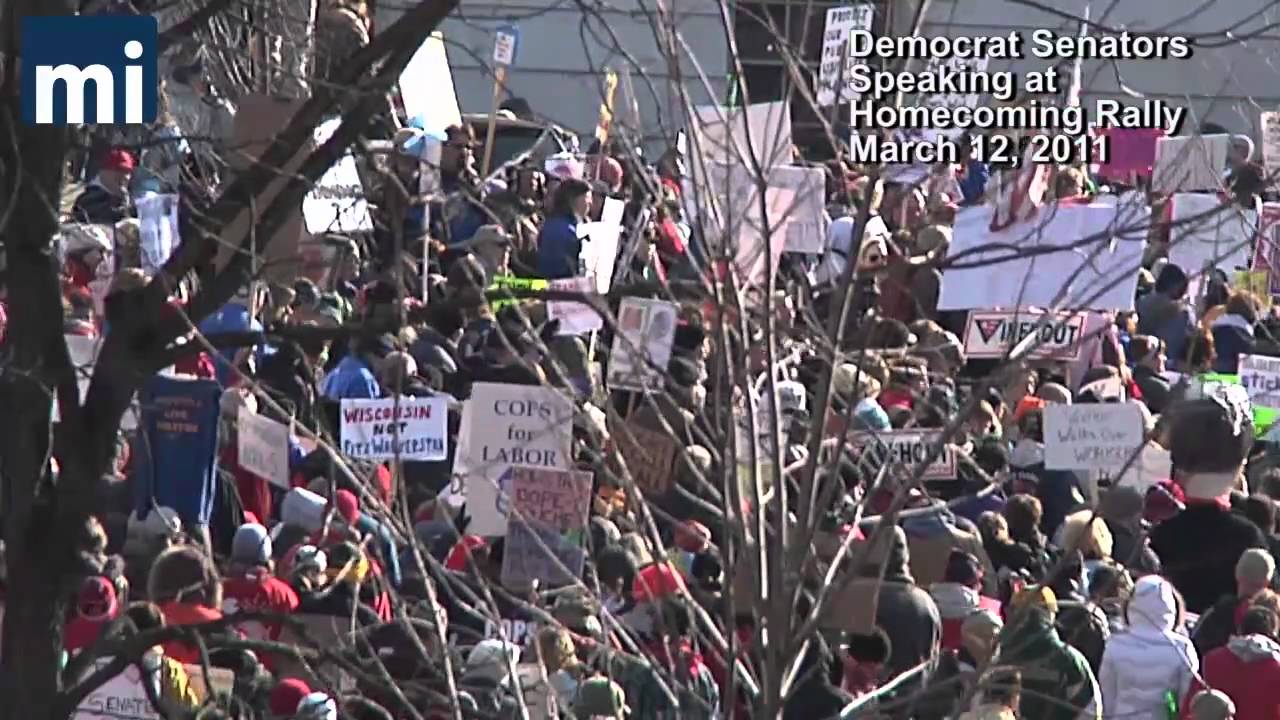 [39] that dismissed the pro-labor protesters as radicalized communists and socialists.
More recently, the Oklahoma Council of Public Affairs, another SPN member, urged lawmakers [40] to "follow Wisconsin's lead" and curb collective bargaining rights for public workers, and the GOP-controlled state Senate voted to do so soon after. Republican Gov. Mary Fallin is expected [41] to sign the repeal into law.
SPN think tanks do more than merely pepper politicians with briefings and a barrage of policy recommendations; they also serve as a farm team for the GOP. Reps. Jeff Flake (R-Ariz.) and Mike Pence (R-Ind.) and former Rep. Tom Tancredo (R-Colo.) all ran SPN think tanks [13] before entering Congress. Following his election in 1994, Massachusetts Gov. William Weld, a Republican, "hired almost everybody" (PDF [42]) out of SPN's Pioneer Institute in Massachusetts, according to an SPN official.
In Michigan, the GOP and Mackinac Center have been particularly close. Before serving as Michigan's governor, Republican John Engler helped found the center [43] in the late 1980s, and the two-term governor would go on to implement many of Mackinac's recommendations. (Engler and the think tank did, however, disagree on a few issues.) In 1995, Engler also appointed [44] Joseph Olson, Mackinac's long-time board chairman, to oversee Michigan's insurance commission. "The Mackinac Center has been tied at the hip with the Republican Party establishment for years," a spokesman for the Michigan Education Association says.
The SPN revolving door spins both ways. Brooke Rollins, president and CEO of the Texas Public Policy Foundation (TPPF), previously served [45] as Republican Gov. Rick Perry's deputy general counsel and the head of Perry's policy division, overseeing the administration's work on everything from health care and education to criminal justice. Jeff Judson, who led the TPPF before Rollins, did stints [46] in the offices of Sen. John Tower and Rep. Tom DeLay, as well as in the George H.W. Bush administration's Department of Energy. Forest Thigpen, president of the Mississippi Center for Public Policy, is a former aide [47] in the DC office of Sen. Thad Cochran (R-Miss.).
Tracie Sharp, SPN's president, told Mother Jones in an email that member think tanks "set their own policy agendas" and "have always been fiercely independent." But those on the other side of the fight see the think tanks as part of a broader effort. "This is not a grassroots movement to eliminate collective bargaining," says Al Mance, executive director of the Tennessee Education Association, the state's largest teachers union. "This is a national movement, and it's funded by all the conservative moneyed interests."
Source URL: http://www.motherjones.com/politics/2011/04/state-policy-network-union-bargaining
Links:
[1] http://motherjones.com/mojo/2011/04/andy-kroll-msnbc-state-policy-network
[2] http://articles.boston.com/2011-04-22/news/29463799_1_union-fees-public-sector-unions-union-benefit
[3] http://www.huffingtonpost.com/2011/03/22/alaska-union-bill-would-r_n_838908.html
[4] http://motherjones.com/mojo/2011/02/whats-happening-wisconsin-explained
[5] http://www.reuters.com/article/2011/03/09/us-states-unions-idUSTRE72802320110309
[6] http://nashvillecitypaper.com/content/city-news/harwell-wants-bill-repeal-teachers-union-collective-bargaining-rights-modified
[7] http://saintpetersblog.com/2011/02/sen-thrasher-would-curb-use-of-union-dues-for-politics/
[8] http://www.reuters.com/article/2011/03/15/us-missouri-unions-idUSTRE72E8L120110315
[9] http://www.guardian.co.uk/commentisfree/cifamerica/2011/apr/20/us-unions-wisconsin
[10] http://www.spn.org/
[11] http://www.spn.org/about/
[12] http://www.spn.org/directory/organizations.asp
[13] http://www.heymiller.com/2009/09/fifty-flowers-bloom/
[14] http://www.tennesseepolicy.org/2011/02/tcpr-leads-charge-against-teachers-union/
[15] http://www.spn.org/about/default.asp
[16] http://www.seekgod.ca/cnp.r.htm#roe
[17] http://www.spn.org/about/spn-leadership-team
[18] http://mediamattersaction.org/transparency/organization/State_Policy_Network/funders
[19] http://mediamattersaction.org/transparency/organization/State_Policy_Network/grants
[20] http://www.iptv.org/iowapress/story.cfm/story/1907/bud_20110127_budget_address
[21] http://www.insideriowa.com/index.cfm?nodeID=18006&audienceID=1&action=display&newsID=11634
[22] http://www.limitedgovernment.org/
[23] http://washingtonindependent.com/106392/iowa-collective-bargaining-bill-doa-in-senate
[24] http://motherjones.com/politics/2011/03/michigan-snyder-mackinac-center
[25] http://www.mackinac.org/14290
[26] http://www.mackinac.org/14756
[27] http://www.mlive.com/politics/index.ssf/2011/03/gov_snyder_signs_controversial.html
[28] http://www.npri.org/publications/unions-another-attempt-to-monopolize-the-public-sector
[29] http://www.rgj.com/article/20110412/NEWS11/110412039/State-Sen-Michael-Roberson-collective-bargaining-system-bankrupting-Nevada
[30] http://www.leg.state.nv.us/Session/76th2011/Reports/HistListBills.cfm?DoctypeID=2
[31] http://www.writeonnevada.com/2011/04/senate-legislative-operations-and.html
[32] http://articles.sfgate.com/2011-02-22/news/28621012_1_pension-reform-gop-bill-public-retirement-system
[33] http://www.pacificresearch.org/press/teacher-unions-and-collective-bargaining
[34] http://maciverinstitute.com/
[35] http://www.wpri.org/pages/about.html
[36] http://maciverinstitute.com/2011/02/union-negotiated-work-rules-for-public-employees-cost-taxpayers-dearly/
[37] http://www.nytimes.com/roomfordebate/2011/02/18/the-first-blow-against-public-employees/wisconsins-governor-is-fiscally-modest-politically-bold
[38] http://www.tax.com/taxcom/taxblog.nsf/Permalink/UBEN-8EDJYS
[39] http://www.youtube.com/watch?v=erBn4xNygPY
[40] http://www.ocpathink.org/articles/971
[41] http://www.reuters.com/article/2011/04/19/us-unions-oklahoma-idUSTRE73I6EE20110419
[42] http://www.google.com/url?sa=t&source=web&cd=1&ved=0CBUQFjAA&url=http%3A%2F%2Fwww.publiceye.org%2Fmagazine%2Fv13n2-3%2FPE_V13_N2-3.pdf&rct=j&q=public%20eye%20takin%20it%20to%20the%20states&ei=3-e0TbuUPIi2tgebsvzpDg&usg=AFQjCNF2uxdcE9kNcNIV7lL0j7qFns2M9w&cad=rja
[43] http://www2.metrotimes.com/OLDWEB/johnengler/002.html
[44] http://www.mackinac.org/bio.aspx?ID=13
[45] http://www.texaspolicy.com/staff_member.php?staff_id=7
[46] http://www.jeffjudson.com/bio.html
[47] http://www.mspolicy.org/about/view_staff.php?entryID=22
http://www.motherjones.com/print/110486
===
SPN Founders, History, and Staff:
This article is a breakout from the main article on the State Policy Network (SPN). Please see State Policy Network for more. Below is information about SPN's founders, history, and important personnel:
Contents [hide] |
SPN History
SPN was founded in November 1991[1] and incorporated in March of 1992.[2] The founding chairman of the board was Thomas A. Roe (1927-2000),[3] and the founding executive director was Byron S. Lamm.[1] It was formerly known as the Madison Group and was formed as an umbrella organization for what were intended to be "mini-Heritage Foundations at the state level" (see SPN's history below).[4]
There were 12 original think tanks when SPN was founded. As of 2012, there are 59 SPN member think tanks in all 50 states.
Founding and Ties to Reagan
According to the National Review[4] and SPN's website,[5] SPN was founded at the suggestion of President Ronald Reagan. In a conversation with Thomas Roe (a member of his "kitchen cabinet") in the 1980s, Reagan allegedly suggested Roe create "something like a Heritage Foundation in each of the states." So in 1986, Roe founded the South Carolina Policy Council. Similar groups -- state-based think tanks -- formed in Colorado, Illinois, Michigan, and elsewhere at around the same time. Representatives of those groups met at the Madison Hotel in Washington, D.C. and started to call themselves the "Madison Group." SPN was formally created as an "umbrella organization"[4] to provide "advisory services" -- bankrolled by Roe and other conservative funders -- in 1992.[5]
SPN's founding executive director was Byron Lamm, who held that position from 1992 until 2000. He was extremely influential in the development of the organization, as well as co-founding SPN member state think tank the Indiana Policy Review Foundation,[1] just as Roe had founded the South Carolina Policy Council. He was succeeded by Tracie Sharp, who was the executive director and one of the founders of the Cascade Policy Institute. Sharp has also been quite influential. During her tenure, SPN has continued to grow at a rapid rate, expanding from 43 member state think tanks in 2002 to 59 member state think tanks in 2012. Sharp also co-founded member state think tank the Cascade Policy Institute.
Roe was chairman of SPN's board from its founding until October 1999. He was succeeded by Carl Helstrom, Executive Director of the JM and Milbank Foundations.[3]
From 1992 to 1998, SPN operated in a relatively limited organizational capacity. Then, according to SPN, "SPN's Board of Directors realized the need for a stronger organization that would provide additional services. After extensive discussions, the existing Board took a bold and historic step in September 1998, dissolving itself and appointing a transitional Board to fulfill the broader role envisioned for the organization."[5]
SPN was founded and headquartered in Fort Wayne, Indiana until 1999, when it moved to Richmond, California.[6] As of April 2013, it is headquartered in Arlington, Virginia.[7]
"Pioneers" of the state think tank movements, as Lamm called them in a 2002 newsletter, included "Joe and Diane Bast at Heartland, John Andrews, then at the Independence Institute [its founder], Larry Reed at Mackinac, Stan Marshall and John Cooper at the James Madison Institute, Fritz Steiger at Texas Public Policy Foundation, and Tom Roe."[1]
Founders
Thomas A. Roe
Thomas Anderson Roe, Jr. (1927-2000, pictured at right) was a businessman and industrialist from Greenville, South Carolina.[8] He was the founding chairman of the State Policy Network (SPN) as well as founder of the South Carolina Policy Council. In the mid-1980s, Roe allegedly told fellow wealthy conservative donor and Heritage Foundation trustee Robert Krieble, "You capture the Soviet Union -- I'm going to capture the states."[9] He was an adviser to President Ronald Reagan[10] and was called "an architect of the South Carolina Republican Party."[11] He died in 2000, but his Roe Foundation "continues to provide financial support to free-market policy groups across the country."[12]
Roe "accumulated his wealth as chairman of the board of Builder Marts of America Inc., which he transformed from a small building-materials supply company into an international corporation," according to The Greenville News.[11] (The company had sales of $600 million in 1998.)[13]
No "Collectivist World" or Organized Musicians: Strict Instructions for Endowment at Roe Foundation
According to the conservative "opposition research" think tank Capital Research Center (CRC), Roe believed in maintaining "donor intent," so the foundation his personal wealth endowed, the Roe Foundation, has explicit by-laws and requires grantees to "sign a document promising to uphold" the following principles:[14]
"First, 'the maximum potential of a free people is achieved when they are free to control their own destiny'; second, 'the greatest threat to these freedoms is intrusive government'; and third, 'the Judeo-Christian tradition represents the underpinnings of a just society.' Furthermore, recipients of the foundation’s support must recognize 'the importance of state and local organizations functioning alongside national organizations in the pursuit of a free society.' Finally, they must 'educate the public at large and all public policy makers to a better understanding of these fundamental values and practical ways to achieve the goals of expanding human freedom.'"[14]
A few grants can go to "nonprofit organizations in the metropolitan area of Greenville until such time as there are no descendents [sic] of Tom or Shirley Roe living there, but one such grant, to the Greenville Symphony Orchestra, "stipulates that its musicians cannot unionize. 'Tom didn’t like unions,' says [his widow] Shirley Roe."[14]
Roe gave the Mont Pelerin Society and Philadelphia Society "standing to sue" the Roe Foundation if, after his death, the Roe Foundation makes a grant to an organization “whose activities or public statements reflect a belief in a collectivist world or any view inconsistent” with the foundation’s announced principles (emphasis added), according to Chicago lawyer Paul Rhoads, who has written for the Philanthropy Roundtable.[14]
Political Influence
According to CRC, Roe was vice chairman and finance chairman of the Republican Party in South Carolina and a member of the Republican National Finance Committee. He was a delegate to the 1964 Republican National Convention, where he "enthusiastically supported the doomed candidacy of Barry Goldwater."[14]
But according to Ed McMullen, president of the South Carolina Policy Council, "He became frustrated with going to meetings of Republicans and discovering that nobody else in the room had even heard of economists such as Ludwig von Mises or Friedrich Hayek." And, according to SPN's founding executive director, Byron Lamm, "He was also concerned that a lot of Republicans were country-club types who weren’t really committed to free-market ideas." As John J. Miller summarizes in his CRC article about Roe, "Too many of them simply hadn’t read their Hayek."[14]
So he turned to conservative policy foundations and was an early funder of the Heritage Foundation, joining Joseph Coors, Samuel RobertsNoble, and Richard Mellon Scaife. He led Heritage's finance committee.[14]
Early Life and Business Career
According to CRC, Roe grew up on his family's farm. He attended Furman University near Greenville, graduating in 1948. The school later gave him an honorary law degree in 1980. He did cancer research as an undergraduate there. In 1961, his father died and he inherited his business, Citizens Lumber Company.[14]
In order for his and other family-owned building materials dealerships to be able to compete with chain stores, he created "Builder Marts of America" to supply "a variety of services to independent dealers, including advertising, security, accounting, and training." Meanwhile, a subsidiary, Builder Way, "moved to acquire" businesses that became available "when a client of Builder Marts would retire or die."[14]
He also started a long-distance phone service to take advantage of the telephone industry deregulation. It was eventually taken over by MCI.[14]
Builder Marts became a "Forbes 500" international company by 2000.[14]
Please see Thomas A. Roe and the Roe Foundation for more.
Byron S. Lamm
Byron S. Lamm was the founding executive director of the State Policy Network (SPN), from 1992[1] until January 2000.[5] According to a 1994 article in The Boston Globe, Lamm was a talk-radio show host, and he told the Globe that SPN often broadcast its messages via talk radio.[15]
Lamm is a managing partner of Pin Oak Group, LLC, an investment firm in Fort Wayne, Indiana.[16][17] He co-founded[16] and is president of the board of the Indiana Policy Review Foundation, an SPN-member think tank founded in 1989.[18] He is on the board of directors of the Roe Foundation.[19] He has previously been chairman of the board of the Center for Education Reform, a group committed to education privatization;[16] and on the board of directors of the Property and Environment Research Center (PERC, formerly the Political Economy Research Center), which describes itself as a “free market environmental” group committed to deregulation of industry and to the privatization of public assets;[20] and the Center for Civic Renewal.[21] He has funded the Heartland Institute.[22]
Lamm has personally given $56,455 to Republican and Libertarian politicians and PACS from 1998 to September 2012, including $1,500 to the influential right-wing political group Club for Growth and its PAC.[23]
Please see Byron S. Lamm for more.
Tracie Sharp
Tracie Sharp , president of the State Policy Network (SPN) since January 2000, had previously served on its board of directors for 14 years. She was the executive director and one of the founders of Cascade Policy Institute, Oregon's market-oriented think tank, from 1991 to 1999. She worked in the areas of education and social security privatization.[5]
In 2012, a list of 2010 funders of an SPN member think tank in Texas, the Texas Public Policy Foundation (TPPF), that was disclosed to the IRS was inadvertently made public. The list of funders revealed is an important case study in how SPN's member think tanks are funded, and by whom. Koch Industries, for example, gave $159,834 directly to TPPF, in addition to $69,788.61 from the Claude R. Lambe Foundation, which is a Koch Family Foundation. SPN itself gave TPPF $49,306.90, but what's more, Tracie Sharp, SPN's executive director, was the contact person for an additional $495,000. These two grants, for $300,000 and $195,000, were listed as being received from the "State Think Tank Fund" and the "Government Transparency Fund," respectively -- two funds about which virtually nothing is known.[24][25]
Sharp represents SPN as a member of the American Legislative Exchange Council (ALEC). She is a member of ALEC's Education Task Force[26] and Health and Human Services Task Force.[27] She was the recipient of ALEC's 2009 Private Sector Member of the Year Award.[28]
Sharp is also a trustee to the Roe Foundation and to the Special Hope Foundation, a "family foundation supporting innovative projects to assist the causes of the physically, emotionally, and developmentally disabled," a biographical note states. In 1993, Sharp founded HOPE-Oregon, a Portland, Oregon-based "private volunteer effort to provide health care education services to low-income families."[5]
"Previously, Ms. Sharp worked with Washington State radio commentator and Republican Party leader John Carlson as director of programs at the Washington Institute for Policy Studies in Seattle."[5] Please see Tracie Sharp for more.
Personnel
Board of Directors
As of April 2013:[29]
- Carl Helstrom, Chairman (The JM Foundation), board member since at least 1997[30]
- Tracie Sharp, President (former executive director and co-founder, Cascade Policy Institute), board member since at least 1997[30]
- Stanford D. Swim, Secretary (The GFC Foundation), board member since 2007[31]
- Thomas Willcox (The Roe Foundation), Treasurer, board member since 2007,[31] son-in-law of Tom and Shirley Roe[14]
- Theodore D. Abram (American Institute for Full Employment), board member since 1998[6]
- Whitney Ball (Donors Trust), board member since 2005[32]
- John Jackson (Adolph :{Coors:(style="background-color:#ffff66;"):}: Foundation and Castle Rock Foundation)[33]
- Barbara Wells Kenney (Freedom Foundation), board member since 2005[32]
- Adam Meyerson (Philanthropy Roundtable), board member since 2007[31]
- Bridgett Wagner (The Heritage Foundation), board member since 2005[32]
Former Board Members
- Gisele Huff, former Treasurer (Jaquelin Hume Foundation), board member from 2004[34] to 2012
- Byron S. Lamm, founding Executive Director and former boardmember from at least 1997[30] to 2006[35] (Pin Oak Group, LLC) (became president in September 1998)[6]
- Robert W. Poole, Jr. (Reason Foundation), from at least 1997[30] to 2006[35]
- Lawrence Reed (Mackinac Center for Public Policy),[36] from at least 1997[30] to 2006[35]
- Gary Palmer (Alabama Family Alliance), from at least 1997[30] to 1998[6]
- C.C. Guy, Assistant Treasurer, from at least 1997[30] to 1998[37]
- Bob Williams (Evergreen Freedom Foundation), from at least 1997[30] to 1998[6]
- Thomas A. Roe (Roe Foundation), from 1992 to October 1999[3]
- Thomas C. Atwood (Heritage Foundation), from at least 1997[30] to 1998[6]
- Judy M. Cresanta (Nevada Policy Research Institute), from at least 1997[30] to 1998[6]
- Rep. Jeff Flake (former executive director, Goldwater Institute, now represents Arizona's 6th district in the U.S. House of Representatives), from at least 1997[30] to 1998[6]
- Jeff Judson (Texas Public Policy Foundation), from at least 1997[30] to 1998[6]
- Jo Kwong (Atlas Economic Research Foundation), from at least 1997[30] to 1998[6]
- Mitchell B. Pearlstein (Center of the American Experiment), from at least 1997[30] to 1998[6]
- Fred Smith (Competitive Enterprise Institute), from at least 1997[30] to 1998[6]
- Michael W. Watson (Arkansas Policy Foundation), from at least 1997[30] to 1998[6]
- Alejandro A. Chafuen, from 1999[37] to 2004[34]
- Derwood S. Chase Jr., from 1999[37] to 2004[34]
- Gaylord K. Swim (Sutherland Institute), from 2000[38] to 2004[34]
Principal Staff
As of April 2013:[29]
- Tracie Sharp, President and CEO
- Jennifer Butler, Executive Vice President since 2006[35]
- Lynn Harsh, Vice President of Strategy
- Daniel J. Erspamer, Vice President for Strategic Partnerships
- Teresa Brown, Director of Strategic Operations
- Becky Helland, Leadership Development Initiative Operations & Tactical Officer
- Meredith Turney, Director of Strategic Communications
- Nicole Williams, Senior Communications Advisor - President, Spark Freedom
- Alexis Baker, Manager of Donor Relations
- Rebecca Bruchhauser, Director of Donor Relations
- Rebecca Feldman, Manager of Foundation Relations
- Rebecca Gaetz, Donor Relations Manager
- Jerry Krause, Manager of Donor Relations
- Brad Gruber, Operations Director
- Rachel Kopec, Coalitions Coordinator
- Kathleen O'Hearn, Director of Coalitions
Former Staff
Former staff, as of 2006, include:[36]
- Kate Doner of Doner Fundraising, Fundraising
- Tonya R. Barr, Outreach Coordinator
- Patrick McDougal, Program Coordinator
- Kurt T. Weber, Senior Advisor
Contact Details
State Policy Network
1655 N. Fort Myer Dr., Suite 360
Arlington, VA 22209
Phone: (703) 243-1655
Fax: (703) 740-0314
Email: info@spn.org
Web: http://www.spn.org/
Facebook: https://www.facebook.com/StatePolicy
Twitter: @StatePolicy
Articles and Resources
Related SourceWatch Articles
- State Policy Network:
- SPN Funding
- SPN Agenda
- SPN Founders, History, and Staff
- SPN Members
- SPN Ties to ALEC
- Thomas A. Roe
- Tracie Sharp
- Byron S. Lamm
- Roe Foundation
- DonorsTrust
- Donors Capital Fund
- Koch Family Foundations
- Koch Industries
- Franklin Center for Government and Public Integrity
- Heritage Foundation
- Think tanks
- Whitney Ball
- Adam Meyerson
- Bridgett Wagner
Related PRWatch Articles
- Rebekah Wilce, A Reporters’ Guide to the "State Policy Network": the Right-Wing Think Tanks Spinning Disinformation and Pushing the ALEC Agenda in the States, PRWatch.org, April 4, 2013.
- Sara Jerving, ALEC and Heartland Aim to Crush Renewable Energy Standards in the States, PRWatch.org, November 27, 2012.
- Connor Gibson, Meet the Network Hiding the Koch Money: "Donors Trust" and "Donors Capital Fund", PRWatch.org, October 29, 2012.
- Brendan Fischer, Koch-Funded Mackinac Center Brings Wisconsin Act 10 Provisions to ALEC, PRWatch.org, May 2, 2012.
- Sara Jerving, Franklin Center: Right-Wing Funds State News Source, PRWatch.org, October 31, 2011.
External Articles and Resources
- Center for Media and Democracy and Arizona Working Families, A Reporter’s Guide to the Goldwater Institute: What Citizens, Policymakers, and Reporters Should Know, organizational report, March 14, 2013.
- Paul Abowd, Center for Public Integrity, Donors use charity to push free-market policies in states, Consider the Source, February 14, 2013.
- John R. Mashey, Fake science, fakexperts, funny finances, free of tax 2, DeSmog Blog report, updated October 23, 2012, p. 74.
- Andy Kroll, The Right-Wing Network Behind the War on Unions, Mother Jones, April 25, 2011.
- Guidestar, State Policy Network, IRS filings and other organizational information about SPN.
- Center for Policy Alternatives, ALEC and the Extreme Right-Wing Agenda, organizational brochure about ALEC and SPN.
- John J. Miller, Fifty Flowers Bloom: Conservative think tanks — mini–Heritage Foundations — at the state level, National Review, November 19, 2007.
- Bridge Project, State Policy Network, online resource listing grants to SPN and SPN's connections to other groups.
- People for the American Way, State Policy Network, RightWingWatch.org, organizational resource.
- Greenpeace, Koch Industries Climate Denial Front Group: State Policy Network (SPN), organizational resource.
References
Big Corporations Put Up Seed Funding for Republican Dark Money Group
Some of the nation's biggest corporations donated more than a million dollars to launch a Republican nonprofit that went on to play a key role in recent political fights.
Like the nonprofit groups that poured money into last year’s elections, the decade-old State Government Leadership Foundation has been able to keep the identities of its funders secret. Until now.
A records request by ProPublica to the IRS turned up a list of the original funders of the group: Exxon, Pfizer, Time Warner, and other corporations put up at least 85 percent of the $1.3 million the foundation raised in the first year and a half of its existence, starting in 2003.
The donor list is stamped "not for public disclosure,” and was submitted to the IRS as part of the foundation’s application for recognition of tax-exempt status. If approved, such applications are public records.
The foundation and other similar nonprofits are allowed to take anonymous and unlimited donations from individuals or corporations. That’s because they are classified as “social welfare” nonprofits, which are supposed to benefit the community at large, and not just one group or political party.
Last year, we reported how the State Government Leadership Foundation paid for Republican redistricting consultantsto draw new congressional district maps in North Carolina. The resulting gerrymander helped flip the state’s congressional delegation to Republicans.
In recent years, the foundation has also funded TV ads targeting Democrats during the 2011 Wisconsin showdown over collective bargaining rights; attacking President Obama in Virginia over his energy policy; and accusing teachers unions of “destroying our children’s future.”
The foundation also gave $1.25 million in 2011 to the Indiana Opportunity Fund, a state-level nonprofit that ran anti-union ads featuring Republican Gov. Mitch Daniels. (That group was founded by attorney Jim Bopp, who has long fought against campaign finance regulation.)
The foundation’s single-biggest early donor was the now-defunct mortgage lender Ameriquest, which gave more than $260,000. (We contacted a number of the companies on the list; they did not respond to requests for comment.) Corporate trade associations including the Pharmaceutical Research and Manufacturers of America, the Edison Electric Institute, and the American Tort Reform Association also pitched in, each giving between $50,000 and $100,000.
The foundation��s affiliated organization, the Republican State Leadership Committee, focuses on winning state-level elections for the GOP and also gets corporate money, including from tobacco and insurance giants. As an explicitly political organization, the committee has to disclose its donors.
By contrast, the recent funders of the foundation, which took in $2.5 million in 2011 including a single donation of $1 million, are still secret.
The foundation applied for IRS recognition as a social welfare group in late 2003 but was initially rejected. The IRS concluded the foundation was “a partisan organization” that ���operated primarily for the benefit of a select group” – the GOP. Social welfare groups, the IRS’ rejection letter noted, must promote the “general welfare of the whole community�� — not a particular group.
The foundation’s lawyers from the firm Arent Fox fired back in an appeal, arguing that the foundation was not a partisan outfit.
The foundation, according to the 2005 appeal, “was created to promote public debate” about issues including pharmaceuticals, securities regulation, and asbestos litigation.
“It may be useful to describe what the SGLF is not,” the appeal says. “The SGLF:
• Is not affiliated with the Republican Party in any way;
�� Does not meet with or coordinate its activities with the Republican Party;
• Does not make contributions to, or accept contributions from, the Republican Party;
• Does not participate in political campaigns, elections or publish electioneering messages on behalf of any candidate or party;
• Does not invite Representatives of the Republican Party to speak at its events, and
• Does not participate in the Republican Party platform, does not recruit or train Republican candidates, does not fundraise for Republican candidates, and does not coordinate its issue selection or policy positions with the Republican Party.
In 2007, more than three years after the foundation’s application, the IRS ultimately recognized it as a tax-exempt social welfare group.
But the group’s protestations that it has nothing to do with the GOP seems at odds with its recent activities. Besides running ads attacking Democrats, the foundation was involved in redistricting in several states to, as the foundation put it in a letter to Republican legislators, draw “legislative lines that we will have to defend in 2012 and beyond.”
Foundation spokesperson Jill Bader told ProPublica that since its creation the foundation’s “activities have evolved in some ways from those that were originally contemplated and conducted by the organization.”
Bader continued: “SGLF’s present activities are in strict compliance with the requirements of the Internal Revenue Code and all future SGLF activities will be in strict compliance as well.”
http://www.propublica.org/article/big-corporations-put-up-seed-money-for-republican-nonprofit
http://www.huffingtonpost.com/elliott-negin/koch-brothers-fund-bogus-_b_2253472.html?ir=
...
Did Muller's conclusions prod the Kochs to reconsider their hardline position against wind, solar and other renewable energy--our best bet, besides energy efficiency, to combat global warming? Hardly. The Kochs' minions merely stepped up their ongoing disinformation campaign to scuttle renewable energy on economicgrounds.
Take the American Legislative Exchange Council (ALEC) and Heartland Institute, two Koch-funded organizations with a history of attacking efforts to address climate change. ALEC, a stealthy lobby group whose corporate, nonprofit and state legislator members ghostwrite and then attempt to implement "model" legislation, played a key role in killing the Midwest Greenhouse Gas Reduction Accord, a six-state regional cap-and-trade agreement. Meanwhile, Heartland--an ALEC member that hosts annual conferences deriding climate science--is probably best known for postinga not-so-subtle billboard in Chicago last May comparing people who accept the reality of global warming with "Unabomber" domestic terrorist Ted Kaczynski.
More recently the two groups made news when the Washington Post reportedALEC's board of directors adopted a Heartland-crafted model bill that would repeal state standards requiring utilities to ramp up their use of renewable energy. The model legislation, the "Electricity :{Freedom :(style="background-color:#fff200"):}:Act," claims these requirements--currently on the books in 29 states and the District of Columbia--will dramatically drive up electricity rates.
That claim, however, is bunk. In fact, renewable electricity standards have not significantly increased rates. In some cases, rates have even dropped a bit. But more on that later.
Garbage in, garbage out. To make its case, ALEC--whose membersinclude major coal, oil and electric utility industry companies--cites analyses by Suffolk University's Beacon Hill Institute commissioned by the Koch-funded **American Tradition Institute**and "free-market" state think tanks associated with the Koch-funded**State Policy Network**. The analyses examine current or proposed standards in more than a dozen states, including Colorado, Kansas, Michigan, Minnesota and New Jersey. The studies were partly funded by, you guessed it, the Koch brothers.
The fact that the Kochs funded the studies doesn't automatically mean they're biased. In this case, however, Beacon Hill research economist Michael Head essentially conceded to Washington Post reporter Juliet Eilperin that he and his colleagues fudged their findings.
That's right.
-
voucher:
Allies of the Right
Lobbyists for virtual school companies have also embedded themselves in the conservative infrastructure. The International Association for Online Learning (iNACOL), the trade association for EdisonLearning, Connections Academy, K12 Inc., American Virtual Academy, Apex Learning and other leading virtual education companies, is a case in point. A former Bush appointee at the Education Department, iNACOL president Susan Patrick traverses right-leaning think tanks spreading the gospel of virtual schools. In the past year, she has addressed the Atlas Economic Research Foundation, a group dedicated to setting up laissez-faire nonprofits all over the world, as well as the American Enterprise Institute in Washington.
Two pivotal conservative organizations have helped Patrick in her campaigns for virtual schools: the American Legislative Exchange Council and the State Policy Network.SPN nurtures and establishes state-based policy and communication nonprofits with a right-wing bent. ALEC, the thirty-eight-year-old conservative nonprofit, similarly coordinates a fifty-state strategy for right-wing policy. Special task forces composed of corporate lobbyists and state lawmakers write “template” legislation [see John Nichols, “ALEC Exposed,” August 1/8]. Since 2005, ALEC has offered a template law called “The Virtual Public Schools Act” to introduce online education. Mickey Revenaugh, an executive at virtual-school powerhouse Connections Learning, co-chairs the education policy–writing department of ALEC.
At SPN��s annual conference in Cleveland last year, held two months before the midterm elections, the think tank network adopted a new push for education reform, specifically embracing online technology and expanding vouchers. Patrick opened the event and led a session about virtual schools with Anthony Kim, president of the virtual-school business Education Elements.
SPN has faced accusations before that it is little more than a coin-operated front for corporations. For instance, SPN and its affiliates receive money from polluters, including infamous petrochemical giant Koch Industries, allegedly in exchange for aggressive promotion of climate denial theories. But SPN’s conference had less to do with policy than with tactics. Kyle Olson, a Republican operative infamous in Michigan and other states for his confrontational attacks on unionized teachers, gave a presentation on labor reform in K-12 education. Stanford Swim, heir to a Utah-based investment fortune and head of a traditional-values foundation, ran a workshop at the conference on creating viral videos to advance the cause. He said policy papers wouldn’t work. Tell your scholars, “Sorry, this isn’t a white paper,�� Swim advised. “You gotta go there,” he continued, “and it’s because that’s where the audience is.” “If it’s vulgar, so what?” he added.
Since the conference, SPN’s state affiliates have taken a lead role in pushing virtual schools. Several of its state-based affiliates, like the Buckeye Institute in Ohio, set up websites claiming that unions—the only real opposition to ending collective bargaining and the expansion of charter school reforms—led to overpaid teachers and budget deficits. In Wisconsin, the MacIver Institute’s “news crew” laid the groundwork for Governor Walker’s assault on collective bargaining by creating news reports denouncing protesters and promoting the governor. In March, while busting the teachers unions in his state, Walker lifted the cap on virtual schools and removed the program’s income requirements.
State Representative Robin Vos, the Wisconsin state chair for ALEC, sponsored the bill codifying Walker��s radical expansion of online, for-profit schools. Vos’s bill not only lifts the cap but also makes new, for-profit virtual charters easier to establish. As the Center for Media and Democracy, a Madison-based liberal watchdog, notes, the bill closely resembles legislative templates put forward by ALEC.
Although SPN���s unique contribution to the debate has been clever web videos and online smear sites, the group’s affiliates have also continued the traditional approach of policy papers. In Washington State, the Freedom Foundation published ��Online Learning 101: A Guide to Virtual Public Education in Washington”; Nebraska’s Platte Institute released “The Vital Need for Virtual Schools in Nebraska”; and the Sutherland Institute, a Utah-based SPN affiliate, equipped lawmakers with a guide called ��Thinking Outside the Building: Online Education.” SPN think tanks in Maine, Maryland and other states have pressed virtual school reforms. Patrick visited SPN state groups and gave pep talks about how to sell the issue to lawmakers.
Meanwhile, ALEC has continued to slip laws written by education-tech lobbyists onto the books. In Tennessee, Republican State Representative Harry Brooks didn’t even bother changing the name of ALEC’s Virtual Public Schools Act before introducing it as his own legislation. Asked by the Knoxville News Sentinel’s Tom Humphrey where he got the idea for the bill, Brooks readily admitted that a K12 Inc. lobbyist helped him draft it. Governor Bill Haslam signed Brooks’s bill into law in May. The statute allows parents to apply nearly every dollar the state typically spends per pupil, almost $6,000 in most areas, to virtual charter schools, as long as they are authorized by the state.
SPN’s fall 2010 conference featured the man perhaps happiest with the explosion in virtual education: Jeb Bush. “I have a confession to make,” he said with grin. ��I am a real policy geek, and this is like the epicenter of geekdom.” Bush shared his experiences initiating some of the nation’s first for-profit and virtual charter school reforms as the governor of Florida, acknowledging his policy ideas came from some in the room. (The local SPN affiliate in Tallahassee is the James Madison Institute.)
The State Policy Network is a professional service organization for the "state-based free market think tank movement." It was started in 1992 by founding chairman Thomas A. Roe, who died in 2000. It was formerly known as the Madison Group. Roe was succeeded by Gaylord K. Swim, who died in 2005. SPN is currently in 37 states The current board members are listed below.[1]
Support for the American Legislative Exchange Council
SPN was a "Chairman" level sponsor of 2011 American Legislative Exchange Council (ALEC) Annual Conference, with a required sponsorship level of $50,000 in 2010.[2] ALEC is also an Associate Member of State Policy Network, as of Aug. 11, 2011.[3]
ALEC is not a lobby; it is not a front group. It is much more powerful than that. Through ALEC, behind closed doors, corporations hand state legislators the changes to the law they desire that directly benefit their bottom line. Along with legislators, corporations have membership in ALEC. Corporations sit on all nine ALEC task forces and vote with legislators to approve “model” bills. They have their own corporate governing board which meets jointly with the legislative board. (ALEC says that corporations do not vote on the board.) They fund almost all of ALEC's operations. Elected legislators who are active in ALEC, overwhelmingly right-wing politicians, then bring those proposals home and introduce them in statehouses across the land as their own brilliant ideas and important public policy innovations—without disclosing that corporations crafted and voted on the bills. ALEC boasts that it has over 1,000 of these bills introduced by legislative members every year, with one in every five of them enacted into law. ALEC describes itself as a “unique,” “unparalleled” and “unmatched” organization. It might be right. It is as if a state legislature had been reconstituted, yet corporations had pushed the people out the door. Learn more at ALECexposed.org.
Mission
The mission of SPN, according to its May 2006 newsletter, is "to provide strategic assistance to independent research organizations devoted to discovering and developing market-oriented solutions to state and local public policy issues."[1]
Member Think Tanks
Alabama
alabamapolicy.org
205-870-9900
Alaska
alaskapolicyforum.org
907-334-5853
Arizona
goldwaterinstitute.org
602-462-5000
Arkansas
arkansaspolicyfoundation.org
501-537-0825
California
pacificresearch.org
415-989-0833
Colorado
i2i.org
303-279-6536
Connecticut
Yankee Institute for Public Policy
yankeeinstitute.org
860-297-4271
��
Delaware
caesarrodney.org
302-535-6523
Florida
jamesmadison.org
850-386-3131
Georgia
Georgia Public Policy Foundation
gppf.org
404-256-4050
Hawaii
grassrootinstitute.org
808-591-9193
Idaho
idahofreedom.net
208-921-6749
Illinois
illinoispolicyinstitute.org
312-346-5700
��
Indiana
Indiana Policy Review Foundation
inpolicy.org
260-417-4094
Iowa
limitedgovernment.org
319-385-3462
Kansas
kansaspolicy.org
316-634-0218
Kentucky
Bluegrass Institute for Public Policy Solutions
bipps.org
270-782-2140
Louisiana
Pelican Institute for Public Policy
pelicaninstitute.org
504-920-4727
Maine
mainepolicy.org
207-321-2550
Maryland
Calvert Institute for Policy Research
calvertinstitute.org
410-752-5887
freestatefoundation.org
301-984-8253
Maryland Public Policy Institute
mdpolicy.org
240-686-3510
Massachusetts
pioneerinstitute.org
617-723-2277
Michigan
Mackinac Center for Public Policy
mackinac.org
989-631-0900
Minnesota
Center of the American Experiment
americanexperiment.org
612-338-3605
Freedom Foundation of Minnesota
freedomfoundationofminnesota.com
612-354-2192
Mississippi
Mississippi Center for Public Policy
mspolicy.org
601-969-1300
��
Missouri
showmeinstitute.org
314-726-5655
Montana
montanapolicy.org
406-219-0508
Nebraska
Platte Institute for Economic Research
platteinstitute.org
402-452-3737
Nevada
Nevada Policy Research Institute
npri.org
702-222-0642
New Hampshire
Josiah Bartlett Center for Public Policy
jbartlett.org
603-224-4450
New Jersey
csinj.org
973-927-9860
Solutions for New Jersey, Inc.
solutionsfornewjersey.com
609-882-1071
New Mexico
riograndefoundation.org
505-264-6090
New York
Empire Center for New York State Policy
empirecenter.org
518-434-3100
North Carolina
johnlocke.org
919-828-3876
John William Pope Civitas Institute
jwpcivitasinstitute.org
919-828-1400
North Dakota
policynd.org
701-223-8155
Ohio
Buckeye Institute for Public Policy Solutions
BuckeyeInstitute.org
614-224-4422
��
Oklahoma
Oklahoma Council of Public Affairs
ocpathink.org
405-602-1667
Oregon
CascadePolicy.org
503-242-0900
Pennsylvania
commonwealthfoundation.org
717-671-1901
Rhode Island
Ocean State Policy Research Institute
oceanstatepolicy.org
401-228-6691
South Carolina
scpolicycouncil.com
803-779-5022
South Dakota
Great Plains Public Policy Institute
greatplainsppi.org
605-334-9400
Tennessee
Tennessee Center for Policy Research
tennesseepolicy.org
615-383-6431
Texas
Texas Public Policy Foundation
texaspolicy.com
512-472-2700
Utah
sutherlandinstitute.org
801-355-1272
Vermont
ethanallen.org
802-695-1448
Virginia
thomasjeffersoninst.org
703-440-9447
Virginia Institute for Public Policy
virginiainstitute.org
703-753-5900
Washington
effwa.org
360-956-3482
washingtonpolicy.org
206-937-9691
West Virginia
Public Policy Foundation of West Virginia
westvirginiapolicy.com
304-282-8249
Wisconsin
MacIver Institute for Public Policy
maciverinstitute.com
608-588-6477
Wisconsin Policy Research Institute
wpri.org
262-367-9940
Wyoming
wyliberty.org
307-632-7020[4]
Funding
The State Policy Network has received funding from the Olin Foundation, the Richard & Helen DeVos Foundation, the Bradley Foundation and the Castle Rock Foundation (Coors affiliated).[5]
Revenue and Expenses
Below is information from the SPN's 2010 Annual Report:[6]
Revenue
Primary Revenue: $4,749,695
Other Revenue: $62,818
Total Revenue: $4,812,513
Expenses
Program Expenses: $766,175
Administrative Expenses: $863,178
Fundraising Expenses: $920,056
Total Functional Expenses: $3,941,133
Payments to Affiliates: $0
Excess (or Deficit) for the year: $871,380
Net Assets: $3,534,009
Principal staff (as of June 2006)
- Tracie Sharp, President
- Tonya R. Barr, Outreach Coordinator
- Patrick McDougal, Program Coordinator
- Kurt T. Weber, Senior Advisor
- Nicole Williams, Management and Technology Advisor
- Kate Doner of Doner Fundraising, Fundraising[1]
Board of Directors (as of June 2006)
- Carl Helstrom, Chairman (The JM Foundation
- Tracie J. Sharp, (President) State Policy Network
- Gisele Huff, Treasurer (Jaquelin Hume Foundation
- Theodore D. Abram (Jeld-Wen Foundation)
- Whitney Hall (Donors Trust
- Barbara Wells Kenney (Lillian S. Wells Foundation)
- Byron S. Lamm (Pin Oak Group, LLC)
- Robert W. Poole, Jr (Reason Foundation)
- Lawrence W. Reed (Mackinac Center for Public Policy)
- Bridgett G. Wagner (The Heritage Foundation[1]
Publications
SPN news
SPN News publishes six times a year.[7]
Policy exchange
Think tank toolkit
Annual meeting and K-12 education and reform summit
SPN offers policy mobilization networks and leadership development. It co-sponsored a summit with the Alliance for School Choice and the Milton and Rose D. Friedman Foundation in 2006. Summit partners included the Agudath Israel of Illinois, Black Alliance for Educational Options, The Center for Education Reform, the Hispanic Council for Reform and Educational Options, the Mackinac Center for Public Policy, Parent's in Charge Foundation and School Choice Wisconsin. The SPN reserves the right to "refuse admittance to private events."[8]
Members
The SPN website states "Membership in State Policy Network is voluntary and by invitation-only."[9] There are regular members and associate members.
Regular Members: "A regular member operates as a full-service think tank, addressing a variety of relevant policy issues, not just a single-issue. They will operate independently with their state, and not as part of a state chapter, franchise, other effort of a separate organization. Their primary goal is to provide educational materials to the citizenry, public officials, and members of the media with a state-based focus. They refuse to accept or solicit government funding, and are IRS approved 501(c)(3)s."
Associate Members: "Like regular members, associate members are organizations that display a commitment to a market-oriented foundational public policy. They are also IRS approved 501(c)(3) organizations primarily focused on education and operate independently of all government funding. However, unlike regular members, SPN Associate Members can be national in scope and are not necessarily oriented towards a single state."
Members include:[10]
- Alabama Policy Institute
- Allegheny Institute for Public Policy
- Arkansas Policy Foundation
- Bluegrass Institute for Public Policy Solutions
- Buckeye Institute for Public Policy Solutions
- Calvert Institute for Policy Research
- Cascade Policy Institute
- Center for Policy Research of New Jersey
- Center of the American Experiment
- Coalition for Connecticut (CFC)
- Commonwealth Foundation===
- Empire Center for New York State Policy
- Ethan Allen Institute
- Evergreen Freedom Foundation
- Flint Hills Center for Public Policy
- Georgia Public Policy Foundation
- Goldwater Institute
- Grassroot Institute of Hawaii
- Great Plains Public Policy Institute
- Heartland Institute
- Illinois Policy Institute
- Independence Institute
- Indiana Policy Review Foundation
- James Madison Institute
- John Locke Foundation
- Josiah Bartlett Center for Public Policy
- Mackinac Center for Public Policy
- Maine Heritage Policy Center
- Maine Public Policy Institute
- Maryland Public Policy Institute
- Mississippi Center for Public Policy
- Montana Policy Institute
- Nevada Policy Research Institute
- Oklahoma Council of Public Affairs
- Pacific Research Institute
- Pioneer Institute
- Public Interest Institute
- Rio Grande Foundation
- Show-Me Institute
- South Carolina Policy Council
- State Policy Network
- Sutherland Institute
- Tennessee Center for Policy Research
- Texas Public Policy Foundation
- Thomas Jefferson Institute
- Virginia Institute for Public Policy
- Washington Policy Center
- Wisconsin Policy Research Institute
- Yankee Institute for Public Policy
Associate members
- Acton Institute
- Alliance for School Choice
- America's Future Foundation
- American Association of Small Property Owners
- American Council of Trustees and Alumni
- **American Legislative Exchange Council**
- Americans for Limited Government
- Americans for Prosperity Foundation
- Americans for Tax Reform
- Atlantic Legal Foundation
- Atlas Economic Research Foundation
- Beacon Hill Institute
- Bill of Rights Institute
- Capitol Research Center
- Cato Institute
- Center for Civic Renewal
- Center for Education Reform
- Center for Individual Freedom Foundation
- Center for the Study of Popular Culture
- Citizens Against Government Waste
- Citizens' Council on Health Care
- Clare Boothe Luce Policy Institute
- Claremont Institute
- Competitive Enterprise Institute
- Cornerstone Policy Research
- DCI Group
- Donors Trust
- Foundation for Education Reform & Accountability
- Foundation for Individual Rights in Education
- Foundation for Research on Economics & the Environment(FREE)
- FreedomWorks
- Fund for American Studies
- Galen Institute
- Institute for Justice
- Institute for Policy Innovation
- Institute of the North
- Landmark Legal Foundation
- Leadership Institute
- Lexington Institute
- Liberty Institute
- Manhattan Institute for Policy Research
- Mercatus Center
- National Center for Policy Analysis
- National Center for Public Policy Research
- National Institute for Labor Relations Research
- National Legal and Policy Center
- National Right to Work Legal Defense Foundation
- National Tax Limitation Committee
- National Taxpayers Union Foundation
- Pacific Legal Foundation
- Parents in Charge Foundation
- Progress & Freedom Foundation
- Public Policy Institute of New York
- Reason Foundation
- Southeastern Legal Foundation
- Tax Foundation
- Taxpayers Network Incorporated
- The Heritage Foundation
- Young America's Foundation
State chapters
- California
- Colorado
- Florida
- Michigan
- Vermont
- North Carolina
- Oregon
- Texas
- Washington State
- Wisconsin
- Oklahoma
- South Carolina
- Virginia
- California
- Colorado
- Kansas
- Pennsylvania
- Iowa
- Maryland
- Montana
- Nevada
- Ohio
- Oregon
Other organizations in its directory
- American Council for Capital Formation Center for Policy Research
- ACCF Center for Policy Research
- Accuracy in Academia
- Accuracy in Media
- Adams Report
- Advocates for Self-Government
- All Children Matter
- Alliance Defense Fund
- Alliance for Choice in Education(ACE)
- Alliance for Maine's Future
- America's Future
- American Center for Law & Justice
- American Conservative Union
- American Enterprise Institute
- American Family Business Institute
- American Institute for Full Employment
- American Land Rights Association
- American Shareholders Association
- Americans for Fair Taxation
- Americans for Free Choice in Medicine
- Americans United for Life
- Arizona Free Enterprise Club
- Asia Cellular Satellite
- Building Excellent Schools
- Caucus For America
- Center for Ethics and the Free Market
- Center for Private Conservation
- Center for Union Facts
- Christian Coalition of Alabama
- Citizen Outreach
- Citizens Equal Rights Alliance (CERA)
- Citizens for Limited Taxation
- Club for Growth
- Concerned Women for America
- Congressional Institute
- Declaration Foundation
- Eagle Forum
- Education Advancement Fund International
- EdWatch Nevada
- eResources
- Ethics and Public Policy Center
- Family Research Council
- Federalist Society for Law and Public Policy Studies
- Florida TaxWatch
- Foundation for Free Enterprise
- Future of Freedom Foundation
- Independent Institute
- Indiana Family Institute
- Institute for the Transformation of Learning
- Jesse Helms Center
- John Jay Institute
- Justice Foundation
- Kansas Taxpayers Network
- Let Freedom Ring
- Liberty Fund
- Lincoln Legal Foundation
- Taxpayers Association
- Mountain States Legal Foundation
- National Alliance for Worker and Employer Rights (NAWER)
- National Taxpayers United of Illinois
- Nebraska Tax Research Council
- Nebraska Taxpayers for Freedom
- New Jersey Family Policy Council
- North Carolina Forum for Research and Economic Education
- Objectivist Center
- Oregonians in Action
- Patrick Henry Center
- Pennsylvania Newsmakers
- Performance Institute
- Potomac Institute for Policy Studies
- Property & Environment Research Center
- Property Rights Foundation of America, Inc.
- Susan B. Anthony List
- Tax Foundation of Hawaii
- Taxpayerâ??s Federation of Illinois
- Taxpayers League Foundation
- Teach New York State
- The Clemson Institute for the Study of Capitalism
- Thomas B. Fordham Foundation
- Victims of the Endangered Species Act (VESA)
- Wisconsin Taxpayers Alliance
- Wyoming Heritage Foundation
- Young Conservatives of Pennslvania
Contact details
State Policy Network
PO Box 5208
Richmond, CA 94805-5208
Phone: 510-965-9700
Fax: 510-965-9701
Email: info AT spn.org
Web: http://www.spn.org/
References
- ↑ 1.0 1.1 1.2 1.3 State Policy Network, SPN News May 2006, organizational newsletter, May 8, 2006
- ↑ American Legislative Exchange Council, 2011 Conference Sponsors, conference brochure on file with CMD, August 11, 2011
- �� State Policy Network, Directory, organizational site, accessed August 11, 2011
- ↑ State Policy Network, Directory of State Think Tanks, organizational member directory, accessed April 12, 2012
- ↑ People for the American Way, State Policy Network, "Right Wing Watch" think tank profile, accessed August 18, 2011
- ↑ State Policy Network, 2010 Form 990, form filed with the IRS, Guidestar non-profit organizational profile, accessed August 18, 2011
- ↑ State Policy Network, Publications: Browse by SPN News, organizational site, accessed August 18, 2011
- ↑ SPN 14th Annual Meeting and K-12 Education Reform Summit, organizational event description, October 4, 2006, accessed August 18, 2011
- ↑ State Policy Network, SPN Membership Information, organizational site, accessed August 2011
- ↑ State Policy Network, Member Directory, organizational site, accessed August 18, 2011
Categories: ALEC Exposed | Water | Energy | Think tanks | Foundations | Education
��
http://www.sourcewatch.org/index.php?title=State_Policy_Network