DeVos $
==
NO MERRI
see amway and mlm
SEE FALIMY FDN
SEE DENIAL CTT
tag
see betsy
2025
https://ecollections.law.fiu.edu/cgi/viewcontent.cgi?article=1743&context=lawreview
Uncharitable Think Tanks 207
Institution—also led in the earlier one, with only slight shifts otherwise.229 • From 2010 on, the top funders were Donors Trust, Donors Capital Fund, and the Scaife, Bradley, and Koch family foundations. The Devos family foundations rose to join the ranks of the top ten. • Grants channeled through Donors Trust and Donors Capital Fund accounted for 13.7% of the total. • 74% of all contributions came from completely unidentified sources. • }:}:
After AEI, Heritage and Hoover, the largest recipients were Cato, the Manhattan Institute, the Hudson Institute, the Mercatus Center, the Acton Institute, the State Policy Network, the Reason Foundation, Heartland, and the Americans for Prosperity Foundation. From 2003 to 2018, Brulle and his co-authors tallied total gifts to this cohort of $9.77 billion 230—a sum that refutes the mistaken notion that charitable giving is small dollars, and influential only at the margin. Now for the thought experiment.
https://www.alternet.org/2020/11/gop-candidate-john-james-high-dollar-legal-fund-to-challenge-michigan-election-loss/
lost by 85K votes vs gary peters sen
graphs:

Top 10 recipients of political gifts from Betsy DeVos and family*
Republican National Cmte
Freedom Partners Action Fund
RNC Soft Money
Senate Leadership Fund
American Crossroads
NRSC
Republican Party of Michigan
Conservative Solutions PAC
NRCC
Ending Spending Action Fund
’s no secret that Betsy DeVos, President-elect Donald Trump’s pick to lead the Education Department, is a political fundraising juggernaut. Her contributions to candidates and school choice causes around the country have been all over the news since she was named the nominee.
More consequential, though, are the depth and breadth of contributions by her family — by birth and by marriage — going back decades. The donations have helped make the clan a pillar of the Republican Party, immensely influential in steering GOP politics and causes.
Since 1989, Betsy DeVos and her relatives have given at least $20.2 million to Republican candidates, party committees, PACs and super PACs, according to an OpenSecrets.org analysis. (A tabbed spreadsheet is here.) Amway, the multilevel marketing giant now known as Alticor that earned much of the family its wealth, gave another nearly $3.6 million to the party prior to 2002. And that’s just at the federal level — family members have given hundreds of millions more to state and local level politics and to nonprofit groups, think tanks and media outlets championing their favored conservative causes.
*At the federal level since 1989
In the 2016 cycle alone, the family had given at least $10 million as of late October to a host of GOP candidates and committees. Much of that — $4.4 million — went to super PACs: those supporting the White House bids of Sens. Marco Rubio and Ted Cruz as well as former Florida Gov. Jeb Bush and businesswoman Carly Fiorina, and the Koch brothers-backed Freedom Partners Action Fund and the super PAC started by Republican strategist Karl Rove, American Crossroads; the latter two groups helped support numerous Republicans in tight House and Senate races.
Betsy herself, along with her husband, Dick DeVos, Jr., has contributed more than $7.7 million to federal candidates, committees and parties since 1990, including almost $4.8 million to super PACs. DeVos and her husband ramped up their gifts significantly in the 2016 cycle, setting a new personal record of about $2.7 million. None of that, however, went to Trump or his supporting super PACs.
Not so for her brother, Erik Prince, co-founder of controversial private security contractor Blackwater (now known as Academi). He made two donations to Make America Number 1, a super PAC that backed Cruz and then Trump; Prince’s $150,000 in gifts came after Trump had become the Republican party nominee. Since 1990, he and his ex-wives have given $519,546, including $175,309 in 2016.
Betsy DeVos voiced her thoughts about her family’s abundant political giving in a 1997 piece in Roll Call, in which she wrote that she had decided “to stop taking offense at the suggestion that we are buying influence. Now I simply concede the point. They are right. We do expect some things in return. We expect to foster a conservative governing philosophy consisting of limited government and respect for traditional American values.”
The definition of “traditional American values” is in the eye of the beholder, of course.
It was Dick Jr.’s father, 90-year-old Richard “Rich” DeVos, Sr., who first established the family as a force in conservative fundraising. The elder DeVos, who co-founded Amway, which his sons have helped lead in various capacities, and owns the NBA’s Orlando Magic, has an estimated worth of $5.1 billion, according to Forbes. He’s a past president of the Council for National Policy, a secretive network of conservative leaders of which he was an early funder.
*At the federal level since 1989
This cycle, he and his wife, Helen, also contributed their highest-ever cash totals, donating almost $2.9 million – the first election cycle they have crested $1 million since 1998. Overall, the elder DeVoses have given nearly $6.8 million in federal elections since 1990.
These are big numbers, relatively speaking. On the Center for Responsive Politics’ list of top individual donors for 2016, Rich and Helen DeVos came in at No. 61 and Dick and Betsy DeVos at No. 65. Family members also made the list in previous election cycles – Dick and Betsy were 53:{rd:(style="position:relative;vertical-align:baseline;top:-0.5em"):}: in 2014 and the “Richard DeVos Family” ranked 54:{th:(style="position:relative;vertical-align:baseline;top:-0.5em"):}: in 2010.
More broadly, Amway’s employees and PAC combined also rank highly among organizational donors: They placed 19th in 2004 and fourth in the nation in 1994.
A web of nonprofits
Savvy political players like the DeVoses don’t engage only in direct electoral action. Through organized giving by its various foundations and strategic involvement in the institutions that receive their money, the DeVos family has leveraged extensive influence in nonprofit networks structured around their pet causes.
Most DeVos giving in this sphere is done through five foundations: the Richard and Helen DeVos Foundation; the Dick and Betsy DeVos Foundation; the Daniel and Pamella DeVos Foundation; Cheri DeVos’ CDV5 Foundation; and the Douglas and Maria DeVos Foundation. (Daniel, Cheri and Douglas DeVos are all siblings of Dick Jr., Betsy’s husband.) According to one analysis of foundation tax records, the DeVos family donated more than $90 million in 2013 altogether and around $94 million in 2014 — with nearly half going to groups involved in education.
The DeVos family’s philanthropic efforts have a more social conservative bent than those of, say, the Koch brothers; for years the DeVoses have providedgenerous grants to religious-based organizations and — in particular — religious schools. Still, they have found common ground with the Kochs on a number of issues. Regular attendees at Koch network biannual donor meetings, the DeVoses have provided substantial support to the Koch-seeded charitable arm of their Americans for Prosperity, a very active dark money group; the FreedomWorks Foundation, which is connected to another dark money outfit that originated with one started by the Kochs; and the Mercatus Institute, a “market-focused” research center at George Mason University that has received funding from the Kochs since the 1980s.
Betsy DeVos may have married into the DeVos dynasty, but her own family has its own strongties to the conservative movement. Her father, Edgar Prince, helped Gary Bauer create the Family Research Council, an influential conservative group. And along with her siblings, Betsy sits on the board of theEdgar & Elsa Prince Foundation, a major donor to groups that include the Education Freedom Fund, the Heritage Foundation and the Alliance Defense Fund.And the family has actively fought to sweep away restrictions on money in politics with substantial contributions to nonprofits that litigate against such limits. Those include theCenter for Competitive Politics and the James Madison Center for Free Speech, a nonprofit set up by Citizens United attorney James Bopp and Sen. Mitch McConnell (R-Ky.) thatconsistently funnels nearly the entirety of its funds to Bopp’s firm each year. Bopp has taken a broadsword to campaign finance restrictions nationwide, mounting legal challenges to them at the federal, state and local levels.
Trump’s choice to run the Education Department holds strategic advisory positions with a number of nonprofit organizations that lobby to varying degrees on education issues, including Jeb Bush’s Foundation for Excellence in Education. But her baby is the American Federation for Children a 501(c)(4) “dark money” group that promotes school voucher programs and charter schools across the country. AFC has significantly increased its efforts in recent years: It told the IRS that it made just $250,000 in political expenditures in 2009, a figure that increased to over $1 million by 2010 and nearly $1.7 million by 2011. In 2014, the number dropped a bit to just over $1 million.
But that year, AFC and its affiliated organizations boasted spending $4.5 million between the primary and general elections on 242 races in nine states — without ever disclosing its donors. It reported that pro-school choice candidates — mainly governors, state legislators and other non-federal politicians — won in 92 percent of the general election races it targeted, distinguishing AFC, with Betsy DeVos as its chair, as a powerhouse in the movement.
And AFC’s efforts go far beyond direct involvement in political contests. Among other activities, it has funneled money into other “dark money” groups thatsupport contenders for state supreme court seats deemed likely to be friendly to policies advocated by AFC that could be legally challenged.
The Education nominee also heads All Children Matter, a political committee that lobbies for school choice. Started with seed money from DeVos’ Advocates for School Choice, the predecessor to AFC, All Children Matter has been funded by millions from the DeVos family over the years, but has also received substantial sums from the Walton family (of Walmart fame) and other high profile conservative donors. Though DeVos was not personally named in the case, All Children Matter has millions in outstanding fines for election law violations dating back to 2008 — a record amount that is nearly a decade past due. Betsy DeVos led the group at the time of the violations — in fact, she is the only person who has been listed on All Children Matter’s leadership page since 2006.
Supporting the bench
Megadonors tend not to focus their contributions only on those in the majors; they direct some of their investments to minor leaguers, too, as well as those who might have a more direct local impact on their concerns. The Grand Rapids, Mich.- based DeVoses are no exception, giving extensively in state and local elections. They’ve contributed, for instance, a combined $9.5 million to the Michigan Republican Party in the last 20 years.
In that contest, DeVos family members (including the candidate) [accounted for](http://www.followthemoney.org/show-me?f-fc=1,2,3&c-t-eid=23175#{1|gro=d-eid,d-ccg) three of his top four donors. But DeVos, who was challenging Democratic incumbent Jennifer Granholm, [fell short in the general election by a 56-to-42 percent margin.According to National Institute on Money in State Politics data, Betsy DeVos [has given](http://www.followthemoney.org/show-me?f-fc=2,3&d-eid=23375#[{1|gro=f-eid) over $1.9 million in state and local elections since 1996, a total that pales in comparison to her husband Dick’s [$40.2 million](http://www.followthemoney.org/show-me?f-fc=2,3&d-eid=26310921#[{1|gro=f-eid). To be fair, the lion’s share of that sum was the nearly $35.4 million that he gave to his own 2006 gubernatorial campaign.
Overall, Dick DeVos’s siblings have cut large checks at the state and local levels. [Doug DeVos](http://www.followthemoney.org/show-me?f-fc=2,3&d-eid=28726#[{1|gro=f-eid), the current president of Amway, has donated almost $2.8 million in these elections with his wife, [Maria](http://www.followthemoney.org/show-me?f-fc=2,3&d-eid=28519#[{1|gro=f-eid), according to the National Institute on Money in State Politics. [Dan](http://www.followthemoney.org/show-me?f-fc=2,3&d-eid=161510#[{1|gro=f-eid), a sports executive and the current chairman of the Orlando Magic, has contributed a little less than $2.4 million with his wife, [Pamella](http://www.followthemoney.org/show-me?f-fc=2,3&d-eid=342588#[{1|gro=f-eid). Their sister, Cheri DeVos, a former Amway vice president, [has given](http://www.followthemoney.org/show-me?f-fc=2,3&d-eid=342612#[{1|gro=f-eid) more than $1.25 million at the state and local level.
State-level advocacy organizations have also drawn significant DeVos largesse. For example, eight DeVos family members [together gave an even $2 million](http://www.followthemoney.org/show-me?f-eid=15794497#{1|gro=d-eid) to Protecting Michigan Taxpayers, a [group that sought (unsuccessfully) in 2015 to repeal Michigan’s prevailing wage law, which ensures state construction contractors pay union wages to their workers.
But if the family has adopted a second state, it’s Florida. DeVos ownership of the Magic dates back to 1991, and family members have donated to a number of Florida politicians and advocacy organizations. In 2008, when the group Florida4Marriage sponsored an amendment to the state constitution that would limit the definition of marriage to a heterosexual union, Dick DeVos [contributed](http://www.followthemoney.org/show-me?f-eid=10243918#[{1|gro=d-eid)$100,000, making him the second-highest donor to the effort. The measure passed — but it was later struck down by the Supreme Court’s 2015 decision in Obergefell v. Hodges.
Researchers Doug Weber and Alex Baumgart contributed to this post, as did Ashley Balcerzak, our money-in-politics reporter, and Brendan Quinn, our outreach and social media coordinator.
Categories: 501(c) groups Influence & Lobbying Presidential Super PACs
Tags: American Crossroads, amway, Anna Massoglia, b3, Betsy DeVos, blackwater, Carly Fiorina, devos, Donald Trump, Doug Devos, Erik Prince, Florida4Marriage, Freedom Partners Action Fund, jack noland, Jeb Bush, Jennifer Granholm, Make america number 1, Marco Rubio, Orlando Magic, Protecting Michigan Taxpayers, richard devos, Ted Cruz, transition
==
https://www.washingtonpost.com/education/2020/02/18/what-it-really-means-when-trump-devos-their-allies-refer-public-schools-government-schools/
some lnx not here
Answer Sheet
Analysis
What it really means when Trump, DeVos and their allies refer to public schools as ‘government schools’
[pix President Trump and Education Secretary Betsy DeVos, shown in2017, refer to public schools as “government schools.” (Jabin Botsford/The Washington Post)]
By
Valerie Strauss
Feb. 18, 2020
If you were listening to President Trump deliver his State of the Union address this month, you heard him refer to public schools as “government schools.” It was not the first time, and you can expect to hear it with increasing frequency from him, Education Secretary Betsy DeVos and their allies as they push to increase programs that use public money for private and religious school education.
Trump and DeVos use the term most often with the adjective “failing” attached as a broad denunciation of the public school system, which advocates see as the nation’s most important civic institution. The president and education secretary say their goal is to provide families with the most education options even as they disparage the one that enrolls most of America’s schoolchildren and continues to get high marks from the public.
It isn’t entirely clear where “government schools” originated in this context. This term showed up in a1929 encyclical from Pope Pius XI on Christian education in which he calls “unjust and unlawful” any “monopoly, educational or scholastic, which, physically or morally, forces families to make use of government schools, contrary to the dictates of their Christian conscience, or contrary even to their legitimate preferences.”
In 1954, a white Southern segregationist [not confed dabney/]who opposed school desegregation used it, as did free-market economist Milton Friedman in 1955. In the mid-2010s, conservatives in Kansas invoked the term during a battle over public education funding. Now, Trump and DeVos use it as they push their No. 1 education priority: Getting Congress to pass a $5 billion tax credit program that would allow use of public money for children to attend private and religious school.
“Government schools” is invoked mostly by people who are suspicious of public institutions and see government as a problem rather than a solution. That sentiment was perhaps best encapsulated by President Ronald Reagan in an Aug. 12, 1986, speech in which he famously said, “'The nine most terrifying words in the English language are: I’m from the government, and I’m here to help.'”
In this line of thinking, schools should be operated like businesses because the private sector and competition always produce better results, which critics say is not supported by evidence. Many of the people who use the term “government schools” also oppose unions and have been antagonistic to the two major teachers unions — the National Education Association and the American Federation of Teachers — and the right of public workers to bargain collectively.
Traditional public schools continue to enroll the vast majority of American schoolchildren despite the growing number of alternatives, and opinion polls shows the public still supports them despite serious problems in some districts. The latest and best-known poll on the subject, the 2019 PDK poll of the public’s attitudes on public schools, found that 76 percent of parents with children in kindergarten through 12th grade gave their own child’s school an A or B grade, even though just 19 percent of Americans overall gave the nation’s schools an A or B.
Trump has been saying “government schools” ever since he took office in 2017 to appeal to people who are suspicious of government. DeVos has been using the phrase even longer.
In her home state of Michigan, she and her husband, Amway heir Richard DeVos Jr., spent millions of dollars on an unsuccessful effort in the early 2000s to change the state constitution to allow school vouchers and successfully pushed for a law that would allow for charter schools to open there. The DeVoses have long supported Christian schools, too, and have donated millions of dollars to them over the years.
In 2015, DeVos made clear her position on traditional public schools: She called them “a dead end” during a speech at the SXSW EDU conference in Austin that year. She said:
“We are the beneficiaries ofstart-ups, ventures, and innovationin every other area of life, but we don’t have that in education because it’s a closed system, a closed industry, a closed market. It’s a monopoly, a dead end. And the best and brightest innovators and risk-takers steer way clear of it. As long as education remains a closed system, we will never see the education equivalents of Google, Facebook, Amazon, PayPal, Wikipedia or Uber. We won’t see any real innovation that benefits more than a handful of students.” [mrs zuck fail NJ? Gates fdn?]
That speech is why the education world was stunned when Trump tapped DeVos to be education secretary, and why her confirmation became controversial: It was the first time that a Cabinet member was confirmed by the Senate only after the vice president, in this case Mike Pence, broke a tie vote.
In 2002, DeVos’s husband used the phrase “government schools” in a speech he gave at a conservative think tank about expanding school vouchers across the country.He offered a four-part strategy and encouraged choice advocates to stop using the term “public schools.” His comments offered one of the common rationales given by pro-choice supporters for a change in terminology:
:{
}:
“l’ve used the word public schools a fair bit [but] I am beginning to change my own terminology. I would encourage you to either improve on mine or adopt it. ‘Public schools’ is such a misnomer today that I really hate to use that. I’ve begun to use the word ‘government schools’ or ‘government-run-schools’ to describe what we used to call public schools because it’s a better descriptor of in fact what they are. Because the public school creates this aura that if anyone walks in off the street into a quote unquote public school they would be welcome. And you and I both know that in America today, unfortunately, if you don’t live in the appropriate school district you are about as welcome in a particular public school as a virus is welcome on a cruise ship." [PRESUMABLY REFERS TO POOR POC WHO TRY TO ENROLL IN BETTER SCH FROM RICHER NEIGHBORHOOD?]
Traditional public schools are required to accept all students who live in their district or who have been assigned to them by lottery. Private and religious schools are not required to accept any students, and religious schools are allowed to legally discriminate against some students, such as LGBTQ students. [IN FACT CREAM FOR TEST SCORES]
In any case, Richard DeVosalso made clear that choice advocates should tread lightly, urging them to “be cautious about talking too much about these activities” so the issue is not “appropriated” and viewed as “only a conservative idea."
Betsy DeVos and her allies are trying to redefine ‘public education.' Critics call it ‘absurd.'
Three years before Richard DeVos’s speech, the term “government schools” was prominent in a 1999 school choice primer for "freedom in education” issued by the ultraconservative Michigan-based Mackinac Center for Public Policy.[LINK]
The center was founded with a big contribution from the DeVoses, and it hosted an event in 2013 at which Jeb Bush, the former governor of Florida and a prominent DeVos ally, said: “Our governance model includes over 13,000 government-run monopolies run by unions.” He also said, “We can’t just outsource public education to bureaucracies and public education unions and hope for the best.”
Richard DeVos has had a long history, too, of opposing unions; he and his family were instrumental in the Michigan legislature passing a law eliminating union contracts between companies and labor unions that charge dues to members, making it a “right to work” state after it had long been union-friendly.
Interestingly, Friedman — the man many people credit with coining “government schools,” or at least the philosophy behind it — did not support right to work laws.Friedman, a Nobel laureate who advocated free markets, has been called the father of the school voucher movement because of a 1955essay, “The Role of Government in Education.” In it, he argues government’s role should essentially be limited to paying for education, not operating schools. He wrote:
In terms of effects, the denationalization of education would widen the range of choice available to parents. Given, as at present, that parents can send their children to government schools without special payment, very few can or will send them to other schools unless they too are subsidized. Parochial schools are at a disadvantage in not getting any of the public funds devoted to education; but they have the compensating advantage of being run by institutions that are willing to subsidize them and can raise funds to do so, whereas there are few other sources of subsidies for schools. Let the subsidy be made available to parents regardless where they send their children — provided only that it be to schools that satisfy specified minimum standards — and a wide variety of schools will spring up to meet the demand.
A year before that essay, Mississippi segregationist Tom P. Brady gave a speech (later expanded into a book) that became an informal manifesto for Southern segregationist leaders. In “Black Monday,” Brady wrote: “The public school is a socialized or politically monopolized institution, and suffers from weakness inherent in all monopolies."
According to Steve Suitts, an academic and author of the new book, “Overturning Brown: The Segregationist Legacy of the Modern School Choice Movement”: “Southern segregationists used the term ‘government schools’ throughout the 1960s to discredit public schools. In 1964, for example, Mississippi white Citizens Council leader William Simmons condemned the monopoly of ‘government school systems.’ The Mississippi Citizens Council later worked to develop a private school system of choice, supported by vouchers, as their leaders condemned ‘government schools’ as ‘socialism in its purest form.’”
The phrase continued to be used by those opposing the system of common schools open to all and funded, operated and governed by the public through local governments.
Strauss is an education writer who authors The Answer Sheet blog. She came to The Washington Post as an assistant foreign editor for Asia in 1987 and weekend foreign desk editor after working for Reuters as national security editor and a military/foreign affairs reporter on Capitol Hill. She also previously worked at UPI and the LA Times
==
==
http://www.alternet.org/story/152420/6_right-wing_sports_team_owners_bankrolling_their_radical_agenda_with_your_tax_dollars
Chances are that basketball fans cheering on the Orlando Magic’s star center Dwight Howard haven’t a clue they’re also supporting the radical right-wing ideology of the team’s billionaire owner, Richard DeVos. And when hockey fans root for the Philadelphia Flyers, they are likely unaware that the team’swar-mongering owner, Ed Snider, is profiting off of their support.
While establishment pundits often claim that sports and politics don’t mix, David Zirin [3], author of Bad Sports: How Owners Are Ruining the Games We Love [4] and sports editor for the Nation, argues just the opposite. He recently told AlterNet that, “The ability to manipulate politics, the ability to pull strings, and the ability to do so without an ounce of public scrutiny -- that is your typical major sports owner.”
The exploitation of professional sports by the powerful is most evident in the hyperpatriotism that saturates almost every major sporting event. The aftermath of 9/11 has seen professional sports, particularly the National Football League and Major League Baseball, co-opted to promote a culture of war under the guise of patriotism and “supporting the troops." The military is more visible than ever in professional sports with fighter jet flyovers that follow the national anthem, the NFL’s military recruitment stations [5] at preseason games, and soldiers returned from war surprising their families for all to see.
Andrew Bacevich [6] recently wrote about the spectacle he witnessed at a Red Sox game on the 4th of July. The Navy and the Red Sox teamed up to perform a “public relations triumph” by reuniting Bridget Lydon, a sailor “serving aboard the carrier USSRonald Reagan”to aid in the Afghanistan war, with her family for the entire ballpark to see. The crowd went wild, erupting in cheers and applause to “honor the families whose sons and daughters are serving our country,” just as the voice from the loudspeaker had requested.
While the ever-increasing patriotic fervor is easy to recognize, there are less visible connections between politics and sports on the part of professional sports team owners, who are among the wealthiest people in the world. They’re also some of the most influential right-wing ideologues in the country.
The intermingling of professional sports ownership and right-wing politics is no more apparent than in the case of President George W. Bush. Long before Bush entered the world of politics, he was part owner of the MLB's Texas Rangers beginning in 1990. The connections he made during his time with the Rangers helped propel him to White House. In 2004, the Associated Press [7] reported that "More than a dozen current and former owners and family members are among the president's top re-election fundraisers.” The report added, “The Bush campaign has also received direct contributions from owners and executives of more than half of the sport's 30 teams.”
During his years as part team owner, Bush and his ownership crew pressured the Texas government into building them a new taxpayer-funded stadium by threatening to relocate the team. In the end, the owners succeeded in securing $135 million from the local government to build a $190 million ballpark. Meanwhile, Bush’s investment in the Rangers skyrocketed. According to Zirin, by the time Bush “cashed out in 1998, the return on his original $600,000 investment in the Rangers was 2,400 percent, upping his takeaway to a cool $14.4 million.”
While all team owners take advantage of their power and the taxpayer subsidies that often finance their stadiums, six go even further by using their ownership power and privilege to push their radical right-wing ideology onto an unsuspecting fan base.
1. Richard ‘Dick’ DeVos
The 85-year-old multibillionaire, Richard DeVos, is the 62nd richest person in America and 254th wealthiest in the world, according to Forbes [8]. He amassed much of his $4.2 billion fortune as cofounder of the Amway Corporation. Along the way, he purchased the NBA’s Orlando Magic for $85 million. That was back in 1991. Today, Forbes values the team at $385 million [9], a number that could rise now that the team’s brand new Amway Center is complete and expected to host the NBA All-Star game in 2012.
DeVos spent years insisting that Florida’s residents build him a new arena, even threatening, as most owners do, to uproot the team if Orlando didn’t heed his demands. Ultimately, his request was granted and last October the Orlando Magic’s new home was unveiled along with a $480 million [10] price tag. State and local taxpayers picked up most of the tab, while the team pitched in a puny 12 percent, according to the Orlando Sentinel [11].
But DeVos is more than just a billionaire owner soaked in hundreds of millions of dollars in corporate welfare. David Zirin has dubbed him “the top chef of every religious-right cause on Pat Robertson’s buffet table.” DeVos funnels millions of dollars through his nonprofit Richard and Helen DeVos Foundation to fund conservative Christian groups championing such causes as discredited reparative gay therapy designed to turn gay and lesbian people into heterosexuals, the teaching of creationism in schools, and the privatization of all things public, to name just a few.
Among his favorite funding projects are Focus on the Family, the Family Research Council, and the Traditional Values Coalition, all of which made it onto the Southern Poverty Law Center’s list [12] of groups that “help drive the religious right's anti-gay crusade.” DeVos has also backed the Christian Dominionist movement, which believes in instituting a Christian theocracy governed by Biblical law in place of the constitution. He is also a member of the Council for National Policy [13] (CNP), a secretive group created by the radical John Birch Society in the early 1980s.
Rachel Tabachnick [14], writing for AlterNet, recently exposed another layer of DeVos' agenda—his relentless support for the decades-long conservative effort to privatize public education, most recently with public school vouchers under the guise of “school choice.”
Dick DeVos also had a close relationship with the late Michigan billionaire Edgar Prince, whose daughter Betsy Prince married Dick DeVos’ son, Dick Jr., in what Zirin describes as a “royal coupling” reminiscent of “feudal Europe.” Edgar Prince’s son is the infamous Erik Prince, founder of Xe Services (formerly known as Blackwater Worldwide), a private army of mercenaries that has received over $1 billion in government contracts over the last decade to help occupy Iraq, Afghanistan and even post-Katrina New Orleans.
The forces of the Prince and DeVos families have combined to manipulate the country’s political landscape by heavily funding organizations of the religious right, free-market fundamentalism and Republican interest groups. According to ABC News [15], the Dick & Betsy DeVos Foundation helped fund the group Citizens United, which filed the lawsuit that led to last year's Supreme Court decision enabling corporations to spend unlimited amounts of money influencing elections, without disclosure.
==
http://www.motherjones.com/politics/2014/01/devos-michigan-labor-politics-gop
**Meet the New Kochs: The DeVos Clan's Plan to Defund the Left**, Mother Jones, January 2014
The billionaire DeVos family exercises huge influence over Michigan politics. In this story, reporter Andy Kroll shows how Dick DeVos Jr. worked to craft a strategy to pass right-to-work legislation in the labor-friendly state and poured money into the effort. "DeVos worked the phones all the way to the end, even calling several lawmakers on their cellphones as they prepared to cast their votes," Kroll wrote. The bill passed, and DeVos has called his strategy a playbook for similar efforts in other states.
==
Richard DeVos
IN THE PREDAWN TWILIGHTof December 4, 2012, Randy Richardville [1], the Republican majority leader of the Michigan Senate, called an old friend to deliver some grim news. Richardville's two-hour commute to the state capitol in Lansing gave him plenty of time to check in with friends, staff, and colleagues, who were accustomed to his early morning calls. None more so than Mike Jackson.
Jackson and Richardville had grown up in the auto town of Monroe, 40 miles south of Detroit. Jackson now headed Michigan's 14,000-member carpenters and millwrights' union [2], which had endorsed Richardville, a moderate Republican, for 10 of the 12 years he'd served in the state Legislature.
"Guess where I was last night," Richardville said.
The pressure came largely from one man present at that fundraiser: Richard "Dick" DeVos Jr. [5] The 58-year-old scion of the Amway Corporation, DeVos had arm-twisted Richardville repeatedly to support right-to-work. After six years of biding their time, DeVos and his allies believed the 2012 lame duck was the time to strike. They had formulated a single, all-encompassing strategy: They had a fusillade of TV, radio, and internet ads in the works. They'd crafted 15 pages of talking points to circulate to Republican lawmakers. They had even reserved the lawn around the state capitol for a month to keep protesters at bay.
A week after Richardville's early morning call to Jackson, it was all over. With a stroke of his pen on December 11, Gov. Rick Snyder—who'd previously said right-to-work was not a priority of his—now made Michigan the 24th state to enact it. The governor marked the occasion by reciting, nearly verbatim, talking points that DeVos and his allies had distributed. "Freedom-to-work," he said, is "pro-worker and pro-Michigan."
THE DEVOSESsit alongside the Kochs [6], the Bradleys [7], and the Coorses [8] as founding families of the modern conservative movement. Since 1970, DeVos family members have invested at least $200 million in a host of right-wing causes—think tanks, media outlets, political committees, evangelical outfits, and a string of advocacy groups. They have helped fund nearly every prominent Republican running for national office and underwritten a laundry list of conservative campaigns on issues ranging from charter schools and vouchers to anti-gay-marriage and anti-tax ballot measures. "There's not a Republican president or presidential candidate in the last 50 years who hasn't known the DeVoses," says Saul Anuzis, a former chairman of the Michigan Republican Party.
Nowhere has the family made its presence felt as it has in Michigan, where it has given more than $44 million to the state party, GOP legislative committees, and Republican candidates since 1997. "It's been a generational commitment," Anuzis notes. "I can't start to even think of who would've filled the void without the DeVoses there."
The family fortune flows from 87-year-old Richard DeVos Sr. [9] The son of poor Dutch immigrants, he cofounded the multilevel-marketing giant Amway with Jay Van Andel [10], a high school pal, in 1959. Five decades later, the company now sells $11 billion a year worth of cosmetics, vitamin supplements, kitchenware, air fresheners, and other household products. Amway has earned DeVos Sr. at least $6 billion; in 1991, he expanded his empire by buying the NBA's Orlando Magic [11]. The Koch brothers can usually expect Richard and his wife, Helen, to attend their biannual donor meetings [6]. He is a lifelong Christian conservative and crusader for free markets and small government, values he passed down to his four children.
Today, his eldest son, Dick [12], is the face of the DeVos political dynasty. Like his father, Dick sees organized labor as an enemy of freedom and union leaders as violent thugs who have "an almost pathological obsession with power." But while DeVos Sr. simply inveighed against unions, Dick took the fight to them directly, orchestrating a major defeat for the unions in the cradle of the modern labor movement.
Passing right-to-work in Michigan was more than a policy victory. It was a major score for Republicans who have long sought to weaken the Democratic Party by attacking its sources of funding and organizing muscle. "Michigan big labor literally controls one of the major political parties," Dick DeVos said last January. "I'm not suggesting they have influence; I'm saying they hold total dominance, command, and control." So DeVos and his allies hit labor—and the Democratic Party—where it hurt: their bank accounts [13]. By attacking their opponents' revenue stream, they could help put Michigan into play for the GOP heading into the 2016 presidential race—as it was more than three decades earlier, when the state's Reagan Democrats were key to winning the White House.
More broadly, the Michigan fight has given hope—and a road map—to conservatives across the country working to cripple organized labor and defund the left. Whereas party activists had for years viewed right-to-work as a pipe dream, a determined and very wealthy family, putting in place all the elements of a classic political campaign, was able to move the needle in a matter of months. "Michigan is Stalingrad, man," one prominent conservative activist told me. "It's where the battle will be won or lost."
STEP OFF THE JET BRIDGEat the Gerald R. Ford International Airport in Grand Rapids, and the DeVos imprimatur is everywhere. Leaving the airport you pass the West Michigan Aviation Academy [14], a charter school founded by Dick DeVos in 2010. In Grand Rapids itself, there's the DeVos Place convention center, the DeVos Performance Hall, the DeVos Graduate School of Management, the Helen DeVos Children's Hospital, the Richard and Helen DeVos Center for Arts and Worship, the DeVos Communication Center at Calvin College, and the DeVos parking lot at Grand Valley State University.
I grew up not far from Grand Rapids, and the DeVos name was never far from mind. I heard it on the radio and at the dinner table—my parents are both teachers, and the DeVoses' education reform efforts were a topic of discussion. In western Michigan, the DeVoses were the closest thing we had to Carnegies or Rockefellers.
Populated by the descendants of devout Dutch immigrants, Grand Rapids is a deeply Christian enclave that locals call "GRusalem [15]." Once a city of furniture makers, Grand Rapids began to prosper in the 1970s and 1980s, thanks largely to Amway. Launched in an abandoned gas station, the company grew into an empire by enlisting an army of "independent business owners," or IBOs, to peddle Amway's wares, eventually expanding to more than 100 countries and territories. The company formulated the business model now used by the likes of Mary Kay, Avon, and Herbalife, in which salespeople earn money by recruiting others into the business. In 1975, the Federal Trade Commission accused Amway of operating a pyramid scheme, but after a years-long investigation the agency rescinded the charge.
From the start, DeVos and Van Andel infused Amway—short for "American Way"—with their Christian beliefs and free-market principles. The Institute for Free Enterprise, a think tank run out of Amway's headquarters, organized workshops nationwide to help teachers incorporate free-market economics into their lesson plans. During the 1970s, Amway bought ads in major newspapers that railed against taxation and regulation. Together, DeVos and Van Andel also helped to launch the now-defunct Citizen's Choice, a conservative counterweight to the good-government group Common Cause. A smattering of headlines in the centerfold of Amway's 1980 corporate magazine captures the company's institutional philosophy: "Entrepreneur DeVos Preaches Self-Help: GOVERNMENT MEDDLING ASSAILED." "Taxes and Government Rules Destroying Free Enterprise—Van Andel."
Amway's success and its conservative ethos catapulted both the elder DeVos and Van Andel into the highest reaches of Republican politics. Van Andel, who :{died:(style="background-color:#fff200"):}: [16] in 2004, chaired the US Chamber of Commerce in 1979 and 1980, and he gave millions to Republican and conservative organizations in his lifetime. DeVos, meanwhile, was an early member and funder of the Council for National Policy, a secretive network of hardline conservative leaders founded by *Left Behind* [17] author Tim LaHaye [18]. Ahead of the 1980 elections, Ronald Reagan personally asked [19] DeVos to lead the GOP's national fundraising efforts. Short on cash and reeling from Jimmy Carter's election and the aftershocks of the Watergate scandal, the party needed all the help it could get. As the Republican National Committee's finance chairman, DeVos raised $46.5 million ($132 million in today's dollars).
He fit the part of GOP rainmaker-in-chief, wearing a diamond pinkie ring and Gucci loafers, driving a Rolls-Royce, and frequently commuting to his nearby office by helicopter. He once docked Amway's $5 million yacht on the Potomac River in Washington to hold court with Michigan's congressional delegation, RNC staffers, and personnel from 12 embassies representing countries where Amway did business. DeVos was also a strident voice within the party: In an era when Republicans still courted labor, he urged the GOP to ignore union members. "If they want to be represented by somebody else," he once said, "good for them." At a party meeting in 1982, he called the recession that was spiking inflation and unemployment "beneficial" and "a cleansing tonic" for society.
The RNC canned him soon after, but that didn't stop DeVos and his clan from steering hundreds of thousands of dollars into Reagan's 1984 reelection effort and George H.W. Bush's 1988 campaign. On the eve of the 1994 elections, Amway made a $2.5 million soft money contribution to the Republican Party; it was the largest corporate donation ever recorded. Amway also galvanized its 500,000-plus sales force into a massive political network, drumming up hundreds of thousands of dollars in contributions for favored candidates like **Rep. Sue Myrick** [20] (R-N.C.), a former Amway saleswoman and the first female chair of the ultraconservative Republican Study Committee.
In late 1992, Dick succeeded his father as the president and CEO of Amway, aggressively expanding the company into Asian markets like China and Korea, which produce much of Amway's profits today. His wife, Betsy [21], an heiress to a Michigan auto parts fortune, hailed from a conservative dynasty of her own; her father, Edgar Prince [22], was a founder of the Family Research Council. (Betsy's brother is Erik Prince [23], the ex-Navy SEAL who founded the infamous private security company Blackwater.) Together, Dick and Betsy formed Michigan's new Republican power couple.
Betsy, who is 56, is the political junkie in the relationship. She got her start in politics as a "scatter-blitzer" for Gerald Ford's 1976 presidential campaign, which bused eager young volunteers to various cities so they could blanket them with campaign flyers. In the '80s and '90s, Betsy climbed the party ranks to become a Republican National Committeewoman, chair numerous US House and Senate campaigns in Michigan, lead statewide party fundraising, and serve two terms as chair of the Michigan Republican Party. In 2003, she returned at the request of the Bush White House to dig the party out of $1.2 million in debt. A major proponent of education reform, Betsy serves on the boards of the American Federation for Children [24], a leading advocate of school vouchers, and Jeb Bush's Foundation for Excellence in Education [25], which supports online schools.
Through the '70s and '80s Dick worked his way up at Amway and, like his father, rose to prominence within GOP circles thanks to his prodigious fundraising, generous political contributions, and his perch atop the family's multibillion-dollar company. In 1998, he launched a PAC called Restoring the American Dream, which then-House Majority Leader (and former Amway salesman) Tom DeLay credited with playing "an essential role [26]" in preserving GOP control of the House in 1998 and 2000. DeLay, Myrick, and three other House Republicans who had been Amway salespeople created an informal "Amway caucus [27]."
The DeVos name carried plenty of weight in Washington, but the clan loomed especially large in Michigan, and had opportunities to exert its influence in ways big and small. Once, Betsy complained to her hometown newspaper, the Grand Rapids Press, after an April 2004 story [28] reported that she had blamed "high wages" for Michigan's economic woes—a comment that touched off a statewide controversy. As unhappy as she was, there wasn't much chance she'd been misquoted: The reporter had taken the language out of an official Michigan GOP press release and had even given Betsy a chance to respond to her own words. Mike Lloyd, then thePress' editor, says that while he doesn't recall the details of DeVos' grievance, it's likely he heard her out. Ultimately, the paper ran an unusual mea culpa saying the article had "oversimplified" the remarks while "distorting her original meaning." (In general, Lloyd denies the family ever used its "economic muscle…to attempt to influence or change" the paper's coverage.)
Mike Pumford knows what it's like to be on the wrong side of the DeVoses. A former high school teacher and public school administrator, he was elected to the state House in 1998 as a moderate Republican, and he publicly opposed Dick and Betsy's push to expand charter schools and introduce school vouchers. (In 2000, Dick and Betsy helped underwrite a ballot initiative to expand the use of vouchers and lost badly.)
When Pumford ran for reelection in 2002, a DeVos-funded group called the Great Lakes Education Project [29] blanketed his rural district with glossy flyers calling him a puppet of the Michigan Education Association [30]and a "tax-and-spend Republican" for backing an increase in cigarette taxes. "They just kicked my ass in that election," he says. And though he eked out a victory, the DeVoses got the final word. When Pumford asked for the chairmanship of the subcommittee overseeing public education funding, he says, then-House Speaker Rick Johnson told him there was "no way in hell we can give it to you." Why? It would piss off the DeVoses. (Johnson did not respond to requests for comment.)
In 2004, Pumford quit politics in disgust. "I spent a lot of time fighting bullies," he told me. "Kids tend to bully with their mouths and fists. Billionaires tend to bully with their pocketbooks."
FOR DICK DEVOS,the fight over right-to-work started with a humbling defeat. In 2006, he ran for governor of Michigan, spending $35 million [31] of family money—the most ever spent on a gubernatorial campaign in the state—only to be routed by incumbent Jennifer Granholm [32]. His timing was terrible: Thanks to Iraq War weariness and a series of GOP scandals, not one Republican beat an incumbent Democrat in a congressional or gubernatorial race anywhere in America that year. Postelection, DeVos turned down offers to run the state party and ducked out of the political limelight to ponder his next move.
The following year, he and a close ally, Ron Weiser [33], whose prolific fundraising had earned him the US ambassadorship to Slovakia under George W. Bush, hired Republican pollster Bill McInturff [34] to gauge Michiganders' views on a range of issues. According to Weiser, McInturff came back with a surprising result—his polls showed nearly 70 percent support for right-to-work. DeVos and Weiser shared their findings with donors and operatives statewide, quietly brainstorming about how to capitalize on those numbers.
Despite declining membership, nearly 20 percent [35] of Michigan's workforce belonged to unions and, as in other union-heavy states, right-to-work had long been a right-wing fantasy. For decades, the lone voice on the issue was the Mackinac Center for Public Policy [36], a state-level think tank founded in 1987 to spread free-market ideas and antagonize the unions. (In a June2011 email [37] obtained by Progress Michigan [38], a Mackinac Center staffer told a state lawmaker: "Our goal is [to] outlaw government collective bargaining in Michigan, which in practical terms means no more MEA.") The DeVoses are among the center's biggest financial backers, and Dick served on its board of directors. Still, despite a flurry of policy briefs and op-eds produced by the Mackinac Center, the issue remained a nonstarter. "We never had the sense that the votes were there to get it done," John Engler, the former governor, told the *National Review* [39] in 2012. "A lot of Republicans weren't ready to deal with the issue. Labor was too strong."
Studying McInturff's polling numbers,DeVos and Weiser saw a shift in the political winds. Early in 2008, they dined in Washington, DC, with former Oklahoma **Gov. Frank Keating** [40], who in 2001 became the first governor in nearly a decade to sign a right-to-work bill into law. He knew just how fierce the fight could be. Keating advised DeVos and Weiser to hold off on right-to-work until they'd elected a Republican governor and, ideally, taken full control of the Legislature. (Democrats controlled the state House at the time.) "That resonated hugely with Dick," says one friend. "He said, 'I'm for this, but until we have a governor who's going to champion it, we need to bide our time.' So it went on the shelf."
In 2009, with DeVos' help, Weiser was elected as the state GOP chair [41], and he led the party to a landslide in 2010, winning every state-level race. But the new Republican governor, Rick Snyder [42], resisted right-to-work, saying repeatedly it was "not on my agenda." Watching his fellow Class of '10 governors—especially Scott Walker in neighboring Wisconsin [43]—clash with organized labor dampened Snyder's enthusiasm for the "very divisive" issue.
But some of the Legislature's Republican members wanted this fight. A small but vocal group of them had campaigned on right-to-work and agitated for the issue as soon as the 2011-12 session convened. "It was kind of like the kid on the way to Disney World saying, 'Are we there yet? Are we there yet?'" recalled Republican state Sen. Patrick Colbeck [44].
As the chorus grew louder, the unions decided to launch a preemptive strike. In July 2012, they got an amendment on the ballot that would enshrine collective bargaining rights in the state constitution. Known as Proposition 2 [45], the ballot measure sent labor's enemies into overdrive. "The minute that thing got on the ballot, we knew we needed to mobilize quickly," says Greg McNeilly, Dick and Betsy's longtime political adviser.
That summer, a group of GOP lawmakers and business leaders—McNeilly won't say who—asked DeVos and Weiser (who served as finance chairman for the Republican National Committee in 2012) to lead the charge to defeat Proposition 2. They gladly took on the job—DeVos called Prop. 2 "a head-shot at Michigan's recovery"—but they had bigger things in mind: With McNeilly, who managed the anti-Prop. 2 campaign, DeVos and Weiser sketched out a strategy to defeat the measure, then use the political momentum to pass right-to-work immediately afterward. They also strategized about every other possible obstacle: defending the law from a possible legal challenge, beating a constitutional amendment to repeal it, and protecting Republican lawmakers from recall elections.
They began the anti-Prop. 2 effort in September. Polls showed that 60 percent of voters supported the measure, but DeVos and Weiser tapped their national donor networks, hauling in millions from Las Vegas gambling tycoon **Sheldon Adelson** [46], Texas investor **Harold Simmons** [47], and a slew of Michigan business groups. Ten DeVos family members pitched in with a combined $2 million. The DeVos-backed campaign ran hundreds of ads [48] in the two months before the vote, claiming the measure would give unions far too much power, cost the state more than $1.6 billion [49], and imperil student safety by making it impossible to fire negligent teachers.
By Election Day, the two sides had spent a total of $47 million [50], making it the most expensive ballot measure in Michigan history. Voters defeated Prop. 2 by a 15-point margin [45]. DeVos and Weiser wasted no time moving to the next phase of their plan.
DESPITE THE DEFEAT of Prop. 2, the unions believed all was not lost. Most Republican lawmakers seemed to have no stomach for another battle with organized labor. Days after the November elections, Mike Jackson, the carpenters' union head, dined in Lansing with a handful of Republican state senators who assured him they didn't support right-to-work. Other Republicans worried that a right-to-work push could lead to recalls. "At the time, I thought it was the dumbest thing we could've done politically," says one GOP legislative aide.
In public, Snyder insisted that right-to-work was still not on his agenda. Privately, his aides met with labor and suggested that concessions on other issues would keep the bill off the table. All the while, though, DeVos and his team were furiously whipping the vote. In the weeks before the start of the lame-duck session, DeVos personally called dozens of state lawmakers, pledging his support if the unions threatened recalls or primary challenges.
A week before the lame duck began, on November 20, 2012, DeVos and Weiser met with members of the Republican leadership, business bigwigs, and the top legislative aide to Gov. Snyder to pitch their plan. Snyder and the GOP leadership were still queasy, fearing a Wisconsin-style revolt; where the protesters in Madison had ultimately failed, in Michigan, a labor stronghold, they just might prevail. "There was all this hemming and hawing," says one attendee.
"What do you guys need to hear?" DeVos asked. "What can we do to help?"
A plan, came the reply. A plan showing that they wouldn't be committing political suicide.
McNeilly, DeVos' political adviser, took the floor. He had recently formed a nonprofit group called the Michigan Freedom Fund [51]. It planned to raise millions from the DeVos family and other donors. McNeilly's pollster was testing DeVos' "freedom-to-work" message statewide. And the group was plotting a statewide ad blitz to give air cover to Republican lawmakers. By the time McNeilly finished talking, the mood in the room had shifted from apprehensive to optimistic. "Sitting around that table we felt like a rag-tag grouping of Davids, in the historic Biblical story," DeVos told me in an email. "But we left the table committed to doing our best to change Michigan's future for the better."
By now it was down to a few Republicans on the fence, and the heavy artillery came in. According to labor lobbyists and House and Senate Republican staffers, several undecided GOP lawmakers received threats of primary challenges from Team DeVos if they opposed right-to-work. One House Republican told me that Weiser called him up to suggest he'd have difficulties in the future if he voted no. The message, according to another wavering lawmaker's aide, was clear: "We will run you out of town."
In early December, the Michigan Freedom Fund unleashed its freedom-to-work ad campaign [52]. The group also enlisted GOP pollster and communications guru :{Frank Luntz:(style="background-color:#fff200"):}: [53] to help craft a message "bible [54]" that was distributed to every Republican state lawmaker for use during the right-to-work push; it included prepackaged answers to potential questions from constituents and reporters. ("Q. Isn't this really just about trying to break unions? A. Freedom-to-work is about restoring workplace fairness and equality, not curtailing unions.") The Freedom Fund even brought Luntz to Lansing to rally lawmakers. This is your chance to make history, Luntz exhorted them. It's now or never.
On December 6, Snyder shocked the state by announcing [55] that lawmakers would vote on right-to-work that day and that he would sign the legislation when it got to his desk. DeVos worked the phones all the way to the end, even calling several lawmakers on their cellphones as they prepared to cast their votes.
The state legislators who led the right-to-work fight say it was the strategy crafted by DeVos and his allies that convinced hesitant Republicans, not least of them the governor himself, to pull off what DeVos called "the largest shift in public policy in Michigan in a generation."
"[Snyder] needed to see the win plan," recalled Rep. Mike Shirkey—it was what swayed him from "'not on my agenda right now' to 'it just moved to the agenda.'"
IN LATE SEPTEMBER 2013, hundreds of Republican lawmakers, political operatives, and activists gathered at picturesque Mackinac Island in northern Michigan for the state party's biannual leadership conference [56]. The gathering is always held at the Grand Hotel, an extravagant, 126-year-old landmark with sweeping views of Lake Huron. The 2013 guest list was packed with prominent names and 2016 hopefuls: Sen. Rand Paul (R-Ky.), Louisiana Gov. Bobby Jindal, Wisconsin Gov. Scott Walker, and Karl Rove all had keynote speaking slots.
One of the main attractions was a Saturday morning [57]. The panelists included DeVos adviser Greg McNeilly and two Republican lawmakers who were instrumental in the bill's passage. Dick and Betsy DeVos watched from the front row.
State Sen. Patrick Colbeck told the crowd that he'd spoken with allies in Illinois, Missouri, and New Hampshire who were interested in passing right-to-work bills of their own. But, he added, conservatives in those states were waiting to see if Michigan Republicans could hold on to their law—and their majority—in 2014. "If we demonstrate that we can defend the high ground, just like Gov. Scott Walker did in Wisconsin, you give courage pills to every state legislator and every state legislature across the country."
"This is the election that seals the deal," said McNeilly. With a GOP victory, "freedom-to-work becomes the new norm."
DeVos and his allies had long since started working toward that goal. Their Michigan Freedom Fund is now a conglomerate of political vehicles, including a charitable foundation, a 501(c)(4) advocacy group, and a 527 political committee. "We're not the Chamber of Commerce; we're not the Republican Party," he says. The groups, McNeilly notes, will steer clear of social issues like abortion and gay rights, and instead promote a "freedom agenda" of lowering taxes, slashing regulations, and privatizing public education. The fund will recruit and groom candidates and campaign to send those politicians to Lansing.
The ambitious project is more than a state-level power play: DeVos is part of a wave of superwealthy political activists—think the Koch brothers on the right, the billionaire environmentalist Tom Steyer [58] on the left—who are operating outside the traditional party system. They are financing their own political infrastructure and setting their own agenda.
And it seems to be working. By pulling off the unthinkable, DeVos and his allies have emboldened conservatives around the country to go on the offensive. Following the passage of right-to-work, DeVos has opened his playbook to lawmakers, activists, and donors nationwide who are interested in following Michigan's lead. "As is often the case in politics generally, timing is critical," DeVos told me. "So the lesson to others is: Be prepared. Invest in the infrastructure necessary to leverage an opportunity when it presents itself." He says other conservatives "are hoping for an opportunity to bring freedom-to-work to their home states" and "have voiced their appreciation for the example Michigan provided." As he told an audience at the annual conference of the conservative State Policy Network in September, "If we can do it in Michigan, you can do it anywhere."
Source URL: http://www.motherjones.com/politics/2014/01/devos-michigan-labor-politics-gop
Mother Jones [1] / By Andy Kroll [2]
Meet the Powerful Billionaire Family Hell Bent on Imposing Their Right-Wing Agenda and Defunding the Left
February 26, 2014 |
In the predawn twilight of December 4, 2012, Randy Richardville [4], the Republican majority leader of the Michigan Senate, called an old friend to deliver some grim news. Richardville's two-hour commute to the state capitol in Lansing gave him plenty of time to check in with friends, staff, and colleagues, who were accustomed to his early morning calls. None more so than Mike Jackson.
Jackson and Richardville had grown up in the auto town of Monroe, 40 miles south of Detroit. Jackson now headed Michigan's 14,000-member carpenters and millwrights' union [5], which had endorsed Richardville, a moderate Republican, for 10 of the 12 years he'd served in the state Legislature.
"Guess where I was last night," Richardville said.
Jackson wasn't in a guessing mood—and it wasn't just the early hour. Since the election a few weeks earlier, Republicans had been aiming to use the current lame-duck session to ram through a controversial piece of legislation known as right-to-work [6]. Such laws, already on the books in 23 states, outlawed contracts requiring all employees in a unionized workplace to pay dues for union representation. Jackson and other labor leaders were scrambling to head off the bill, widely regarded as a disaster for unions. Richardville, who had once told a hotel conference room filled with union members that right-to-work would pass "over my dead body," was one of the votes they'd counted on.
Richardville said he'd spent the previous evening at a fundraiser in western Michigan. At one point during the event, he was escorted into a private room where a dozen wealthy business moguls were waiting for him. Some he recognized as heavy hitters in Michigan politics; others had flown in from out of state.
One of the men in the room glared at Richardville. "You gotta grow a set and move this legislation," the man said, referring to right-to-work. Had he ever run for office? Richardville asked. The man said no. "Well, when you grow a set and give that a try," Richardville snapped, "then you can talk about the size of my testicles."
Jackson was wide awake now. "Good for you," he said. "How'd it end?"
"Mike, you're fucked," Richardville said. "They've got all the money they need, they're going up on the air, and they're going to push this freedom-to-work thing."
Wasn't there some way to head off the bill? Jackson asked. "They've got my caucus," Richardville replied. "You can't imagine the pressure I'm under."
The pressure came largely from one man present at that fundraiser: **:{Richard "Dick" DeVos Jr.:(style="color:#ed1c24"):}:** [7] The 58-year-old scion of the Amway Corporation, DeVos had arm-twisted Richardville repeatedly to support right-to-work. After six years of biding their time, DeVos and his allies believed the 2012 lame duck was the time to strike. They had formulated a single, all-encompassing strategy: They had a fusillade of TV, radio, and internet ads in the works. They'd crafted 15 pages of talking points to circulate to Republican lawmakers. They had even reserved the lawn around the state capitol for a month to keep protesters at bay.
A week after Richardville's early morning call to Jackson, it was all over. With a stroke of his pen on December 11, Gov. Rick Snyder—who'd previously said right-to-work was not a priority of his—now made Michigan the 24th state to enact it. The governor marked the occasion by reciting, nearly verbatim, talking points that DeVos and his allies had distributed. "Freedom-to-work," he said, is "pro-worker and pro-Michigan."
The DeVoses sit alongside the Kochs [8], the Bradleys [9], and the Coorses [10] as founding families of the modern conservative movement. Since 1970, DeVos family members have invested at least $200 million in a host of right-wing causes—think tanks, media outlets, political committees, evangelical outfits, and a string of advocacy groups. They have helped fund nearly every prominent Republican running for national office and underwritten a laundry list of conservative campaigns on issues ranging from charter schools and vouchers to anti-gay-marriage and anti-tax ballot measures. "There's not a Republican president or presidential candidate in the last 50 years who hasn't known the DeVoses," says Saul Anuzis, a former chairman of the Michigan Republican Party.
Nowhere has the family made its presence felt as it has in Michigan, where it has given more than $44 million to the state party, GOP legislative committees, and Republican candidates since 1997. "It's been a generational commitment," Anuzis notes. "I can't start to even think of who would've filled the void without the DeVoses there."
The family fortune flows from 87-year-old Richard DeVos Sr. [11] The son of poor Dutch immigrants, he cofounded the multilevel-marketing giant Amway with Jay Van Andel [12], a high school pal, in 1959. Five decades later, the company now sells $11 billion a year worth of cosmetics, vitamin supplements, kitchenware, air fresheners, and other household products. Amway has earned DeVos Sr. at least $6 billion; in 1991, he expanded his empire by buying the NBA's Orlando Magic[13]. The Koch brothers can usually expect Richard and his wife, Helen, to attend theirbiannual donor meetings [8]. He is a lifelong Christian conservative and crusader for free markets and small government, values he passed down to his four children.
Today, his eldest son, Dick [14], is the face of the DeVos political dynasty. Like his father, Dick sees organized labor as an enemy of freedom and union leaders as violent thugs who have "an almost pathological obsession with power." But while DeVos Sr. simply inveighed against unions, Dick took the fight to them directly, orchestrating a major defeat for the unions in the cradle of the modern labor movement.
Passing right-to-work in Michigan was more than a policy victory. It was a major score for Republicans who have long sought to weaken the Democratic Party by attacking its sources of funding and organizing muscle. "Michigan big labor literally controls one of the major political parties," Dick DeVos said last January. "I'm not suggesting they have influence; I'm saying they hold total dominance, command, and control." So DeVos and his allies hit labor—and the Democratic Party—where it hurt: their bank accounts [15]. By attacking their opponents' revenue stream, they could help put Michigan into play for the GOP heading into the 2016 presidential race—as it was more than three decades earlier, when the state's Reagan Democrats were key to winning the White House.
More broadly, the Michigan fight has given hope—and a road map—to conservatives across the country working to cripple organized labor and defund the left. Whereas party activists had for years viewed right-to-work as a pipe dream, a determined and very wealthy family, putting in place all the elements of a classic political campaign, was able to move the needle in a matter of months. "Michigan is Stalingrad, man," one prominent conservative activist told me. "It's where the battle will be won or lost."
Step off the jet bridge at the Gerald R. Ford International Airport in Grand Rapids, and the DeVos imprimatur is everywhere. Leaving the airport you pass the West Michigan Aviation Academy [16], a charter school founded by Dick DeVos in 2010. In Grand Rapids itself, there's the DeVos Place convention center, the DeVos Performance Hall, the DeVos Graduate School of Management, the Helen DeVos Children's Hospital, the Richard and Helen DeVos Center for Arts and Worship, the DeVos Communication Center at Calvin College, and the DeVos parking lot at Grand Valley State University.
I grew up not far from Grand Rapids, and the DeVos name was never far from mind. I heard it on the radio and at the dinner table—my parents are both teachers, and the DeVoses' education reform efforts were a topic of discussion. In western Michigan, the DeVoses were the closest thing we had to Carnegies or Rockefellers.
Populated by the descendants of devout Dutch immigrants, Grand Rapids is a deeply Christian enclave that locals call "GRusalem [17]." Once a city of furniture makers, Grand Rapids began to prosper in the 1970s and 1980s, thanks largely to Amway. Launched in an abandoned gas station, the company grew into an empire by enlisting an army of "independent business owners," or IBOs, to peddle Amway's wares, eventually expanding to more than 100 countries and territories. The company formulated the business model now used by the likes of Mary Kay, Avon, and Herbalife, in which salespeople earn money by recruiting others into the business. In 1975, the Federal Trade Commission accused Amway of operating a pyramid scheme, but after a years-long investigation the agency rescinded the charge.
From the start, DeVos and Van Andel infused Amway—short for "American Way"—with their Christian beliefs and free-market principles. The Institute for Free Enterprise, a think tank run out of Amway's headquarters, organized workshops nationwide to help teachers incorporate free-market economics into their lesson plans. During the 1970s, Amway bought ads in major newspapers that railed against taxation and regulation. Together, DeVos and Van Andel also helped to launch the now-defunct Citizen's Choice, a conservative counterweight to the good-government group Common Cause. A smattering of headlines in the centerfold of Amway's 1980 corporate magazine captures the company's institutional philosophy: "Entrepreneur DeVos Preaches Self-Help: GOVERNMENT MEDDLING ASSAILED." "Taxes and Government Rules Destroying Free Enterprise—Van Andel."
Amway's success and its conservative ethos catapulted both the elder DeVos and Van Andel into the highest reaches of Republican politics. Van Andel, who died[18] in 2004, chaired the US Chamber of Commerce in 1979 and 1980, and he gave millions to Republican and conservative organizations in his lifetime. DeVos, meanwhile, was an early member and funder of the Council for National Policy, a secretive network of hardline conservative leaders founded by Left Behind[19]author Tim LaHaye [20]. Ahead of the 1980 elections, Ronald Reagan personally asked [21] DeVos to lead the GOP's national fundraising efforts. Short on cash and reeling from Jimmy Carter's election and the aftershocks of the Watergate scandal, the party needed all the help it could get. As the Republican National Committee's finance chairman, DeVos raised $46.5 million ($132 million in today's dollars).
He fit the part of GOP rainmaker-in-chief, wearing a diamond pinkie ring and Gucci loafers, driving a Rolls-Royce, and frequently commuting to his nearby office by helicopter. He once docked Amway's $5 million yacht on the Potomac River in Washington to hold court with Michigan's congressional delegation, RNC staffers, and personnel from 12 embassies representing countries where Amway did business. DeVos was also a strident voice within the party: In an era when Republicans still courted labor, he urged the GOP to ignore union members. "If they want to be represented by somebody else," he once said, "good for them." At a party meeting in 1982, he called the recession that was spiking inflation and unemployment "beneficial" and "a cleansing tonic" for society.
The RNC canned him soon after, but that didn't stop DeVos and his clan from steering hundreds of thousands of dollars into Reagan's 1984 reelection effort and George H.W. Bush's 1988 campaign. On the eve of the 1994 elections, Amway made a $2.5 million soft money contribution to the Republican Party; it was the largest corporate donation ever recorded. Amway also galvanized its 500,000-plus sales force into a massive political network, drumming up hundreds of thousands of dollars in contributions for favored candidates like Rep. Sue Myrick 22, a former Amway saleswoman and the first female chair of the ultraconservative Republican Study Committee.
In late 1992, Dick succeeded his father as the president and CEO of Amway, aggressively expanding the company into Asian markets like China and Korea, which produce much of Amway's profits today. His wife, Betsy [23], an heiress to a Michigan auto parts fortune, hailed from a conservative dynasty of her own; her father, Edgar Prince [24], was a founder of the Family Research Council. (Betsy's brother is Erik Prince [25], the ex-Navy SEAL who founded the infamous private security company Blackwater.) Together, Dick and Betsy formed Michigan's new Republican power couple.
Betsy, who is 56, is the political junkie in the relationship. She got her start in politics as a "scatter-blitzer" for Gerald Ford's 1976 presidential campaign, which bused eager young volunteers to various cities so they could blanket them with campaign flyers. In the '80s and '90s, Betsy climbed the party ranks to become a Republican National Committeewoman, chair numerous US House and Senate campaigns in Michigan, lead statewide party fundraising, and serve two terms as chair of the Michigan Republican Party. In 2003, she returned at the request of the Bush White House to dig the party out of $1.2 million in debt. A major proponent of education reform, Betsy serves on the boards of the American Federation for Children [26], a leading advocate of school vouchers, and Jeb Bush's Foundation for Excellence in Education [27], which supports online schools.
Through the '70s and '80s Dick worked his way up at Amway and, like his father, rose to prominence within GOP circles thanks to his prodigious fundraising, generous political contributions, and his perch atop the family's multibillion-dollar company. In 1998, he launched a PAC called Restoring the American Dream, which then-House Majority Leader (and former Amway salesman) Tom DeLay credited with playing "an essential role [28]" in preserving GOP control of the House in 1998 and 2000. DeLay, Myrick, and three other House Republicans who had been Amway salespeople created an informal "Amway caucus [29]."
The DeVos name carried plenty of weight in Washington, but the clan loomed especially large in Michigan, and had opportunities to exert its influence in ways big and small. Once, Betsy complained to her hometown newspaper, theGrand Rapids Press, after an April 2004 story [30] reported that she had blamed "high wages" for Michigan's economic woes—a comment that touched off a statewide controversy. As unhappy as she was, there wasn't much chance she'd been misquoted: The reporter had taken the language out of an official Michigan GOP press release and had even given Betsy a chance to respond to her own words. Mike Lloyd, then thePress' editor, says that while he doesn't recall the details of DeVos' grievance, it's likely he heard her out. Ultimately, the paper ran an unusual mea culpa saying the article had "oversimplified" the remarks while "distorting her original meaning." (In general, Lloyd denies the family ever used its "economic muscle…to attempt to influence or change" the paper's coverage.)
Mike Pumford knows what it's like to be on the wrong side of the DeVoses. A former high school teacher and public school administrator, he was elected to the state House in 1998 as a moderate Republican, and he publicly opposed Dick and Betsy's push to expand charter schools and introduce school vouchers. (In 2000, Dick and Betsy helped underwrite a ballot initiative to expand the use of vouchers and lost badly.)
When Pumford ran for reelection in 2002, a DeVos-funded group called the Great Lakes Education Project [31] blanketed his rural district with glossy flyers calling him a puppet of theMichigan Education Association [32] and a "tax-and-spend Republican" for backing an increase in cigarette taxes. "They just kicked my ass in that election," he says. And though he eked out a victory, the DeVoses got the final word. When Pumford asked for the chairmanship of the subcommittee overseeing public education funding, he says, then-House Speaker Rick Johnson told him there was "no way in hell we can give it to you." Why? It would piss off the DeVoses. (Johnson did not respond to requests for comment.)
In 2004, Pumford quit politics in disgust. "I spent a lot of time fighting bullies," he told me. "Kids tend to bully with their mouths and fists. Billionaires tend to bully with their pocketbooks."
For Dick DeVos, the fight over right-to-work started with a humbling defeat. In 2006, he ran for governor of Michigan, spending $35 million [33] of family money—the most ever spent on a gubernatorial campaign in the state—only to be routed by incumbent Jennifer Granholm [34]. His timing was terrible: Thanks to Iraq War weariness and a series of GOP scandals, not one Republican beat an incumbent Democrat in a congressional or gubernatorial race anywhere in America that year. Postelection, DeVos turned down offers to run the state party and ducked out of the political limelight to ponder his next move.
The following year, he and a close ally, Ron Weiser [35], whose prolific fundraising had earned him the US ambassadorship to Slovakia under George W. Bush, hired Republican pollster Bill McInturff [36] to gauge Michiganders' views on a range of issues. According to Weiser, McInturff came back with a surprising result—his polls showed nearly 70 percent support for right-to-work. DeVos and Weiser shared their findings with donors and operatives statewide, quietly brainstorming about how to capitalize on those numbers.
Despite declining membership, nearly 20 percent [37] of Michigan's workforce belonged to unions and, as in other union-heavy states, right-to-work had long been a right-wing fantasy. For decades, the lone voice on the issue was the Mackinac Center for Public Policy [38], a state-level think tank founded in 1987 to spread free-market ideas and antagonize the unions. (In a June 2011 email [39] obtained byProgress Michigan [40], a Mackinac Center staffer told a state lawmaker: "Our goal is [to] outlaw government collective bargaining in Michigan, which in practical terms means no more MEA.") The DeVoses are among the center's biggest financial backers, and Dick served on its board of directors. Still, despite a flurry of policy briefs and op-eds produced by the Mackinac Center, the issue remained a nonstarter. "We never had the sense that the votes were there to get it done," John Engler, the former governor, told the National Review [41] in 2012. "A lot of Republicans weren't ready to deal with the issue. Labor was too strong."
Studying McInturff's polling numbers, DeVos and Weiser saw a shift in the political winds. Early in 2008, they dined in Washington, DC, with former Oklahoma Gov. Frank Keating [42], who in 2001 became the first governor in nearly a decade to sign a right-to-work bill into law. He knew just how fierce the fight could be. Keating advised DeVos and Weiser to hold off on right-to-work until they'd elected a Republican governor and, ideally, taken full control of the Legislature. (Democrats controlled the state House at the time.) "That resonated hugely with Dick," says one friend. "He said, 'I'm for this, but until we have a governor who's going to champion it, we need to bide our time.' So it went on the shelf."
In 2009, with DeVos' help, Weiser was elected as the state GOP chair [43], and he led the party to a landslide in 2010, winning every state-level race. But the new Republican governor, Rick Snyder [44], resisted right-to-work, saying repeatedly it was "not on my agenda." Watching his fellow Class of '10 governors—especially Scott Walker in neighboring Wisconsin [45]—clash with organized labor dampened Snyder's enthusiasm for the "very divisive" issue.
But some of the Legislature's Republican members wanted this fight. A small but vocal group of them had campaigned on right-to-work and agitated for the issue as soon as the 2011-12 session convened. "It was kind of like the kid on the way to Disney World saying, 'Are we there yet? Are we there yet?'" recalled Republican state Sen. Patrick Colbeck [46].
As the chorus grew louder, the unions decided to launch a preemptive strike. In July 2012, they got an amendment on the ballot that would enshrine collective bargaining rights in the state constitution. Known as Proposition 2 [47], the ballot measure sent labor's enemies into overdrive. "The minute that thing got on the ballot, we knew we needed to mobilize quickly," says Greg McNeilly, Dick and Betsy's longtime political adviser.
That summer, a group of GOP lawmakers and business leaders—McNeilly won't say who—asked DeVos and Weiser (who served as finance chairman for the Republican National Committee in 2012) to lead the charge to defeat Proposition 2. They gladly took on the job—DeVos called Prop. 2 "a head-shot at Michigan's recovery"—but they had bigger things in mind: With McNeilly, who managed the anti-Prop. 2 campaign, DeVos and Weiser sketched out a strategy to defeat the measure, then use the political momentum to pass right-to-work immediately afterward. They also strategized about every other possible obstacle: defending the law from a possible legal challenge, beating a constitutional amendment to repeal it, and protecting Republican lawmakers from recall elections.
They began the anti-Prop. 2 effort in September. Polls showed that 60 percent of voters supported the measure, but DeVos and Weiser tapped their national donor networks, hauling in millions from Las Vegas gambling tycoon Sheldon Adelson [48], Texas investor Harold Simmons [49], and a slew of Michigan business groups. Ten DeVos family members pitched in with a combined $2 million. The DeVos-backed campaign ran hundreds of ads [50] in the two months before the vote, claiming the measure would give unions far too much power, cost the state more than $1.6 billion [51], and imperil student safety by making it impossible to fire negligent teachers.
By Election Day, the two sides had spent a total of $47 million [52], making it the most expensive ballot measure in Michigan history. Voters defeated Prop. 2 by a 15-point margin [47]. DeVos and Weiser wasted no time moving to the next phase of their plan.
DESPITE THE DEFEAT of Prop. 2, the unions believed all was not lost. Most Republican lawmakers seemed to have no stomach for another battle with organized labor. Days after the November elections, Mike Jackson, the carpenters' union head, dined in Lansing with a handful of Republican state senators who assured him they didn't support right-to-work. Other Republicans worried that a right-to-work push could lead to recalls. "At the time, I thought it was the dumbest thing we could've done politically," says one GOP legislative aide.
In public, Snyder insisted that right-to-work was still not on his agenda. Privately, his aides met with labor and suggested that concessions on other issues would keep the bill off the table. All the while, though, DeVos and his team were furiously whipping the vote. In the weeks before the start of the lame-duck session, DeVos personally called dozens of state lawmakers, pledging his support if the unions threatened recalls or primary challenges.
A week before the lame duck began, on November 20, 2012, DeVos and Weiser met with members of the Republican leadership, business bigwigs, and the top legislative aide to Gov. Snyder to pitch their plan. Snyder and the GOP leadership were still queasy, fearing a Wisconsin-style revolt; where the protesters in Madison had ultimately failed, in Michigan, a labor stronghold, they just might prevail. "There was all this hemming and hawing," says one attendee.
"What do you guys need to hear?" DeVos asked. "What can we do to help?"
A plan, came the reply. A plan showing that they wouldn't be committing political suicide.
McNeilly, DeVos' political adviser, took the floor. He had recently formed a nonprofit group called the Michigan Freedom Fund [53]. It planned to raise millions from the DeVos family and other donors. McNeilly's pollster was testing DeVos' "freedom-to-work" message statewide. And the group was plotting a statewide ad blitz to give air cover to Republican lawmakers. By the time McNeilly finished talking, the mood in the room had shifted from apprehensive to optimistic. "Sitting around that table we felt like a rag-tag grouping of Davids, in the historic Biblical story," DeVos told me in an email. "But we left the table committed to doing our best to change Michigan's future for the better."
By now it was down to a few Republicans on the fence, and the heavy artillery came in. According to labor lobbyists and House and Senate Republican staffers, several undecided GOP lawmakers received threats of primary challenges from Team DeVos if they opposed right-to-work. One House Republican told me that Weiser called him up to suggest he'd have difficulties in the future if he voted no. The message, according to another wavering lawmaker's aide, was clear: "We will run you out of town."
In early December, the Michigan Freedom Fund unleashed itsfreedom-to-work ad campaign [54]. The group also enlisted GOP pollster and communications guru Frank Luntz [55] to help craft a message "bible [56]" that was distributed to every Republican state lawmaker for use during the right-to-work push; it included prepackaged answers to potential questions from constituents and reporters. ("Q. Isn't this really just about trying to break unions? A. Freedom-to-work is about restoring workplace fairness and equality, not curtailing unions.") The Freedom Fund even brought Luntz to Lansing to rally lawmakers. This is your chance to make history, Luntz exhorted them. It's now or never.
On December 6, Snyder shocked the state by announcing [57] that lawmakers would vote on right-to-work that day and that he would sign the legislation when it got to his desk. DeVos worked the phones all the way to the end, even calling several lawmakers on their cellphones as they prepared to cast their votes.
The state legislators who led the right-to-work fight say it was the strategy crafted by DeVos and his allies that convinced hesitant Republicans, not least of them the governor himself, to pull off what DeVos called "the largest shift in public policy in Michigan in a generation."
"[Snyder] needed to see the win plan," recalled Rep. Mike Shirkey—it was what swayed him from "'not on my agenda right now' to 'it just moved to the agenda.'"
IN LATE SEPTEMBER 2013, hundreds of Republican lawmakers, political operatives, and activists gathered at picturesque Mackinac Island in northern Michigan for the state party'sbiannual leadership conference [58]. The gathering is always held at the Grand Hotel, an extravagant, 126-year-old landmark with sweeping views of Lake Huron. The 2013 guest list was packed with prominent names and 2016 hopefuls: Sen. Rand Paul (R-Ky.), Louisiana Gov. Bobby Jindal, Wisconsin Gov. Scott Walker, and Karl Rove all had keynote speaking slots.
One of the main attractions was a Saturday morning [59]. The panelists included DeVos adviser Greg McNeilly and two Republican lawmakers who were instrumental in the bill's passage. Dick and Betsy DeVos watched from the front row.
State Sen. Patrick Colbeck told the crowd that he'd spoken with allies in Illinois, Missouri, and New Hampshire who were interested in passing right-to-work bills of their own. But, he added, conservatives in those states were waiting to see if Michigan Republicans could hold on to their law—and their majority—in 2014. "If we demonstrate that we can defend the high ground, just like Gov. Scott Walker did in Wisconsin, you give courage pills to every state legislator and every state legislature across the country."
"This is the election that seals the deal," said McNeilly. With a GOP victory, "freedom-to-work becomes the new norm."
DeVos and his allies had long since started working toward that goal. Their Michigan Freedom Fund is now a conglomerate of political vehicles, including a charitable foundation, a 501(c)(4) advocacy group, and a 527 political committee. "We're not the Chamber of Commerce; we're not the Republican Party," he says. The groups, McNeilly notes, will steer clear of social issues like abortion and gay rights, and instead promote a "freedom agenda" of lowering taxes, slashing regulations, and privatizing public education. The fund will recruit and groom candidates and campaign to send those politicians to Lansing.
The ambitious project is more than a state-level power play: DeVos is part of a wave of superwealthy political activists—think the Koch brothers on the right, the billionaire environmentalist Tom Steyer [60] on the left—who are operating outside the traditional party system. They are financing their own political infrastructure and setting their own agenda.
And it seems to be working. By pulling off the unthinkable, DeVos and his allies have emboldened conservatives around the country to go on the offensive. Following the passage of right-to-work, DeVos has opened his playbook to lawmakers, activists, and donors nationwide who are interested in following Michigan's lead. "As is often the case in politics generally, timing is critical," DeVos told me. "So the lesson to others is: Be prepared. Invest in the infrastructure necessary to leverage an opportunity when it presents itself." He says other conservatives "are hoping for an opportunity to bring freedom-to-work to their home states" and "have voiced their appreciation for the example Michigan provided." As he told an audience at the annual conference of the conservative State Policy Network in September, "If we can do it in Michigan, you can do it anywhere."
See more stories tagged with:
labor [61]
Source URL: http://www.alternet.org/meet-powerful-billionaire-family-hell-bent-imposing-their-right-wing-agenda-and-defunding-left
Ideological Interests Lift the ALEC Agenda
An array of right-wing nonprofits also promote the school privatization agenda in ALEC.
The 501(c)(4) American Federation for Children and its 501(c)(3) wing the Alliance for Children, for example, have brought an array of privatization bills to ALEC and promoted the legislation across the country. The groups were organized and are funded by the billionaire DeVos family (heirs to the Amway fortune); Richard DeVos has received the ALEC "Adam Smith Free Enterprise Award." AFC's top lobbyist is disgraced former Wisconsin Assembly Speaker Scott Jensen, who was convicted of three felonies for misuse of his office for political purposes and banned from the state Capitol for five years (though the charges were later reversed and dropped as part of a plea agreement). Jensen represents the organization on the ALEC Education Task Force and has brought AFC bills to ALEC for adoption as "model" legislation. AFCspent at least $7 million electing privatization-friendly state legislators across the country in 2012, butreported far less to state election authorities.
From SourceWatch
Jump to: navigation, search
Richard DeVos co-founded Amway Corp. and is owner of the Orlando Magic, NBA franchise. He served as the finance chairman of the Republican National Committee. [1] According to *Forbes*, he is the 73rd richest person in the U.S. with US$3.5 billion. [1]^(http://www.sourcewatch.org/index.php?title=Richard_DeVos#cite_note-0)
Contents[hide] |
Money to conservative causes
He has been associated with various Christian and conservative organizatons, such as the Council for National Policy, the Free Congress Foundation, and the Federalist Society for Law and Public Policy. His grantmaking to foundations reflects these conservative Christian affiliations. [2]^(http://www.sourcewatch.org/index.php?title=Richard_DeVos#cite_note-1)
According to FEC records, Richard DeVos gave $2 million to the conservative Progress for America Voter Fund. [3]^(http://www.sourcewatch.org/index.php?title=Richard_DeVos#cite_note-2)
Richard DeVos's son is Dick DeVos who later became president of Amway and who is married to Betsy DeVos. Betsy is the sister of Erik Prince who is the founder of private military corporation Blackwater USA. [4]^(http://www.sourcewatch.org/index.php?title=Richard_DeVos#cite_note-3) [5]^(http://www.sourcewatch.org/index.php?title=Richard_DeVos#cite_note-4)
Resources
Related SourceWatch articles
References
- ↑ Richard DeVos, Forbes, accessed April 2008.
- ↑ Richard and Helen DeVos Foundation, Media Transparency, accessed April 2008.
- ↑ Progress For America Voter Fund, CampaignMoney.com, accessed April 2008.
- ↑ Richard DeVos, NNDB, accessed April 2008.
- ↑ "Q&A: Blackwater's founder on the record", The Virginian Pilot, July 24, 2006.
External articles
- Rachel Burstein and Kerry Lauerman, "She Did It Amway", MotherJones, September/October 1996.
- "Tough Sell: Richard DeVos (#165)", MotherJones, 1996.
- Steven Harmon, "DeVos creates buzz as GOP meets here", The Grand Rapids Press, February 5, 2005.
- Marcy Wheeler, "Dick DeVos Is a Welfare Queen," The Next Hurrah Blog, November 12, 2007.
External resources
- The Presidential Prayer Team 2003, "American Inspirations Award April 2003 Richard DeVos", undated, accessed April 2004.
- Person: Richard DeVos, Forbes.com, October 2004.
Betsy DeVos, the former "chair of the Michigan Republican Party, has a little known connection to war profiteering and private security forces in Iraq." Her younger brother, Erik D. Prince, is "the founder of Blackwater USA, a private security firm currently working in Iraq." [1] [1]^(http://www.sourcewatch.org/index.php?title=Betsy_DeVos#cite_note-0)
Contents[hide] |
Money in politics
DeVos is a member of the DeVos family, which owns the direct sales company Amway and is noted for its election largess, contributing over $1 million in 1998 and over $750,000 in 2000, entirely to Republicans. Her particular area of interest is the deregulation and privatisation of the education system, initially through the introduction of education vouchers.
The Center for Public Integrity writes that DeVos, 'is a longtime Michigan GOP activist and served as chairwoman of the Michigan Republican Party and finance chairwoman of the National Republican Senatorial Committee. In a 1997 op-ed she wrote for the Capitol Hill newspaper Roll Call, Betsy DeVos was brutally candid about her views on money in politics: "[M]y family is the largest single contributor of soft money to the national Republican party…. I have decided, however, to stop taking offense at the suggestion that we are buying influence. Now, I simply concede the point. We expect to foster a conservative governing philosophy consisting of limited government and respect for traditional American virtues. We expect a return on our investment; we expect a good and honest government. Furthermore, we expect the Republican party to use the money to promote these policies, and yes, to win elections."' [2]^(http://www.sourcewatch.org/index.php?title=Betsy_DeVos#cite_note-1)
Her husband is Dick DeVos, former president of Amway and son of Richard and Helen DeVos. The Richard and Helen DeVos Foundation is a major funder of conservative organizations, such as the Family Research Council, Focus on the Family, and Coral Ridge Ministries. The foundation also supports parts of the Atlas Economic Research Foundation network, such as the State Policy Network. [3]^(http://www.sourcewatch.org/index.php?title=Betsy_DeVos#cite_note-2) [4]^(http://www.sourcewatch.org/index.php?title=Betsy_DeVos#cite_note-3)
Positions
- Advisory Committee, Susan B. Anthony List [5]^(http://www.sourcewatch.org/index.php?title=Betsy_DeVos#cite_note-4)
- Acton Institute, Director
- Children First America, CEO
- Choices for Children, Chairman
- Education Freedom Fund, Director
- Great Lakes Education Project (GLEP), Founder and Past Chairman
- James Madison Institute, Director
- Kids Hope USA
- Michigan Repulican Party, Chairman
- National Right to Life Committee, Founder
- Of The People, Co-Chairman
- Windquest Group, Chairman (storage and space utilization multi-company management firm)
- Director, Alliance for School Choice [6]^(http://www.sourcewatch.org/index.php?title=Betsy_DeVos#cite_note-5)
References
- ↑ Michigan Republican Party Chairman Saulius "Saul" Anuzis, Michigan Republican Party, accessed April 2008.
- ↑ Profiles: Organizational Donors, Center for Public Integrity, accessed April 2008.
- ↑ Dick DeVos, NNDB, accessed April 2008.
- ↑ A Profile of Dick DeVos, People for the American Way Foundation, accessed April 2008.
- ↑ Advisory Committee, Susan B. Anthony List, accessed December 19, 2007.
- ↑ Directors, Alliance for School Choice, accessed September 19, 2008.
External links
Profiles
- Betsy DeVos biography, Michigan Republicans website, accessed December, 2003.
- The Far Right in West Michigan: Betsy DeVos
Articles & Commentary
- Curt Guyette, "God bless vouchers," Metro Times (Detroit), February 23, 2000.
- "Privatization of Public Education: A Joint Venture of Charity and Power," People for the American Way, accessed December 2003.
- Cynthia L. Cooper, "Republican Party Donates to Right to Life," Women's eNews, December 17, 2003.
- Media Mouse, "Betsy DeVos' Connection to War Profiteering in Iraq," Mediamouse.org, May 19, 2004.
- "DeVos on illegal immigrants: Bring 'em in," MLM Liberal Blogspot, March 25, 2006.
- Media Mouse, "Dick and Betsy DeVos Supporting the School Vouchers in Michigan and across the United States," Mediamouse.org, September 20, 2006.
- Media Mouse, "Dick and Betsy DeVos Funding the Far Right through Foundation Grants," Mediamouse.org, October 5, 2006.
Dick and Betsy DeVos Foundation
- PAGE SECTIONS
The DeVos Foundation is the main funder of the Education Freedom Fund (EFF), which funds low-income children to attend private schools. The Foundation has also provided funds for various groups advocating vouchers, running demonstration private voucher programmes, and promoting school choice, charter schools, and school privatisation including:
 American Education Reform Council
- Alliance for School Choice
- Choices for Children
- Children First America
- Children's Scholarship Fund, a private voucher programme
- Greater Educational Opportunities Foundation
- Black Alliance for Educational Options - Detroit
- Friedman Foundation
For a full list from 1999 to 2007 see MediaMatters Action Network and MediaMouse.org. It is also one of the largest contributers of soft money to the Republican Party.
The Foundation also funds free-market think tanks such as the Heritage Foundation, the American Enterprise Institute, the Competitive Enterprise Institute and the Hudson Institute. Many of these groups and think tanks are also funded by the the Richard and Helen DeVos Foundation.
Dick DeVos
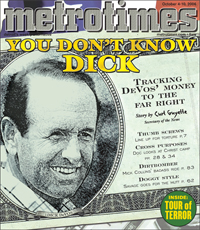 Dick DeVos is the son of Richard DeVos, billionaire co-founder of Amway, where Dick was CEO from 1993 to 2002. He ran as a republican candidate for governor of Michigan in 2006 but despite spending record amounts of money was unsuccessful.
According to People for the American Way (PFAW):

Reference: 'Voucher Warriors', People for the American Way (PFAW), 2006.
DickDevos has used his family's fortune and status to create an intricate national network of non-profits, political action committees and federal groups known as 527's that effectively fund the political arm of the school voucher movement... Nowhere is the impact of the DeVos family fortune greater, though, than in the movement to privatize public education. After 69 percent of Michigan voters rejected a DeVos-led drive for vouchers in 2000, he and his family turned their attention in recent years to building an organizational infrastructure that pumps huge amounts of money into ballot initiatives and political races at the local, state and federal level.... In 2006, the funding network he has built is putting more money into pro-voucher candidates and legislation than ever before.

Reference: Quoted in 'DeVos dollars back school choice', MediaMouse.org, 9 July 2006.
bnThe Dick and Betsy DeVos founded All Children Matter (AMC) in 2003, funded by the the DeVoses and John Walton. It recruits, trains, and funds candidates for election throughout America who are committed to school choice and publicly-funded vouchers to attend private schools. According to Clint Bolick, president of the Phoenix-based Alliance for School Choice: “They have almost single-handedly made the school choice movement a significant factor in state legislative races around the country.”
Advocacy Groups Dick and Betsy Have Been Involved in
Dick DeVos has been:
- Co-chair and member of board of directors, Education Freedom Fund (EFF), which funds children to attend private schools
- Co-chair of Kids First! Yes! which sponsored a voucher/tax credit ballot measure in Michigan in 2000
- Co-chair, Education Freedom FundBoard of the Children’s Scholarship Fund
- Founder and donor of All Children Matter (AMC).
- Board member, Children’s Scholarhip Fund, a private voucher programme.
- Michigan Board of Education, 1990-92
- Member Michigan Business Roundtable (co-chair, 1997, chair 1998)
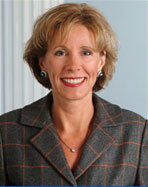 Betsy DeVos has been:
- Co-chair, Education Freedom Fund (EFF).
- Co-chair, Of the People
- Chair, Choices for Children
- CEO and Board of Children First America
- Founder and director of All Children Matter (AMC).
- Founder, chair, Great Lakes Education Project, which promotes publicly-funded vouchers to attend private schools.
- Director, James Madison Institute
- Chair of Michigan Republican Party
- Director and board member, Alliance for School Choice
Links
- 'Dick DeVos', Wikipedia
- 'Dick DeVos', SourceWatch
- 'Betsy DeVos', SourceWatch
- 'Dick and Betsy Devos Foundation', MediaMatters Action Network
- 'Dick and Betsy DeVos Foundation', MediaMouse.org
Articles
- Curt Guyette, 'You don’t know Dick', Metro Times, 4 October 2006.
- 'Voucher Warriors', People for the American Way (PFAW), 2006.
- 'Dick and Betsy DeVos Supporting the School Vouchers in Michigan and across the United States', MediaMouse.org, 20 September 2006.
http://herinst.org/BusinessManagedDemocracy/education/campaigns/DeVos.html
cf you don't know dick metrotimes?
Yes, the same Enterprise yacht upon which the DeVos family has hosted countless Republican fund-raisers, including the ones to benefit indicted former House leader Tom DeLay. Good ole Jack Abramoff was also known to schmooze with the DeVos family upon the Enterprise. (What pleasant company they keep, eh?)
http://www.democrats.com/node/8385
"Business Week and the Associated Press reported in 1999 that Abramoff was “first to sign up” for a meeting with GOP House conservatives hosted by DeVos on the Amway yacht. Brewer demanded that DeVos abide by his own words on accountability and release the photographs of him and Abramoff at that event and from other meetings they had."
"Abramoff attended the meeting of GOP conservatives called the “Potomac River Cruise” hosted by Dick DeVos on the Amway yacht Enterprise in the summer of 1999. Abramoff was the first person to sign up for DeVos’ meeting. Indicted Rep. Tom DeLay, another leader along with DeVos and Abramoff of the GOP culture of corruption, also attended the meeting."
http://www.democraticunderground.com/discuss/duboard.php?az=view_all&address=159x7256
Hightower:
AMERICAN FEDERATION FOR CHILDREN.
Forget children, AFC is an astroturf organization spreading the gospel of public education privatization. It is a creature of Michigan's multi-billionaire DeVos family--daddy Richard founded Amway, ranks 62nd among the richest Americans, and owns the Orlando Magic basketball team.
AFC is ramrodded by Betsy DeVos, whose right-wing bona fides are rock solid. Raised in the wealthy, ueber-conservative Prince family (her brother is Erik Prince, founder of Blackwater, the infamous private war corporation), she married Dick (son of Richard) and has been a major donor/fundraiser for the GOP, for religious-right political groups, and for a national web of school privatizers. Also, she and the larger DeVos klan are longtime co-conspirators in and co-funders of the Koch brothers' plutocratic political network. Bonus tidbit:** The DeVoses reportedly helped finance the [*Citizens United* case that the Supreme Court used last year to unleash secret, unlimited corporate money on our elections.] Betsy is unabashed about using the family's vast fortune for, as she puts it, "buying influence" in government. In 1997 she bluntly declared, "We expect a return on our investment."
Eradication of public schools is her passion, and AFC is her machine. It's essentially a front group that funnels big money from a cadre of like-minded rich people into other front groups across the country. In turn, these groups funnel AFC's money into local privatization campaigns. Last year, for example, just one political action committee registered by AFC in Indiana amassed $4.6 million from only 13 donors--none from Indiana. The list included Alice and Jim Walton (two billionaire Walmart heirs), a trio of super-rich global speculators (who, interestingly, say they base their risky gambles on poker strategies), a multi-millionaire operator of a national chain of for-profit charter schools, and Betsy herself. Very little of the money stayed in Indiana--more than $4 million was flung out to pro- privatization front groups and candidates running campaigns in Florida, Georgia, New Jersey, Pennsylvania, Utah, and Wisconsin. This shell game is repeated in campaigns around the country, with the same core group of gabillionaires putting up the cash.
While you are not likely to have heard of Betsy DeVos, chances are she and her deep-pocket cohorts are behind efforts to privatize schools right where you live. By running money through their maze of shell organizations, they keep their own identities secret. Voters in the six states that got cash last year from the Indiana PAC, for example, might see that a group with the sweet-sounding name of the American Federation for Children is running campaign ads and funding candidates in their area--but there's no disclosure that Amway, Walmart, a trio of poker-guided speculators, and a charter school profiteer are the real source of the effort to undermine their public school system
In campaign after campaign, the 'local' demand for privatization turns out to be little more than AFC money creating the illusion of grassroots support (in fact, the steady infusion of millions of dollars from DeVos, the Waltons, et al. is often the only thing propping up many of the so-called 'school choice' organizations at the local, state, and national levels). AFC will gush money into state initiatives, legislative lobbying campaigns, and political races, especially in the crucial couple of weeks before a vote. The money buys glossy (and often nastily negative) media, creating the impression that there's a groundswell for taking public schools private. "Flooding the zone" is the phrase that AFC's cynical political operatives use to describe this astroturf tactic. Polls consistently show strong public opposition to using tax dollars to fund private and parochial schools, but a little thing like that doesn't deter DeVos and her tiny band of rich ideologues. Through their stealth campaigns, they have helped elect governors who are on board their corporatization crusade. In April, for example, Gov. Mitch Daniels rammed a sweeping, DeVos-backed voucher bill into law. This radical movement is out to eradicate public education (one group funded by DeVos, Koch, and company even calls itself the Alliance for the Separation of School and State, proudly proclaiming that it supports "ending gov- ernment involvement in education").
The vast majority of America's 310 million people adamantly supports public education, but DeVos intends to overwhelm those millions with her millions of dollars, strategically using untraceable money to pervert public policy to her will, one campaign at a time. Last year she launched the AFC Action Fund to focus on state legislative races across the country, with the intention of surreptitiously stacking legislatures with school privatizers.
http://www.hightowerlowdown.org/node/2680