Bear Sterns
oddly blank 419
MERRI OK
---
GGL 11 25
AI Overview
Jeffrey Epstein was hired at the investment bank
Bear Stearns in 1976 by its then-partner (and later CEO) Alan "Ace" Greenberg. Epstein worked at the firm for five years, quickly rising to become a limited partner before his mysterious departure in 1981.
Jeffrey Epstein's Career at Bear Stearns
- Hiring and Early Role: Epstein, who was teaching math and physics at the elite Dalton School in Manhattan, was recommended to Greenberg by a student's parent. Greenberg, known for his "poor, smart and determined" (PSD) hiring philosophy, was impressed by Epstein's intelligence and offered him a job as a junior assistant and options trader.
- Rapid Ascent: Epstein quickly climbed the ranks, moving from the trading floor to advising wealthy clients on complex tax strategies. In 1980, just four years after joining with no formal financial background or college degree, he was made a limited partner.
- Departure: Epstein's formal career at Bear Stearns ended abruptly and mysteriously in 1981. According to his later testimony, he left due to a "Reg D violation" (a type of SEC regulation infraction), though specific details are unclear. Rumors at the time ranged from resigning to start his own firm to being forced out, but he remained close with some of the firm's top executives, including Greenberg and his successor, James "Jimmy" Cayne.
- Post-Bear Stearns Connection: After leaving, Epstein launched his own lucrative career as a money manager for billionaires, leveraging his Wall Street connections. Years later, his investment firm was a major investor in two Bear Stearns hedge funds that collapsed in 2007, leading to a settlement with JPMorgan Chase after it acquired the failing firm in 2008.
Alan "Ace" Greenberg's Relationship with Epstein
Greenberg (who died in 2014) was a legendary figure on Wall Street, known for building Bear Stearns into a major investment bank. His connection to Epstein is largely defined by hiring him and maintaining a friendly, albeit not close, relationship in the years that followed.
Messages from Greenberg, Cayne, and other former colleagues were included in a birthday book compiled for Epstein in 2003 by Ghislaine Maxwell. Greenberg's widow stated the two did not have a relationship beyond Epstein's time at the firm, and her husband would not have said no to a request for a birthday message.
BIZ INSIDER
- effrey Epstein's 50th birthday book, released this week, details his expansive social network.
- The book ends with five letters written by his former Bear Stearns colleagues.
- These five notes offer a glimpse into how Epstein's financial career got started.
How exactly did Jeffrey Epstein get his start as a consigliere to billionaires? Look no further than his 50th birthday book for clues.
The book, which contains sexually explicit snapshots and hand-drawn images, concludes with a less-provocative section titled "Business." It offers a rare glimpse into the Wall Street job that helped launch Epstein's lucrative career as a money manager for businessmen like Les Wexner, the former owner of Victoria's Secret.
The section includes letters from five former colleagues from Bear Stearns, the investment bank where Epstein worked for five years before hanging out his own shingle in 1981 as a financial advisor to the rich and powerful.
Inclusion in the book — assembled in 2003 by his longtime associate Ghislaine Maxwell, years before Epstein's first arrest — is not an indication of wrongdoing. Ted Serure, a managing director at Jeffries, didn't immediately respond to a request for comment. Calls and emails to Elliot Wolk and Ira Zicherman were not returned.
These letters offer a unique window into how some of Wall Street's most powerful men viewed Epstein when he was starting out in finance.
He was an options trader in the early days of the industry
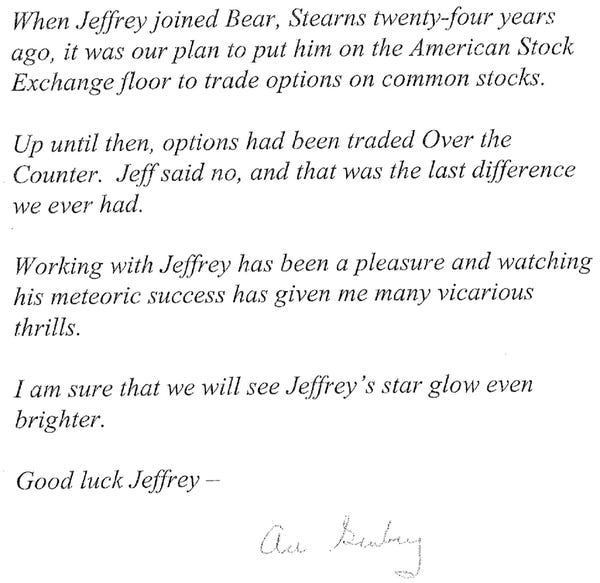
A letter that Alan "Ace" Greenberg wrote to Jeffrey Epstein for his 50th Birthday Book. House Oversight Committee
Alan "Ace" Greenberg, then a partner at Bear Stearns, hired Jeffrey Epstein — who was working as a math teacher at Manhattan's prestigious Dalton School — to the firm in 1976.
"A parent at Dalton called my husband and said, 'This kid is brilliant,'" Greenberg's widow, Kathryn Olson Greenberg, told Business Insider. "My husband had the mindset to try someone out."
Two years after hiring Epstein, Greenberg became the investment bank's CEO.
In the birthday letter, Greenberg wrote that Epstein had been hired to trade stock options on the American Stock Exchange floor. Stock options, which give investors the ability to buy a stock at a fixed price, were becoming more common, but they were typically traded "over the counter," or informally over the phone, instead of on a stock exchange.
When Epstein was hired, the plan was for him to trade options more formally on the exchange floor, but he said, "no," according to the letter. It's unclear what transpired, but Greenberg's missive noted that it was the last time the two disagreed.
Olson Greenberg told Business Insider that "there was no relationship" between the two men after Epstein left the firm. She explained Greenberg's message to Epstein by saying her husband, who died in 2014, "never would have said no" to someone asking him for a birthday letter.
He may have first learned of the wealthy Maxwell family from his time at Bear Stearns
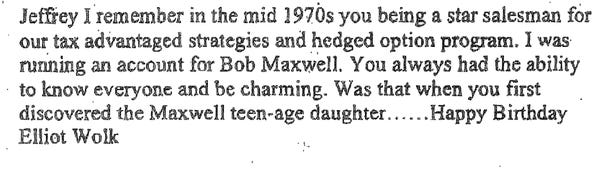
A letter that Elliot Wolk wrote to Jeffrey Epstein for his 50th Birthday Book. House Oversight Committee
Epstein quickly climbed the ranks at Bear Stearns, moving from trading on the floor to working with wealthy clients on tax issues and being named a limited partner in 1980.
He may have learned of Ghislaine Maxwell and her media mogul father, Robert Maxwell, through his work, according to a letter by Elliot Wolk, a longtime Bear Stearns employee.
At the time, Wolk ran an account for Robert Maxwell. Wolk's letter suggests that Epstein, who "always had the ability to know everyone and be charming," may have met, seen, or learned of Ghislaine as a result of this connection.
"Was that when you first discovered the Maxwell teenage daughter …" he wrote.
Ghislaine told Deputy Attorney General Todd Blanche earlier this year that she met Epstein in 1991, a decade after he left Bear Stearns, and that her father never knew him.
Wolk did not respond to inquiries from Business Insider.
His mysterious Bear Stearns exit didn't cost him powerful friends
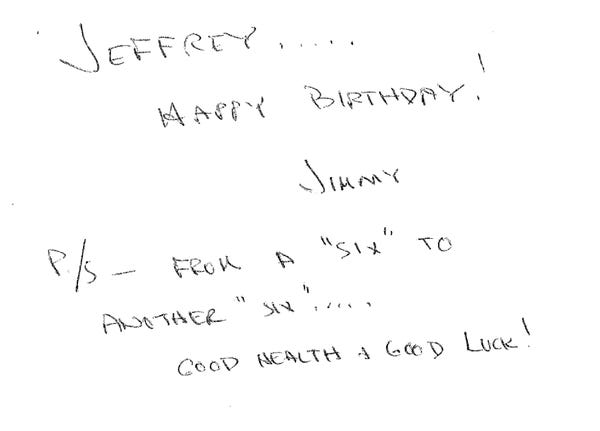
A letter that Jimmy Cayne wrote to Jeffrey Epstein for his 50th Birthday Book. House Oversight Committee
A 2003 Vanity Fair profile raising questions about Epstein's 1981 departure from Bear Stearns quoted insiders who said he left of his own accord to start his own firm while also reporting on rumors within the firm that he was forced to resign.
Olson Greenberg told Business Insider that she remembered Alan "Ace" Greenberg, who was CEO of Bear Stearns at the time of the departure, getting a phone call and being told that Epstein was going to be "fired" from the firm, though she did not know why.
Despite the murky circumstances surrounding his departure, he remained close with some of the most powerful people at Stearns.
Cayne, who went on to become CEO in 1993, wrote a birthday letter to Epstein wishing him "good health and good luck" that included an apparent chummy inside joke: "P/S - From a 'six' to another 'six.'"
At least one Bear Stearns colleague went on to work for Epstein
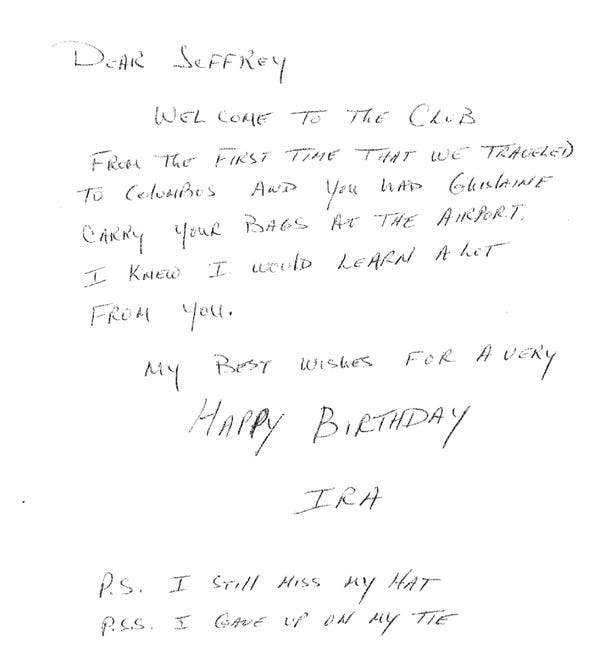
A letter that Ira Zicherman wrote to Jeffrey Epstein for his 50th Birthday Book. House Oversight Committee
Another former colleague who wrote a letter, Ira Zicherman, became one of the original trustees for Epstein's foundation. The letter references travelling with Ghislaine Maxwell to Columbus, near where longtime benefactor Les Wexner lives, and also seems to conclude with an inside joke.
Epstein's quick ascent after Bear Stearns was the stuff of legend
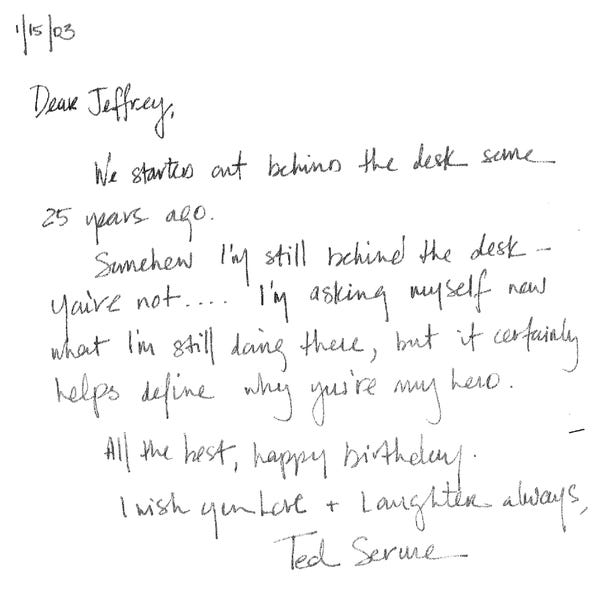
A letter that Ted Serure wrote to Jeffrey Epstein for his 50th Birthday Book. House Oversight Committee
Ted Serure, the now-Jeffries managing director who spent many years at Bear Stearns, wrote about how he and Epstein started their careers together at the same desk 25 years earlier — only to take very different paths.
"Somehow I'm still behind the desk — you're not…" Serure wrote. "I'm asking myself now what I'm still doing there, but it certainly helps define why you're my hero."
WS ON PARADE
FRom 1976 to 1981, Jeffrey Epstein worked for the Wall Street investment bank, Bear Stearns. Epstein was found dead in his jail cell on August 10 while awaiting trial on charges of sex trafficking of underage girls, dozens of whom he allegedly sexually assaulted after grooming them first with “inappropriate touching.”
Bear Stearns collapsed in the early days of the 2008 financial crisis and was purchased by JPMorgan Chase. One of the last acts of Bear Stearns’ CEO, Jimmy Cayne, was to make a $2 million payment to a woman who charged that the legendary Chairman of Bear Stearns, Ace Greenberg, had engaged in “inappropriate touching.” The young woman was said to have had a witness to her charges.
In a 2017 report by the New York Times, a former Managing Director of Bear Stearns, Maureen Sherry, reported that “…it was mostly the same men who preyed on young women.” In a 2016 report by Maureen Callahan at the New York Post, a former Bear Stearns’ employee reports that men at Bear Stearns were “getting bl*w jobs in front of staff – that happened all the time.” Claims that men at Bear were demanding sexual favors from female colleagues and getting away with it date all the way back to the 1980s.
As more allegations emerge daily into the sexual assault horrors of Jeffrey Epstein and his band of enablers, a profile is emerging that bears a striking resemblance to how Wall Street has allowed its highest-producing brokers to behave toward vulnerable young female employees for decades. In both situations, there are the enablers; in both situations there is a failed justice system and powerful lawyers cutting deals; in both situations there are hundreds of different females asserting the same type of claims over a long period of time with no governmental authority stopping the abuse; and in both situations, powerful men who were an important cog in Wall Street’s insatiable quest for profits were allowed to walk away from a multitude of credible sexual assault allegations.
Jeffrey Epstein’s major divergence from the sexual assaults by Wall Street brokers’ is that he preyed on underage girls. It is notable, however, that many Wall Street firms hire young women just out of high school to be “trained” to work in their branch offices. The sexual grooming is not as overt as in the Jeffrey Epstein cases, where the young girls were hired to give a massage and then told, over time, the massage had to be administered by them naked; and then, after more time, upped to a full-scale sexual assault. But young women in these Wall Street offices are sent a clear message by their Human Resources departments that they need to “get along” with those big producing brokers who generate outsized profits for the firm.
Walk into any of the Wall Street retail brokerage offices that dot the landscape in every major town and city across America and you will see glass-windowed offices filled with white male brokers and pretty, young female sales assistants (a/k/a client service associates) sitting in a low-wage, subservient position at a desk directly outside that office.
Subservience to that broker is ingrained in the following ways: the sales assistant’s performance is officially evaluated by that broker and becomes a written, permanent part of her employment file; the broker, if he is a big producer for the firm, can have the sales assistant fired over any flimsy, trumped-up claim; and, importantly, most Wall Street firms pay these women low wages, leaving it to the broker they work for to give the woman a percentage of his commissions if he finds her “performance” to be to his liking.
All that Wall Street would have to do to alter these sexual and power dynamics is to pay these women a good salary and take the broker’s additional compensation out of the equation. The fact that Wall Street doesn’t alter this dynamic suggests that the industry likes its hunting band to hone their skills on the vulnerable prey in the office as a form of target practice.
Just as Epstein was able to keep his abuse hidden for decades by employing a roster of expensive lawyers who knew how to work the system, Wall Street has all of the largest law firms in America at its beck and call. These law firms have systematically convinced the U.S. Supreme Court and Appellate Courts around the country that Wall Street should be allowed to run its own private justice system; that it should be allowed to make its employees sign a waiver giving up their rights to access the nation’s courts and use Wall Street’s rigged kangaroo court system instead.
Most Americans would agree that Wall Street is the most corrupt industry in America. And yet, the most corrupt industry is the only industry that universally requires both employees and customers to waive their rights to use the nation’s courts to settle claims and, instead, must use the Wall Street-created mandatory arbitration system which has none of the procedural protections of a court of law.
What is hiding behind that rigged system of justice is akin to what happened in the Catholic Church where abusing priests were transferred from parish to parish and sexual assault claims were secretly settled with gag orders. At the hands of Wall Street and its private justice system, the media is deprived of a seat in an open courtroom; there are no publicly available court transcripts of the hearings; and the worst sexual assaults are settled quickly with a gag order on all parties. Invariably, the abusive broker keeps his job with no mark on his publicly available record about any sexual assault or sexual harassment settlement. The broker’s public record is maintained by Wall Street’s self-regulator, FINRA – the very same organization that runs the private justice system for Wall Street.
In March of last year Lorena Alcantara filed a sexual harassment claim against Michael Ladge, a high-producing broker in the Beverly Hills office of Morgan Stanley. According to Alcantara’s complaint, “Ladge’s real purpose in hiring Alcantara—a beautiful young woman in her mid-twenties at the time—was to try to exploit his power with Alcantara, to subject her to demeaning and harassing behavior, to use her beauty to attract clients, and to pursue a sexual relationship with her.” Ladge had offered Alcantara a job when he met her working as a waitress and bartender at an L.A. Sports Club. (As one of the largest investment banks on Wall Street, one would think Morgan Stanley would do its own hiring of office personnel.) Alcantara’s complaint included a sworn statement from another assistant, who corroborated much of her account.
According to a quick check at FINRA’s BrokerCheck this morning, Ladge is still employed at Morgan Stanley.
Alcantara filed her complaint in the California court system. It was, as usual, moved to Wall Street’s private justice system based on that mandatory arbitration agreement that is slipped into a stack of papers that new hires are requested to speedily sign as a non-negotiable condition of getting the job. There have been no media reports on what has happened to the case since it disappeared into the bowels of the arbitration system.
In a saner age of American jurisprudence, these types of non-negotiable contracts were found by courts to be unenforceable and ruled to be contracts of adhesion, since they were offered on a take-it or leave-it basis by the corporation. The very concept of contract law is that both parties to the contract are able to negotiate the final terms. But there is little on Wall Street today that comports with a society based on well-reasoned law. Operating its own private justice system, where arbitrators even hear rape cases, Wall Street has been able to draw a no-law-zone around its coast-to-coast offices.
In April of last year, Susan Antilla, in partnership with the Investigative Fund at the Nation Institute, looked at FINRA’s records going back 30 years. Her investigative team found that only 17 women had prevailed in all that time on their sexual harassment claims against Wall Street firms under this self-imposed private justice system. One of the cases Antilla reviewed involved an alleged rape against a young woman. Antilla reports as follows:
“In 2004, FINRA arbitrators considered a complaint against Southwest Securities, a Dallas firm, and three of its male brokers who worked at a Long Island branch. The branch sales manager, Kim Marie Vescova, alleged that one of them raped her in the office and threatened to kill her if she told anyone, according to the panel’s summary of her testimony. She also testified that the men at various times had bitten her on the buttocks, grabbed her breasts and asked for milk, and pulled down her pants.
“The arbitrators said her testimony did not prove rape, though they told the firm to pay her $300,000 in compensatory and punitive damages, plus nearly $30,000 in back pay, and ordered one of the men, Michael Aspler, then the branch manager, to pay her $100,000 for physical assault, verbal abuse, negligent supervision, and infliction of emotional distress. Contacted recently, Vescova said that after the firm had threatened to tie her up in appeals court, she settled for ‘pennies on the dollar’ on those FINRA awards. (Hilltop Securities, parent of Southwest, did not respond to a query; Aspler declined to comment.) The arbitrators also ordered the two other men, Robert Mitchell and Mark Kern — the broker Vescova accused of rape — to pay her $25,000 each for verbal abuse, assault, and intentional infliction of emotional distress. But neither paid her. FINRA suspended both of their licenses five years later — not because of what they’d done to Vescova, but for failing to pay the judgment. Mitchell and Kern did not respond to queries sent to their last known emails and addresses. Finra asks brokers to report only investment-related customer disputes to be included on their records, so the findings against the men were not detailed in their BrokerCheck records.”
Wall Street men preying on young women with impunity under its private justice system has been the bedrock of Wall Street for as long as anyone can remember. ABC’s 20/20 program brought together 17 women from coast-to-coast offices of the giant brokerage firm, Smith Barney, in 1998 to give first-hand accounts of their sexual assaults and extreme sexual harassment at a firm then headed by Jamie Dimon, now Chairman and CEO of JPMorgan Chase. Jennifer Flood told the moderator, Deborah Roberts, how she was a new young hire in Smith Barney’s Hartford, Connecticut office when one of the brokers offered to drive her to lunch. Flood stated that “He said he wanted to pull my stockings down and sit me on his lap…I jumped out of the car and ran. He caught up to me, grabbed me by the back of the neck, threatened me that I couldn’t tell anybody because no one would believe me because I was this new sales assistant that means nothing, and I’m very expendable.” After Flood filed her complaint with management, the broker continued to work for the firm.
Marianne Dalton, a new broker trainee in the Los Angeles branch of Smith Barney in 1995, also appeared on 20/20 and gave a first-hand account. The exchange went like this:
Marianne Dalton: It was like working in a male locker room. It was really degrading comments about women. They were nothing but sperm vaults, sperm banks. And I listened to this every single day. Women were referred to as bitches and whores…
Deborah Roberts: What would you say to someone who would say maybe it had nothing to do with the fact that you’re a woman, but just that you’re a new broker?
Marianne Dalton: I would ask them how they would feel if they had their boss undress every single day at the desk – every single day at 12:45, day in and day out for months, right down to his genitals?
(Dalton explained that despite there being a men’s room in eyeshot of her boss’s desk, he preferred to change into his gym clothes in front of her.)
Deborah Roberts: It’s hard to imagine this could go on in a professional office and nobody would think that this was objectionable.
Marianne Dalton: The bottom line at this firm is that they don’t want the assets to walk, so we’re going to do whatever it takes to make these senior people as happy as can be.
The supervisor Dalton had complained about was still working for the firm at the time the 20/20 program aired.
On the same program, Lisa Mays, an operations manager in the Walnut Creek, California branch of the predecessor firm to Smith Barney described how a top producing broker there, Stu Buttery, tried to rape her when she arrived at the office before other employees had arrived. Despite Mays’ formal complaints to management, Buttery continued to be allowed to work at the firm for the next 24 years.
Robin Leopold had been a Vice President of Human Resources at Smith Barney when women in coast-to-coast offices were making desperate pleas for relief from this outrageous and illegal conduct – pleas that for the most part fell on deaf ears. According to her LinkedIn profile, Leopold is back working for Jamie Dimon as a Managing Director in Human Resources at JPMorgan Chase.
The Smith Barney women organized themselves into a class action lawsuit and filed their claims in Federal Court in 1996, challenging the mandatory arbitration system as a violation of their civil rights. (See Editor’s note below.) Dimon, the New York Stock Exchange and the predecessor to FINRA, the NASD, were among the named defendants along with Smith Barney. The New York Stock Exchange and the NASD eventually dropped their own requirement that civil rights complaints had to go through the mandatory arbitration system. The big Wall Street banks’ response to that was to simply draft their own mandatory arbitration agreements that they, then and now, force all new hires to sign.
Smith Barney’s initial response to the lawsuit was to call the women “disgruntled employees” and hire a top attorney at Paul, Weiss, Rifkind, Wharton & Garrison, the same law firm that was hired more recently by Fox News parent, 21st Century Fox, to investigate the alleged sexual abuse of women by Roger Ailes.
The Paul Weiss settlement in the Smith Barney case was assailed by civil rights and employment lawyers. It ushered all claims into its own private arbitration system and extinguished all claims against the male brokers – leaving them free to assault again. It was also revealed in the press that while the case was pending before Judge Constance Baker Motley, the Paul Weiss law firm made job offers to two of the Judge’s law clerks assigned to the case.
The New York Post further revealed that the sexual harassment hotline that was ostensibly set up by Smith Barney to help women make complaints was a dud. The lead lawyer for Paul Weiss in the case, Mark Belnick, moved on to become General Counsel at Tyco International and was indicted for grand larceny and securities fraud. He was acquitted at trial but only after he had inked a retention agreement that guaranteed him a payment of at least $10.6 million should he commit a felony and be fired before October 2003. Any disputes arising out of the retention agreement matter were to be handled in arbitration rather than a court of law.
The National Organization for Women of New York State was so appalled by the terms of the Smith Barney settlement that its President, Lois Shapiro-Canter, an attorney, filed an Amicus brief with the court asking the Judge to reject the settlement. Shapiro-Canter wrote on behalf of NOW-NYS:
“Closed door proceedings and arbiters of justice chosen in part by Defendant Employer confers the appearance of impropriety and does not reflect the open door access to the judiciary of Title VII and other civil rights laws. If in fact Defendant Employer intends in good faith to proceed wholeheartedly with the diversity plans outlined in the agreement, why does it need a mandatory arbitration process a/k/a mandatory alternative dispute resolution system which denies women and minorities their constitutional right to access the courts to ensure freedom from discrimination and sexual harassment?”
When Epstein’s powerful lawyers cut his plea deal with Federal prosecutors in 2008, the Palm Beach police had credible evidence that Epstein had sexually assaulted dozens of underage girls at his home in Palm Beach. The police had even asked the FBI to investigate. But the Federal government left Epstein off with a single count of soliciting sex from a minor and one count of soliciting prostitution from an adult. His 13 months of jail time consisted of being ferried by his private driver and limo to an office where he spent 12 hours a day on a so-called work release program. According to the New York Times, “When Jeffrey Epstein was serving time in Florida for soliciting prostitution from a minor, he got a surprising visitor: James E. Staley, a top JPMorgan Chase executive and one of the highest-ranking figures on Wall Street.” Staley wanted to keep his relationship with Epstein, according to the Times, because “Epstein had funneled dozens of wealthy clients to Mr. Staley and his bank.”
This is precisely the same motive that keeps the big producing brokers safe on Wall Street.
Editor’s Note: Pam Martens, the co-author of the above article and Editor of Wall Street On Parade, worked for two major Wall Street firms for 21 years. During that time, from 1996 through 2001, Martens challenged Wall Street’s mandatory arbitration system and the sexual assaults and sexual harassment of women facilitated under that system in the U.S. District Court for the Southern District of New York and at the 2nd Circuit Court of Appeals in a case titled Martens v Smith Barney in which she originally served as lead plaintiff. The settlement fashioned by plaintiffs’ attorneys and Paul Weiss was deemed so conflicted by Martens that she withdrew from the settlement and never profited from the settlement or any subsequent payment from the parties. Her original co-plaintiff, Judy Mione, joined her in withdrawing from the settlement for the same reasons. Martens also appeared in the ABC 20/20 program referenced above.
Related Articles:
JPMorgan’s Jamie Dimon Has Gone to Defcon 1 Over Bank’s Ties to Jeffrey Epstein
Jeffrey Epstein’s Death Adds to the JPMorgan Body Count
Bookmark the permalink.
---
GGL 11 25
What Jeffrey Epstein's birthday book tells us about his Wall ...

Business Insider
https://www.businessinsider.com › Finance › Law](https://www.businessinsider.com/jeffrey-epstein-birthday-book-bear-stearns-financial-career-trading-options-2025-9)
Sep 10, 2025 — He went from teaching math to managing millions. Letters from Bear Stearns colleagues show how Jeffrey Epstein started his financial ascent.
[### The Talented Mr. Epstein

Vanity Fair
https://www.vanityfair.com › News › Society](https://www.vanityfair.com/news/2003/03/jeffrey-epstein-200303?srsltid=AfmBOoooEenk7umw9ypuGjAgDy-zm6Gz-8MbBADHv1elIGDF9RvbNLtd)
Mar 1, 2003 — Vicky Ward explores Epstein's investment career, his ties to retail magnate Leslie Wexner, and his complicated past.
[### 'Poor, smart and desperate to be rich': How Epstein went ...

Miami Herald
https://www.miamiherald.com › state › article232678997](https://www.miamiherald.com/news/state/florida/article232678997.html)
Jul 16, 2019 — He was a teacher at a fancy private school in New York City when Jeffrey Epstein came to the attention of an executive at Bear Stearns ...
[### Alan Greenberg's Bear Stearns linked Trump's empire and ...

Substack
1 like · 3 months ago](https://substack.com/home/post/p-171098262)
While Donald Trump's relationship with Alan Greenberg was rooted in the financial world of Wall Street, his connection to Jeffrey Epstein was ...
[### What Jeffrey Epstein's birthday book tells us about his Wall ...

AOL.com
https://www.aol.com › articles › jeffrey-epsteins-birthda...](https://www.aol.com/articles/jeffrey-epsteins-birthday-book-tells-183247800.html)
He went from teaching math to managing millions. Letters from Bear Stearns colleagues show how Jeffrey Epstein started his financial ascent.
[### The woes of Jeffrey Epstein: How he maintained Wall ...

Fox Business
https://www.foxbusiness.com › features › jeffrey-epstei...](https://www.foxbusiness.com/features/jeffrey-epstein-wall-street-connections-child-sex-trafficking)
Aug 10, 2019 — FOX Business senior correspondent Charlie Gasparino's investigation into Epstein - and his Wall Street connections - before his death.
[### Who Is Jeffrey Epstein? An Opulent Life, Celebrity Friends ...

The New York Times
https://www.nytimes.com › 2019/07/09 › nyregion › je...](https://www.nytimes.com/2019/07/09/nyregion/jeffrey-epstein-who-is-he.html)
Jul 9, 2019 — The money manager once socialized with celebrities, presidents and princes but remained an enigma.
[### Jeffrey Epstein's first criminal conviction was far earlier than ...

mjr.news
https://www.mjr.news › jeffrey-epsteins-first-criminal-c...](https://www.mjr.news/p/jeffrey-epsteins-first-criminal-conviction)
The release of a 1981 deposition transcript reveals an earlier conviction for the late sex offender… and not for the reasons you might think.
Missing: ACE | Show results with: ACE
[### Interview Transcript - Maxwell 2025.07.24 (Redacted).pdf

Department of Justice (.gov)
https://www.justice.gov › storage › audio-files](https://www.justice.gov/storage/audio-files/Interview%20Transcript/Interview%20Transcript%20-%20Maxwell%202025.07.24%20%28Redacted%29.pdf)
Jul 24, 2025 — APPEARANCES: For the United States: Todd Blanche, Deputy Attorney General. Diego Pestana, Acting Associate Deputy. Attorney General.
[### Jeffrey Epstein Learned His Sexual Depravity from ... Wall Street On Parade
https://wallstreetonparade.com › 2019/08 › jeffrey-epstei...](https://wallstreetonparade.com/2019/08/jeffrey-epstein-learned-his-sexual-depravity-from-wall-street-then-took-it-to-the-next-level/)
Aug 19, 2019 — By Pam Martens and Russ Martens: August 19, 2019 ~ From 1976 to 1981, Jeffrey Epstein worked for the Wall Street investment bank, Bear ...
| 1 | 2 | 3 | 4 | 5 | 6 | 7 | 8 | 9 | 10 | Next |
==
omg fail
Reports have emerged that Trump will nominate David Malpass, a Treasury Department official, to be the new head of the World Bank. Malpass is an outspoken critic of the World Bank, saying it is overly intrusive. Malpass previously worked on Wall Street as the chief economist of Bear Stearns. In 2007, he wrote a Wall Street Journal op-ed titled “Don’t Panic About the Credit Market”—less than a year before the collapse and subsequent sale of Bear Stearns amid the 2008 financial crisis.
---
---
AN 7 25 PROSECUTED HUMAN TRAFFIC AND EPSTEIN PAL gISANE
Firing of 'high-profile' prosecutor shows Trump 'is not thinking clearly': analysis
---
https://gregolear.substack.com/p/deconstructing-the-epstein-myth-what
...SK
Well, was looking at all of the criminals around Donald, and I had a head start with a piece of information that I had gotten in 2005—before there was even an imagination that this man would run for president. I think to the layman’s understanding, if you knew who Trump was, which people did, that he was political in any way, just maybe he had been and we learned that he had been.
In 2005, Trump had this new reality show with Mark Burnett. And so I had a circle of people that I knew. I’m a writer, screenwriter. So I knew folks in that circle with that man.
GO
Okay. Meaning Burnett.
SK
Yes, Burnett. And I had learned that Donald was in a tremendous amount of debt to some Russians. And it was threatening this new thing—this idea of him as this self-made, you know, billionaire, whatever, whatever the thing was, a successful businessman, because it was all about to crumble. And there’s been a tremendous amount of reporting since I learned that. Verifying all of that. So I had that information at the time, back in the day.
And so when he came down that escalator, I knew, I was like, “Oh no, that’s the guy that’s in debt to a bunch of Russian gangsters!” And so I started trying to figure out who those Russians may be. And then in doing that, I came across Jeffrey Epstein.
GO
Okay, interesting. So Trump to the Russians to Epstein.
## Tinker, Tailor, Mobster, Trump
March 31, 2020
SK
Yeah, well, organized crime—specifically Russian organized crime. And then trying to understand Donald and Fred, Fred’s empire, his father’s empire, which was built with the Genovese crime family. And then the building of Trump Tower in Manhattan that moved in—they had different territory as Fred would call it, as Donald has said on the record—that Manhattan wasn’t. According to his father, “That’s not our territory,” because it wasn’t, it was Gambino territory. For Donald Trump specifically to be able to build in Manhattan, develop in Manhattan, Fred arranged for, and Roy Cohn arranged for, the two crime families, the Gambinos and the Genovese to form what became known as a concrete cartel—all the five families were in there. And this was the bid-rigging over concrete contacts to develop in Manhattan. And it was called “the Donald Trump deal.” And so that was in the middle of it, for those U.S. crime families and the racket they were running, which is this very racket that Giuliani used to prosecute the five families. So…
GO
Four of the five families.
SK
Four of the five families. Castellanos was a holdout and then was killed, shot dead in the street. So that’s the history.
There’s way more than that. During that time, before the Russian mafia had really taken over New York—which it did; it rolled in in the late 80s, some of it even back to the 70s, but very specifically in the 80s and the 90s and just sort of rolled up a lot of the territories as their own. And they did it by laundering money through Donald’s casinos. There was a lot of ways that they did all of that. There was a very prominent Russian gangster named Ivankov, who had actually an office in Trump Tower in Manhattan, but he was ultimately caught, tipped off and caught by Andy McCabe’s team.
Like when you start learning about these characters, of what they were doing back in the day, both on the law enforcement side pursuing Russian organized crime and from the Russian organized crime side—the bosses and the key figures there were all in business in some fashion with Donald Trump.
Then in the mid early 2000s to like 2005, 2006, right around when I was hearing this stuff about him, what was happening was the Russians were wanting to keep using Trump to go internationally. So the properties: Trump Panama developing and Trump Toronto developing and Trump Georgia developing and all of these foreign developments, which we were watching. If you watch “The Apprentice,” it unfolds on “The Apprentice” as well. This sort of expansion of the Trump thing where he was just licensing his name to be put on these things, because he was really over-leveraged.
Like the one in Georgia, the country Georgia—the Trump Tower there, all they did was just stick a shovel in the ground, and a whole bunch of money was laundered. There’s Trump Baku, which, you know, there was quite a bit of reporting how that was probably a front for the Iranian Revolutionary Guard. Again, Iran and their corruption very closely tied in with Russian organized crime as well.
GO
Right. Adam Davidson in the New Yorker.
SK
So that’s the background. That’s why the Trump/Russia thing is not a hoax. Donald is the hoax. You know, he did. And there’s so much reporting and Trump, the company, Allen Weisselberg, all those people, they affirm this, they said, “Yeah, yeah, we took that money.” The problem with it is some of it was illegal, but a lot of it’s not illegal, right?
He couldn’t get a casino license in Australia, infamously. They would not give him a casino license because of his ties to organized crime, both U.S. organized crime and Russian organized crime.
GO
So a major Five Eyes power decided that Trump couldn’t have a casino license because of his ties to organized crime—and specifically Russian organized crime. Let’s just underline that because it seems important. Australia is, as they say, a real country, you know—that is one of our strongest allies.
SK
Right. Right.
So how you get to Jeffrey is, there was a time in the 80s where Donald was really having issues, and he was sort of over-leveraging himself. He was building in Atlantic City. He was doing these things and couldn’t get them funded. He always had a problem getting the money because legitimate banks would stop lending to him, which was the crisis he was facing in the early 2000s, mid-2000s. There was Deutsche Bank, but even Deutsche Bank was turning him down, so he had to go for this Russian money. You could get Russian money, you could get Chinese money, and the Chinese money hadn’t quite showed up yet. But the gangsters will invest in you. So the banks were difficult.
Now part of the stuff that made it hard to get finding from U.S. banks is because of what happened with him in the 80s with Bear Stearns. So there’s a guy that ran Bear Stearns.
(This is all the reporting done by Wayne Barrett. And I recommend everybody go read Wayne Barrett’s work on Donald and Fred Trump and that sort of “Trump Inc.” He did extraordinary work on that. He also did great work on Giuliani and showing what sort of a criminal and a fraud Giuliani was. And it still is, I guess.)
So Ace Greenberg ran Bear Stearns. Bear Stearns is the company that infamously went down in 2008 with all the credit-default swaps, all that kind of stuff that just crashed—you know, the Big Shorttype of thing.
But before that, they were a real player—Bear and Lehman and these other entities. Goldman Sachs. And so Donald had a very close relationship with Ace Greenberg. Ace Greenberg is the man whose daughter was Jeffrey Epstein’s student when Jeffrey Epstein was at the Dalton School. And Epstein did whatever he did at the Dalton School to leverage his just being a math teacher and tutor at this private school into working directly for Ace Greenberg.
So he went into the financial industry at Bear Stearns. And he didn’t come in as a low-level person and work his way up. He came in at a very senior level, and it caused a great sort of upset at Bear Stearns. Who is this guy? Where is he coming from? And why is Ace giving him this plum spot?
And he was handling private wealth management. And his big client that he had, that Ace gave him, was Edgar Bronfman, who’s Sam Bronfman’s son. Sam Bronfman, he established Seagrams, and he was Meyer Lansky and Lucky Luciano’s business partner during the bootlegging days. And Edgar Bronfman has a lot of ties to Russia as well, quite frankly. And it’s his daughters that were part of that NXIVM thing. That’s how people recognize that name, Bronfman.
GO
He’s Canadian though, right? Sam Bronfman?
SK
Yes, he was Canadian. So that was part of the bootlegging thing. Yeah.
But that was Jeffrey’s client, and he got into difficulties and troubles there at Bear Stearns with that particular client managing, you know, and he basically had to be fired. And Ace really resisted firing Jeffrey. And what I uncovered and discovered was that he didn’t fire him. He just moved him into Offshores. Jeffrey went into establishing offshore accounts and offshore money, sort of tax havens for Bear Stearns clients.
If you go into the Offshore Leaks database—which is where I found Jeffrey’s offshore accounts, some of them—you can see there are old Bear Stearns officers. In fact, Ace Greenberg’s partner at Bear Stearns is still connected and linked into those offshore accounts. So Epstein was very much doing that business, and he was doing that business for Bear Stearns right at the time that Bear Stearns was doing these wild, risky, money-backing things for Donald, for Donald developing his casino.
:{:{So thatis where I found him. And I’m like, “Who’s this Jeffrey Epstein, and what is this?” And then I started looking into Jeffrey Epstein, and I’m like, “My God, everybody’s some kind of sex-trafficking criminal.” He’s not the only one that was tied in with Donald’s business or his financial backing in some way that also was convicted for sex trafficking.}:
There’s another guy named Tevfik Arif, who was a big partner with Donald, who had that yacht with all the underage prostitutes and the trafficking that went on there. There’s a yacht, I think off of Turkey where they were finally caught, he was finally caught. So there’s the folks in Panama: his business partners in Panama were nailed for sex trafficking, international sex trafficking. And the people in Canada: there’s ties in there for his business partners in Trump Toronto and Canada, who were also Russian. The main partner there was the son-in-law of Semion Mogilevich’s business partner and consigliere—Semion Mogilevich being a great big Russian gangster.}:
And then there’s all the Craig Unger reporting on Mogilevich, that Donald was in fact laundering Mogilevich’s money himself. And that’s the man who originally compromised him. So that’s the money. It’s full of sex traffickers and it’s full of Russian gangsters.
GO
So let’s underline again Semion Mogilevich. That’s an important connection because Semion Mogilevich, if I remember correctly, was at one point directly working with Robert Maxwell. That was in one of those books, right?
SK
Correct. In Maxwell’s biography, Mogilevich is named several times. I believe the source for that was Ari Ben-Manashe, a former Israeli intelligence officer who also worked for the Kremlin. But that Robert Maxwell biography—this is Ghislaine Maxwell’s father—outlines Robert Maxwell as a Mossad and a KGB spy. That means that he was an intelligence officer. It looks like he also did—there’s quite an FBI file on him. He probably worked with U.S. intelligence at times, and it looks like he definitely worked for the Queen. He was very close with, very close with the Queen. He touched the Queen. There’s video of him, footage of him touching her, like walking alongside her and touching her like.
GO
He was friends with the Queen. Yeah.
SK
That’s very rare and weird and very strange.
GO
It’s very strange. Robert Maxwell also, when he died in 1991, in November of 1991, by falling off a yacht off the coast of the Canary Islands—as happens, I guess, all the time, so no foul play at all, none suspected; it’s weird how that thread keeps going up—but remember, he had defrauded the pensions of the company, the publishing company that he bought. So he was about to collapse before he died, like his entire...
SK
That’s right.
GO
…financial empire was a house of cards, and it was all bullshit. So that’s an important thing to keep in mind.
SK
That’s right. And he knew Donald. Donald knew him directly. There’s a lot of images and photographs. They were on the yacht, the Lady Ghislaine, that he named after his daughter. So yeah.
GO
They were on the yacht, in Page Six. With Ivana, which is interesting because Robert Maxwell is born Jan Hoch and is from Czechia. And Ivana Trump is also Czech. So I envision a scenario where the two of them are on the yacht talking in Czech, and Trump is just standing there like an idiot.
SK
I’m sure, yeah. Junior, I believe, is fluent in Czech. People underestimate Don Jr.
GO
Yeah, and Baron is fluent in Slovenian, yes.
SK
But you know, another character that was in that world with them, with Robert Maxwell—and it’s important because his money shows up in Jeffrey Epstein’s next big financial scam after the Bear Stearns moving him—is a man named Adnan Khashoggi, who is Jamal Khashoggi’s uncle. And there’s not a lot of Khashoggis, actually, by the way.
Donald knew the Khashoggis very, very, very well. Ivana called Adnan her best friend quite often. When Donald bought the one and only yacht he’s ever bought, he bought Khashoggi’s yacht. So he bought Khashoggi’s, yeah.
And Khashoggi was a known intelligence officer for Saudi Arabia, but he was at one point the wealthiest man in the world.
GO
He was an arms dealer, right? Wasn’t he an arms dealer?
SK
He was a big arms dealer. Yeah.
GO
I remember that, even in the moment, people knew who he was. Like, he wasn’t some hidden figure. I remember reading about him in the 80s. I didn’t know what these people were at the time. But I knew their names.
SK
Paul Manafort was also in this mix, Tom Barrack was in this mix. There were a lot of folks that we saw show up in Trump 1.0 as President, helping with his campaign, that were swirling around in this—what I call the underworld. But it’s where crime syndicates and intelligence services are just, you know, intertwined.
And that’s what MAGA is aware of when it comes to Jeffrey Epstein. They can kind of feel that there’s something odd there. There are intelligence services there.
Now, it’s important to point out that before Robert Maxwell died—there are several people who are credible witnesses and know what they’re talking about that have identified that Robert Maxwell was taking Jeffrey Epstein around and sort of introducing him as his protégé. So this myth—this lie—that Ghislaine and Jeffrey told that he showed up after Ghislaine’s dad died, that she moved to New York and that’s where she met Jeffrey? No, no, no, no, no, no, no. They knew each other before her father died or was killed or whatever happened off the side of that yacht. So that’s kind of key.
And then Jeffrey went from there to creating one of the biggest Ponzi schemes, the biggest Ponzi scheme ever before Bernie Madoff. He almost kind of invented it. That was called Towers Financial. And I talked a lot with Steve Hoffenberg; you talked with him as well. He was a tricky character. He’s passed away now, but he went to prison for quite a long time, and he got out of prison right at the beginning of Trump’s first term. The first person to call him when he was out of prison actually was Roger Stone, he told me.
But Hoffenberg was mortified with what Jeffrey had done with the victims. That reporting had kind of just come out when he was just out of prison. And he did contact the victims, and he did want to kind of make good. Because the money from Towers Financial was never fully recovered, Hoffenberg didn’t understand why he went to prison and Jeffrey got off.
I talked to Hoffenberg a bit. I’m like, “Well, what are some of the ways that someone gets out of being prosecuted for a big crime financial crime like this?” And it looks like Jeffrey very much cooperated with prosecutors. Now, there were a lot of criminals that were part of Towers; that was a big money laundering vehicle. Quite a lot of the money from Iran-Contra, Steve Hoffenberg suspected, was pushed—that Jeffrey got his hands on—it was pushed through Towers.
That is money that Robert Maxwell was in charge of that also disappeared around the time of his pension scandal. And so there was a lot of pressure on Robert Maxwell right before his death. It wasn’t just that his empire was crumbling. There was a lot about to be exposed of the kind of places he’d had his hands in, money that disappeared that he should never have been anywhere near it. And it exposed nation-states, intelligence services, doing what maybe they shouldn’t have been doing.
So that’s the world. It’s like a private intelligence rogue operatives. Private arms dealers like Adnan Khashoggi or the guy that Nicolas Cage played in that movie, Lord of War—like those guys, that world.
There’s also: you don’t have to just deal in arms or traffic in arms. You can traffic in kompromat, right? You can traffic in other things that would have value to intelligence services of both our nation and other nations. And it does very much look like that Robert Maxwell was in that business. It looks like Ghislaine took the mantle, and Jeffrey took the mantle from him and developed their own little operation. So all of the pieces are there for Epstein to have that connection.
And Towers Financial, I think, is also a great big piece that doesn’t get talked about enough, in terms of, What kind of deal did this guy cut with those prosecutors, that he got out of facing prison? And his business partner went in for 20 years, 18 years or whatever.
And knowing the kind of money, the kind of players that Epstein ran with, just with that one fraud and scheme alone—those are very valuable names, and a lot of money that he could have turned over to prosecutors to cut himself a deal. That could very well be the key to Alex Acosta’s phrase about Jeffrey, when he says he was told Epstein “belonged to Intelligence.” Because he would have some really big names in Towers, and really powerful players that maybe were on a sanction list, quite frankly.
GO
So just to review quickly, Towers Financial ran from 1988-1993. He’s now worked, Jeffrey has, as a math teacher at Dalton (where he got fired), at Bear Stearns in some weird capacity (where he got sort of fired). And then he went to work, if I remember correctly, Hoffenberg said Epstein went to work for Douglas Leese, who was another person in that world.
SK
Leese, yes—who was an arms dealer for the Queen. Right.
GO
And he, Leese, according to Hoffenberg, recommended Epstein to Hoffenberg by saying, “He’s smart and he has no moral compass.” So Hoffenberg knew he was going to do this Ponzi scheme, and he needed like a guy to help him with it. And that’s why he hired him. Like, specifically.
SK
And that would have been while Robert Maxwell was still alive or just sort of on his way out to the next world. Yeah. Right. All right around that time.
GO
Right. Again; so now, we’re all the way into the early 90s, and so far it’s money and offshores and arms deals and Russian mobsters and shady characters, but we haven’t even—we haven’t gotten to the sex trafficking part yet, right?
SK
Yeah, as far as we know, it wasn’t happening then. And that’s just—we only know what’s in those court documents, with what the prosecutors brought to light. And a lot of it’s still redacted. But yeah, then he’s setting up, and he’s got Les Wexner, you know, somehow come folding him in.
GO
Les Wexner being the guy that owns Victoria’s Secret and these other big retail chains. And that was the time when Jeffrey was walking around saying he was a model scout for Victoria’s Secret, you know, as a pickup line that he was using.
SK
That’s correct. There is a journalist in the Ohio area, Bob Fitrakis, who’s really good, a great muckraker, and he did a lot of work on Wexner and Wexner’s ties to organized crime. And Wexner as a potential…what’s called a non-official cover, a NOC, for our own intelligence services. Wexner has an airfield there in Ohio, a private airstrip, and there were planes coming in and out of there that Fitrakis believed and tracked to our own intelligence services.
GO
Right, and Wexner’s the guy that owns the lovely, huge mansion on the Upper East Side of New York, on East 73rd, where he’s like, “Why don’t you just live in my mansion? You know? Why don’t you Kato Kaelin this? And you just move in. I don’t need it, it’s fine, it’s good.”
SK
Right. Yeah. To Epstein, yeah, Wexner handed over the most valuable piece of property, the most valuable private residence in Manhattan to Jeffrey—just gave it to him.
GO
Which is, I think, I would say odd, unusual, strange, whatever word you want to use. Weird.
SK
It’s odd.
The other odd thing, and we talked about this this past week a lot, but we kept talking about it at the time, too. We do know that that all of these homes, New York, down in Palm Beach, out in New Mexico, the island and the plane, that these properties that either Jeffrey owned or had access to or were his in some way or form, all had surveillance technology wired throughout them. That’s in the underlying evidence in the court cases against him. So we’re not just speculating about this. It’s in the evidence. And you have to understand that we’re talking about properties that he was using for the—you know, for the abuse, while he abusing these minors and raping the minors.
---
---