An Absorption
Elements of radiation transport theory
In the Sun, radiation is emitted and absorbed across all layers, but we predominantly observe radiation from the surface. Most radiation from the lower layers is absorbed before reaching the surface. To comprehend our observations of the Sun, understanding the interaction between radiation and matter is crucial. Studying spectral lines and the continuum provides valuable insights into the solar atmosphere. Radiation transport theory, examining how radiation interacts with matter, enables the extraction of detailed information about the solar atmosphere using spectral lines.
Absorption of radiation by atoms in matter. the atoms as acts like small spheres, each of radius r. Each sphere absorbs any radiation that strikes it. To any beam of radiation, a sphere looks like a circle of projected area πr2. If the beam is within that circle, it will strike the sphere and be absorbed.
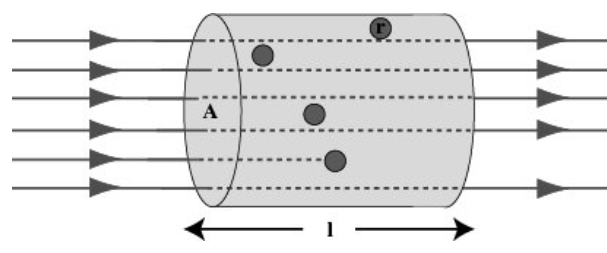
The cross section for striking a sphere is σ = πr2. The concept of a cross section carries over into quantum mechanics.Instead of the actual size of an atom, the effective area over which a process (e.g., absorption) occurs is considered. The parameter "r" represents the proximity a photon needs to be to the atom to undergo absorption.
To examine a cylinder made up of these spheres, with radiation entering from one end. To determine the absorption and transmission of radiation, "n" is defined as the number of spheres per unit volume. The cylinder, with length "l" and area "A," has a volume of Al, and the number of spheres within the cylinder is:
\[N=nAl\]
the total cross section of all the spheres as the number of spheres multiplied by the cross section per sphere:
\[\sigma _{tot}=N\sigma\]
\[\sigma _{tot}=nAl\sigma\]
By assumption that the incoming beam can “see” all the spheres. No sphere blocks or shadows another. There is assured of little shadowing if the spheres occupy a small fraction of the area, as viewed from the end. That is
\[\sigma _{tot}<<A\]
Under these conditions, the fraction of the incoming radiation that will be absorbed, f, is just that fraction of the total area A that is covered by the spheres. That is
\[f=\sigma_{tot}/A\]
so:
\[N=nl\sigma\]
If the optical depth to be this quantity is:
\[\tau =nl\sigma\]
But \(\sigma _{tot}<<A\) requires that \(\tau _{tot}<<1\). Under this restriction, the optical depth of any section of material equals the absorbed fraction of incoming radiation.
In general, σ will be a function of wavelength. For example, because a wavelength corresponding to a spectral line, a particular atom will have a very large cross section for absorption. At a wavelength not corresponding to a spectral line, the cross section will be very small. This means that the optical depth is also a function of λ.
\[\tau_{\lambda} =nl\sigma_{\lambda}\]
The optical depth relies on material properties, such as particle cross-section and density, as well as the size of the absorbing region.
Column Density
represens the number of particles across the entire length "l" of the cylinder per unit surface area.
\(nl\) (number per unit area)
represents the optical depth per unit length through the material.
\[\kappa _{\lambda}=\frac {\tau _{\lambda}}{l}=n\sigma _{\lambda}\]
Mean Free Path
the mean distance between absorptions.
\[L_{\lambda}=\frac 1{\kappa_{\lambda}}=\frac 1{n\sigma _{\lambda}}\]
So the optical depth is given by:
\[\tau _{\lambda}=\frac l{L_{\lambda}}=\kappa _{\lambda}l\]
If (τ << 1) is not hold, the cylinder must be divided into multiple thin layers. By ensuring that each layer has a very small optical depth, the analysis proceeds by tracking the radiation through these layers, examining the fraction absorbed in each layer individually.
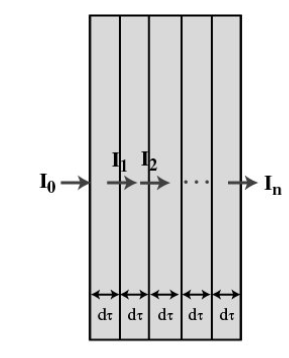
In this case, since dτ <<1, it is the fraction of this radiation that is absorbed. The amount of radiation absorbed in this layer is I dτ. The amount of radiation passing through to the next layer is I(1 − dτ). The change in intensity, dI, while passing through the layer, is:
\[dI=I_{out}-I_{in}\]
so:
\[dI=-Id\tau\]
To find the effect on the whole sample of material. If τ′ is the optical depth through which the radiation has passed by the time it reaches a particular layer, and I′ is the intensity reaching that layer. Then τ′ ranges from zero, at the point where the radiation enters the material, to τ, the full optical depth where the radiation leaves the material. Over that range, I′ varies from \(I_0\), the incident intensity, to I, the final intensity.
\[\frac {dI’}{I’}=-d\tau ‘\]
so:
\[\int_{I_0}^I \frac {dI’}{I’}=-\int_0^{\tau}d\tau’\]
\[\ln (I)-\ln (I_0)=-\tau\]
\[\ln (I/I_0)=-\tau\]
\[I=I_0e^{-\tau}\]
to check this result in the limit τ<< 1, called the optically thin limit, using the fact that ex ≅ 1 + x, for x 1. In this case,
\[I=I_0(1-\tau)\]
This is the expected result for small optical depths.
The rapid decrease of (\(e^{-\tau}\)) with \(\tau\) implies that for radiation to escape from the Sun, it primarily originates within approximately one optical depth of the surface. This phenomenon explains why only the outermost layers are visible. Since the absorption coefficient (\(\kappa_{\lambda}\)) is wavelength-dependent, different depths are observed at different wavelengths. Higher values of (\(\kappa_{\lambda}\)) limit visibility into the material, while lower values require more material for (\(\tau_{\lambda}=1\)). This property is exploited to study conditions at various depths beneath the surface.
Sophisticated radiative transfer calculations, factoring in both radiation absorption and emission influenced by optical depth, are essential for understanding stellar atmospheres. Computer models integrate temperature, density, and composition distributions to predict observed spectra, considering emission and absorption lines. Iterative adjustments of input parameters ensure model predictions align with observations. While results are not unique, they provide valuable insights into crucial processes within stellar atmospheres. The ongoing refinement of these models, guided by the convergence of observational data, enhances confidence in derived values for temperatures, densities, and compositions.