Nuclear Energy
Nuclear energy for stars
proton– proton chain
When a star is on the main sequence, its primary source of energy is the conversion of hydrogen into helium. While it's improbable for four protons to directly form a \(^4He\) nucleus in a single reaction, there are various series of reactions leading to this outcome. The energy released in converting four protons to one \(^4He\) can be calculated by comparing their masses.
\[4m_p-m(^4He)=0,0007 (4m_p)\]
This raaction is called the proton– proton chain, because it starts with the direct combination of two protons:
\[ 2\ ^1H\rightarrow\ ^2H+e^++\nu\]
The presence of the neutrino indicates this process is a weak interaction, and therefore goes very slowly.
Once the deuteron has been created, it can quickly react with another proton:
\[^2H+^1H\rightarrow \ ^3He +\gamma\]
If each of these reactions takes place twice, then it started with six protons, and it resulted with two \(^3He\) nuclei:
\[2\ ^3He\rightarrow ^4He+2\ ^1H\]
The net outcome is:
- the transformation of four protons into a \(^4He\) nucleus
- two positrons: contributing in heating the gas by scattering off or annihilating with particles in the gas.
- two gamma-rays: heating the gas as they travel a short distance before being absorbed.
- two neutrinos: interacting weakly, escape the star completely.
The hot gas emits new photons, undergoing absorption and re-emission until photons are close enough to the surface to escape.
triple-alpha process
Stars more massive than the Sun, with higher central temperatures, allow reactions involving higher charged nuclei.
The triple-alpha process is one such mechanism, converting three alpha particles into a \(^{12}C\) nucleus. Due to the increased repulsion between two alpha particles, higher temperatures are required for this process. The first step in the chain is:
\[2\ ^4He\rightarrow\ ^8Be+\gamma\]
The binding energy of two \(^4He\) nuclei is greater than that of the \(^8Be\) nucleus, indicating the instability of \(^8Be\) , which should break up. However, the abundance of alpha particles allows some \(^8Be\) nuclei to capture an alpha particle before breaking up. Without this process, the formation of heavier elements would be hindered. The combination of \(^4He\) and \(^8Be\) leads to further nuclear reactions.
\[^4He+\ ^8Be\rightarrow\ ^{12}C+\gamma\]
The triple-alpha process is also important as solar mass stars age and leave the main sequence
CNO cycle
In massive stars, there is another scheme that is important in converting four protons into one \(^4He\) nucleus. It is called the CNO cycle.
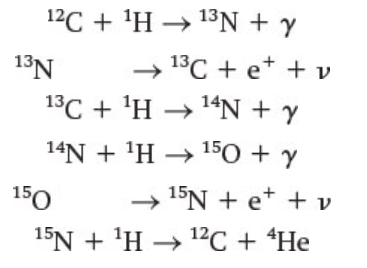
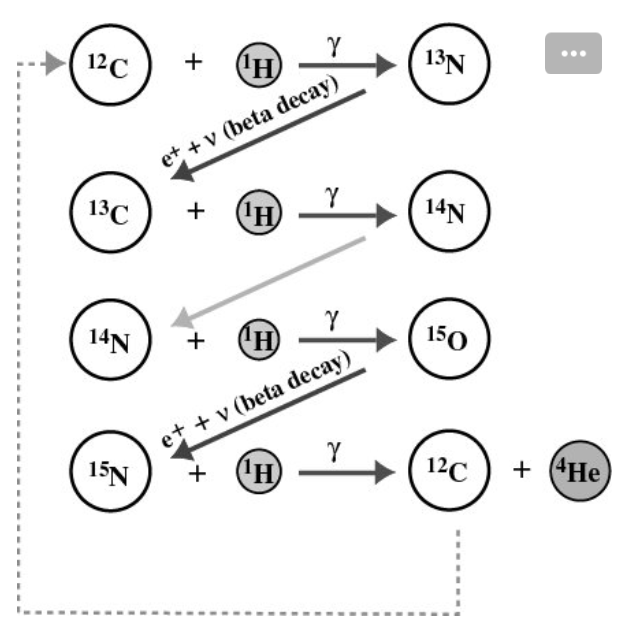
The nuclear fusion cycle converts four protons into one \(^4He\) nucleus along with two positrons, two neutrinos, and three photons. Intermediate nuclei produced in the process are utilized in subsequent steps, and the final step regenerates the \(^{12}C\) needed to restart the cycle. The \(^{12}C\) acts as a catalyst in this cycle. Despite the increasing electrical repulsion as we attempt to form heavier elements through fusion, the presence of free neutrons, which can be captured by nuclei, allows for the possibility of building heavier elements, especially in stellar environments where free neutrons are available.
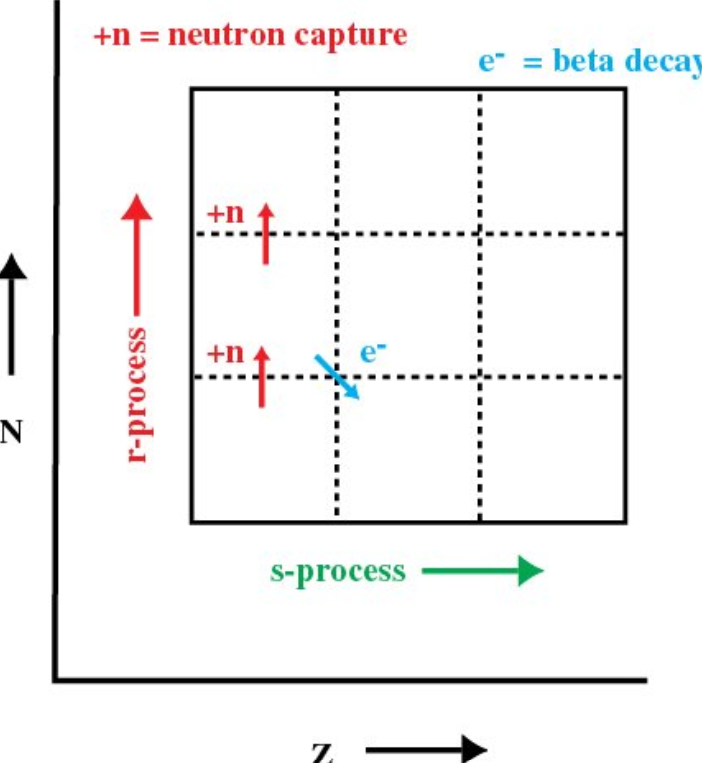
A nucleus (Z, A) captures a neutron:
\[(Z,A)+n\rightarrow(Z,A+1)\]
What happens next depends on whether the rate of neutron capture is slow or rapid, compared to the rate of beta decay:
- s-process: If neutron capture is slow. tthe new nucleus (Z, A + 1) will beta decay before it can capture another neutro. \((Z,A+1)\rightarrow(Z+1,A)+e^-+ \bar \nu\)
- r-process: If the neutron capture is rapid. The nucleus (Z, A+1) will capture another neutron before it beta decays: \((Z,A+1)+n\rightarrow(Z,A+2)\)
In either case, the resulting nucleus can either beta decay or capture a neutron, depending on the relative rates. In case of a string of nuclei for which neutron capture is favorable, the r-process allows the buildup of neutron rich nuclei. This will go on until so many neutrons are added that a beta decay breaks the chain. The r- and s- processes can explain the abundances of many of the heavier nuclei. (It should be noted that these are not equilibrium processes.)