Eclipsing Binary
The observed light periodically becomes brighter and fainter, signifying that the dimming occurs when the companion star passes either behind or in front of the primary star. To witness these eclipses, the observer needs to be aligned with the orbital plane.
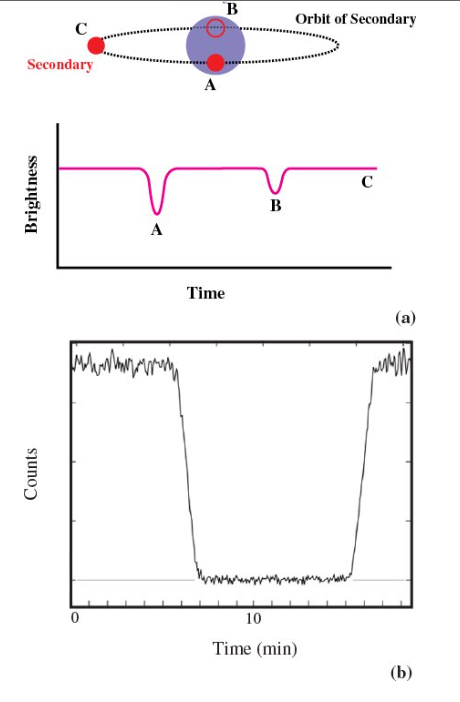
Eclipsing binary. (a) The binary system is shown above; the light curve below. The fainter secondary passes alternately in front of and behind the primary. Most of the time, as at position C, we see light from both stars. When the secondary eclipses the primary, part of the primary light is blocked and there is a dip in the intensity, as at point A. When the secondary passes behind the primary, as at B, its light is lost. Since the secondary is not as hot as the primary, the loss of brightness is not as great as at A. (b) Part of the light curve for the eclipsing binary, NN Ser, around the eclipse part of the orbit
A famous example of such a star is Algol (also known as β Persei, indicating that it is the second brightest star in the constellation Perseus).
Eclipsing Binaries offer a method for determining stellar radii by analyzing light curve shapes and utilizing orbital velocities obtained from Doppler shift measurements. This technique eliminates concerns about the orbit's inclination. The rate of light level changes during eclipses is crucial. Estimating the radii of rotating stars involves observing brightness variations caused by surface irregularities like hot or cool spots. The rotation period (P) is determined from these variations, and the rotation speed (v) is obtained from spectral line broadening due to the Doppler shift.
\[R=Pv/2\pi\]