Refracting Telescopes
A refracting telescope consists of two sets of optical elements:
- The objective lens: it is a large lens that light passes first. The objective is the part that intercepts the incoming light, so it determines the light-gathering power of the telescope.
- the eyepiece: a lens that light is concentrated on after passing the objective. It inspects the image formed by the objective. The image formed by the eyepiece is viewed either by the eye or by a camera.
Its’ operation is as like the camera. If the focal length of the objective is \(f_{obj}\). Since the stars are at infinity, the objective forms their images this distance behind the objective. The eyepiece has a focal length \(f_{eye}\).
The eyepiece is placed \(f_{eye}\) behind the images formed by the objective.
This means that the objective and eyepiece are separated by a distance \(f_{obj}+f_{eye}\).
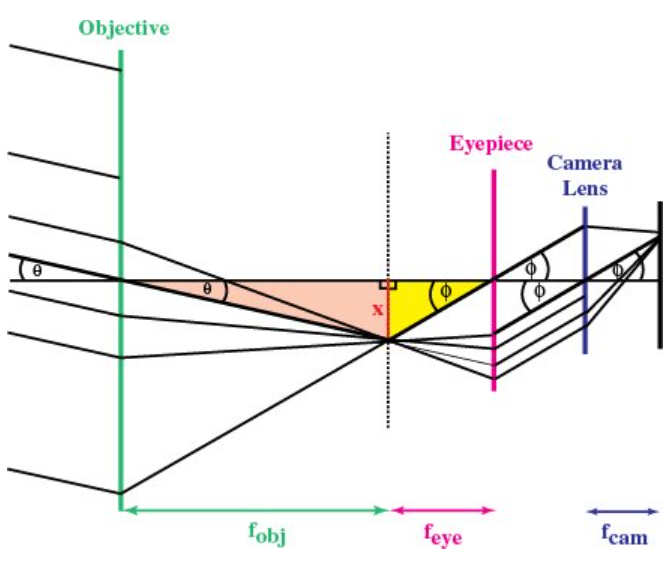
Since the initial images of the stars are \(f_{eye}\) from the eyepiece, the eyepiece will focus the light at infinity. This means that all of the rays in a given bundle emerge from the eyepiece parallel to one another.
Light from a star enters from the left, making an angle θ with the axis, and leaves the eyepiece making a larger angle with the axis. The focal lengths of the objective, eyepiece and camera lens are indicated. For each lens, the ray that goes through the center undeflected (the chief ray) is indicated as a heavier line. In a real telescope, the angles would be much smaller.
The two bundles of rays emerge from the eyepiece. Even though the rays within a given bundle are parallel to one another, the bundles make some angle with each other.
If the two stars are an angle θ apart on the sky, then the two bundles will enter the objective, making this angle with each other. The bundles leave the eyepiece, making a larger angle with each other. The angle can be found by following the chief ray through the eyepiece.
The chief ray at the eyepiece is not the same ray that was the chief ray at the objective. However, all rays in a given bundle will emerge from the eyepiece parallel to the new chief ray.
From the two right triangles in the diagram with the common side x:
\[\tan \theta =x/f_{obj}\]
\[\tan \phi =x/f_{eye}\]
If the angles are small:
\[ \phi /\theta =f_{obj}/f_{eye}\]
It means that the angular magnification is equal to the ratio of the value of the focal lengths of the two optical elements.
In general, for good detail in the image, the used telescope must have a long focal length objective.
The angular magnification of the telescope can be changed by changing the eyepiece.
There is a practical limit. magnifing the image can blow up the blurring caused by atmospheric seeing.
Usage Limitations:
- The chromatic aberration of the objective.
- The objective must be made from a piece of glass that is perfect throughout its volume. This gets harder when making larger objectives. Larger objectives are also harder to support. The objective can only be supported at its edges, since light must pass through.
- In many modern applications, it is crusial to place instruments near the eyepiece. The telescope must be supported closer to the center of mass, which means far from the eyepiece. Any instrument hung at the eyepiece will exert a large torque about the mount, limiting the weight of the instrument.