Radial Velocity
In Doppler Effect, is the component of the relative velocity between the source and the observer along the line of sight.
\[v_r=dr/dt\]
If the source and observer move apart, the radial velocity \(v_r\) is positive, and if they move together, vr is negative.
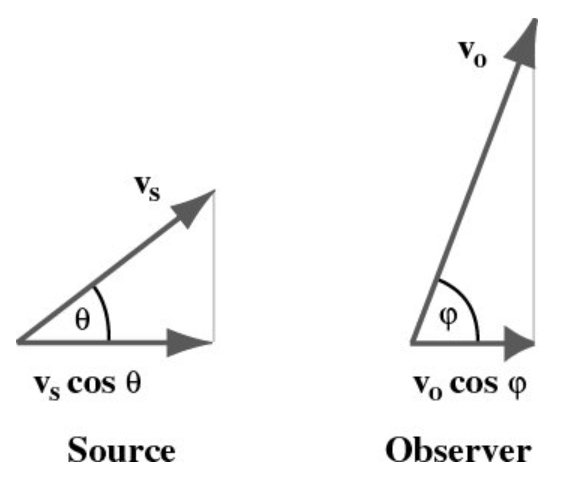
The horizontal line is the line of sight. The radial velocity is the difference between the line of sight components of the observer and source velocities.
the source is moving with a speed \(v_s\) in a direction that makes an angle θ with the line of sight, and the observer is moving with a speed \(v_0\) in a direction making an angle ϕ with the line of sight.
\[v_r=v_s\cos \theta -v_0 \cos \phi\]
In Elliptical Orbits:
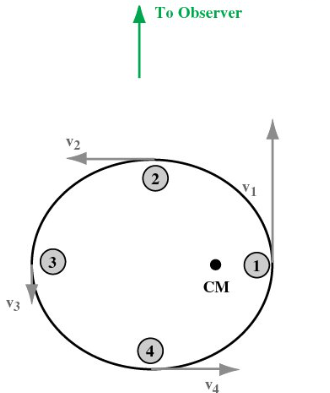
both the magnitude and direction of radial velocity change throughout the orbit. (If the observer is in the plane of the orbit, or that i = 90°.) Four points are shown in the orbit and in the radial velocity curve. At points 2 and 4 the motion is perpendicular to the line of sight, so vr = 0. For point 1 the motion is directly toward the observer, producing the maximum negative vr, and, for point 3, the motion is away from the observer, producing the maximum positive vr. The motion is also faster at 1 than at 3. In addition, going from 4 to 1 to 2 takes less time than going from 2 to 3 to 4. This accounts for the distorted shape of the radial velocity curve.