Logical Reasoning
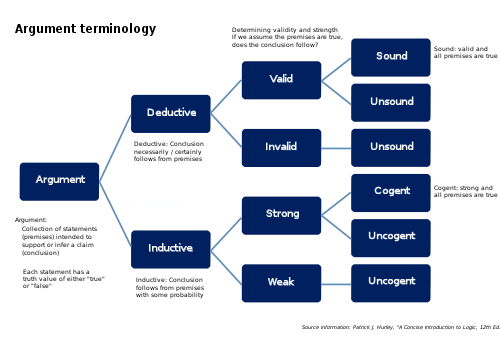
Argument terminology used in logic
Deduction, abduction and induction[edit]
There are three types of logical reasoning. Informally, two kinds of logical reasoning can be distinguished in addition to formal deduction, which are induction and abduction.
Deduction
- Deduction is the conclusion drawn from the structure of an argument's premises, by use of rules of inference formally those of propositional calculus. For example: X is human and all humans have a face, so X has a face.
Induction
- Induction is drawing a conclusion from a pattern that is guaranteed by the strictness of the structure to which it applies.
Abduction
- Abduction is drawing a conclusion using a heuristic that is likely, but not inevitable given some foreknowledge. For example: I observe sheep in a field, and they appear white from my viewing angle, so sheep are white. Contrast with the deductive statement: Some sheep are white on at least one side.
Critical thinking and rationality
Kerry S. Walters, an emeritus philosophy professor from Gettysburg College, argues that rationality demands more than just logical or traditional methods of problem solving and analysis or what he calls the "calculus of justification" but also considers "cognitive acts such as imagination, conceptual creativity, intuition and insight".[35]: 63
These "functions" are focused on discovery, on more abstract processes instead of linear, rules-based approaches to problem-solving.
The linear and non-sequential mind must both be engaged in the rational mind.[35]
The ability to critically analyze an argument—to dissect structure and components, thesis and reasons—is essential.
But so is the ability to be flexible and consider non-traditional alternatives and perspectives.
These complementary functions are what allow for critical thinking to be a practice encompassing imagination and intuition in cooperation with traditional modes of deductive inquiry.[35]