Eczema (atopic dermatitis)
Eczema (and psoriasis) is not an external problem, dermatologists will treat it externally (corticosteroids) as if its an external problem. It's an internal problem, the internal organs of elimination can't handle the job, toxins are coming out through the skin... and the main organ of elimination we should focus on is the kidney. (The skin is called the third kidney). Cleansing the kidney allows lymph waste removal, lymph waste removal facilitates blood cleansing. See kidney cleanse.
The second organ system to look at is the gut, check for leaky gut, gluten sensitivity, leptin sensitivity. And any other food sensitivities. Things are getting into the bloodstream that shouldn't be there.
Next comes the liver.
Rub some olive oil onto the eczema-affected areas of your skin, and it should help quite a bit.
Powdered white oak bark can be sprinkled on eczema to dry the affected area. For application as a treatment for eczema, an oak bark tea is made by boiling 1–2 tablespoons of the bark for 20 minutes in 2 cups of water, and this is applied to the rash three to five times daily.
Tips:
- Increase the omega 3 in your diet, especially DHA. This helps skin barrier function.
- Get enough sunlight, early morning sunlight is going to prepare for mid-day UV with its healing effect, at sunset the red light from the sun is also healing to the skin.
- Do a full body detox
Videos
AI enhances diagnosis of atopic dermatitis
The Truth About Eczema and Allergies
Webinar: Face the Facts—All About Facial Eczema
Introducing the 7 Types of Eczema (and What to do About Them)
Difference between atopic dermatitis and eczema - Dr. Rashmi Ravindra
Naturopathic Approaches for Eczema and Atopic Dermatitis with Rebecca Hughes
Beyond AD: Other Eczemas
How Depression and Anxiety Can Impact Asthma, Allergies and Eczema
Understanding the Lived Experience of Eczema
Solutions to Eczema: The Spa of Embarrassing Illnesses (Documentary)
Dry Skin with Eczema
How to treat eczema naturally
Eczema Treatment with Evening Primrose Oil, Borage Oil vs. Hempseed Oil
Healing by Design
How to treat facial eczema
Mild Atopic Dermatitis
- Elevated skin barrier pH
- Skin barrier lipid disruption
- Altered calcium gradients
- Defective cellular differentiation
They need barrier repair and little to no anti-inflammatories
Moderate Atopic Dermatitis
- Increasing skin barrier pH
- Skin barrier lipid disruption
- Altered calcium gradients and cellular differentiation
- Aberrant microbiome/infection
- Inflammation
- Allergy starts to set in, or allergic contact dermatitis
Needs barrier repair and anti-inflammatories
Severe Atopic Dermatitis
Even more elevated ph, everything has increased.
Needs barrier repair and MORE anti-inflammatories
Cause
“It seems highly likely that pH plays a key role in the pathogenesis not only of Atopic Dermatitis, but likely also in other inflammatory dermatoses.” Peter Elias, Exp. Dermatol. Feb 2015
New Study Connects Air Pollution With Increased Eczema Risk
Epigenetic methylation changes in pregnant women: bisphenol exposure and atopic dermatitis.
The presented review suggests a strengthening tie between air pollution and atopic dermatitis.
Epidermal pH in atopic dermatitis, aging skin and inflamed skin is elevated. – Hakano et al, 2009
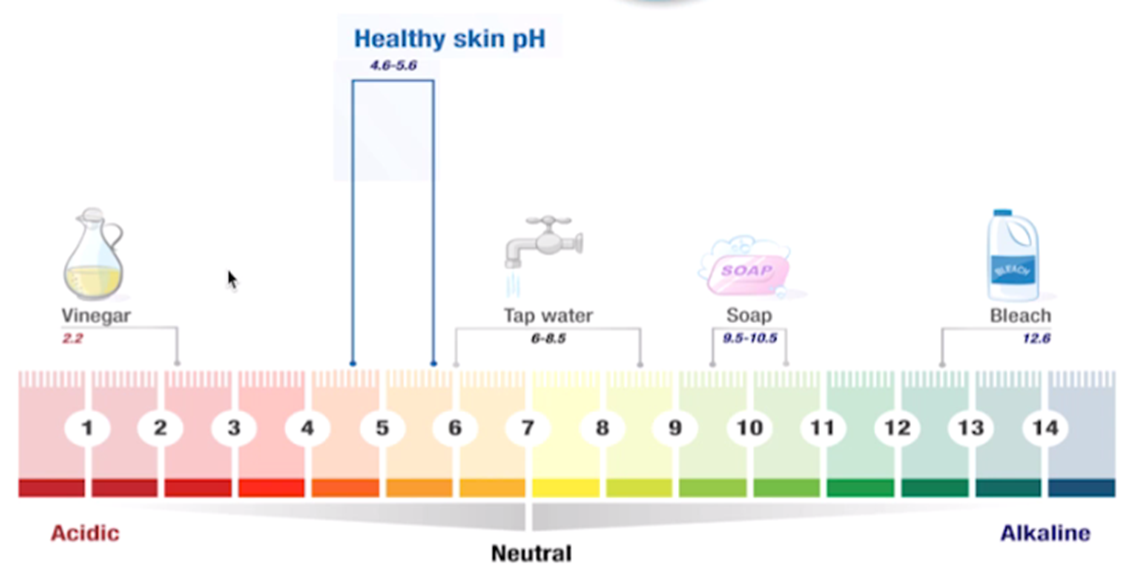
The higher the pH, the more likely the skin is to become infected. There are enzymes responsible for making the lipids in the skin and they don’t work when the pH is elevated.
Alkalinzation of the skin induced Kalikrein 5 (serine proteases that catabolize acid sphingomyelinase and beta-glucocerebrosidase). This initiated cutaneous T-helper 2 allergic response which increased transepidermal water loss and led to the development of dermatitic lesions.
Skin pH is the master switch of Kallikrein 5-mediated skin barrier destruction in a murine atopic dermatitis model. Yang et. al., 2016
Maintenance of normal Skin Barrier pH (4.6 to 5.6)
- Prevents emergence of hapten-induced, murine atopic dermatitis
- Largely prevents emergence of epidermal hyperplasia
- Partially prevents emergence of TH2-type inflammation
- Prevents development of tissue eosinophilia and mast cell infiltration/degranulation
- Normalizes both serine protease (SP) and lipid-processing enzyme activities
- Normalizes or supernormalizes antimicrobial peptide expression in Ox-AD mice.
- Normalizes lamellar body (LB) secretion
- Normalizes lamellar bilayer structure
- Normalizes post-secretory lipid processing
- Decreases epidermal IL-1a production and TNF
- Topical PHA prevents the hapten induced increase in stratum corneum pH.
Maintenance of an acidic corneum prevents emergence of murine atopic dermatitis. Hatano et. al, 2009
Antimicrobial peptides are the skin’s natural antibiotics and the higher the pH, the fewer are produced making it more likely the skin barrier will become infected, causing itching, irritation and other problems.
Studies:
The importance of Acidification in Atopic Eczema: An Underexplored Avenue for Treatment. Panther et. al., 2015
Acid Water Bathing Could Be a Safe and Effective Therapeutic Modality for Severe and Refractory Atopic Dermatitis – Lee et. al, 2016
Maintenance of Acidic Stratum Corneum Prevents Emergence of Murine Atopic Dermatitis. Hatano et. al., 2016
Atopic March from Atopic Dermatitis to Asthma-like Lesions in Nc/NGA Mice is Accelerated or Aggravated by Neutralization of Stratum Corneum but Partially Inhibited by Acidification. Lee et. al. 2015
The Benefits of Polyhydroxyl acids delta-gluconolactone and lactobionic acid
- Hyperacidifying the SC with the polyhydroxyl acids (PHAs) enhances the structure and function of normal mouse skin. Hachem et al. 2009
- Topical PHAs normalize pH and barrier function in parallel both in neonatal (Fluhr et al. 2004) and in moderately aged (Choi et al. 2007b) human and rodent skin.
- In both age groups, lowering of pH in turn corrected the epidermal structural and functional abnormalities that distinguish these divergent age groups from young (normal) skin. Yutaka et al., 2009
Vinegar and Acetic Acid
The key to the antibacterial kingdom? Eliminating biofilm, controlling S. aureus, C. albicans and pseudomonas.
Complete eradication of gram negative and gram positive biofilms with acetic acid at a pH of 4.33. Antibiofilm Properties of Acetic Acid, Bjarnsholt et al, 2015
Acetic acid in the treatment of superficial wounds infected by Pseudomonas aeruginosa, Phillips et al 1968
Effects of acetic acid on biofilms formed by Staphylococcus aueus. Aklyama et al. 1999
Vinegar as an antimicrobial agent for control of Candida spp. Pinto et al, 2008
If you have a superficial infection on the skin make a compress of 1 part vinegar and 4 parts warm water. For a bath use a pH meter to bring the pH down to 4.
For Mild Atopic Dermatitis: Acidification of SC alone substantially prevents development of barrier abnormalities and downstream immune abnormalities during the elicitation phase of murine AD. These results provide direct evidence for the “outside-inside” pathogenesis of AD and further suggest that maintenance of an acidic SC ph could prevent the emergence of AD in humans. Hatano et. al., 2009
If there is AD in the family and there’s a new baby, it’s recommended to acidify the skin using a dilute vinegar bath or acidic personal care products such as the True Cider Serum.
Acid Sphingomyelinase and Beta-glucocerebrosidase are the two enzymes primarily for producing the lipids in the skin. They only function in the pH range of 4.6-5.8.
Many of the lipids such as Ceramide 3, are naturally anti-staph
Physiologic Skin Barrier Lipid Levels
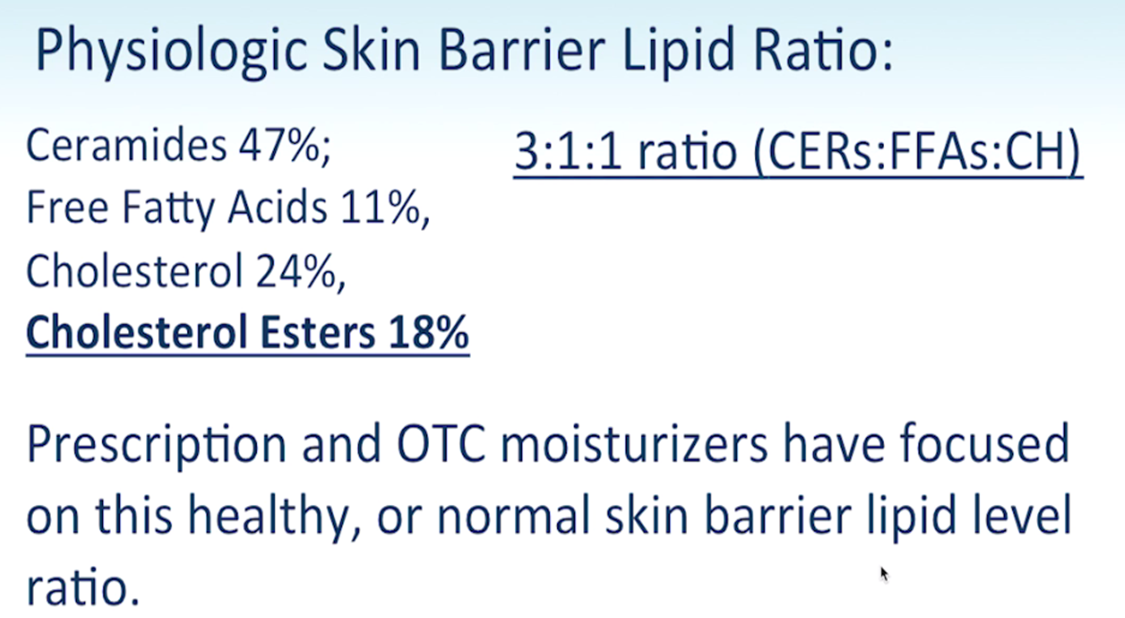
Though the normal or physiologic skin barrier lipid content is reflective of the 3:1:1 lipid ration specific lipid deficiencies in atopic dermatitis, xerosis and aging skin leave the skin in need of specific lipids and in excess of others. In eczema, dry skin and aged skin there is too much cholesterol relative to cholesterol esters so they’re in need of cholesterol esters.
Elevated Cholesterol: Cholesterol Ester Ratios
- Atopic skin has an excessive amount of cholesterol and a specific deficiency of the phytosphingosine-containing ceramide 3 (CER3)
- Decreased levels of CER3 is correlated with increased transepidermal water loss. Di Nardo et al. 1998
- Xerotic skin and surfactant-induced xerotic skin have also been shown to have a deficiency of cholesterol esters relative to cholesterol. Saint-Leger et. al 1989, Fulmer et al., 1986
- SDS-induced dry skin treated with 1% cholesterol base was compared to 1% cholesterol ester base, the cholesterol ester treated skin showed improved conductance values while the cholesterol-treated skin did not. Imokawa et al., 1989
Free Fatty Acid Deficiencies: medium and very long chain
- A reduction of FFA chain length and an increase in unsaturated FFAs has been observed in non-lesional and lesional stratum corneum of atopic patients. Reduction in lipid chain length also correlated with less dense lipid-organization and decreased skin barrier function. Van Smeden et al. 2014
- Specific deficiencies of three saturated very long chain fatty acids (VLCFAs) in atopic dermatitis identified: cerotic (C26), montanic (C28), and melissic (C30) acids. Machleidt et al. 2002
- FFA chain length plays an important role in skin barrier integrity in atopic dermatitis. Deficiency of the FFAs, palmitic (C16) and stearic acid (C18), in atopic skin. Yamato et al. 1991
Infection and pH
Acidify the skin barrier to prevent infection. Antibiotics are almost never necessary, instead use skin barrier acidification.
Bacteria have an optimal environmental pH in which they grow. Staph. aureus, Candida albicans and P. acnes all thrive in an alkaline environment.
- Naturally occurring broad spectrum antimicrobial peptides cathelicidin and human B-defensin 2 are stored in llamellar bodies and secreted into the permeability membrane.
- As skin barrier pH rises above 5.7 lamellar body secretion is inhibited. Hachem et al 2010
- Epidermal pH in atopic dermatitis, aging skin and inflamed skin is elevated. Hakano et. al. 2009
- Secretion of the broad spectrum antimicrobial peptides cathelicidin and human B-defensin 2 are decreased in an alkaline environment.
- By acidifying overly alkaline skin in atopic dermatitis and aging skin, lamellar body secretion is normalized. Maintenance of an acidic stratum corneum prevents emergence of murine atopic dermatitis. Hatano et al., 2009
Inflammation: Get ahead of it but don’t break down the skin barrier in the process
Short term (3 day) exposure to a potent Topical Corticosteroids (TCS) in humans resulted in delayed barrier integrity, and impaired stratum corneum integrity and cohesion.
In systemic or TCS treated mice, significant decrease in production and secretion of lamellar bodies and profound decrease in extracellular lamellar bilayers. Global inhibition of lipid synthesis noted.
Diminution in the density of corneodesmosomes in the lower stratum corneum was also noted.
Short-term Glucocorticoid Treatment Compromises Both permeability Barrier Homeostasis and Stratum Corneum Integrity: inhibition of Epidermal lipid Synthesis Accounts for Functional Abnormalities. Kao et al, 2011
OTC Safe, Anti-Inflammatories that don’t break down the barrier
Niacinamide:
- Has demonstrated anti-inflammtory activity that may be of benefit to patients with inflammatory skin conditions including such conditions as acne vulgaris, rosacea and atopic dermatitis. Nicotinamide in the treatment of inflammatory skin conditions. Niren et al 2000
- Niacinamide can suppress antigen-induced, lymphocytic transformation.
- Ability to block the inflammatory actions of iodides known to precipitate or exacerbate inflammatory acne. Shalita et al, 1995
- Decreases transepidermal water loss in atopic dermatitis and has been shown to be a more effective moisturizer than white petrolatum on atopic dry skin. Soma et. al, Moisturizing effects of topical nicotinamide on atopic dry skin 2005
- Nicotinamide increases biosynthesis of ceramides as well as other stratum corneum lipids to improve the epidermal permeability barrier. Tanno et al. 2000
18-B Glycyrrhetinic acid: (from Licorice)
One of the central ingredients in the prescription medical device cream Atopiclair is glycyrrhetinic acid, also known as 18-Glycyrrhetinic (GLY) acid or enoxalone.
- Structurally resembles cortisone
- Known for its anti-inflammatory, anti-bacterial an anti-redness qualities
- Reduced scores fo erythema, edema and itching in atopic dermatitis. Saeedi et al, 2003
- Bactericidal to MRSA and reduces virulence gene expression in S. aureus. Effective against Mycobacterium, RSV and Candida. Mitscher 1980, Long et al., 2013, Hardy et al 2012
- After UV exposure, shown to reduce ROS, Nf-KB, cytochrome c, caspase 3 levels and inhibition of hyaluronidase. Inhibits MMP1 activation by modulating Nf-kb signaling.
- Known to inhibit delta4B-reductase, an enzyme that competitively inactivates steroid hormones, and 11B-hydroxysteroid dehydrogenase, an enzyme that deactivates cortisol. Hikino, 1985
Avoid Chemical Exposures to Prevent Contact Sensitization in Atopic Dermatitis
Top 10 pediatric allergens in personal care products:
- Neomycin
- Balsam of Peru
- Fragrance Mix (1)
- Benzlkonium chloride
- Lanolin
- Cocamidopropyl betaine
- Formaldehyde
- MCI/MI
- Propylene Glycol
- Glucocorticoids
- Hill et al. 2016
Mathew Wood reports using Elder tincture internally on infants and children with rough, dry skin sometimes diagnosed as eczema, especially where the "meaty tissues" of the cheeks or on the forearms are involved.
Two common triggers are food sensitivity and stress, that's why it will come and go.
Steps to take :
- Eliminate the common dietary stressors of the body: sugar, dairy (causes lymph congestion), processed grains (and for some, grains all together), meat (red meat can cause flare ups by throwing a lot of acid waste into the liver and bloodstream). Focus on eating greens, lemons, beets, berries, dark cherries. Spirulina, chlorella . Nuts and seeds. Don't eat late at night and if you have to eat late at night, keep it light.
- Fasting
You can start with fasting just one day a week. Or intermittent fasting.
- Cleanse: colon and kidney first. Then lymph and then the liver. (look up "detox" in the database) Note, we're not talking about some of the popularized cleanses, and the order is important. If you do a liver cleanse for example, without starting with colon, kidney, lymph, toxins get backed up and you start poisoning your bloodstream (autotoxicity).
A way to stop itchiness quickly is use of a salt compress. A sea salt bath helps.
A product that has been effective for external use is called Africa's Secret.
Bentonite Clay is also useful. You can take a bath in it to cool the skin. A clay poultice, wrapped with plastic and left on over night on a bad spot.
Make a healing oil using plantain and comfrey.
Note: when this or any other skin condition goes away, that's just the beginning of health recovery.
Articles/Studies
Touch Neurons That Drive Chronic Eczema Itch Revealed - Peach fuzz linked to chronic itch.
A new study identifies the precise molecular and cellular mechanisms behind mechanical itch sensations.
Homoeopathic treatments could be a good addition to conventional treatments of eczema.
A Probiotic Skin Cream made with a Person's Own Microbes
Bee venom acupuncture and herbal medicine for hand eczema.
Eczema linked to Obesity, Higher Rates of Smoking and Drinking
Medical Herbalist, Richard Whelan on Atopic Dermatitis
Water baths as good as bleach baths for treating eczema
Topical vitamin B-12 may be a treatment option in children with eczema
Scientists Think They Know What Happens to the Skin when you have Eczema
The mechanism action of German chamomile in the treatment of eczema.
A homogeneous Lonicera japonica polysaccharide attenuates atopic dermatitis.