Elecampane Root
See also: Inula (genus)
Videos


Overview
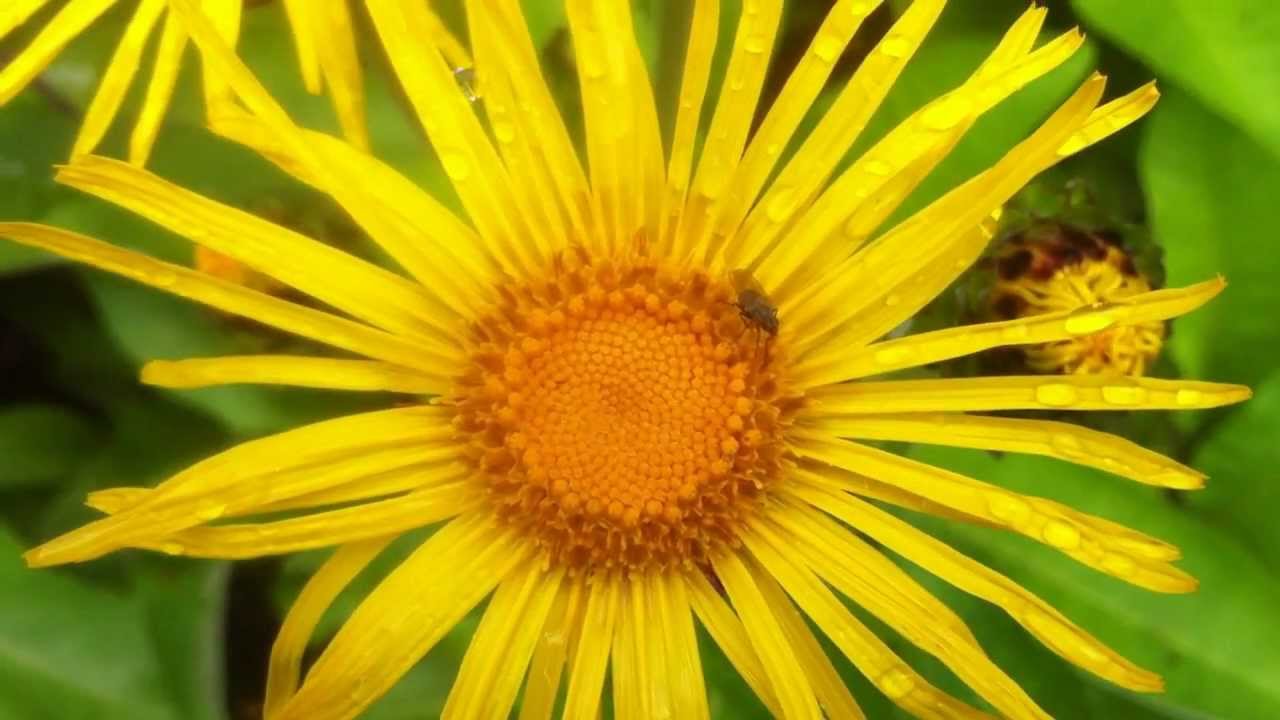
A widespread Eurasian species, now naturalized in parts of North America, Elecampane is a yellow daisy flower with numerous petals born on erect stems reaching about 5 feet tall. Elecampane is one of the old European hers, used back in the times of the ancient Celts, and then named “Elfwort”, as it was thought to be a medicine of the fairies and elves. In more recent times, it has been used as one of the ingredients in the manufacture of absinthe. Elecampane is considered GRAS in the US as a flavor.
This is an outstanding remedy for clearing phlegm and mucus from the lungs, urinary system and digestive system. It is a specific for chronic irritation and infection of the respiratory system. It’s a great ingredient in glycerites and syrup for coughs. It contains inulin, which feeds friendly bacteria in the colon.
Map of where it grows in the U.S.
Qualities: sweet, bitter, pungent, aromatic, warm, dry, restoring, astringing, stimulating, decongesting, downward moving
Tropism: lungs, stomach, spleen, pancreas, liver, bladder, kidneys, uterus, nerves
Ground: Phlegmatic and melancholic temperaments; Dependent/Tai Yin Earth, Self-Reliant/Yang Ming metal; Burdened/Shao Yin biotypes
Identification Cues
Growth Form
- Robust perennial herb arising from a thick, woody, nodose rhizome with a strong odor Plants of the World Online Springer
- Height ranges 1–2 m (sometimes 30 cm–2.5 m depending on region) Plants of the World Online Springer
- Stems erect, angular below, densely tawny‑pubescent and glandular, with branching in the upper portion Plants of the World Online
Leaves
Basal Leaves
- Large, lanceolate‑elliptic, up to 40–50 cm long and 15–25 cm wide Springer
- Long petioles (distinct petiole in Kew description; 18–35 cm in Springer description) Plants of the World Online Springer
- Margins crenulate to serrate; surfaces shortly pilose and papillate‑glandular above, tomentose below Plants of the World Online
- Texture often rugose above, velvety‑woolly beneath (SEINet) SEINet
Cauline (Stem) Leaves
- Sessile, amplexicaul, often cordate‑clasping at the base Plants of the World Online SEINet
- Shape shifts from oblong/ovate to lanceolate as they ascend the stem
- Upper leaves narrower, lanceolate, acute‑tipped Springer
Inflorescence & Flower Cues
- Large yellow composite heads typical of Asteraceae
- Heads 6–8 cm wide (Springer) or 30–40 mm involucre diameter (SEINet) Springer SEINet
- Ray florets numerous, long, slender:
- Rays 15–35 mm (Kew) or 20–30+ mm (SEINet) Plants of the World Online SEINet
- Disc florets golden yellow, 7–9 mm (Kew) or 9–11 mm (SEINet) Plants of the World Online SEINet
- Involucre hemispherical, 2.5–4 cm, with densely velvety‑tomentose phyllaries on the outer layers Plants of the World Online
- Heads often few but large, on thick peduncles (6–10 cm) in lax racemes or corymbs Springer
Fruit
- Achenes 3–5 mm long, glabrous, 4‑angled/prismatic, finely ribbed Plants of the World Online Springer
- Pappus brownish‑white, 7–10 mm (Kew) or 2–3× achene length (Springer) with numerous bristles Plants of the World Online Springer
Habitat & Distribution (useful for confirming ID)
- Found in mountain slopes, valleys, meadows, forest glades, and moist disturbed sites Plants of the World Online Springer SEINet
- Widely naturalized in North America, often along roadsides, pastures, streamsides SEINet
- Flowers mid–late summer (May–Aug depending on region) SEINet
Field‑Ready Quick Cues
- Tall (up to 2 m), coarse perennial with huge basal leaves and velvety undersides
- Clasping, heart‑based stem leaves
- Large yellow daisy‑like heads with long, thin rays
- Thick, aromatic rhizome with a distinctive medicinal scent
- Velvety/tomentose phyllaries on the flower head
Constituents:
Inulin (40%), bitters, triterpenes, essential oil (incl. camphor, sesquiterpene lactones [incl. isoalantolactone, alantolactone, helenalin (elecampane camphor)] alantic acid, azulene), alkaloid, helinin, synanthrose, sterols, inulic acid, mucilage, bitter resin, sodium calcium magnesium
- Listing on Duke's Phytochemical Database
- Sesquiterpene Lactones from *Inula helenium*
- Thymol Derivatives from a Root Culture of Inula helenium
Effects
The main active principles are alantolacton, isoalantolacton, and other sesquiterpenlactones. Compounds of this kind have an antiphlogostic and antibiotic effect. Antifungal activity has also been demonstrated.
The antimicrobial and anthelmintic effect results from the sesquiterpenelactones. Alantolactone and isoalantolactone are antitumoral, and helenin shortens clotting time.Alantolactone andhelenin leadto complete paralysis of the spontaneouscontraction of theintestine in animal studies.
The plant has mild antiseptic and expectorant effect due to the volatile oil which contains sesquiterpene.
Tissue State Relevance
1. Damp / Stagnation — Strong
Elecampane is historically and clinically centered on wet, phlegmy, stuck respiratory conditions.
- It is “the classic herb for wet coughs with thick, stuck mucus, chronic bronchitis, and weak, damp lung conditions” blog.nutrient-wise.com.
- Its sesquiterpene lactones (alantolactone, isoalantolactone) show antimicrobial, antifungal, antibacterial, and antiparasitic activity repository.iuls.ro.
Interpretation:
This is textbook Damp/Stagnation—boggy mucosa, phlegm, microbial overgrowth, sluggish respiratory clearance.
2. Cold / Depression — Strong
Elecampane’s root is a warming aromatic stimulant with bitter, camphoraceous qualities.
- Historically used as an aromatic tonic and stimulant of secretory organs en.wikipedia.org.
- Sesquiterpene lactones contribute warming, activating, circulatory‑moving actions (inference based on phytochemistry from the ingredient breakdown) blog.nutrient-wise.com.
Interpretation:
Cold/Depression patterns—slowed digestion, low tone, cold lungs, sluggish secretions—respond strongly to elecampane’s warming, activating nature.
3. Wind / Tension — Moderate
Elecampane has a long history of use for coughs with constriction, “windy stomach,” and internal blockages.
- Culpeper used it to “warm a cold and windy stomach” and “clear internal blockages” en.wikipedia.org.
- Aromatic sesquiterpenes often have spasm‑modulating effects (inference from phytochemical profile) blog.nutrient-wise.com.
Interpretation:
Wind/Tension patterns—tight coughs, spasmodic respiratory or digestive tension—are moderately addressed by elecampane’s aromatic dispersal.
Secondary Tissue State Notes
Dry / Atrophy — Moderate
Elecampane contains inulin and mucilage, which are soothing, demulcent compounds that coat and protect mucous membranes blog.nutrient-wise.com.
This gives it a moistening, protective counterbalance to its warming expectorant nature.
Heat / Excitation — Low
Although elecampane has anti‑inflammatory activity (sesquiterpene lactones suppress pro‑inflammatory cytokines) blog.nutrient-wise.com, it is not a cooling herb. Its dominant energetics are warming and stimulating.
Damp / Relaxation — Low
Elecampane is not sedative; its actions are stimulating, expectorant, and tonifying.
Summary Table
| Tissue State | Relevance | Evidence |
|---|---|---|
| Damp / Stagnation | Strong | Classic for wet, stuck mucus; antimicrobial & antiparasitic actions blog.nutrient-wise.com repository.iuls.ro |
| Cold / Depression | Strong | Warming aromatic tonic; stimulates secretory organs; bitter camphoraceous root en.wikipedia.org |
| Wind / Tension | Moderate | Used for windy stomach, cough tension; aromatic dispersive profile en.wikipedia.org blog.nutrient-wise.com |
| Dry / Atrophy | Moderate | Inulin + mucilage soothe and protect mucosa blog.nutrient-wise.com |
| Heat / Excitation | Low | Anti‑inflammatory but not cooling |
| Damp / Relaxation | Low | Not sedative |
TCM & Western Uses
Ancient Romans used Elecampane’s bitter and aromatic leaves as potherbs, and cooked them before eating, whereas the roots have been candied and eaten for confectionary. Medicinally, Elecampane has a long history of use as being a warming tonic herb, great for the respiratory system, especially for coughs and bronchitis, as well as aiding digestion. As it contains up to 44% inulin it is also considered a good prebiotic. External applications of the herb are also used for skin inflammations and for its anti-inflammatory activity.
Preparations of the rhizome are used to treat bronchitis, whooping cough, bronchial catarrh, menstrual complaints, urinary tract infections, colds,worm infestation and headaches. Externally, poultices are used for skin infections.
Homeopathic: Used for stomach ulcers and chronic cough
Applicable to mucosa in need of renewed secretion, stimulation, microbial cleansing and toning to restore atonic, relaxed tissue.
1. Tonifies digestive Qi, promotes absorption and relieves fatigue; restores the endocrine and nervous systems, replenishes deficiency, and enhances and regulates immunity
stomach and intestines (spleen) Qi deficiency; appetite loss, fatigue, loose stool MALABSORPTION, malnutrition, metabolic acidosis
lung Qi deficiency: shortness of breath, feeble low cough, weakness, melancholy
heart and lung Qi deficiency: (as above with ) palpitations worse on exertion, chronic cough hypotension, ANEMIA
Qi deficiency: tiredness, debility, low resistance, frequent infections IMMUNODEFICIENCY DISORDERS with SPLEEN/THYMUS DEFICIENCY (incl. chronic fatigue syndrome, AIDS) - AUTOIMMUNE DISORDERS, DIABETES (supportive), FATIGUE in general
2. Stimulates digestion, resolves mucous damp, resolves accumulation and relieves appetite loss; clears parasites
intestines mucous damp (Spleen damp): indigestion, distended painful abdomen, loose stool
liver, gallbladder and stomach Qi stagnation: subcostal and epigastric pain and fullness, slow painful digestion, nausea, appetite loss GASTRIC & BILIARY DYSPEPSIA, liver congestion INTESTINAL PARASITES
- PROMOTES EXPECTORATION, RESOLVES PHLEGM AND RELIEVES COUGHING; RESTORES THE LUNGS
lung phlegm damp/cold: full cough with expectoration of white sputum, tight chest, chills, fatigue
CHRONIC BRONCHITIS, bronchial asthma
lung Yin deficiency: night sweats, dry unproductive cough, emaciation, fatigue
LUNG TB
- PROMOTES MENSTRUATION AND EXPELS THE AFTERBIRTH; STOPS DISCHARGE; INCREASES HORMONES
genitourinary damp cold, and uterus cold: white leucorrhea, mucous in urine, painful urination, delayed scanty menses, cramps with onset, PMS
ESTROGEN AND PROGESTERONE DEFICIENCY menstrual disorders.
PMS with swollen breasts, dry skin, confusion, low self-esteem
RETAINED PLACENTA and LOCHIA
5. PROMOTES URINATION, RESOLVES TOXICOSIS, BENEFITS THE SKIN AND RELIEVES PAIN
kidney and liver Qi stagnation; water retention,painful scanty urine, skin rashes, headache, malaise*
SKIN CONDITIONS (incl. dermatosis, eczema, herpes, atonic skin ulcers, scabies, scurf, pruritus)
ACUTE PAIN from sciatica, gout, arthritis, paralysis, urination
NERVE INJURY, wounds, damp sores, chronic ulcers
6 REDUCES INFECTION
INFECTIONS (esp. chronic, of bronchi, trachea, kidneys, bladder; e.g. nephritis)
NOTES - HOLMES
Although elecampane's botanical name helenium is named after the Greek heroine, Helen of Troy, this remedy has nothing very heroic about its action. "Inula is somewhat slow in action, and should be used for quite some time to get its full action" (KING/FELTER/LLOYD 1898) It is known to us primarily as an aromatic stimulating expectorant "adapted to cases with free and abundant expectoration, teasing cough and pain beneath the sternum." Chronic bronchial and "humid asthma" conditions of lung phlegm damp type are clearly described here. Because of its antiseptic essential oil content and demulcent mucilage, Elecampane is also successfully used in lung Yin deficiency conditions such as TB, where it also controls night sweats.
In the digestive tract also, Elecampane root's bitter-pungent, warm, dry qualities indicate use for catarrhal stagnant damp conditions arising from weakness and congestion of all the digestive organs. The symptom pictures show this: intestines mucous damp and gallbladder/stomach Qi stasis presenting chronic forms of atonic indigestion and mucus-discharges. In the latter case, this remedy, which is called "native mu xiang" (Tu Mu Xiang) in parts of China, acts exactly like the original Mu Xiang, the composite plant Saussurea lappa.On the whole, however, for these conditions Elecampane acts more like Pinellia Ban Xia in removing damp from both the Upper and Middle Warmer.
However, there is another side to this remedy, signaled by its sweet taste. Elecampane traditionally and in modern times is used in various deficiency conditions involving poor digestive assimilation and immune deficiency with spleen and thymus hypofunctioning. The remedy has also shown to benefit the hypothalamus, thereby creating long-term enhancement of immune potential. Its use for controlling blood sugar, as in diabetes, is well documented. This endocrine restorative action in concert with the bitter digestive stimulation over time will increase overall strength, indicating use in conditions of chronic fatigue, whatever the etiology. Elecampane is a Qi tonic,in other words. Like many another Chinese Qi tonic(Astragalus root, Asian ginseng root, etc.) Elecampane is an excellent candidate for management of chronic immunodeficiency conditions such as CFS and the first stage of AIDS, as well as for treating frequent or chronically recurring infections in general.
On balance, Elecampane root is particularly appropriate for long-term Qi deficiency conditions resulting in Qi stagnation and damp of the internal organs, especially with fatigue and recurring infections present. In this overall sense, the root's action corresponds to another remedy in the composite family, Atractylodes Bai Zhu - also bitter, sweet and pungent. These two can replace each other any time, they're so close. Technically, Elecampane root is like Atractylode Bai Zhu combined with a little Pinellia Ban Xia and a suggestion of Saussurea Mu Xiang. A perfect herb for many a prescription.
Like the other endocrine remedies Schisandra Wu Wei Zi and Ganoderma Ling Zhi, Elecampane root also presents a tantalizing immune-regulating dimension. The root's high inulin content is the rationale for the indication of autoimmune disorders. In the face of insufficient clinical and theoretical evidence, however, we can only speculate at this point on the extent of the inulin's antiallergicand anti-inflammatory activity here with regard to hypersensitivity disorders.
Physio-Medical Therapeutics, Materia Medica and Pharmacy BY T. J. LYLE, A.M.M. 1897
The root is a gently stimulating tonic to the mucous membrane. Diaphoretic, diuretic and expectorant, it is warming, strengthening, cleansing, and toning to the gastric, alvine and pulmonary mucous membrane, and is very serviceable in catarrhal conditions of the bronchi, and catarrhal dyspepsia. It is better suitable to chronic than acute cases. It is an excellent addition to cough syrups. In hot infusion its stimulating power gives a good outward circulation.
The Physiomedical Dispensatory by William Cook, M.D., 1869
The root of this plant is thick, whitish, mucilaginous, and of a feeble balsamic odor. It usually comes to market in flat slices, grayish, of a pleasant aroma, and a warming and rather bitter taste. It contains, especially early in the spring, a large quantity of a starchy substance called inulin. It yields its properties readily to water and alcohol.
Properties and Uses: The root is stimulating and relaxing, leaving behind a tonic and slightly astringing impression. Its influence is expended chiefly upon the mucous structures of the lungs; but it also acts moderately upon the stomach, uterus, skin, and kidneys. To the lungs it is warming and strengthening, promoting the discharge of viscid mucous, but leaving the surfaces slightly dry. It is a popular remedy in coughs, but is often used without sufficient discrimination; for while it answers an excellent purpose in sub-acute and chronic cases where the lung structure is relaxed and expectoration viscid or too profuse, (as in humid asthma,) it is not suitable for cases of any class where the lungs are irritated or dry–as it then increases the dryness, and gives a feeling of constriction. It is an ingredient in the Compound Sirup of Aralia; and may be combined with any of the relaxing and demulcent expectorants, though rarely used in conjunction with stimulants of that class. It may be associated with lobelia, cimicifuga, and licorice in the formation of cough lozenges or troches; and the people use it largely with hoarhound and comfrey.
It has a moderate influence in promoting menstruation; for which purpose it may be combined with anthemis and caulophyllum in uterine languor. Some physicians use it in dyspepsia and hepatic torpor, and in the cutaneous affections arising from biliary accumulations; but it is of small value in such cases. From ten to twenty grains of the powder may be used as a dose, three or more times a day; but it is most customary to prepare it in a compound infusion or sirup, and then to employ such doses as will rarely contain more than from two to five grains of the elecampane in each.