Common Comfrey
See also: Symphytum (genus)
Comfrey: The "Miracle Plant" Teachings
Videos
Comfrey- Research On A Natural Remedy for BACK PAIN, Arthritis and More
Eat your comfrey flowers
Overview
Parts used: leaf and root
Tropism: lungs, skin, stomach, intestines, bladder, genitals
Qualities:
a bit sweet, bitter and astringent, cool, moist with a secondary drying effect, softening, astringing, solidifying, restoring, nourishing
Identification Cues
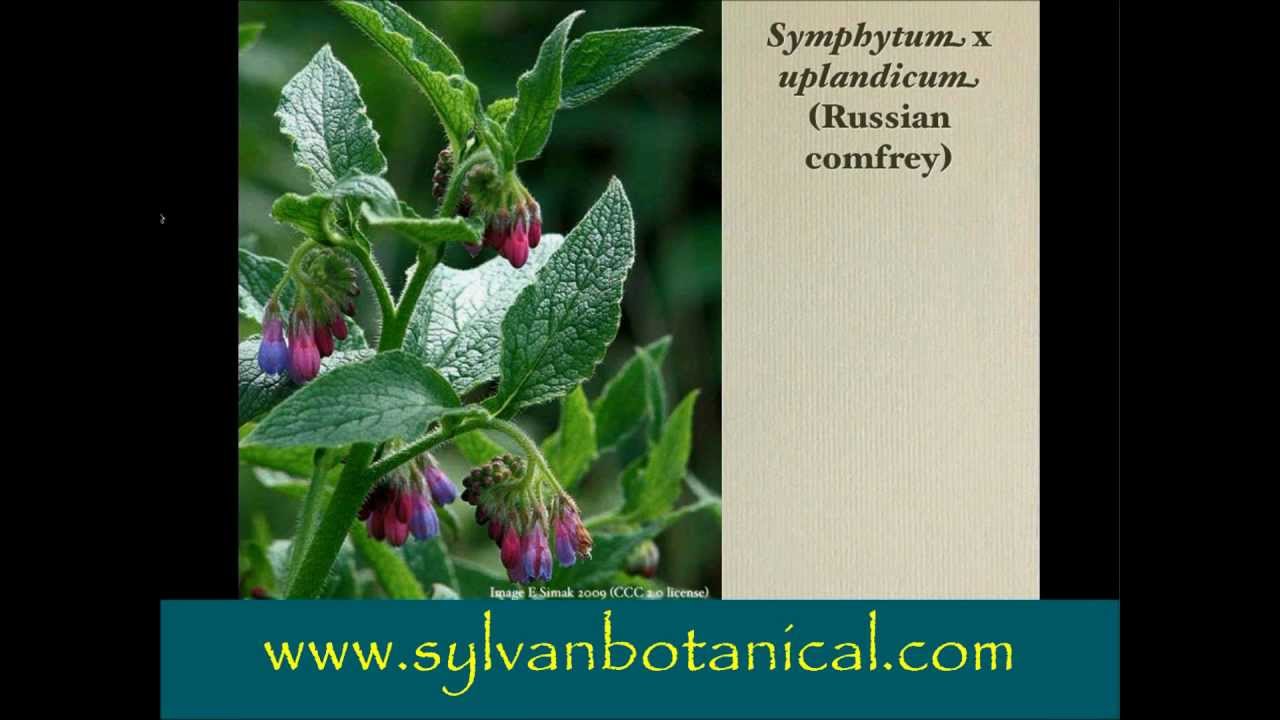
- Habit: Robust, coarse, bristly perennial herb, commonly about 0.6–1.2 m tall; often forms dense clumps.
- Leaves: Large, rough, hairy, lance-shaped to ovate leaves with prominent veins. Lower leaves are long-stalked; upper leaves become smaller and clasp the stem. The foliage is notably rough to the touch.
- Stem: Upright, stout, winged or ridged from the decurrent leaf bases, and covered with stiff hairs.
- Flowers: Drooping, tubular, bell-shaped flowers borne in curled clusters (scorpioid cymes). Common colors include pink, purplish, violet, or cream-white; flowering is generally from late spring through summer.
- Calyx: Five narrow, hairy lobes; the calyx remains conspicuous around the flower.
- Fruit: Four small, dark nutlets develop after flowering.
- Root: Thick, fleshy, branched, and typically dark brown to black outside with pale cream interior; may be described as beet-like when fresh.
- Habitat: Moist, fertile soils—especially stream margins, ditches, meadows, roadsides, field edges, and gardens. It can persist around former cultivation sites.
- Seasonal cue: Basal foliage emerges early; the characteristic nodding tubular flowers appear in late spring and summer.
- Look-alikes and safety: Do not identify from a single feature. Foxglove can be confused with comfrey, and other Boraginaceae species may resemble it. Do not ingest or use internally based on field identification. Comfrey contains hepatotoxic and carcinogenic pyrrolizidine alkaloids; use particular caution with roots and internally administered preparations. Confirm identity with a current regional flora or a qualified botanist.
Constituents:
Tannins (incl. pyrocatechol tannins), allantoin 0.6-3.5%, inulin, pyrrolizidine alkaloids (incl. consolidin, consolicin, symphytine, cynoglossine, echimidine, lycopsamine, symlandine), choline, protein, mucopolysaccharid 29%, steroidal saponins (incl. asparagine), sitosterol, echinatine, nicotinic/pantothenic/lithospermic/chlorogenic/caffeeic acids, phenolic acids, gums, resins, triterpenes, essential oil, minerals (incl. iron, calcium phosphorus), trace minerals, vitamins (incl. A, B12,C,E)
Effects
Comfrey exerts anti-inflammatory and antimitotic actions, and furthers the formation of callus.An in vitro study found allantoin to accelerate wound healing. Anticancer activity also has been demonstrated in vitro.
Anti-inflammatory Effects: A placebo-controlled study documented some anti-inflammatory action in various musculoskeletal disorders, but the effects were not consistent. Information on anti-inflammatory actions is sparse, but some positive actions occur. It suppresses leukocyte infiltration during the inflammation process.
Demulcent Effects: The mucilages act as demulcants for a soothing and irritation reduction effect.
Tissue/Nerve Stimulation: The wound healing effect is thought due to allantoin, a component in Comfrey that stimulates tissue repair and wound healing through cell proliferation. Allantoin has also had significant effect on cellular multiplication in degenerating and regenerating peripheral nerves.
Symphytum officinale (Comfrey) maps most strongly to the tissue states of Cold/Depression, Dry/Atrophy, and Wind/Tension, with conditional relevance to Heat/Excitation and minimal relevance to Damp/Stagnation.
Below is a full tissue‑state breakdown grounded in the pharmacology reported in the 2026 ethnopharmacology and phytochemical studies.
Tissue State Relevance
1. Cold / Depression — Primary relevance
Comfrey’s strongest alignment is with cold, underperforming, low‑tone tissues.
Why (grounded in evidence):
- Comfrey’s key constituents—allantoin, rosmarinic acid, polysaccharides, lignans—stimulate tissue regeneration, cell proliferation, and bone repair. These actions counter the “slowed metabolic tone” of Cold/Depression. Frontiers
- Inhibits NF‑κB and MAPK inflammatory pathways, reducing chronic cold inflammation and supporting repair. Frontiers
- Clinical trials show comfrey improves acute back pain, osteoarthritis, ankle sprains, myalgia, all of which often present as cold/depressed connective tissue patterns. Frontiers
Tissue-state translation:
- Restores metabolic activity in sluggish tissues
- Enhances repair in low‑circulation, cold injuries
- Ideal for chronic sprains, slow‑healing fractures, cold arthritic joints
2. Dry / Atrophy — Strong relevance
Comfrey is deeply restorative to tissues that are depleted, thinned, or structurally compromised.
Why:
- Allantoin promotes cell proliferation, granulation, and matrix rebuilding, directly addressing atrophic tissue states. Frontiers
- Polysaccharides and phenolic compounds support moisture retention and tissue regeneration. MDPI
- Historically used for wounds, fractures, soft‑tissue injuries, all classic Dry/Atrophy presentations. MDPI
Tissue-state translation:
- Rebuilds thinned fascia, ligaments, and bone matrix
- Supports wound closure and structural restoration
- Excellent for chronic depletion after injury
3. Wind / Tension — Moderate relevance
Comfrey helps tissues that are tight, strained, or irritated, especially connective tissues.
Why:
- Anti-inflammatory actions reduce irritation-driven tension. Frontiers
- Traditional “knitbone” use reflects its ability to restore glide and reduce strain in ligaments and fascia. Frontiers
- Wound-healing studies show improved hemostasis and tissue organization, reducing chaotic, wind-like tissue patterns. MDPI
Tissue-state translation:
- Eases ligament/tendon tension after strain
- Reduces fascial irritation
- Helps tissues reorganize after trauma
4. Heat / Excitation — Conditional relevance
Comfrey is anti-inflammatory, but not primarily cooling.
Why:
- Rosmarinic acid and lignans suppress pro-inflammatory cytokines via NF‑κB/MAPK inhibition. Frontiers
- Useful when heat accompanies injury, especially acute sprains or inflamed joints.
Tissue-state translation:
- Reduces hot irritation in injured tissues
- Best when heat is secondary to trauma, not systemic excitation
5. Damp / Stagnation — Minimal relevance
Comfrey does not drain dampness and may be contraindicated in boggy, stagnant patterns.
Why:
- Root extracts contain pyrrolizidine alkaloids (PAs), which require caution and do not support damp-clearing physiology. MDPI
- Its actions are rebuilding and moistening, not drying or mobilizing.
Tissue-state translation:
- Not ideal for edema, boggy joints, or phlegm-heavy tissue states
- Use cautiously where fluid stagnation is primary
Summary
| Tissue State | Relevance | Why |
|---|---|---|
| Cold / Depression | ⭐⭐⭐⭐⭐ | Regenerative, proliferative, anti-inflammatory; restores low-tone tissues |
| Dry / Atrophy | ⭐⭐⭐⭐ | Allantoin-driven rebuilding; supports wound and bone repair |
| Wind / Tension | ⭐⭐⭐ | Reduces irritation; reorganizes strained connective tissue |
| Heat / Excitation | ⭐⭐ | Anti-inflammatory; useful when heat accompanies injury |
| Damp / Stagnation | ⭐ | Moistening/rebuilding; not draining or mobilizing |
Application
Comfrey belongs in structural repair, connective tissue restoration, and post-injury recovery.
Best paired with:
- Solomon’s Seal for tendon/fascia restoration (Dry + Wind)
- Mullein root for structural mucosal dryness
- Goldenrod for cold/depressed connective tissue with mild inflammation
Avoid pairing with strongly dampening herbs unless dryness or cold is dominant.
TCM & Western Herbalism Uses
Approved by Commission E:
- Blunt Injuries
Externally: Used for bruises, sprains, pulled muscles and ligaments and promotion of bone healing. The root has been used externally as a mouthwash and gargle for gum disease, pharyngitis and strep throat. Internally, the root has been used for gastritis and gastrointestinal ulcers. In folk medicine, the root has been used for rheumatism, pleuritis and as an antidiarrheal agent.
1. NOURISHES THE YIN, MOISTENS DRYNESS, GENERATES FLUIDS AND CLEARS DEFICIENCY HEAT; BENEFITS THE THROAT; AND RELIEVES COUGHING AND CONSTIPATION
Yin and fluids deficiency:* thirst, dry mouth and throat, hot spells, feverishness*
TIDAL FEVER (Shao Yin stage), dehydration, heat exhaustion
lung dryness/Yin deficiency: unproductive dry cough, dry mouth and nose, headache, sore throat, feverishness, cough with scanty bloody sputum
LARYNGITIS, BRONCHITIS, WHOOPING COUGH, pneumonia, lung TB
stomach dryness: difficult bowel movement, dry hard stool
CHRONIC CONSTIPATION
2. NOURISHES THE BLOOD AND RELIEVES FATIGUE: STRENGTHENS THE CONNECTIVE TISSUE
blood and fluids deficiency: fatigue, weakness, dry skin, pale complexion, scanty or no periods
ANEMIA, wasting disease
muskuloskeletal deficiency (Liver and Kidney depletion):* weak, sore legs and knees, weakness*
CONNECTIVE TISSUE WEAKNESS, BONE WEAKNESS
3. CLEARS DAMP HEAT, REDUCES INFLAMMATION AND STOPS DISCHARGE AND BLEEDING: RELIEVES PAIN
bladder damp heat: irritated or painful urination, blood in urine, black pain
URINARY INFECTION (esp. acute)
NEPHRIIS (acute or chronic)
intestines damp heat: painful burning urination, loose stool, thirst
ENTERITIS (incl. dysentery), diverticulitis, colitis, hiatial hernia
HEMORRHAGE internal or external, from any orifice
PERIOSTITIS, tendinitis, arthritis
JOINT, MUSLCE, BONE, and TENDON PAIN
4. PROMOTES TISSUE REPAIR AND REDUCES INFLAMMATION, CLOTTING, SWELLING AND PAIN: SOFTENS BOILS AND DRAWS PUS
BONE FRACTURES, WOUNDS, RUPTURES, internal and external, acute and chronic (esp. with swelling, pain and contusion); anal fissures, cracked nipples, perineal tears, psoriasis
BRUISES, sprains, strains, cuts, abrasions, burns
CHRONIC ULCERS (all types, incl. skin, leg, peptic, bladder and kidney ulcers)
BOILS, ACNE, abscesses, varicose veins
Use on the Face
Allantoin is found within the root mucilage that the comfrey produces, and accelerates new skin cell growth while also being a natural anti-inflammatory agent. The Comfrey Extract contains many beneficial compounds to assist in anti aging and revive tired skin, as well as combating conditions such as eczema, psoriasis, burns, cuts and dermatitis due to its anti inflammatory properties.
Allantoin has the ability to act as an emollient, that helps develop a protective film over skin cells which leads to less water loss. Allantoin also acts as a keratinolytic which soften the keratin protein found in the outer layer of the skin, allowing the skin to hold onto water better. This makes it moister, more supple, and extremely hydrated. Keratinolytics also promote shedding of the skin which results in visibly smoother and improved skin texture.
The University of Liverpool conducted research that confirmed Allantoin holds significant anti aging properties that promote longer life effects and slow down the aging process. *Face cream ingredient found to mimic life-extending effects of a calorie restriction diet.
Comfrey is considered to be an essential anti-aging ingredient, because it contains both allantoin and rosmarinic acid. Allantoin promotes the growth of new skin cells and rosmarinic acid acts as a painkiller and reduces inflammation. Comfrey softens skin and reduces the appearance of fine lines and wrinkles.
Per Sloan-Kettering
Comfrey is a fast-growing plant whose leaves and roots have been used for centuries to treat many ailments, especially for wound healing.
A study done in mice indicated that oral comfrey has antiproliferative effects ; the leaves showed wound healing properties; and the root extract was useful in relieving acute back pain and osteoarthritis of the knee. However, comfrey contains pyrrolizidine alkaloids that are hepatotoxic and carcinogenic.
There is extensive literature concerning hepatotoxicity with use of comfrey . However, the risk of systemic absorption following the use of topical comfrey preparations is not known.
Comfrey was used since the 1930s for animal feed, but has been prohibited in Australia and New Zealand. In June 2001, the FDA asked all manufacturers to remove products containing comfrey from the market.
Comfrey herbal tea use resulted in several cases of cardiac glycoside poisoning due to misidentification with foxglove as the leaves of both plants look similar.
Mechanism of Action
The mechanism of action has not been elucidated, but the therapeutic properties of comfrey are thought to be based on its anti-inflammatory and analgesic properties.
Comfrey was shown to stimulate granulation and tissue regeneration, and support callus formation. Allantoin and rosmarinic acid, two important components, are believed responsible for cell proliferation and anti-inflammatory effects.