Button Snakeroot (Rattlesnake master)
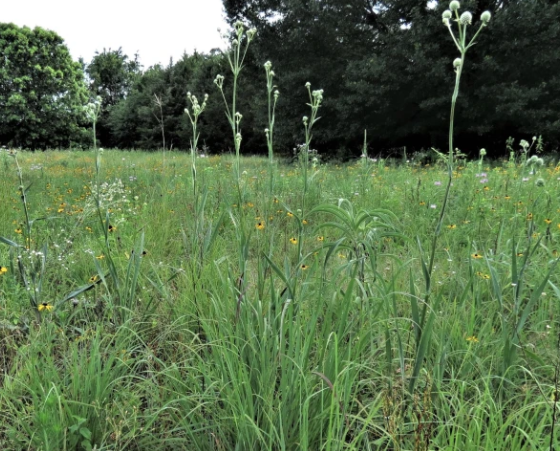
An American variety of sea holly. Used in a very similar way to Sea Holly. Being a urogenital stimulant, diaphoretic and expectorant, this root is more of an eliminant remedy than Sea Holly root which is more restoring. Nevertheless, Button snakeroot contains most of Sea holly's restorative properties. It strongly dried mucous damp and calms sexual over-excitement. Its ability to resolve phlegm damp in the lungs is said to equal that of Seneca snakeroot
Botanical Description: This plant is an indigenous perennial herb, with a single stem from 1 to 5 feet in height. The root is tuberous. Its leaves are from 1 to 2 feet long, by ½ an inch to 1 ½ inches wide, broadly linear, parallel veined, taper pointed, grass-like, ciliate and armed with remote soft spines. The bracts are tipped with spines, those of the involucels being entire and shorter than the heads. The flowers, which are white or pale and inconspicious, are disposed in ovate globose heads, which are pedunculate, and from ½ to 1 inch in diameter. The calyx is 5-parted and permanent; the styles slender; the petals connivent, oblong, and emarginate, with a long, in flexed point. The fruit is scaly, top-shaped, and bipartile.
Reflection: Button snake root is indigenous to the peat moss bog environment in the south from Virginia to Texas. It generally found along the edges on the incline leading to the bog or along the edges of the ditches. In Kings it is reported abundant on the prairie lands such as in Texas. . It is not a plant that is striking with its color, but the unusual shape of the plant with its spike sputnik looking flower heads makes it easily discernible for even those slightly familiar with its growth. It is amazing that we can see plants for so long and never stop to wonder what is their unique purpose. Button Snake root looks very common in some ways but once you are familiar with it, it becomes very attractive. The eryngium aquaticum has a pretty purplish tint to it flowering tops as does the integrifolium.
The Yuccifolium is quite a bit larger than the others and when not blooming could be mistaken for a very young Yucca plant. The root is the part used and will be a great deal stronger than the other parts. It is not a large root and has a good many rootlets coming off the main root. The root is usually from one to three inches long and sometimes the young plants may have only small ball shaped tubers. They are soft and somewhat whitish inside. Very earthy in their odor.
Native American Uses
CREEK-kidney trouble-The pounded root is put into water. This is drunk to relieve kidney trouble.
CREEK-neuralgia-Cold water, in which the pounded root' been placed, is drunk to cure neuralgia
CREEK-snake bite.
CREEK-to cleanse the system and purify the blood.
NATCHEZ-nosebleed-The stem and leaves are chewed to stop a nosebleed.
NATCHEZ-dysentery-The parched leaves are made into a tea which is drunk to cure dysentery.
Medicinal Uses:
This contains diuretic, expectorant and diaphoretic properties. In large doses it is emetic.
Button snake root is one of those herbs which has a very substantial reputation, but has slipped out of use because somehow or other it is not commercially available. Sort of a connoisseur herb. It is very effective in its use so the decrease in popularity is definitely not due to ineffectiveness. The main use is in urinary complaints especially where there is burning painful urination. Although all conditions such as gravel, stricture, etc would be indications also, although it is famous for its use in burning urination. It lessens erectile power so it would be useful in nocturnal emissions. It could be combined with willow blossoms in this regard. Button snake root is indicated by pain in the testes. Again the combination would be good with willow blossoms and I would try this combination also in pain in the ovaries. It would be useful in the inability to pass urine called dysuria. Whenever there is uneasy or painful sensations in the urinary tract button snake root should be used.
In women’s disorders, it is of much value when the condition occurs where there is burning pain on urination. It is very useful in spasmodic stricture and could be combined with Gelsemium in this regard.
Edibility
Eryngium species are a rich source of flavonoids. Young shoots and leaves are edible but only in small quantities. Although not confirmed, the roots of this species may be edible.
The Physiomedical Dispensatory by William Cook, M.D., 1869
This is a perennial plant, with a tuberous root and herbaceous stem; growing in moist grounds, (but not in water, as the old name, Eryngium aquaticum, suggested;) reaching a height of from two to four feet; branching by forks of two or three, looking much like an endagen. Leaves grass-like, one to two feet long, rigid, nerved, fringed with soft bristles. Flowers very small, whitish, in pedunculate and globose heads half an inch in diameter; bracts spinose; calyx five-parted. July.
This plant is found in nearly all sections of the United States. The rhizoma is knotty, wrinkled, dark-brown without and yellowish-white within, of a sweetish-aromatic taste, leaving behind a slight bitterness.
Properties and Uses: This is another of the plants introduced to the notice of medical men by Prof. Rafinesque. It combines stimulating and relaxing properties, the stimulant rather predominant; its action is moderately diffusive; and all the secernent organs feel its influence more or less. Thus it promotes the flow of saliva, expectoration, perspiration, and urine; and large doses of it will prove emetic to some persons, and muco-cathartic to others. These rather general and somewhat transient influences make this a suitable agent to use in combinations for dropsy, chronic torpor of kidneys, chronic congestion of the bladder, gleet, and chronic coughs associated with debility. It is also useful in compounds for scrofula; and especially so in secondary syphilis, where the depression of the system is not excessive. The case for which it is to be used, will determine the articles of its association–the eryngium itself being stimulating enough to give promptness and pungency to more relaxing articles, and at the same time to leave behind a slightly toned condition. By such usage, it will be found a good remedy. Used both externally and internally, Rafinesque says it is unsurpassed for the bites of poisonous serpents, and no doubt it would be excellent to aid in the elimination of viri; and I have found a warm infusion of it quite valuable to promote the tardy eruption in scarlatina, small-pox, and other
exanthems, though not such a distinct diaphoretic as Rafinesque supposed it to be. It is best used in decoction, prepared by macerating two ounces of the root in a quart of hot water for half an hour. Dose of the decoction, two fluid ounces four times a day. When combined with other agents, it is made into sirup or tincture in the usual way. Dr. T. A. Wells, of Cincinnati, tells me its combination with agrimony forms a superior tonic diuretic; and he commends it highly for all nephritic maladies.