Eyebright
See also : Euphrasia (genus)
Videos

Overview
This plant is being over-harvested, a good substitute is Purple Loosestrife
Medicinal Parts: the flowering plant
The identity of Euphrasia officinalis L. and its nomenclatural implications
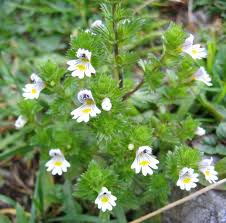
A small mounding herbaceous annual native to western Europe to eastern Asia. Eyebright produces leaves with jagged edges and flowers which also look “jagged” and vary in color, but usually white with a yellow spot on the throat. Historical use of Eyebright dates back to Greek Mythology, as the Eyebright herb was likened to the one of the key “graces” which was that of delight—to bring delight to the eyes of mortals. Although not very common, Eyebright leaves have been consumed as a food, but used sparingly because of their bitter flavor. In foods today, Eyebright is used as a flavoring ingredient. In Europe it is approved as a food flavoring.
Constituents
Iridoide monoterpenes: aucubin, catalpol, euphroside, ixoroside, veronicoside, verproside, mussaenoside, ladroside
Lignans: dehydrodiconiferyl-4-beta-D-Glucoside
Flavonoids: including apigenin- , chrysoeriol- and luteolin-7-O-galactosides and -rhamnogalactosides
Tannins
Eight iridoid glucosides have been isolated from Euphrasia rostkoviana by the combination of open column- and high performance liquid chromatography. The structure of a new compound, named eurostoside, and the identity of the others have been established by chemical transformations and spectral evidence of the compounds and their derivatives. Source
STUDIES IN THE SCROPHULARIACEAE–PART VIII1 PHYTOCHEMICAL INVESTIGATION OF EUPHRASIA OFFICINALIS
Effects
The constituent aucubin has anti-inflammatory effects and has shown to be hepatoprotective against poisonins with carbon tetrachloride or alpha-amantitine. Further, acubin has shown inhibitory effects against hepatitis B virus in vitro.
Antioxidant Activity of Different Phenolic Fractions Separated From Euphrasia Rostkoviana Hayne
Uses
Eyebright has a long history of herbal use for restoring eyesight and eye problems, such as conjunctivitis, blepharitis and eye fatigue, and is still used today—thus its common name. Eyebright is often misunderstood in mass-market products and popular literature. Because of the common name it is often promoted to help vision. But this has never been the case. Because of its favorable effect on upper respiratory mucous membranes, the conjunctiva acquires a healthy sheen, hence the ‘eye is bright’. The herb will have this effect if taken orally or applied topically. (Bone & Mills)
There are many cautions against its use, as preparations may not be hygenic, and people have used the wrong forms of the herb or used incorrect preparations with harm. Eyebright also has uses for promoting respiratory or cognitive health, and it is generally thought to have an anti-inflammatory effect on membrane inflammation, allergies, the common cold, sinusitis and others. In one non-placebo controlled clinical study, one drop of Eyebright eye drops up to five times daily led to the recovery of 82% of patients. Eyebright contains iridoid glycosides, and one called Aucubin has been found to exhibit anti-inflammatory effects orally or topically, as well as antiviral, antifungal and antibacterial effects in preclinical studies. Eyebright has also been found through scientific investigation to exhibit antioxidant, hypotensive, anticancr, hepatoprotective, anti-epileptic, and anti-catarrhal activities. A homeopathic preparation of Eyebright is used as eyedrops.
Preparations are used externally as lotions, poultices and eye-baths, for eye complaints associated with disorders and inflammation of the blood vessels, inflammation of the eyelids and conjunctiva, as a preventive measure against mucus and catarrh of the eyes.
In folk medicine, it is used for blepharitis, conjunctivitis, styes, eye fatigue symptoms, functional eye disorders of muscular and nervous origin, coughs and hoarseness.
Physio-Medical Therapeutics, Materia Medica and Pharmacy BY T. J. LYLE, A.M.M. 1897
The leaves are a mild, stimulating, astringent tonic influencing chiefly the mucous membrane, and useful wherever there is too free discharge, whether it be of the bladder, urethra, bowels, or bronchi.
In cholera infantum when there is an excessive greenish mucous discharge, in leucorrhoea, gonorrhoea, cystic catarrh, and catarrhal ophthalmia this agent may be used with profit. In cases of congestions and inflammations of the eyes, especially of any torpid grade, it is valuable as an eye-wash.
In nasal catarrh when the discharge is too free it may be used with the douche or atomizer and is a good cleansing remedy. It is an astringent but is not drying and hence is more toning to the membrane.
Euphrasia will be found very useful for the relief of acute inflammation of the eye and for opacity of the cornea and when there is an acrid secretion of either eyes or nose with heat and pain.
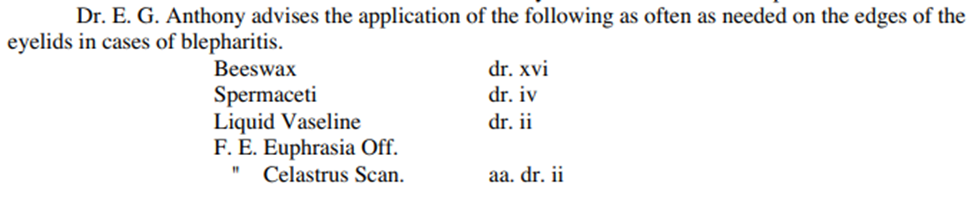
The Physiomedical Dispensatory by William Cook, M.D., 1869
This is a pretty little plant from four to six inches in height, found through the New England States and Canada, and quite abundant in Europe. Stem somewhat square, downy, branched, slender. Leaves opposite, less than half an inch in length, ovate. Flowers axillary, solitary, light blue or red, as long as the leaves, strongly two-lipped; upper lip concave, and two-lobed, lower lip three-lobed and spreading; lobes deeply emarginate. July. The small size of this plant causes it generally to be overlooked; and it is often confounded with the euphorbia hypericifolia, which also has the common name of eyebright. The latter article is acrid and poisonous; and may be distinguished by its purple and
prostrate stem one or two feet long and much branched; by ifs yielding an acrid and milky juice wherever broken; and by its leaves having dark spots near the center.
Properties and Uses: The leaves are mildly stimulating and astringing, and exert a somewhat tonic influence. They act principally upon mucous membranes; and may be used to advantage in all excessive mucous discharges, as in leucorrhea, gonorrhea, coughs, catarrh of the bladder, and laxity of the bowels. They are best adapted to mild cases, but are reliable in their action; and are a valuable remedy in the peculiar summer complaints of children. Their common name refers to their decided efficacy as wash or poultice in weak eyes and congestion of the conjunctiva;, and
in catarrhal ophthalmia. They are also reputed useful in the cough and headache that sometimes follow catarrhal affections. An infusion is made of an ounce of the leaves to a pint of hot water, and used in doses of two fluid ounces every four hours.
Preparation/Dose
The diminutive Eyebright is a parasite on grass and is most often found on the margins of well-used pathways and ‘rides’ in open country. As it’s not particularly common, harvest only one plant in ten and keep an eye in subsequent years that you’re not causing depletion. The whole aerial herb is gathered in full flower from mid-summer to late autumn – try not to uproot any plants if possible. Being very fibrous, comminution is best achieved by shredding, or secateuring bunches into 3cm sections.
It works best for the eyes when used as an eyewash.
A tincture from the fresh plant will open up the Eustachian tubes in children, allowing the inner ear to drain, preventing earaches. The dried leaf is almost entirely ineffective for allergies and Eustachian tub issues.
Tincture Fresh laf (1:2, 60% alcohol); 1-4 ml; 1-4 times daily
Tea: 2 to 3 g of finely cut herb to boiling water, strain after 10 minutes
Topical Use Prepare a compress or fomentation from a standard infusion of dried leaf. Apply as needed
Daily Dose: decoction used 3 to 4 times a day for eye rinses.