Introduction and History
BLUE FILE – SUMMARY REPORT 2004

Investigation into the Affairs of the Bernard Glazer Estate (Deceased)
CONFIDENTIAL – ALL RIGHTS RESERVED
An International Fraud?
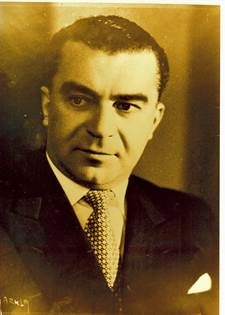
Bernard Glazer 1913–1984
A truly remarkable story of a great man who laid the foundation for an international empire.
The discovery referenced as the “Blue File” arose from an investigation into a fraud concerning the Estate of the late Bernard Glazer.
Nowhere in history are the Glazer Brothers mentioned for their achievements, and yet, as research has revealed, they were very powerful men on this continent as well as abroad. Bernard Glazer was a private individual who played a major role in developing Southern and Central Africa when he consolidated their interests after his brother Sam’s untimely death in 1959. Bernard represented honour, integrity and courage, representative of the former generation that built this country. He acted behind the scenes in conjunction with the highest executive levels of both government and private enterprise, in Africa and globally.
In his Will he appointed his son Sam Glazer (after reaching 21), Julius Feinstein and Cyril Jaffe as Administrators – the latter two being his oldest and most trusted directors of numerous companies locally and abroad – to ensure and perpetuate his vision.
Bernard Glazer passed away under unusual circumstances on 17 July 1984. Michele Glazer, his eldest daughter and a beneficiary, entered into a family agreement in 1997 where she ceded her entitlement in terms of the Will to her brother, Sam Glazer.
Based upon the evidence and with a proper reading of the Will and Powers of Trustees, the contract entered into with her brother and the so-called ratification thereof by the Administrators – and with reference to the Administration of Deceased Estates Act and certain provisions therein – we believe that Michele is compelled to set the matter right by way of an application to Court for an Order setting aside the agreement entered into.
We are of the view that the agreement between Michele and her brother, wherein she cedes her entitlement in terms of the Will from that date to him, is irregular and unenforceable and in fact void ab initio in view of the fact that the position that he, her brother, occupied at the time of concluding the contract was as an heir as well as an Administrator of the Trust. There is a clear conflict between these two positions with regard to prejudicing other heirs and, furthermore, the agreement is not approved by the Master of the Supreme Court. On our interpretation of the Will, wherein the Trust is created, the Will does not make provision for this scenario.
Further to the above, having regard to the assets of the Estate and the complex web of transactions of the Tati Concessions and mineral rights and royalties accruing thereto and its successors, there appears to have been a massive fraud committed by the Administrators and Executors of the late estate, whereby assets that were the property of the deceased at the time of his death were wilfully and deliberately concealed from the Master of the Supreme Court, are not referred to in the Liquidation & Distribution (L&D) accounts, and have effectively been siphoned off.
This prejudices not only the South African and UK Governments and others – by not disclosing the estate duty that would be due to them – but also the heirs, in that the impression is created that the Trust does not have assets, whereas in fact substantial portions thereof were never, in the first place, brought into the Trust. This should be of interest to the Receiver of Revenue and may constitute a criminal offence. Furthermore, her brother fraudulently withheld relevant information from her, which would be a further ground of setting aside the 1997 Agreement, based on fraudulent misrepresentation, as well as whether or not one can cede, in the context of a vesting estate, a future right or hope.
The reconstruction of the Glazer Brothers’ history in Southern Africa and internationally remains the significant intellectual property that will provide an understanding of what is happening in South Africa presently and is perhaps the entry point for much that was excluded from the TRC.
Contrary to public opinion of mineral rights ownership in Southern Africa – beginning with Cecil John Rhodes and the Charter Group of companies, and the well‑publicised history of Anglo American / De Beers, Rio Tinto and Lonrho – there is the unpublished history of the Glazer Brothers. It is this extraordinary story that demonstrates a far more sinister and unbridled greed that casts long shadows, reaching across the decades to darken the reputations of some of South Africa’s most eminent professional men.
Bernard Glazer did much to open up Botswana, Zimbabwe and Zambia from the early 1950s with acquisitions of former British South Africa Company (BSAC) assets, such as Tati Co (1.6 million acres in Botswana) and The Bechuanaland Exploration Co, the former managers for the BSAC in Southern Africa. This company held vast interests in Botswana, Zimbabwe and Zambia, including mineral, trading, timber and water rights.
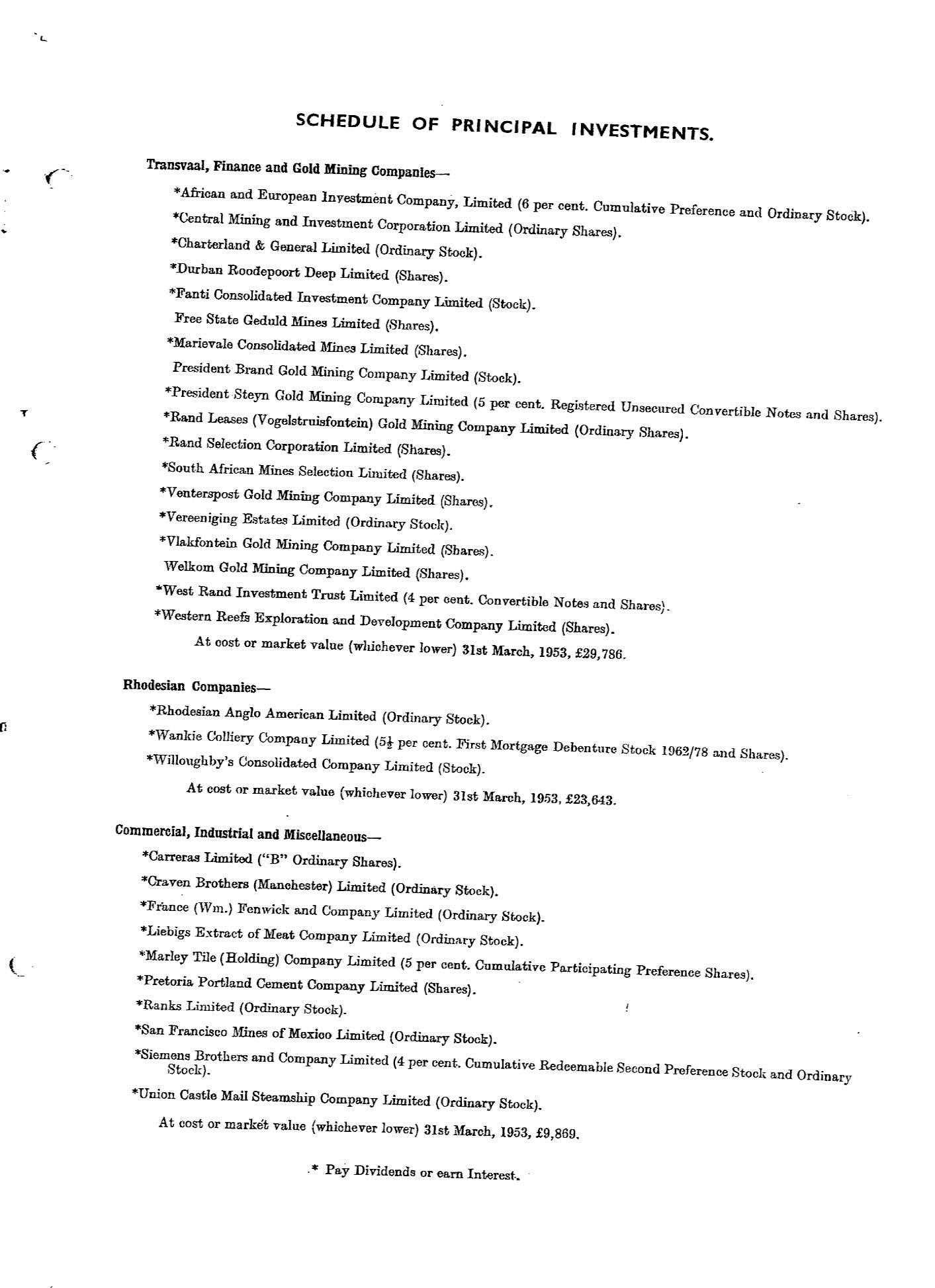
A schedule of some principal investments included Central Mining and Investment Corp / Rand Mines, African & European Investment Co, Charterland & General, Durban Roodepoort Deep, Rand Selection Corp, SA Mines Selection Ltd, Rhodesian Anglo American, President Steyn Gold Mining Co and Pretoria Portland Cement. With these various share interests the Glazer Brothers made controlling bids for Central Mining, Investment Corp and Lonrho in 1956/57. At the same time Consolidated Gold Fields was formed and records indicate an interest therein.
One must bear in mind that the foundation of Southern Africa’s wealth and development after WWII was created in all commercial spheres, with mining at the core. An understanding of current developments such as the Gold Fields / Harmony take‑over and Barclays / Absa acquisition requires an understanding of those foundation structures put in place between 1948–1984.
A core asset of the Glazer Brothers’ property portfolio was their acquisition of African City Properties Trust in 1952. This company was incorporated in England in 1894 and owned a large portfolio of land and buildings mostly in the Johannesburg CBD area. This company, with its entire asset portfolio, was sold in 1965 to Urban Investment Properties (Pty) Ltd, the sole shareholder of which was the Joint Municipal Pension Fund (Transvaal), situated in Benoni. The entire parcel was later acquired by Retco Ltd at some time in the seventies.
Retco’s major shareholder appears to have been Federated Employers Insurance Ltd, which later became Fedsure, before it was taken over by Investec in 1987. However, the parcel of land didn’t move all the way with the Federated bundle. It was hived off in 1981 – after having been held through Retco by South African Breweries for a while – to the CBD Property Fund, which was controlled by Sage Holdings Ltd through Sage‑Ned‑Equity Properties (Pty) Ltd.
The start of the exit trail was when ACP (1952) Ltd was converted to a private company in 1983, as were many of Glazer’s companies around this time.
By 1997, the year Michele signed the questionable Family Agreement with her brother Sam, Sage Group was ranked at number 51 on the Sunday Times Business Times Top 100 Companies list. It had a turnover of R2.4 billion, total assets of R5.8 billion and managed assets exceeding R9 billion.
Of particular relevance was Glazer’s expansion of his international operations in the 1970s. He enjoyed a close friendship with his banker, Jan Hurter, who at the time was Chairman of Volkskas and also sat on the board of the South African Reserve Bank.
One important subsidiary acquired was E.S. Schwab, a small merchant bank in London, which facilitated the banking licence so necessary in the days of apartheid sanctions. Prior to his death Bernard Glazer entered into a Joint Venture (JV) with Volkskas Limited resulting in him owning a 25% share in Volkskas International.
Also acquired in the 1970s was the Siberian Syndicate Limited (Inc. 1913), an investment holding company with interests in Siberia and other mining investments, such as a substantial holding in Gold Fields. The name was changed to Crest International Securities and had on its board numerous influential South Africans such as the Lubner brothers.
One cannot look at the future without taking into account the structures that he created and how these have been used by creative legal and accounting brains to funnel large amounts of wealth out of a number of African countries, particularly since his death in 1984. The same group that has used his structures to “run away with the bone” currently holds sway over Africa’s destiny through the control of, or at least a major influence over, the financial and mining sectors.
The historical relevance of his story lies in exposing, or illuminating, the global political and financial structures that existed behind the veil of apartheid and in spite of economic sanctions; it will also suggest a plan to bring the ANC into government and to strip the country of its wealth at the same time.
Our investigation reveals a pattern of destruction of company records from the DTI, Companies House London and various other depositories, to reconstruct the history of Bernard Glazer outside the orbit of the Administrators. Michele Glazer has suffered undue and unnecessary prejudice since her father’s passing in her attempts to unravel the truth. There was no effort made to memorialise his legacy and Michele was marginalised and every effort was made for her to cede her rights and entitlement through debt‑for‑equity entrapments, which included Regal Treasury.
After a 20‑year battle the matter rested with the High Court of Pretoria where the Estate had been temporarily suspended from closing on 5 July 2004. Her Application had been made for the suspension of the Administrators subject to an investigation into the affairs of the Trust. The Administrators deny mineral and other international financial interests, yet our research strongly suggests otherwise.
In October 2005, our client Michele Glazer “unilaterally” withdrew Case No. 9575/2004 in the High Court of Pretoria and we suspect an arrangement with her family ensued.
Notwithstanding extreme prejudice, the project team salutes a remarkable South African, Bernard Glazer – a truly larger‑than‑life individual. The scope of this draft report was limited to the denials in the Application as an introduction. The scope is far broader and more sinister as the pursuit for truth evolved. The private acquisition of BSA Companies in the 1950s remains an historical precedent and a foundation for transparency today.
Salutes
I salute the “project team” that rose above adversity in this journey of discovery.
We began with limited information other than unsubstantiated allegations by the client. The name “Blue File” was derived from a file including correspondence from Sam Glazer (brother), which Michele found in her late father’s London penthouse in 1992. The contents revealed relationships and non‑disclosure which activated this study.
In order to establish what Glazer had purchased by the time of his passing in 1984 we had to go back to the beginning.
Reconstruction of history involved following mineral right ownership in various countries from the inception of Rhodes Companies and management by the Crown Agents for Overseas Governments.
Also, to complete the matrix, interconnectivity and symbiotic corporate activity over a hundred years, hundreds of local and international companies were researched, social network charts were constructed manually, dusty archives scoured and interviews held with the intelligence community, academia, retirees and media.
This daunting task received the cooperation of numerous individuals from every sector. Their unselfish contribution to establish the truth remains the basis for this salutation.
The object was not to audit financials rubber‑stamped by the Glazer Will Trustees but to illuminate historical misrepresentation and follow the money trail to the present day.
We had no idea where this investigation would lead us or what budget to set aside. We initially focused on Botswana mineral rights and the Tati Exploration Company. We began with all government records of correspondence between South Africa and Botswana since inception and finally retrieved physical copies of title deeds from a “green safe” in Botswana. This adventure remains the basis for a novel.
Mineral right ownership was further validated with recently declassified correspondence from the UK Commonwealth Office (CO). Nathan Werksman, Glazer’s legal representative, defended a takeover bid in 1960 by the UK Commonwealth Office to exclude mineral right ownership and a transfer of management followed to Central Mining & Investment Corp – Rand Mines. The bid via Syfrets was unsuccessful, but defence of those mineral interests was evident then and the project team proceeded cautiously.
By March 2003, evidence of fraud by the Administrators had received favourable opinion by a team of legal professionals and Glazer’s passing in 1984 was suspect.
Research was seriously hampered by the lack of resources to thoroughly investigate the finances of the Panamanian‑registered holding company, Amarena, and/or the Swiss bank accounts held by Bernard Glazer before his death. Also, the confidential records maintained by the SA Reserve Bank, relating to the Reserve Bank approval that was previously granted for certain financial institutions.
We could not solicit help from the Botswana Government regarding royalty arrangements, but the private agreement in 1970 between Sir Seretse Khama and Bernard Glazer is self‑explanatory and elaborated on later in this draft report.
The interlocking mineral interests of Glazer Companies acquired in the 1950s included, amongst others, vast areas in Zambia, Congo (DRC) and Zimbabwe. Glazer Brothers Zimbabwe (Pty) Ltd was headquartered in Bulawayo and ultimately controlled by Panamanian shell Amarena. Due to political instability in Zimbabwe (formerly Southern Rhodesia), we retrieved the mirror image of mineral succession records from Northern Rhodesia, now called Zambia (see Ch. 6 Rhodesian Anglo Holdings 1962 and Company Interrelationships for BSA Chartered Company). The cooperation of individuals in destabilised countries is symbiotic and courageous.
Interviews with senior intelligence personnel in 2002 revealed there was no information on Glazer other than the kidnapping ransom for Sam Glazer Jnr. Ownership of mineral interests in Africa was vested with Anglo / De Beers, Lonrho (formerly London Rhodesia) and Rio Tinto, period. History was silent on the controlling bid by Glazer Brothers for the investment holding company Central Mining – Rand Mines 1956/57 and Lonrho 1958. This acquisition trail may go some way to explaining the equally unusual passing away of Sam Glazer (Bernard’s brother) in 1959. However, they spoke frankly of a predetermined plan to destabilise South Africa and bring the ANC into power.
The industrial development that evolved in Southern Africa in the 1960s resulted in an investigation that expanded exponentially to include financial institutions such as Volkskas International UK, established at the apex of sanctions in the 1970s.
The results described in Chapter 4 leaked in 2003 and the subsequent ABSA acquisition by Barclays followed. We were bound by law to report a fraud to SARS and summary evidence of the Blue File investigation was placed on record with the Business Intelligence Division of SARS and validated by December 2005. I salute those individuals that digested more than a mouthful. The least known of all taxpayers is Glazer.
Since 2003, the scope simply expanded to a point where it became obvious the race was on to retrieve records that were being destroyed as fast as we requested or retrieved them. Those records we planned for retrieval later due to budgetary constraints were gone by the time we got back there.
Relevant company records from our Department of Trade and Industry (DTI) were simply missing or in many cases diluted to render them useless after two generations of trading. Physical records of principal UK controlling entities with Companies House UK were burnt by an “employee” in Cardiff, the main repository which is not accessible to the public. We were fortunate on various occasions to have specific permission and access to share registers. We thank those archivists from Cardiff for assistance to company records and confirmation of those destroyed.
Logistically, we relocated on numerous occasions for security reasons and remained confined to premises for three years. The volume of data retrieved was so voluminous that history was segregated between:
- 1890–1960 – the foundation period of Glazer acquisitions
- 1960–1970 – Glazer consolidation
- 1970–1984 – Glazer deceased / establishment of international operations
- 1985–1994 – the exit of “property” and ANC appointment
- 1995–2004 – SA destabilisation, debt‑for‑equity and Glazer Will Trust liquidation
I salute our legal representatives who endured endless frustration as they waded through mountains of information and defended Michele in various debt‑for‑equity entrapments – for their protection and motivation.
I thank those investors and suppliers who have provided credit for repayment of loans for expenses that were inherited on behalf of M. Glazer. We had borrowed and invested millions of Rand for the cost of international records, but Michele sought to come to a private family arrangement rather than suffer marginalisation by family, friends and ongoing financial duress. Her father’s legacy could not now be illuminated without successful conviction of Defendants and related parties.
The wheel turns and the parts continue to be illuminated, for some consolation (please see the current Financial Services Board (FSB) allegations and a review of past members, which is relevant).
Disappearance of Michele and the Intelligence Task Force
Michele chose to disappear without contact from 2005 and Blue File Summary Report 04 was simultaneously filed with SARS Business Intelligence Unit, our mandatory responsibility.
Our initial request was for assistance to complete this investigation and for access to SA Reserve Bank Records. The SARB had indicated that substantial files exist, but without consent from the Administrators or a Court Order, the Bank was unable to assist.
Without a plaintiff we had no chance of further illuminating the historical precedents uncovered. After 12 months the results of the Blue File investigation received “informal” National Security Status. Individuals were assigned from National Intelligence Agency, Military Intelligence, SA Secret Service, SARS Business Intelligence, Counter Intelligence, Organised Crime, Department of Minerals, Legal and others for International Liaison.
This task force reports to the President’s Office, which to date is void of any response, receipt or acknowledgement for information supplied directly to the Deputy President’s Office from the outset. A full circle via the intelligence community – and thanks to those who tirelessly pushed the information “up the hill”.
The intelligence task force have also disappeared with no further contact.
In a few years, we have witnessed the exit of miners, seen consolidation as never before, explosion of mining development in Africa, reduction and delineation of the interests of Anglo / De Beers, old faces like General Mining disappear, new faces front for old.
The African invasion is Rhodes revisited with a different mask.
A similar invasion is that of foreigners in all parts of Africa, not dissimilar to a gold rush 100 years ago. An article in Sunday Times 18 February 2007, p26, “The Chinese are the new ‘colonials’” – “…the state keeps slicing an ever‑shrinking pie, believing you can build a sustainable economy purely on the services sector and raw material exports. The Chinese are wooing Africa to build infrastructure and create permanent jobs for Africans. They are the new ‘colonials’ and it would appear that, like George Bush who learnt nothing from Vietnam, our politicians have learnt nothing from colonialism.”
Simply, the primary interests were fronted by the Russians, Chinese, Canadian, Swiss and various financial institutions which remain at the forefront of Rhodes revisited. Mergers and consolidation have progressed at such a pace that transparency and structure to this matrix of global activity would escape the most agile of minds unless you have insight into a predetermined plan.
I invite the reader to review the important group of companies and individuals that remain the foundation of our history. Bernard Glazer’s history is missing and may history be your judge. Salutations!
“Is Government up for sale” – Sunday Times 18 February 2007, p28 – and violent crime is more prevalent than it was 10 years ago.
The matrix of the Blue File is the entry point to illuminate those historical structures that paved the way even for Mugabe. Must remaining South African taxpayers fit this reconstruction bill estimated to exceed $5 billion?
Our media frenzy continues with the suspect leadership in SA and journalists Ann Crotty and Renee Bonorchis received prize‑winning accolades on articles relating to “Executives’ Golden Parachute” for ABSA Directors Nallie Bosman, Frans du Toit and Rupert Pardoe with the Barclays takeover. Also, the Harmony / Gold Fields bid required Harmony to honour golden parachutes for three directors, Holland, Ian Cockerill and Craig Nelson. In both cases the media speculated as we were helpless to this asset strip taking place right in front of our very eyes.
There was some speculation as to Anglo shares in Gold Fields that ended up with Norilsk. What if Norilsk’s origins and history coincide with The Siberian Syndicate (1913) UK acquired by Glazer in 1970? What if Anglo held the shares on behalf of “nominees” in Gold Fields as managers or through a financial institution? Could it be that the historical mineral interests of both Harmony and Gold Fields have foundations that succeed Central Mining – Rand Mines consolidation in the 1960s?
The disclosure of sensitive information has been validated, yet we review in dismay as old order mineral rights are reinstated with “Rhodes revisited”. I salute the media for their continuous illumination of the various appendages of this octopus. The Brett Kebble saga remains the tip of the iceberg.
Conclusion
There is a new generation of South Africans born since the time of the UNION; generations which have shouldered their fathers’ responsibilities and think they are heavier than they used to be – they might well be right.
The history of an era in which South Africa came of age and grew in stature will stir up events of the past thirty years ago that influence our destiny. Today the youth is dissatisfied, restless and disappointed.
Singer Steve Hofmeyr, objecting to plans to change Pretoria’s name to “Tshwane”, said:
“You cannot have a city named after you because you walked through the place with four cows and pissed against an acacia tree. You can only have a city named after you if you built it.”
Whatever qualities the founders of this initial group of companies lacked, enterprise was not certainly one of them. In this fast‑changing world in which we live there was never a time when enterprise was more needed than today.
However, I refer to an article in Sunday Times 22 February 2007, p22, “Drilling the death drill on a sinking ship”:
“…Where, in some African quarters, the two ‘world wars’ are considered little more than European wars for world dominance – which to some degree they were.”
This must be measured, however, against the tendency to excise the colonised from history. This plays down the contribution of previously colonised people to the making of the modern world and oppressive forces of every kind.
Stop for a moment and review the last moments of the sinking SS Mendi 90 years ago, when those left on board removed their boots and stamped the death dance on the slanting deck of the sinking ship chanting:
“I, a Xhosa, say you are my brothers. Zulus, Swazi, Pondos, Basothos and all others, let us die like warriors. We are the sons of Africa.”
In 1916, Britain asked South Africa for troops to serve as labour battalions. According to Military History, 10 000 African volunteers served in France between 1916–1918. The Order of the Mendi Decoration for Bravery is South Africa’s highest award for courage.
Salutations to the sons of Africa – this is for you.
A Brief History of Bernard Glazer
1.1 An African Pioneer
Bernard Glazer was born in Lithuania in 1913 and came to South Africa in 1930, when he was 17. The Lithuanian Jews who immigrated en masse to South Africa in the late nineteenth and early twentieth century played a dominant role in the latter country’s economic history and Bernard Glazer was no exception.
While most people were active in Kimberley and the Witwatersrand, Glazer headed north to Botswana, Southern Rhodesia (now Zimbabwe) and Northern Rhodesia (now Zambia). He acquired a company, Tati Goldfields, a company listed on the London Stock Exchange, and the first ledger entry is dated 30 April 1955, wherein there are royalty and rental payments reflected, with specific reference made to the Monarch Mine, which claims date back to 1934.
Importantly, for Glazer it was not all gold and diamonds. Strategic metals such as zinc, lead and copper played an important part in the development of the West following the Industrial Revolution. Copper, in particular, was crucial for the expansion of electricity and telephony and for ammunition shells, and the Rhodesias were rich in copper.
According to the book Oppenheimer and Son by Anthony Hocking (McGraw‑Hill, 1973), “Northern Rhodesia possessed a mining field likely to achieve greater importance than any other in the British Empire with the possible exception of the Rand.” And, the author continues, Ernest Oppenheimer told the shareholders of Anglo American that he was not convinced that the area wouldn’t surpass the Witwatersrand in value and importance.
To understand the business of procurement in the colonies it is necessary to understand the British Crown Agents. The Crown Agents, which was established in 1863 and still exists today, was an independent organisation (self‑funded and answerable to no‑one, not to the Crown nor to the British parliament) whose job it was to procure supplies and contracts on behalf of colonial administrations for the development of the colonies.
For example, if a colonial government or administration needed a railway line or a harbour to be built, the Crown Agents would procure the contractors and the materials necessary for the operation. Naturally this type of business put them in a position to benefit Great Britain commercially, but it also meant that they could perform a vital intelligence function.
The Crown Agents managed the Colonies and mineral interests of the British South Africa Company (BSAC). The Glazer Brothers had close links with the British establishment, such as Baron Elie de Rothschild and, in France, Leopold David de Rothschild (see Central Mining Bid).
It is possible that his Estate was wrested from Glazer and his beneficiaries by those who were concerned about his power base in Africa. Bernard Glazer had access to a top‑level system locally and internationally. The risks of doing business in Africa would necessitate the creative use of shell corporations, as is still applicable today.
The Blue File contains much evidence of the trans‑national flow of capital and the pattern is evident as was necessary with the development of southern Africa. This evidence includes:
- Classified foreign affairs documents which give an insight into the workings of a global network of influence that has the power to steer world events towards a predetermined plan
- Reports on the flow of trans‑national capital from Europe and America during apartheid, with particular reference to bank loans
- Copies of documents lodged at Companies House in London which reveal the use of front companies to acquire an international bank that became Volkskas International, and how control of this bank was wrested from Bernard Glazer by Afrikaner interests only a year before his passing – only a year before the South African rand began a dramatic slide that lasted almost two decades but which suddenly corrected itself in the very year that the Glazer estate closes

Bernard Glazer operated in partnership with his brother, Samuel Lieb Glazer, who was found slumped over his desk in 1959, having suffered what the coroner said was a heart attack. This, a mere two years after their much‑publicised controlling bids for Central Mining Investment Corporation / Rand Mines and London Rhodesia Mining Corporation (Lonrho), of which their substantial interests therein have yet to be determined.
It may be argued that these interests were acquired in the 1950s; however, a closer look at the share registers of these companies clearly shows that large share blocks were held by nominee entities, registered in tax safe havens such as Panama, Bermuda and the Jersey Islands, to name but a few.
The Administrators are being economical with the truth by hiding behind technical limitations imposed by financial institutions in various jurisdictions. Therefore our investigation is restricted as to the true identity of the nominee companies utilised and the non‑disclosure by the South African Reserve Bank on a substantial file held by them on Bernard Glazer. By his own admission, Feinstein was Bernard Glazer’s financial advisor.
Research has revealed that the Glazer Brothers acquired, with the purchase of the Bechuanaland Exploration Company Limited, principal investments in over 40 Transvaal finance and gold mining companies, Rhodesian companies and commercial and industrial holdings. These were in the form of cumulative preference and ordinary stock, preference shares, convertible notes and shares, mortgage debenture stock and so forth.
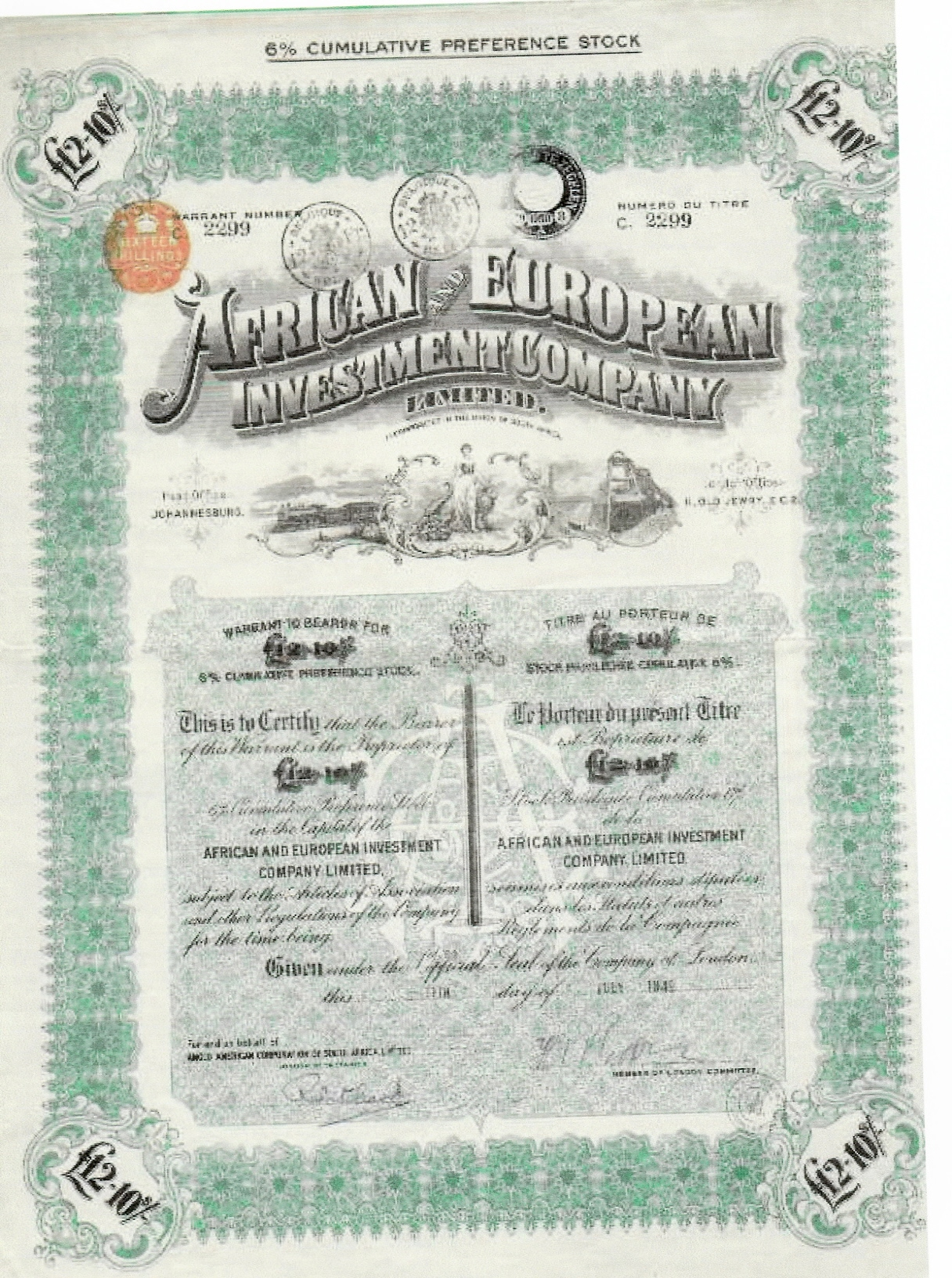
After the acquisition these assets disappeared from the financials and this would tie in with the opening of a Swiss bank account in 1956. Prior to the introduction of the electronic system, these shares were elaborately engraved certificates. An example is the 6% cumulative preference stock of African and European Investment Company, of which these shares can be tracked in the financials up until 1990, when the company is de‑registered from Companies in London.
The solution remains access to his fiscal records maintained by his primary bankers.
The Glazer brothers’ first post‑war transaction on record is their acquisition of Marston House, a building in Johannesburg in January 1946 and the subsequent registration of a company, Embassy Investments (Pty) Ltd.
This was the first investment in a real estate portfolio that by the mid‑1950s would include dozens of companies and even more buildings, most of which were in the Johannesburg CBD and which included most, if not all, of the prime spots around the intersections of Eloff / Plein / Jeppe / Joubert Streets. But it was the acquisition of vast landholdings – with mineral rights – in Bechuanaland (now Botswana) and Northern and Southern Rhodesia (now Zambia and Zimbabwe respectively) in the mid‑1950s that would announce the Glazer brothers’ arrival as major players on the African scene.
The link between urban real estate and mineral rights is important. In the same way that cash‑rich pension funds and insurance companies invest in real estate, so too did the cash‑rich holders of mineral rights, the Glazer brothers.
So while they were well known around Johannesburg as property magnates, nobody guessed at the real source of their income, nor the extent of it – a fact which would serve the administrators of Bernard’s estate only too well.
1.2 Mineral Rights – The Glazer Modus Operandi
The ownership of mineral rights is quite separate from the physical act of mining. Following the discovery of diamonds in Kimberley and gold on the Witwatersrand in the late nineteenth century, the race was on to see what other riches Africa had in store and prospectors headed northwards.
However it was not a free‑for‑all, but rather controlled in a most gentlemanly manner. Most of the expeditions were sponsored by corporate backers in London and Paris, and were conducted by teams that included more businessmen and lawyers than prospectors.
For the first priority was not to determine the value of the gold or base metal deposits, but rather to secure the rights to do so over vast areas from the tribal chiefs.
The biography of Cecil John Rhodes, The Founder by Robert I. Rotberg (Jonathan Ball, 2nd ed., 2002), illustrates this process clearly when it tells about the team that Rhodes sent to negotiate with King Lobengula of the Ndebele, who ruled over the independent Matabeleland.
The team included Charles Rudd, a wealthy businessman who was a principal in Gold Fields and held shares in De Beers, as well as Rochfort Maguire, an Oxford graduate and one of the up‑and‑coming star lawyers of the day. When they arrived, “Gbulawayo was … crowded with a motley collection of would‑be syndicate creators, hunters, traders, prospectors and other hopefuls”. The king kept Rhodes’s party on a string for more than a month – they were camped outside his kraal – while he considered his options, but eventually he awarded the concession to Rhodes’s team and it became known as the Rudd Concession.
In return for paying Lobengula £100 a month and supplying him with guns and ammunition and an armed steamboat to patrol the Zambezi, the king “assigned Rudd and company ‘the complete and exclusive charge over all the metals and minerals situated and contained in my kingdoms, principalities and dominions…’”.
The concession gave the company carte blanche to do whatever was necessary to extract the metals and minerals and to protect their rights to the profits; it gave the company the right “to exclude all others seeking land or prospecting privileges from his kingdom”.
It is known that the Glazer Brothers gained control over what was known as the Tati Concession, which would have been acquired in very much the same way and with similar terms and conditions.
The actual work of prospecting, and the wholly separate operation of physically extracting the metals or minerals from the ground and transporting and marketing them, was done by companies created and financed specifically for that purpose.
Such mining companies were sometimes created by the same people who owned the mineral rights, but more often than not it was a completely different company that moved in on the land with the consent of the rights holder. The rights holder, in effect, became the mining company’s landlord. This structure and practice remains in place today.
The physical component of mining requires large investments in equipment, negotiations with labour, and a risk exposure to the vicissitudes of the market. The landowner, on the other hand, just sits back and waits. If gold – or nickel or copper – comes out of the ground, he gets a few pennies for every ounce, by simple virtue of the fact that he owns the mineral rights.
What’s more, until such mining takes place, the landowner can sell the surface rights to a farmer, who will farm subject to allowing prospecting to take place on that farm. If a decision is taken to mine the area, the farmer – in exchange for certain compensation – has to allow the mining company access and he has to allow the mining company to put up whatever structures are necessary.
The mineral rights in most African countries were nationalised following the independence of those countries. It is not known what compensation was paid to the holders of those rights, either by the governments in question or by the British government.
The possibility exists that deals were made whereby African presidents formed partnerships with the original owners of the mineral rights; the history of corruption and skewed wealth in Africa strongly suggests such an arrangement and it is the hope of the Blue File investigators that the Glazer case will expose a few of these arrangements.
The infrastructure required to support a mining operation is vast; it includes roads, railway lines, electrical and telecommunications supplies, offices, housing for the workers, shops and so on. In many cases this infrastructure extends to whole towns being built.
It’s a great business for landlords to be in, a fact well noted by Bernard and Sam Glazer, who, as mentioned, acquired a number of Cecil John Rhodes’s companies, with landholdings that stretched from Botswana through Zimbabwe (the former Rhodesia) to Zambia (the former Northern Rhodesia).
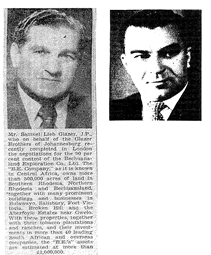
For example, a report in The Bulawayo Chronicle of 7 May 1955 on the acquisition by Glazer Brothers (Pty) Ltd of 90% of Bechuanaland Exploration Company (a former Rhodes company) put the latter company’s holdings at “more than 500 000 acres of land in Southern Rhodesia, Northern Rhodesia and Bechuanaland, together with many prominent buildings and businesses in Bulawayo, Salisbury, Fort Victoria, Broken Hill, and the Aberfoyle Estates near Gwelo”.
The report continued thus:
“With these properties, together with their tobacco ranches, and their investments in more than 40 leading South African and overseas companies, the ‘B.E.’s’ assets are estimated at more than £1,000,000.”
A schedule of principal investments included shares in companies such as African and European Investments Company, Central Mining and Investments Corporation Limited, Charterland and General, Durban Roodepoort Deep Limited, Free State Geduld Mines Limited, President Steyn Gold Mining Company, Rand Selection Corporation, South African Mines Selection Limited, West Rand Investment Trust, Western Reefs Exploration and Development Co, Rhodesian Anglo American and Pretoria Portland Cement, to name but a few.
African and European Investment Co Ltd played a major role in developing the Orange Free State goldfields during the 1950s. The 6% cumulative preference shares held by BE can be traced to 1990 when African and European Investment Co is de‑registered from the records in Companies House, London, due to the fact that the company ceased to have an office in the United Kingdom.
As can be seen, they held a substantial portfolio even then. And more importantly, they held the mineral rights to all that land.
A study of the financial records of the BE Company reveals that within a few months of having gained control of the company, the Glazers moved the registered office to Zimbabwe and, true to form in other companies acquired by them, they raised mortgages on all the properties within the company to a total value of nearly £500 000.
With this gearing they launched new developments, acquired more companies and financed the establishment of many others.
The value of his estate at the time of his passing was given as being in the region of R30 million. Having acquired companies worth some £5 million in the 1950s, this would not represent good growth over 30 years. The Blue File wished to uncover whether this was the true state of affairs or whether certain assets were hidden from his beneficiaries – his wife and children – who would have known little or nothing about the true nature and extent of his business at the time of his passing.
1.3 Making an “Invisible” Asset Disappear
Bernard Glazer did much to open up Botswana, Zimbabwe and Zambia and to provide the kind of infrastructure mentioned earlier. His involvement in the development of Francistown in Botswana is perhaps the best example.
Extensive details of his activities are available in the Blue File and will be discussed below. However, it’s important at this stage to understand the implications of the “invisible” asset of mineral rights and how they provide the spine for the claims made by the Blue File.
The Rudd Concession mentioned above was the crucial deal that enabled Rhodes to gain a Charter from the British parliament. The Charter was Britain’s colonial arrangement whereby a company that showed itself to be worthy was given the right to govern a territory on its behalf. It could collect taxes, run an army and generally turn the landscape into a private commercial enterprise.
In this way the British government could tax the profits of the colonies without having to incur the expenses of maintaining them. But more importantly, this arrangement gave the English commercial control – to the exclusion of all others – over the world’s richest mineral and metal deposits.
This changed in the latter half of the twentieth century, when public pressure forced the political face of the colonised countries to change. However, it remains to be seen whether confidential agreements ensured that the mineral rights, which in most cases were nationalised, remained under the covert control of British companies.
The information in the Blue File invites the conclusion that Bernard Glazer was a force for stability and long‑term growth in Africa through the gradual opening up of mining areas and the reinvestment of profits locally. However it would appear that his interests ran contrary to those of certain people around him.
In the third quarter of 1984, the South African rand, until then a strong and stable currency, lost nearly 13% of its value against the British pound and 19% of its value against the US dollar. This was by far the largest fall in the rand’s value since 1972. (Prior to 1972 exchange rates were fixed against the dollar.)
In the 50 quarter‑year periods from the first‑quarter 1972 up to and including the second‑quarter 1984, the rand had only lost value (quarter‑on‑quarter) against the British pound 24 times. This reflects a stable currency with the number of times it increased in value being almost the same as the number of times it decreased in value (26 vs 24). It should be noted too that this was during the years of economic sanctions against the apartheid regime, although as will be shown, many European and American banks still made millions of dollars worth of loans to the South African government during this time.
From third‑quarter 1984 up to and including fourth‑quarter 2002, the rand increased in value against the British pound (quarter‑on‑quarter) only 16 times. In other words its trend was dramatically downwards, decreasing (quarter‑on‑quarter) 58 times, or in 78% of the periods in question. Graphs in the Blue File illustrate this dramatic shift in the rand’s value.
It should be remembered that Bernard Glazer died on 17 July 1984 and it is the contention of the Blue File that for the following decade and more, his assets were systematically restructured and moved offshore. In particular, it is alleged that if any sums were paid to him or, following his passing, to his Estate in the form of mining royalties, then they were similarly redirected and, possibly, used to finance or collateralise new structures, including, possibly, an international investment bank and other international mining and property companies.
1.4 Alleged Use of Glazer Structures
At the same time, it is alleged that structures created by him were used by other groups to move vast sums of their own money offshore in advance of a change of government that they knew would happen in accordance with a predetermined plan. The Blue File has evidence of these structures as well as evidence to support this notion of a predetermined plan. The foreign exchange figures indicate that this process started immediately following Bernard Glazer’s death and some actions of his employees which are revealed in the Blue File are indicative of this urgency.