6.4 Zambia
6.4 Zambia
On 16 December 1991 Sam Glazer drafted a letter to Mr. Neil Armstrong of Armstrong Attorneys in Botswana. It read:
As discussed please find enclosed copies of the following documents:
- Title Deed Farm 157 (a) – Kafue Hot Springs (Kafue).
- Title Deed Farm 158 (a) – Sugar Loaf (Kafue).
- Title Deed Farm 159 (a) – Ninga (Kafue).
- Title Deed Farm 709 – Chanobie (Kafue). [Reinstated to Tati Co. 6 September 1999]
- Title Deed Farm 726 – Algoa (Luangwa). [Reinstated to Tati Co. 6 September 1999]
- Certificate Number 40 – Northern Rhodesia Mines Department.
- Certificate of registration of special grant number 003.
- 5 Jan. 1923: Memorandum of Agreement between BSAC and South African Townships Mining and Finance Corporation Limited
- 26 Jun. 1939: BSAC & South African Townships Mining and Finance Corporation Limited - Deed of Variation
- 27 Jun. 1939: South African Townships Mining and Finance Corporation Limited and Another to African Gold & Base Metal Holdings Limited – Deed of Assignment of Mining Rights
- Certificate of registration of special grant number 004.
- 15 Dec. 1924: Memorandum of Agreement between BSAC and Kafue Copper Development Company Limited
- Certificate of registration of special grant number 005.
- 15 Dec. 1924: Memorandum of Agreement between BSAC and Bechuanaland Exploration Company Limited
- Certificate of transfer number 2.
The above land and mineral rights were owned by the Bechuanaland Exploration Company plc (BE), an associate company, up until they were expropriated by the Zambian government in approximately 1970. BE never gave up the right to claim compensation from the Zambian government in respect of these assets. In 1988, all claims that BE had against the Zambian government, not only in respect of the above assets but generally in respect of all land and mineral rights previously owned by BE, were transferred to Tati Company Limited. (Italics author’s own.)
A formal agreement recording the transfer was not concluded between the companies. The transaction was effected by means of journal entries in their respective financial records. The transfer was made in contemplation of the anticipated members voluntary liquidation of BE, which was commenced in 1989.
Please find attached a draft memorandum of agreement between the two companies. Could you advise whether such an agreement should be entered into and if so, whether the wording contemplated is correct? Furthermore, your advice on how to proceed with the claims and/or the reinstatement of the assets would be appreciated.
Yours sincerely
for: TATI COMPANY LIMITED
SAM GLAZER
DIRECTOR
The relevant section of the draft memorandum referred to in the above draft memorandum read as follows:
Draft Memorandum of Agreement between Tati Company Limited and B.E.
It has now been agreed:
- That BE cedes, for a nominal amount of Z$2, to Tati all its rights to claim from Government compensation in respect of the assets and/or the return of the assets.
- That this agreement shall cover any other assets previously owned by BE and subsequently expropriated by Government.
It is noted that the shareholders of BE and Tati are to all intents and purposes the same.
The semantics of this memorandum are important: Sam stated explicitly that in 1988, ‘all claims that B.E. had against the Zambian government, not only in respect of the above assets but generally in respect of all land and mineral rightspreviously owned by BE, were transferred to Tati Company Limited’ (author’s emphasis). The first implication of this sentence is quite clear: BE also held other land and mineral rights in Zambia and ‘not only’ the assets mentioned in the memorandum. The second implication is ambiguous: it clearly states that BE had ‘previously’ owned other land and mineral rights; however it’s not clear whether this statement implies that they are now owned by Tati, or that they are now owned (were expropriated) by the Zambian government.
Above all, one must bear in mind that Bechuanaland acquired all the rights and entitlements for the Northern Copper (BSA) Company on 28 September 1914.
The financial statements of BE stated consistently from 1970 onwards that ‘three farms’ belonging to the company had been expropriated. Presumably these were the same three farms that Sam referred to in his 1992 memorandum. This would also imply that whatever other land and mineral rights BE had held was not expropriated; they were transferred to Tati Co.

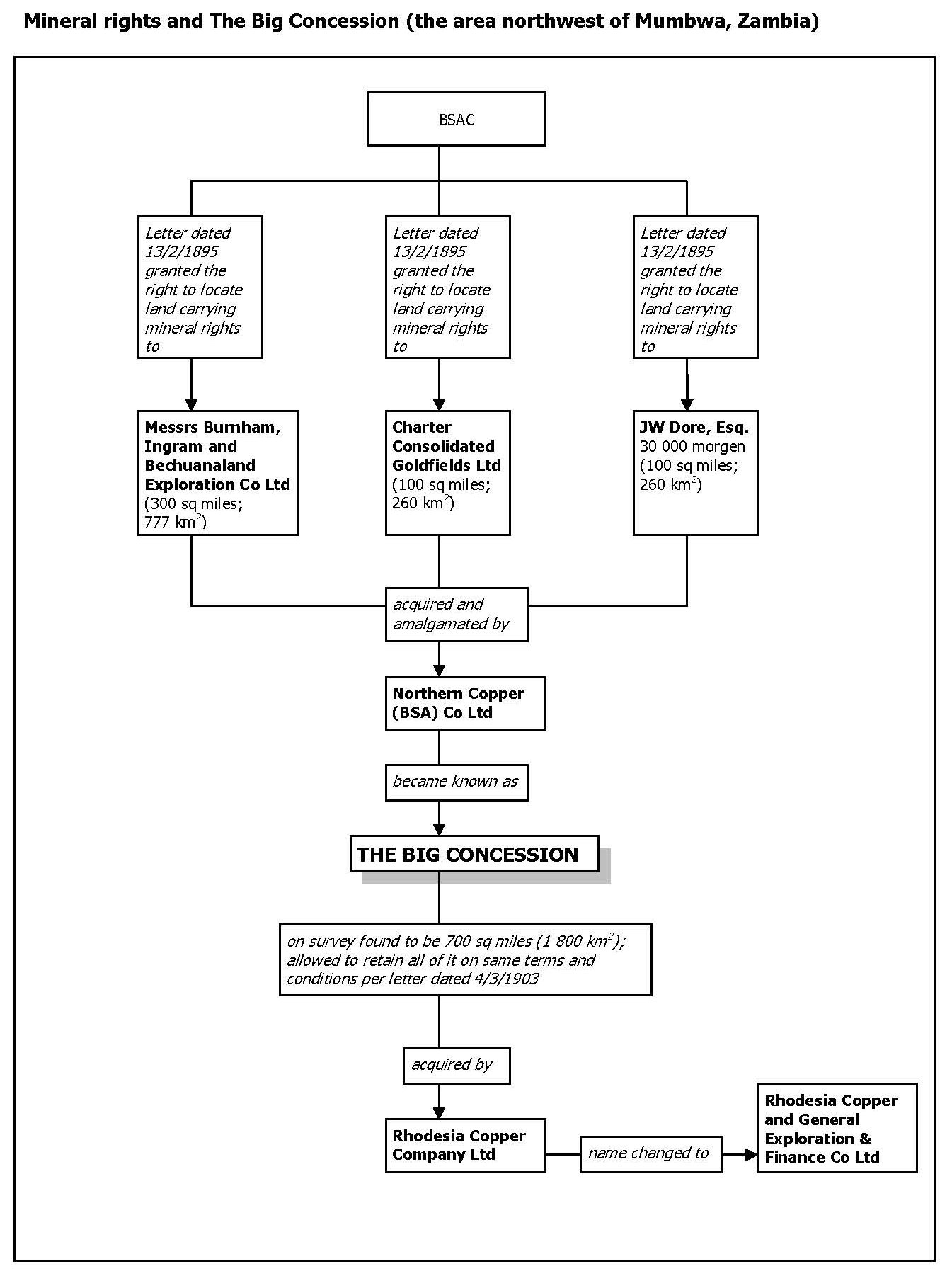
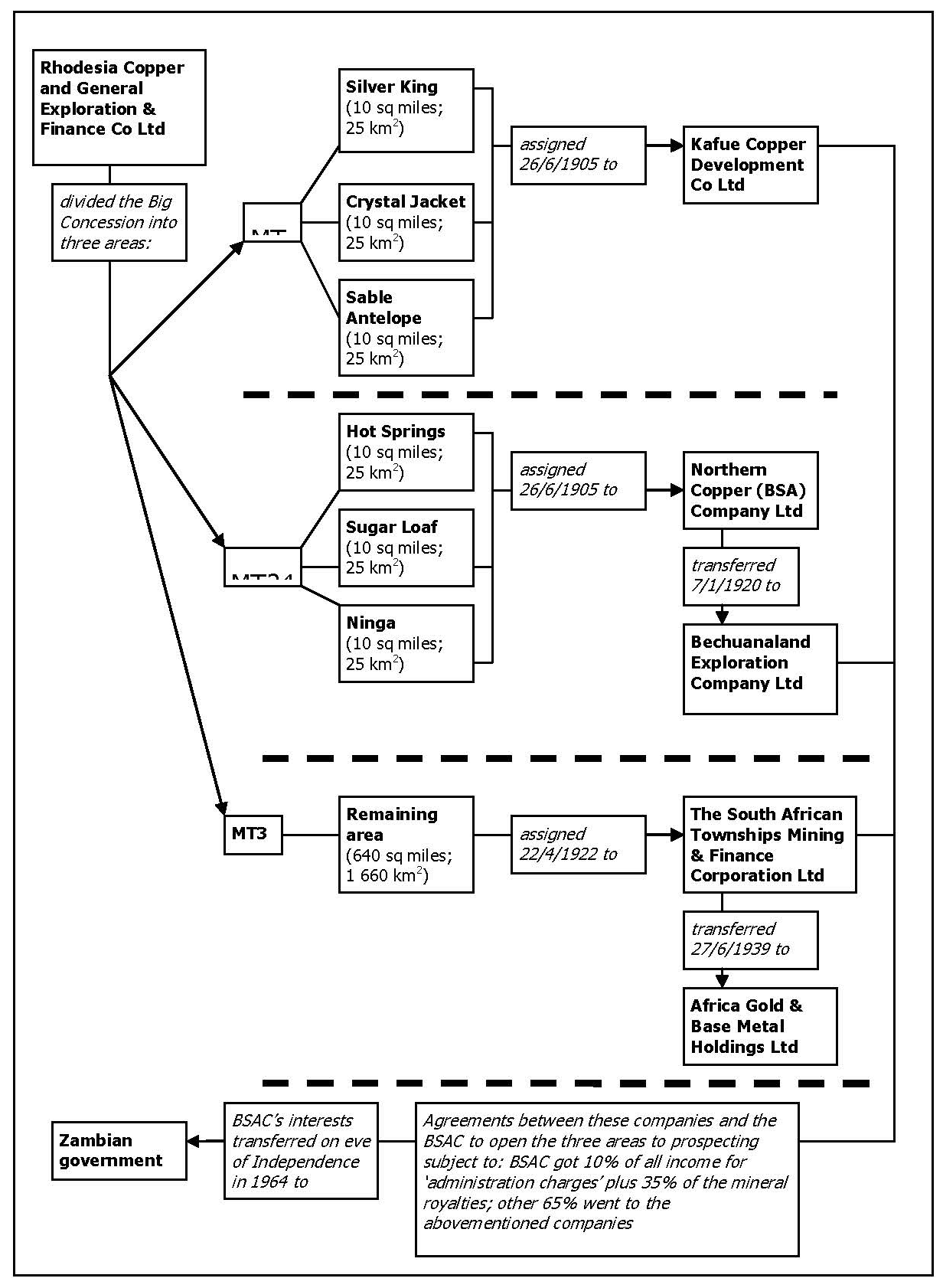
Although Kafue, Sugar Loaf and Hot Springs – the three farms mentioned in the memorandum – were described as farms, they were in fact mineral areas; each covered an area of 10 square miles, or 25km2; together they formed a single mineral area which was identified as MT24. Combined with two other mineral areas (MT3 and MT4), it was part of a much larger mineral area called the Big Concession (see map). Situated a few miles northwest of a town called Mumbwa, the Big Concession was a triangular piece of ground that covered 700 square miles (1 800 km2). It originated from three separate grants made by the British South Africa Company in 1895; these three grants were amalgamated then subdivided and, by 1922, had been assigned to three different companies: Kafue Copper Development Co Ltd; Bechuanaland Exploration Co Ltd; and The South African Townships Mining & Finance Corporation Ltd. (The South African Townships Mining & Finance Corporation Ltd transferred its rights to African Gold & Base Metal Holdings Ltd in 1939.)
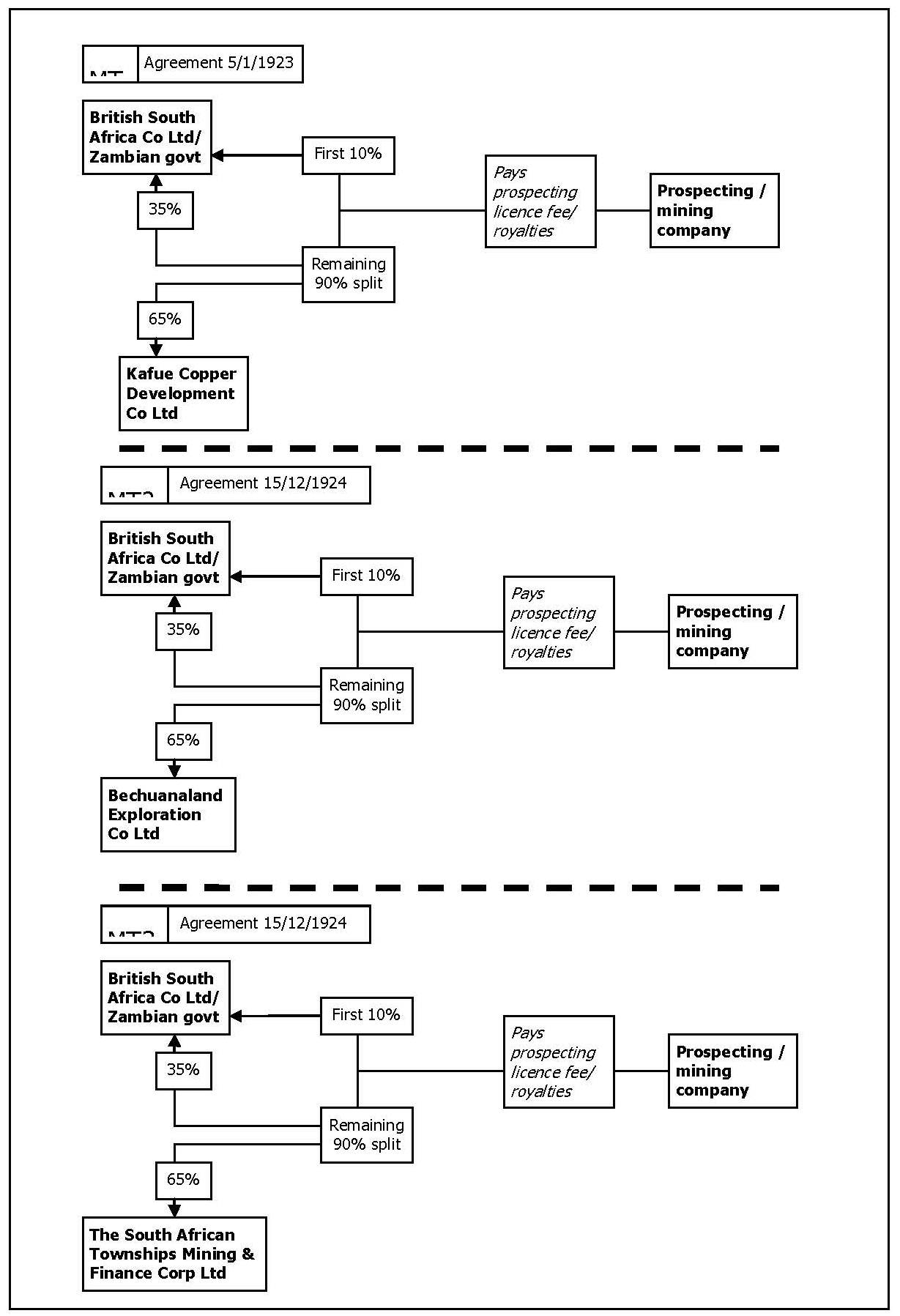
These companies in turn did deals with the BSAC whereby each one opened the area under its control to general prospecting; the BSAC got the first 10% of any licence fees or royalties received for so-called ‘administration charges’; it also got 35% of the remaining 90%; the assignee company got the other 65% (see Appendix A: Flowcharts). However, according to a geological report (No 27) on the area completed in 1968 ‘no mining [was] undertaken in the Big Concession [from] about 1923, apart from the working of the dumps at Sable Antelope during 1952 and the period 1955-6’.
According to the abovementioned geological report, the BSAC’s interests in terms of the above agreement ‘were transferred to the Government of the Republic of Zambia on the eve of Independence in 1964’.
A government White Paper on ownership of mineral rights in Northern Rhodesia, as it was then known, was issued in that same year and stated that £135 million before tax (£70 million after tax) had accrued to the BSAC by that time; the BSAC received £40 for every ton of copper mined. It estimated that if the private ownership of mineral rights continued the company would receive between £7 million and £12 million a year after tax for the next 22 years, until 1986; the national budget for African (meaning black) education at the time was £3 million. Why 1986? It turns out that an agreement had been signed in 1950 whereby the BSAC would give the state a 20% cut of its share of the royalties until 30 September 1986; thereafter the company’s entitlement to royalties would be transferred entirely to the state. On the surface, therefore, the date of this transfer of royalty interests was brought forward by 22 years as a result of the country gaining its independence.
This is further confirmed in South Africa Inc.: David Pallister, Sarah Stewart, Ian Lepper which states:” Anglo had first invested in the Rhodesian copperbelt (most of it in present-day Zambia) in 1924. This was the same year in which Cecil Rhode’s B.S.A Company transferred its 30 year old administration of Northern Rhodesia to a legislative council that excluded Africans. After Anglo incorporated its Rhodesian holding company, Rhodesian Anglo American (Rhoanglo), in London in December 1928…” “The lineage began as far back as 1928, when Rhoanglo was formed in London to finance the expansion on the copperbelt. It moved to Zambia in 1954, and ten years later was renamed Zambian Anglo American (Zamanglo) when the country acquired its independence. In 1970, when the new government took 51% of the company, it was transferred to the tax haven of Bermuda to receive the compensation monies in the form of dividends from government bonds. Four years later, it was renamed Minorco and was soon to overtake Charter as the group’s overseas flagship. The two big copper mining companies, Anglo and the US firm AMAX, had sent £260 million out of the country in dividends, interest and royalty payments during the previous ten years. The B.S.A Company had received £82 million net for its mineral royalties from 1923 to 1964. Over the same period, the British Treasury received £40 million in taxes, in part because the mining companies were based in London until the 1950’s.”
It’s also not made clear whether the other parties to the contract – Kafue Development Company, BE and African Gold & Base Metal Holdings Ltd – were made to give up their ownership – and consequent share of the royalties – in every instance or only in some.
The arguments presented for the nationalisation of mineral ownership in the 1964 White Paper were simple and compelling: Firstly, a private, UK-registered company controlled the country’s most valuable resource – and one that was exhaustible to boot. Surely any decisions to exploit this resource should be made by the government on behalf of the people of the country. And, more to the point, surely Zambia and not some other country should benefit financially from its resources. Apparently, by 1964 the BSAC had only reinvested about 10% of its total gross royalty receipts in Zambia and its Zambian portfolio represented only one-fifth of its total investment portfolio.
The original or founding agreements were struck between the emissaries of Cecil John Rhodes and various African tribal chiefs or kings during the late nineteenth century; the African chiefs granted Rhodes ownership of the minerals in exchange for a few hundred pounds a year, maybe some guns, possibly a steamship patrol for protection, and invariably the promise of education and other trappings of ‘civilisation’. The agreements took the form of letters addressed to the company, drawn up on behalf of the illiterate chiefs by Rhodes’s lawyers who used deliberately ambiguous language that failed to draw a clear distinction between the British Crown and the company. Rhodes in turn waved these letters in front of the British prime minister, Lord Salisbury, and gained a Royal Charter, signed by Queen Victoria on 29 October 1889; the Charter gave the company immense powers to ‘make treaties, promulgate laws, preserve the peace, maintain a police force and acquire new concessions’. Essentially, it could run the colonies like a government but make profits as a private company. Rhodes’s model was the highly profitable East India Company which had done the same thing in India a century before. In both cases Britain enjoyed the fruits of control over vast natural and human resources without incurring any direct costs other than the occasional military intervention. The BSAC became known as the ‘Chartered Company’ and incurred the costs of running and developing the country.
According to the 1964 White Paper, the British government took over the administration of both Southern and Northern Rhodesia from the BSAC in 1923. The company agreed to drop its claim of a £1,6 million administration deficit in exchange for ‘half the revenue from certain future land sales’ and recognition of the company as owner of all Northern Rhodesia’s mineral rights in perpetuity. As various Englishmen argued in disgust at the time, the British government effectively gave away the mineral rights of an entire country to a private company, registered on its (Great Britain’s) own shores, without consulting the people of that country. The White Paper even implied a certain degree of complicity between the British government and the company in maintaining the status quo after it had been challenged publicly on numerous occasions and accused of having its own narrow financial interests ahead of those of an entire nation. It alleged that by the time of independence the British government had allegedly earned some £12 million in taxes on the royalties earned by the BSAC.
RhodesiaBroken Hill
The Rhodesia Broken Hill was formed by the Rhodesia Copper Company and registered in London on 30 November 1904. The authorised capital was £550,000, in shares of £1 each. The first board of directors consisted of Edmund Davis, Rt. Hon Lord Gifford, Rt. Hon Lord Teynham, C.H. Villiers, Sir Albert Markham, H.W. Fox and P.C. Tarbutt. On 1 July 1929 the Company was granted a lease over 64 square miles adjacent to the Mulunghushi River. It financed these developments by increasing its capital to £1,000,000 in 1923 and doubled it two years later to extend the Mulungushi scheme and erected a large zinc and vanadium plant. In 1925 Anglo American Corporation of South Africa was appointed as the consulting engineers. This contract was terminated in 1931 at the time when the world-wide depression was at its worst. In 1936 the Company was reconstructed with an authorised capital of £3,500,000 of which £3,250,000 was issued in 13,000,000 shares of 5s each.
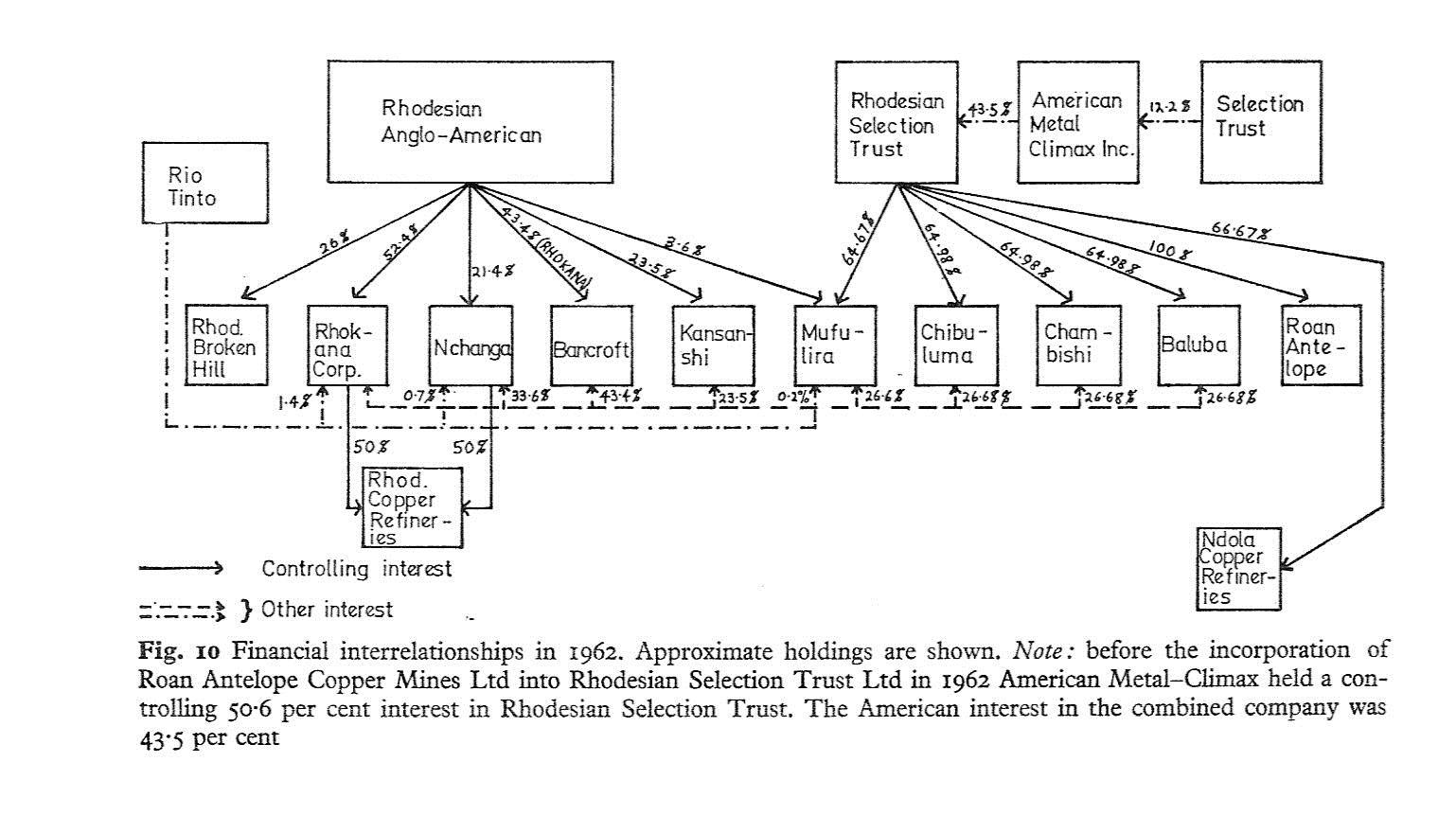
The annual report for BE for the year ended 31 March 1937 stated:’ Rhodesia Broken Hill: The operations of the Rhodesia Broken Hill Development Company Limited during the year ended 31st December 1936, resulted in an output of 20,730 tons Zinc, 179 tons fused vanadium oxide and 1,250 tons of vanadium concentrates. The Company recently increased its Capital upwards of £560 700 has been provided for development and equipment of the Mine to a greater depth to further the exploitation of the sulphide ores. The future management of the undertaking has been transferred to the Anglo American Corporation of South Africa and a profitable future is anticipated.’ Rhodesian Anglo-American formed part of the list of ‘principal investments’ acquired by the Glazer Brothers in 1955. Below find a diagram of the financial interrelationships in 1962.
The annual report for BE for the year ended 31 March 1973 stated that, ‘Claims for compensation [for the three farms which had been expropriated] have been lodged through the Foreign and Commonwealth Office in London and the directors anticipate that adequate compensation will be received.’ According to Sam’s 1992 memorandum, however, such compensation was never received. This is not to say that there were no agreements over other portions of land held by BE and any other companies which had been assigned land by the BSAC. Subsequent writings make no mention of any agreement between the government of Zambia and companies with claims to mineral rights ownership. Rather they make it emphatically clear that the ownership of minerals in Zambia reverted to the state with independence. For example a publication by Muna Ndulo called Mining Rights in Zambia (ISBN 9982-01-001-8) states emphatically that, ‘the property in all minerals within Zambia is vested in the President on behalf of the people of Zambia’. However, the question remains whether a deal was done behind the scenes to the satisfaction of all parties.
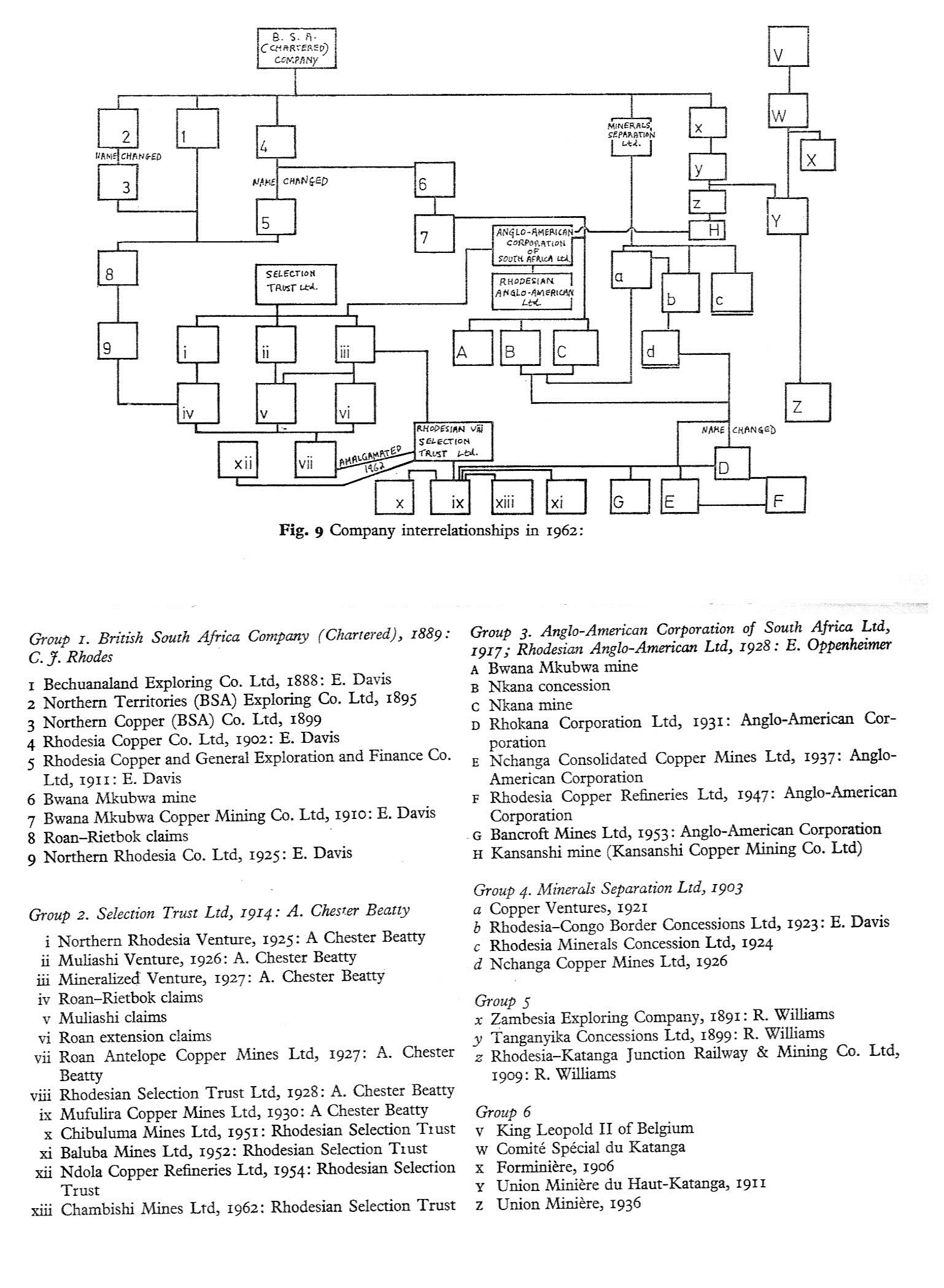
COMPANY INTERRELATIONSHIPS IN 1962

Next => Conclusion