SAM ESTATES LAND COMPANY
SAM ESTATES LAND COMPANY
On 10 May 1988, certificates of incorporation were issued for two new companies registered in Botswana: Sam Estates Land Company Ltd and Sam Estates Holdings Ltd; the registration fees for these two new companies were paid by Tati. Six months later four portions of land were transferred from BEC to Sam Estates Land Company. These were described as Portions 1, 2, 6 & Remaining Extent of Farm 77NQ. The purchase consideration was P312 000 (about R400 000). Sam Estates Holdings owned 99 out of the 100 issued shares in this company; Tati owned the other share. Two shareholders held shares in Sam Estates Holdings: Tati Company Limited held 49 shares; the remaining 51 were held by Hermanus Christoffel du Plessis.
An extraordinary item was reflected in the accounts for the Bechuanaland Exploration Company for the year ended 31 March 1985. It was an amount of P431 659 and came from ‘profit on the sale of land in Botswana’. It’s not known what land was disposed of nor to whom it was sold, only that it was jettisoned from the BEC portfolio within the same financial year of Glazer’s passing. Fixed assets for that year were listed as ‘Land, certain farm improvements, mineral rights, and unlisted investments…’ By 1987 the net book value of the fixed assets of BEC and its subsidiaries was given as $166 643, down from $173 886 the year before (and before that?). A loan of $1 769 400 from Embassy Investments (Pty) Ltd – ‘a company controlled by the administrators’ – was recorded. Embassy Investments owned a building in Johannesburg and had a subsidiary called Katlani Diamonds.
On 29 June 1988 the swath of mortgages taken out by Sam and Bernard Glazer in 1955 to the value of £417 500 was repaid in full.
On 17 April 1989, less than five years after his father’s passing Sam Glazer presented to Louise Vosloo, Notary Public – at Werksmans Chambers in Johannesburg – a statement of voluntary liquidation for BEC. The statement listed the value of marketable securities as being worth £1; balance at bank was listed as £724 852; debtors, as £606 372; and estimated realisable value of assets, as £1 331 225. Less a few creditors and costs, the estimated surplus was £1 242 974 (equivalent at that time to R5 383 196). Under remarks it was stated that the company operated ‘solely in Zimbabwe’.
Two weeks later, at an extraordinary general meeting held in Bulawayo, a special resolution was passed to wind up the company voluntarily. David H. Gilbert, ACA of Levy Gee & Partners in London was appointed as the Liquidator in the UK; HE Bloch & Co was the liquidators in Zimbabwe. On the official forms, the nature of the company was listed as ‘Cattle farming and property owners.’ The mineral rights had taken a left turn in the intervening period and disappeared.
Shutting up shop was not what Bernard Glazer had had in mind: In his will he’d directed his administrators to ‘endeavour to purchase any shares offered for sale to them’ in BEC, excluding those held by his niece – his late brother Sam’s daughter – Lorraine Munitz of Cape Town. Of course, they would argue that things had changed since he’d drafted his will: Nelson Mandela was out of jail; the ANC would soon rule South Africa; the last domino was about to fall; it was time to get out.
But while they’d cleaned up the assets in a hurry, there seemed to be no urgency to conclude the winding up of the company: The official liquidator’s statement submitted one year later said the winding up could not be concluded because of ‘assets not realised (administration of case being carried out in Zimbabwe)’; the period within which winding up was expected to be completed was given as ‘Uncertain’. The same information was submitted in the Liquidator’s Statement of 5 November 1990 and has been repeated with slight variations ever since! Another favourite has been, ‘Awaiting UK and Zimbabwe tax clearance.’ To date, the company has still not been wound up and the chaos in Zimbabwe has provided a convenient cover for the delay. The Glazer estate is due to close in July 2004; it’s apparent that for some reason this date has to pass before the final nail can be driven home.
But that was a long way off in 1989. The first target for the administrators appears to have been the first disbursement of Bernard Glazer’s estate. In terms of his will, this was to take place when Sam turned 30; the target date for any orchestrated cleanup would therefore have been July 1994; the main objective may have been not to let any of the real assets slip into the hands of Michele, perhaps because they felt they could not control the way they’d managed her younger brother.
In October 1992, shortly after he’d drafted the memo to his managers expressing his concern about royalty calculations, Sam transferred all 2 300 shares held by the estates of the late Bernard Glazer, Sam Lieb Glazer, and Sam and Bernard Glazer in Glazer Bros Investments (Zimbabwe) Ltd into his name. This was in direct contravention of paragraph 6.2.2 of Bernard Glazer’s will, which expressly precluded his administrators from purchasing or otherwise acquiring assets which his niece Loraine Munitz ‘has acquired or will acquire’ from the estate of the late Sam Lieb Glazer, her father, and precluded his administrators from acquiring any shares in Glazer Bros Investments (Rhodesia) (Private) Limited, as it was then known. Glazer Bros was the holding company for Tati and BEC.
It was at this point that Sam opened discussions with the Botswana government in terms of their breach of the 1970, 1972 and 1981 Agreements that finally resulted in a settlement of P16, 711,431 in November 1993 and a further P13, 746,749 in November 2000, a total of P30, 458,180. One must take into account that the total amount received as compensation, for relatively small pieces of land exceeds the book value for the entire Tati Company property portfolio, which is reflected at a net value of P17, 202,462 in the Bernard Glazer Will Trust Financial Statement for the year ended 29 February 1996.
Note 5.3 to the financial statements of Tati for the year ended 28 February 1994 read: ‘This exchange has been finalised till 24 November 1993 and has resulted in the receipt of compensation from Government. Further commercial, industrial and residential land will be received from government as and when it develops the balance of the land acquired from the company and will be brought to account on receipt of such land.’
Another action designed to benefit the administrators took place in the Tati boardroom in Glasco House, Johannesburg, back in 1989, right around the time that the resolution was passed to put BEC into voluntary liquidation: A special resolution was passed to change Article 57 of the Articles of Association; this change made it possible for the directors of Tati to borrow in excess of R3 million; in fact, there would be no limits to how much they could borrow.
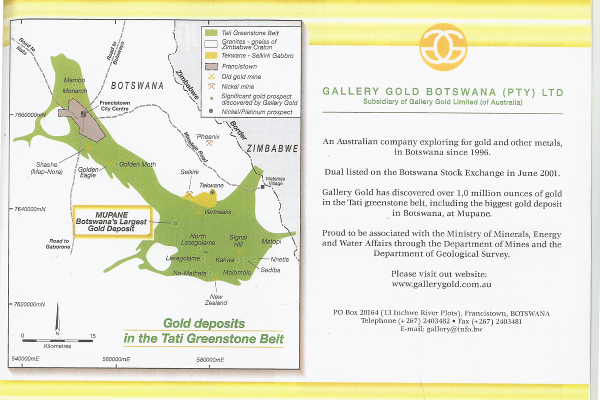
So, what happened to the mineral rights? A court action will illuminate their exit trail, but here’s a clue: The biggest gold mining operation in the history of Botswana is planned to come on-stream in August 2004 – the month after the Glazer estate closes.
It covers a few thousand acres of the very same land over which mineral rights were once held by Bernard Glazer through Tati Company Ltd.
Francis Prospecting was incorporated on 5 July 1994 [coincidently the day the first tranche of the Trust was due] and changed its name to Gallery Gold on the 9 September 1999.
In 1994 Gallery Gold purchased the then operating Monarch Gold Mine on the outskirts of the city Francistown. The Company conducted small-scale mining operations at Monarch and at the nearby Golden Eagle and Shashe leases until mid 1998. In 1996 it was recognised that the surrounding greenstone belts had good potential for the discovery of significant gold discoveries and the Company considerably increased it tenement holdings. Gallery has built a large and strategic land holding in Botswana and currently has a controlling interest in tenements totalling approximately 1,825 square kilometres and covering some 90 % of the Tati and Vumba greenstone belts.
In late 1997 Lion Selection Group, a Melbourne-based pooled development fund agreed to provide ongoing finance to the Company for a major gold exploration program. As a result, Lion Selection has become a major shareholder with a 44 % interest in the Company. In December 1999, Lion Selection Group invested a further $2 million in Gallery Gold Limited, taking its interest to 49 % for $4.6 million total investment. The funds raised are part of a rights issue and will be used for gold exploration in Botswana.
To trace the journey of those mineral rights every step of the way would be critical to establishing who the beneficial holder is and whether his daughter Michele is entitled to any of the royalty payments. It would also unlock the door to the ownership of mineral rights over other areas of Botswana and Zimbabwe and would go a long way towards exposing the control of Africa’s wealth, which is managed almost entirely through the esoteric subject of mineral rights ownership.
Next => 6.4 Zambia