THE BACKGROUND- David Guyatt 2003
THE BACKGROUND - David Guyatt 2003
Beginning in 1988 and lasting until approximately 1992, Project Hammer was the latest in a series of highly secretive banking practices – known as collateral trading programmes – that are used to create, as if by magic, huge amounts of unaccountable funds for use in specific projects.
These vast pools of unvouchered slush funds are applied to finance a wide variety of clandestine activities that include secret military projects, geo-political requirements and the development of infrastructure projects.
It is also whispered that in the case of the Project Hammer programme at least, that a percentage of the proceeds generated from this secretive activity found their way into the pockets of VIP’s and well-known politicians. Names associated with such corrupt behaviour are carried on the wind but if one listens attentively the names George Bush (senior) and Jim Baker III are just discernible - to the trained ear.
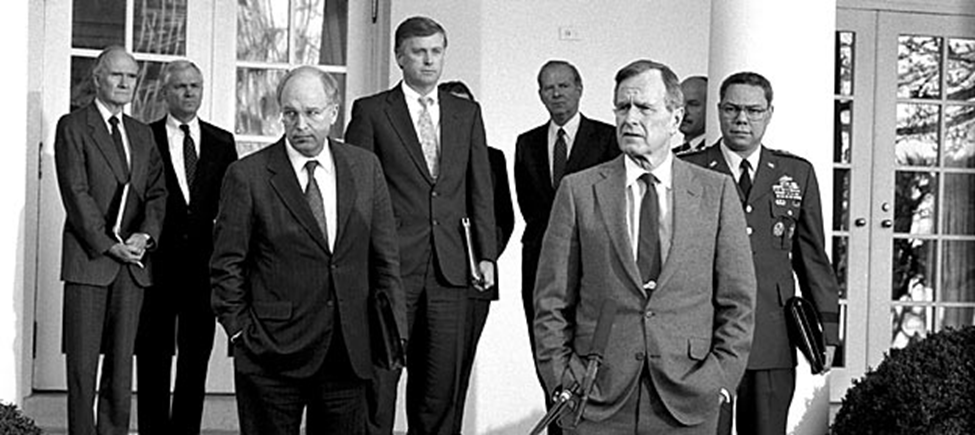
David Hume Kennerly / Getty Images
Supporting Cast: Bush 41's national-security team, in 1991. From far left, Scowcroft, Gates, Cheney, Quayle, Baker, Bush and Powell.
An example of the types of projects that these funds are expended on, was the trading programme known as E F G Jacobi – a predecessor of Hammer – that was, I understand, used largely to finance military facilities and related operations at the top secret US “Pine Gap” base located near Alice Springs, in Australia.
In order to maintain secrecy that surround genuine activity, these trading programmes are routinely said not to exist. Enquiries about them are deflected and attention is, instead, focused on the warnings issued by government agencies about fake programmes. This, when combined with the numerous prosecutions that occur every year of fraudulent High Yield Investment Programme transactions, serve to create the impression that authorised programmes do not occur.
The reasons for this deflection are many but not least is the fact that the asset base on which these programmes usually operate are also said not to exist – at least in the quantities that they actually do. The assets in question are large volumes of gold and lesser amounts of platinum plundered by the Nazis and Japanese during WWII.
The fact that gold has been the one stable commodity used to back and support the issuance of currency over the decades, means that it has been subject to considerable government and central bank secrecy. It was only in 1997, that the Bank of England decided to lift this veil of secrecy and allow the London bullion market a degree of openness. But that openness did not include coming clean about the true amount of gold in existence that is far larger than official figures allow.
Because of this and the extremely covert nature of related trading programmes, comprehensive details of their operations and the financing techniques employed have remained hidden from public view. This, at least, was the case prior to the publication of part one of this series The Project Hammer File[1]. Further examination of the techniques and activity of Project Hammer represented by this essay, now places into the public domain additional important material.
Project Hammer remains a high level state secret in a number of countries including the USA. This was de facto confirmed by the CIA in its refusal to release any relative information following to my Freedom of Information Act request. The exemption used by the CIA to reject my request was that relative material is “properly classified pursuant to an Executive order in the interest of national defence or foreign policy.”[2]
Project Hammer also stands out because proceeds from the trading activity were illegally diverted by major banks. Confirmation of this was provided by Brigadier General Erle Cocke in his April 2000 affidavit. In this, General Cocke was asked about the involvement of former US Treasury Secretary, Lloyd Bentsen, who was retained to investigate what had happened to (and to also recover) the missing funds. Asked if Bentsen “had the government’s interest in closing this whole problem, have you ever had a discussion [with Bentsen],” Cocke replied.
“Many hours just trying to find out whether any agency, any group, Federal Reserve, Treasury, CIA, FBI, security agencies, and so forth, all of them put together whether any of which would really like to finish. And, quite frankly, nobody stepped up to the plate.”
Cocke was the asked if “…they would like to finish it?” and responded:
“I think they would like to finish it, but they all back away. It is not my cup of tea, or they have spent enough time with it and are not going to realize anything, and therefore they just quit. They don’t confirm, they don’t deny, they just stop.”
One can conclude that the banks that diverted this money, were too powerful for any agency of the US government to tackle. Providing suitable and substantial “incentives” to former senior Bush Administration figures to bring their influence to bear quietly to ensure that action against the banks was not taken, also helped.
Although not part of the sanctioned plans for Project Hammer - which was to generate funds to pay off debts on bullion certificates issued by certain metal trusts – the funds were siphoned-off surreptitiously to rescue numerous major US and other banks that were, by the latter half of the 1980’s, tottering on the brink of bankruptcy.[3]
The banks only had themselves to blame for their imminent collapse. Reckless lending to Third World nations for over a decade or more when combined with the raw greed of senior bank executives had caused unparalleled damage to the worlds banking system. The inability of indebted Third World nations to repay their massive debts could have been – in fact was – foreseen but ignored.
The spiral of gluttony had taken prisoner the faculty of prudence and reason as bank executives, seeking their next bonus and promotion, pleaded with sovereign nations to take loans they did not need and ultimately could not repay. Nor was it unusual for some of the loaned funds to find their way into the private bank accounts of corrupt state officials – “diversions” that were known about in the boardrooms of the top banks, but ignored as “business as usual.”
By the end of the 1980’s big banks including Citibank, Chase Manhattan, the Hongkong & Shanghai Banking Corporation, England’s Midland Bank and many, many others were in dire straits. In all but name they were bankrupt. The fear of a prolonged series of collapses – a sort of “domino theory” of finance - of the worlds top banks was regarded in some quarters with palpable fear; the entire western banking system was rocking when it should have been rolling along nicely.
Somewhere, someone – nobody knows who (or at least no one is saying) took the decision to bail out the banks and save the banking system by diverting Project Hammer funds for this purpose. Those banking executives who caused the problem in the first place weren’t confronted by their mistakes or held to account by their shareholders but instead continued to collect their million dollar pay cheques, boost their bonus payments and profit shares, flick ash off their Cuban cigars, quaff bottles of expensive Cheval Blanc and slap each other on the back in delighted relief. One of those sighing relief was almost certainly Citibank’s John Reed. Another quite likely to have also been cultivating a quiet exhalation was Hong Kong & Shanghai Bank boss, Sir William Purvis.
Meanwhile many investors who had placed their money into Project Hammer in return for an agreed profit as well as all those middle-men who had worked hard for their promised commission, were relieved of their money in a twisted version of the well known axiom: one man’s loss is another banker’s gain.