STEALING FROM THIEVES
STEALING FROM THIEVES
The sanctioned purpose of Project Hammer was of a MacroEconomic nature.
Which is a nice way of saying that it was all to do with “repatriating” assets stolen earlier by someone else.
However, when nations steal valuable assets during wartime it’s called “plunder”.
But when the victors in that war grab those same assets they call it “recovery.”
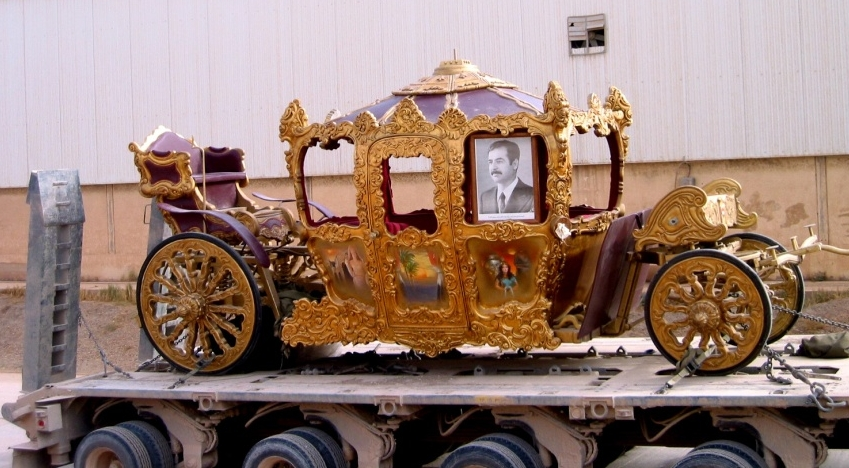
@*@Figure 1 -@@ Saddam Hussein's Gold Chariot*The assets in question were a vast horde of gold and lesser quantities of platinum – plus not inconsiderable volumes of loose gemstones – that had been grabbed by the Nazi’s and the Japanese during WWII.
Large volumes of this loot found their way to the Philippines where they were hidden in numerous treasure sites by the Japanese occupiers who planned to recover them after the war.
But it didn’t quite work out the way the Japanese had planned.
They lost the war along with the Philippines, that, it seems, they were fairly confident they would be allowed to keep in a negotiated truce with the Allies.
In their place the OSS – the wartime forerunner of America’s spy agency the Central Intelligence Agency (CIA), began recovering the bullion plundered from a dozen or so nations.
This bullion formed what became known as the “Black Eagle” fund, which was part of a secret agreement eclipsed behind the 1944**Bretton Woods Agreement**.
Consequently, the metal was placed under the care of OSS (and later CIA) operative, Severino Garcia Santa Romana, who put it under the control of numerous corporate entities he formed for the purpose.
These entities, in turn, proceeded to establish 176 bank accounts in 42 different countries in which to deposit these assets under private treaty agreement.
Confirmation for this comes from General Cocke who was asked: “I have been advised that a chunk of the Hammer Project funds that were used to trade, to invest and reinvest, came from a large block of assets that CIA put into the bank [Citibank]?”
Cocke replied: “And they pulled that several times from several sources. Nobody is going to confirm it.”[4]
Following Santa Romana’s death in 1974, his former attorney and trustee was able to “acquire” considerable portions of Santa Romana’s estate by illicit means. The lawyer was Ferdinand Marcos who went on to become president of the Philippines and a favourite friend of the United States until his overthrow in 1986. The acquisition of these assets helped give rise to stories of “Marcos gold” – a legend that was supplemented by additional later recoveries of WWII gold and other loot using a Filipino Army Battalion under the overall command of Marcos henchman, General Fabian Ver.
But Marcos was not the sole illegitimate beneficiary of war loot once controlled by Santa Romana. Another was the late Baron Krupp who, I have been told, also gained access to some of these assets.
Meanwhile, it is worth mentioning that Santa Romana, prior to his death, was apparently associated with former US president and head of the CIA, George Bush, and “had some contact” with Jeb Bush, the governor of Florida.
In any event, this bullion has, collectively, given rise to a whole class of gold and platinum certificates issued over the decades, mainly by top-drawer European banks. The certificates bear the names of prominent, and in some cases infamous individuals – usually heads of state – as beneficiaries. But these named owners were and are not the legal beneficiaries but rather were cat’s paws used to muddy the waters concerning the true origin of the bullion. Nor did the banks that held the assets own them but they could and did use them in support of their off-balance sheet activity - to the point of irresponsibility.
It should not be forgotten that this gold and platinum was stolen and under international law every effort should have been made to return it to its rightful owners – rather than secretly stash it in bank vaults for use in cold war covert operations. And although it can reasonably be argued that the true owners could never be traced, since the greater quantity of the bullion was privately owned (rather than being central bank bullion), it is clear that the ends dictated the means.
And even though numerous nations around the world were to benefit from post war reconstruction based on the use and application of this war booty, the price of this apparent largesse was for these nations to be moulded into Uncle Sam’s image. As they say in American boardrooms, there is no such thing as a “free lunch.”
In examining the techniques employed in setting up Project Hammer, one is struck not just by the complexity of it but also by the way the banks and intelligence agencies involved structured things to shield themselves from responsibility (and lawsuits no doubt) by utilising subterranean networks each working at “arms-length.”
Piecing these techniques and networks together has been an arduous, painstaking task but in doing so it further unveils a shadow world of parallel finance usually only known to those initiated into it.