Maalde
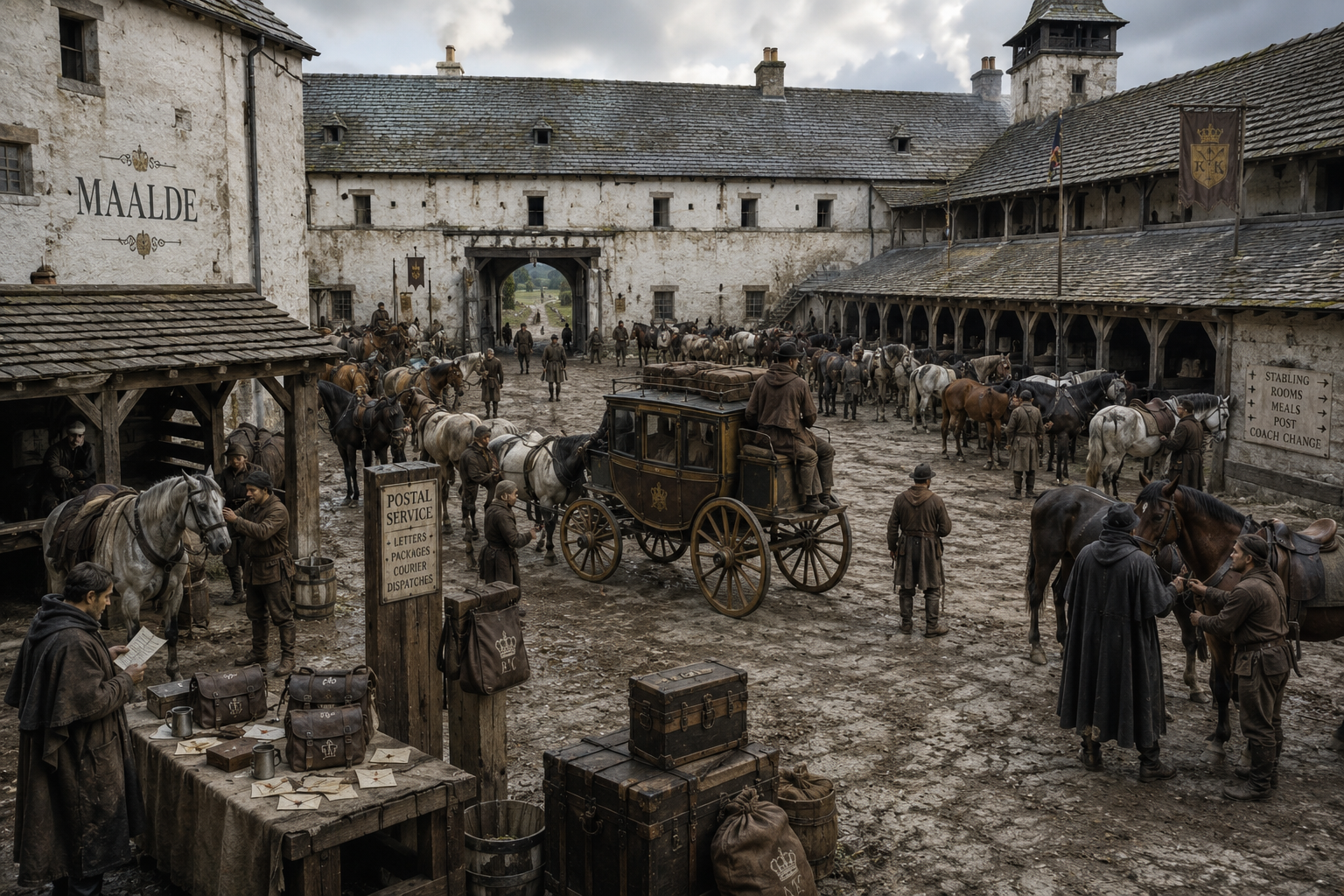
The Maalde is what happens when a kingdom realizes roads are more important than castles.
Not romantically. Not symbolically. Logistically.
A castle projects authority over land already possessed. A Maalde keeps the arteries open. Grain moves. Couriers move. Tax silver moves. Legionaries move. Nobles move. Priests move. Information moves. Without the Maalde system, the Kingdom fragments into damp little valleys full of mutually suspicious peasants and local strongmen pretending the King is far away.
So the Maalde exists less as a tavern and more as an organ of state infrastructure disguised as hospitality.
You usually see the walls first.
Not towering fortress walls, but thick practical masonry, limewashed or darkened by rain depending on region. High enough to discourage bandits, desperate refugees, drunk mercenaries, and wolves. The gate is often reinforced oak bound with iron, and unless the road is considered exceptionally safe, somebody armed watches arrivals carefully from either the wall walk or a narrow gatehouse slit.
There are always horses.
Not a few horses. Horses everywhere. Draft teams steaming in cold weather. Nervous courier mounts. Pack mules. Military remounts. Merchant geldings with rubbed flanks. Expensive destriers attended like minor royalty. One smells horse before entering properly: dung, leather, oats, sweat, liniment oil, wet straw.
The stable complex matters almost more than the lodging itself.
A good Maalde is judged first by whether your horse survives.
Within the Kingdom, particularly along the King’s Roads linking Muoran, Ashillas, Dulmar, Aerond, Begoth, and the richer interior circuits, the Maalde network functions almost like a circulatory relay. Fresh mounts can be hired for official dispatches. Coaches rotate teams. Postal satchels change hands under seal. Military riders arrive at impossible hours and depart fifteen minutes later under torchlight.
Everything is organized around movement.
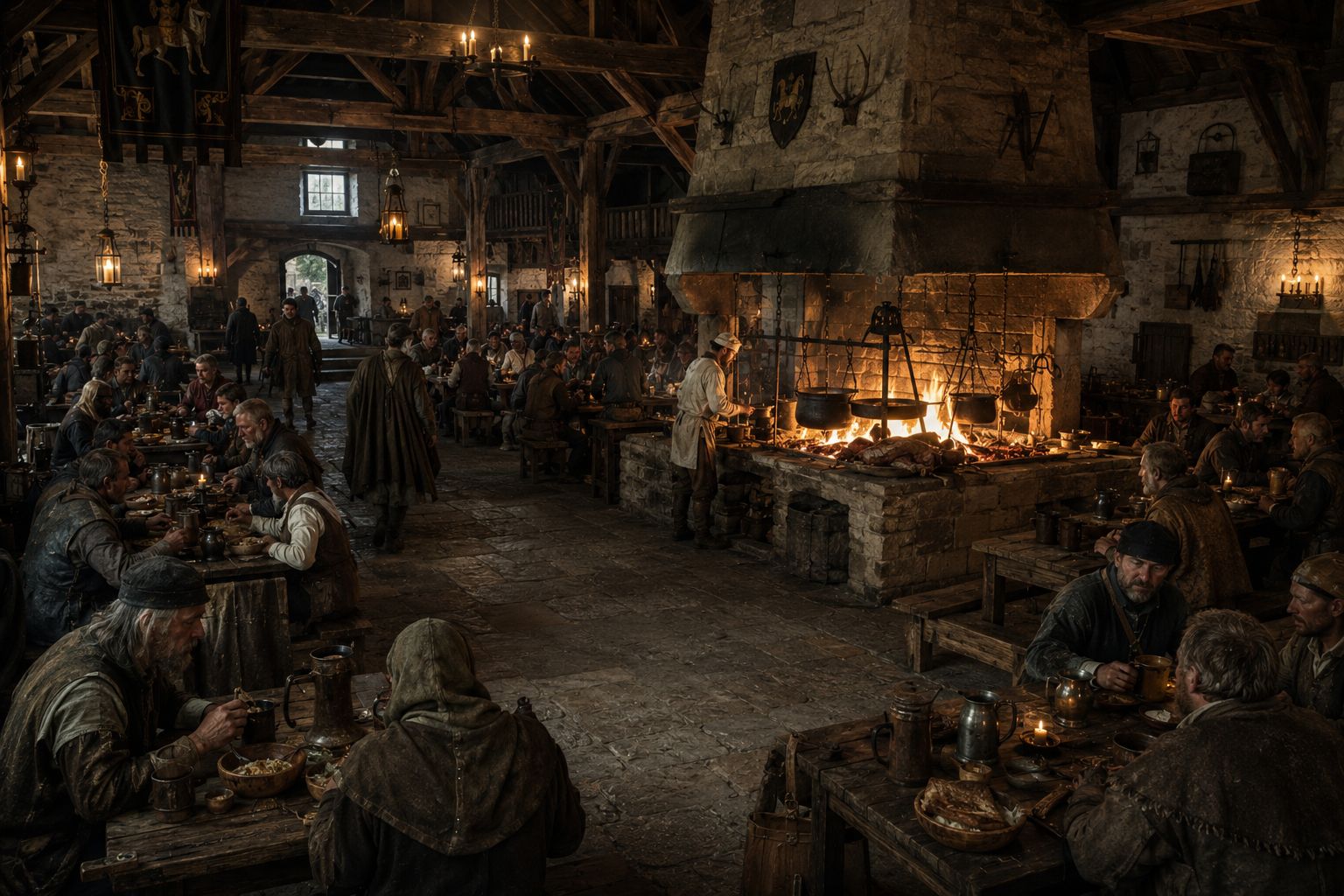
The common fantasy notion of a tavern — people lingering for pleasure, singing around a roaring hearth, wandering bards reciting epics while serving girls laugh and carry frothing ale — exists only in diluted fragments here. The Maalde is fundamentally transitional space. People are arriving exhausted or departing anxious.
Even at supper, one feels departure hanging over the room.
The common room is large but practical. Thick beams. Solid tables. Iron hooks for lanterns. Smoke-blackened rafters. Floors of fitted stone or hard timber scrubbed repeatedly with sand and hot water. One notices immediately that the building is designed not merely for comfort but survivability.
A Maalde burns down and the Kingdom notices.
Thus the laws.
Every licensed Maalde must possess a fireproof chimney stack lined properly in masonry and fitted with an iron grate. Ostensibly this protects against faeries entering through smoke paths — and there are enough old stories about smiling ash-covered things crawling down chimneys that nobody entirely laughs at the requirement — but practically it prevents sparks from reaching roof thatch.
The Kingdom has learned expensive lessons.
Many Maalde roofs are tile or slate where possible. Rain cisterns are mandatory in wealthier provinces. Sand buckets stand near hearths. Stable lanterns are hooded carefully. Candle placement is regulated with near military severity by some Masters.
And the Masters themselves are often old legionaries.
One recognizes them immediately.
Broad men gone heavy with age but not softness. Scarred wrists. Broken noses. Military posture surviving beneath wool and aprons. They move with the habit of men accustomed to command but too tired now to seek glory. Many possess a quiet intolerance for nonsense.
A drunken merchant insulting servants may discover himself physically removed with terrifying efficiency by a gray-haired innkeeper who forty years ago helped storm a fortress in winter.
The best Masters cultivate an atmosphere not of fear exactly, but disciplined civility.
Weapons peace-bound indoors.
No screaming after midnight.
No brawling near horses.
No drawing blades except in mortal emergency.
No insulting priests during supper.
No open sorcery without declaration.
No vomiting in the cistern.
People obey because the Maalde is neutral ground and because expulsion onto the road at night can kill you.
Outside the inner Kingdom the tone hardens further.
A frontier Maalde near forest marches or disputed territories resembles a fortified caravanserai more than an inn. Arrow slits. Heavy shutters. Watch rotations. Hardened travelers sleeping with knives nearby. Mercenaries quietly assessing exits. Men speaking in low voices about roads no longer safe after dusk.
But in the safer heartlands — especially near prosperous cities — some Maalde soften into something approaching the iconic tavern image.
Not fully.
Never fully.
But enough.
A bard may indeed sing near the hearth in winter. Ale flows more freely after harvest. Young squires flirt disastrously with serving girls. One sees embraces, gambling, songs, the occasional scandalized priest pretending not to notice impropriety. Teamsters laugh too loudly. Retainers arm wrestle. Somebody inevitably tells the story about the ghost near Dulmar for the thousandth time.
Yet even these warmer Maalde retain a certain Kingdom pragmatism.
The laughter ends early because people travel at dawn.
The women serving tables are rarely fantasy “wenches.” Most are workers: daughters, widows, practical girls earning wages, older servants with terrifying authority, or occasionally retired camp followers who have seen enough human behavior to become immune to embarrassment. Flirtation exists, certainly. So does prostitution in some establishments, discreetly regulated.
But the Kingdom dislikes disorderly lust almost as much as disorderly fire.
Thus accommodations are sharply stratified.
The common room floor may hold laborers, pilgrims, soldiers, and poor travelers sleeping wrapped in cloaks near banked embers. A partitioned women’s sleeping chamber provides marginal privacy and relative safety. Better guests purchase narrow private cells with lockable doors and actual mattresses. Wealthy patrons rent full suites at astonishing cost.
And nobles almost never trust Maalde kitchens entirely.
Which is why advance servants matter.
A proper household dispatches outriders ahead carrying bedding, spices, wine, cookware, physicians, and trusted cooks. By the time the lord arrives, the kitchen fire is already under supervision. Chickens have been slaughtered properly. Water boiled. Vegetables inspected. Sauces prepared under paranoid scrutiny.
Food poisoning is not considered an unfortunate inconvenience among the aristocracy.
It is politics.
A respectable Maalde kitchen therefore becomes a bizarre intersection of military logistics, peasant practicality, and aristocratic terror. Giant cauldrons of onion stew simmer beside delicate sauces prepared by imported cooks for a countess with a sensitive stomach. Teamsters devour black bread while minor nobility quietly receive trout poached in wine.
Good Maalde food is hearty rather than refined.
Stews thick enough to survive travel.
Roasted roots.
Strong mustard.
Dark bread.
Smoked fish.
Cheese hard as masonry.
Pickled vegetables.
River eel.
Mutton.
Oats.
Cider.
Weak ale.
In winter the common room smells magnificently of wet wool, garlic, horse sweat, smoke, and soup.
One of the defining characteristics of the Maalde is that nobody is fully at ease there.
Not even regulars.
The merchant worries about brigands ahead.
The courier worries about delay.
The knight worries about politics.
The pilgrim worries about sin.
The servant worries about theft.
The Master worries about all of them simultaneously.
And because the Maalde sits directly upon the arteries of the Kingdom, information accumulates there like sediment.
One can sit quietly in a Maalde for three evenings and learn:
which roads flood,
which baron is feuding,
where plague appeared,
whether goblins crossed the eastern passes,
which legion transferred north,
which bishop drinks secretly,
which harvest failed,
which prince may be dying.
The Kingdom itself becomes audible in fragments.
That is why serious people prefer the Maalde.
Not because it is comfortable.
Because it is connected.
And occasionally, very occasionally, in the prosperous old inner routes where danger has receded for generations, one finds the almost theatrical Maalde of popular imagination.
Lantern glow.
Mead mugs.
Roaring laughter.
Travel songs.
A fat merchant kissing everybody.
A limping bard singing heroic nonsense.
Young soldiers flirting.
Somebody shouting “yarr” in an accent from nowhere identifiable.
A serving girl smacking wandering hands with a tray while laughing anyway.
A ridiculous fight ending in shared drinks ten minutes later.
But even there the Kingdom peeks through.
The walls are still thick.
The gates still lock at dusk.
The horses are still counted carefully.
The fire grate still glows black beneath the chimney.
And somewhere nearby an old legionary Master watches the room with patient predator eyes, making absolutely certain the merriment never quite becomes chaos.