Tsirvile
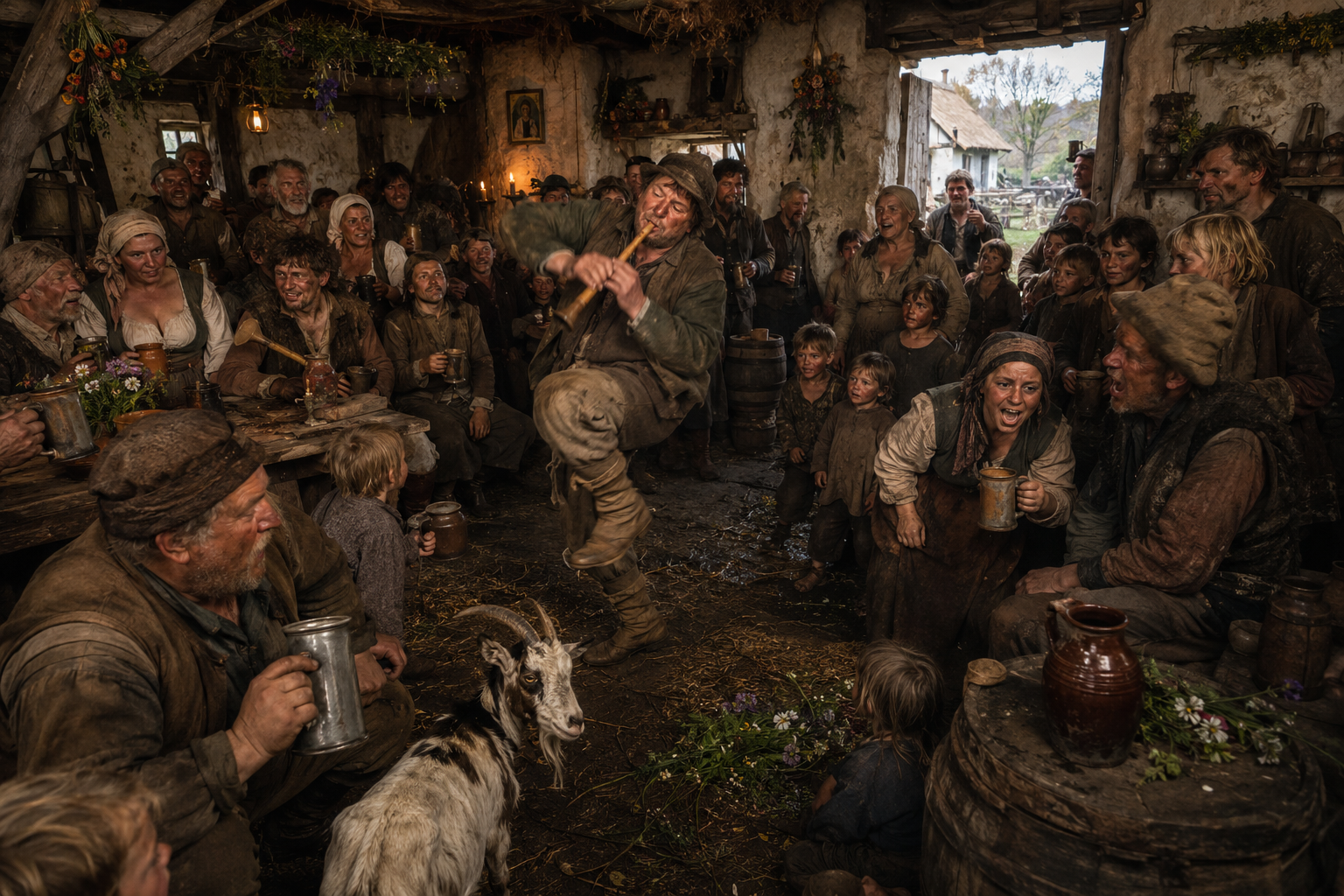
The Tsirvile usually announces itself long before you see it. Not with signs or lanterns or painted heraldry — such things belong to proper inns, monasteries, caravanserais, and the urban drinking houses of chartered towns — but through noise, smoke, and a subtle disturbance in the ordinary rhythm of village life. A lane that ought to be quiet after dusk is suddenly full of silhouettes. Children remain awake far too late. Someone is laughing too hard. Dogs bark continuously. A reed flute whines somewhere ahead like a wounded bird trapped in a chimney.
Then the smell arrives.
Wet wool steaming near firelight. Old ale. Pig grease. Sour grain mash. Damp soil churned under dozens of boots. Smoke from green wood. Human bodies that have labored honestly and washed infrequently. If rain fell recently, there is also the rich smell of mud and trampled vegetation, mixed with dung from whatever animals have been inconveniently tethered nearby. In warmer months one catches the odor of nettles, sweat, onions, crushed flowers, river fish, and occasionally vomit.
The Tsirvile is not truly an inn. It is not even fully a tavern. It is a household temporarily transformed into a public drinking place under tolerated custom. In some fiefdoms this is heavily restricted and requires permission from local lords or temple officials. Elsewhere it is loosely ignored so long as nobody dies, riots, or publicly insults the gods. Generally the practice emerges after late spring planting and continues through harvest season, when grain stores can support brewing and laborers briefly possess enough spare energy to remember they are human beings rather than draft animals.
Most Tsirviles begin accidentally.
A family brews too much small beer. A widow inherits three cider barrels she cannot consume alone. A son returns from market with spoiled wine that can still be diluted into something vaguely drinkable. A pig is slaughtered. Cousins arrive. Somebody produces a fiddle. Somebody else says they know a cooper willing to lend benches. Before long the farmhouse has become, for a few evenings or weeks, the center of a tiny social universe.
The house itself always remains visible beneath the performance.
No matter how carefully the hosts prepare, the building is still recognizably a peasant dwelling. Fresh rushes are spread across a dirt or uneven plank floor to disguise older smells. Wildflowers are gathered and shoved into chipped ceramic jugs. Cracks in the walls are covered with hanging cloths or saint charms. The front table receives the household’s one respectable linen. Extra candles are burned despite the cost. If the family possesses painted icons, polished copperware, or inherited silver spoons, they are conspicuously displayed to imply prosperity that does not truly exist.
Yet one still notices the roof sagging slightly above the hearth. One sees chickens wandering through legs in search of crumbs because nobody owns another enclosure. Smoke stains blacken the rafters. There are lice somewhere in the room. The benches are uneven. The mugs smell faintly of old yeast. A baby cries continuously from somewhere behind a curtain.
The people who gather there are not merry fantasy peasants. They are agrarian humans worn down by labor, childbirth, weather, taxes, infection, superstition, and proximity to animals.
Most are ugly in the ordinary, statistical sense.
Faces weather badly under Dreamlands suns. Teeth fail early. Backs bend. Hands become swollen and misshapen. Men of thirty-five often resemble exhausted grandfathers. Women age hard after multiple pregnancies and decades carrying water, grain, and firewood. Teenagers are awkward and underfed. Children are dirty almost by definition. Many people bear healed burns, old knife scars, missing fingers, cataracts, twisted noses, fungal infections, or badly set bones from accidents no healer properly treated.
Nobody arrives styled for spectacle.
Hair is greasy. Beards are uneven. Clothes are patched repeatedly until original fabric can barely be identified. Boots rot. Wool stinks in rain. Linen yellows. Some people smell distinctly of livestock because they were working among livestock an hour earlier. Others smell of tannery chemicals, fish oil, river mud, charcoal smoke, or horse sweat.
And yet the Tsirvile matters profoundly because these people possess almost nowhere else to exist socially.
A villein may spend months speaking only to family and immediate labor companions. Entire lives shrink into repetitive circuits of field, hearth, prayer, and sleep. The Tsirvile interrupts this rhythm. For a brief period one may hear gossip from neighboring villages, rumors of wars, strange theological arguments, dirty songs, market prices, marriages, deaths, monster sightings, taxes, miracle claims, and outright lies.
Travelers become dangerously important in such places.
A single caravan guard who once saw the sea can dominate conversation for hours. A peddler with colored glass beads becomes a figure of wonder. A soldier with foreign coins may be treated with both fascination and terror. People who have visited cities are regarded almost as unreliable witnesses from another dimension.
Naturally, this also means the Tsirvile exists under constant suspicion from authority.
Lords dislike uncontrolled gatherings because uncontrolled gatherings produce grievances. Temples distrust intoxication because intoxicated people ask theological questions. Magistrates fear gambling, fighting, disease transmission, and illicit trade. Some cults condemn music entirely. Others permit drinking but forbid dancing. Certain fiefdoms require holy symbols to remain visible during all communal drinking. Some insist the local priest or shrine keeper attend personally. Others prohibit Tsirviles on saints’ days or eclipse nights or during funeral periods.
The result is an atmosphere of cautious relief rather than freedom.
People lower their voices when discussing taxes. Someone always glances toward the road. If horses approach after dark, conversation falters immediately. A reeve, bailiff, militia patrol, or temple functionary can close the gathering at any moment. Fines are common. So are confiscations.
Yet enforcement itself is inconsistent because officials are human too.
Many local priests quietly enjoy drinking with commoners. Some militia captains use Tsirviles to gather information. Minor nobles occasionally appear disguised in ordinary cloaks seeking novelty or sex or simply the pleasure of being around unfiltered humanity for an evening. Entire local political networks may quietly operate through these informal gatherings.
The entertainment is terrible.
This is essential.
Modern people tend to imagine communal festivities as competent performances. The Dreamlands Tsirvile is mostly noise produced by enthusiastic amateurs. One man plays the same flute phrase repeatedly because it is the only one he knows. A woman sings half a ballad before forgetting the words. Someone stomps rhythm on a barrel. Children imitate adults badly. Drunk laborers attempt dances requiring far more coordination than they possess.
And yet moments of startling beauty emerge unpredictably from the chaos.
An old widower suddenly reveals a magnificent singing voice. A shepherd girl dances with eerie grace learned from nowhere obvious. Three exhausted women harmonize perfectly while gutting fish. For perhaps twenty seconds the entire room achieves genuine communal rhythm before collapsing again into disorder and laughter.
Animals complicate everything continuously.
Goats eat decorations. Dogs steal food directly from tables. Chickens roost in absurd places. Pigs escape. Horses panic at music. Geese become violent. Cats prowl beneath benches hunting scraps and mice alike. Fleas migrate freely between species.
Children meanwhile absorb everything.
They crowd doorways, crawl beneath tables, stare openly at strangers, and listen far too carefully to adult conversations. Many are technically not supposed to be present, but nobody possesses the luxury of separate childcare. Older children become unofficial servers carrying pitchers dangerously larger than their own torsos. Teenagers flirt aggressively and awkwardly under the half-supervision of exhausted relatives.
Sexuality within the Tsirvile is neither romanticized nor absent.
People pair off because they are lonely, drunk, curious, opportunistic, grieving, or briefly hopeful. Sometimes genuine affection begins there. More often it produces regret, scandal, pregnancy, or fights. Local morality tends to be practical rather than idealized. Villages know perfectly well what happens at these gatherings. The concern is less purity than stability. Affairs that disrupt households become dangerous very quickly.
Violence exists near the surface at all times.
Most Tsirviles conclude peacefully. Some end with broken teeth, stabbings, or feuds lasting generations. Agricultural societies accumulate resentment like sediment. Land disputes, inheritance conflicts, old humiliations, religious insults, accusations of theft, and romantic jealousy all ferment beneath communal drinking. A man insulted during harvest may remember it for twenty years.
The drink itself ranges from mediocre to actively alarming.
Small beer is safest: weak, cloudy, filling, vaguely sour. Ciders vary wildly. Berry wines may resemble vinegar. Herbal brews taste medicinal. Distilled liquor exists in some regions but is often crude and dangerous. Foreign alcohols from larger cities are prized almost mythologically. People dilute bad drink, spice spoiled drink, heat questionable drink, or simply consume it while pretending not to notice.
Water cannot always be trusted anyway.
And intoxication serves purposes beyond pleasure.
For a laborer who spends every daylight hour under obligation, drunkenness represents temporary escape from hierarchy itself. One may mock a cousin. Dance badly. Cry openly. Sing obscenities. Admit fear. Tell stories. Flirt above one’s station. Briefly become louder than life permits during ordinary days.
That is the heart of the Tsirvile.
Not joy exactly.
Not misery either.
Suspension.
A small pocket of tolerated disorder within a civilization otherwise built upon endless obligation. For a few hours the rigid machinery of agrarian survival loosens slightly. People become foolish, sentimental, aggressive, nostalgic, horny, theatrical, melancholy, honest, deceitful, and human all at once.
Then dawn arrives.
The barrels empty. Fires cool. Children sleep against walls. Someone vomits beside the goat pen. Somebody’s husband never came home. Two men refuse to speak to each other. A girl quietly realizes she has changed her future. The host counts coins and worries whether the bailiff heard about the gathering.
And by morning the house is only a farmhouse again.
Rushes are swept out.
Benches returned.
Flowers wilted.
Mud drying in bootprints across the yard.
The fields still need tending.