Skaeln
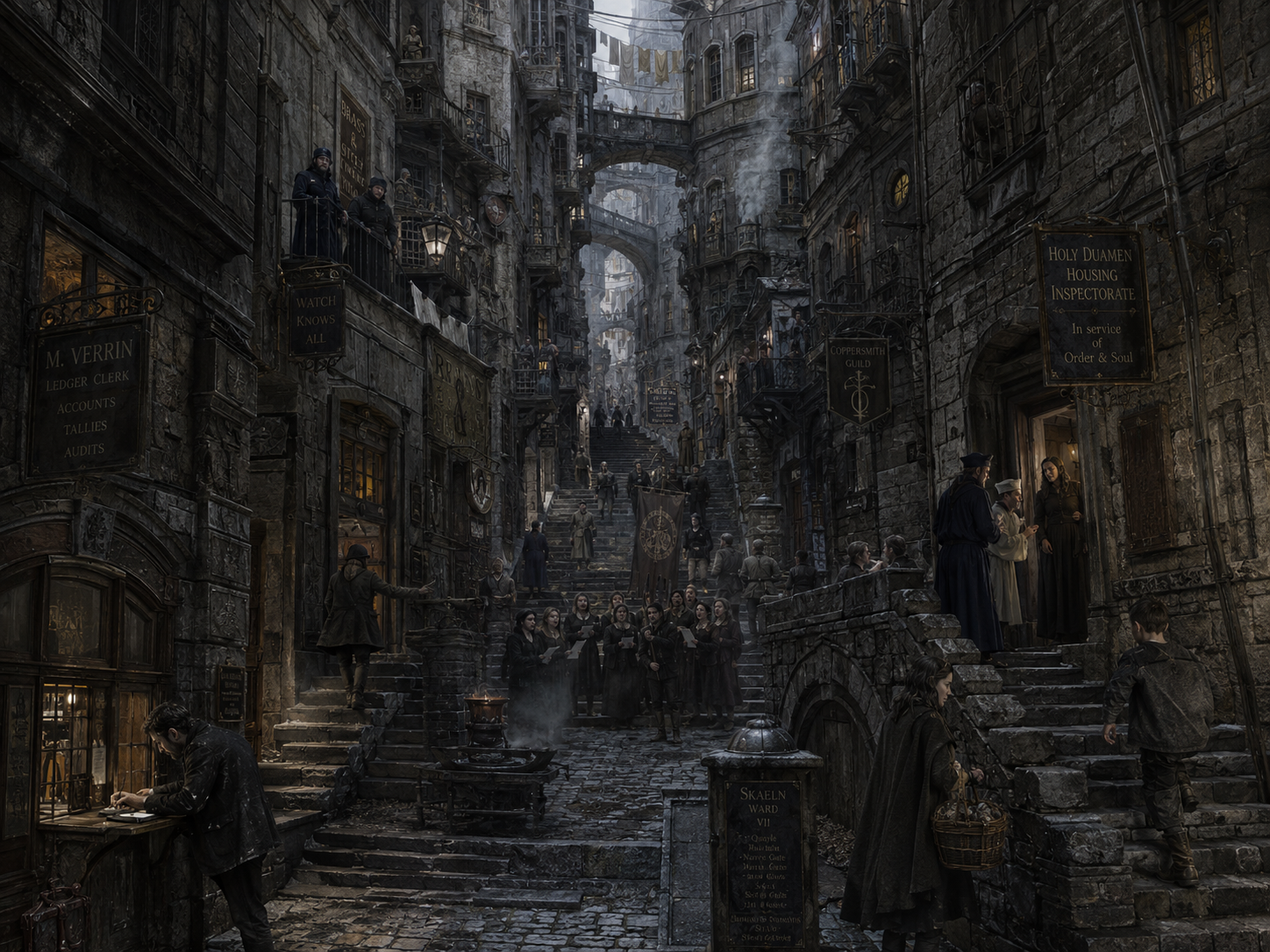
Skaeln lies below the gentler heights of the Quayle and away from the loud ceremonial commerce of the Nuster Deminu, and for that reason visitors sometimes mistake it for a quieter district. It is quieter only in the sense that a workshop is quieter than a market square. The noise is closer, more domestic, and more persistent: boots on stone stairs, coughing behind shutters, arguments carried through walls, metal tools dropped on benches, guild songs rising from a tiny courtyard, a constable knocking at a door nobody intended to answer, and the endless movement of people whose work requires them to live near the center of the city whether they like the place or not.
The streets are narrow enough that opposite houses seem to study one another. Sunlight reaches the lower alleys reluctantly, usually for a brief interval around noon, and even then only in thin, cold bands that travel across walls and disappear before anyone has made much use of them. Most of Skaeln is built in stone because the fire laws are merciless, and the laws are merciless because the district has burned before. Everyone knows the stories. Everyone knows the dates. Everyone knows which stairwell once trapped seventeen families and which courtyard became a chimney. Wood is restricted, chimneys are inspected, lamp stores are regulated, and householders who ignore the rules discover very quickly that the clergy and the city watch share information.
The rents are high because the demand is higher. Skaeln is full of people who cannot afford the Quayle and cannot afford to live far from work: clerks, assay workers, legal copyists, surveyors, instrument repairers, guild accountants, warehouse supervisors, scribes, inspectors, specialist craftsmen, minor physicians, bookkeepers, laboratory assistants, translators, undertakers, draughtsmen, customs officials, and every other sort of skilled person whose labor is too exacting to be casual and too necessary to be moved to the outskirts. Their apartments are often cramped, cold in winter, damp in bad weather, and stacked with furniture that has been made to fit spaces no sensible architect would have designed on purpose.
Housing inspections are strict enough to be legendary. Clerical inspectors arrive with measuring rods, ledgers, seals, and an almost religious hostility to blocked exits, unsafe hearths, overcrowded sleeping rooms, and landlords who imagine that a wall without a window still counts as ventilation. Tenants complain about them until the inspectors leave, then complain louder if they do not return. The clergy maintain that habitation is a moral matter because a city that permits people to suffocate, burn, freeze, or rot in rooms unfit for animals has failed in its obligations. Landlords maintain that the clergy are impossible. Both sides are correct.
The stairs define Skaeln almost as much as the stone. Streets rise and split, lanes become staircases, staircases enter buildings, interior flights emerge onto little landings open to the sky, and from there another stair may continue upward into a different house entirely. Residents learn the district through legs and memory. A child can explain three routes to the same bakery, one suitable in rain, one suitable when carrying a basket, and one suitable when avoiding an aunt. Visitors become lost because they assume that streets should remain streets and houses should remain houses, while Skaeln has spent centuries demonstrating that such distinctions are negotiable.
The tenements are tall and dense, and life passes through their walls. You hear people before you meet them. Somebody is practicing scales badly. Somebody is dictating a letter. Somebody is wheezing through another winter. Somebody is singing a guild loyalty song with excessive conviction. Somewhere two sisters are arguing about money. Somewhere a man is rehearsing a speech he will never give. Somewhere a baby wakes three floors of strangers. There is very little privacy, but there is also very little anonymity.
This is why the police of Skaeln are spoken of with a peculiar mixture of respect and resentment. They know the district because they have to. They know which households are fighting, which apprentices are gambling, which landlord is hiding an illegal room behind a partition, which guild has been recruiting too aggressively, which drunk is harmless, which respectable widow is buying stolen coal, which boy has started carrying a knife, and which staircase becomes dangerous after dark. People complain that the watch knows everything, and then go directly to the watch when they need to know something themselves.
The guilds are everywhere, though often in miniature. A guild presence in Skaeln may be no more than three rooms above a workshop, a painted sign, a meeting table, and a courtyard where thirty people can stand shoulder to shoulder and sing with alarming volume. These small guild houses produce fierce loyalties because professional identity matters here. Skaeln is full of people whose pride comes from being competent at something difficult, and the district respects exactness more than charm. A person who does their work well can earn standing. A person who does it badly will be remembered.
There is little glamour in Skaeln, but there is dignity. Laundry dries between buildings where sunlight rarely reaches. Soup simmers on narrow stoves. Work clothes are patched carefully. Boots are repaired until the leather has forgotten its first owner. Children learn sums early because sums matter. Families save for better rooms, better tools, better apprenticeships, and the possibility that one child might someday move upward, perhaps to the Nuster, perhaps even to the Quayle, though such ambitions are rarely spoken too loudly.
Evenings are close and smoky. Lamps glow behind thick glass, stairs shine with rain, windows fog, and the district settles into the exhausted rhythm of people who have spent the day doing work that required attention. A song may rise from a courtyard, first one voice and then twenty, and someone above will shout for them to stop while someone else joins in. The police know who started it. The clergy know which building has six people sleeping where four are permitted. The landlord knows the roof leaks. The tenants know which inspector can be persuaded to look at the roof before looking at the extra bed.
Skaeln is not beautiful in the easy way of the Quayle, and it does not impress strangers in the manner of the Nuster Deminu. It is difficult, dense, cold, expensive, watched, regulated, argued over, and indispensable. It is where the city keeps the people who know how to make the city function.
And that, in Skaeln, is considered reason enough to stay.