The Quayle
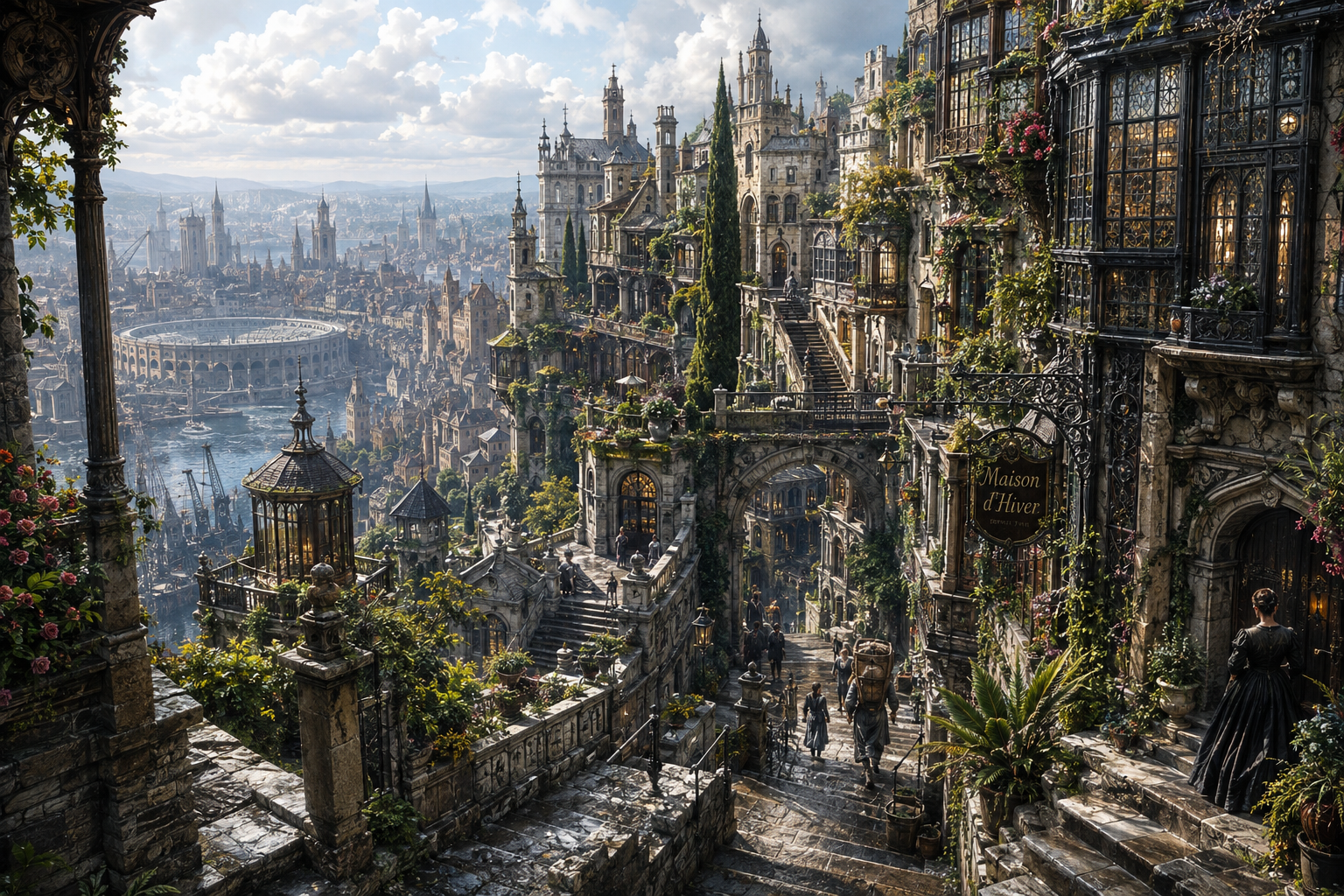
There are quarters in Rinyldissen where a man may lose his purse, his temper, his faith, or an afternoon, but in the Quayle he is more likely to lose his sense of haste, for the hill has been inhabited so long, and climbed by so many patient generations, that even time seems to take the steps there rather than hurry by the road.
The Quayle rises beyond the Pallisades upon the old bones of a fortress so ancient that no living house can say with certainty where the castle ended and the city began, and everywhere one finds some fragment of its forgotten strength pressed gently into domestic life: a wall broad enough to have once carried soldiers now bears roses and breakfast tables, an old tower has become three adjoining residences and a wine cellar, a gatehouse shelters a family whose drawing room occupies the chamber where men once waited beneath murder-holes, and stairways polished into shallow bowls by thousands of years of passing feet turn unexpectedly beneath houses, through courtyards, beneath bridges, and into lanes which have never once consented to run straight.
No one truly enters a house in the Quayle simply by opening its door. The door may be black oak, very old and very beautiful, fitted with iron whose maker has been dead eight centuries, but what lies behind it is anybody’s guess, for one threshold may lead upward through a narrow stair toward sunlit rooms and a garden suspended above another man’s roof, while another descends through cool vaulted passages before turning sideways beneath a neighboring property and emerging, improbably, into a salon overlooking half the city. Windows appear where no sensible window should be, climbing three floors in panes of smoky green and amber glass, turning corners around old masonry, projecting outward in carved bays, or peering down into gardens so deep between the houses that they seem to have been discovered rather than planted.
In spring the Quayle belongs to roses, though the ferns dispute this with considerable vigor. The roses climb railings and old columns, spill from balconies, twist themselves around drainpipes and lintels, and occasionally conquer a wall so completely that some visiting architect is reduced to guessing where the stonework might be underneath, while ferns prosper in the perpetual damp of shadowed steps and rain channels, filling cracks, wells, abandoned niches, and the little courts where sunlight arrives for only an hour each morning. Vines creep everywhere with the confidence of old citizens, and even the grandest families tolerate them, perhaps because a house without greenery is thought faintly vulgar, like a guest who has dressed exquisitely but forgotten how to converse.
The pleasures of the Quayle are therefore quiet ones, and very often accidental. There is the pleasure of taking coffee beside a window while rain whispers through the leaves outside, of hearing a servant somewhere below laugh at something one cannot quite make out, of opening a door upon a terrace one has passed a hundred times and finding the city suddenly spread beneath it in evening gold, or of sitting beneath an arcade while distant bells answer one another across the roofs. There are small bookshops whose owners know the reading habits of three generations of the same family, pastry kitchens which begin work before dawn and send warm scents down stairwells long before their doors are opened, little dining rooms with six tables and no sign at all, music teachers who have occupied the same upper chambers for half a century, and florists who somehow carry impossible quantities of cut flowers up the hill without ever appearing hurried.
People elsewhere sometimes imagine that the Quayle is silent, but this is not so, for quiet and silence are entirely different things. The hill is full of sound, only none of it is obliged to shout. One hears footsteps upon wet granite, the creak of carrying poles, the knock of deliveries at side doors, bells from kitchens, the murmur of lessons through open windows, children reciting something they have plainly been told to memorize and plainly resent, a distant violin, the clipped instructions of a housekeeper, the soft argument of two old men who have held the same disagreement for thirty years, and always the patient labor of porters climbing upward with baskets, trunks, coal, wine, fruit, flowers, linen, books, guests, invalids, furniture, and all the innumerable necessities by which elegance is kept from admitting how much work it requires.
A service position in the Quayle is respectable, and everyone knows it. A girl who is taken into a proper Quayle household may learn accounts, letters, wines, flowers, fabrics, manners, languages, the management of servants younger than herself, and the delicate art of knowing when a guest wishes to be interrupted and when a guest most certainly does not. A cook who has served on the hill can find employment anywhere in the city, a porter entrusted with a noble household’s deliveries may know more private business than a magistrate, and an experienced chambermaid can identify three generations of scandal from the placement of shoes outside a bedroom door. Parents boast that their daughters have gone up to the Quayle, and in that phrase the direction is both geographical and social.
The wealthy, of course, make the climb disappear whenever possible. They are carried in chairs, borne in litters, assisted by household men who know every useful stair, or hoisted with luggage upon little private platforms concealed in courtyards and service alleys, while the less fortunate discover very quickly whether their knees deserve the confidence they have placed in them. Yet even those who curse the ascent generally forgive it when they turn at some landing and look back, for the views from the Quayle are not reserved for the owners of great houses and cannot be entirely bought.
They arrive between buildings, over walls, through arches, beneath hanging gardens, and at the ends of lanes where one expects nothing more remarkable than another flight of steps. The Old Quarters lie folded below in their smoke and roofs, the distant waterways catch the sun like drawn wire, towers rise one behind another into the haze, and even the Arena, viewed from high enough and far enough away, loses much of its brutality and becomes almost picturesque, a fact which the people of the Quayle are perhaps too fond of mentioning.
At night the hill becomes another city altogether, for the black-oak windows kindle one by one behind their leaded panes, lamps appear beneath arcades, terraces glow through leaves, and the innumerable stacked houses resolve themselves into constellations climbing the dark. From below, the Quayle seems impossibly serene, but from within it remains what it has always been: servants finishing supper, old women watering plants, scholars refusing to go to bed, lovers lingering on steps, cooks drinking the last cup in warm kitchens, porters rubbing tired calves, and important people discovering, as important people occasionally do, that the finest luxury available to them is simply to sit beside an open window while rain falls over Rinyldissen and nothing at all is required of them for another hour.