The Pallisades
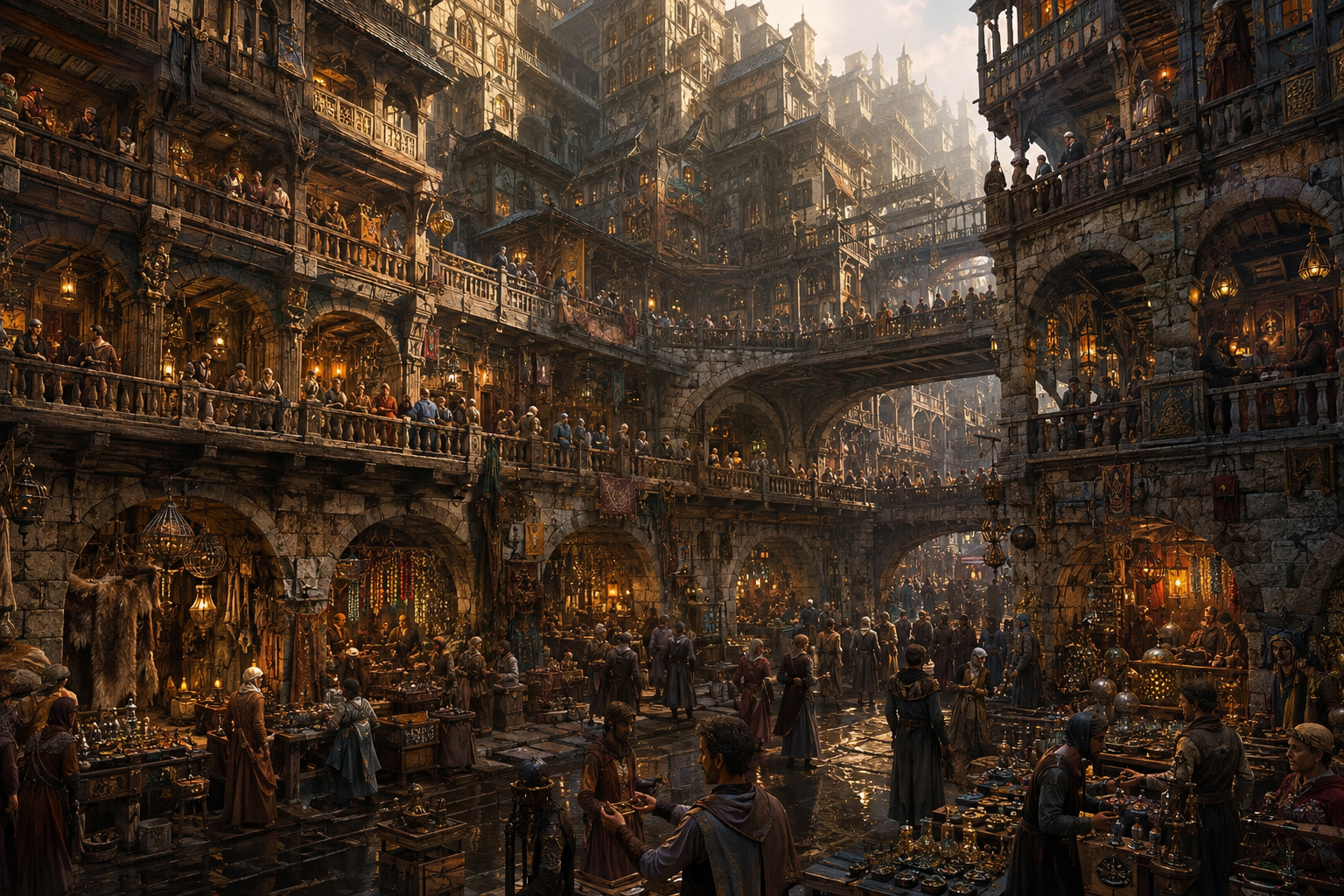
In an industrious part on Rinyldissen, in the famous and renowned Old Quarters, off the Marksman’s Quarters, up the Saeldon, not yet up the Quayle, lie the Pallisades—an address spoken with the slow relish of the locally initiated and the tight-lipped caution of everyone else. You do not arrive at the Pallisades so much as you are processed by it, like ore through a cranky mill: ground down, sorted, sniffed, priced, and—if you prove tolerable—permitted to continue uphill with your dignity bruised but intact.
This is Rinyldissen proper, the old granite heart of the city, where anyone not from the city is stared at with the frank attention reserved for suspicious sausages. Trade is conducted in a thick local dialect whose consonants strike sparks. The vowels are swallowed like grudges. Here, commerce is not the polite exchange of coin for goods; it is ritual. It is a social sport with rules invisible to outsiders and punishments delivered in small humiliations—an incorrect honorific, a mis-timed nod, a smile held half a second too long. The Pallisades has its own weather, too: a perpetual mingling of smoke, steam, damp stone, fried fat, and old wool, rising in layers like a family secret.
The climb begins innocently enough. “Up the Quayle,” they’ll say, and you’ll imagine a gentle rise, perhaps a charming stroll with a view. This is the lie the city tells tourists in order to test their knees. The roads are steep and interspersed with stone stairs that were clearly designed by someone who hated carts, horses, and the concept of leisure. The carts move slow, wheels complaining on cobble, axles squealing like offended geese, their drivers hunched into their collars, whispering insults at gravity. The houses crowd inward, leaning like gossips, their upper stories reaching across the street as if to exchange notes. And you will need strong legs. Not “strong legs” in the lyrical sense. Strong legs in the sense that your calves will develop opinions and begin to file petitions.
Then, suddenly, the city cheats.
A staircase—narrow, spiraling, damp as a cellar thought—will cut away from the street and climb to a second-story arcade. And there, at the “second floor” (as the civilized might call it, and the locals would never), you find the Storied Rows: elevated walkways that run along the façades like the city’s secret second spine. They are arcades, yes, but not in the manner of some grand ceremonial promenade meant for strolling poets and fashionably bored nobles. These are working rows. They are traffic lanes for human purposes: errands, arguments, deliveries, seductions, and the quick disposal of small inconveniences. They are the city refusing to stay in one layer. The Pallisades is not a neighborhood. It is a stack of neighborhoods that forgot to coordinate.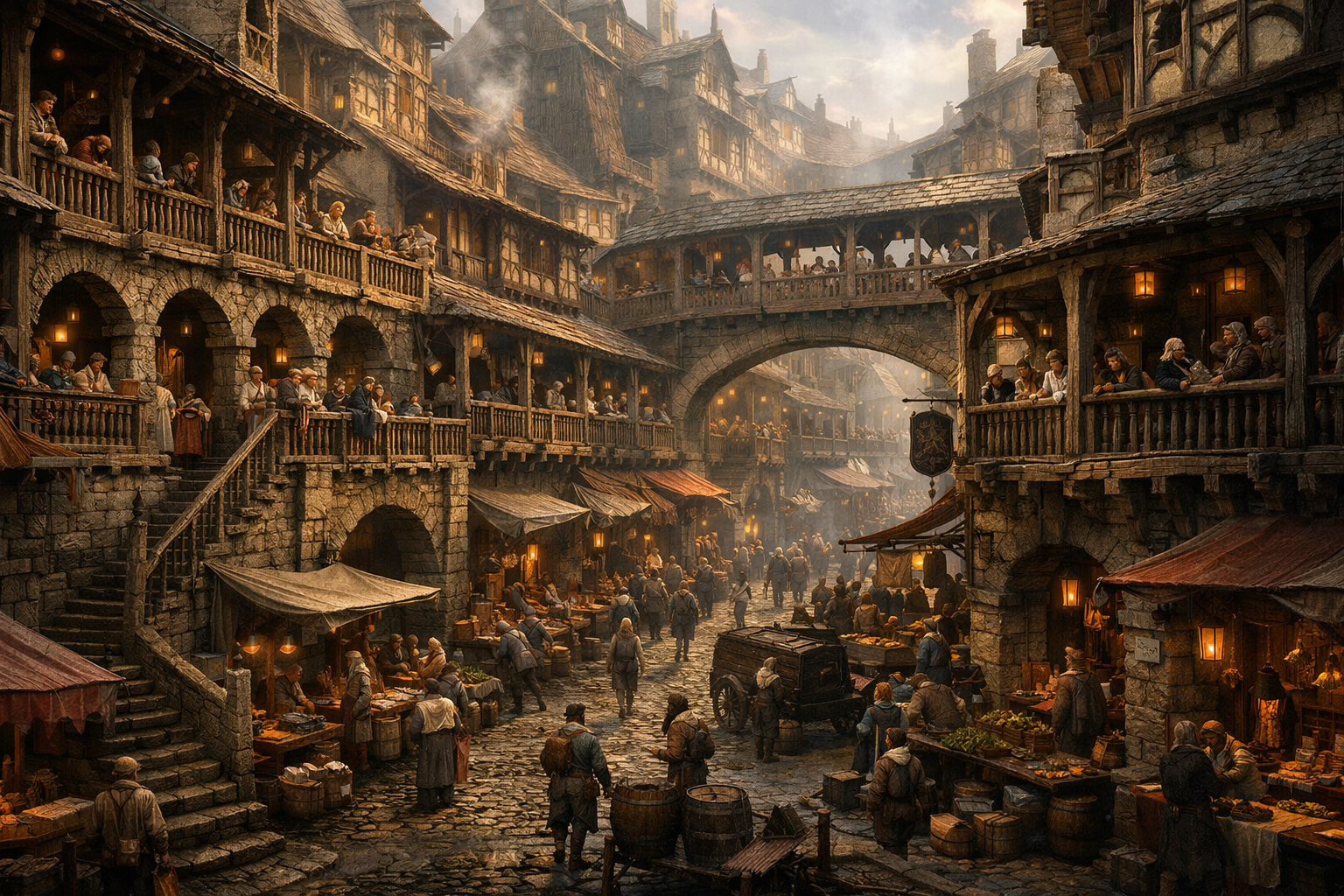
From the Rows, you look down on the street level and it is like gazing into the riverbed of commerce: bodies flowing, barrows nudging through the press, a fishmonger waving a cleaver as if blessing the crowd. Above you, at the third story, there is another Row—sometimes open to the sky, sometimes roofed, sometimes boxed in with trelliswork and stained boards. From that third story, a bridge crosses the street: discreet, functional, and intensely unromantic, because romance implies you have time. The bridges are built with the matter-of-factness of people who intend to use them. They pass through buildings, cut across courtyards, vanish into tunnels and corridors, reappear where you least expect. A bridge will lead you into a shop. A corridor will lead you into someone’s kitchen. A portal-like arch will lead you into a narrow passage where the walls are too close, the air too warm, and the sounds too intimate to belong to strangers.
The courtyards are the Pallisades’ true teeth. There are many of them—inner squares and well-courts and wedge-shaped voids where laundry lines zigzag overhead like bunting for a festival no one invited you to. Strangers entering these spaces are met with hostile stares that land like thrown pebbles. Not aggressive, exactly; merely definitive. The locals look at you the way a locksmith looks at a bent key: Where did you come from and what stupid door did you think you were opening? Children pause mid-chase to watch. Old women in doorways go quiet at the same time, as if they share a string between their throats. Somewhere, a dog decides you are untrustworthy and barks once—an authoritative bark, as though it has paperwork.
And yet: it is beautiful. Not pretty. Not “charming.” Beautiful in the way a working engine is beautiful, full of heat and friction and purposeful complexity. The Pallisades winds up toward the Qauyle like a thought that refuses to conclude. It has a thousand details that insist on being noticed: iron brackets shaped like sea-beasts, carved lintels showing saints with suspicious expressions, door knockers polished by ten thousand impatient hands. Lanterns glow even in daylight because the alleys are narrow and the sky is often only a rumor.
People are everywhere. Not “crowds” in the anonymous sense, but people with occupations so specific they verge on theology. You will pass a man whose entire trade is braidework—braiding cords for guild sashes, ceremonial knots for marriages, tension braids for pulley rigs, protective braids said to turn aside ill fortune (and if you ask whether that last one works, he will stare at you as though you’ve asked whether gravity is popular). You will see bead-workers hunched like scribes, threading minuscule glass and bone and carved seed, assembling patterns that carry meanings the outsider cannot decode: district loyalties, apprenticeship lineages, grudges maintained across generations like heirloom spoons.
There are furriers, of course, but not the crude furriers of the simpler neighborhoods. These are furriers who will tell you, with bleak patience, the difference between northern pelt and upland pelt, between winter coat and hunger coat, between fur that warms and fur that signifies. There are metalworkers who deal not in iron and bronze but in intricate alloys and rare minerals: thread-thin filigree, hollow rivets, clasp mechanisms smaller than a fingernail, and those maddening little hinges that fold and unfold like the joints of insects. There are sellers of alchemical components, and their stalls smell like vinegar, resin, dried citrus, and something faintly metallic that makes your tongue feel as if it has opinions. If you are lucky, you will see a “raree mineral” merchant. If you are unlucky, he will see you.
And because the Pallisades never does anything in a straight line when it can do it in a labyrinth, the route to any given shop becomes a pilgrimage of absurdity. A stair leading up to a second-story Row might wind forty meters around a wedge of stone, passing a sleeping porter, a window stuffed with basil and superstition, and a niche containing a half-melted candle that looks embarrassed. Then you climb another set of stairs—twenty meters this time—so steep your knees become negotiators. Then across a bridge over a street. Then another twenty meters, another stair, up again, through a building where wash-wives yell and gossip with the full-throated power of women who have seen every kind of stain and consider secrets a species of laundry. Their voices ricochet off stone like thrown coins. The steam from their vats drifts into the corridor, warm and sour. You pass through, trying not to look like prey.
And then: a shop.
It is always a shop, because the Pallisades believes in commerce the way priests believe in confession. This shop sells one thing. Exactly one thing. A fetish-craft silverwater device mounted on shark tooth and set with opals, arranged in a manner that suggests both craftsmanship and spite. The device serves a function nobody explains, partly because nobody wants to, and partly because explanation in the Pallisades is a luxury item with a high tax. The object sits there, in solemn rows, each variant slightly different, each with a shark-tooth mount that looks as though it would prefer to be in a mouth. Opals wink in lantern light. Silverwater—whatever it is—slips in shallow channels with a slow, deliberate movement, as if reluctant to be observed.
The proprietor is a rickety old gnome, more wood than flesh, with fingers like bent nails and eyebrows that could shelter birds. He speaks only the thick Old Quarters dialect, which comes at you like a bucket of gravel. You try the trade tongue. He squints. You try gestures. He squints harder. You point at the silverwater device. He produces a sound that might be a price or might be a curse. You offer a coin. He picks it up, bites it, sniffs it, holds it to the light as if trying to detect your moral character in the metal. Then he says something that—if you later ask a local to translate—will be rendered as: “You look like someone who’d drop it.”
And he is right.
The Pallisades is thick with just that: smelly and grandiose and specialized and full of character and aloofness and joy and pride. It is a place where every doorway seems to lead to a trade so narrow it becomes profound, as if the city is a cathedral and its saints are artisans. The commonest emotion here is not friendliness; it is assurance. People know what they do. They know what their fathers did. They know what their apprentices will do. They treat outsiders with suspicion not because they are cruel, but because an outsider is a variable, and variables are how disasters begin.
And yet the joy is undeniable. It hums under the grit. It’s in the way a bead-worker smiles at a perfect loop. In the way a metalwright tests a hinge and nods once, satisfied, like a judge delivering a merciful verdict. In the way the wash-wives laugh—not kindly, not cruelly, but expansively—as if laughter itself were a kind of soap. In the way the street-level merchants call up to the Rows and the Rows answer back, voices weaving vertically through the neighborhood like ropes.
At dusk, the Pallisades turns operatic. Lanterns ignite along the galleries. The bridges glow softly, each one a suspended line of light. The street below becomes a moving tapestry of shadows and shoulders. From above, on the Rows, you see the city as a living mechanism: levels of circulation, layers of commerce, pockets of private life tucked behind shutters. A barrow creaks along; a courier runs up a stair; a pair of lovers argues in a doorway; a guild apprentice carries a long bundle of braided cord like a sacred relic. Somewhere in an inner courtyard, someone is playing a thin, urgent tune on a reed instrument, and the notes climb the stone like ivy.
If you stay long enough, the staring eases—slightly. Not into acceptance, exactly, but into classification. You become “the outsider who doesn’t block the stairs.” You become “the one who paid the correct amount.” You become “the stranger who didn’t ask what the silverwater does.” This is as close to praise as the Pallisades ever gets. It is the neighborhood’s way of saying: you have not insulted our reality.
And when you finally descend—because everyone descends eventually—you will feel oddly flattened, like a book closed too quickly. The street elsewhere will seem too wide, too simple, too honest. You will miss the layered paths, the overhead footfalls, the bridges that crossed like stitched seams. You will miss the way the Pallisades made you work for every step and rewarded you with a city that felt not designed, but accumulated. Not built, but insisted upon.
You will also miss the dialect, even though it bruised your ears, because it belongs to the stone as much as the stone belongs to it. And perhaps, in a moment of weakness or vanity, you will find yourself holding a shark-tooth silverwater fetish device set with opals, purchased at unfair cost from a gnome who looked at you like a loose bolt.
You will not know what it does.
But you will know where it came from.