Welles, Orson
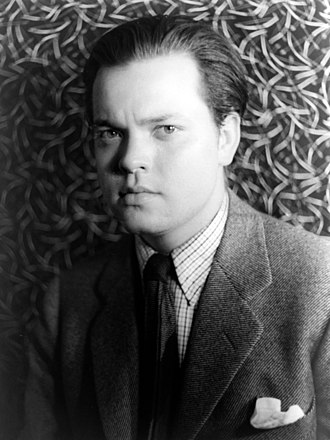
George Orson Welles (May 6, 1915 – October 10, 1985) was an American actor, director, screenwriter, and producer who is remembered for his innovative work in film, radio, and theatre. He is considered to be among the greatest and most influential filmmakers of all time.[1]
While in his 20s, Welles directed high-profile stage productions for the Federal Theatre Project, including an adaptation of *Macbeth* with an entirely African-American cast and the political musical The Cradle Will Rock. In 1937, he and John Houseman founded the Mercury Theatre, an independent repertory theatre company that presented a series of productions on Broadway through 1941, including a modern, politically charged Caesar (1937).
In 1938, his radio anthology series The Mercury Theatre on the Air gave Welles the platform to find international fame as the director and narrator of a radio adaptation of H. G. Wells's novel The War of the Worlds, which caused some listeners to believe that a Martian invasion was in fact occurring. Although reports of panic were mostly false and overstated,[2] they rocketed 23-year-old Welles to notoriety.
His first film was Citizen Kane (1941), which he co-wrote, produced, directed and starred in as the title character, Charles Foster Kane, has been consistently ranked as one of the greatest films ever made. He directed twelve other features, the most acclaimed of which include The Magnificent Ambersons (1942), The Stranger (1946), The Lady from Shanghai (1947), Touch of Evil (1958), The Trial (1962), Chimes at Midnight (1966) and F for Fake (1973).[3][4] Welles also starred in films such as Jane Eyre (1943), The Third Man (1949), and A Man for All Seasons (1966).
His distinctive directorial style featured layered and nonlinear narrative forms, dramatic lighting, unusual camera angles, sound techniques borrowed from radio, deep focus shots and long takes. He has been praised as "the ultimate auteur".[5]: 6 Welles was an outsider to the studio system and struggled for creative control on his projects early on with the major film studios in Hollywood and later in life with a variety of independent financiers across Europe, where he spent most of his career. Many of his films were either heavily edited or remained unreleased.
Welles received an Academy Award and three Grammy Awards among other numerous honors such as Academy Honorary Award in 1970, the Golden Lion in 1970, the AFI Life Achievement Award in 1975, and the British Film Institute Fellowship in 1983. In 2002, he was voted the greatest film director of all time in two British Film Institute polls among directors and critics.[6][7] In 2018, he was included in the list of the 50 greatest Hollywood actors of all time by The Daily Telegraph.[8] Welles had three marriages, including one with Rita Hayworth, and three children.
- Early life
- Early career (1931–1935)
- Theatre (1936–1938)
- Radio (1936–1940)
- Hollywood (1939–1948)
- Europe (1948–1956)
- Return to Hollywood (1956–1959)
- Return to Europe (1959–1970)
- Later career (1970–1985)
- Personal life
- Politics and activism
- Death and tributes
- Unfinished projects
- Theatre credits
- Radio credits
- Filmography
- Discography
- Awards and honors
- Legacy and reception
- Cultural references
- Notes
- References
- Further reading
- Documentaries about Orson Welles
- External links
Early life
 Orson Welles at age three (1918)

Welles's birthplace in Kenosha, Wisconsin (2013)

Welles with his mother, Beatrice Ives Welles
George Orson Welles was born May 6, 1915, in Kenosha, Wisconsin, a son of Richard Head Welles (1872–1930)[9]: 26 [10][a] and Beatrice Ives Welles (née Beatrice Lucy Ives; 1883–1924).[10][11]: 9 [b] He was named after one of his great-grandfathers, influential Kenosha attorney Orson S. Head, and his brother George Head.[9]: 37
An alternative story of the source of his first and middle names was told by George Ade, who met Welles's parents on a West Indies cruise toward the end of 1914. Ade was traveling with a friend, Orson Wells (no relation), and the two of them sat at the same table as Mr. and Mrs. Richard Welles. Mrs. Welles was pregnant at the time, and when they said goodbye, she told them that she had enjoyed their company so much that if the child were a boy, she intended to name him after them: George Orson.[13]
Despite his family's affluence, Welles encountered hardship in childhood. His parents separated and moved approximately 55 miles south to Chicago in 1919. His father, who made a fortune as the inventor of a popular bicycle lamp,[14] became an alcoholic and stopped working. Welles's mother was a pianist who studied with Leopold Godowsky.[15] She played during lectures by Dudley Crafts Watson at the Art Institute of Chicago to support her son and herself.
The older Welles boy, "Dickie", was institutionalized at an early age because he had learning difficulties. Beatrice died of hepatitis in a Chicago hospital on May 10, 1924, just after Welles's ninth birthday.[16]: 3–5 [17]: 326 The Gordon String Quartet, a predecessor to the Berkshire String Quartet, which had made its first appearance at her home in 1921, played at Beatrice's funeral.[18][19]
After his mother's death, Welles ceased pursuing music. It was decided that he would spend the summer with the Watson family at a private art colony established by Lydia Avery Coonley Ward in the village of Wyoming in the Finger Lakes Region of New York.[20]: 8 There, he played and became friends with the children of the Aga Khan, including the 12-year-old Prince Aly Khan.[c]
Then, in what Welles later described as "a hectic period" in his life, he lived in a Chicago apartment with both his father and Maurice Bernstein, a Chicago physician who had been a close friend of both his parents. Welles briefly attended public school[21]: 133 before his alcoholic father left business altogether and took him along on his travels to Jamaica and the Far East. When they returned, they settled in a hotel in Grand Detour, Illinois, that was owned by his father. When the hotel burned down, Welles and his father took to the road again.[20]: 9
"During the three years that Orson lived with his father, some observers wondered who took care of whom," wrote biographer Frank Brady.[20]: 9
"In some ways, he was never really a young boy, you know," said Roger Hill, who became Welles's teacher and lifelong friend.[22]: 24
 Welles in 1926: "Cartoonist, Actor, Poet and only 10"
Welles briefly attended public school in Madison, Wisconsin, enrolled in the fourth grade.[20]: 9 On September 15, 1926, he entered the Todd Seminary for Boys,[21]: 3 an expensive independent school in Woodstock, Illinois, that his older brother, Richard Ives Welles, had attended ten years before until he was expelled for misbehavior.[9]: 48 At Todd School, Welles came under the influence of Roger Hill, a teacher who was later Todd's headmaster. Hill provided Welles with an ad hoc educational environment that proved invaluable to his creative experience, allowing Welles to concentrate on subjects that interested him. Welles performed and staged theatrical experiments and productions there.[23]
 Welles (fourth from left) with classmates at the Todd School for Boys (1931)
"Todd provided Welles with many valuable experiences," wrote critic Richard France. "He was able to explore and experiment in an atmosphere of acceptance and encouragement. In addition to a theatre, the school's own radio station was at his disposal."[24]: 27 Welles's first radio experience was on the Todd station, where he performed an adaptation of Sherlock Holmes that was written by him.[16]: 7
On December 28, 1930, when Welles was 15, his father died of heart and kidney failure at the age of 58, alone in a hotel in Chicago. Shortly before this, Welles had announced to his father that he would stop seeing him, believing it would prompt his father to refrain from drinking. As a result, Orson felt guilty because he believed his father had drunk himself to death because of him.[25] His father's will left it to Orson to name his guardian. When Roger Hill declined, Welles chose Maurice Bernstein.[26]: 71–72
Following graduation from Todd in May 1931,[21]: 3 Welles was awarded a scholarship to Harvard College, while his mentor Roger Hill advocated he attend Cornell College in Iowa.[27] Rather than enrolling, he chose travel. He studied for a few weeks at the Art Institute of Chicago[28]: 117 with Boris Anisfeld, who encouraged him to pursue painting.[20]: 18
Welles occasionally returned to Woodstock, the place he eventually named when he was asked in a 1960 interview, "Where is home?" Welles replied, "I suppose it's Woodstock, Illinois, if it's anywhere. I went to school there for four years. If I try to think of a home, it's that."[29]
Early career (1931–1935)
 After graduating, 16-year-old Welles embarked on a painting and sketching tour of Ireland and the Aran Islands, traveling by donkey cart (1931).
After his father's death, Welles traveled to Europe using a small portion of his inheritance. Welles said that while on a walking and painting trip through Ireland, he strode into the Gate Theatre in Dublin and claimed he was a Broadway star. The manager of the Gate, Hilton Edwards, later said he had not believed him but was impressed by his brashness and an impassioned audition he gave.[30]: 134
Welles made his stage debut at the Gate Theatre on October 13, 1931, appearing in Ashley Dukes's adaptation of Jud Süß as Duke Karl Alexander of Württemberg. He performed small supporting roles in subsequent Gate productions, and he produced and designed productions of his own in Dublin. In March 1932, Welles performed in W. Somerset Maugham's The Circle at Dublin's Abbey Theatre and traveled to London to find additional work in the theatre. Unable to obtain a work permit, he returned to the U.S.[17]: 327–330
Welles found his fame ephemeral and turned to a writing project at Todd School that became immensely successful, first entitled Everybody's Shakespeare and subsequently, The Mercury Shakespeare. Welles traveled to North Africa while working on thousands of illustrations for the Everybody's Shakespeare series of educational books, a series that remained in print for decades.[31]
In 1933, Roger and Hortense Hill invited Welles to a party in Chicago, where Welles met Thornton Wilder. Wilder arranged for Welles to meet Alexander Woollcott in New York in order that he be introduced to Katharine Cornell, who was assembling a repertory theatre company. Cornell's husband, director Guthrie McClintic, immediately put Welles under contract and cast him in three plays.[20]: 46–49 Romeo and Juliet, The Barretts of Wimpole Street and Candida toured in repertory for 36 weeks beginning in November 1933, with the first of more than 200 performances taking place in Buffalo, New York.[17]: 330–331
In 1934, Welles got his first job on radio—with The American School of the Air—through actor-director Paul Stewart, who introduced him to director Knowles Entrikin.[17]: 331 That summer, Welles staged a drama festival with the Todd School at the Opera House in Woodstock, Illinois, inviting Micheál Mac Liammóir and Hilton Edwards from Dublin's Gate Theatre to appear along with New York stage luminaries in productions including Trilby, Hamlet, The Drunkard and Tsar Paul. At the old firehouse in Woodstock, he also shot his first film, an eight-minute short titled, The Hearts of Age.[17]: 330–331
On November 14, 1934, Welles married Chicago socialite and actress Virginia Nicolson[17]: 332 (often misspelled "Nicholson")[32] in a civil ceremony in New York. To appease the Nicolsons, who were furious at the couple's elopement, a formal ceremony took place December 23, 1934, at the New Jersey mansion of the bride's godmother. Welles wore a cutaway borrowed from his friend George Macready.[26]: 182

Playbill for Archibald MacLeish's Panic (March 14–15, 1935), Welles's first starring role on the U.S. stage
A revised production of Katharine Cornell's Romeo and Juliet opened December 20, 1934, at the Martin Beck Theatre in New York.[17]: 331–332 [33] The Broadway production brought the 19-year-old Welles (now playing Tybalt) to the notice of John Houseman, a theatrical producer who was casting the lead role in the debut production of one of Archibald MacLeish's verse plays, Panic.[34]: 144–158 On March 22, 1935, Welles made his debut on the CBS Radio series The March of Time, performing a scene from Panic for a news report on the stage production.[20]: 70–71
By 1935, Welles was supplementing his earnings in the theatre as a radio actor in Manhattan, working with many actors who later formed the core of his Mercury Theatre on programs including America's Hour, Cavalcade of America, Columbia Workshop and The March of Time.[17]: 331–332 "Within a year of his debut Welles could claim membership in that elite band of radio actors who commanded salaries second only to the highest paid movie stars," wrote critic Richard France.[24]: 172
Theatre (1936–1938)
...
Politics and activism
Welles was politically active from the beginning of his career. He remained aligned with left-wing politics and the American Left throughout his life,[180] and always defined his political orientation as "progressive". A Democrat, he was an outspoken critic of racism in the United States and the practice of segregation.[73]: 46 He was a strong supporter of Franklin D. Roosevelt and the New Deal and often spoke out on radio in support of progressive politics.[180] He campaigned heavily for Roosevelt in the 1944 election.[180] Welles did not support the 1948 presidential bid of Roosevelt's second vice president Henry A. Wallace for the Progressive Party, later describing Wallace as "a prisoner of the Communist Party".[156]p. ^66
In a 1983 conversation with his friend Roger Hill, Welles recalled: "During a White House dinner, when I was campaigning for Roosevelt, in a toast, with considerable tongue in cheek, he said, 'Orson, you and I are the two greatest actors alive today.' In private that evening, and on several other occasions, he urged me to run for a Senate seat in either California or Wisconsin. He wasn't alone."[21]: 115 In the 1980s, Welles still expressed admiration for Roosevelt but also described his presidency as "a semidictatorship".[181]p. ^187
During a 1970 appearance on The Dick Cavett Show, Welles claimed to have met Hitler while hiking in Austria with a teacher who was a "budding Nazi". He said that Hitler made no impression on him at all and does not remember him. He said that he had no personality at all: "He was invisible. There was nothing there until there were 5,000 people yelling sieg heil."[182]
In 1946, Welles took to the airwaves in a series of radio broadcasts demanding justice for a decorated Black veteran Isaac Woodard, who had been beaten and blinded by white police officers. Welles devoted his July 28, 1946 program to reading Woodard's affidavit and vowing to bring the officer responsible to justice. He continued his crusade over four subsequent Sunday afternoon broadcasts on ABC Radio. "The NAACP felt that these broadcasts did more than anything else to prompt the Justice Department to act on the case," the Museum of Broadcasting stated in its 1988 retrospect Orson Welles on the Air: The Radio Years.[183]
For several years, he wrote a newspaper column on political issues and considered running for the U.S. Senate in 1946, representing his home state of Wisconsin—a seat that was ultimately won by Joseph McCarthy.[180]
Welles's political activities were reported on pages 155–157 of Red Channels, the anti-Communist publication that, in part, fueled the already flourishing Hollywood Blacklist.[184] He was in Europe during the height of the Red Scare, thereby adding one more reason for the Hollywood establishment to ostracize him.[185]
In 1970, Welles narrated (but did not write) a satirical political record on the rise of President Richard Nixon titled The Begatting of the President.[186]
In the late 1970s Welles referred to Josip Tito as "the greatest man in the world today" on Yugoslav television.[187]
Welles spoke before a crowd of 700,000 at a nuclear disarmament rally in Central Park on June 12, 1982, and attacked the policies of President Ronald Reagan and the Republican party.[188]
American: An Odyssey to 1947, a documentary by Danny Wu that looks at Welles's life against the political landscape of the 1930s and 1940s, had its premiere at the Newport Beach Film Festival in October 2022.[189]
Death and tributes
On the evening of October 9, 1985, Welles recorded his final interview on the syndicated TV program The Merv Griffin Show, appearing with biographer Barbara Leaming. "Both Welles and Leaming talked of Welles's life, and the segment was a nostalgic interlude," wrote biographer Frank Brady.[20]: 590–591 Welles returned to his house in Hollywood and worked into the early hours typing stage directions for the project he and Gary Graver were planning to shoot at UCLA the following day. Welles died sometime on the morning of October 10, following a heart attack.[17]: 453 He was found by his chauffeur at around 10 a.m.; the first of Welles's friends to arrive was Paul Stewart.[73]: 295–297 Welles was 70 years old at his death.
Welles was cremated by prior agreement with the executor of his estate, Greg Garrison,[20]: 592 whose advice about making lucrative TV appearances in the 1970s made it possible for Welles to pay off a portion of the taxes he owed the IRS.[20]: 549–550 A brief private funeral was attended by Paola Mori and Welles's three daughters—the first time they had ever been together. Only a few close friends were invited: Garrison, Graver, Roger Hill[73]: 298 and Prince Alessandro Tasca di Cuto. Chris Welles Feder later described the funeral as an awful experience.[26]: 1–9
A public memorial tribute[20]: 593 took place November 2, 1985, at the Directors Guild of America Theater in Los Angeles. Host Peter Bogdanovich introduced speakers including Charles Champlin, Geraldine Fitzgerald, Greg Garrison, Charlton Heston, Roger Hill, Henry Jaglom, Arthur Knight, Oja Kodar, Barbara Leaming, Janet Leigh, Norman Lloyd, Dan O'Herlihy, Patrick Terrail and Robert Wise.[20]: 594 [73]: 299–300
"I know what his feelings were regarding his death", Joseph Cotten later wrote. "He did not want a funeral; he wanted to be buried quietly in a little place in Spain. He wanted no memorial services ..." Cotten declined to attend the memorial program; instead, he sent a short message, ending with the last two lines of a Shakespeare sonnet that Welles had sent him on his most recent birthday:[43]: 216
But if the while I think on thee, dear friend,
All losses are restored and sorrows end.[43]: 217
Bogdanovich, who was directed by Welles in The Other Side of the Wind, wrote that "being directed by Welles was like breathing pure oxygen all day long. He was so totally in control that he never had to prove a point out of any kind. I never saw him get angry or impatient, or raise his voice in any way but hilarity... Sometimes Orson was holding the camera himself, but wherever the camera was, he had put it there, and all the lights were placed exactly where he said they were to be put. There wasn't anything seen or heard in any scene that wasn't there because Orson wanted it that way, but he was never dictatorial."[190]
In 1987 the ashes of Welles were taken to Ronda, Spain, and buried in an old well covered by flowers on the rural estate of a long-time friend, bullfighter Antonio Ordóñez.[73]: 298–299 [191][j][k]
Unfinished projects
Welles's reliance on self-production meant that many of his later projects were filmed piecemeal or were not completed. Welles financed his later projects through his own fundraising activities. He often also took on other work to obtain money to fund his own films.
...
Main article: Orson Welles theatre credits