Roosevelt FD
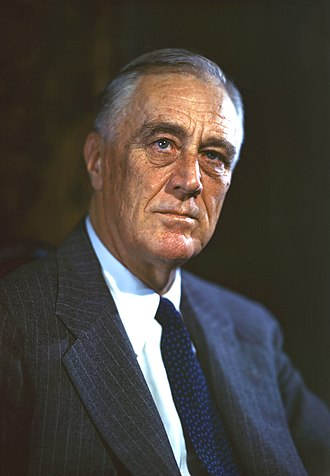
Nickname/Alias: FDR; President Roosevelt; The Squire of Hyde Park
Achievements: Led the United States through the Great Depression. Also pushed to get the US involved in World War II, and played an active role as Commander in Chief once America entered the war.
Born: January 30, 1882; Hyde Park, New York
Died: April 12, 1945; Warm Springs, Georgia
Field & Discipline: Government; Politics, Law; President
Language: English
Father: James Roosevelt
Mother: Sara Delano
Siblings: None
Spouse: Eleanor Roosevelt
Children: Anna Eleanor; James, Elliot; Franklin Delano Jr.; John Aspinwall (The sibling who passed away, born between James and Elliot, was also named Franklin Roosevelt Jr. The name was re-used when the surviving Jr. was born)
Education: Groton (prep school); Harvard, Columbia University
Major Work:
New Deal Legislation.
Life & Times:
Franklin Delano Roosevelt was born to James Roosevelt and Sara Delano on January 30, 1882. He grew up on his father’s estate, leading a fairly solitary yet privileged childhood. Much of his early education took place at home, and at age 14 he was sent to Groton, a prestigious prep school for boys located in Massachusetts. Afterwards he attended Harvard, where he earned his BA in 1903. Finally, he wrapped up his education at Columbia University Law School. He didn’t leave with a degree, but still passed the bar examination.
In 1905, FDR married his distant cousin Eleanor Roosevelt, who was also the niece of [related by marriage to] Theodore Roosevelt*. Together they had six children, five of whom survived infancy.
FDR gave up law in 1910 and got into politics, running for the New York State Senate. Running as a reform Democrat, working against “political bossism” and “machine politics,” he was elected and remained in the Senate until 1913.
In 1912, FDR supported the [supporter of] Woodrow Wilson* campaign for President, and as a reward, President Wilson made FDR Assistant Secretary of the Navy.
In 1920, the Democratic Party nominated FDR as vice-presidential running mate to presidential candidate James Cox. He had gained respect for his performance as Assistant Secretary of the Navy, and his name was becoming more and more widely known. However, the country had begun to view the progressive views of the Democrats in a less positive light, and as a result, the Republican candidate, Warren Harding, won the election.
Roosevelt decided to return to law practice, establishing himself on Wall Street as a corporate lawyer. In 1921 he contracted polio while vacationing on Campobello Island, New Brunswick. He suffered permanent paralysis in both legs, and despite efforts with exercise, therapy, and experimental treatments, was never able to walk again unassisted. In trying to find a cure, FDR founded the Georgia Warm Springs Foundation, located in Warm Springs, Georgia. The organization worked to treat those afflicted with polio and to develop a vaccine.
In 1928, FDR entered once again entered politics. This time he was called upon by New York Governor Al Smith, who was running for President in the 1928 election and wanted Roosevelt to run as his successor. Though his legs were no longer operational, FDR managed to stand up by gripping his podium while giving speeches during his campaign, so as to alleviate any concerns regarding his health.
In the end, Smith’s opponent, Herbert Hoover, won the Presidential election by a landslide. Nonetheless, after a long and arduous campaign, FDR won the Governor’s seat in New York.
From 1928 to 1932, Roosevelt served two terms as Governor. During this time he beefed up the regulatory capacity of the state government and also expanded several social programs. In response to the Great Depression, which had begun with the stock market crash of 1929, FDR worked to bring into being the New York State Unemployment Relief Act and the Temporary Emergency Relief Administration (TERA). These measures were intended to relieve the unemployment that had resulted from the onset of the depression.
On March 23, 1923, Roosevelt took the oath of office and became the 32nd President of the United States. At this point the effects of the Great Depression had the country in economic ruin and FDR began his “New Deal” program to get the country back on its feet. As part of the New Deal, Roosevelt had 15 major laws enacted within his first 100 days as president.
One such law was the Banking Act of 1933, which was meant to restore America’s faith in the country’s banking system. During one of his many radio fireside chats FDR assured the people that their investments would not be lost again, thanks to the new Federal Deposit Insurance Corporation (FDIC).
Other New Deal acts spawned such organizations as the Agricultural Adjustment Association (AAA), the Works Progress Administration (WPA) and the Civilian Conservation Corps. The purpose was to help the unemployed find jobs.
FDR appointed the young future president [employed] Lyndon B Johnson* head of an initiative known as the National Youth Administration in Texas.
One of the most important acts passed by the Roosevelt administration was the Social Security Act, established in 1935. This act established pension plans for the elderly and the disabled.
The work that Roosevelt did is not immune to criticism. Today, many people on both sides of the political spectrum believe that the New Deal was flawed. Liberal critics believe that it a step in the right direction, but did not pack the punch required to end the Depression. On the other hand, conservatives believe that his initiatives ultimately brought too much government into American business. Conservatives living at the time of FDR’s presidency were especially troubled, as FDR’s many social programs aggravated the concern of many Americans that the country was gradually adopting communism.
In the late 30’s and early 40’s, as fascism began to sweep across Europe, and after the bloodbath of World War I, many Americans believed it would be best to leave foreign wars to the countries involved. Roosevelt, however, pushed the U.S. to enter the fight against Germany.
He was certain that should Hitler, Mussolini, and their allies manage to dominate all of Europe, America would certainly be next. FDR’s view met opposition from many people, including celebrity and aviator Charles [opposed by] Lindbergh*, who insisted that the best course of action for the U.S. would be to maintain its isolationist philosophy.
Roosevelt began a Lend-Lease program that provided assistance, especially in the form of naval destroyers to Britain, employing the analogy of lending a neighbor a hose to put out a fire on his house to prevent it spreading.
Before the United States entered the war after Pearl Harbor, FDR began programs to rearm the country. Factories closed down since the Great Depression were now reopened and converted armaments, sold to America’s allies while the country was still neutral. Following America’s entry into World War II, FDR assembled a team of extraordinary generals and admirals, among them Dwight [employed] Eisenhower* and Douglas MacArthur.
He also organized an alliance to beat back the Nazi menace, collaborating with British Prime Minister Winston [worked with] Churchill* and Russian Premier Joseph [worked with] Stalin*.
After the attack on Pearl Harbor, many US citizens on the West Coast demanded that Japanese Americans on that seaboard be relocated as potential spies or even saboteurs. FDR signed Executive Order 9066, forcing the mass relocation of over 120,000 Japanese-American citizens to internment camps located farther inland. The President repealed the order in 1944, but by that time most of the internees had already lost their jobs, homes and businesses.
In 1945, as the power of the Axis began to dwindle and Allied victory seemed certain, Roosevelt returned home from a trip to the Crimean Peninsula for a meeting with Churchill and Stalin. The journey had been exhausting, and he visited Warm Springs to rest.
While having his portrait done, he suffered a massive stroke, thought to be induced largely by the stress of being a wartime president. Franklin Delano Roosevelt did not regain consciousness, and died in his sleep about two and a half hours later. His final resting place is in Hyde Park, New York.
EXTRA-CONNECTIONS:
He appointed Clarence [appointed] Darrow* to commission post.
He appointed [appointed] Vannevar Bush* to Aeronautics Committee
He appointed RE [appointed] Byrd* to Antarctic Survey
He heard from [heard from] Bohr* on nuclear issues.
His visit to Canada was arranged by John [Canada visit arranged by] Buchan*
He had difficulties with French General [had difficulties with] De Gaulle*
He worked with JB [worked with] Conant* on atomic bomb policy group.
He appointed WA [appointed to Recovery Program] Harriman*
He knew the work of [knew work of] Fermi*
[supported by] Mitchell A Palmer* was a supporter.
He instigated [instigated] Pan Am* airline
He worked with Russian Minister [worked with] Molotov*
An opponent was HL [opposed by] Mencken* , poet Ezra [opposed by] Pound*, CM [opposed by] Sheldon* , WA [opposed by] Wirth*
He furthered the work of [furthered work of] Rauschenbusch*
Was lobbied on the atomic bomb by [lobbied by] Teller*
The choreographer [invited to dance at White House] Martha Graham* performed for him at the White House.
Assessment: Franklin Roosevelt was 32nd President of the United States. He is the only American president to be elected to any more than two terms (he was elected to office four times).
Oneliner: F D Roosevelt, 32nd American President
Bibliography:
- Roosevelt’s life: http://www.feri.org/archives/fdrbio/newdeal.cfm,
- Roosevelt and Johnson: http://www.lnstar.com/mall/texasinfo/lbj.htm
- Lindbergh and Roosevelt: http://www.brothersjudd.com/index.cfm/fuseaction/reviews.detail/book_id/138
- Japanese internment, and Executive Order 9066: http://www.lib.utah.edu/spc/photo/9066/9066.htm