Ford, John
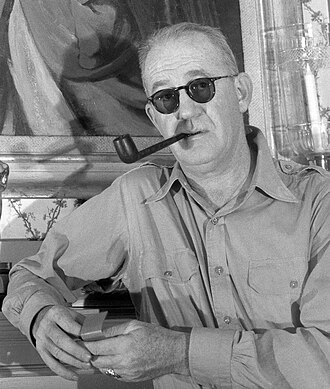
Ford, John
ACHIEVEMENTS: Oscar winner, one of Hollywood’s greatest and most versatile directors. Lifetime achievement award by the American Film Institute for his direction of 130 films, March 31, 1973.
NICKNAME/ALIAS: Sean Aloysius O'feeney, or O'fearna. Jack. John Feeney.
DATE AND PLACE OF BIRTH: Feb. 1, 1895. Cape Elizabeth, ME.
DATE/PLACE OF DEATH/AGE AT DEATH: Aug. 31, 1973 in Palm Desert, CA. Age 78
DISCIPLINE: Film
FIELD: Director
LANGUAGE: English
PARENTS: Father: Sean O'Fearna. Mother: Barbara "Abbey" Curran
SIBLINGS: Mary Agnes (Maime) 1879, Patrick 1880, Bridget (died in infancy), Francis 1883, Eddie 1885, Dorothy 1886 (died at age 2), Josephine 1892.
SPOUSE: Mary McBryde Smith (1920)
CHILDREN: Barbara, Patrick.
EDUCATION: Portland High School, Maine.
MAJOR WORK: Iron Horse(1924), The Informer(1935), The Grapes of Wrath(1940), How Green Was My Valley (1941), The Quiet Man (1952), and several other westerns.
LIFE AND TIMES:
Sean Aloysius O'Fearna, better known as John Ford, became one of Hollywood’s most celebrated directors with his distinctive directing style. His films were famous for their artistic vision and technical grace. He favored outdoor settings and chose to record the vast landscape, often at the expense of the actors.
Ford was born Feb. 1, 1895 in Cape Elizabeth, Maine into a large family of Irish immigrants. His parents, Sean O'Fearna, a seaman and saloon keeper, and Barbara "Abbey" Curran emigrated from Galway, Ireland and changed their name to O’Feeney. Ford’s life was full of name changes: his family name changed from O’Feeney to O’Fearna, his last name changed to Feeney and then to Ford, his first name changed from Sean to Jack, and (finally) he adopted the first name John.
The young Ford was interested in sailing and drawing, and worked as a seaman on a merchant ship during high school. Despite his parents’ encouragement to go to college, in 1914 Ford decided to follow his brother Frances to Hollywood. As “Jack” Ford he got a job as a property man at Universal studios and worked as a bit actor and assistant for his brother. This led to a position as an assistant director and work on westerns and other short films.
His first major role as an actor was as a Klansman in D.W. Griffith*’s The Birth of a Nation (1915) and as a director in 1917 with The Tornado (he wrote and starred).
Ford’s 1920 marriage to Mary McBryde Smith was a union of opposites. Smith was a member of the Daughters of the American Revolution and a Protestant from the Deep South. Ford’s Irish Catholic family didn’t like her or the fact that their ceremony wasn’t performed by a Catholic priest. The couple had two children, Barbara and Patrick.
In 1923 Ford moved to Fox studios and began to bill himself as John Ford. His first major success as a director came in 1924 with the film Iron Horse. This film told the tale of the first transcontinental railroad and won Ford critical acclaim and popular success.
Ford's first major success as a director was the historical drama The Iron Horse (1924), an epic account of the building of the First transcontinental railroad. It was a large, long and difficult production, filmed on location in the Sierra Nevada. The logistics were enormous—two entire towns were constructed, there were 5000 extras, 100 cooks, 2000 rail layers, a cavalry regiment, 800 Native Americans, 1300 bison, 2000 horses, 10,000 cattle and 50,000 properties, including the original stagecoach used by Horace Greeley, Wild Bill Hickok's derringer pistol and replicas of the "Jupiter" and "119" locomotives that met at Promontory Summit when the two ends of the line were joined on May 10, 1869.[24]
The movie’s $2 million in revenue laid the foundation for Ford’s future big-budget Westerns. Five years later Ford began work on the film Hangman’s House, where he employed the stunt-man Marion Michael Morrison.
Ford knew this actor had talent, but his name fell flat on the screen, so he renamed him John Wayne*. Friendship with Ford and small parts in his films ultimately made Wayne a star. After Ford’s 1939 film Stagecoach Wayne was guaranteed his place in American cinema and his popularity grew with each passing year.
Wayne reported that working with Ford was like working with an artist. It was as though he painted with his camera, creating one frame at a time. Ford also helped launch the career of another screen legend: Spencer Tracy, whose big break came when Ford saw him in the play *The Last Mile and was impressed with his skill. Ford persuaded Fox to sign him for his 1930 movie Up the River.
Ford began his lifetime collaboration with Dudley Nichols in 1930. Their films were popular and well-received, and included such hits as Men Without Women (1930), Arrowsmith(1932), The Lost Patrol (1934). Ultimately, Ford’s critical acclaim and reputation came on his own. His 1935 pet project The Informer, which starred Victor McLaughlin, won several Academy Awards, including one for Ford as best director. This film also won Best Picture in the New York Film Critics Award. This Oscar achievement was repeated in three subsequent films—The Grapes of Wrath (1940), How Green Was My Valley (1941), and The Quiet Man (1952).
Before WW II Ford made arrangements to join the U.S. Navy and train a documentary film unit to record the war. In 1941 he became the Chief of the Photographic Branch of the OSS Office of Strategic Services and recorded several naval battles, including one at Midway Island where he was injured.
In 1942 he released a documentary on this experience, aptly named The Battle at Midway Island, which won him an Oscar for Best Documentary. He also traveled to Europe as the head of an inter-service group organized to collect footage of Nazi Holocaust concentration camps later used at the Nuremberg trials.
For his work he received the Purple Heart, the Legion of Merit, and an Air Medal. Throughout his life he maintained his military connection as a naval reserve officer with the rank of Rear Admiral.
After the war he returned to making box-office films. Both his westerns and other genre films were characterized by Ford’s unique artistic vision. He tackled social issues, as well as entertained the masses. His works were characterized by concepts such as the tension between order and disorder, the inarticulate male hero who was part of a larger (inexpressive) male order, and underdeveloped female characters. Because he relied on the visual to convey his message, dialog was sparse in most of his films.
By the 1960s, Ford’s films had gone out of fashion. His conservative males with their rugged individualism clashed with the developing liberal spirit of the age. Ironically, his reputation with critics increased as his popularity with audiences decreased. On March 31, 1973 he was awarded the lifetime achievement award by the American Film Institute.
In a career of more than 50 years, Ford directed more than 140 films (although most of his silent films are now lost). Ford's work was held in high regard by his contemporaries, with Akira Kurosawa, Orson Welles and Ingmar Bergman naming him one of the greatest directors of all time.[3]
ASSESSMENT: Ford, the American motion-picture director, was Hollywood's best-known director of westerns and American epics.
EXTRA CONNECTIONS:
He followed in the footsteps of his multi-talented older brother Francis Ford, twelve years his senior, who had left home years earlier and had worked in vaudeville before becoming a movie actor. Francis played in hundreds of silent pictures for filmmakers such as Thomas Edison, Georges Méliès and Thomas Ince.
Ford's films used a 'stock company' of actors, far more so than many directors. Many famous stars appeared in at least two or more Ford films, including Harry Carey Sr., (the star of 25 Ford silent films), Will Rogers, John Wayne, Henry Fonda, Maureen O'Hara, James Stewart, Woody Strode, Richard Widmark, Victor McLaglen, Vera Miles and Jeffrey Hunter.
Ford's attitude to McCarthyism in Hollywood is expressed by a story told by Joseph L. Mankiewicz. A faction of the Directors Guild of America, led by Cecil B. DeMille, had tried to make it mandatory for every member to sign a loyalty oath. A whispering campaign was being conducted against Mankiewicz, then President of the Guild, alleging he had Communist sympathies. At a crucial meeting of the Guild, DeMille's faction spoke for four hours until Ford spoke against DeMille and proposed a vote of confidence in Mankiewicz, which was passed. His words were recorded by a stenographer:
My name's John Ford. I make Westerns. I don't think there's anyone in this room who knows more about what the American public wants than Cecil B. DeMille—and he certainly knows how to give it to them ...[looking at DeMille]But I don't like you, C. B. I don't like what you stand for and I don't like what you've been saying here tonight.[103]
Mankiewicz's version of events was contested in 2016, with the discovery of the court transcript, which was released as part of the Mankiewicz archives. Mankiewicz's account gives sole credit to Ford in sinking DeMille...
ONELINER: John Ford, Oscar-winning film director
BIBLIOGRAPHY:
Ford, Dan, Pappy: The Life of John Ford, New York: De Capo Press, 1998.
EB, ANB