De Gheyn
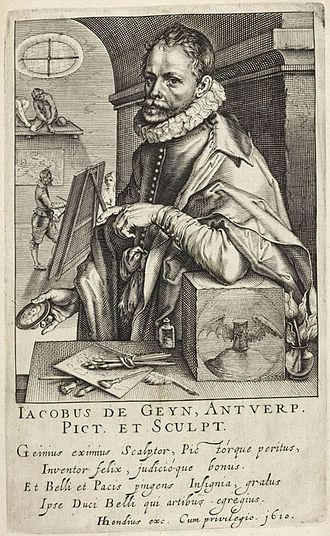
NAME: De Gheyn, Jakob
ACHIEVEMENTS: Action by numbers
NICKNAME/ALIAS:
None
DATE AND PLACE OF BIRTH:
c.1565, Antwerp, Netherlands
DATE AND PLACE OF DEATH AND AGE AT DEATH:
29 March 1629, The Hague, Netherlands. Aged around 64
DISCIPLINE: Art
FIELD: Engraver. Painter
LANGUAGE: Dutch
PARENTS:
Father: Jakob de Gheyn the Elder
Mother: name unknown
SIBLINGS:
2 brothers: Steven, Isaac
1 sister: Anna
SPOUSE:
Eva Stalparts van der Wielen
CHILDREN:
1 son: Jacques de Gheyn, jnr
EDUCATION:
Unknown
MAJOR WORK:
"The Exercise of Armes" (1607)
LIFE AND TIMES:
De Gheyn’s father was an artist who painted on glass and also worked as a miniaturist. De Gheyn followed him in both crafts and after his father’s death in 1582 continued to do so until 1585 when he began an apprenticeship with the engraver Hendrik Goltzius at Haarlem.
By 1591 de Gheyn was working as an independent craftsman in Amsterdam and was already making his name as an engraver of prints designed by others. His first important work was engravings of the Apostles from drawings by Carel van Mander. He then began to design his own work and was led to painting.
He began to do work for the government of the United Provinces (the States of Holland) and for the city of the Hague, mostly commemorating the scenes of battles where the Dutch overcame the Spaniards, who controlled the Southern Netherlands, such as the battle of Turhout on 24 January 1597. He also designed the front of a medal struck to commemorate the Dutch victory at Nieuwpoort in July 1600.
In 1594 De Gheyn appeared in a pageant in honour of Prince Maurice of Nassau*, the military head of the United Provinces. The following year, De Gheyn married and set up home in Leyden. He drew portraits of the wealthy citizens and University elite he mixed with, including the lawyer Hugo Grotius* whose portrait he engraved.
Prince Maurice was engaged in improving the Dutch army in preparation for an assault on the southern Netherlands, and around this time, De Gheyn was commissioned by a cousin of Maurice, Jan van Nassau-Siegen, to design a military manual for the use of captains and commanders on the correct use of fire-locks, muskets and pikes, as ordered by Maurice. De Gheyn produced an illustrated handbook book in which the illustrations are captioned with precise instructions, providing a drill for each weapon.
The book, dedicated to Maurice, was not published until 1607, probably because it was thought unwise to do so until the armistice with Spain had been declared. It was reprinted frequently, translated into French, German, English and Danish. Gustavus Adolphus* of Sweden developed Prince Maurice’s ideas about modernizing army tactics and they also influenced Prince Rupert* of the Rhine who fought for the English Crown in the Civil War of the 1640’s. The book was so clearly designed that it could easily be understood, even by those who couldn’t read, and it made a significant contribution to the increasing professionalism of the common soldier.
It is possible that De Gheyn knew Ludolf van Collen who was appointed by Prince Maurice to head the new school of engineering at Leyden and that this connection resulted in the commission he received in 1603 from Prince Maurice of Nassau to paint his famous grey stallion.
In the same year, De Gheyn moved to the Hague where he lived comfortably. He was interested in new inventions and made a print of Stevin’s* 26-passenger "Sailing Coach" for which he was paid by the government. In his last years he was employed as an architect by Prince Maurice for whom he designed a pavilion and court garden in the gardens of Maurice’s Palace in the Hague.
ASSESSMENT: Best remembered for his illustrated military manual.
EXTRA CONNECTIONS: He engraved a portrait of Brahe*
ONELINER: Jakob de Gheyn, who first introduced ‘action by numbers’
BIBLIOGRAPHY:
Alterna, JH van Regteren, The Drawings of Jacques de Gheyn, N V Swets & Zeitlinger, Amsterdam, 1936
De Gheyn, Jacob de, The Exercise of Armes, A Seventeenth Century Military Manual, England Language Edtn, Greenhill Books, London, 1986.