Brahe, Tyco
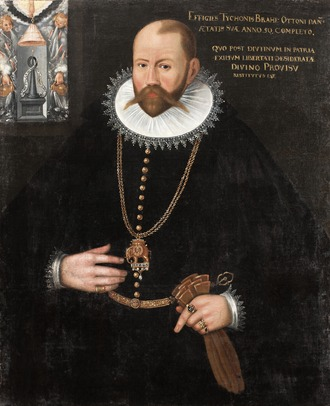
Tycho Brahe 2
Achievements: Produced a new solar system design
Born: December 14, 1546; Knudstrup, Scania, Denmark
Died: October 24, 1601; Prague, German Empire (Aged 55)
Field & Discipline: Astronomy
Language: Danish
Father: Otto Brahe
Mother: Beate Bille
Siblings: 4 brothers; 2 sisters
Spouse: Kirsten Jorgensdatter
Children: 8
Education: Private tutors; University of Copenhagen; University of Leipzig
Major Work:
"The new star" (1573)
"On the Most Recent Phenomena" (1588)
Life & Times:
At the age of fourteen, while studying law at Copenhagen, Brahe heard about the eclipse of the Sun, predicted for 21 August 1560. After he saw the eclipse he regularly stayed up at night observing the stars while continuing to study law by day.
He read the only astronomical book available to him (by [studied] Ptolemy*, the ancient Greek writer who believed in a geocentric universe) and he began to construct his own instruments for plotting and recording the movements of the stars. He entered Leipzig University in 1562 and in August 1563 he made his first recorded observation: a conjunction (an overlap) of Jupiter and Saturn. Brahe's astronomical investigations began to suggest that the existing literature on the solar system was inaccurate.
In 1543 the Polish astronomer [influenced by] Copernicus* had published a book which challenged the Ptolemaic view of a geocentric universe but even Copernican astronomical tables were not precise (they were several days out on the conjunction of Jupiter and Saturn). Brahe decided that he would spend his life making astronomical observations in order to produce an accurate map of the sky.
He left Leipzig in 1565 and spent the next five to seven years travelling in Europe. He studied at Wittenberg, Ausburg, Basel and at Rostock where he fought a duel which injured his nose so badly that he wore a metal replacement for the rest of his life. As he travelled, Brahe searched for the best mathematical and astronomical instruments and by the time he returned to Scania in 1571-2, he had acquired a giant quadrant and an impressive collection of instruments. His aristocratic background gave him access to court life and he established a good relationship with King Frederick II, who was keen to foster education and to attract scholars to Denmark.
At Herrevad Abbey, Brahe and one of his mother’s brothers established a scientific and technological complex that included an instrument factory, paper mill, glassworks, chemical laboratory and observatory.
On 11 November 1572 Brahe made his most famous astronomical observation when he saw a nova. It was brighter than Venus and appeared in the constellation Casssiopeia. His observations and measurements showed that the new star was positioned beyond the Moon and was in the area of fixed stars (a region which was supposed to be of unchanging perfection). This was the first empirical evidence that change occurred in the sky.
The following year, Brahe published his findings in "De nova stella". They had the same disturbing effect as Copernicus's suggestion that the universe was sun-centered. Both Brahe and Copernicus were challenging the order of the universe as decreed by [questioned] Aristotle* and accepted by the Church. This divine order had for centuries been the symbol of harmony and perfection. To question it was considered blasphemous by many.
Brahe was now established in the first rank of astronomers and began to plan a larger observatory. When Frederick II found out that Brahe was proposing to site his observatory in Germany he induced him to stay in Denmark by giving him the island of Hven, in the middle of the Danish Sound, and enough lucrative sinecures to pay for the building works.
The cornerstone of the new observatory of Hven was provided and laid by the French envoy to Denmark, [a pal was] De Dancay* 1576 at a ceremony attended by many of Brahe's scholarly friends. The site was named Uraniborg, after Urania, the muse of astronomy, and Uraniborg became a gathering place for scholars and enthusiasts. Brahe also set up a printing shop for publication of his manuscripts; he employed craftsmen from Augsburg to make astronomical instruments, and artists and architects from Italy and Holland.
On 13 November 1577 he experienced the second great astronomical event of his life when he observed a comet, while fishing at dusk in one of his ponds. He later provided proof that the orbit of the comet lay beyond the moon and published his findings in. He also made a study of the solar system and he produced his own astronomical system in which the planets revolved around the Sun while the Sun moved around a fixed Earth.
He kept up an extensive correspondence with scholars, instrument makers, and astronomers such as [corresponded with] Maestlin*. In 1595 the Dutch cartographer [worked with] Blaeuw* spent six months at Urania copying Brahe's unpublished stellar positions onto a celestial globe and making a map of the heavens.
Frederick had been succeeded by Christian IV who was not as friendly to Brahe and the relationship between them declined as funds for the upkeep of Urania grew scarce. Finally, in 1597, Brahe and his family left Hven and after staying in Rostock and at Wandsbeck, near Hamburg, they settled in Prague in 1599 where they lived under the patronage of the Emperor Rudolf II.
[assistant was] Kepler* became one of Brahe's assistants in Prague, as did the mathematician [assistant was] Snell*. At Brahe’s death not long after, he left all his material to Kepler.
Extra Connections:
In 1586 his portrait was engraved by [portrait engraved by] De Gheyn*
His work related to that of [work related to] Al Battani*, and [work related to] T. Bartholin*
Influenced by [influenced by] Regiomontanus*
His biography was written by [biography by] Brewster* and by [biography by] Gassendi*
His observatory was used by [observatory used by] Peiresc*
He disproved the theory of [disproved theory of] Peuerbach*
Possibly anticipated by [anticipated by] Reinhold*
His manuscripts were edited by [work edited by] Romer*
His solar system was used by [used by] Scaliger*
Influenced by [influenced by] Witelo*
Uraniborg’s position was calculated by [work related to] Picard*
Assessment: Brahe's astronomical observations, which until the advent of the telescope were the most accurate ever made, laid the foundations for future discoveries and more accurate predictions of astronomical phenomena.
Oneliner: Tycho Brahe, astronomer and innovator
Bibliography:
- Christianson, John Robert, On Tycho's Island, Cambridge University Press, Cambridge, 2000.
- Thoren, Victor E, The Lord of Uraniborg, Cambridge University press, Cambridge, 1990.