Gustavus Adolphus
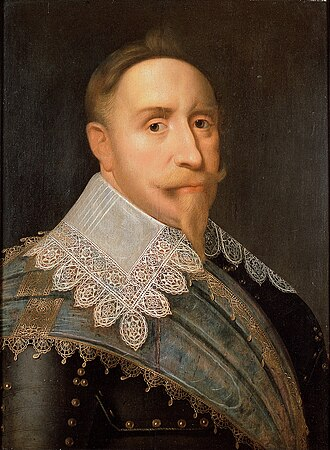
Name: Gustav II of Sweden
Nickname/Alias: born Gustavus Adolphus; Lion of the North
Achievements: 17th century King of Sweden, leading Protestant royal in Europe, and military innovator.
Born: December 9, 1594; Stockholm, Sweden
Died: November 6, 1632; Lutzen, Germany (Aged 38)
Field & Discipline: Royalty; Military; Monarch; Commander
Language: Swedish
Father: Charles IX of Sweden
Mother: Christina of Holstein
Siblings: Names unknown
Spouse: Maria Eleonora of Brandenburg
Children: 1 daughter: Christina
Education: Private tutors
Life & Times:
Gustavus’ early military studies included modern developments in the art of warfare like the tactical innovations of Prince [improved tactics of] Maurice of Nassau. The strongest influence on Gustavus's foreign policy was his desire to bolster Sweden's income from trade, and to guarantee security.
He ended the war with Denmark with the Peace of Knared in 1613 but at a huge cost in indemnity payments for which Alvsborg, the only Swedish port in the North Sea, was ceded to the Danes.
Gustavus increasingly concentrated on an attempt to prevent Russia from gaining direct access by sea to the west, in the hope that Russian trade would then be channelled through Swedish middlemen. By the Peace of Stolbova which ended the war in 1617, Sweden gained Ingria and Kexholm which meant that Finland was connected with the Swedish province of Estonia and the Russians were cut off from the Baltic. The expected trade bonus did not happen but Gustavus's reputation rose and he gained valuable military experience in the field.
In 1620, while visiting Germany to arrange his marriage, Gustavus toured the courts of the Protestant rulers, some of whom had already tried to enlist his aid in a defensive alliance against the Catholic powers. He formed a poor opinion of them and thought even less of their military competence.
At the end of 1620 he married the daughter of the Elector of Brandenburg, the ruler of the second most important Lutheran state in Germany. Their daughter ([daughter was] Queen Christina of Sweden*) eventually succeeded Gustavus.
The following year he captured the Polish port of Riga and continued to campaign on Polish territory with the aim of getting the Polish king, Sigismund, to renounce his claim to the Swedish throne.
At home Gustavus initiated reforms in education with a system of secondary education, he endowed the University of Uppsala and founded the University of Dorpat (now Tartu) where Baltic languages were studied at degree level for the first time.
In 1626 Gustavus extended his military campaigns into Prussian territory, hoping that by controlling the River Vistula he could cut off one of Poland's main export routes to western Europe.
Gustavus still held back from taking his forces into Germany because he distrusted the commitment of the German Protestants. His own war machine was becoming daily more efficient, as built a great many ships, standardized the calibre of their guns, organised regular recruiting and training and created a professional class of naval officers. In the army, he reformed conscription for the infantry and the artillery and offered inducements to the nobility who supplied the cavalry. Weapons were standardized, with an emphasis on simplification and increased mobility.
Gustavus personally supervised experiments for a 3-pounder which needed only one horse, or two or three men, to move it (because the ball was wired to a cartridge it had unprecedented rapidity of fire).
He introduced new tactics, developed from the tactical flexibility introduced by Prince Maurice, and troops were drilled to a standard never seen before. Gustavus worked out the best way that the different fighting units cavalry, infantry with pikes, musketeers, and artillery could support each other.
He invented the salvo, where musketeers in alternate platoons or ranks fired simultaneously. This, in turn, gave the gunners time to reload. Gustavus attached musketeers to his cavalry units for the same reason.
He transformed the use of artillery, previously set up at a fixed point where it remained throughout an engagement, by moving his guns during combat to give support to the musketeers.
Rules of conduct were drawn up with a clear structure of command which ensured direct orders from the monarch must be obeyed.
In 1628 a joint Danish and Swedish force saved Straslund, the last Protestant territory in Pomerania, from capture by the Catholics, and in 1629 the Truce of Altmark ended Sweden's war with Poland. Gustavus was now free to fight in Germany but he was still without major allies.
In September 1631, Swedish-Saxon forces defeated the Catholic armies at Breitenfeld in a victory which marked the beginning of a new type of warfare. By the end of the year Gustavus was at Mainz with most of northern and central Germany under his control. His demands for indemnity from the German rulers now went beyond monetary ompensation and included territory.
The campaign in the south during 1632 opened with Gustavus leading six different armies and occupying territory from Silesia to the upper Rhine. His strategy was to storm through Bavaria and occupy Swabia, which would give him the resources he needed to make an assault on Vienna.
In April he made a crossing of the river Lech into Bavaria, beyond which the Emperor's forces were waiting for him. Gustavus employed text-book tactics, superbly executed (diversionary attacks, smoke screens, artillery barrage, and a technical innovation of a floating bridge almost at water level which reduced the vulnerability to enemy fire). He occupied Augsburg but was forced to leave Bavaria when the imperial armies threatened the city of Nurnberg.
Poor intelligence resulted in an unsuccessful attack on the entrenched imperial forces at Alte Veste in which his army suffered big losses. Some weeks later, the two armies met at Lutzen on 6 November 1632. Gustavus planned a dawn attack but was frustrated by a dense mist.
The Swedes won the battle but Gustavus was shot in the back after he became separated from his escort while leading a cavalry charge.
Extra Connections:
Gustavus Adolphus is known as the "father of modern warfare",[9] or the first modern general. Spoils meant he became a successful bookraider in Europe, targeting Jesuit collections.[10]...Future commanders who studied and admired Gustavus Adolphus include Napoleon I of France and Carl von Clausewitz. His advancements in warfare made Sweden the dominant Baltic power for the next hundred years (see Swedish Empire). He is also the only Swedish monarch to be styled "the Great.”
Gave [fiscally inspired] Charles I King* of England fiscal inspiration.
His tactics taught to [studied by] James Graham Marquis of Montrose*
Employed [hired] Guericke*
Influenced [influenced] John Dury*, [influenced] Andreae* and [influenced] Prince Rupert*
Used [used work of] De Gheyn’s* musket drill books
Met [met] Harrington*
Assessment: The intervention of Gustavus Adolphus in Germany saved Protestantism from being crushed by the forces of the Counter Reformation. His military innovations transformed the exercise of war, and his domestic reforms made Sweden a European power.
Oneliner: Gustavus Adolphus of Sweden, military innovator
Bibliography:
- Roberts, Michael, Gustavus Adolphus and the Rise of Sweden, The English Universities Press Ltd., London, 1973.