Cleopatra
Cleopatra VII Thea Philopator (Koinē Greek: Κλεοπάτρα Θεά Φιλοπάτωρ,[a] lit. Cleopatra "father-loving goddess";[note 5] 70/69 BC – 10 August 30 BC) was Queen of the Ptolemaic Kingdom of Egypt from 51 to 30 BC, and its last active ruler.[note 6] A member of the Ptolemaic dynasty, she was a descendant of its founder Ptolemy I Soter, a Macedonian Greek general and companion of Alexander the Great.[note 7] After the death of Cleopatra, Egypt became a province of the Roman Empire, marking the end of the last Hellenistic period state in the Mediterranean and of the age that had lasted since the reign of Alexander (336–323 BC).[note 8] Her first language was Koine Greek and she is the only known Ptolemaic ruler to learn the Egyptian language.[note 9]
In 58 BC, Cleopatra presumably accompanied her father, Ptolemy XII Auletes, during his exile to Rome after a revolt in Egypt (a Roman client state) allowed his rival daughter Berenice IV to claim his throne. Berenice was killed in 55 BC when Ptolemy returned to Egypt with Roman military assistance. When he died in 51 BC, the joint reign of Cleopatra and her brother Ptolemy XIII began, but a falling-out between them led to open civil war. After losing the 48 BC Battle of Pharsalus in Greece against his rival Julius Caesar (a Roman dictator and consul) in Caesar's civil war, the Roman statesman Pompey fled to Egypt. Pompey had been a political ally of Ptolemy XII, but Ptolemy XIII, at the urging of his court eunuchs, had Pompey ambushed and killed before Caesar arrived and occupied Alexandria.
Caesar then attempted to reconcile the rival Ptolemaic siblings, but Ptolemy's chief adviser, Potheinos, viewed Caesar's terms as favoring Cleopatra, so his forces besieged her and Caesar at the palace. Shortly after the siege was lifted by reinforcements, Ptolemy XIII died in the Battle of the Nile; Cleopatra's half-sister Arsinoe IV was eventually exiled to Ephesus for her role in carrying out the siege. Caesar declared Cleopatra and her brother Ptolemy XIV joint rulers but maintained a private affair with Cleopatra that produced a son, Caesarion. Cleopatra traveled to Rome as a client queen in 46 and 44 BC, where she stayed at Caesar's villa. After the assassination of Caesar and (on her orders) Ptolemy XIV in 44 BC, she named Caesarion co-ruler as Ptolemy XV.
In the Liberators' civil war of 43–42 BC, Cleopatra sided with the Roman Second Triumvirate formed by Caesar's grandnephew and heir Octavian, Mark Antony, and Marcus Aemilius Lepidus. After their meeting at Tarsos in 41 BC, the queen had an affair with Antony. He carried out the execution of Arsinoe at her request, and became increasingly reliant on Cleopatra for both funding and military aid during his invasions of the Parthian Empire and the Kingdom of Armenia. The Donations of Alexandria declared their children Alexander Helios, Cleopatra Selene II, and Ptolemy Philadelphus rulers over various erstwhile territories under Antony's triumviral authority.
This event, their marriage, and Antony's divorce of Octavian's sister Octavia Minor led to the final war of the Roman Republic. Octavian engaged in a war of propaganda, forced Antony's allies in the Roman Senate to flee Rome in 32 BC, and declared war on Cleopatra. After defeating Antony and Cleopatra's naval fleet at the 31 BC Battle of Actium, Octavian's forces invaded Egypt in 30 BC and defeated Antony, leading to Antony's suicide. When Cleopatra learned that Octavian planned to bring her to his Roman triumphal procession, she killed herself by poisoning, contrary to the popular belief that she was bitten by an asp.
Cleopatra's legacy survives in ancient and modern works of art. Roman historiography and Latin poetry produced a generally critical view of the queen that pervaded later Medieval and Renaissance literature. In the visual arts, her ancient depictions include Roman busts, paintings, and sculptures, cameo carvings and glass, Ptolemaic and Roman coinage, and reliefs. In Renaissance and Baroque art, she was the subject of many works including operas, paintings, poetry, sculptures, and theatrical dramas. She has become a pop culture icon of Egyptomania since the Victorian era, and in modern times, Cleopatra has appeared in the applied and fine arts, burlesque satire, Hollywood films, and brand images for commercial products.
- Etymology
- Biography
- Cleopatra's kingdom and role as a monarch
- Legacy
- Ancestry
- See also
- Notes
- References
- Further reading
- External links
Etymology
The Latinized form Cleopatra comes from the Ancient Greek Kleopátra (Κλεοπάτρα), meaning "glory of her father",[7] from κλέος (kléos, "glory") and πατήρ (patḗr, "father").[8] The masculine form would have been written either as Kleópatros (Κλεόπατρος) or Pátroklos (Πάτροκλος).[8] Cleopatra was the name of Alexander the Great's sister, as well as Cleopatra Alcyone, wife of Meleager in Greek mythology.[9] Through the marriage of Ptolemy V Epiphanes and Cleopatra I Syra (a Seleucid princess), the name entered the Ptolemaic dynasty.[10][11] Cleopatra's adopted title Theā́ Philopátōra (Θεᾱ́ Φιλοπάτωρα) means "goddess who loves her father".[12][13][note 10]
Biography
Background
 Hellenistic portrait of Ptolemy XII Auletes, the father of Cleopatra, located in the Louvre, Paris[14]
Ptolemaic pharaohs were crowned by the Egyptian high priest of Ptah at Memphis, but resided in the multicultural and largely Greek city of Alexandria, established by Alexander the Great of Macedon.[15][16][17][note 11] They spoke Greek and governed Egypt as Hellenistic Greek monarchs, refusing to learn the native Egyptian language.[18][19][20][note 9]
In contrast, Cleopatra could speak multiple languages by adulthood and was the first Ptolemaic ruler known to learn the Egyptian language.[21][22][20][note 12] Plutarch implies that she also spoke Ethiopian, the language of the "Troglodytes", Hebrew (or Aramaic), Arabic, the Syrian language (perhaps Syriac), Median, and Parthian, and she could apparently also speak Latin, although her Roman contemporaries would have preferred to speak with her in her native Koine Greek.[22][20][23][note 13] Aside from Greek, Egyptian, and Latin, these languages reflected Cleopatra's desire to restore North African and West Asian territories that once belonged to the Ptolemaic Kingdom.[24]
Roman interventionism in Egypt predated the reign of Cleopatra.[25][26][27] When Ptolemy IX Lathyros died in late 81 BC, he was succeeded by his daughter Berenice III.[28][29] With opposition building at the royal court against the idea of a sole reigning female monarch, Berenice III accepted joint rule and marriage with her cousin and stepson Ptolemy XI Alexander II, an arrangement made by the Roman dictator Sulla.[28][29] Ptolemy XI had his wife killed shortly after their marriage in 80 BC, and was lynched soon after in the resulting riot over the assassination.[28][30][31]
Ptolemy XI, and perhaps his uncle Ptolemy IX or father Ptolemy X Alexander I, willed the Ptolemaic Kingdom to Rome as collateral for loans, so that the Romans had legal grounds to take over Egypt, their client state, after the assassination of Ptolemy XI.[28][32][33] The Romans chose instead to divide the Ptolemaic realm among the illegitimate sons of Ptolemy IX, bestowing Cyprus on Ptolemy of Cyprus and Egypt on Ptolemy XII Auletes.[28][30]
Early childhood
Main article: Early life of Cleopatra
Cleopatra VII was born in early 69 BC to the ruling Ptolemaic pharaoh Ptolemy XII and an uncertain mother,[34][35][note 14] presumably Ptolemy XII's wife Cleopatra V Tryphaena (who may have been the same person as Cleopatra VI Tryphaena),[36][37][38][note 15][note 3] the mother of Cleopatra's older sister, Berenice IV Epiphaneia.[39][40][41][note 16]
Cleopatra Tryphaena disappears from official records a few months after the birth of Cleopatra in 69 BC.[42][43] The three younger children of Ptolemy XII, Cleopatra's sister Arsinoe IV and brothers Ptolemy XIII Theos Philopator and Ptolemy XIV,[39][40][41] were born in the absence of his wife.[44][45] Cleopatra's childhood tutor was Philostratos, from whom she learned the Greek arts of oration and philosophy.[46] During her youth Cleopatra presumably studied at the Musaeum, including the Library of Alexandria.[47][48]
Reign and exile of Ptolemy XII
Main article: Early life of Cleopatra
Further information: First Triumvirate
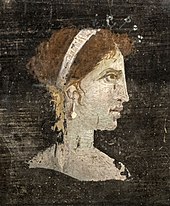
Most likely a posthumously painted portrait of Cleopatra with red hair and her distinct facial features, wearing a royal diadem and pearl-studded hairpins, from Roman Herculaneum, Italy, 1st century AD.
In 65 BC the Roman censor Marcus Licinius Crassus argued before the Roman Senate that Rome should annex Ptolemaic Egypt, but his proposed bill and the similar bill of tribune Servilius Rullus in 63 BC were rejected.[51][52] Ptolemy XII responded to the threat of possible annexation by offering remuneration and lavish gifts to powerful Roman statesmen, such as Pompey during his campaign against Mithridates VI of Pontus, and eventually Julius Caesar after he became Roman consul in 59 BC.[53][54][55][note 18] However, Ptolemy XII's profligate behavior bankrupted him, and he was forced to acquire loans from the Roman banker Gaius Rabirius Postumus.[56][57][58]
In 58 BC the Romans annexed Cyprus and on accusations of piracy drove Ptolemy of Cyprus, Ptolemy XII's brother, to commit suicide instead of enduring exile to Paphos.[59][60][58][note 19] Ptolemy XII remained publicly silent on the death of his brother, a decision which, along with ceding traditional Ptolemaic territory to the Romans, damaged his credibility among subjects already enraged by his economic policies.[59][61][62] Ptolemy XII was then exiled from Egypt by force, traveling first to Rhodes, then Athens, and finally the villa of triumvir Pompey in the Alban Hills, near Praeneste, Italy.[59][60][63][note 20]
Ptolemy XII spent nearly a year there on the outskirts of Rome, ostensibly accompanied by his daughter Cleopatra, then about 11.[59][63][note 21] Berenice IV sent an embassy to Rome to advocate for her rule and oppose the reinstatement of her father Ptolemy XII. Ptolemy had assassins kill the leaders of the embassy, an incident that was covered up by his powerful Roman supporters.[64][57][65][note 22] When the Roman Senate denied Ptolemy XII the offer of an armed escort and provisions for a return to Egypt, he decided to leave Rome in late 57 BC and reside at the Temple of Artemis in Ephesus.[66][67][68]
The Roman financiers of Ptolemy XII remained determined to restore him to power.[69] Pompey persuaded Aulus Gabinius, the Roman governor of Syria, to invade Egypt and restore Ptolemy XII, offering him 10,000 talents for the proposed mission.[69][70][71] Although it put him at odds with Roman law, Gabinius invaded Egypt in the spring of 55 BC by way of Hasmonean Judea, where Hyrcanus II had Antipater the Idumaean, father of Herod the Great, furnish the Roman-led army with supplies.[69][72]
As a young cavalry officer, Mark Antony was under Gabinius's command.[73] He distinguished himself by preventing Ptolemy XII from massacring the inhabitants of Pelousion, and for rescuing the body of Archelaos, the husband of Berenice IV, after he was killed in battle, ensuring him a proper royal burial.[74][75] Cleopatra, then 14 years of age, would have traveled with the Roman expedition into Egypt; years later, Antony would profess that he had fallen in love with her at this time.[74][76]

The Roman Republic (green) and Ptolemaic Egypt (yellow) in 40 BC
Gabinius was put on trial in Rome for abusing his authority, for which he was acquitted, but his second trial for accepting bribes led to his exile, from which he was recalled seven years later in 48 BC by Caesar.[77][78] Crassus replaced him as governor of Syria and extended his provincial command to Egypt, but he was killed by the Parthians at the Battle of Carrhae in 53 BC.[77][79] Ptolemy XII had Berenice IV and her wealthy supporters executed, seizing their properties.[80][81][82] He allowed Gabinius's largely Germanic and Gallic Roman garrison, the Gabiniani, to harass people in the streets of Alexandria and installed his longtime Roman financier Rabirius as his chief financial officer.[80][83][84][note 23]
Within a year Rabirius was placed under protective custody and sent back to Rome after his life was endangered for draining Egypt of its resources.[85][86][82][note 24] Despite these problems, Ptolemy XII created a will designating Cleopatra and Ptolemy XIII as his joint heirs, oversaw major construction projects such as the Temple of Edfu and a temple at Dendera, and stabilized the economy.[87][86][88][note 25] On 31 May 52 BC, Cleopatra was made a regent of Ptolemy XII, as indicated by an inscription in the Temple of Hathor at Dendera.[89][90][91][note 26] Rabirius was unable to collect the entirety of Ptolemy XII's debt by the time of the latter's death, and so it was passed on to his successors Cleopatra and Ptolemy XIII.[85][78]
Accession to the throne
Main articles: Early life of Cleopatra and Reign of Cleopatra

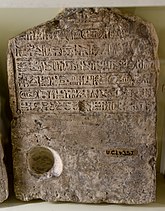
Top: Cleopatra dressed as a pharaoh and presenting offerings to the goddess Isis, on a limestone stele dedicated by a Greek man named Onnophris, dated 51 BC, and located in the Louvre, Paris
Bottom: The cartouches of Cleopatra and Caesarion on a limestone stele of the High Priest of Ptah in Egypt, dated to the Ptolemaic period, and located in the Petrie Museum of Egyptian Archaeology, London
Ptolemy XII died sometime before 22 March 51 BC, when Cleopatra, in her first act as queen, began her voyage to Hermonthis, near Thebes, to install a new sacred Buchis bull, worshiped as an intermediary for the god Montu in the Ancient Egyptian religion.[92][93][94][note 27] Cleopatra faced several pressing issues and emergencies shortly after taking the throne. These included famine caused by drought and a low level of the annual flooding of the Nile, and lawless behavior instigated by the Gabiniani, the now unemployed and assimilated Roman soldiers left by Gabinius to garrison Egypt.[95][96] Inheriting her father's debts, Cleopatra also owed the Roman Republic 17.5 million drachmas.[97]
In 50 BC Marcus Calpurnius Bibulus, proconsul of Syria, sent his two eldest sons to Egypt, most likely to negotiate with the Gabiniani and recruit them as soldiers in the desperate defense of Syria against the Parthians.[98] The Gabiniani tortured and murdered these two, perhaps with secret encouragement by rogue senior administrators in Cleopatra's court.[98][99] Cleopatra sent the Gabiniani culprits to Bibulus as prisoners awaiting his judgment, but he sent them back to Cleopatra and chastised her for interfering in their adjudication, which was the prerogative of the Roman Senate.[100][99] Bibulus, siding with Pompey in Caesar's Civil War, failed to prevent Caesar from landing a naval fleet in Greece, which ultimately allowed Caesar to reach Egypt in pursuit of Pompey.[100]
By 29 August 51 BC, official documents started listing Cleopatra as the sole ruler, evidence that she had rejected her brother Ptolemy XIII as a co-ruler.[97][99][101] She had probably married him,[79] but there is no record of this.[92] The Ptolemaic practice of sibling marriage was introduced by Ptolemy II and his sister Arsinoe II.[102][103][104] A long-held royal Egyptian practice, it was loathed by contemporary Greeks.[102][103][104][note 28] By the reign of Cleopatra, however, it was considered a normal arrangement for Ptolemaic rulers.[102][103][104]
Despite Cleopatra's rejection of him, Ptolemy XIII still retained powerful allies, notably the eunuch Potheinos, his childhood tutor, regent, and administrator of his properties.[105][96][106] Others involved in the cabal against Cleopatra included Achillas, a prominent military commander, and Theodotus of Chios, another tutor of Ptolemy XIII.[105][107] Cleopatra seems to have attempted a short-lived alliance with her brother Ptolemy XIV, but by the autumn of 50 BC Ptolemy XIII had the upper hand in their conflict and began signing documents with his name before that of his sister, followed by the establishment of his first regnal date in 49 BC.[92][108][109][note 29]
Assassination of Pompey
Main article: Reign of Cleopatra
In the summer of 49 BC, Cleopatra and her forces were still fighting against Ptolemy XIII within Alexandria when Pompey's son Gnaeus Pompeius arrived, seeking military aid on behalf of his father.[108] After returning to Italy from the wars in Gaul and crossing the Rubicon in January of 49 BC, Caesar had forced Pompey and his supporters to flee to Greece.[110][111] In perhaps their last joint decree, both Cleopatra and Ptolemy XIII agreed to Gnaeus Pompeius's request and sent his father 60 ships and 500 troops, including the Gabiniani, a move that helped erase some of the debt owed to Rome.[110][112] Losing the fight against her brother, Cleopatra was then forced to flee Alexandria and withdraw to the region of Thebes.[113][114][115] By the spring of 48 BC Cleopatra had traveled to Roman Syria with her younger sister, Arsinoe IV, to gather an invasion force that would head to Egypt.[116][109][117] She returned with an army, but her advance to Alexandria was blocked by her brother's forces, including some Gabiniani mobilized to fight against her, so she camped outside Pelousion in the eastern Nile Delta.[118][109][119]
In Greece, Caesar and Pompey's forces engaged each other at the decisive Battle of Pharsalus on 9 August 48 BC, leading to the destruction of most of Pompey's army and his forced flight to Tyre, Lebanon.[118][120][121][note 30] Given his close relationship with the Ptolemies, Pompey ultimately decided that Egypt would be his place of refuge, where he could replenish his forces.[122][121][119][note 31] Ptolemy XIII's advisers, however, feared the idea of Pompey using Egypt as his base in a protracted Roman civil war.[122][123][124]
In a scheme devised by Theodotus, Pompey arrived by ship near Pelousion after being invited by a written message, only to be ambushed and stabbed to death on 28 September 48 BC.[122][120][125][note 32] Ptolemy XIII believed he had demonstrated his power and simultaneously defused the situation by having Pompey's head, severed and embalmed, sent to Caesar, who arrived in Alexandria by early October and took up residence at the royal palace.[126][127][128][note 32] Caesar expressed grief and outrage over the killing of Pompey and called on both Ptolemy XIII and Cleopatra to disband their forces and reconcile with each other.[126][129][128][note 33]
Relationship with Julius Caesar
Main article: Reign of Cleopatra
Further information: Military campaigns of Julius Caesar, Siege of Alexandria (47 BC), Battle of the Nile (47 BC), and Caesareum of Alexandria
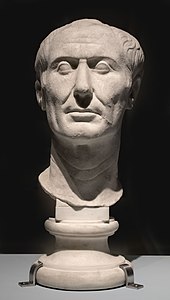 The Tusculum portrait, a contemporary Roman sculpture of Julius Caesar
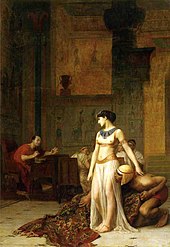 Cleopatra and Caesar* (1866), a painting by Jean-Léon Gérôme
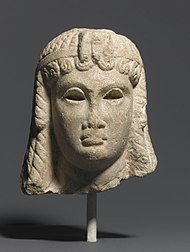
An Egyptian portrait of a Ptolemaic queen, possibly Cleopatra, c. 51–30 BC, located in the Brooklyn Museum[130]
Ptolemy XIII arrived at Alexandria at the head of his army, in clear defiance of Caesar's demand that he disband and leave his army before his arrival.[131][132] Cleopatra initially sent emissaries to Caesar, but upon allegedly hearing that Caesar was inclined to having affairs with royal women, she came to Alexandria to see him personally.[131][133][132] Historian Cassius Dio records that she did so without informing her brother, dressed in an attractive manner, and charmed Caesar with her wit.[131][134][135] Plutarch provides an entirely different account that alleges she was bound inside a bed sack to be smuggled into the palace to meet Caesar.[131][136][137][note 34]
When Ptolemy XIII realized that his sister was in the palace consorting directly with Caesar, he attempted to rouse the populace of Alexandria into a riot, but he was arrested by Caesar, who used his oratorical skills to calm the frenzied crowd.[138][139][140] Caesar then brought Cleopatra and Ptolemy XIII before the assembly of Alexandria, where Caesar revealed the written will of Ptolemy XII—previously possessed by Pompey—naming Cleopatra and Ptolemy XIII as his joint heirs.[141][139][133][note 35] Caesar then attempted to arrange for the other two siblings, Arsinoe IV and Ptolemy XIV, to rule together over Cyprus, thus removing potential rival claimants to the Egyptian throne while also appeasing the Ptolemaic subjects still bitter over the loss of Cyprus to the Romans in 58 BC.[142][139][143][note 35]
Judging that this agreement favored Cleopatra over Ptolemy XIII and that the latter's army of 20,000, including the Gabiniani, could most likely defeat Caesar's army of 4,000 unsupported troops, Potheinos decided to have Achillas lead their forces to Alexandria to attack both Caesar and Cleopatra.[142][139][144][note 36] After Caesar managed to execute Potheinos, Arsinoe IV joined forces with Achillas and was declared queen, but soon afterward had her tutor Ganymedes kill Achillas and take his position as commander of her army.[145][146][147][note 37] Ganymedes then tricked Caesar into requesting the presence of the erstwhile captive Ptolemy XIII as a negotiator, only to have him join the army of Arsinoe IV.[145][148][149] The resulting siege of the palace, with Caesar and Cleopatra trapped together inside, lasted into the following year of 47 BC.[150][129][151][note 38]
Sometime between January and March of 47 BC, Caesar's reinforcements arrived, including those led by Mithridates of Pergamon and Antipater the Idumaean.[145][129][152][note 39] Ptolemy XIII and Arsinoe IV withdrew their forces to the Nile, where Caesar attacked them. Ptolemy XIII tried to flee by boat, but it capsized, and he drowned.[153][129][154][note 40] Ganymedes may have been killed in the battle. Theodotus was found years later in Asia, by Marcus Junius Brutus, and executed. Arsinoe IV was forcefully paraded in Caesar's triumph in Rome before being exiled to the Temple of Artemis at Ephesus.[155][156][157] Cleopatra was conspicuously absent from these events and resided in the palace, most likely because she had been pregnant with Caesar's child since September 48 BC.[158][159][160]
Caesar's term as consul had expired at the end of 48 BC.[155] However, Antony, an officer of his, helped to secure Caesar's appointment as dictator lasting for a year, until October 47 BC, providing Caesar with the legal authority to settle the dynastic dispute in Egypt.[155] Wary of repeating the mistake of Cleopatra's sister Berenice IV in having a female monarch as sole ruler, Caesar appointed Cleopatra's 12-year-old brother, Ptolemy XIV, as joint ruler with the 22-year-old Cleopatra in a nominal sibling marriage, but Cleopatra continued living privately with Caesar.[161][129][152][note 41] The exact date at which Cyprus was returned to her control is not known, although she had a governor there by 42 BC.[162][152]
Caesar is alleged to have joined Cleopatra for a cruise of the Nile and sightseeing of Egyptian monuments,[129][163][164] although this may be a romantic tale reflecting later well-to-do Roman proclivities and not a real historical event.[165] The historian Suetonius provided considerable details about the voyage, including use of Thalamegos, the pleasure barge constructed by Ptolemy IV, which during his reign measured 90 metres (300 ft) in length and 24 metres (80 ft) in height and was complete with dining rooms, state rooms, holy shrines, and promenades along its two decks, resembling a floating villa.[165][166] Caesar could have had an interest in the Nile cruise owing to his fascination with geography; he was well-read in the works of Eratosthenes and Pytheas, and perhaps wanted to discover the source of the river, but turned back before reaching Ethiopia.[167][168]
Caesar departed from Egypt around April 47 BC, allegedly to confront Pharnaces II of Pontus, the son of Mithridates VI of Pontus, who was stirring up trouble for Rome in Anatolia.[169] It is possible that Caesar, married to the prominent Roman woman Calpurnia, also wanted to avoid being seen together with Cleopatra when she had their son.[169][163] He left three legions in Egypt, later increased to four, under the command of the freedman Rufio, to secure Cleopatra's tenuous position, but also perhaps to keep her activities in check.[169][170][171]
Caesarion, Cleopatra's alleged child with Caesar, was born 23 June 47 BC and was originally named "Pharaoh Caesar", as preserved on a stele at the Serapeum of Saqqara.[172][129][173][note 42] Perhaps owing to his still childless marriage with Calpurnia, Caesar remained publicly silent about Caesarion (but perhaps accepted his parentage in private).[174][note 43] Cleopatra, on the other hand, made repeated official declarations about Caesarion's parentage, naming Caesar as the father.[174][175][176]
Cleopatra and her nominal joint ruler Ptolemy XIV visited Rome sometime in late 46 BC, presumably without Caesarion, and were given lodging in Caesar's villa within the Horti Caesaris.[177][173][178][note 44] As with their father Ptolemy XII, Caesar awarded both Cleopatra and Ptolemy XIV the legal status of "friend and ally of the Roman people" (Latin: socius et amicus populi Romani), in effect client rulers loyal to Rome.[179][180][181] Cleopatra's visitors at Caesar's villa across the Tiber included the senator Cicero, who found her arrogant.[182][183]
Sosigenes of Alexandria, one of the members of Cleopatra's court, aided Caesar in the calculations for the new Julian calendar, put into effect 1 January 45 BC.[184][185][186] The Temple of Venus Genetrix, established in the Forum of Caesar on 25 September 46 BC, contained a golden statue of Cleopatra (which stood there at least until the 3rd century AD), associating the mother of Caesar's child directly with the goddess Venus, mother of the Romans.[187][185][188] The statue also subtly linked the Egyptian goddess Isis with the Roman religion.[182]
Cleopatra's presence in Rome most likely had an effect on the events at the Lupercalia festival a month before Caesar's assassination.[189][190] Antony attempted to place a royal diadem on Caesar's head, but the latter refused in what was most likely a staged performance, perhaps to gauge the Roman public's mood about accepting Hellenistic-style kingship.[189][190] Cicero, who was present at the festival, mockingly asked where the diadem came from, an obvious reference to the Ptolemaic queen whom he abhorred.[189][190] Caesar was assassinated on the Ides of March (15 March 44 BC), but Cleopatra stayed in Rome until about mid-April, in the vain hope of having Caesarion recognized as Caesar's heir.[191][192][193] However, Caesar's will named his grandnephew Octavian as the primary heir, and Octavian arrived in Italy around the same time Cleopatra decided to depart for Egypt.[191][192][194] A few months later, Cleopatra had Ptolemy XIV killed by poisoning, elevating her son Caesarion as her co-ruler.[195][196][176][note 45]
Cleopatra in the Liberators' civil war
Main article: Reign of Cleopatra
Further information: Liberators' civil war
 Cleopatra's Gate in Tarsos (now Tarsus, Mersin, Turkey), the site where she met Mark Antony in 41 BC[197]
Octavian, Antony, and Marcus Aemilius Lepidus formed the Second Triumvirate in 43 BC, in which they were each elected for five-year terms to restore order in the Republic and bring Caesar's assassins to justice.[198][199] Cleopatra received messages from both Gaius Cassius Longinus, one of Caesar's assassins, and Publius Cornelius Dolabella, proconsul of Syria and Caesarian loyalist, requesting military aid.[198] She decided to write Cassius an excuse that her kingdom faced too many internal problems, while sending the four legions left by Caesar in Egypt to Dolabella.[198][200] These troops were captured by Cassius in Palestine.[198][200]
....
Downfall and death
Main article: Death of Cleopatra
Further information: Epaphroditus (freedman of Augustus) and Tomb of Antony and Cleopatra
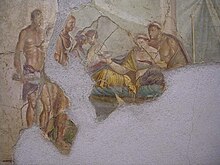 A Roman painting from the House of Giuseppe II in Pompeii, early 1st century AD, most likely depicting Cleopatra, wearing her royal diadem and consuming poison in an act of suicide, while her son Caesarion, also wearing a royal diadem, stands behind her.[303][304]
While Octavian occupied Athens, Antony and Cleopatra landed at Paraitonion in Egypt.[301][305] The couple then went their separate ways, Antony to Cyrene to raise more troops and Cleopatra to the harbor at Alexandria in an attempt to mislead the oppositional party and portray the activities in Greece as a victory.[301] She was afraid that news about the outcome of the battle of Actium would lead to a rebellion.[306] It is uncertain whether or not, at this time, she actually executed Artavasdes II and sent his head to his rival, Artavasdes I of Media Atropatene, in an attempt to strike an alliance with him.[307][308]
Lucius Pinarius, Mark Antony's appointed governor of Cyrene, received word that Octavian had won the Battle of Actium before Antony's messengers could arrive at his court.[307] Pinarius had these messengers executed and then defected to Octavian's side, surrendering to him the four legions under his command that Antony desired to obtain.[307] Antony nearly committed suicide after hearing news of this but was stopped by his staff officers.[307]
In Alexandria he built a reclusive cottage on the island of Pharos that he nicknamed the Timoneion, after the philosopher Timon of Athens, who was famous for his cynicism and misanthropy.[307] Herod, who had personally advised Antony after the Battle of Actium that he should betray Cleopatra, traveled to Rhodes to meet Octavian and resign his kingship out of loyalty to Antony.[309] Octavian was impressed by his speech and sense of loyalty, so he allowed him to maintain his position in Judea, further isolating Antony and Cleopatra.[309]
Cleopatra perhaps started to view Antony as a liability by the late summer of 31 BC, when she prepared to leave Egypt to her son Caesarion.[310] Cleopatra planned to relinquish her throne to him, take her fleet from the Mediterranean into the Red Sea, and then set sail to a foreign port, perhaps in India, where she could spend time recuperating.[310][308] However, these plans were ultimately abandoned when Malichus I, as advised by Octavian's governor of Syria, Quintus Didius, managed to burn Cleopatra's fleet in revenge for his losses in a war with Herod that Cleopatra had largely initiated.[310][308] Cleopatra had no other option but to stay in Egypt and negotiate with Octavian.[310] Although most likely later pro-Octavian propaganda, it was reported that at this time Cleopatra started testing the strengths of various poisons on prisoners and even her own servants.[311]
 The Death of Cleopatra (1658), by Guido Cagnacci
Cleopatra had Caesarion enter into the ranks of the ephebi, which, along with reliefs on a stele from Koptos dated 21 September 31 BC, demonstrated that Cleopatra was now grooming her son to become the sole ruler of Egypt.[312] In a show of solidarity, Antony also had Marcus Antonius Antyllus, his son with Fulvia, enter the ephebi at the same time.[310] Separate messages and envoys from Antony and Cleopatra were then sent to Octavian, still stationed at Rhodes, although Octavian seems to have replied only to Cleopatra.[311]
Cleopatra requested that her children should inherit Egypt and that Antony should be allowed to live in exile in Egypt, offered Octavian money in the future, and immediately sent him lavish gifts.[311][308] Octavian sent his diplomat Thyrsos to Cleopatra after she threatened to burn herself and vast amounts of her treasure within a tomb already under construction.[313] Thyrsos advised her to kill Antony so that her life would be spared, but when Antony suspected foul intent, he had this diplomat flogged and sent back to Octavian without a deal.[314]
After lengthy negotiations that ultimately produced no results, Octavian set out to invade Egypt in the spring of 30 BC,[315] stopping at Ptolemais in Phoenicia, where his new ally Herod provided his army with fresh supplies.[316] Octavian moved south and swiftly took Pelousion, while Cornelius Gallus, marching eastward from Cyrene, defeated Antony's forces near Paraitonion.[317][318] Octavian advanced quickly to Alexandria, but Antony returned and won a small victory over Octavian's tired troops outside the city's hippodrome.[317][318] However, on 1 August 30 BC, Antony's naval fleet surrendered to Octavian, followed by Antony's cavalry.[317][299][319]
Cleopatra hid herself in her tomb with her close attendants and sent a message to Antony that she had committed suicide.[317][320][321] In despair, Antony responded to this by stabbing himself in the stomach and taking his own life at age 53.[317][299][308] According to Plutarch, he was still dying when brought to Cleopatra at her tomb, telling her he had died honorably and that she could trust Octavian's companion Gaius Proculeius over anyone else in his entourage.[317][322][323] It was Proculeius, however, who infiltrated her tomb using a ladder and detained the queen, denying her the ability to burn herself with her treasures.[324][325] Cleopatra was then allowed to embalm and bury Antony within her tomb before she was escorted to the palace.[324][308]
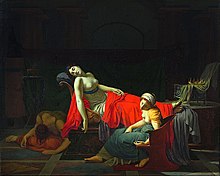 ]The Death of Cleopatra (1796–1797), by Jean-Baptiste Regnault
Octavian entered Alexandria, occupied the palace, and seized Cleopatra's three youngest children.[324][326] When she met with Octavian, Cleopatra told him bluntly, "I will not be led in a triumph" (Ancient Greek: οὑ θριαμβεύσομαι, romanized: ou thriambéusomai), according to Livy, a rare recording of her exact words.[327][328] Octavian promised that he would keep her alive but offered no explanation about his future plans for her kingdom.[329]
When a spy informed her that Octavian planned to move her and her children to Rome in three days, she prepared for suicide as she had no intentions of being paraded in a Roman triumph like her sister Arsinoe IV.[329][299][308] It is unclear if Cleopatra's suicide on 10 August 30 BC, at age 39, took place within the palace or her tomb.[330][331][note 4] It is said she was accompanied by her servants Eiras and Charmion, who also took their own lives.[329][332]
Octavian was said to have been angered by this outcome but had Cleopatra buried in royal fashion next to Antony in her tomb.[329][333][334] Cleopatra's physician Olympos did not explain her cause of death, although the popular belief is that she allowed an asp or Egyptian cobra to bite and poison her.[335][336][308] Plutarch relates this tale, but then suggests an implement (κνῆστις, knêstis, lit. 'spine, cheese-grater') was used to introduce the toxin by scratching, while Dio says that she injected the poison with a needle (βελόνη, belónē), and Strabo argued for an ointment of some kind.[337][336][338][note 56] No venomous snake was found with her body, but she did have tiny puncture wounds on her arm that could have been caused by a needle.[335][338][334]
Cleopatra decided in her last moments to send Caesarion away to Upper Egypt, perhaps with plans to flee to Kushite Nubia, Ethiopia, or India.[339][340][318] Caesarion, now Ptolemy XV, would reign for a mere 18 days until executed on the orders of Octavian on 29 August 30 BC, after returning to Alexandria under the false pretense that Octavian would allow him to be king.[341][342][343][note 2]
Octavian was convinced by the advice of the philosopher Arius Didymus that there was room for only one Caesar in the world.[344][note 57] With the fall of the Ptolemaic Kingdom, the Roman province of Egypt was established,[345][299][346][note 58] marking the end of the Hellenistic period.... In January of 27 BC Octavian was renamed Augustus ("the revered") and amassed constitutional powers that established him as the first Roman emperor, inaugurating the Principate era of the Roman Empire.[349]
Cleopatra's kingdom and role as a monarch
 Cleopatra on a coin of 40 drachms from 51 to 30 BC, minted at Alexandria; on the obverse is a portrait of Cleopatra wearing a diadem, and on the reverse an inscription reading "ΒΑΣΙΛΙΣΣΗΣ ΚΛΕΟΠΑΤΡΑΣ" with an eagle standing on a thunderbolt.
Main article: Reign of Cleopatra § Egypt under the monarchy of Cleopatra
Further information: Ptolemaic coinage and Ancient Greek coinage
Following the tradition of Macedonian rulers, Cleopatra ruled Egypt and other territories such as Cyprus as an absolute monarch, serving as the sole lawgiver of her kingdom.[350] She was the chief religious authority in her realm, presiding over religious ceremonies dedicated to the deities of both the Egyptian and Greek polytheistic faiths.[351] She oversaw the construction of various temples to Egyptian and Greek gods,[352] a synagogue for the Jews in Egypt, and even built the Caesareum of Alexandria, dedicated to the cult worship of her patron and lover Julius Caesar.[353][354]
Cleopatra was directly involved in the administrative affairs of her domain,[355] tackling crises such as famine by ordering royal granaries to distribute food to the starving populace during a drought at the beginning of her reign.[356] Although the command economy that she managed was more of an ideal than a reality,[357] the government attempted to impose price controls, tariffs, and state monopolies for certain goods, fixed exchange rates for foreign currencies, and rigid laws forcing peasant farmers to stay in their villages during planting and harvesting seasons.[358][359][360] Apparent financial troubles led Cleopatra to debase her coinage, which included silver and bronze currencies but no gold coins like those of some of her distant Ptolemaic predecessors.[361]
Legacy
Children and successors
After her suicide, Cleopatra's three surviving children, Cleopatra Selene II, Alexander Helios, and Ptolemy Philadelphos, were sent to Rome with Octavian's sister Octavia the Younger, a former wife of their father, as their guardian.[366][367] Cleopatra Selene II and Alexander Helios were present in the Roman triumph of Octavian in 29 BC.[366][241] The fates of Alexander Helios and Ptolemy Philadelphus are unknown after this point.[366][241] Octavia arranged the betrothal of Cleopatra Selene II to Juba II, son of Juba I, whose North African kingdom of Numidia had been turned into a Roman province in 46 BC by Julius Caesar due to Juba I's support of Pompey.[368][367][326]
The emperor Augustus installed Juba II and Cleopatra Selene II, after their wedding in 25 BC, as the new rulers of Mauretania, where they transformed the old Carthaginian city of Iol into their new capital, renamed Caesarea Mauretaniae (modern Cherchell, Algeria).[368][241] Cleopatra Selene II imported many important scholars, artists, and advisers from her mother's royal court in Alexandria to serve her in Caesarea, now permeated in Hellenistic Greek culture.[369] She also named her son Ptolemy of Mauretania, in honor of their Ptolemaic dynastic heritage.[370][371]
Cleopatra Selene II died around 5 BC, and when Juba II died in 23/24 AD he was succeeded by his son Ptolemy.[370][372] However, Ptolemy was eventually executed by the Roman emperor Caligula in 40 AD, perhaps under the pretense that Ptolemy had unlawfully minted his own royal coinage and utilized regalia reserved for the Roman emperor.[373][374] Ptolemy of Mauretania was the last known monarch of the Ptolemaic dynasty, although Queen Zenobia, of the short-lived Palmyrene Empire during the Crisis of the Third Century, would claim descent from Cleopatra.[375][376] A cult dedicated to Cleopatra still existed as late as 373 AD when Petesenufe, an Egyptian scribe of the book of Isis, explained that he "overlaid the figure of Cleopatra with gold."[377]
Roman literature and historiography
Further information: Roman historiography, Greek historiography, Latin literature, and Latin poetry....
Portland Vase
Further information: Portland Vase

A possible depiction of Mark Antony on the Portland Vase being lured by Cleopatra, straddling a serpent, while Anton, Antony's alleged ancestor, looks on and Eros flies above[445][446]
The Portland Vase, a Roman cameo glass vase dated to the Augustan period and now in the British Museum, includes a possible depiction of Cleopatra with Antony.[445][447] In this interpretation, Cleopatra can be seen grasping Antony and drawing him toward her while a serpent (i.e. the asp) rises between her legs, Eros floats above, and Anton, the alleged ancestor of the Antonian family, looks on in despair as his descendant Antony is led to his doom.[445][446] The other side of the vase perhaps contains a scene of Octavia, abandoned by her husband Antony but watched over by her brother, the emperor Augustus.[445][446] The vase would thus have been created no earlier than 35 BC, when Antony sent his wife Octavia back to Italy and stayed with Cleopatra in Alexandria.[445]
Depictions:
...
In the performing arts, the death of Elizabeth I of England in 1603, and the German publication in 1606 of alleged letters of Cleopatra, inspired Samuel Daniel to alter and republish his 1594 play Cleopatra in 1607.[466] He was followed by William Shakespeare, whose Antony and Cleopatra, largely based on Plutarch, was first performed in 1608 and provided a somewhat salacious view of Cleopatra in stark contrast to England's own Virgin Queen.[467] Cleopatra was also featured in operas, such as George Frideric Handel's 1724 Giulio Cesare in Egitto, which portrayed the love affair of Caesar and Cleopatra;[468] Domenico Cimarosa wrote Cleopatra on a similar subject in 1789.[469]
Modern depictions and brand imaging
Further information: List of cultural depictions of Cleopatra and Egyptomania
 The Triumph of Cleopatra (1821), by William Etty, now in the Lady Lever Art Gallery, Port Sunlight, England
In Victorian Britain, Cleopatra was highly associated with many aspects of ancient Egyptian culture and her image was used to market various household products, including oil lamps, lithographs, postcards and cigarettes.[470] Fictional novels such as H. Rider Haggard's Cleopatra (1889) and Théophile Gautier's One of Cleopatra's Nights (1838) depicted the queen as a sensual and mystic Easterner, while the Egyptologist Georg Ebers's Cleopatra (1894) was more grounded in historical accuracy.[470][471]
The French dramatist Victorien Sardou and Irish playwright George Bernard Shaw produced plays about Cleopatra, while burlesque shows such as F. C. Burnand's Antony and Cleopatra offered satirical depictions of the queen connecting her and the environment she lived in with the modern age.[472]
Shakespeare's Antony and Cleopatra was considered canonical by the Victorian era.[473] Its popularity led to the perception that the 1885 painting by Lawrence Alma-Tadema depicted the meeting of Antony and Cleopatra on her pleasure barge in Tarsus, although Alma-Tadema revealed in a private letter that it depicts a subsequent meeting of theirs in Alexandria.[474]

Also based on Shakespeare's play was Samuel Barber's opera Antony and Cleopatra (1966), commissioned for the opening of the Metropolitan Opera House.[475] In his unfinished 1825 short story The Egyptian Nights, Alexander Pushkin popularized the claims of the 4th-century Roman historian Aurelius Victor, previously largely ignored, that Cleopatra had prostituted herself to men who paid for sex with their lives.[476][477] Cleopatra also became appreciated outside the Western world and Middle East, as the Qing-dynasty Chinese scholar Yan Fu wrote an extensive biography of her.[478]
Georges Méliès's Robbing Cleopatra's Tomb (French: Cléopâtre), an 1899 French silent horror film, was the first film to depict the character of Cleopatra.[479] Hollywood films of the 20th century were influenced by earlier Victorian media, which helped to shape the character of Cleopatra played by Theda Bara in Cleopatra (1917), Claudette Colbert in Cleopatra (1934), and Elizabeth Taylor in Cleopatra (1963).[480]
In addition to her portrayal as a "vampire" queen, Bara's Cleopatra also incorporated tropes familiar from 19th-century Orientalist painting, such as despotic behavior, mixed with dangerous and overt female sexuality.[481] Colbert's character of Cleopatra served as a glamour model for selling Egyptian-themed products in department stores in the 1930s, targeting female moviegoers.[482]
In preparation for the film starring Taylor as Cleopatra, women's magazines of the early 1960s advertised how to use makeup, clothes, jewelry, and hairstyles to achieve the "Egyptian" look similar to the queens Cleopatra and Nefertiti.[483] By the end of the 20th century there were forty-three films, two hundred plays and novels, forty-five operas, and five ballets associated with Cleopatra.[484]