Shaw, George B
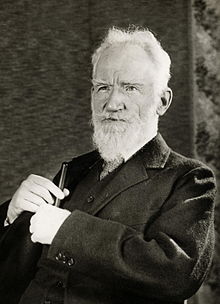
Achievements: Plays, essays, criticism
Born: July 26, 1856; Dublin, Ireland
Died: November 2, 1950; Ayot St Lawrence, Hertfordshire, England (Aged 94)
Field & Discipline: Performing Arts; Theater; Journalism; Playwright; Essayist; Critic
Language: English
Father: George Carr Shaw
Mother: Lucinda Elizabeth Gurly
Siblings: 2 sisters: Lucy, Elinor
Spouse: Charlotte Payne-Townshend
Children: None
Education: Wesley Connexional School, Dublin
Major Work:
Plays:
"Caesar and Cleopatra" (1901)
"Man and Superman" (1905)
"Major Barbara" (1905)
"Heartbreak House" (1920)
"St Joan" (1923)
Life & Times:
Under pressure from his family Shaw made sporadic attempts to get paid work. He spent his afternoons in the reading room of the British Library in London, educating himself and learning to write. In the interests of eating cheaply, he went to the vegetarian restaurants clustered around the museum and became a vegetarian.
He submitted four novels for publication, all of which were rejected, although one of them, "Cashel Byron's Profession" was later highly praised by the well-known editor [a supporter was] Henley*.
Shaw's short stories, articles, essays and most of the journalism he wrote were also rejected by publishers. He led a lonely life, very occasionally appearing in a few houses, an extraordinary figure: over six feet tall, his red beard and moustache curling rakishly, and too poor to do anything about his broken boots, frayed cuffs, and a top hat so limp he could not raise it properly in greeting. He finally found his niche in the various literary, debating and political societies which he joined in the 1880's.
In 1884 the socialist [a pal of] William Morris* asked to meet Shaw after reading some of his work in a socialist magazine, and he became one of Shaw's political mentors. In the same year Shaw joined the newly founded Fabian Society whose members were drawn from the middle class intelligentsia.
Together with [group member with] Sidney and Beatrice Webb*, Shaw became one of the leading Fabian members and made his reputation there as a polemicist and brilliant orator. Among those who heard him speak was the future novelist [fellow-socialist was] HG Wells* who later clashed with Shaw over leadership of the Fabians. Through the National Secular Society, Shaw met the social reformer [met] Bradlaugh* and at the Dialectical Society he met theosophist [employed by] Annie Besant* who employed him to write on the arts for her publication "Our Corner".
His career as a critic advanced rather more positively when the drama critic [helped by] Archer*, who had spotted Shaw reading opera scores in the reading room of the British Library, found work for Shaw as a book reviewer for the "Pall Mall Gazette" (1885-88), and art critic for the "World" (1886-89).
After failing as a leader writer on the "Star", where he kept writing about Socialism in Liberal columns, Shaw was transferred to the music section where he wrote under the name "Corno di Bassetto". As music critic on the "Star" and then for the "World", Shaw championed the composer [promoted work of] Elgar* and attacked others like [attacked] Parry* who dominated the music establishment and whom he considered to be untalented and derivative.
By the end of the decade, Shaw was being praised by [a fan was] Beerbohm* as 'the most brilliant and remarkable journalist in London'. In 1890 the first modern realistic drama appeared in London when [a fan of] Ibsen's* "A Doll's House" was staged. The following year Shaw published "The Quintessence of Ibsen" and at the same time rewrote his own "Widowers' Houses" which was performed in 1892.
It was all about the wickedness of slum landlords and was received with almost as much protest as Ibsen's work had received. In 1893 Shaw wrote one of his best plays, "Mrs Warren's Profession" which, because it was about prostitution, was refused a license by the censor. Both plays were full of wit but were also about social evil. Shaw labelled them 'unpleasant,' and he now set about writing what he called 'pleasant' plays which would attract backers and audiences.
One such, a comedy about love and war set in the Balkans called "Arms and the Man" was performed in 1894 but lasted only a few weeks, and the following year Shaw accepted an invitation from the writer [employed by] Harris* to become theatre critic for the "Saturday Review".
Shaw did not like spectacular theatrical effects or flamboyant actors; the sort of thing he admired was the combination of drama with the playing of pipe and tabor by [a fan of] Dolmetsch*, or the intelligent acting of [a fan of] Duse* who was his ideal actress. Two of his own plays, "Candida" and "The Devil's Disciple" were staged in 1897 followed by "You Never Can Tell" in 1897.
In 1898, at the age of forty-two, Shaw collapsed from overwork and while convalescing met the Irish heiress Charlotte Payne-Townshend with whom he contracted an apparently celibate but happy and long-lasting marriage.
Over the next decade he produced almost a play a year, of which the most notable were "Caesar and Cleopatra" (1901), considered by many to be his masterpiece; "Man and Superman" (1905) which took up the idea of [based play on] Nietzsche's* will to power; "Major Barbara" (1905), in which one of the characters is based on the Greek scholar [based play on] Gilbert Murray*; and "The Doctor's Dilemma" (1906) in which the immunologist [based play on] Almroth Wright* provided inspiration for one of the characters.
All his plays were didactic and their theme was set out in a preface. "Pygmalion" (1914) was about phonetics. This was a subject which had interested Shaw since he was a young man. He had met the phoneticist [used material of] Sweet* and was familiar with shorthand systems like that of [used material of] Alexander Melville Bell*.
His play "Heartbreak House" (1920) was set at an English country house and in it Shaw explored the lack of moral passion and purpose in the generation he considered responsible for the outbreak of World War I.
"Saint Joan" (1923) was his last major play. It was highly acclaimed and led to Shaw being awarded the Nobel Prize for literature in 1925. He remained politically active and in 1928 wrote "The Intelligent Woman's Guide to Socialism and Capitalism".
The most popular of his later plays was "The Apple Cart" (1929) in which the character of Private Meek was based on [based play on] TE Lawrence*, whom he had met when Lawrence was brought by a friend to help remove one of the portraits of Shaw by [painted by] John* which Shaw was donating to the Fitzwilliam Museum in Cambridge. Shaw acted as literary agent and editor for Lawrence.
Shaw had a natural affinity with the rebellious and when he met [a fan of] Gandhi* in London in 1931 they saw each other as kindred spirits. Shaw thought Gandhi a saint and a natural leader, and he believed India, like Ireland, should have her independence.
Shaw was now regarded as a national treasure and he remained a stimulating force even in old age. His 90th birthday was celebrated by pieces from Wells, Beerbohm and [a fan was] Aldous Huxley*
Extra Connections:
Met [met] JB Priestley*.
He was an admirer of [admired] Baudelaire*, [admired] Berlioz*, [admired] Mussolini*, [admired] Stalin*, [admired] Jerome K Jerome*, [admired] Strindberg* and [admired] Puccini*
Knew [knew] William Booth* (Salvation Army) and Sir William[knew] Rothenstein*
Advised [advised] Forbes-Robertson*
A friend of [a pal of] Barrie and [a pal of] Eleanor Marx*
A fan of [a fan of] Grieg*
His work was promoted by [work promoted by] Howells*
[reviewed by] Mencken* wrote about his work
GG Murray*?
Based a play on [bases play on] Joan of Arc*
Fellow socialists were [fellow socialist was] Yeats*, [fellow socialist was] Upton Sinclair* and [fellow socialist was] Sickert*
[funded by] Henry Irving* paid him a retainer
He wrote an article supporting the Irish nationalist Roger [supported] Casement*
Assessment: Shaw was a great polemicist who made his plays a vehicle for his ideas.
Oneliner: GB Shaw, major 20th-Century literary figure.
Bibliography:
- Holroyd, Michael, Bernard Shaw, Vols 1,2,3, Chatto & Windus, London, 1988.