Husserl E
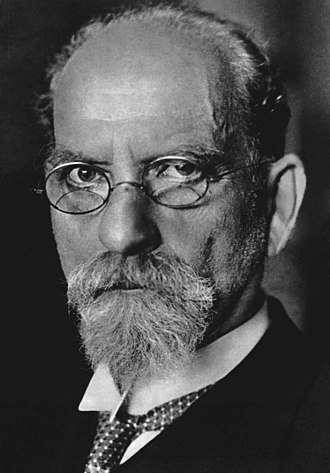
Edmund Gustav Albrecht Husserl (/ˈhʊsɜːrl/ *HUUSS-url*,[20][21][22] US also /ˈhʊsərəl/ *HUUSS-ər-əl*,[23] German: [ˈɛtmʊnt ˈhʊsɐl];[24] 8 April 1859 – 27 April 1938[25]) was an Austrian-German philosopher and mathematician who established the school of phenomenology.
In his early work, he elaborated critiques of historicism and of psychologism in logic based on analyses of intentionality. In his mature work, he sought to develop a systematic foundational science based on the so-called phenomenological reduction. Arguing that transcendental consciousness sets the limits of all possible knowledge, Husserl redefined phenomenology as a transcendental-idealist philosophy. Husserl's thought profoundly influenced 20th-century philosophy, and he remains a notable figure in contemporary philosophy and beyond.
Husserl studied mathematics, taught by Karl Weierstrass and Leo Königsberger, and philosophy taught by Franz Brentano and Carl Stumpf.[26] He taught philosophy as a Privatdozent at Halle from 1887, then as professor, first at Göttingen from 1901, then at Freiburg from 1916 until he retired in 1928, after which he remained highly productive. In 1933, under racial laws of the Nazi Party, Husserl was expelled from the library of the University of Freiburg due to his Jewish family background and months later resigned from the Deutsche Akademie. Following an illness, he died in Freiburg in 1938.[27]
- Life and career
- Development of his thought
- Husserl's thought
- Husserl and psychologism
- Influence
- Bibliography
- See also
- Notes
- Citations
- Further reading
- External links
Life and career
Youth and education
Husserl was born in 1859 in Proßnitz in the Margraviate of Moravia in the Austrian Empire (today Prostějov in the Czech Republic). He was born into a Jewish family, the second of four children. His father was a milliner. His childhood was spent in Prostějov, where he attended the secular primary school. Then Husserl traveled to Vienna to study at the Realgymnasium there, followed next by the Staatsgymnasium in Olmütz.[28][29]
At the University of Leipzig from 1876 to 1878, Husserl studied mathematics, physics, and astronomy. At Leipzig, he was inspired by philosophy lectures given by Wilhelm Wundt, one of the founders of modern psychology. Then he moved to the Frederick William University of Berlin (the present-day Humboldt University of Berlin) in 1878 where he continued his study of mathematics under Leopold Kronecker and the renowned Karl Weierstrass. In Berlin he found a mentor in Tomáš Garrigue Masaryk, then a former philosophy student of Franz Brentano and later the first president of Czechoslovakia. There Husserl also attended Friedrich Paulsen's philosophy lectures. In 1881 he left for the University of Vienna to complete his mathematics studies under the supervision of Leo Königsberger (a former student of Weierstrass). At Vienna in 1883 he obtained his PhD with the work Beiträge zur Variationsrechnung (Contributions to the Calculus of Variations).[28]
...
Influence
 Husserl's gravestone at Günterstal
David Carr commented on Husserl's following in his 1970 dissertation at Yale: "It is well known that Husserl was always disappointed at the tendency of his students to go their own way, to embark upon fundamental revisions of phenomenology rather than engage in the communal task" as originally intended by the radical new science.[100] Notwithstanding, he did attract philosophers to phenomenology.
Martin Heidegger is the best known of Husserl's students, the one whom Husserl chose as his successor at Freiburg. Heidegger's magnum opus Being and Time was dedicated to Husserl. They shared their thoughts and worked alongside each other for over a decade at the University of Freiburg, Heidegger being Husserl's assistant during 1920–1923.[101][102][103] Heidegger's early work followed his teacher, but with time he began to develop new insights distinctively variant. Husserl became increasingly critical of Heidegger's work, especially in 1929, and included pointed criticism of Heidegger in lectures he gave during 1931.[104] Heidegger, while acknowledging his debt to Husserl, followed a political position offensive and harmful to Husserl after the Nazis came to power in 1933, Husserl being of Jewish origin and Heidegger infamously being then a Nazi proponent.[105] Academic discussion of Husserl and Heidegger is extensive.
At Göttingen in 1913 Adolf Reinach (1884–1917) "was now Husserl's right hand. He was above all the mediator between Husserl and the students, for he understood extremely well how to deal with other persons, whereas Husserl was pretty much helpless in this respect."[106] He was an original editor of Husserl's new journal, Jahrbuch; one of his works (giving a phenomenological analysis of the law of obligations) appeared in its first issue.[107] Reinach was widely admired and a remarkable teacher. Husserl, in his 1917 obituary, wrote, "He wanted to draw only from the deepest sources, he wanted to produce only work of enduring value. And through his wise restraint he succeeded in this."[108]
Edith Stein was Husserl's student at Göttingen and Freiburg while she wrote her doctoral thesis The Empathy Problem as it Developed Historically and Considered Phenomenologically (1916). She then became his assistant at Freiburg in 1916–18. She later adapted her phenomenology to the modern school of modern Thomism.[109]
Ludwig Landgrebe became assistant to Husserl in 1923. From 1939 he collaborated with Eugen Fink at the Husserl-Archives in Leuven. In 1954 he became leader of the Husserl-Archives. Landgrebe is known as one of Husserl's closest associates, but also for his independent views relating to history, religion and politics as seen from the viewpoints of existentialist philosophy and metaphysics.
Eugen Fink was a close associate of Husserl during the 1920s and 1930s. He wrote the Sixth Cartesian Meditation which Husserl said was the truest expression and continuation of his own work. Fink delivered the eulogy for Husserl in 1938.[29]
Roman Ingarden, an early student of Husserl at Freiburg, corresponded with Husserl into the mid-1930s. Ingarden did not accept, however, the later transcendental idealism of Husserl which he thought would lead to relativism. Ingarden has written his work in German and Polish. In his Spór o istnienie świata (Ger.: "Der Streit um die Existenz der Welt", Eng.: "Dispute about existence of the world") he created his own realistic position, which also helped to spread phenomenology in Poland.
Max Scheler met Husserl in Halle in 1901 and found in his phenomenology a methodological breakthrough for his own philosophy. Scheler, who was at Göttingen when Husserl taught there, was one of the original few editors of the journal Jahrbuch für Philosophie und Phänomenologische Forschung (1913). Scheler's work Formalism in Ethics and Nonformal Ethics of Value appeared in the new journal (1913 and 1916) and drew acclaim. The personal relationship between the two men, however, became strained, due to Scheler's legal troubles, and Scheler returned to Munich.[110] Although Scheler later criticised Husserl's idealistic logical approach and proposed instead a "phenomenology of love", he states that he remained "deeply indebted" to Husserl throughout his work.
Nicolai Hartmann was once thought to be at the center of phenomenology, but perhaps no longer. In 1921 the prestige of Hartmann the Neo-Kantian, who was Professor of Philosophy at Marburg, was added to the Movement; he "publicly declared his solidarity with the actual work of die Phänomenologie." Yet Hartmann's connections were with Max Scheler and the Munich circle; Husserl himself evidently did not consider him as a phenomenologist. His philosophy, however, is said to include an innovative use of the method.[111]
Emmanuel Levinas in 1929 gave a presentation at one of Husserl's last seminars in Freiburg. Also that year he wrote on Husserl's Ideen (1913) a long review published by a French journal. With Gabrielle Peiffer, Levinas translated into French Husserl's Méditations cartésiennes (1931). He was at first impressed with Heidegger and began a book on him, but broke off the project when Heidegger became involved with the Nazis. After the war he wrote on Jewish spirituality; most of his family had been murdered by the Nazis in Lithuania. Levinas then began to write works that would become widely known and admired.[112]
Alfred Schutz's Phenomenology of the Social World seeks to rigorously ground Max Weber's interpretive sociology in Husserl's phenomenology. Husserl was impressed by this work and asked Schutz to be his assistant.[113]
Jean-Paul Sartre was also largely influenced by Husserl, although he later came to disagree with key points in his analyses. Sartre rejected Husserl's transcendental interpretations begun in his Ideen (1913) and instead followed Heidegger's ontology.[114]
Maurice Merleau-Ponty's Phenomenology of Perception is influenced by Edmund Husserl's work on perception, intersubjectivity, intentionality, space,[115] and temporality, including Husserl's theory of retention and protention. Merleau-Ponty's description of 'motor intentionality' and sexuality, for example, retain the important structure of the noetic/noematic correlation of Ideen I, yet further concretize what it means for Husserl when consciousness particularizes itself into modes of intuition. Merleau-Ponty's most clearly Husserlian work is, perhaps, "the Philosopher and His Shadow." Depending on the interpretation of Husserl's accounts of eidetic intuition, given in Husserl's Phenomenological Psychology[116] and Experience and Judgment, it may be that Merleau-Ponty did not accept the "eidetic reduction" nor the "pure essence" said to result.[117] Merleau-Ponty was the first student to study at the Husserl-archives in Leuven.
Gabriel Marcel explicitly rejected existentialism, due to Sartre, but not phenomenology, which has enjoyed a wide following among French Catholics. He appreciated Husserl, Scheler, and (but with apprehension) Heidegger.[118] His expressions like "ontology of sensability" when referring to the body, indicate influence by phenomenological thought.[119]
Kurt Gödel is known to have read Cartesian Meditations. He expressed very strong appreciation for Husserl's work, especially with regard to "bracketing" or "epoché".
Hermann Weyl's interest in intuitionistic logic and impredicativity appears to have resulted from his reading of Husserl. He was introduced to Husserl's work through his wife, Helene Joseph, herself a student of Husserl at Göttingen.
Colin Wilson has used Husserl's ideas extensively in developing his "New Existentialism," particularly in regards to his "intentionality of consciousness," which he mentions in a number of his books.[120]
Rudolf Carnap was also influenced by Husserl,[121] not only concerning Husserl's notion of essential insight that Carnap used in his Der Raum, but also his notion of "formation rules" and "transformation rules" is founded on Husserl's philosophy of logic.
Karol Wojtyla, who would later become Pope John Paul II, was influenced by Husserl. Phenomenology appears in his major work, The Acting Person (1969). Originally published in Polish, it was translated by Andrzej Potocki and edited by Anna-Teresa Tymieniecka in the Analecta Husserliana. The Acting Person combines phenomenological work with Thomistic ethics.[122]
 Plaque commemorating Husserl in his home town of Prostějov, Czech Republic
Paul Ricœur has translated many works of Husserl into French and has also written many of his own studies of the philosopher.[123] Among other works, Ricœur employed phenomenology in his Freud and Philosophy (1965).[124]
Jacques Derrida wrote several critical studies of Husserl early in his academic career. These included his dissertation, The Problem of Genesis in Husserl's Philosophy, and also his introduction to The Origin of Geometry. Derrida continued to make reference to Husserl in works such as Of Grammatology.
Stanisław Leśniewski and Kazimierz Ajdukiewicz were inspired by Husserl's formal analysis of language. Accordingly, they employed phenomenology in the development of categorial grammar.[125]
José Ortega y Gasset visited Husserl at Freiburg in 1934. He credited phenomenology for having 'liberated him' from a narrow neo-Kantian thought. While perhaps not a phenomenologist himself, he introduced the philosophy to Iberia and Latin America.[126]
Wilfrid Sellars, an influential figure in the so-called "Pittsburgh School" (Robert Brandom, John McDowell) had been a student of Marvin Farber, a pupil of Husserl, and was influenced by phenomenology through him:
Marvin Farber led me through my first careful reading of the Critique of Pure Reason and introduced me to Husserl. His combination of utter respect for the structure of Husserl's thought with the equally firm conviction that this structure could be given a naturalistic interpretation was undoubtedly a key influence on my own subsequent philosophical strategy.[127]
In his 1942 essay The Myth of Sisyphus, absurdist philosopher Albert Camus acknowledges Husserl as a previous philosopher who described and attempted to deal with the feeling of the absurd, but claims he committed "philosophical suicide" by elevating reason and ultimately arriving at ubiquitous Platonic forms and an abstract god.
Hans Blumenberg received his habilitation in 1950, with a dissertation on ontological distance, an inquiry into the crisis of Husserl's phenomenology.
Roger Scruton, despite some disagreements with Husserl, drew upon his work in Sexual Desire (1986).[128]: 3–4
The influence of the Husserlian phenomenological tradition in the 21st century extends beyond the confines of the European and North American legacies. It has already started to impact (indirectly) scholarship in Eastern and Oriental thought, including research on the impetus of philosophical thinking in the history of ideas in Islam.[129][130]