Camus
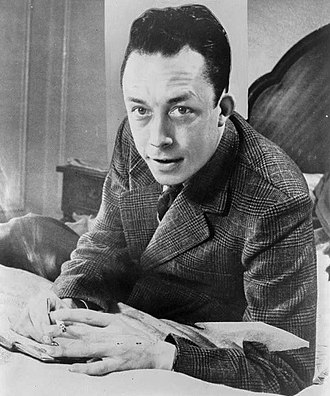
NAME: Camus, Albert
ACHIEVEMENTS: A noted novelist, essayist and playwright. Nobel Prize for Literature, 1957
NICKNAME/ALIAS:
DATE AND PLACE OF BIRTH: 7th November 1913 in Mondovi, Algeria
DATE/PLACE OF DEATH/AGE AT DEATH: 4th January 1960, near Paris, France. Aged 46.
DISCIPLINE: Author
FIELD: Literature
LANGUAGE: French,
PARENTS: Lucien Camus and Catherine Sintes
SIBLINGS: One brother
SPOUSE: Simone Hie (first), Francine Faure (second)
CHILDREN: twins, son Jean and daughter Catherine
EDUCATION: University of Algiers
MAJOR WORK: Novels: L’Etranger (The Stranger) 1942, La Peste (The Plauge) 1947, La Chute (The Fall) 1956, Le Premier Homme (The First Man) 1994. Plays: Caligula (1944), L’Etat de siege (State of Siege) 1948, Les Justes (Just Assassins) 1957. The essay L’Homme revolte (The Rebel: An Essay on Man in Revolt) 1951.
LIFE AND TIMES: Camus was born into a poor working class family in Algiers, Algeria. When he was only a year old, his father, a laborer, died fighting in World War One. He was raised by his illiterate and partially deaf mother and his grandmother. Camus excelled at school, and with the help of a teacher, won a scholarship that allowed him to attend high school instead of getting a job.
After high school he attended the University of Algiers, where he became a member of an Algerian intellectual group known as the North Africa Literary School. It was also during this time that he became involved with the Theatre du Travail (Worker’s Theater) in Algiers. In 1936, Camus earned his degree, but due to contracting tuberculosis at 17, he could not pass the physical examination that would have allowed him to become a teacher. Instead, he became a journalist, writing for the anti-colonialist newspaper, Alger-Republicain.
Camus wrote detailed articles documenting and chronicling the plight of poor Muslims and Arabs in Algiers under French colonial control, and supported the anti-colonial struggle. Around this period, Camus adopted the anti-fascist stance of many students of his generation and joined the Communist Party (although he became disillusioned with the part and broke all ties in 1937).
After breaking from the Communist Party, Camus was sympathetic towards anarchism and wrote for the French syndicalist worker’s paper, Le Combat Syndicaliste.
During the Second World War, Camus, now living in Paris, was part of the French resistance movement against the Nazis and wrote for the underground paper, Combat. Many notable French intellectual of this period were also on the Combat staff, including Sartre*, Simone de Beauvoir, and worked with> Malraux*. When France was liberated from German occupation Combat became a daily newspaper and Camus its editor, a position he kept until 1944 when he left journalism to devote himself to writing.
Camus is often associated with the French existentialist movement and writers such as Sartre, but he rejected existentialism and his work can more clearly be understood as absurdist. That is, his writing tried to work out the instability of a world without any stable moral truths, in which life’s senselessness make all acts senseless, and no individual, faced with the absurdity of death, can understand their experiences. However, Camus’ work is also colored by his conviction that, while life is absurd, there must be some moral right in the world and some way in which each man is responsible for speaking out for, and living those morals.
Much of Camus’ writing is concerned with the complications, problems, and relationships between political action, morality, and artistic creation.
The works that most explicitly deal with these issues were published during and after World War Two and include The Stranger (1942; English translation, 1946) a long essay on the absurd, The Myth of Sysiphysus(1942; English translation, 1955); and two plays published in 1944, Cross Purpose(English translation, 1948) and Caligula (English translation, 1948). Camus’ work after this point more explicitly illustrates his exploration of the ways individuals “rebel” against the absurd and find a way to move beyond moral neutrality.
The Plague (1947; Eng. trans., 1948) symbolically dealt with the individual’s ability to overcome difficulties and explored the human ability to accomplish the extraordinary in times of danger and emergency. The novel suggests that there is hope for the human condition and something beyond nihilism.
In The Rebel (1951; English translation, 1954), Camus’ controversial long essay, he comes the closest to laying out his political philosophy. In the essay, Camus continues to explore the human condition of rebellion, and explain the “impulse that drives an individual to the defense of dignity common to all man.”
The essay also criticizes the absolutist philosophies that underlie both Christianity and Marxism, writing of Hegel’s dialectical philosophy, “any revolt which does not recognize that it should transcend nihilism and establish limit is doomed to justify murder and lead to dictatorship.”
Camus’ essay caused considerable controversy for his condemnation of Marxism and especially Stalinism, popular political theories of intellectuals of the time. His criticism of theories that privileged the ends, over the means, leading to morally objectionable acts, and his call on the intellectual Left to oppose Stalinism, led to his essay being attacked in a number of papers, and his break with Sartre, who still supported Stalinism.
After this period, Camus worked to adapt and produce a number of plays from novels, most notably William Faulkner’s Requiem for a Nun (1956) and Dostoevsky’s* The Possessed (1959).
Camus died, ironically and perhaps most absurdly, in a car accident. Found in the car accident with him was the first draft of his epic novel, The First Man, that was to tell the stories of the first French settlers in Algeria. The novel, which was not published until 1994, is largely autobiographical and deals with an elite writer coming to terms with his childhood and history.
ASSESSMENT: Albert Camus was an important mid-century writer whose works explored nihilism, existentialism, and absolutism, while at the same time insisting upon an adherence to moral principles and the artist’s engagement with the world and the struggles of humanity.
EXTRA CONNECTIONS: None
ONELINER: Albert Camus, French Nobel for literature.
BIBLIOGRAPHY:
anon. “Albert Camus,” Contemporary Authors Online. Detroit: Gale Group, 2002.
Bree, Germaine. “Albert Camus,” European Writers, Vol. 13. Charles Scribner’s Sons, 1990. pp. 3049-3078.
Pantheon rank 217