Christie SH
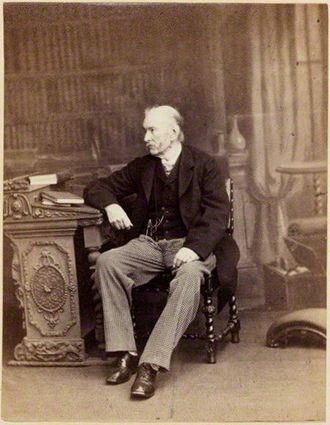
Achievements: The first to observe the rotation of a piece of iron producing polarity in a compass needle.
Born: March 22, 1784; London.
Died: January 24, 1865; Twickenham, London (Aged 80)
Field & Discipline: Mathematics
Language: English
Father: James Christie
Mother: Mrs Urqhuart
Siblings: Unknown
Spouse: 1) Elizabeth Theodora Clayton (m. 1808, d. 1829); 2) Margaret Ellen Malcolm (m. 1844)
Children: William Henry Mahoney
Education: Walworth School, Surrey; Trinity College, Cambridge
Life & Times:
Christie was the youngest son of James Christie, who founded the famous auctioneer’s. In his childhood, although Christie was often in the company of artists (among them [a pal of] Sir Joshua Reynolds*) his greatest ability in mathematics became evident from an early age. He was given a place at Trinity College, Cambridge, in 1800, taking his BA in 1805, and winning the second highest honours in mathematics.
In his college days, Christie was an enthusiastic athlete and founded the Cambridge University boat club. He was in the University Volunteers and served as a brother officer of Lord Palmerston in the Grenadier Company. The Royal Military Academy at Woolwich, London, employed him as a math teacher from 1806.
Christie introduced a system of competitive examinations in 1812, although the school system did not entirely follow his direction until he became a full professor in 1838. He remained at the Military Academy for forty-two years, during which time he extensively reformed the curriculum and raised the academic standard.
Christie also studied magnetic science, and his main discovery in the field took place in 1821, when he was holding an unmagnetized iron plate near a compass needle and noticed that “the simple rotation of the iron had a considerable influence on its magnetic properties.” In 1824, at the Royal Society, he described his experiments into the effects of the application of heat and cold on magnetic forces.
Christie’s detailed description of his theories first appeared in 1825. He stated that “the direction of magnetic polarity, which iron acquires by rotation about an axis has always reference to the direction of the terrestrial magnetic forces. This magnetism is communicated from the earth.” His work in this field predates and was independent of [anticipated] Arago’s*. Christie also went so far as to suggest that the earth itself derived its magnetism from the sun.
He also considered the effect of solar rays on magnetic needles and he found that their effect was definite and not just coincidental with increased heat. Another significant suggestion he made was that the magnetic force around the earth was caused by the influence of the sun.
He wrote an explanation of his theory on this in “Report of the British Association for 1833.” In the report, he claimed that the quasi-polarity of the earth was due to the solar heat of electric currents at near right angles to the meridian and that these currents must be influenced by the continents, seas and mountain chains over which they passed.
In his “Philosophical Transactions” Christie theorised that the heat of the sun producing thermoelectric currents in the earth caused the variations in the earth's magnetic field. In another paper, for “the Journal of the Royal Institution,” he discussed how the dip and horizontal intensity of the earth’s magnetic field is directly influenced by the aurora.
In 1826, he was elected a Fellow of the Royal Society, later to serve as secretary for 17 years. Christie, using data gathered by naval officers during different polar expeditions, wrote a report on “The State of Our Knowledge Respecting the Magnetism of the Earth,” in 1833.
Another paper he wrote that year showed that the power of conduction varies, in several different metals, inversely, according to the length of the piece of metal, and directly as the square of the diameter of the conducting wire.
[influenced by] Alexander von Humboldt* wrote to the Royal Society recommending that permanent magnetic observatories should be set up, in different parts of the United Kingdom. His letter was given to Christie and [wrote report with] Airy* to consider, and the report which they wrote, “Report upon a letter on the Phenomena of Terrestrial Magnetism, addressed by M. le Baron de Humboldt to the President of the Royal Society,” appeared in 1836. The result, two years later, was government funding for observatories at various locations.
In 1844 the first two parts of his “An Elementary Course of Mathematics for the use of the Royal Military Academy, and for students in general” was published in the same year, and the third part appeared in 1847.
In 1854, he retired from the Royal Society, and went to live in Lausanne, Switzerland, for sake of his health. He returned to England in 1865 and died at his residence, Ailsa Villa, in Twickenham, London, on 24th January.
Extra Connections: He inspired [inspired] Sturgeon* and [inspired] Wheatstone*
[his father knew] Gainsborough* knew his father
His work related to that of [work related to] AM Ampere*
Assessment: Christie made significant contributions to the understanding of the earth’s magnetic fields.
Oneliner: SH Christie, early electromagnetism pioneer
Bibliography:
- Boase, Frederick, Modern English Biography.
- Dictionary of National Biography.
- Dictionary of Scientific Biography.