Arago
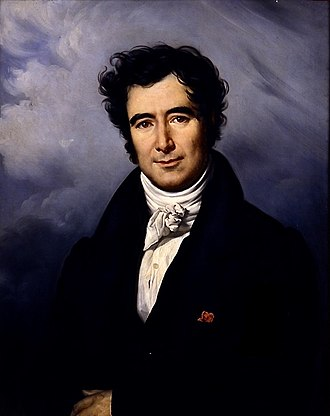
NAME: Arago, Dominique François Jean
ACHIEVEMENT(S): He developed the experiment which proved that the wave theory of light was correct.
DATE/PLACE OF BIRTH: 26th February, 1786, at Estagel, France.
DATE/PLACE/AGE AT DEATH: 2nd October, 1853, at Paris, France. Aged 67
DISCIPLINE: Physicist and astronomer
FIELD: Physics
LANGUAGE: French
EDUCATION: École Polytechnique, Paris
MAJOR WORK: Arago’s disc phenomenon.
LIFE AND TIMES:
Arago was appointed to the Bureau des Longitudes, and in this capacity travelled to the south of France and Spain in 1806 with Biot* on an expedition to complete the measuring of an arc of the terrestrial meridian. On his return Arago was elected to the Académie des Sciences and was given the post of professor of analytical geometry at the École Polytechnique, which he held until 1830, when he became secretary of the Académie.
There were two main areas of scientific research with which Arago was involved. One was the establishment of the wave theory of light. At this period it was still argued whether light moved as a stream of particles or as a wave. At first, Arago favored the first view, but after conducting experiments in which polarized light was passed through gaseous or crystalline substances, Arago joined Alexander von Humboldt* in defending the work of Fresnel,* who maintained that light moved as a wave. From 1815, Arago worked with Fresnel on polarization and they were able to determine its fundamental laws. They published a series of papers refuting the arguments of their critics.
In 1811 Arago invented the polariscope, a device by which he could measure the degree of polarization of light rays. He then developed the polariscope into a polarimeter, which enabled him to establish that the outer rim of the sun was gaseous, to determine that he sun’s rays are refracted not reflected, to observe polarization of the corona during an eclipse and the nature of a comet’s tail, and to calculate the height of isolated clouds. In 1815, Arago devised a cyanometer for measuring the intensity of the blueness of the atmosphere, Later this was adapted for hydrographical studies to help in determining the depth of the sea.
In 1838 Arago made public his ideas on a method for establishing the speed of light using a rotating mirror, the idea originating in Wheatstone’s* work on the speed of electricity. Arago’s experiment was capable of investigating the speed of light travelling through water or air. Unfortunately, problems with his equipment, then his involvement with the Revolution of 1848, and finally the sudden loss of his eyesight in 1850, prevented Arago from completing this project. In the end it was Foucault* who was able to produce useful findings from Arago’s initial idea and prove the wave theory of light.
The second major area of Arago’s scientific research was in electromagnetism. The work of Oersted* on the effect of an electric current on magnet was announced to the Académie des Sciences by Arago in 1820. After this he enthusiastically began to research into the field of electromagnetism himself, inspiring A.M. Ampère* to do so too. In 1820 Arago was responsible for the discovery that an electric current passing through an iron plate produces temporary magnetism. The theory that Ampère formulated on the nature of magnetic currents as result of this laid the basis for the telegraph. In 1824 Arago also found that a rotating nonmagnetic metal disc, such as copper, deflects a magnetic needle held above it. This discovery won him the Copley Medal in 1825. The ‘Arago’s disc’ phenomenon was a demonstration of electromagnetic induction. Both JFW Herschel* and Babbage* attempted to explain this behaviour, but it would be [Faraday](https://app.thebrain.com/brain/f3e16344-7cd9-4fa3-ae1d-59876e128474/16b955df-8c5a-5e24-9323-2d745dd0ae60)* who explained it in 1831.
In 1824, Arago was made a member of an academic commission to investigate steam pressure, in order to reduce the explosions of steam engines. Further research into gases by Arago included an investigation of their compressibility, density, diffraction and dispersion.
In astronomy he studied the solar corona and discovered the chromosphere. He is also remembered for his measurements of the diameters of planets. Popular public lectures on astronomy were given by him between 1812 and 1845.
Arago wrote many articles on various subjects throughout his scientific career. Humboldt encouraged him in particular to write about meteorology and physical geology, the consequent articles covering topics such as the temperature of the earth, the atmosphere and the oceans, earthquakes and magnetic variations of the earth. Arago also played a prominent role in promoting and recognising the photographic inventions of Niepce* and Daguerre*. He wanted the technique to be widely available, so pushed the French government to buy it, conflicting with Daguerre’s attempts to patent it.
In 1830, Arago entered politics on the far left as a deputy for the Pyrénées Orientales. He was elected to the provisional government of 1848 as minister of War and Marine. He spoke influentially on matters to do with education, freedom of the press and the application of scientific knowledge for the improvement of transport and communication. It was through his offices that slavery was abolished in the colonies of France, corporal punishment banned and the rations for sailors at sea increased. He was also a deputy of the Constituent Assembly and member of the Executive Commission.
In his later years, Arago slowly lost his eyesight, until he finally went blind. He continued to work, however, his dedicated students conducting experiments for him, observing the results and on which he would afterwards dictate his conclusions. He also continued actively as perpetual secretary of the Academy, summarizing the work of other scientists and proposing new experiments for others to try.
ASSESSMENT: Arago made significant advances in the areas of the theory of light and electromagnetism.
EXTRA CONNECTIONS:
Work related to that of Soleil*, Ramsden*, Cavendish*, Airy G B* Christie*, Fizeau*, Thomas Young*
Worked with Fox Talbot*
Met Brewster*, and Somerville*
Was a colleague of Colby*
In an 1834 talk at the French Academy, he argues the French lead on steam engines isbeing ceded to Watt and England. He later adds that engines will help not hurt the poor. Francois Arago and Watt | The Engines of Our Ingenuity
ONELINER: DFJ Arago, French physicist who showed the wave theory of light
BIBLIOGRAPHY:
Dictionary of Scientific Biography.
PARENTS: François Bonaventure Arago and Marie Roig.
SIBLINGS:
Jacques an explorer (friend and model of Jules Verne), His four other brothers were Jean Arago (1788–1836), a general in the Mexican army; Victor Arago (1792-1867), a military man in France; Joseph Arago (1796-1860), also a military officer in France and Mexico, Étienne Arago (1802–1892), a writer and politician.
SPOUSE: married 1811.
CHILDREN: three sons.