Medici Catherine de
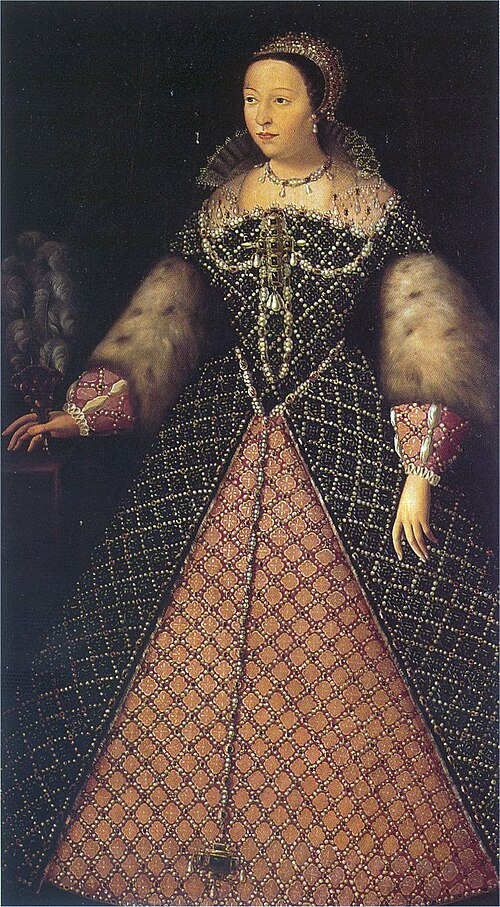
ACHIEVEMENTS: Ruled France as Regent
NICKNAME/ALIAS: (Born: Caterina Maria Romula)
DATE AND PLACE OF BIRTH: 13 April 1519, Florence, Italy
DATE AND PLACE OF DEATH AND AGE AT DEATH: 5 January 1589, Blois, France. Aged 70
DISCIPLINE: Monarch
FIELD: Royalty
LANGUAGE: Italian/French
PARENTS:
Father: Lorenzo de Medici
Mother: Madeleine de la Tour d’Avergne, comtesse de Boulogne
SIBLINGS: None
SPOUSE: Henri II of France
CHILDREN: 10, including: Francis II of France, Charles IX of France, Henri III of France
EDUCATION: Convents: Florence and Rome
MAJOR WORK: None
LIFE AND TIMES:
Catherine, the daughter of the ruler of Florence and a Bourbon princess, was orphaned within two months of her birth. She was educated at convents in Rome and Florence and regarded by her Medici uncle, Pope Clement VII, as a valuable future element in the international marriage market. Before her marriage, her portrait was painted by Vasari*. She was not beautiful but she was vivacious and intelligent.
In 1533, when she was fourteen, the Pope gave Catherine some of the largest pearls ever seen, and married her to Henri, duc d’Orleans, second son of Francis king of France. The Pope died soon after and Catherine’s political importance disappeared overnight. Her marriage was unpopular and became more so when the French Crown Prince died suddenly in 1536 and foul play was suspected. Henri was now heir to the throne, and there was speculation that his wife was implicated in the dauphin’s death. The fact that she did not have a child for the first ten years of her marriage made her position even more difficult. In 1544 she eventually produced the first of ten children and three years later became queen when Henri inherited the throne as Henri II*. For the next twelve years she devoted herself to her husband, whom she adored, her children and the pleasures of court.
Despite Henri’s permanent liaison with Diane de Poitiers, Catherine’s marriage was not unhappy and she knew how to enjoy life. She was a skilled rider who loved hunting and is credited with the introduction into France of the side-saddle. Catherine acted as regent in 1552 when Henri was away besieging Metz; in 1557, after the French were defeated by the Spanish at Saint-Quentin, she personally persuaded the city of Paris to hand over money to raise more French troops. In 1559, Henri died and Catherine’s son Francis II became king of France.
Francis was married to Mary, Queen of Scots*, the daughter of James V of Scotland and Mary Guise, and he was completely under the thumb of the Guise family who followed a policy of personal ambition and zero tolerance for Protestants. Catherine’s more moderate influence can be seen in the Edict of Amboise (March 1560) which offered an amnesty to Protestant rebels and in the Edict of Romorantin (May 1560) by which heresy was distinguished from sedition, saving heretics from penalties invoked for treason by the state.
When Francis II died at the end of 1560, he was succeeded by his brother Charles IX who was a minor. Catherine, without commitment to either the Bourbons or the Guises, became regent. Over the next decade, she struggled to maintain the independence of the monarchy and the peace of the country which was increasingly riven by the divide between Catholics and Protestants. She sent moderates to the Colloquy of Poissy in 1561 in an attempt to achieve religious reconciliation and by going personally to the French parliament in March 1562 she forced through the Edict of January which gave some relief to the Calvinists. The Catholics extremists, however, refused to accept the Edict and in 1562 Civil War broke out in France after the duc de Guise was involved in a massace of Huguenots.
In March 1563 she negotiated the Edict of Amboise which made some concessions to Protestants. In the same year, Catherine declared Charles IX to be of age. From 1564-66 she took Charles on an extraordinary royal progress through France, accompanied by several thousand courtiers and official. Her purpose was to enforce the Edict of Amboise across the French kingdom and to drum up loyalty to the new king, in both of which she was only partially successful. When passing through Provence in 1564 she called in on Nostradamus for a reading.
In 1567, the Spanish sent a large army to quell a Protestant rebellion in the Spanish Netherlands. The arrival of these forces on the border with France alarmed French Protestants and civil war broke out again in September. Catherine secretly negotiated with the Protestant rebels and peace was regained in March 1568. Historians are divided on the question of Catherine’s true feelings about the Huguenot threat at this point; many of them now reject the traditional view that she had already decided not to honour the peace and was involved in a policy of elimination of the Huguenot commanders.
In any case, by August of the same year, war broke out again, Conde was murdered and peace was only restored by the Treaty of Saint-Germain in 1570 which was regarded by Catholic extremists as a sell-out to the Protestants. Catherine now looked to marriage alliances to preserve the peace. She got Charles IX married to Elizabeth of Austria, which pleased the Catholics and in August 1572, at last succeeded in marrying her daughter to the Protestant prince, Henri de Navarre, a project encouraged by the English ambassador Walsingham*. The marriage took place at a ceremony in Notre Dame where Huguenot banners were on display and which was attended by the Huguenot leader Gaspard de Coligny.
Five days later, there was an attempt to murder Coligny, and on 24 August he was killed, together with his principal supporters and several thousand Protestants, in the notorious St Bartholomew’s Day Massacre. Catherine has traditionally been seen as the instigator of these events although modern historians point to the motivation of the Spanish monarchy and the Papacy. Most are agreed that she had agreed to the plan to kill Coligny and the most prominent of his followers but had no hand in the massacre.
Contemporary Protestant writers such as Estienne* pointed to her familiarity with the Florentine predilection for cunning. In 1573 Catherine realized her ambition get her son Henri (the duc d’Anjou) elected to the throne of Poland. He was still in Poland when he inherited the French throne after Charles IX’s death in 1574. Catherine assumed the regency until Henri’s return.
She spent much of the remaining years of her life trying to reconcile Henri III with his brother the duc d’Alencon, and with restraining Henri from allying himself too closely with the Spanish and the extremist Catholic League. She was unable, however, to avert the signing of the Treaty of Nemours in 1585 by which Henri was committed to crushing the Huguenots. The following year Catherine, despite increasingly poor health, journeyed to Cognac through Protestant territory in an unsuccessful attempt to persuade Henri of Navarre to return to the Catholic faith or at least disown the Protestants.
ASSESSMENT: Catherine succeeded in protecting the inheritance of her sons and thus maintaining dynastic continuity during the civil wars in Sixteenth Century France.
EXTRA CONNECTIONS: She may have been the first user of snuff, provided by her ambassador to Portugal Nicot*
ONELINER: Catherine de'Medici, French Queen
BIBLIOGRAPHY:
Brooks, Jerome E, The Mighty Leaf, Tobacco Through the Centuries, Alvin Redman Ltd., London and Sydney, 1953
Knecht, R J, Catherine de Medici, Longman, London and New York, 1998.
Multimedia:
Badass of the Week 9 26
https://music.youtube.com/podcast/6JERoQ8FJVw