Printing
A printing press is a mechanical device for applying pressure to an inked surface resting upon a print medium (such as paper or cloth), thereby transferring the ink. It marked a dramatic improvement on earlier printing methods in which the cloth, paper or other medium was brushed or rubbed repeatedly to achieve the transfer of ink, and accelerated the process. Typically used for texts, the invention and global spread of the printing press was one of the most influential events in the second millennium.[1][2]
In Germany, around 1440, goldsmith Johannes Gutenberg invented the movable-type printing press, which started the Printing Revolution. Modelled on the design of existing screw presses, a single Renaissance movable-type printing press could produce up to 3,600 pages per workday,[3] compared to forty by hand-printing and a few by hand-copying.[4] Gutenberg's newly devised hand mould made possible the precise and rapid creation of metal movable type in large quantities. His two inventions, the hand mould and the movable-type printing press, together drastically reduced the cost of printing books and other documents in Europe, particularly for shorter print runs.
From Mainz the movable-type printing press spread within several decades to over two hundred cities in a dozen European countries.[5] By 1500, printing presses in operation throughout Western Europe had already produced more than twenty million volumes.[5] In the 16th century, with presses spreading further afield, their output rose tenfold to an estimated 150 to 200 million copies.[5]
By the mid-17th century the first printing presses arrived in colonial America in response to the increasing demand for Bibles and other religious literature.[6] The operation of a press became synonymous with the enterprise of printing, and lent its name to a new medium of expression and communication, "the press".[7]
The arrival of mechanical movable type printing in Europe in the Renaissance introduced the era of mass communication, which permanently altered the structure of society. The relatively unrestricted circulation of information and (revolutionary) ideas transcended borders, captured the masses in the Reformation and threatened the power of political and religious authorities.
The sharp increase in literacy broke the monopoly of the literate elite on education and learning and bolstered the emerging middle class. Across Europe, the increasing cultural self-awareness of its peoples led to the rise of proto-nationalism, and accelerated the development of European vernaculars, to the detriment of Latin's status as lingua franca.[8] In the 19th century, the replacement of the hand-operated Gutenberg-style press by steam-powered rotary presses allowed printing on an industrial scale.[9]
History
Main article: History of printing
Economic conditions and intellectual climate
See also: History of capitalism and Medieval university

Medieval university class (1350s)
The rapid economic and socio-cultural development of late medieval society in Europe created favorable intellectual and technological conditions for Gutenberg's improved version of the printing press: the entrepreneurial spirit of emerging capitalism increasingly made its impact on medieval modes of production, fostering economic thinking and improving the efficiency of traditional work processes. The sharp rise of medieval learning and literacy amongst the middle class led to an increased demand for books which the time-consuming hand-copying method fell far short of accommodating.[10]
Technological factors
See also: History of Western typography and Medieval technology
Technologies preceding the press that led to the press's invention included: manufacturing of paper, development of ink, woodblock printing, and distribution of eyeglasses.[11] At the same time, a number of medieval products and technological processes had reached a level of maturity which allowed their potential use for printing purposes. Gutenberg took up these far-flung strands, combined them into one complete and functioning system, and perfected the printing process through all its stages by adding a number of inventions and innovations of his own:

Early modern wine press. Such screw presses were applied in Europe to a wide range of uses and provided Gutenberg with the model for his printing press.
The screw press which allowed direct pressure to be applied on a flat plane was already of great antiquity in Gutenberg's time and was used for a wide range of tasks.[12] Introduced in the 1st century AD by the Romans, it was commonly employed in agricultural production for pressing wine grapes and olives (for olive oil), both of which formed an integral part of the Mediterranean and medieval diet.[13] The device was also used from very early on in urban contexts as a cloth press for printing patterns.[14] Gutenberg may have also been inspired by the paper presses which had spread through the German lands since the late 14th century and which worked on the same mechanical principles.[15]
During the Islamic Golden Age, Arab Muslims were printing texts, including passages from the Qur’an, embracing the Chinese craft of paper making, developed it and adopted it widely in the Muslim world, which led to a major increase in the production of manuscript texts. In Egypt during the Fatimid era, the printing technique was adopted reproducing texts on paper strips by hand and supplying them in various copies to meet the demand.[16]
Gutenberg adopted the basic design, thereby mechanizing the printing process.[17] Printing, however, put a demand on the machine quite different from pressing. Gutenberg adapted the construction so that the pressing power exerted by the platen on the paper was now applied both evenly and with the required sudden elasticity. To speed up the printing process, he introduced a movable undertable with a plane surface on which the sheets could be swiftly changed.[18]

Movable type sorted in a letter case and loaded in a composing stick on top
The concept of movable type existed prior to 15th century Europe; sporadic evidence that the typographical principle, the idea of creating a text by reusing individual characters, was known and had been cropping up since the 12th century and possibly before (the oldest known application dating back as far as the Phaistos disc). The known examples range from movable type printing in China during the Song dynasty; in Korea during the Goryeo Dynasty, where metal movable-type printing technology was developed in 1234;[19][20] to Germany (Prüfening inscription) and England (letter tiles) and Italy (Altarpiece of Pellegrino II).[21] However, the various techniques employed (imprinting, punching and assembling individual letters) did not have the refinement and efficiency needed to become widely accepted. Tsuen-Hsuin and Needham, and Briggs and Burke suggest that the movable-type printing in China and Korea was rarely employed.[19][20]
Gutenberg greatly improved the process by treating typesetting and printing as two separate work steps. A goldsmith by profession, he created his type pieces from a lead-based alloy which suited printing purposes so well that it is still used today.[22] The mass production of metal letters was achieved by his key invention of a special hand mould, the matrix.[23] The Latin alphabet proved to be an enormous advantage in the process because, in contrast to logographic writing systems, it allowed the type-setter to represent any text with a theoretical minimum of only around two dozen different letters.[24]
Another factor conducive to printing arose from the book existing in the format of the codex, which had originated in the Roman period.[25] Considered the most important advance in the history of the book prior to printing itself, the codex had completely replaced the ancient scroll at the onset of the Middle Ages (AD 500).[26] The codex holds considerable practical advantages over the scroll format: it is more convenient to read (by turning pages), more compact, and less costly, and both recto and verso sides could be used for writing or printing, unlike the scroll.[27]
[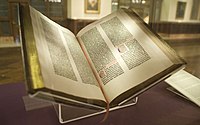
A paper codex of the acclaimed 42-line Bible, Gutenberg's major work
A fourth development was the early success of medieval papermakers at mechanizing paper manufacture. The introduction of water-powered paper mills, the first certain evidence of which dates to 1282,[28] allowed for a massive expansion of production and replaced the laborious handcraft characteristic of both Chinese[29] and Muslim papermaking.[30] Papermaking centres began to multiply in the late 13th century in Italy, reducing the price of paper to one-sixth of parchment and then falling further; papermaking centers reached Germany a century later.[31]
Despite this it appears that the final breakthrough of paper depended just as much on the rapid spread of movable-type printing.[32] It is notable that codices of parchment, which in terms of quality is superior to any other writing material,[33] still had a substantial share in Gutenberg's edition of the 42-line Bible.[34] After much experimentation, Gutenberg managed to overcome the difficulties which traditional water-based inks caused by soaking the paper, and found the formula for an oil-based ink suitable for high-quality printing with metal type.[35]