Henri II
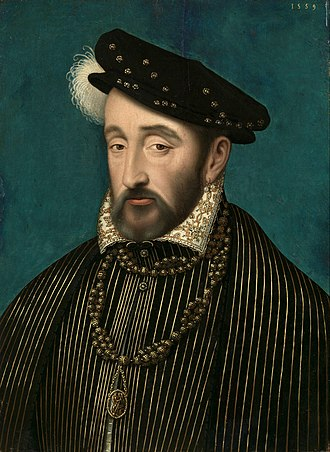
Name: Henri II of France
Achievements: Ruled France
Born: March 31, 1519; Saint-German-en-Laye, near Paris, France
Died: July 10, 1559; Paris, France (Aged 40)
Field & Discipline: Royalty; Monarch
Language: French
Father: Francis I
Mother: Claude de France
Siblings: 5
Spouse: Catherine de Medici
Children: 8 survived infancy: Francis II; Charles IX; Henri III; Louis; Hercule; Elisabeth; Marguerite; Claude
Education: Private tutors
Life & Times:
Henri was the second son of [father was] Francis I. [godfather was] Henry VIII* of England was his godfather and his christening was attended by the English ambassador to France, Sir Thomas Boleyn whose daughter Anne married Henry VIII.
At the age of seven, Henri and his elder brother Francis were sent to Spain as hostages in exchange for their father who had been taken captive by the forces of the Holy Roman Emperor, [hostage to] Charles V*, while pursuing French interests in Italy. The two French princes were treated kindly at first but as Francis I failed to fulfill Charles’s demand to give up Burgundy their treatment became more harsh. They were taken from the care of Queen Eleanor of Castile and removed to a castle near Valladolid. In 1527 they were taken deeper into Castile and separated from most of their entourage.
After Francis I declared war on Charles V, the rigors of the prince’s captivity were further increased and they were confined in the isolated fortress of Pedraza in the mountains north of Madrid. They were finally released in July 1530. Henri was judged to have become taciturn and aggressive during his confinement and he certainly inherited his father’s antipathy to Charles V.
In 1533, at the age of fourteen Henri was married to [wife was] Catherine de’Medici*. Three years later he became heir to the French throne when his elder brother died. It was probably around the same time that Diane de Poitiers, a beautiful and considerably older woman, became Henri’s mistress.
Henri was anxious to take up his hereditary prerogative of commanding the royal army and he gained military experience campaigning with the experienced Marshal de Montmorency in Provence and Piedmont.
On the death of Francis I in 1547, Henri became king of France. His closest advisers were Montmorency, who held very conservative views, and the Duc de Guise and his brother, the Cardinal of Lorraine who were extreme Catholics. Henri’s rather obstinate temperament and the influence of these men made him impervious to the need for reconciliation with Protestants. Nor was he interested in reforming the Catholic church. One of his first actions on taking the throne was to create a special department, the Chambre Ardente, for trying heretics.
His first diplomatic initiative was to arrange for the child queen, [son betrothed to] Mary Queen of Scots*, to be sent from Scotland and brought up with her Guise relatives at the French court. He was particularly anxious to put a stop to the plan for Mary to marry Henry VIII’s son, Edward VI who became king of England in 1547.
France preferred an independent kingdom of Scotland that was susceptible to French influence. Mary was sent to France in 1548 and in the same year became betrothed to Henri’s son, Francis.
In the first year of his reign, Henri introduced a number of administrative reforms to strengthen royal administration. Specialized departments were created within the King’s Council (the main administrative body) and the office of secretary of state was defined and enlarged. To maintain royal authority throughout France, he set up a system whereby royal officials were sent to the new provinces to carry out the king’s commands. These officials were the forerunners of the “intendants” introduced in the next century. Henri also enlarged the justice system with the creation of a new intermediate court.
Like all French monarchs in the sixteenth century, he was always seeking new revenue. He borrowed from the Italian banking community at Lyon to supplement tax revenue but was still short of money so he eventually did what most kings did then and turned to doctoring the currency. In 1550 he reduced the gold content of the ecu and renamed it the ‘henri’.
This affected the livre, which was the money of account and was based on the value of silver (the royal accounts were calculated in livres but paid in ecus). Many small copper coins of the realm became debased and Henri ordered that the old debased coins be exchanged for new coins, at a rate profitable for the monarchy. Most of his debts were incurred by war.
He was a keen participant in jousting tournaments and chivalric sports and was equally keen on real-life fighting. During his reign, he completed the process of transforming the French army from a mediaeval force into an early modern force. He reorganized the artillery and integrated it more closely into the army and he made improvements in siege warfare and fortifications.
In his foreign policy, he continued his father’s resistance to the dominance of Charles V. He even treated with Protestants when he signed the Chambord agreement in 1552 by which he agreed to back their rebellion against the Emperor in exchange for the French taking the bishoprics of Metz, Toul and Verdun. After victory at Metz, Henri made the mistake of disbanding his forces and Charles invaded Picardy.
For the rest of his reign, Henri was in and out of war with Charles and then with his Charles’s son, [fought against] Philip II* of Spain.
The situation became even more dangerous when Philip married the Mary Tudor, Queen of England, particularly because of the danger of invasion from Calais was then an English possession. In 1558 the French under the Duc de Guise took Calais, an event of great significance for France.
The following year Henri, out of money and wanting to pursue hostilities within his kingdom against the Protestants, concluded the Peace of Cateau-Cambresis with Philip.
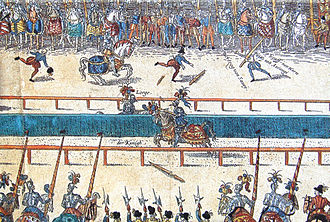
At the festivities to mark the peace treaty, Henry was fatally wounded in the head while jousting. Despite the presence of the famous surgeon [treated by] Vesalius* who was summoned from Brussels by Philip, Henri died of blood poisoning ten days later.
Extra Connections: He hired [hired] Schwab* to make new coins (‘henri’s’) for him.
Nostradamus also served King Henry as physician and astrologer.
Henry II introduced the concept of publishing the description of an invention in the form of a patent. The idea was to require an inventor to disclose his invention in exchange for monopoly rights to the patent.
Assessment: Henri was an able king who strengthened the administration of government. He left his kingdom greatly indebted through war, and his harsh treatment of Protestants laid the ground for the religious wars in France which followed his death.
Bibliography:
- Baumgartner, Frederic J, Henry II, King of France 1547-1559, Duke University Press, Durham and London, 1988.
- Knecht, R J, Catherine de’Medici, Longman, London and New York, 1998.
Henry II of France - Wikipedia