Paganini
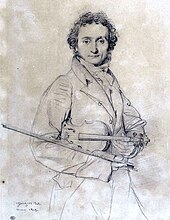
ACHIEVEMENTS: The first modern violin virtuoso.
DATE AND PLACE OF BIRTH: 27th October 1782, in Genoa, Italy.
DATE/PLACE OF DEATH/AGE AT DEATH: 27th May 1840, in Nice, France. Aged 58.
DISCIPLINE: Violinist and composer.
FIELD: Music
LANGUAGE: Italian, German, French, English.
EDUCATION: Studied violin with Antonio Paganini, Giovanni Cervetto, and Giacomo Costa. Studied composition with Franceso Gnecco and Fernandino Paer.
MAJOR WORKS: Caprices for unaccompanied violin, violin concerti.
LIFE AND TIMES:
In 1801 Paganini moved to Lucca, where he first began to display the irreverent, flamboyant style that would mark his career as a concert violinist. He won great applause, stunning listeners with his virtuosity. But he also invited their derision by playing practical jokes with his violin—imitating animal sounds, for example—and making no secret of his contempt for the audience.
Paganini stayed in Lucca for ten years, building his reputation as a virtuoso soloist and composer and playing in various orchestras. When Napoleon's sister Elisa came to rule Lucca with her husband, Prince Felice Baciocchi, Paganini went to work for them as a violin teacher and orchestra conductor. He was also rumored to be Elisa's lover. One of his first important works for violin and orchestra, Napoléon, was written in honor of Elisa's brother.
Paganini decided to strike out on his own in 1810. From 1810-1814 he traveled throughout Italy, amazing and infuriating audiences in equal measure. They were mesmerized by his ability to play faster and more flexibly than any violinist ever had before him. He was able to stretch his fingers laterally to a greater than average degree, and as a result he could produce double stops and double harmonics with unprecedented ease.
But he was also criticized for his unorthodox interpretations of the violin repertoire, which he did not find challenging enough - a fact which further encouraged him to compose his own music.
Paganini gave triumphant performances in Milan and Genoa, where in 1814 he fell in love with Angiolina Cavanna and eloped with her to Parma. Their marriage only lasted a few months before her father charged Paganini with abduction. He spent a few days in prison before continuing on his concert tour.
In 1820 Ricordi* published his first set of Caprices for unaccompanied violin, which were immediately judged "unplayable," but have since become standard for violinists and today are often used as compulsory pieces in competitions.
By the time he began his second Italian tour in 1825, Paganini's reputation had grown tremendously, and his concerts were met with enthusiastic acclaim. This time he brought along his mistress, Antonia Bianchi, who gave birth to their son Achille in 1825. That same year, Paganini was honored as a Knight of the Golden Spur and a member of the Accademia di S. Cecilia in Rome.
In 1828, he decided to tour abroad for the first time. He traveled to Vienna, where he gave fifteen concerts in four different theaters over the course of three months. His concerts sold out immediately, and Viennese audiences had to take their seats two hours early to avoid having them stolen. Schubert* who was at one of these concerts, compared Paganini's playing to an angel singing. In addition to his concerts, Paganini was inspired by Viennese music and composed a number of works while he was there. He also broke off his relationship with Antonia; under the terms of their separation, he had to pay her a large sum of money, but won sole custody of their son.
Paganini left Vienna in summer 1828. He went to Prague, where he found audiences scarce and critics hostile. He had better luck with his tour of Germany and Poland in 1829-1830. A number of great musicians were stunned and deeply affected by what they heard. Felix Mendelssohn* who heard Paganini play in Berlin—and would later perform chamber music with him in London—said his violin playing was impossible to describe.
The young pianist Chopin* heard Paganini in Warsaw and was so thrilled he composed Souvenir de Paganini to honor the occasion. Robert Schumann* traveled from Heidelberg to Frankfurt to attend one of Paganini's concerts, and decided soon after to give up his law studies and concentrate on music full-time. Although some German reviewers criticized Paganini's eccentric style of playing, the list of his admirers was impressive, including Clara Schumann* and Goethe*.
Paganini had his Paris debut in 1831. As expected, he dazzled an audience that included Liszt*, Donizetti* and George Sand*. Audiences paid double the normal ticket price to hear him, and the critics were lavish in their praise. Liszt, in particular, would find Paganini a significant inspiration for the virtuoso elements in his own compositions.
From Paris Paganini went to London, where a controversy involving inflated ticket prices made him threaten to cancel his performance. The admission price was quickly lowered, and he played to adoring fans and critics. When Paganini returned to Paris, he asked Berlioz* to compose a viola concerto for him. After receiving the work (later rearranged as Harold in Italy), Paganini declared it unsuitable and rejected it. He eventually apologized to Berlioz, calling him a genius and giving him a gift of 20,000 francs in thanks for his "divine compositions." Berlioz returned the favor by dedicating his symphony Roméo et Juliette to Paganini.
Paganini finally left Paris in 1834, after an internationally-reported scandal involving the daughter of his English piano accompanist, whom he had attempted to marry without her father's permission.
He returned to Italy, and moved restlessly around Italy and southern France for the next few years, working for a short time for Napoleon's second wife, Marie-Louise of Austria. By this time, his health was failing and his days as a star performer were over. He invested some money in the Casino Paganini, an ill-fated music establishment in Paris, and finally set up a string instrument dealership in Nice, where he died.
Today, Paganini is perhaps most famous for the wild rumors that circulated about him during his celebrity years: that he had learned to play the violin while imprisoned for murder, or that he had sold his soul to the devil in exchange for his virtuosity. Despite such fantastic tales, he is also remembered for his real contributions, as the inventor of modern violin playing and as an inspiration to the great Romantic composers of the nineteenth century.
ASSESSMENT: His brilliant technique had a major influence on the history of the violin and helped to increase the importance of virtuosity in nineteenth century music.
EXTRA CONNECTIONS: Paganini's fame was so widespread and so lasting that other musicians, including Offenbach* were frequently compared to him.
ONELINER: Nicolo Paganini, the first great violin virtuoso
BIBLIOGRAPHY:
Neill, Edward, 'Paganini, Nicolo,' grovemusic.com, ed. L. Macy, 2001,
Sugden, John, Nicolo Paganini, Midas Books, Tunbridge Wells, England, 1980.
PARENTS: Father, Antonio Paganini. Mother, Teresa Bocciardo.
SIBLINGS: 1 brother, Carlo, and 3 sisters.
SPOUSE: Briefly married to Angiolina Cavanna.
CHILDREN: 1 son, Achille Ciro Alessandro Paganini (with Antonia Bianchi).