Liszt
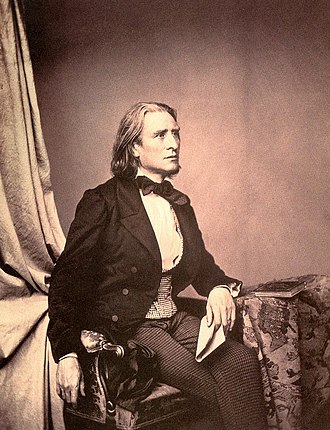
Achievements: Famous composer and performer.
Born: October 22, 1811; Raiding, Hungary
Died: July 31, 1886; Bayreuth, Germany (Aged 74)
Field & Discipline: Music; Composer; Pianist
Language: German
Father: Adam Liszt (1776-1827)
Mother: Maria Anna Lager (1788-1886)
Siblings: Unknown
Spouse: Unmarried; had three illegitimate children with the married Marie d'Agoult
Children: Blandine-Rachel, who married Emile Ollivier, later prime minister of France ; Cosima, who married Hans von Bulow and , later, Richard Wagner; Daniel, who died at 20
Education: private
Major Work:
“Liebestraum No 3”
“Piano Sonata in B minor”
Life & Times:
In 1822, Liszt's family moved to Vienna, where Liszt studied the piano with Austrian pianist and composer [taught by] Czerny*, and composition with Italian composer and conductor [taught by] Salieri*, musical director of the Viennese court. His first public concert in Vienna, in late 1822 , at age 11, was a great success. Some weeks before a second concert the next April, he had a private interview with [met] Beethoven*, the only documented meeting between the two.
In 1823, now a famous child prodigy, Liszt moved with his family to Paris, giving concerts in Munich, Stuttgart and other German towns. In Paris, he studied theory with Anton Reicha, and composition with Ferdinando Paer, the director of the Theatre-Italien in Paris and a composer of light operas. He played at many fashionable concerts.
In June, 1824, he played in London and toured England the following year, playing for George IV at Windsor Castle and visiting Manchester, where his "New Grand Overture" was performed for the first time. The piece was the overture to his one-act opera "Don Sanche", the only opera he completed.
He came into contact with many of the leading French writers of the day, including [knew] Lamartine*, and [knew] Hugo*. Although he had composed little since 1827 , the July Revolution of 1830 in Paris inspired him to sketch out the "Revolutionary Symphony."
During this period, three men were to have a powerful influence on Liszt. At the end of 1830, he met [influenced by] Berlioz* and heard the first performance of his "Symphonie fantastique". In 1831, Liszt heard [influenced by] Paganini* play at the Opera, and also heard him in private performance at the salon of [influenced by] Rothschild*, the banker. The experience inspired him to a period of feverish practice, literary absorption and composition.
In 1831, Liszt became attracted to the idealistic cult founded by [a follower of] St. Simon*. The following year, through poet and dramatist [a pal of] de Musset*, he also met [a pal of] Chopin*, who had arrived in Paris from Vienna. Chopin's poetical style exerted a profound influence on Liszt. Liszt also became acquainted with writer George a pal of] Sand*.
In 1833, de Musset introduced him to Countess Marie d’ [had children by] Agoult*. Their stormy affair endured 11 years and produced three children. In 1835, at 24, Liszt took a teaching post at the newly founded Geneva Conservatory and wrote a manual of piano technique (now lost). For the next four years Liszt and the countess lived mainly in Switzerland and Italy. Their second daughter, who was to become [daughter was] Cosima von Bulow* and then to marry [son-in-law was] Wagner* was born in 1837 at Como and their son, Daniel, in 1839.
By this time, the relationship was becoming strained. The Countess returned to Paris and Liszt returned to his career as a virtuoso. His concert tour in Hungary in 1839-40, his first visit there since boyhood, revived his interest in Gypsy music and thus laid the foundation for his "Hungarian Rhapsodies." In 1844, Liszt and d'Agoult finally parted, with Liszt taking the children to Paris.
Liszt's brilliance and success were now at their peak. He was showered with honors. He had numerous mistresses, and continued to compose, writing songs as well as piano works, including the "Hungarian Rhapsodies" and a cantata for the Beethoven Festival of 1845, his first work for chorus and orchestra.
In 1847, Liszt played in Kiev, where he met the Princess Carolyne Sayn-Wittgenstein, who encouraged him to abandon his constant touring and concentrate on composition. After a tour of the Balkans, Turkey and Russia, Liszt gave his final concert at Elisavetgrad (Kirovograd), and spent the winter with Princess at her estate in Woronince in Poland.
Liszt had been director of music to the Weimar court in Germany since 1843, and decided to take the appointment as a full-time job, moving there in 1848, with the Princess joining him later. Liszt now had ample time to compose, as well as conduct the court orchestra for the next 12 years, a period of remarkable productivity. He wrote or revised most of the major works for which he is known. In Weimar, in 1856, the writer [visited by] George Eliot* visited Liszt.
The Weimar establishment also objected to the Princess openly living with Liszt, and the grand duchess of Weimar, under pressure from her brother, Nicholas I of Russia, banned the princess from all court functions. Liszt resigned his Weimar post in 1858, but remained in the city until 1861.
After Daniel died in 1859 at age 20, Liszt wrote the oration for orchestra " Les Morts" in the youth's memory. In 1860, the princess left Weimar for Rome in the hope of having her divorce sanctioned by the Pope so she could marry Liszt.
Liszt arrived in Rome in 1861 only to find the Pope had refused to sanction the princess's divorce. For the next eight years Liszt lived mainly in Rome and occupied himself more and more with religious music.
In 1862, his elder daughter Blandine died at the age of 26, which moved him to write the variations on the passacaglia theme from the J.S. Bach Cantata No. 12, " Weinen, Klagen" (Weeping, Mourning).
Liszt spent some time at the Villa d'Este at Tivoli, near Rome.. Here, in 1867, he wrote the "Hungarian Coronation Mass" for the coronation of the emperor Francis Joseph I of Austria as king of Hungary.
In 1869, Liszt was invited to return to Weimar by the Grand Duke to give master classes in piano. Two years later he was asked to do the same in Budapest. From then until the end of his life he divided his time between Rome, Weimar, and Budapest. He was visited by numerous composers, including [visited by] Borodin*, [visited by] Saint-Saens* and [visited by] Faure*.
In his last years, Liszt's music became starker, more introverted, and more experimental. His later works anticipate the harmonic style of Debussy and one late work called "Bagatelle Without Tonality" anticipates [anticipated] Bartok*. In 1885, [visited by] Debussy* visited Liszt in Rome.
In the summer of 1886, Liszt visited Bayreuth for the wedding of his granddaughter Daniela von Bulow, and then went to Luxembourg, where he made his last appearance as pianist at a concert of the Musical Society of Luxembourg, playing his first "Liebestraum" and no. 6 of his "Soirees de Vienne".
In Bayreuth to attend the 1886 festival, he contracted pneumonia and died.
Extra Connections:
[met] Dvorak* attended his concert in Prague.
He corresponded with [corresponded with] Grieg*.
Met [met] Brahms* [met Mendelssohn*, [met] De Vigny*
Work related to [work related to] Smetana*
Was friends with [a pal of] Rossini*
Was visited by [visited by] Gounod*
Knew [knew] Faure*
[approached by] Gustav Mahler* sent him work for comment.
His work was choreographed by Isidora [work choreographed by] Duncan*
Praised work of [a fan of] Bizet*, [a fan of] Robert Schumann*, [a fan of] Clara Schumann* [a fan of] Glinka*
Performed with [performed with] Offenbach*
Son-in-law was [son-in-law was] Hans Von Bulow*
Influenced [influenced] Richard Strauss*
Was interested in the movement started by [follower of] Saint-Simon*
Assessment: Liszt was the greatest piano virtuoso of his time, a composer of enormous originality, and a principal figure in the Romantic movement.
Oneliner: Franz Liszt, piano virtuoso and Romantic composer
Bibliography:
- Encyclopedia Britannica.
- Searle, Humphrey, "Franz Liszt", in The New Grove Early Romantic Masters 1, London: Macmillan, 1985.
- Taylor, Ronald, Liszt: The Man and the Musician, London: Grafton Books, 1987.
Franz Liszt[n 1] (22 October 1811 – 31 July 1886) was a Hungarian composer, virtuoso pianist and teacher of the Romantic period. With a diverse body of work spanning more than six decades, he is considered to be one of the most prolific and influential composers of his era and remains one of the most popular composers in modern concert piano repertoire.[1]
Liszt first gained renown during the early nineteenth century for his virtuoso skill as a pianist.[2] Regarded as one of the greatest pianists of all time, he toured Europe during the 1830s and 1840s, often playing for charity.[3] In these years, Liszt developed a reputation for his powerful performances as well as his physical attractiveness.[4] In what has now been dubbed "Lisztomania", he rose to a degree of stardom and popularity among the public not experienced by the virtuosos who preceded him. Whereas earlier performers mostly served the upper class, Liszt attracted a more general audience.[5][6]
During this period and into his later life, Liszt was a friend, musical promoter and benefactor to many composers of his time, including Frédéric Chopin, Charles-Valentin Alkan, Richard Wagner, Hector Berlioz, Robert Schumann, Clara Schumann, Camille Saint-Saëns, Edvard Grieg, Ole Bull, Joachim Raff, Mikhail Glinka, and Alexander Borodin.[7]
Liszt was one of the most prominent representatives of the New German School (German: Neudeutsche Schule). He left behind an extensive and diverse body of work that influenced his forward-looking contemporaries and anticipated 20th-century ideas and trends. Among Liszt's musical contributions were the symphonic poem, developing thematic transformation as part of his experiments in musical form, and radical innovations in harmony.[8] Liszt has also been regarded as a forefather of Impressionism in music, with his Années de pèlerinage, often regarded as his masterwork, featuring many impressionistic qualities.[9] In a radical departure from his earlier compositional styles, many of Liszt's later works also feature experiments in atonality, foreshadowing the serialist movement of the 20th century.....
Father: Adam Liszt (1776-1827)
Mother: Maria Anna Lager (1788-1886)
Siblings: Unknown
Spouse: Unmarried; had three illegitimate children with the married Marie d'Agoult
Children: Blandine-Rachel, who married Emile Ollivier, later prime minister of France ; Cosima, who married Hans von Bulow and , later, Richard Wagner; Daniel, who died at 20