Chopin, FF
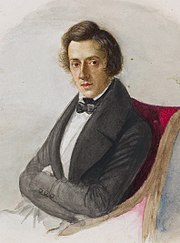
ACHIEVEMENTS: Great Romantic composer
NICKNAME/ALIAS: None.
DATE/PLACE OF BIRTH: 1st March 1810, Zelazowa Wola, near Warsaw, Poland.
DATE/PLACE OF DEATH/AGE AT DEATH: 17th October 1849, Paris, France. Aged 39.
DISCIPLINE: Composer/Pianist.
FIELD: Music.
LANGUAGE: Polish/French.
EDUCATION: Warsaw Lyceum, Warsaw Conservatory.
MAJOR WORK:
"Piano Concerto in F minor" (1830)
"Piano Concerto No 1 in E minor" (1830)
"Sonata in B flat minor" (1840)
"F sharp minor Polonaise" (1840-41)
"Polonaise in A flat major" (1842)
"Third Piano Sonata in B minor" (1844)
LIFE AND TIMES: By the time he was eight years old, Chopin was already playing in public and beginning to compose small pieces of music. In November1817, he produced both "Polonaise in C minor" and a Military March (which impressed the Grand Duke Constantine of Russia so much that he had it scored for band and performed).
At the age of sixteen, Chopin entered the Warsaw Conservatory. A year later, in 1827, while he was there, he wrote "Nocturne in E minor, Op.72", influenced by the music of an Irish composer, John Field. His most significant early composition was "Variations" on an aria from Mozart's opera, "Don Giovanni", later performed by the pianist Clara Schumann*. (Clara was later to be the wife of the composerRobert Schumann* and was the first person, other than Chopin, to play the "Variations" in public).
In 1828, Chopin visited Berlin, where he was introduced to Georg Freidrich Handel's "Ode for St Cecilia's Day, " and in 1829, he attended a performance of the violinist Paganini* in Warsaw.
After visiting Prague and Dresden, Chopin returned to Warsaw. He began composing his "Piano Concerto in F minor" and in 1830, played the work at his official debut in Warsaw, for which tickets were sold out three days in advance.
He then completed his "Piano Concerto No. I in E minor", a melancholy reflection of his love for Konstancja Gladkowska, a young Polish soprano. In October 1830, after a highly successful performance of this work in Warsaw, Chopin left for Vienna, where he wrote his "First Scherzo" and "First Ballade".
In July 1831, he travelled to Salzburg and then on to Munich. Then, on a visit to Paris at the end of September, he met Ferdinand Paer, a prominent musician and conductor of the Court Theatre in Paris, who introduced him to Rossini*.
He gave his first concert in Paris in February 1832, playing his "F minor Concerto" and "Variations". His reputation had gone before him, and the performance was attended by many distinguished musicians, including Liszt* andFelix Mendelssohn*. Liszt became an admirer and friend, as did the French composer,Berlioz*.
Prince Valentin Radziwill took him to meet Baron Jacob Rothschild, a member of the immensely wealthy and influential Rothschild* banking family. These contacts helped Chopin build up his piano teaching classes. As a result, he saved enough money to move into a luxurious apartment and was, by now, in great demand for recitals.
In April 1833, he gave a concert with Liszt, and in 1834 he went to the Rhineland music festival in Aachen, where he became friendly with Mendelssohn, travelling with him to Dusseldorf and Cologne.
Chopin successfully published his popular "Grand Valse Brillante", but two concerts which he gave in Paris, in 1835, were far from successful. With his popularity waning, they were his last. He took a holiday at Carlsbad with his family and his childhood friends, the Wodzinskis. It was at this time that he began a very short engagement with Maria Wodznski.
Upset by the reaction of his Paris audiences, he stopped performing in public and concentrated on composition. His most important works at this time were "Etudes" 1829-36, the "Ballade in G minor" 1831-35 and "Fantaisie-Impromptu". In 1837, he made a brief visit to England where, despite his reluctance to perform, he played in the home of James Broadwood, of the piano-making family.
In 1838, Chopin began an affair with George Sand*, the novelist and unconventional woman of letters, renowned for her love life. At the end of the year, after an ex-lover had challenged Chopin to a duel, the two decided to spend time away from Paris and went to the island of Mallorca with Sand's two children.
They took rooms in a deserted monastery in the isolated mountain village of Valldemosa, where Sand worked on a novel. Chopin spent time composing new works, but damp conditions and bad weather made him unhappy. This is reflected in most of the music he began there: his "Polonaise in C minor" and the "C sharp minor Scherzo (No.3)", are both melancholic and disturbed.
For the next few years, Chopin shared his life with Sand and divided his time between her country house at Nohant in Berry and his apartment in Paris. The long summers at Nohant were enlivened by visitors such as Liszt and the painter Delacroix*, who painted portraits of both Chopin and Sand.
Most of his music in the following years was composed during summers at Nohant. In 1839, he wrote the "Nocturne in G major", followed by his "Piano Sonata in B flat minor". When the Sonata was published in 1840, Chopin had added to it the Funeral March he had composed in 1837. The B flat minor sonata became one of his greatest works.
In 1841, he completed his composition of the brilliant "F sharp minor Polonaise" and his "Fantasy in F minor". These were closely followed by "Polonaise in A flat major", the "Fourth Ballade in F minor" and the "Fourth Scherzo in E major", in 1842.
The following year, he and Sand moved into a new house in Paris, where he wrote one of his masterpieces, "Third Piano Sonata in B minor", in 1844.
Shortly afterwards, his affair with Sand ended. Chopin did not share Sand's progressive attitude to social reform, or her freethinking view of religion. In 1846, she published her book, "Lucrezia Floriani", which told the story of their relationship and created a split between them. They last met in 1848.
When Revolution broke out in 1848, he accepted an invitation from Jane Stirling, a Scottish pupil, to visit her and her sister in London. There he met Queen Victoria* and, in November 1848, gave his last concert, at the Guildhall in London.
Chopin returned to Paris in November, now very ill with tuberculosis. He moved to an apartment in the Place Vendome in September 1849, where he died on 17th October, aged only thirty nine.
ASSESSMENT: Chopin was a composer in the romantic tradition who embodied the Polish character and soul in his music.
EXTRA CONNECTIONS: He met Balzac* who disliked his music.
He was a friend of De Musset*
He influenced the work of Glinka*
Isadora Duncan* choreographed his music
He met De Vigny*
He was a friend of Countess Marie d’ Agoult*
ONELINER: Frederic Chopin, great Romantic composer
BIBLIOGRAPHY:
Orga, Ates, Chopin, His Life and Times, Midas Books, Kent, 1976.
Zamoyski, Adam,Chopin, A biography, Collins, London, 1979.
PARENTS: Nicholas Chopin and Justyna Krzyzanowska
SIBLINGS: Three sisters: Louise, Isabella and Emilia.
SPOUSE: None.
CHILDREN: None.