Gilbert, WS
See Gilbert & Sullivan
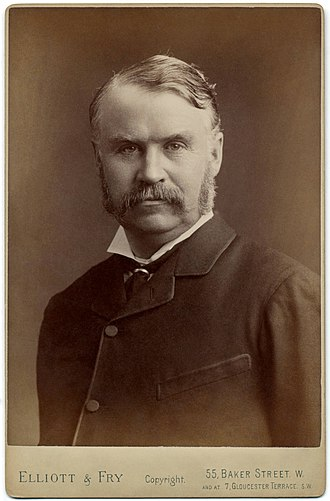
Gilbert, William Schwenk
NICKNAME/ALIAS: Bab
DATE OF BIRTH: 18 November 1836
PLACE OF BIRTH: 17 Southampton Street, Strand, London, England
DATE OF DEATH: 29 May 1911
PLACE OF DEATH: Old Redding, Harrow, Middlesex, England
DISCIPLINE: Theater, Literature
CATEGORY: Performing Arts & Sports; Literature
ASSESSMENT: He is remembered primarily for the words he wrote for the 14 operettas he created in partnership with Arthur Sullivan, a composer, and secondarily for the Bab Ballads, a series of poems accompanied by Gilbert's own illustrations.
LANGUAGE: English
EDUCATION: Western Grammar School, Brompton, England; Great Ealing School, London, England; King's College, University of London (Department of General Literature and Science), London, England (degree 1857)
ACHIEVEMENTS: Words for the 14 Gilbert & Sullivan operettas (listed below under Major Works). Knighted, 1907
MAJOR-WORK: Bab Ballads (written 1861-1769, published as a collection in 1869); The libretti (words) for 14 operettas, in collaboration with Arthur Sullivan - Thespis (1871); Trial by Jury (1871); The Sorcerer (1877); H.M.S. Pinafore (1878); The Pirates of Penzance (1880); Patience (1881); Iolanthe (1882); Princess Ida (1884); The Mikado (1885); Ruddigore (1887); The Yeomen of the Guard (1888); The Gondoliers (1889); Utopia, Limited (1893); The Grand Duke (1896). Dates are for first production
PARENTS: Dr. William Gilbert (1804-1890); Anne Mary Bye Morris Gilbert (?-1888)
SPOUSE: Lucy Agnes Blois Turner (m. August 1867)
SIBLINGS: Jane Morris Gilbert Weigall (1838-1906); Florence Gilbert (?–1911); Anne Maude Gilbert (?-1932)
CHILDREN: None
LIFE AND TIMES: Gilbert was interested in the theatre, writing and drawing from his early years and participated in these activities during his youth. Although he qualified to practice law in 1861 and tried various careers as a government clerk and barrister between 1857 and 1866, he shifted his attention to full-time creative endeavors as soon as he could.
In 1861-1862, he began contributing drawings, prose and verse to a recently-established comic journal called Fun. Fun was as much a parody of the popular journal <contributed to and parodied> Punch* as anything else. Although Gilbert contributed some items to Punch in the early 1860s, they finally refused to take anything from him unless he gave up his association with Fun. This resulted from the suspicious similarity of some items he provided for both journals. Gilbert opted to continue with Fun.
One of Gilbert's most popular contributions to Fun was a series called the Bab Ballads. They combined witty verse with vigorously-realized sketches, both by Gilbert. In 1869, a number of these verses were collected and published in book form under the title The Bab Ballads. Gilbert provided somewhat toned-down drawings for the book.
From 1862 Gilbert also tried writing a variety of theatrical pieces including plays, burlesques and pantomimes. As time went on, he also learned the craft of stage direction and began to direct his own plays. By 1871, Gilbert was so busy writing theatrical works, including farces, operetta libretti, extravaganzas, fairy comedies, and so forth, that he resigned from Fun. Though some of his theatrical pieces were moderately successful, his real theatrical peak did not occur until he began to collaborate with Arthur <artistic partner of> Sullivan*.
Gilbert and Sullivan first collaborated on an operetta entitled Thespis, produced in 1871. While not a smash hit, it was successful enough to encourage them to try again. The second collaboration produced Trial by Jury. Not only was this operetta profitable, it also brought Richard D'Oyly Carte into the picture. D'Oyly Carte did not bring Gilbert and Sullivan together, but he made a major contribution to keeping this pair of very different creative talents working in effective partnership for many years.
Gilbert and Sullivan created a total of 14 operettas. The most well-known are probably The Mikado, The Pirates of Penzance and H.M.S. Pinafore. Sullivan contributed lively and often elegant music. Gilbert provided provocative, witty and often very funny words. Though Gilbert wrote a variety of other things without a contribution by Sullivan, none of them were as successful as the operettas.
In spite of their artistic cooperation, Gilbert and Sullivan did not get along very well. They were very different in outlook, working method, and even in the guiding goals of their lives. This lead to considerable friction and their troubled relationship finally ended in 1896, after the production of The Grand Duke. Gilbert announced his retirement and took up residence in his country home at Grim's Dyke in Harrow, Middlesex, England.
In 1907, Gilbert received a knighthood in honor of his distinguished career as a playwright. He was pleased at being the first to be knighted for writing plays, but would have preferred to be described as a dramatist. In a letter to his cousin Mary Talbot, however, he noted that the title of dramatist "is not applied to us until we are dead & then we become dramatists as oxen & sheep & pigs are transfigured into beef, mutton & pork after their demise." (Stedman, p. 328-329)
Though he continued to take an interest in the theatre and wrote a few more plays, none achieved the popularity or longevity of the 14 Gilbert and Sullivan operettas. His final play, The Hooligan (produced in 1911 and a more serious examination of themes which had been addressed in many of the operettas), looked at justice and the effect of upbringing and economic circumstance on the fate of the individual.
Gilbert died of a heart attack while assisting a young woman who had encountered difficulties swimming in a lake in the grounds of his home.
A summary of Gilbert's achievements must include shaking the English theatre out of a rut and moving it into a livelier and more iconoclastic mode. Along with his interest in theatre and writing in general, Gilbert was always concerned with social injustice. He used the wit of his plays and verse to address issues more serious than love, courtship and humor. The themes examined in The Hooligan were also presented satirically in H.M.S. Pinafore and The Pirates of Penzance.
Gilbert was also active in efforts to improve the theatre he loved so well.
He engaged in attempts to loosen the grip of censorship on English theatre and in the early 1900s, he joined a group which included his cousin, <cousin was> Gilbert Murray*, for this purpose. In addition, Gilbert was a member of the Society of Authors (founded by <colleague of> Sir William Besant* in 1884), a group which it was hoped would one day become a sort of "craft union" to protect writers from exploitation by theatre owners, managers and agents.
On a personal level, Gilbert was equally renowned for his openhandedness to those in need and for the fiery temper which led him to bring a number of lawsuits over the years and to engage in quarrels with friends and co-workers that sometimes reached legendary status.
EXTRA CONNECTIONS:
A fellow member of the Society of Authors was his friend <a pal of> Jerome K. Jerome*.
ONELINER: W.S. Gilbert, writer (of Gilbert-and-Sullivan fame)
BIBLIOGRAPHY: Stedman, Jane W., W.S. Gilbert: A Classic Victorian and His Theatre. Oxford: Oxford University Press, 1996.
Complete text of the 14 Gilbert & Sullivan operettas: Gondoliers; Grand Duke; H.M.S. Pinafore; Iolanthe; The Mikado; Pirates of Penzance; Princess Ida; Ruddigore; The Sorcerer; Thespis; Trial by Jury; Utopia, Limited; Yeomen of the Guard; Patience. Project Gutenberg
ftp://ibiblio.org/pub/docs/books/gutenberg/etext97/cpogs10.txt Accessed February 27, 2004.
Baily, Leslie, Gilbert and Sullivan and Their World. London: Thames and Hudson, 1973.
The Gilbert and Sullivan Archives – many links including MIDI and RealAudio files of music
diamond.boisestate.edu/gas/index.html Accessed February 27, 2004.
National Portrait Gallery (England) – four portraits of W.S. Gilbert
http://www.npg.org.uk/live/search/person.asp?LinkID=mp01774 Accessed February 27, 2004.